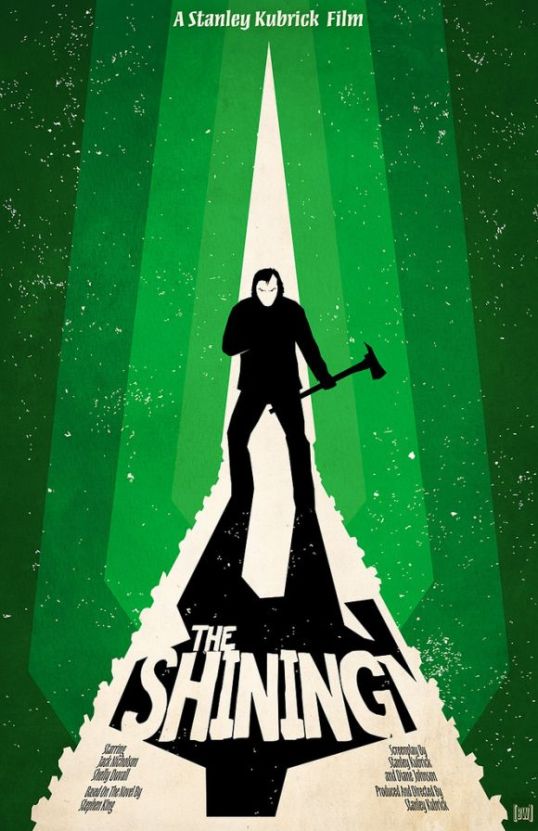
Horror Film Review: The Shining (dir by Stanley Kubrick)


The Shining is one of the few horror movies that still scares me.

I say this despite the fact that I’ve lost track of the number of times that I’ve watched Stanley Kubrick’s 1980 adaptation of Stephen King’s third novel.  It’s a film that I watch nearly every October and it’s a film that I’ve pretty much memorized.  Whenever I watch the film, I do so with the knowledge that Jack Torrance (Jack Nicholson), the caretaker of the Overlook Hotel, is eventually going to start talking to ghosts and he’s going to try to kill his wife Wendy (Shelley Duvall) and his son, Danny (Danny Lloyd).  Whenever I watch this film, I know what Jack is going to find Room 237.  I know about the blood pouring out the elevator like the Tampax commercial from Hell.  I know what Danny means when he says, “Redrum….”  I know about the twins and their request of “Come play with us, Danny.”  And, of course, I know about the film’s famous ending.

Whenever I start watching this film, I know everything that is going to happen.  And yet, as soon as I hear the booming beat of of Wendy Carlos’s theme music and I see the overhead shot of the mountain roads leading to the Overlook Hotel, I start to feel uneasy.  Whenever Barry Nelson (played the hotel’s general manager) starts to blandly explain that a previous caretaker got cabin fever and chopped up his twin daughters, I smile because Nelson delivers the lines so casually.  But I also get nervous because I know Charles (or is it Delbert) Grady is going to show up later.

(Incidentally, Barry Nelson never gets enough credit for his brilliant cameo as the friendly but guarded hotel manager.  In Stephen King’s original novel, the character was a stereotypically unsympathetic middle manager, a martinet who existed largely to be told off.  In Kubrick’s film, the manager is one of the most fascinating of the supporting characters.)

I still get nervous when I see Wendy and Danny, sitting in their disturbingly sterile Colorado home while Jack interviews for the caretaker job.  Wendy smokes and Danny talks about how his imaginary friend, Tony, doesn’t want to go to the hotel.  With her unwashed her and her tentative voice, Shelley Duvall is a far cry from the book’s version of Wendy.  However, Duvall’s Wendy is also a far more compelling character, an abused woman who finds her strength when her son is put in danger.  Duvall is the perfect choice for Wendy because she seems like someone who you might see in the parking lot of your local grocery store, trying to load the bags in her car and keep an eye on her young child at the same time.  She seems real and her reactions remind us of how we would probably react if we found ourselves in the same situation.  Wendy makes the mistakes that we would all probably make but she refuses to surrender to her fear.

Why does The Shining remain so powerful and so frightening, even after repeated viewings?  Most of the credit has to go to Stanley Kubrick.  Stephen King has been very vocal about his dislike of the film, claiming that The Shining was more Kubrick’s version than his.  King has a point.  Film is a director’s medium and few directors were as brilliant as Stanley Kubrick.  (Along with The Shining, Kubrick also directed Paths of Glory, 2001, Barry Lyndon, Dr, Strangelove, Spartacus, Lolita, The Killing, A Clockwork Orange, Eyes Wife Shut, and Full Metal Jacket.  Stephen King directed Maximum Overdrive.)  From the minute we see the tracking shots that wind their way through the desolate mountains and the empty hallways of the Overlook, we know that we’re watching a Kubrick film.  Those tracking shots also put us in the same role as the spirits in the Overlook.  We’re watching and following the characters, observing and reacting to their actions without being able to interact with them.  King has complained that Kubrick’s version of The Shining offers up no hope.  But, honestly, what kind of hope can one have after discovering that ghosts are real and they want to kill you?  Once Jack Torrance finally accepts that drink from Joe Turkel’s Lloyd and meets Phillip Stone’s Grady, there is no more room for hope.  King’s book ends with the Overlook destroyed and Jack Torrance perhaps redeeming himself in his last moments.  Kubrick’s film suggests that Jack Torrance never cared enough about his family to be worthy of redemption and that the evil that infected the Overlook is never going to be destroyed.  In the end, not even the kindly presence of Scatman Crothers in the role of Dick Halloran can bring any real hope to the Overlook.

The Shining is unsettling because, more than being a ghost story, it’s a film about being tapped.  Physically, the Torrances are trapped by the blizzard.  Mentally, Jack is trapped by his addictions and his resentments.  One gets the feeling that he’s deeply jealous of Danny, viewing him as someone who came along and took away all of Wendy’s attention.  Wendy is trapped in a bad and abusive marriage and there’s something very poignant about the way Duvall both captures Wendy’s yearning for outside contact (like when she uses the radio to communicate with the local rangers station) and her hope that, if she’s just supportive enough, Jack will get his life together.  Danny’s trapped by his psychic visions and his knowledge of what’s to come.  The victims of the Overlook appear to be trapped as well.  Grady’s daughters are fated to always roam the hallways, looking for someone to play with them.  The Woman in 237 will always wait in her bathtub.  Were these spirits evil before they died or were the twisted by the Overlook?  It’s an unanswered question that sticks with you.

As I mentioned earlier, Stephen King has been very vocal about his dislike of both The Shining and its director.  (King once boasted about outliving Kubrick, a comment that showed a definite lack of class on the part of America’s most commercially successful writer.)  Why does King hate the Kubrick film with such a passion?

I have a theory.  Both King’s second novel, Salem’s Lot, and The Shining feature a writer as the man character.  In both cases, King obviously related to the main character.  Ben Mears in Salem’s Lot is charming, confident, articulate, and successful.  He’s a writer that everyone respects and he’s even well-known enough to have a file with the FBI.  Jack Torrance, on the other hand, is a struggling writer who has a drinking problem, resents authority figures (like the hotel manager), and has issues with his father.  Torrance is a much more interesting character than Ben Mears, precisely because Torrance is so flawed.  (King, and I give him full credit for this, has been open about his own struggles with substance abuse and how he brought his own experiences to the character of Jack Torrance.)  I’ve always suspected that, at the time that King wrote Salem’s Lot and The Shining, Ben Mears was King’s idealized version of himself while Jack Torrance, with all of his struggles and flaws, reflected how King actually felt about himself.  (That the Wendy Torrance of the novel is a beautiful blonde who sticks with her husband despite his drinking problem feels like a bit of wish fulfillment on the part of King.)  When Stanley Kubrick made his version of The Shining and presented Jack Torrance as essentially being a self-centered jerk who, even before arriving at the hotel, had a history of abusing his wife and son, it’s possible King took it a bit personally.  Since King had poured so much of himself into Jack Torrance, it was probably difficult to see Kubrick present the character an abusive narcissist whose great novel turned out to be literally a joke.  And so, Stephen King has spent the last 45 years talking about how much he hates Kubrick’s film.

King’s opinion aside, Kubrick’s The Shining is probably the most effective Stephen King adaptation ever made, precisely because Kubrick knew which parts of the book would work cinematically and which parts were best excised from the plot.  As opposed to later directors who often seem intimidated by King’s fame, Kubrick was able to bring his own signature style to the story.  Stanley Kubrick’s The Shining is a masterpiece and one that I look forward to revisiting this October.

Retro Television Review: Fantasy Island 6.19 “Edward/Extraordinary Miss Jones”


Welcome to Retro Television Reviews, a feature where we review some of our favorite and least favorite shows of the past!  On Tuesdays, I will be reviewing the original Fantasy Island, which ran on ABC from 1977 to 1984.  Unfortunately, the show has been removed from most streaming sites.  Fortunately, I’ve got nearly every episode on my DVR …. nearly being the word to remember.

This week, Sammy Davis Jr. comes to Fantasy Island.

That’s be cool, right?

Episode 6.19 “Edward/Extraordinary Miss Jones”

(Dir by Don Ingalls, originally aired on April 9th, 1983)

Or, it would have been cool if my DVR had actually recorded this episode!

Sorry, it’s the curse of the DVR.  This is one of the episodes that my DVR did not record.  I’m not sure if it’s a case of the episode not being aired or perhaps the cable itself was out when it should have been recording but, for whatever reason, I do not have this episode and I also don’t remember having watched it in the past.

For now, I can’t review it.  But I’m going to leave this here as a placeholder, in case the show ever starts streaming again.

Again, I regret not being able to review this episode at this time.  But, as Mr. Roarke always says, “Smiles, everyone, smiles!”

A Blast From The Past: Casino Royale (dir by William H. Brown)


Everyone knows that Sean Connery made his debut of James Bond in 1962’s Dr. No but what they may not know is that Sean Connery was not the first actor to play James Bond.  James Bond made his first appearance 8 years earlier when an American television show called Climax! presented a 48-minute adaptation of Ian Fleming’s first Bond novel, Casino Royale.

In this version of Casino Royale, James Bond was known as Jimmy Bond and he was about as American as you can get.  (Felix Leiter, meanwhile, was now English and named Clarence Leiter).  Jimmy Bond was played by Barry Nelson, an actor who is probably best known for playing the blandly friendly hotel manager in Stanley Kubrick’s The ShiningCasino Royale’s villain, Le Chiffre, was played by none other than Peter Lorre.

This version of Casino Royale was initially meant to serve as a pilot for a weekly television series but, perhaps fortunately, the Climax version of Casino Royale didn’t get much attention when it was originally aired.  According to Sinclair McKay’s authoritative Bond book, The Man With The Golden Touch, this version of Casino Royale was forgotten about until a copy of it was discovered in the 1980s.  By that time, of course, everyone knew that James Bond was English and that Felix Leiter was American.

Thanks to YouTube, I’ve seen the Climax! Casino Royale and it’s definitely a curiosity.  If Dr. No hadn’t launched the James Bond film franchise, there would be little reason to watch this version of Casino Royale.  It moves a bit slowly, is way too stagey, and it reveals that, contrary to what we’ve all heard, live television was not always the greatest thing on the planet.  Not surprisingly, this adaptation contains none of the brutality or the moral ambiguity that makes Fleming’s novel such a fun read.  American television audiences would not see Jimmy Bond strapped naked to a chair and an American television show would never end with the hero saying, “The bitch is dead.”  The best you can say about this version of Casino Royale is that Peter Lorre makes for a good villain (in fact, of the three versions of Casino Royale, the television version is the only one to feature an effective Le Chiffre) and Barry Nelson would have made a good Felix Leiter.

That said, I still find the television version of Casino Royale to be fascinating from a historical point of view.  This is the type of show that you watch for curiosity value.  This is the type of show that you watch so that you can think about how different things could have been.

So, presented for your viewing pleasure, here’s the original version of Casino Royale:

Late Night Retro Television Review: Monsters 2.19 “Far Below”


Welcome to Late Night Retro Television Reviews, a feature where we review some of our favorite and least favorite shows of the past! On Wednesdays, I will be reviewing Monsters, which aired in syndication from 1988 to 1991. The entire series is streaming on YouTube.

This week, there’s something in subways!

Episode 2.19 “Far Below”

(Dir by Debra Hill, originally aired on February 25th, 1990)

Alex Kritz (John Scott Clough) is a city bureaucrat who has been sent to do an audit and discover why one subway maintenance crew is getting paid so much despite the high rate of turnover on the crew.  The head of the crew, Dr. Vernon Rathmore (Barry Nelson), not only overpays his workers but he also offers them full insurance and a pension.  Kritz not only wants to understand why Dr. Rathmore is spending so much money but also how he has been able to get away with it for so long.

Dr. Rathmore invites Kritz to watch a monitor so he can observe two of his workers gunning down what appears to be a Yeti with glowing white fur.  Kritz is outraged, accusing Rathmore of killing a homeless man.  Rathmore explains that his section of the subway is full of prehistoric, ape-liked monsters who feast on human flesh.  Rathmore has taken it upon himself to keep the population under control.

When Kritz again accuses Rathmore of genocide, Rathmore reveals that he actually has two of the monsters locked away in the office.  And one of them is his wife!  It turns out that she has quite the appetite for nosey bureaucrats….

This was a simple but entertaining episode of Monsters, one that was well-acted by Nelson and Clough and which made great use of two sets, Rathmore’s office and the atmospheric and dark subway tunnels where Rathmore’s men work.  The escalating tension between Rathmore and Kritz was well-handled, with Rathmore growing more and more annoyed with Kritz’s questions.  Based on all of the urban legends that have sprung up over the years about monsters living in the subways and the sewers (check out Raw Meat for another example), this was an effective episode that managed to tell a complete and interesting story in only 20 minutes.  Monsters was a frequently uneven show, as is true of most anthology series.  Fortunately, for every couple of bad episodes that the viewer got, the viewer would also occasionally get a masterpiece like Far Below.

Far Below was directed by Debra Hill, who is probably best-known for co-producing several of John Carpenter’s early films, including the original Halloween. This episode was Hill’s directorial debut and it was one of only two things she directed.  (The other was an episode of a 90s sitcom called Dream On.)  She did an excellent job with this episode and it’s a shame that she didn’t direct more.

Finally, this was the final performance of actor Barry Nelson.  Nelson was the first actor to ever play James Bond, playing an Americanized version of the character in a 1950s television adaptation of Casino Royale.  (Nelson technically played “Jimmy Bond.”)  Modern horror fans know Nelson best for his wonderful performance as the blandly professional Mr. Ullman in The Shining.  The scene where Nelson (as Ullman) cheerfully talks about what happened to the last caretaker and his family is one of my favorite bits of acting of all time.  Nelson retired after this episode of Monsters and it’s nice to able to say that he went out on a high note.

Horror Scenes I Love: The Job Interview From The Shining


Since today’s song of the day came from The Shining, it only seems appropriate that today’s scene should come from the same film.

I’ve always felt that Barry Nelson’s performance as Ullman is one of the best parts of the early part of the film.  Whereas Ullman was presented as being a stereotypical jerk in King’s novel, the film presents him as a blandly friendly bureaucrat who can talk about what happened with the previous caretaker and make it sound like the most normal thing in the world.  The scene were he interviews Jack Torrance for the caretaker job is wonderfully ominous, even if it’s hard to describe why.  I know that Stephen King disliked this scene because it made Jack look unbalanced from the start but, personally, I think it does a wonderful job of setting the mood.

Finally, Ullman’s office reminds me of Ben Horne’s office in Twin Peaks, right down to the somewhat campy name plate on his desk.


Retro Television Reviews: The Love Boat 2.27 “Third Wheel/Grandmother’s Day/Second String Mom”


Welcome to Retro Television Reviews, a feature where we review some of our favorite and least favorite shows of the past!  On Wednesdays, I will be reviewing the original Love Boat, which aired on ABC from 1977 to 1986!  The series can be streamed on Paramount Plus!

This week, the second season of The Love Boat comes to a close.

Episode 2.27 “Third Wheel/Grandmother’s Day/Second String Mom”

(Dir by Gordon Farr, originally aired on May 12th, 1979)

 It’s time for a special Mother’s Day cruise!

Gopher is excited because his mother, Roz (Ethel Merman), and his father, Eliot (an unwell-looking Robert Cummings), will be on the ship.  As quickly becomes clear, Gopher takes after his mother.  Like her son, Roz is impulsive, loves show business, and has issues with recognizing boundaries.  As soon as she boards the boat, she and Gopher are singing songs and imitating the Marx brothers.  Eliot, on the other hand, is quiet and reserved.  Interesting enough, Eliot has quite a bit in common with Captain Stubing.  Seeing Eliot and Stubing interact, the viewer suddenly understands why Gopher is always looking for the Captain’s approval.  Gopher and Eliot have a distant relationship and Gopher now sees Stubing as being more of a father figure to him than his own father.  Awwwww, how sad!

What’s even more sad is that it is easy to see that Eliot would like to be closer to his son.  He just doesn’t know how to go about it and he knows that he can’t compete with Roz’s carefree personality.  When Gopher and Roz agree to perform a number at a special Mother’s Day variety show, Eliot becomes jealous.  He claims that he’s worried that Roz is somehow going to embarrass Gopher in front of his co-workers but it’s obvious that Eliot is the one who is embarrassed by his lack of a relationship with his son.  It all works out in the end, of course and Gopher becomes closer to both of his parents.

Meanwhile, Mac O’Brian (Barry Nelson, best-known for being the first actor to play James Bond and for playing Mr. Ullman in Kubrick’s The Shining) is looking forward to a life of retirement.  Except, his wife, Maggie (Nanette Fabray), keeps having dizzy spells.  Doc examines her and announces that, despite the fact that she’s nearly 60, Maggie’s pregnant!  Maggie worries about how tell her husband, who has made it clear that he feels that he’s earned a rest from worrying about children.  At first, Mac doesn’t take the news well but never fear.  Things work out in the end because it’s The Love Boat!

Finally, Mary Noble (Michele Tobin) and her sister, Judy Noble (Shelly Juttner), are on their cruise with their father (Ken Berry) and his new wife (Beth Howland).  At first, they go out of their way to be rude to their new stepmother but eventually, they realize how happy she makes their father and they come to accept her.  Once again, everyone gets a happy ending on The Love Boat.

Despite the fact that it featured Gopher’s parents and offered up some insight into what made one of the show’s main characters tick, this episode of The Love Boat was pretty forgettable.  The success or failure of a show like this all comes down to chemistry and none of the guest stars on this particular episode seemed to have any.  Robert Cummings, in particular, looked absolutely miserable throughout the entire cruise while Barry Nelson and Nanette Fabray seemed more like strangers having a random hook-up than a longtime married couple.  I did like the storyline about the stepparent but that’s just because I could relate to the two sisters because I know me and my sisters had a tendency to get a bit bratty whenever we felt anyone was trying to take our mom away from us.  But, in the end, even this storyline felt like something The Love Boat had done better in the past.

Sadly, the second season of The Love Boat came to end with not a bang but a whimper.  Next week, we start season 3!

Horror on TV: Circle of Fear 1.17 “Doorway to Death” (dir by Daryl Duke)


Tonight, on Circle of Fear, bratty Robert (played by Leif Garrett) discovers that an upstairs door in his family’s new apartment building leads to someplace very unexpected.  His older sister, Peggy (Susan Dey), doesn’t believe him but she soon learns the error of her ways.  

This episode is really creepy and atmospheric and I don’t want to spoil too much of it.  It was written by Jimmy Sangster, who also did several Hammer films, and it was directed by Daryl Duke.  To be honest, this episode reminds me of the episode of Lost where Jack stumbles across the ghosts of Ben’s parents outside of the cabin.  It has a similar, dream-like feel to it.

The episode originally aired on January 26th, 1973.

Scenes That I Love: The Job Interview From The Shining


I don’t care what Stephen King says.  Stanley Kubrick’s adaptation of The Shining is great.

One of King’s big complaints about the film is that Jack is obviously unhinged from the start.  King is right that Jack Nicholson plays Jack Torrance as being someone who has a few screws loose even before he starts to work as the caretaker.  But it works for the film, as can be seen in this scene in which Stuart Ullman tells Jack about what happened to previous caretaker.

https://www.youtube.com/watch?v=-sLVxrT8tdw

Incidentally, Barry Nelson’s performance as Ullman is seriously underrated.  Ullman is a far more interesting character in the movie than he was in King’s book.  For that matter, the same can be said of just about every character in the movie as opposed to the way King envisioned them in his novel.  Maybe that’s the main reason King doesn’t like this movie.  Kubrick understood King’s story better than King himself did.

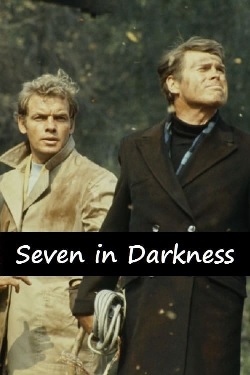
Seven in Darkness (1969, directed by Michael Caffey)


A group of blind people, led by teacher Alex Swain (Barry Nelson), are flying to a convention for the blind in Seattle.  When their flight is knocked off-course by an unexpected storm, the plane crashes into a remote forest.  The plane’s crew and the one sighted passenger are all killed in the crash, leaving the eight blind passengers to fend for themselves.  The plane is perched on the edge of a mountain, there are wolves all around, and no one can see the surrounding terrain.  And one of the passengers is pregnant and could give birth at any minute!  To Alex’s resentment, the group turns to Mark (Sean Garrison) to help them survive in the wilderness.  Mark was blinded while serving in Viet Nam and he’s still haunted by what happened during the war.  At first, he resists being thrust into a leadership role but finally, it becomes clear that he has no choice.  Under Mark’s leadership and despite Alex’s protestations, the eight survivors try to find their way back to civilization.

Filmed for television and based on a novel by Leonard Bishop, Seven in Darkness is a tense and well-acted movie.  It’s not easy to watch the survivors feeling around in the darkness, trying to find their way to safety.  That we can see what they don’t makes things all the more suspenseful.  Even more importantly, the film does a good job of presenting the survivors of being individuals.  Even though they all share a disability, they still have their own personality quirks, strengths, and flaws.  Surprisingly the stand-out amongst the cast is none other than Milton Berle, cast in a dramatic role and giving a nuanced performance as the angriest of the survivors.  Watching Seven in Darkness, you come to care about all of the survivors and you get very wrapped up in whether or not they’re going to be able to make it to safety.

Seven in Darkness was the first film to be shown as a part of ABC Movie of the Week.  It can be found on YouTube.


30 Days of Noir #15: The Man With My Face (dir by Edward Montagne)


The 1951 film, The Man With My Face, tells the story of Chick Graham (Barry Nelson).

Chick’s a nice guy.  He might be a little bit bland but, at the same time, he’s also never been in any real trouble.  He’s the type of person who you would trust to look after your money but, at the same time, you would probably also forget to wish him a happy birthday on Facebook.  He’s just one of those decent but forgettable human beings.

After serving his country in World War II, Chick moved to Puerto Rico and opened up a business with his best friend from the army, Buster Cox (John Harvey).  Not only that but he also married Buster’s sister, Cora (Lynn Ainley).  Of course, when he fell in love with Cora, he also abandoned his then-girlfriend, Mary (Carole Mathews).  Mary’s still a little bit upset about that but you know who is really bitter about it?  Mary’s brother, Walt (Jack Warden).  Walt says that Chick’s no good and there’s no way that he would ever help Chick out if Chick ever got in any trouble.

But no matter!  Chick’s got a nice house.  He’s got a loving wife.  He’s got a loyal best friend.  And he’s got a dog!  It’s a perfect life!

Or is it?

One day, Chick is shocked when his wife doesn’t pick him up after dropping him off in the city.  When she calls his house and asks her what’s going on, she replies that she doesn’t have the slightest idea who he is.  When Chick finally makes it home, both Cora and Buster continue to insist that they don’t know who he is.  His own dog doesn’t even seem to know him!

However, what’s really strange is that, in Chick’s house, there’s a man who looks exactly like him.  Cora, Buster, and the man all claim that he’s the real Chick Graham and that the original Chick is just a double. Fleeing his house, Chick soon discovers that his picture is on the front page of every newspaper!

Except, of course, it’s not his picture.  Instead, it’s a picture of Bert Rand!  Bert is a notorious criminal who recently robbed a bank in Miami.  It’s rumored that he’s fled to Puerto Rico!  It doesn’t take long for Chick to figure out that Bert has stolen his identity and moved into his house.  But how can Chick prove it?  (Remember this film was made in 1951, back when most people didn’t even know what DNA was.)  Making things even worse for Chick is that he now has a crazed dog handler (Jim Boles) and a doberman chasing him all over San Juan….

As far as stolen identity films are concerned, The Man With My Face isn’t bad, though it is kind of predictable.  It’s not a spoiler to say that people are conspiring against Chick but, as you watch the film, you have to wonder why these criminals would pursue such a needlessly complicated scheme.  You have to admire their dedication but, at the same time, it’s seems like they could have gotten the same results with a much simpler plan.  On the plus side, Barry Nelson (who you might recognize as Mr. Ullman from Kubrick’s The Shining) is a sympathetic hero and character actor Jack Warden has a nice supporting role as Mary’s world weary brother.  Though Puerto Rico may seem like a strange place to set a film noir, the film’s final chase scene makes good and atmospheric use of the Fort San Cristobal.  All in all, The Man With My Face is an entertaining little time waster.