Back to School Part II #20: Secret Admirer (dir by David Greenwalt)


Secret_admirer

After I finished watching Girls Just Want To Have Fun, it was time for the 1986 film, Secret Admirer!

Secret Admirer is a fairly good example of a film that is dependent upon the idiot plot.  Every plot complication could have been avoided by the characters not being idiots.  The entire storyline could have been resolved within five minutes if some of the characters had been willing to ask questions before jumping to assumptions.  Idiot plots tend to fun when they deal with teenagers, largely because, when you’re that age, you can get away with being an idiot.  That’s part of the charm of being a teenager and why nobody ever wants to grow up.  When you’re a teenager, you’re not expected to have any common sense or knowledge of the real world so you can get away with a lot more.  At the same time, idiot plots involving adults tend to be annoying because adults really should know better.  The idiot plot of Secret Admirer involves both teenagers and adults and, as a result, the film is half-charming and half-annoying.

Smart but shy Toni (Lori Loughlin) has a crush on her lifelong friend, the sweet but kinda stupid Michael (C. Thomas Howell).  So, Toni writes Michael an incredibly eloquent love note and slips it into his locker.  When Michael finds the note, he assumes that it was written by Debbie (Kelly Preston), who is pretty and popular but only dates college students.  When Michael attempts to write a response to Debbie, he is sabotaged by his limited vocabulary, lack of eloquence, and general dimness.  Luckily, Toni finds the note and, wanting to spare Michael any embarrassment, rewrites it for him.  Debbie is so touched by Toni’s note that she goes out on a date with Michael.  Toni is forced to stand in the background and watch while the boy she loves falls for a girl who is obsessed with shopping.  (Secret Admirer suggests that this obsession indicates that Debbie is shallow but seriously, who doesn’t love to shop?)  Will Toni tells Michael that she loves him or will she leave him so that she can spend a year studying abroad?  (Personally, I would leave and have fun exploring Europe but then again, I also love to shop so obviously, Toni and I have conflicting worldviews.)

But that’s not all!  Michael’s dad, George (Cliff DeYoung), also finds the note and assumes that it was written to him by Debbie’s mom, Elizabeth (Leigh Taylor-Young).  Of course, Debbie’s father, a police detective named Lou (the always gruff Fred Ward), also comes across the note and becomes convinced that George and Elizabeth are having an affair.  He somewhat forcibly recruits George’s wife, Connie (Dee Wallace Stone), to help him expose George and Elizabeth for being the cheaters that he believes them to be….

I got annoyed with the parents fairly quickly.  It’s always fun to watch Fred Ward grimace and glare at people but otherwise, all of the adults were way too stupid and their behavior reminded me of that terrible episode of Saved By The Bell where the exact same thing happens to Mr. Belding.  Secret Admirer works best when the adults are pushed to the background and the film concentrates on the relationship between Toni and Michael.  They’re a sweet couple and you really want to see them end up together.  Michael may be stupid but he’s still really cute and the film is perfectly charming whenever it concentrates on him and Toni.

Incidentally, Michael has several friends.  They all ride around in a van and look through old issues of Playboy together.  Most of the friends are interchangeable but I did like Ricardo (Geoffrey Blake), just because he was wearing a suit and a fedora for no particular reason.  Ricardo didn’t really get to do much but his fashion sense made a definite impression.

By the admittedly high standards of 80s teen films, Secret Admirer is a minor film.  It’ll never be mistaken for Sixteen Candles or Pretty In Pink.  That said, it’s still an entertaining and occasionally sweet film.  You’ll want to skip over the scenes involving the adults but the scenes involving C. Thomas Howell and Lori Loughlin are perfectly charming.
Back to School Part II #19: Girls Just Want To Have Fun (dir by Alan Metter)


Girls_just_want_to_have_fun

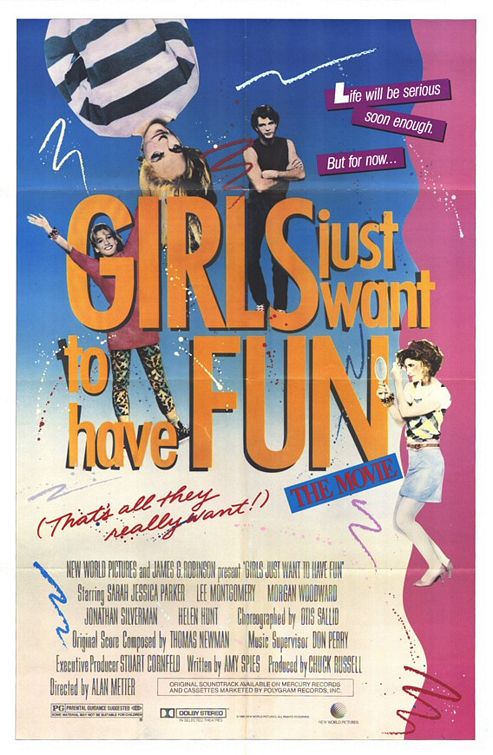
For our next film in this series of Back to School reviews, we take a look at 1985’s Girls Just Want To Have Fun!

And you know what?

It’s true — we do just want to have fun!

The fun in Girls Just Want To Have Fun is pretty much defined by dancing, which is okay with me because I love to dance.  However, Girls Just Want To Have Fun had the misfortune to be made in the mid-80s.  I have lost track of many 80s films that I’ve watched but I’m still always shocked at how undanceable most 80s music truly was.  This film, of course, does contain a cover version of the famous song by Cyndi Lauper and that’s actually a pretty good 80s song.  However, the rest of the music (and, by that, I mean the music that everyone in the movie is actually dancing to) is incredibly bland in the way that only music from the decade of We Built This City could be.

As for the film itself, it takes place in Chicago.  Janey Glenn (Sarah Jessica Parker) is the newest student at the local Catholic girls school.  Janey’s overprotective father (Ed Lauter) is in the army and Janey has lived all over the world.  Despite that, Janey is not at all worldly.  In fact, when she tries to introduce herself to her classmates, all she can get out is that she’s a gymnast and she loves to dance. (When we actually see Janey dancing or doing any sort of gymnastics, Sarah Jessica Parker’s hair always seems to fall in her face, which is certainly one way to hide a stunt double.)

Janey makes one friend at the school.  Lynn (Helen Hunt, looking like a teenager but already sounding like a hung over 40 year-old) is about as wild as a girl can be in 1980s PG-rated film.  That’s to say, she wears a leather skirt when she’s not in school and, when she babysits, she orders pizza and then allows the baby to sit on it.  (Ewwwwwww!  There’s a reason why babies wear diapers….)  Lynne and Janey are automatically BFFs because they both love Dance TV!

That’s right — it’s DTV!  I wonder what that’s supposed to be based on…

It turns out that DTV is having a contest to pick two new dancers!  Disobeying her strict father, Janey sneaks out of the house and joins Lynn in auditioning!  Lynn’s partner turns out to be so spastic that Lynn doesn’t make the semi-finals.  Later, Lynn discovers that her partner was bribed by rich bitch Natalie Sands (Holly Gagnier).  I’m not sure why Natalie felt the need to do that since Lynn wasn’t that impressive to begin with.  She’s about as good a dancer as you would expect Helen Hunt to be.

However, Janey does make it to the semi-finals, where she’s partnered with Jeff.  Jeff is tough and blue-collar and, at first, it doesn’t seem like he and Janey will get along.  So, of course, they end up falling in love and, of course, Natalie’s father tries to force Jeff out of the contest by threatening to put his father out of work.  Jeff, incidentally, is played by Lee Montgomery.  Years before appearing in Girls Just Want To Have Fun, Montgomery played the little kid who gets crushed by a chimney at the end of Burnt Offerings.  Burnt Offerings is a really crappy film but I watch it every time that it comes on TCM just so I can see that chimney crush Lee Montgomery.  That said, Montgomery actually does a pretty good job of Jeff.  You never quite buy him as a rebel without a cause but he still seems like an authentic and likable teenager.  Jeff and Janey are a cute couple and that’s all that really matters.

Just as Janey has a best friend, Jeff also has a best friend.  Drew Boreman (Jonathan Silverman) talks too much, tries to sell t-shirts from the trunk of his car, and there’s also a scene were he grabs a random girl’s breasts and makes a comment about using her nipples to tune a radio.  Drew is annoying and, once you get over the fact that she’s being played by a young Helen Hunt, so is Lynn.  Watching the movie, you kind of want to tell both of them to just calm down for a few minutes.

But you know who is not annoying?  Jeff’s younger sister, Maggie, who is played by none other than a very young Shannen Doherty.  Maggie was my favorite character because she alone seemed to understand how stupid everyone else in the film was.  And she was willing to call them out on it.

ANYWAY — Girls Just Want To Have Fun is one of those movies where next to nothing actually happens.  There is an extended sequence where our heroes destroy Natalie’s snooty party with the help of a bunch of punks and female body builders but otherwise, it’s remarkable how little actually happens.  That said, some of the dancing is good (even if most of the music is totally bland in the way that only 80s music can be) and it’s interesting to see Sarah Jessica Parker and Helen Hunt when they were young.  Sarah Jessica Parker actually gives a surprisingly likable performance here, even if it is often way too obvious that a body double is doing the majority of her dancing.  That said, you really can’t get any further away from Carrie Bradshaw than Janey Glenn.

Girls Just Want To Have Fun is a time capsule of the decade in which it was made and that is definitely the main reason to watch it.  Until time machines are a reality and we can experience the past firsthand, we’ll just have to keep getting our information from movies like this one.

Back to School Part II #18: Not My Kid (dir by Michael Tuchner)


Not_my_kid

Not My Kid, a made-for-television from 1985, opens with 15 year-old Susan Bower (Viveka Davis) in a car with her friends.  They’re drunk.  They’re stoned.  They’re laughing.  And soon, they’re screaming as the driver loses control and the car ends up getting overturned!  (I’ve had that happen before.  It wasn’t fun but I survived with only a few cuts and bruises.)  Susan isn’t seriously hurt but, at the hospital, it’s discovered that she has alcohol and drugs in her bloodstream.

“NOT MY KID!” her father, surgeon Frank Bower (George Segal), declares.

“NOT MY KID!” her mother, Helen Bower (Stockard Channing, totally wasted in a thinly written role), agrees.

“Totally your kid!” her younger sister, Kelly (Christa Denton), says before then revealing where Susan hides her drugs.  This leads to Kelly getting beaten up by Susan and her drug addict boyfriend, Ricky (Tate Fuckin’ Donavon, decades before playing a hostage in Argo.).

Anyway, neither Frank nor Helen want to admit that Susan has a drug problem so instead, they go to see a smug family counselor who tells them that they are both being too hard on their daughter and that they need to just let Susan be Susan.  That sounds like a good (and easy) plan but then Susan runs away and disappears for two days.  After she’s finally found, stoned and hiding out in the family’s boat, her parents finally decide to send her to rehab.

The rehab is run by Dr. Royce.  Dr. Royce is played by Andrew Robinson and it took me a while to recognize him as being the same actor who played the Scorpio Killer in Dirty Harry.  Perhaps that explains why Dr. Royce came across as being such a creepy character.  As I watched this movie, I kept waiting for the big reveal where Dr. Royce would turn out to be a murderer or something.  That never happened, of course.  In the world of Not My Kid, the harsh and confrontational Dr. Royce is the only thing keeping the entire teenage population for shooting up heroin.

The majority of the film takes place at the rehab and it gets annoying pretty quickly.  This is one of those places where everything is done as a group activity.  Whenever someone says something, everyone in the group replies with, “We love you, so-and-so.”  When Susan doesn’t act properly ashamed of herself, the group gangs up on her.  “You’re a phony!” someone says.  “You’re full of crap!” another person adds.  “We love you, Susan,” the group chants.

AGCK!  Seriously, the rehab scenes totally freaked me out because it came across less like therapy and more like brainwashing.  I spent the entire movie waiting for Susan to escape and when she did, I was happy for her.  She may have been a self-destructive drug addict but at least wasn’t a mindless zombie like everyone else in the movie!  But then she ended up getting caught by her father and taken back to the rehab.

Meanwhile, her parents are going through therapy as well.  Again, it’s all group therapy.  When Frank tries to talk about how Susan’s behavior makes him feel, someone says, “You’re a phony!’  Another person adds, “You’re full of crap!”  And the group chants, “We love you, Frank.”  Okay, to be honest, I’m taking some dramatic license with the dialogue here but hopefully, you get the general idea.

I mean, seriously — I understand that I was supposed to be like, “Yay rehab!” while watching the movie but the rehab came across more like some sort of creepy cult.  It reminded me of both a Canadian film called, Ticket To Heaven and a Texas film called Split Image.  As I watched Not My Kid, I kept waiting for James Woods to show up as a cult deprogrammer.

Anyway, don’t worry.  Everything turns out well in the end.  This was a made-for-TV movie, after all.  Not My Kid is way too heavy-handed for its own good and it lacks a certain self-awareness.  On a more positive note, George Segal does a good job in the role of Frank.

You can watch Not My Kid below!

Back to School Part II #17: The Boys Next Door (dir by Penelope Spheeris)


Boys-next-door

Three years after starring in Grease 2, Maxwell Caulfield starred in another (albeit far different) film about teenage delinquents, 1985’s The Boys Next Door.  Directed by Penelope Spheeris (who also did Suburbia, another film about wayward youth), The Boys Next Door is a frequently harrowing film about a road trip gone very wrong.

The film opens with a series of black-and-white photographs of real-life serial killers, so you know what you’re about to get yourself into before the main action even begins.  Caulfield plays Roy, a not-very-smart teenager who lives in an industrial town in the southwest.  With his generally bad attitude and violent temper, Roy is one of the least popular kids at the local high school.  In fact, his only friend appears to be Bo (Charlie Sheen).  Bo is just as stupid as Roy but he’s not as violent.  Bo’s problem is that he’s a follower, the type who is incapable of making his own decisions.  If Roy says, “Let’s beat the Hell out of someone,” Bo is going to agree because … well, why not?

When Roy and Bo graduate from high school, they don’t have much more to look forward to than a life of working in a factory.  After an angry Roy violently lashes out at a graduation party, he decides that he and Bo should get out of town.  Fortunately, Bo has received $200 as a graduation gift.  Roy and Bo decide to use that money to take a trip to Los Angeles.

On the way to L.A., it quickly becomes obvious that Roy is more than just an angry kid.  When he and Bo rob a gas station, Roy savagely beats the attendant.  When they get to Los Angeles, all Roy can talk about is how much he hates the city and everyone who lives in it.  Roy is especially vocal about how much he hates anyone who he perceives as being gay…

Of course, even as Roy is loudly expressing every homophobic thought that pops into his tiny mind, it’s hard not to notice that he seems to be rather obsessed with Bo.  In fact, he is so obsessed with Bo that he basically kills anyone who shows the least bit of interest in Bo.  Paranoid that Bo is going to abandon him, Roy is willing to do anything to keep that from happening.

The Boys Next Door is one of those films that really took me by surprise.  It may start and look like your typical low-budget thriller but The Boys Next Door ultimately reveals itself to be a disturbingly plausible portrait of a sociopath.  The film suggests that, as individuals, both Roy and Bo are somewhat laughable but, as a team, they’re deadly.  It’s no wonder that Roy is so insistent that Bo always stay with him because, without Bo around, Roy wouldn’t have any motivation to do anything.  Everything that Roy does — from theft to murder — is largely to impress Bo.  Unfortunately, Bo is too stupid to understand what’s going on in his friend’s head.

Especially when compared to some of the other performances that they are known for, both Sheen and Caulfield do surprisingly good work as the two murderers.  Penelope Spheeris wisely directs the film as if it were a documentary and the end result is a harrowing film that deserves to be far better known.

Back to School Part II #16: The Karate Kid (dir by John G. Avildsen)


320px-Karate_kid

Finally, I am getting a chance to continue my series of Back to School reviews!

Earlier today, we had a pretty big storm down here in Texas and it knocked out the electricity for three and a half hours!  There I was, sitting in the dark and wondering if I would ever get a chance to review the 16th movie in this 56-film review series.

(Originally, I was planning on being done by this weekend but, as always seems to happen whenever I do a review series, I’m currently running behind so it’ll probably won’t be until the weekend after next that I post my final Back to School review.)

Fortunately, the Oncor truck eventually showed up in the alley.  I, of course, ran out into the back yard and started to shout at them, “I need power!  I have movies to review!”  They must have heard me because, suddenly, the power came back on.  And now, I can finally get around to sharing a few thoughts on the original, 1984 version of The Karate Kid!

Up until last night, believe it or not, I had never seen The Karate Kid before.  Certainly, I knew about it.  Much like Star Wars and Star Trek, The Karate Kid is one of those cultural landmarks that everyone knows about even if they haven’t actually sat down and watched the movie.  Even before I watched the film, I knew about Mr. Miyagi.  I knew about “wax on” and “wax off.”  I knew about the crane.  I even knew about “You’re alright, LaRusso!”

But I hadn’t actually seen the film and I have to admit that I was a little bit hesitant about doing so.  Everything I had heard about The Karate Kid made it sound like a thoroughly predictable and excessively 80s sports film.  I was expecting the film to be all about power ballads and training montages and uplifting dialogue and certainly, The Karate Kid had a lot of that.

But what took me by surprise is what a genuinely sweet movie The Karate Kid is.  Yes, it’s predictable and it’s full of clichés but dammit, it all works.  It still brought tears to my mismatched eyes.

The karate kid of the title is Daniel LaRusso (Ralph Macchio), who moves, with his mother, from New Jersey to California.  Daniel’s a nice kid who has learned a little karate from reading books but he’s still no match for the bullies at his new high school.  Daniel does get a girlfriend, Ali Mills (Elisabeth Shue, giving a performance that feels far more genuine than any of her more recent work), but even that leads to him getting in trouble.  It turns out that Ali’s ex-boyfriend is Johnny (William Zabka), the top student at Cobra Kai.  Oddly enough, Johnny’s teacher is also named John.  John Kreese (Martin Kove) is a Vietnam veteran who decorates his dojo with pictures of himself looking threatening.  Kreese, we soon discover, is a total psychopath.  “NO MERCY!” he shouts at this students.

When Johnny and his fellow Cobra Kai students beat up Daniel on Halloween, Daniel’s life is saved by Mr. Miyagi (Pat Morita).  Mr. Miyagi may appear to just be a simple maintenance man but he’s actually a total badass.  He teaches Daniel not only the moves of karate (“Wax on…wax off…”) but the philosophy as well.  He explains to Daniel that there are “No bad students.  Just bad teacher.”  In short, he is the exact opposite of Kreese.

Who is the better teacher?  That’s a question that will be answered when Daniel faces off against the Cobra Kai bullies at the Under-18 All-Valley Karate Tournament.  Can Daniel defeat Johnny, win Ali’s love, and earn the right to live free of harassment?

Well, it would be a pretty depressing movie if he didn’t…

Anyway, The Karate Kid turned out to be a really sweet and likable movie.  I was never surprised by the movie’s plot but I still found myself being drawn into the story and hoping that everything would work out for Daniel and Ali.  The character of Mr. Miyagi has been parodied in so many other films that I was a bit surprised to see just how good Pat Morita was in the role.  Yes, Morita gets to say a lot of funny lines but he also gets a rather harrowing dramatic scene where talks about how his wife and child died while he was away, serving in the army.

It’s interesting to note that, at the end of the film, even Johnny got to show a glimmer of humanity, suggesting that even the worst jerk in the world can be redeemed by a good ass-kicking.  That said, Kreese is pure evil from beginning to end and Johnny’s friend, Dutch (played by Chad McQueen), is about as scary a high school bully as I’ve ever seen.  But at least Johnny is willing to admit the truth.

LaRusso?

He’s alright.


Back to School Part II #15: Joy of Sex (dir by Martha Coolidge)


Joy_of_Sex_Movie_Poster

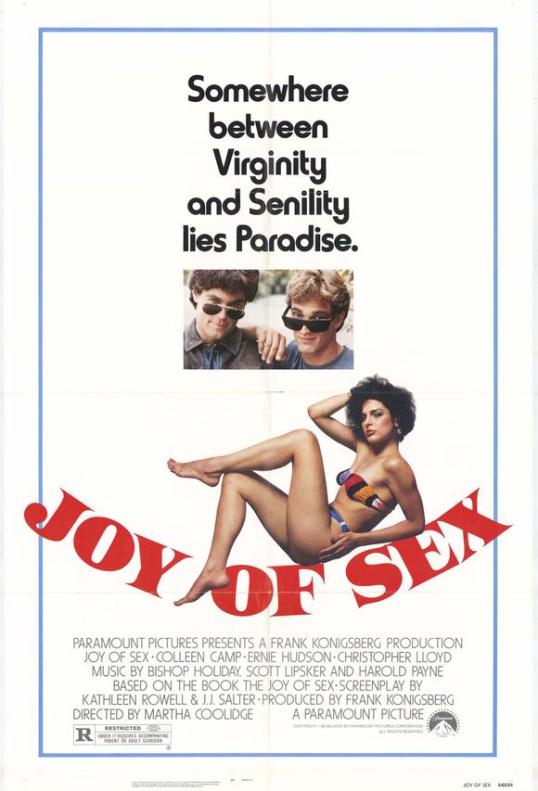
Let’s say one positive thing about the 1984 “comedy” Joy of Sex.

The tag line on the poster: “Somewhere between virginity and senility, lies paradise,” is brilliant.  Whoever came up with it deserves a lot of credit because it sounds a lot better than anything that’s actually heard in the movie.

Let’s say something else good at Joy of Sex.  The two stars of the movie — Cameron Dye and Michelle Meyrink — both gave good and likable performances, even if their characters got a little bit annoying at times.  (Then again, just about everyone in Joy of Sex gets annoying.)  Also, there’s a subplot about an undercover cop (played by Colleen Camp) that predates 21 Jump Street and which occasionally shows off a few hints of genuine wit.

Otherwise, this is probably one of the worst of the 80s teen comedies that I’ll be reviewing for this series of Back to School reviews.  Joy of Sex is officially credited as being an adaptation of a sex manual that was popular back in the 70s.  According to the imdb and Wikipedia, Joy of Sex went through a rather tortured development.  At one point, it was going to be an anthology film, starring John Belushi and co-produced by National Lampoon.  However, Belushi died of a drug overdose, National Lampoon abandoned the project, and the final film turned out to be another high school film.  Imagine Fast Time At Ridgemont High … but really, really bad.

Leslie Hindenberg (Michelle Meyrink) is a student at Richard Nixon High School.  She’s the daughter of the school’s phys ed coach (Christopher Lloyd, playing what was probably meant to be the Belushi role) and, as a result, she is viewed as being untouchable, even by the sex-crazed boys of Nixon High.  The problem is that Leslie has recently discovered a mole on chest and is convinced that she has skin cancer.  Believing that she only has 6 weeks to live, Leslie sets out on a mission to lose his virginity.  However, she wants to lose it to the perfect guy and there aren’t many of those at her school.  (Can you really afford to be picky when you’ve only got 6 weeks to live?)  Add to that, everyone’s terrified of the coach…

Leslie’s lab partner is Alan (Cameron Dye), who is a nice guy.  He not only has a huge crush on Leslie but he’s also desperate to lose his virginity as well!  Problem solved, right?  Well, no.  See, Alan has been led astray by the new girl in school.  Liz (Colleen Camp) is tough, outspoken, and no-nonsense.  As soon as she shows up in school, she lets everyone know that she’s obsessed with two things — sex and drugs.  In fact, she’s especially interested in drugs…

A lot of students, of course, are suspicious of Liz.  She seems to be older than everyone else and speak in out-of-date slang.  “Could she be a narc?” some students wonder.  Well, actually, she is.  She is working undercover at Nixon High and is convinced that Alan knows who is supplying drugs to all of the students.  And, it must be said, that Colleen Camp really throws herself into the role.  As happens with most of the film’s subplots, the undercover narc storyline doesn’t really go anywhere but at least Camp made the effort.

Meanwhile, Leslie’s best friend has been kicked out of school because she’s pregnant.  Leslie approaches a local reporter, hoping to convince him to do a story about what’s happened.  And, while getting her best friend back into school, Leslie starts to wonder if maybe she’s found the right man to take her virginity…

(But wait!  We know she’s meant to be with Alan!  So, surely, the reporter will turn out to be a sleaze, right?)

But that’s not all!  Someone is running around the school and using superglue to play pranks.  Who could it be?  Will the crazy principle (Ernie Hudson) be able to maintain order until the big dance?  And will the portrayal of the school’s frequently confused foreign exchange student manage to get any more racist?

And what about Tom Pittman (Robert Prescott)?  Pittman is the most popular guy in school.  Pittman doesn’t really do a lot.  To make an undeserved comparison to Animal House, he’s kind of the Bluto character, just not as interesting.  Whereas Bluto smashed guitars and beer cans and gave inspiration speeches, Pittman tries to light his farts on fire and is something of a bully.  (There is a kinda funny scene where he’s suddenly nice to Leslie and everyone’s shocked.)  The most memorable thing about Pittman is that he wears thick black glasses which are held together by tape.  So, if nothing else, Joy of Sex is important chapter in the history of myopia in film.

Anyway, Joy of Sex has remarkably little joy and next to no sex.  I imagine that were riots in the theaters after this movie came out, as thousands of angry teenagers chanted, “We want joy!  We want sex!  When do we want them!?  NOW!”

There were a lot of great teen films released in the 80s.  Joy of Sex is not one of them.

Back to School Part II #14: Grease 2 (dir by Patricia Birch)


Grease_2


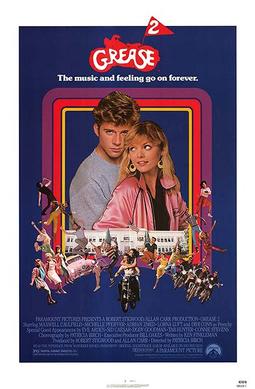
So, the whole reason that I watched Grease last week was so I would be prepared to watch the 1982 sequel Grease 2 over the weekend.  As I’ve mentioned many times on this site, I absolutely hate Grease and I know what you’re probably asking yourself:

“But Lisa, if you hate Grease so much, why did you want to see Grease 2?”

Well, there’s a very good answer to that question but I’m not going to reveal it.  I’m going to encourage you to learn to love the mystery.  For whatever reason, I wanted to watch Grease 2.  Perhaps it was because I’ve heard that Grease 2 is the worst sequel ever made.  I really didn’t see how that was possible.  How, I wondered, could a film be any worse than the original Grease?

And, so, I watched Grease 2 on Netflix and yes, it was really, really bad.  But you know what?  It was so bad that it became almost compulsively watchable.  Unlike the first Grease, which is full of slow spots, Grease 2 is oddly exciting in its mediocrity.  I watched much of it in open-mouthed horror, wondering if things could possibly get any worse.  And, with each scene, it did get worse.  It was so overwhelmingly and shamelessly bad and so thoroughly misguided that, strangely enough, I really want to rewatch it.

Grease 2 takes place in 1961.  There’s a whole new gang of students at Rydell High!  Well, actually, Frenchy (Didi Conn) has returned.  You may remember that, in the previous film, Frenchy dropped out of high school and went to beauty school.  (She was also visited by Satan, who came to her disguised as the Teen Angel.)  But now Frenchy is back, trying to pass a chemistry class so she can … well, I’m not really sure what the whole deal with Frenchy was.  I imagine that Didi Conn was probably free for a weekend.

The T-bird and the Pink Ladies are still around but they have a whole new membership.  The head of the Pink Ladies is Stephanie Zinone (played, in her film debut, by Michelle Pfeiffer).  Her boyfriend, Johnny Nogorelli (Adrian Zmed), is the chain-smoking leader of the T-birds.  Actually, Johnny is now her ex-boyfriend.  He cheated on her over the summer.

And there’s a new boy at Rydell!  He’s originally from England and he’s Sandy’s cousin!  His name is Michael Carrington (superhandsome Maxwell Caulfield, who is perhaps fated to always be best known for playing Rex Manning in Empire Records) and, when we first meet him, he’s getting off a school bus and he’s wearing a suit!  Michael really likes Stephanie but you have to be a T-bird if you’re going to date a Pink Lady and…

AGCK!

Sorry, that was a primal scream.  Trying to describe the plot of Grease 2 inspires a lot of primal screams.

Anyway, this is a film is also a musical but apparently, none of the original Grease composers were involved with the sequels.  All the songs kinda sound like something you would hear in a parody of Grease, as opposed to a sequel.  Also adding to bizarre feel of this sequel is that everyone delivers their lines as if they’re appearing in a stage production, projecting to the back of the theater and overenunciating every single syllable.  This may have made sense for Grease, which was adapted from an actual stage show and, despite efforts to open up the action, was still deliberately stagey.  Grease 2, meanwhile, is an adaptation of a stage show that never actually existed.

The film starts with a 7 minute production number called Back To School Again.  As the Pink Ladies and the T-birds and all the other students show up outside of Rydell, they sing, “Woe is me!  The Board of Education took away my parole.”  And the scene just keeps going and going, until you start to wonder if Rydell High is a cult compound.

This is followed by a song about bowling (!) that’s called “Score Tonight.”

And it just keeps getting worse from there.  The film becomes sickly fascinating as you find yourself trying to predict how much more worse it can possibly get.  You may be tempted to give up but you’ll definitely want to stick around for the scene in which Michael discovers that Stephanie wants a “cool rider.”  How does he know that?  She sings a song about it!

Naturally, Michael gets a motorcycle, a helmet, and pair of goggles and he starts to romance Stephanie.  Stephanie doesn’t know who that Michael is the mysterious motorcyclist, despite the fact that Michael is just wearing a helmet and a pair of goggles.  Though you have to admire Pfieffer’s commitment to her role (and she gives a fairly good performance, considering the material she was working with), you can’t help but feel that Stephanie might not be the smart.  Especially after she sings, “Who’s that guy?”

Uhmmm … it’s Michael.  It’s not like he’s dressed up like a bat or wearing the Iron Man armor.  He’s just got a helmet and goggles on.  Add to that, while Maxwell Caulfield doesn’t give a bad performance (he seems to be doing the best he can with what he’s been given to work with), he also doesn’t attempt to act any differently when he’s the mysterious motorcyclist than when he’s Michael.

There are other things going on as well.  The film is full of vignettes about life in 1961, all featuring the students and teachers at Rydell High.  For instance, former teen idol Tab Hunter shows up as a substitute teacher and sings a song about reproduction.

And again, it’s so bad that you can’t look away and you watch knowing that you’ll never get the images and the songs out of your head.  So compulsively watchable is this bad movie that I may have to watch it again after I finish this review.  (Then again, I’ll probably just rewatch the fifth season of Degrassi…)

(That said, I would actually argue that Grease 2 is a better directed film than the first Grease.  Grease 2 was directed by Grease‘s choreographer and, as opposed to the first film, the dance numbers are actually framed with modicum of care.)

(By the way, I’ve always wanted to use the phrase “modicum of care” in a review.)

Anyway, Grease 2 apparently bombed at the box office and, as a result, there have been no further Grease films.  It’s a shame because you so know that Grease 3 would have taken place in 1967 and featured hippies.

Oh well.

We’ll survive…


Back to School Part II #13: The Last American Virgin (dir by Boaz Davidson)


The_Last_American_Virgin_movie_poster

(SPOILERS BELOW!)

For the past week, I have been doing a chronological review of films about high school, college, and teenagers.  I started things off on Monday by taking a look at Teenage Devil Dolls, a film from the 1950s.  From there, I moved on to the 60s and then the 70s and now, finally, I am now ready to start in on the golden age of teen films — the 1980s!

I started things off by watching The Last American Virgin, a low-budget film from 1982 and oh my God!  Seriously, The Last American Virgin has got to be one of the strangest films that I’ve ever seen.  I can only imagine what teen audiences in 1982 must have thought when they went to see the latest sex comedy and discovered that it was actually one of the darkest and most depressing films ever made.

Actually, The Last American Virgin is two films in one.  The first film is pretty much a typical teen comedy.  Three friends — awkward but sweet Gary (Lawrence Monoson), handsome but shallow Rick (Steve Antin), and funny fat guy Dave (Joe Rubbo) — try to get laid and survive their senior year in high school.  They pick up three girls by pretending to have cocaine.  (They offer them sweet-n-low instead, which leads to a lengthy scene of the girls snorting the artificial sweetner and then saying stuff like, “This is the best Colombian that I’ve ever had.”)  They meet a lonely housewife who had sex with two of them before her husband arrives home.  (As usual, Gary misses out.)  They have sex with a crude hooker and all end up with crabs as a result.  It’s a typically crude teen comedy, distinguished only by the fact that Monoson, Antin, and Rubbo are a lot more believable as teenagers than the usual 25 year-old actors who often starred in these films.  (According to the imdb, Monoson was only 16 when The Last American Virgin first went into production.)

But, right there in the middle of the usual teen movie shenanigans, there’s this other movie taking place.  Gary is in love with Karen (Diane Franklin, who appeared in several teen films in the 80s, including Better Off Dead) but Karen is dating Rick.  When Gary finds out that Karen has lost her virginity to his best friend, he ends up sitting alone in a diner while Just Once (“I did my best … but I guess my best wasn’t good enough…”) plays on the soundtrack.  In fact, that song shows up several times during the movie.  Basically, whenever Gary tries to do anything, we suddenly hear: “I did my best … but I guess my best wasn’t good enough….”

I mean, seriously, poor Gary!  Even the soundtrack is implying that he’s a loser!

Eventually, Karen discovers that she’s pregnant.  Rick refuses to help out and promptly leaves on a ski trip.  Gary and Karen tell their parents but they’re going on the ski trip as well but instead, they go to an empty house that once belonged to Gary’s late grandmother.  Gary points out a huge, old-fashioned radio sitting in a corner and says that Karen can listen to it if she wants.  Karen starts to cry.  Gary starts to cry and swears that he’ll never abandon her.

Karen gets an abortion.  Shots of Karen at the clinic are mixed in with scenes of Gary desperately trying to raise the money to pay for her abortion.  He begs his boss for an advance on his salary.  He pawns his stereo.  All the while, U2’s I Will Follow plays on the soundtrack.

At this point, the film had gotten so serious that I was half-expecting for Gary to come to the clinic to pick up Karen, just to be told that she had died during the procedure.  But no, Karen survives.  They go back to grandma’s house.  Karen thanks Gary for all that he’s done for her.  Gary cries and says that he loves her.  Karen invites Gary to her birthday party.

Gary goes to the birthday party, bringing with him the gift of a ring.  But, as soon as Gary steps into the kitchen, what’s the first thing he sees?

Karen hugging Rick.  Both of them have tears in their eyes.  They look back at Gary.

Gary stumbles out of the party.  He gets in his car and drives away.  We get a close-up of Gary sobbing in the car…

I did my best …. but I guess my best wasn’t good enough…

AND THEN THE MOVIE ENDS!

I mean … MY GOD, HOW DEPRESSING CAN A MOVIE BE!?

And yet, that depressing ending is what sets The Last American Virgin apart.  I mean, it’s not a happy ending but it definitely elevates this low-budget and rather crude movie.  If nothing else, it feels more realistic than having Lawrence Monoson punch out Steve Antin and then live happily ever after.  Sometimes, stories don’t end with love and smiles.  Often times, they end with an awkward teenager sobbing as he drives home.

So, that’s The Last American Virgin.  It’s an odd little movie.  It was also a remake of a film that the same director had previously made in Israel and the film’s mix of low humor and high drama feels more European than American.  This is definitely a film made by an outsider, trying to imagine what American teenagers are like.  It makes for a movie that, though it may appear to be a typical teen sex comedy, is actually something else altogether.

Seriously, this is a weird one.  I’m as surprised as anyone to say that I recommend it.

Back to School Part II #12: Breaking Away (dir by Peter Yates)


Has Indiana changed much since 1979?

I ask because I just watched Breaking Away, a 1979 nominee for best picture.  Breaking Away was shot on location in Bloomington, Indiana and on the campus of Indiana University.  And though the film doesn’t go out of its way to idealize either the state, the town, or the university –in fact, the title refers to the desire of several characters to break away from their life in Bloomington — it still manages to make Indiana look like the nicest place on Earth.  Add to that, Indiana University is home to the Eskenazi Museum of Art, which I will someday visit.

Breaking Away is actually a film about a lot of things: it’s a comedy, it’s a quasi-love story, it’s bittersweet coming-of-age story, it’s a sports film, and it’s a sweet, good-natured film that made me cry.  At the heart of the film is Dave Stoller (Dennis Christopher), who has just graduated from high school and whose cheerful and eccentric exterior hides the fact that he appears to have no real future.  Dave is obsessed with bicycle racing and idolizes that the Italian cycling team.  In fact, he idolizes them so much that he decides to be Italian.  He rides around Bloomington, greeting people with a merry “Ciao!”  At home, he listens to opera and renames the family cat “Fellini.”  While his mother (Barbara Barrie) is understanding, his father (Paul Dooley) cannot understand what’s happening to his son.  Of course, Dave doesn’t truly believe that he’s Italian.  He just desperately wants to be something other than who he is.

And who is Dave?  He’s a citizen of Bloomington, a town that is divided between the upper class students at Indiana University and the blue-collar townies.  The students call Dave and his friends “cutters,” because the only real industry in town is working in the quarry, cutting stone.  The students look down on the cutters and the cutters resent the students.

Dave has three close friends, all of whom were big in high school and who are now facing an uncertain future of anonymity.  Cyril (Daniel Stern) is the funny and quirky one, the former basketball player who talks about how he would like to be a cartoon character.  Moocher (Jackie Earle Haley) is usually easy-going but loses his temper whenever anyone mentions that he’s short.  (At one point, Moocher’s boss orders him to, “Punch the time clock, Shortie!”  Moocher literally does just that.)  And finally, there’s Mike (Dennis Quaid).  Mike is their leader, a former high school quarterback who idolizes the Marlboro Man and who knows that he’s destined to spend the rest of his life in Bloomington, going from “20 year-old Mike” to “mean old man Mike.”

When Dave meets a student named Katherine (Robyn Douglass), he pretends to be an Italian exchange student and, soon, he’s serenading her on the lawn of her sorority house.  That doesn’t make Katherine’s boyfriend, Rod (Hart Bochner), happy.  Rod and his friends beat up Cyril, which leads to another fight at a bowling alley.  (Cyril, for his part, gets his finger stuck in a bowling ball.)  Seeking to broker some sort of peace and understanding between the students and the town, the university president (played by John Ryan, who was the real-life President of Indiana University at the time) announces that the cutters will be invited to take part in the annual Little 500 bicycle race at Indiana University.

And you can probably guess how the race turns out.  It’s a feel-good sports film so you already know who is going to win and that he’s going to have to win after initially falling behind and sacrificing a big lead.  You know all that but it doesn’t matter.  Breaking Away is such a sweet and well-acted movie that it still brought tears to my eyes even if the ending didn’t surprise me.

And really, the film does have a few surprises.  For one thing, Rod turns out to be not as bad a guy as you initially think he’s going to be.  Over the course of the film, he gets two small reaction shots, both of which hint that he’s not as much of a jerk as he often appears to be.  It’s a minor detail and it’s easy to miss but what’s important that it’s there and it’s one of the many small details that makes Breaking Away feel alive.  After watching the movie, I feel like I could go to Bloomington and still find all these character hanging out at the quarry.

There’s another scene that I want to mention.  This is the scene that made me cry.  Dave and his father walk around the university and his dad talks about how he and the fathers of all of Dave’s friends helped to cut the stone that was used to build campus.  His dad admits that, even though he helped to build it, he’s never felt comfortable on the campus and then tells his son that he doesn’t have to be a cutter.  And it’s such a heartfelt scene and so beautifully performed by Paul Dooley and Dennis Christopher that I started to cry.  Perfectly acted, perfectly directed, and perfectly written, what a great scene!  Fantastico!, as Dave might say.

I loved Breaking Away and I bet you would to.

Breaking Away

Back to School Part II #11: Skatetown U.S.A. (dir by William A. Levey)


Poster_of_the_movie_Skatetown,_USA

Now that I’ve fully recovered from the trauma of writing about Grease, let me tell you about a little movie from 1979.  It’s a movie about teenagers, love, and competition.  It’s also a movie about disco and some actors who had some extra time on their hands.  It has a great soundtrack and the whole movie is pure 70s.  It even features the debut performance of a future movie star!

What film am I talking about?

SKATETOWN, USA, of course!

But before I talk about the movie, check out the trailer.  This is one of my favorite trailers of all time.  It pretty much tells you everything that you need to know about the movie.  There’s not a deceptive moment to be found in this preview:

Skatetown, U.S.A. is one of those movies that you watch and think, “This could only have been made in the 70s.”  Remember how watching Hollywood High caused me to doubt whether or not the 70s were actually all they were cracked up to be?  Well, Skatetown USA has renewed my faith!  Skatetown is such a 70s film that I personally think someone should send me an honorary coke spoon to reward me for watching it.

(Maureen McCormick, who is best known for playing Marcia Brady and who had a small role in Skatetown, wrote in her autobiography that the main thing she remembers about Skatetown is all the cocaine on the set.)

Skatetown USA doesn’t really have a traditional plot.  Instead, it’s a collection of “comedic” skits mixed in with roller skating performances and a nonstop soundtrack.  There is not a second that music is not playing in the background and, for what appears to be a low-budget film, the soundtrack is truly impressive.  Basically, almost every great disco song from the 1970s is heard at some point during Skatetown USA.  (Even that “Boogie Nights” song that Paul Thomas Anderson was apparently not allowed to actually use in Boogie Nights!  Imagine being the copyright holders who said yes to Skatetown but no to Paul Thomas Anderson…)

The film’s main character appears to be an unnamed DJ (Denny Johnston).  The DJ wears a big white afro wig and is always dancing in his booth.  Occasionally, he shoots a lightning bolt from his middle finger and suddenly, professional roller dancers appear and do a routine.  At the end of the movie, he looks at the camera, says that it’s all a fantasy, and winks.

Skatetown is the most popular disco roller rink in town.  Clean-cut teenager and all around nice guy Stan Nelson (Greg Bradford) wants to win Skatetown’s roller dancing contest.  (The prize is $1,000 and a moped!)  His best friend, Richie (Scott Baio), accompanies him and hopes to win a lot of money by betting on the outcome of the contest.  Stan angrily reprimands him, “This isn’t the streets!  This is Skatetown, U.S.A!”

That’s right — don’t mess with the good name of Skatetown!

Anyway, Stan’s actually a pretty good performer and he does this trick where he rides a skateboard while wearing roller skaters so you would think he would be a sure bet to win.

BUT NO!

The reigning Skatetown champion is Ace Johnson (Patrick Swayze, making his film debut) and we know that Ace is a bad guy because he wears all black and he occasionally snaps a whip while he’s rolling around!  Ace isn’t above cheating to win but really he doesn’t have to cheat!  Ace may be the bad guy but, seriously, he totally kicks ass while wearing roller skates.  As soon as he rolls out there, you understand why he’s the reigning champion.

See, here’s the thing with Skatetown: We’re supposed to be rooting for Stan but Ace really is a hundred times better than him.  There’s a reason why Patrick Swayze went on to have a career after Skatetown while Greg Bradford only has 8 credits on the imdb.  Swayze, even in this silly role, had movie star charisma whereas Bradford — well, he’s comes across as a nice guy but there’s nothing special about him.  Swayze, meanwhile, is dangerous and smoldering.

For instance, when Stan does his routine, his background music is The Village People singing “Macho Man” and you can’t help but snicker a little.  Whereas, when Ace performs, his background music is a slightly menacing cover of Under My Thumb.  Stan is the Village People.  Ace is the Rolling Stones.

Anyway, the film might not be good in the traditional sense but I absolutely loved Skatetown, U.S.A.  Why?  Because it’s a total time capsule! Watching it is such a totally 70s experience that I was even tempted to get a frizzy perm, start wearing bell bottoms, and stop wearing a bra.  Fortunately, the temptation passed but still, I enjoyed getting to use my cinematic time machine.

Add to that, the film itself is just so over-the-top and silly that … well, you can really believe that everyone involved in the movie was snorting mountains of cocaine in between takes.  There’s not a subtle moment to be found in Skatetown, U.S.A.  Instead, it’s all bright neon, loud music, flamboyant characters, silly melodrama, and corny humor.

(My personal theory is that Skatetown, U.S.A. was taking place in the same cinematic universe of A Clockwork Orange and it was showing what normal teenagers were doing while Alex and his droogs were seeking out the ultraviolence.  The over-the-top design of Skatetown reminded me of the similar flamboyance of the Korova Milk Bar and the droogs’s bowlers and oversized codpieces weren’t that different from some of the costumes worn by the cast of Skatetown.)

Anyway, Skatetown is one of those films that everyone should see once.  Unfortunately, because of all the music in the film, it’s never been released on DVD or Blu-ray and it probably never will be because life sucks.  It is on YouTube, though it was recorded off an old VHS tape so the transfer is not the best.

Here’s Skatetown, USA:

One final note: Skatetown, USA was directed by the same William Levey who also directed Blackenstein, Hellgate, and The Happy Hooker Goes to Washington.  It was written Nick Castle, who played Michael Myers in the original Halloween and directed a film that is well-liked by several of the writers here at the Shattered Lens, The Last Starfighter.