Now separated from Jane (Priscilla Presley) and working in Washington D.C., Frank (Leslie Nielsen) finds himself investigating a bombing at the offices of Dr. Albert S. Meinheimer (Richard Griffiths), an advocate of renewable energy who has just been put in charge of America’s energy policies by President George H.W. Bush (John Roarke, who was better-known for playing Ronald Reagan on Friday’s). With the help of Captain Ed Hocken (George Kennedy) and Officer Nordberg (O.J. Simpson), Drebin’s investigation leads him to Quentin Haspburg (Robert Goulet), an oilman who is plotting on replacing Dr. Meinheimer with a double. It also leads him back to Jane, who is now working as an assistant to Meinheimer and being wooed by Hapsburg.
The Naked Gun 2 1/2 is a worthy sequel to the first Naked Gun. It’s more plot-heavy than the first film and some of the jokes feel a little bit too familiar but it’s still a very funny film. That’s largely due to Neilsen, Kennedy, and Presley, all of whom really commit to playing their absurd characters. (Robert Goulet gives a game performance but he really can’t match Ricardo Montalban’s villainous turn in the first movie.) Nielsen was probably the only actor alive who could keep a straight face even while hitting Barbara Bush in the face while opening a door and then struggling to eat lobster at a state dinner. As was often the case with the ZAZ films (even though Jim Abrahams and Jerry Zucker didn’t have anything to do with the screenplay of the sequel), the funniest moments are also the most random and the stupidest. I laughed a lot harder than I should have at Leslie Neilsen struggling with a very small towel that had been thrown against his face. And don’t worry, O.J. Simpson fans. Nordberg gets injured in this movie too.
Leslie Nielsen was one of those actors who could make anything funny. Whether he was delivering his hard-boiled dialogue or doing absurd physical comedy with an absolutely straight face, it was impossible not to laugh when Leslie Nielsen was onscreen. He was a true cinematic treasure.
“Don’t count on me to make you feel safe.” — The Stranger
High Plains Drifter stands as one of the bleakest, most enigmatic entries in Clint Eastwood’s filmography—a Western that bleeds unmistakably into the realms of psychological and supernatural horror. This 1973 film is not just another dusty tale of lone gunfighters and frontier justice. It’s a nightmare set in broad daylight, a morality play whose hero is more monster than man.
Eastwood’s Stranger comes riding into the town of Lago from the shimmering desert, a silhouette both akin to and apart from his famed Man With No Name persona. The townsfolk are desperate, haunted by fear—less afraid of imminent violence, more of the sins they’ve half-buried. This is a place where a lawman was brutally murdered by outlaws while the townspeople looked away, their silence paid for with cowardice and greed. When the Stranger assumes command, he does so with often-gleeful sadism—kicking people out of their hotel rooms, replacing the mayor and sheriff with the dwarf Mordecai, and ordering that the entire town be painted red before putting “Hell” on its welcome sign.
There’s a surface plot: the Stranger is hired to protect Lago from the same three outlaws who once butchered its marshal. But he’s there for far more than that. The story unspools through dreamlike sequences, flashbacks that suggest the Stranger may well be an avenging spirit or a revenant—the dead lawman, spectral and merciless, returned to claim what the townsfolk owe to Hell itself.
The horror here isn’t about jump scares or gothic haunted houses. The supernatural lurks everywhere and yet nowhere. The Stranger moves with the implacable calm—and violence—of a slasher villain, transforming Lago into his personal stage for retribution. His nightmares, full of images of past atrocities, are painted with the same vivid brutality as the daytime violence. Eastwood’s use of silence, the squint of a face, the twitch of a pistol replaces musical cues in amplifying dread. The sound design evokes otherness—a howling wind, footsteps echoing across empty streets—that builds a shadow of terror around the Stranger’s presence.
This violence is hurried and brutal; its sexual politics unflinching. When the Stranger enacts revenge, he punishes not just the outlaws, but the townsfolk complicit in their crimes. There is little comfort in his sense of justice—the pleasures he takes border on sadistic. The film’s moral ambiguity cuts deeper than most Westerns or horrors: this is not a clear-cut tale of good versus evil, but a brutal reckoning of collective guilt, cowardice, and corruption.
Lago itself acts almost like a town stuck in purgatory—a holding pen between redemption and eternal damnation. The infamous “Welcome to Hell” sign the Stranger paints at the town’s entrance serves as a grim message. It’s no welcome to law and order, but a symbolic beacon to the very outlaws the Stranger is hired to confront, suggesting that Lago is a place where sin festers and punishes itself. The town’s dance with Hell is both literal and metaphorical. The inhabitants aren’t just awaiting judgment; they have invited it in their desperate attempts to hide their cowardice and greed under the guise of civilization.
This notion of Lago as purgatory stands in sharp contrast to other recent horror Westerns, which serve as prime examples of the genre’s thematic spectrum. These films tend to focus on the primal terror of nature barely held at bay by the fragile veneer of civilization the settlers claim. They pit human beings against the ancient, untamed forces of the wilderness—whether monstrous creatures or surreal phenomena—emphasizing that the supposed order and progress of the West remain fragile and constantly threatened. This dynamic symbolizes the uneasy balance between civilization’s reach and nature’s primal power, often revealing how thin and tenuous that barrier truly is.
Among these, Bone Tomahawk and Ravenous stand out as vivid examples. Bone Tomahawk confronts menacing cannibals lurking in the wild, reminding viewers that the West’s order is fragile and under perpetual threat from untamed wilderness. Ravenous uses cannibalism and survival horror as metaphors for nature’s savage predation hidden beneath the polite façade of civilization—nature’s horrors masked but not erased.
By contrast, High Plains Drifter directs its horror inward, exposing the corruption that manifest destiny imposed on settlers themselves. Instead of fearing nature as an external force, the film presents settlers as haunted by their own moral failures and complicity in violence and betrayal. The Stranger’s vengeance is a reckoning with the darkness festering inside the community, a brutal meditation on guilt, collective cowardice, and the price of greed disguised as progress.
Eastwood’s film strips away the mythic promises of the American West as a land of freedom and opportunity, revealing instead the brutal reality of communities locked in complicity, violence masquerading as justice, and the moral rot at the heart of manifest destiny. This moral ambiguity and psychological depth give High Plains Drifter a unique position in the horror Western subgenre, elevating it beyond simple scares to a profound exploration of American cultural myths.
The Stranger is not a traditional hero but a spectral judge, embodying divine or supernatural retribution. His calm yet ruthless punishment exposes the cruelty, cowardice, and malevolence within Lago’s population, meting out a justice that is neither neat nor forgiving. His supernatural aura and sadistic tendencies make him an unforgettable figure of terror and fate.
Visually, the film’s harsh daylight contrasts with the romanticized Western landscapes of earlier films. Instead of shadows hiding evil, blinding light exposes the town’s moral decay. Characters are reduced to symbols of greed, fear, and cruelty, highlighting that the true horror lies within human nature and the failure to uphold justice.
High Plains Drifter operates on multiple levels—a Western, a ghost story, a horror film, and a dark morality play. It is a relentless meditation on justice and punishment and a dismantling of the traditional Western hero myth. Through layered narrative, stark visuals, and Eastwood’s chilling performance, it remains an essential entry in the horror Western canon.
For those seeking a Western that doesn’t just entertain but unsettles and challenges, High Plains Drifter offers an unforgiving descent into darkness. It strips away the comforting myths of the frontier and exposes the raw, rotting core beneath. Unlike other modern horror Westerns such as Bone Tomahawk and Ravenous, which confront external terrors lurking in the wilderness, this film turns its gaze inward—on the moral decay, guilt, and violence festering within the settlers themselves. It’s a brutal, haunting reckoning, and Eastwood’s Stranger is the cold, relentless agent of that reckoning. This is a journey into a hell both literal and psychological, where justice is merciless and safety is a long-forgotten promise.
In 1977’s The Fifth Floor, Dianne Hull plays Kelly McIntyre.
Kelly is a college student by day and a disco dancer by night! Unfortunately, after someone spikes her drink at the discotheque and she suffers an overdose, she becomes a full-time patient at a mental asylum. Neither the head doctor (Mel Ferrer) nor the head nurse (Julia Adams, who once swam with The Creature From The Black Lagoon) believes her claim that her drink was spiked. Judged to be suicidal and delusional, Kelly is sent to the Fifth Floor!
While her boyfriend (John David Carson) tries to convince the authorities that she’s not insane, Kelly adjusts to life on the Fifth Floor. She befriend Cathy (Patti D’Arbanville). She encourages her fellow patients to dance and enjoy themselves. She tries to escape on multiple occasions. She draws the unwanted attention of a male orderly named Carl (Bo Hopkins, giving a wonderfully sinister performance). A sadist equipped with down-home country charm, Carl has got all of his co-workers convinced that he’s a great guy. The patients, though, know that Carl is a petty authoritarian who enjoys showing off his power. (“I’m just doing my job,” is the excuse whenever he’s challenged.) Carl takes an obsessive interest in Kelly and soon, Kelly is not only trying to get her life back but also trying to escape from Carl’s cruel intentions.
Most film directories list The Fifth Floor as being a horror film and certainly, there are elements of the horror genre to be found in the film. The smooth-talking and nonchalantly cruel Carl is certainly a horrific character and Kelly’s attempts to escape from the asylum capture the very primal fear of not having any control over one’s life. That said, The Fifth Floor owes greater debt to One Flew Over The Cuckoo’s Nest than to the typical slasher film. Kelly is a rebel who brings the patients in the ward together. Much as in Cuckoo’s Nest, the nurses and the orderlies use the threat of electro-shock treatment to keep the patients under control.
It’s not a bad film, though it definitely has its slow spots and I do wish the film had embraced its own sordidness with a bit more style. I’m a history nerd so I appreciated the fact that The Fifth Floor was so obviously a product of its time. Any film that features the heroine showing off her disco moves before being taken to a mental hospital is going to hold my interest. That said, the most interesting thing about the film are some of the familiar faces in the cast. For instance, Earl Boen — who played so many authority figures over the course of his career and appeared as a psychiatrist in the early Terminator films — plays a patient who wears a NASA jacket. The always intimidating Anthony James plays the most violent patient. Michael Berryman and Tracey Walter appear as background patients.
And then you’ve got Robert Englund, cast here as Benny. Benny is the most gentle of the patients, a prankster who befriends Kelly. It’s always so interesting to see the type of roles that Englund played before he was cast as Freddy Krueger in A Nightmare On Elm Street. In this film, Englund is so goofy and friendly that you actually find yourself worrying about something happening to him. Englund’s role is small but his amiable nerdiness definitely makes an impression.
The Fifth Floor opens and ends with a title card telling us that the film is based on a true story. Sure, it was.
In 1973’s High Plans Drifter, Clint Eastwood plays …. The Stranger.
No, not the Man With No Name. The Stranger has a name but he chooses not to share it. That said, when one person says that he doesn’t even know the Stranger’s real name, the Stranger replies, “Yes, you do.” The Stranger appears to emerge from the heat of the desert, riding into the small mining town of Lago and gunning down the three bullies that the townspeople hired to protect them after the murder of their town marshal. With no other option, the townspeople accept the Stranger as the town’s new protector.
The Stranger is drawn to the town and the townspeople but he doesn’t seem to particularly like any of them, with the exception of Mordecai (Billy Curtis), the dwarf that the Stranger appoints as the town’s new sheriff. The townspeople, the majority of whom are cowardly and motivated by greed, aren’t particularly likable themselves. The Stranger rules the town like a dictator, kicking everyone out of the hotel so that he can have it for himself and ordering that every building in the town be painted red. Over the town’s welcome sign, he paints one word: “Hell.” When the townspeople see how well the Stranger can shoot, they celebrate in the belief that they’ll always be safe. The Stranger responds by leaving town just as three sadistic outlaws, led by Stacey Bridges (Geoffrey Lewis), approach. The Stranger may be looking for revenge on Bridges but he also seems as if he wants to make the town suffer for its sins as well.
Much as with the case of The Man With No Name, the Stranger is not motivated by kindness or any sort of concern for the safety of the townspeople. He often shows a cruel-streak when it comes to dealing with the cowardly townspeople. He doesn’t attack unless he’s attacked first but once you’re on his bad side, he’ll gun you down without a hint of emotion. When the Stranger sleeps, he is haunted by nightmares of the previous marshal (played by Buddy Van Horn, Clint Eastwood’s stunt double) being murdered by Bridges and his men while the townspeople stood by and did nothing. We learn that the townspeople, worried that it might be bad for their business interests, didn’t even give the late marshal a decent headstone after his death. One woman mentions that spirits can’t rest unless they have a proper marker….
Getting the idea?
High Plains Drifter is probably the closest that Eastwood has ever come to making a supernatural horror film. The Stranger may or may not be a vengeful ghost (the movie leaves that for you to decide) but he turns the small town of Lago into his own personal version of Hell and, when he attacks the men who killed the marshal, he moves with the ruthless determination of a slasher villain. The scene where Bridges and his men ride into the town is like a filmed nightmare. This is a dark film, one in which Eastwood’s Stranger is not the hero because he’s particular heroic but just because everyone else in the film is so bad.
This was also Eastwood’s second film as a director (following Play Misty For Me) and also the first of many westerns that Eastwood would direct. The imagery is often haunting, all the more so because some of the most violent scenes take place in broad daylight. The scenes where the Stranger seems to materialize out of the desert’s heatwaves perfectly capture the mythology of the old west and its “heroes.” Eastwood gets good performances out of his ensemble cast and, even more importantly, he shows that Eastwood the director had a perfect understanding of Eastwood the actor. As the Stranger, Eastwood says more with a snarl or a half-smile than most actors could say with a multi-page monologue.
High Plains Drifter is violent, often disturbing, and ultimately unforgettable.
The 1992 Best Picture winner, Unforgiven, begins as a story of frontier justice.
In Kansas, a young and cocky cowboy who calls himself the Schofield Kid (Jaimz Woolvett) rides up to an isolated hog farm. He’s looking for Will Munny (Clint Eastwood), a notorious outlaw with a reputation for being a ruthless killer. Instead, he just finds a broken down, elderly widower who is trying to raise two young children and who can barely even manage to climb on a horse. Will Munny, the murderer, has become Will Munny the farmer. He gave up his former life when he got married.
The Schofield Kid claims to be an experienced gunfighter who has killed a countless number of men. He explains that a group of sex workers in Wyoming have put a $1,000 bounty on two men, Quick Mike (David Mucci) and his friend, Davey Bunting (Rob Campbell). Quick Mike cut up one of the women when she laughed at how unimpressively endowed he was. While Davey didn’t take part in the crime, he was present when it happened and he didn’t do anything to stop it. The local sheriff, a man named Little Bill Daggett (Gene Hackman), had Davey give the woman’s employer several horses as compensation. The Kid wants Munny to help him collect the bounty.
At first, Munny refuses to help the Kid. But, when he realizes that he’s on the verge of losing his farm, Munny changes his mind. He and his former partner, Ned Logan (Morgan Freeman), join with the Kid and the three of them head to Wyoming. Along the way, they discover that the Kid is severely nearsighted and can hardly handle a pistol.
Meanwhile, in the town of Big Whiskey, Wyoming, Little Bill ruthlessly enforces the peace. He’s a charismatic man who is building a house and bringing what many would consider to be civilization to the Old West. When we first meet Little Bill, he seems like a likable guy. The town trusts him. His deputies worship him. He has a quick smile but he’s willing to stand his ground. But it soon becomes apparent that, underneath that smile and friendly manner, Bill is a tyrant and a petty authoritarian who treats the town as his own personal kingdom. Little Bill has a strict rule. No one outside of law enforcement is allowed to carry a gun in his town. When another bounty hunter, English Bob (Richard Harris), comes to town to kill the two cowboys, Little Bill humiliates him and sends him on his way but not before recruiting Bob’s traveling companion, writer W.W. Beauchamp (Saul Rubinek), to write Bill’s life story. Bill’s not that much different from the outlaws that he claims to disdain. Like them, Bill understands that value of publicity.
Unforgiven starts as a traditional western but it soon becomes something else all together. As the Schofield Kid discovers, there’s a big difference between talking about killing a man and actually doing it. Piece-by-piece, Unforgiven deconstructs the legends of the old west. Gunfights are messy. Gunfighters are not noble. Davey Bunting is the only man in town to feel guilty about what happened but, because he’s included in the bounty, he still dies an agonizing death. Quick Mike is killed not in the town square during a duel but while sitting in an outhouse. Ned and Munny struggle with the prospect of going back to their old ways, with Munny having to return to drinking before he can once again become the fearsome killer that he was in the past. And Little Bill, the man who says that he’s all about taming the west and bringing civilization to a lawless land, turns out to be just as ruthless a killer as the rest. A lot of people are dead by the end of Unforgiven. Some of them were truly bad. Some of them were good. Most of them were in the wrong place at the wrong time. Everyone’s got it coming, to paraphrase Will Munny.
With its violent storyline, deliberate pacing, and its shots of the desolate yet beautiful western landscape, Clint Eastwood’s film feels like a natural continuation of the Spaghetti westerns that he made with Sergio Leone. (Unforgiven is dedicated to both Leone and Don Seigel.) Unforgiven was the first of Eastwood’s directorial efforts to be nominated for Best Picture and also the first to win. It’s brutal meditation on violence and the truth behind the legends of the American frontier. Eastwood gives one of his best and ultimately most frightening performances as Will Munny. Gene Hackman won his second Oscar for playing Little Bill Daggett.
Unforgiven holds up well today. Hackman’s Little Bill Dagget feels like the 19th century version of many of today’s politicians and unelected bureaucrats, authoritarians who claims that their only concern is the greater good but whose main interest is really just increasing their own power. Unforgiven remains one Clint Eastwood’s best films and one of the best westerns ever made. Leone would have been proud.
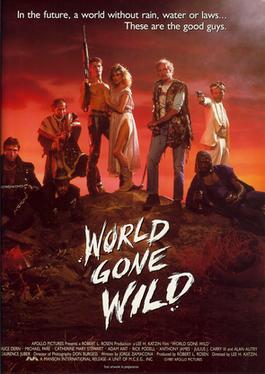
Don’t ask me. I just watched the movie and I’m not particularly sure what the point of it all was. Released in 1987, World Gone Wild is one of those films that was made to capitalize on the post-apocalypse boom of the 70s and 80s. Basically, imagine a Mad Max film that sucks and you’ll have a pretty good idea of what World Gone Wild is like.
There’s been a nuclear war. Civilization has collapsed and now, there are just tiny outposts of humanity who are trying to survive. It hasn’t rained in decades. Old-timer Ethan (Bruce Dern) is in charge of a town called Lost Wells. He remembers what rain was like and he also remembers what rock music used to sound like, too. As for Lost Wells, it’s one of those dreary little desert communities that always tend to pop up in movies like this. Angie (Catherine Mary Stewart) teaches the community’s children in an abandoned school bus. They have a bunch of books on etiquette. One little girl can recite every word ever written by Emily Post. That gets annoying fast. Emily Post didn’t live on a school bus in the desert.
That etiquette doesn’t do much good when it comes to protecting Lost Wells from Derek Abernathy (Adam Ant), a cult leader who dresses in all-white and who wants to take control of Lost Wells away from Ethan. (In a somewhat clever twist, it turns out that Ethan learned how to become a cult leader by reading a book about Charles Manson.) Knowing that the majority of the people in his town are too obsessed with Emily Post to fight off Derek and his army, Ethan recruits a group of mercenaries led by George Landon ( who is played by Michael Pare, who looks like he was absolutely miserable while shooting this movie). George and his men agree to protect Lost Wells from Derek and, in the process, they regain some of their lost humanity and they start to believe in the possibility of rain. Or something like that. Fortunately, one of George’s mercenaries is played by the supercool character actor Anthony James. He doesn’t get to do much but hey, it’s still Anthony James and Bruce Dern in the same movie! Yay!
For a film called World Gone Wild, this is a strangely low-key affair. Even the most unimpressive of Mad Max rip-offs will usually have an exciting car chase or two. At the very least, there’s usually a big battle where people sacrifice their lives for the future of humanity. In World Gone Wild, the mercenaries pretty much just go to Lost Wells and then wait for Derek to come back. And when Derek returns, there’s a few explosions and some gunfire but that’s pretty much it. Neither side really puts up much of a fight, which leads me to wonder if Derek really even cared about Lost Wells.
On the plus side, the film has got Bruce Dern, doing his wild-eyed old-timer bit. That’s always fun to watch and, if nothing else, Dern appears to be having fun in this movie. At the very least, he’s having more fun that Michael Pare and Catherine Mary Stewart, both of whom seem to spend the majority of the movie looking for a way to make a quick escape. And I suppose the film does win some novelty points for casting Adam Ant as the main villain, even though Derek ultimately turns out to be not much of a threat.
In the end, World Gone Wild‘s greatest strength is Bruce Dern. He’ll make you believe in the rain again.
This 1976 film is about a family so obnoxious that their own house tries to kill them!
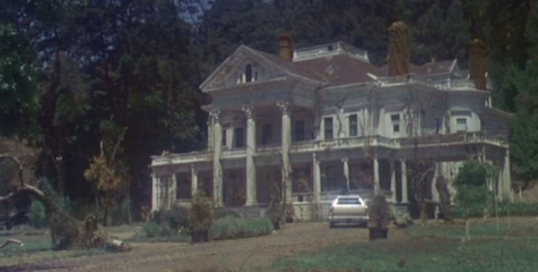
Well, maybe it’s not entirely the family’s fault. The film suggests that the house would have tried to kill anyone who lived there because the house itself is possessed by ghosts or Satan or something of that nature. Still, you can’t help but feel that the house took some extra joy out of destroying the Rolf family. I know that I got some extra joy out of watching them get destroyed.
Ben (Oliver Reed) is a writer. Ben’s wife, Marian (Karen Black), is a flake who becomes obsessed with the house as soon as she sees it. Their son 12 year-old son, Davey (Lee Montgomery), is …. well, there’s no nice way to say this. He’s a brat. He’s the type of kid who you would be terrified of your kid befriending at school because then he’d want to come hang out at your house all the time. The movie doesn’t seem to realize that he’s a brat but the audience does. And finally, Aunt Elizabeth (Bette Davis) is Bette Davis, which means that she spends most of the movie delivering her lines in the most overdramatic and arch way possible.
The Rolfs are renting the house for the summer. The owners of the house are the Allardyces (Burgess Meredith and Eileen Heckart) and you would think that people would know better than to rent a house from Burgess Meredith. I mean, how many horror films in the 70s specifically featured Meredith as some sort of emissary of the devil? The Rolfs are asked to do two things: look after the house and look after Mrs. Allardyce, who lives on the top floor and never wants to be disturbed. The Rolfs are assured that they’ll never see Mrs Allardyce and the Rolfs are like, “Sure! That makes sense!”
Anyway, as soon as the Rolfs move in, the house starts to make weird noises and shingles start flying off the roof and, at one point, Ben nearly drowns his son in the pool. And while it’s kind of understandable, considering how annoying his son is, it’s still not a good look.
Yep, it’s pretty obvious that the house is evil but Marian loves it, almost as if she’s becoming …. possessed! Meanwhile, Ben keeps having visions of a sinister looking chauffeur (Anthony James, whose creepy smile is the only memorable thing about this film) and Davey keeps standing too close to the outside chimney. You don’t want to do that when a house hates your guts.
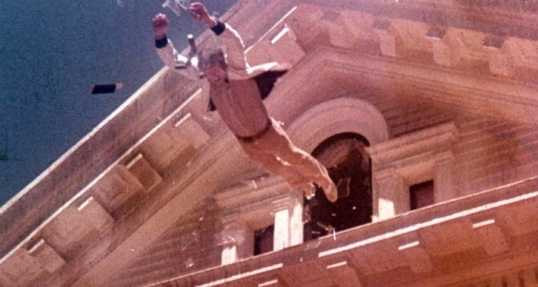
It all leads to the inevitable ending, which involves people getting tossed out of windows and *ahem* crushed by chimneys. The family’s so obnoxious that you can’t help but cheer when that chimney comes down. In fact, to be honest, as little as I think of this movie, I always specifically watch it just to see that chimney come down on one certain character. Things might not work out well for the Rolfs or anyone else watching this rather slow and predictable movie but at least the house survives.
Fly, baby, fly!
Now, I will admit that I do own this film on DVD, simply because I love the commentary track. Director Dan Curtis, star Karen Black, and the film’s screenwriter, William F. Nolan, watch and discuss the film and it quickly becomes obvious that none of them remember much about making it. While Karen Black tries to keep the peace, Curtis and Nolan bicker over who is most responsible for the parts of the film that don’t work. When Anthony James shows up as the creepy chauffeur, Dan Curtis says that he doesn’t remember his name and then gets visibly annoyed when Karen Black spends the next few minutes talking about what a good actor Anthony James is. It’s all enjoyably awkward and, as someone who has hosted her share of live tweets, I couldn’t help but sympathize with everyone’s efforts to find something positive to say about Burnt Offerings.
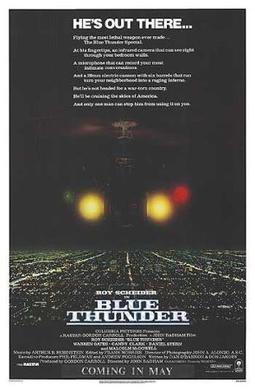
Frank Murphy (Roy Scheider) is a Vietnam vet-turned-cop who pilots a police helicopter for the LAPD. Every night, he and his partner, Richard Lymangood (Daniel Stern) fly over Los Angeles, helping to keep the peace and peeping on anyone undressing in a high-rise apartment.
Murphy is selected to serve as the test pilot for what is described as being the world’s most advanced military helicopter, Blue Thunder. Blue Thunder is so advanced that the pilot can control the gun turrets just by turning his head and it’s also been supplied with the latest state of the art surveillance equipment. The pilot of a Blue Thunder can literally spy on anyone while listening to and recording their conversations. With the Olympics coming up, the city of Los Angeles wants to test out the Blue Thunder as a way to control the crowds and prevent crime during the Games.
Murphy may be impressed by the helicopter but he has his reservations about the program. He immediately sees that Blue Thunder could be a dangerous tool in the wrong hands. Those wrong hands would belong to Col. Cochrane (Malcolm McDowell), who was Blue Thunder’s first pilot and also Murphy’s commanding officer during Vietnam. Murphy is still haunted by the atrocities that he saw committed by Cochrane during the war.
When it turns out that Murphy was right to be suspicious of Cochrane’s intentions, the movie turns into an exciting aerial chase above Los Angeles, with Murphy in Blue Thunder, trying to outrun F-16s, heat-seeking missiles, and eventually Cochrane, who enters the chase in a Blue Thunder of his own.
I’m always surprised that Blue Thunder doesn’t have a bigger following than it does. It’s an action classic, with a gritty performance from Roy Scheider, a villainous performance from Malcolm McDowell, and comedic relief from the always reliable Daniel Stern. Even Warren Oates is in the movie, playing Murphy’s LAPD commander! The script actually does have something relevant to say about the militarization of America’s police forces (and it feels downright prophetic today) and the chase scenes are all the more exciting because they were filmed in the era before CGI and have an authenticity to them that is missing from most modern action films.
Blue Thunder is a perfect example of the “don’t do this really cool thing” style of action film. The Blue Thunder helicopter is described as being a danger to everyone in the country and the movie even ends with a note saying that real-life Blue Thunders are currently being designed. But I don’t think anyone who has ever watched this film has thought, “I hope they stopped making those helicopters.” Instead, this movie makes you want to have a Blue Thunder of your very own. They’re so cool, who wouldn’t want to fly one of those things?
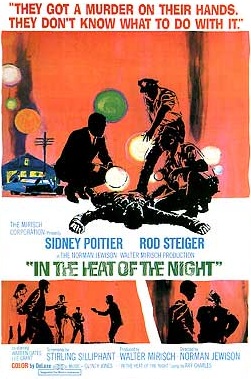
The 1967 film, In the Heat of the Night, tells the story of two very different men.
Chief Gillespie (Rod Steiger) is the police chief of the small town of Sparta, Mississippi. In many ways, Gillespie appears to the epitome of the bigoted Southern cop. He’s overweight. He loses his temper easily. He chews a lot of gum. He knows everyone in town and automatically distrusts anyone who he hasn’t seen before, especially if that person happens to be a black man or from the north.
Virgil Tibbs (Sidney Poitier) is a black man from the north. He’s a detective with the Philadelphia Police Department and he’s as cool and controlled as Gillespie is temperamental and uncouth. Tibbs has no patience for the casual racism that is epitomized by lawmen like Chief Gillespie. When Gillespie says that Virgil is a “fancy name” for a black and asks what people call Virgil in Philadelphia, Virgil declares, “They call me Mister Tibbs!,” with an authority that leaves no doubt that he expects Gillespie to do the same.
Together …. THEY SOLVE CRIMES!
For once, that old joke is correct. When a Chicago industrialist named Phillip Colbert is discover murdered in Sparta, Chief Gillespie heads up the investigation and, assuming that the murderer must be an outsider, orders Deputy Wood (Warren Oates) to check out the train station for any suspicious characters. When Wood arrives at the station, he discovers Virgil standing on the platform. Virgil is simply waiting for his train so that he can get back home to Philadelphia. However, Wood promptly arrests him. Gilespie accuses him of murdering Colbert, just to discover that Virgil’s a police detective from Philadelphia.
Though neither wants to work with the other, that’s exactly what Gillespie and Virgil are forced to do as they investigate Colbert’s murder. Colbert was planning on building a factory in Sparta and his wife (Lee Grant) makes it clear that, if Sparta wants the factory and the money that comes with it, Virgil must be kept on the case. Over the course of the investigation, Gillespie and Virgil come to a weary understanding as both of them are forced to confront their own preconceived notions about both the murder and life in Sparta. In the end, if it’s impossible for them to truly become friends, they do develop a weary respect for each other. That is perhaps the best that one could have hoped for in 1967.
I have to admit that it took me a few viewings before I really appreciated In the Heat of the Night. Though this film won the Oscar for Best Picture of 1967, it’s always suffered when compared to some of the films that it beat. One can certainly see that the film was superior to Doctor Dolittle and Guess Who’s Coming to Dinner. But was it a better film than The Graduate or Bonnie and Clyde? Did Rod Steiger really deserve to win Best Actor over Dustin Hoffman and Warren Beatty? (Amazingly, Poitier wasn’t even nominated.)
To be honest, I still feel that In The Heat of the Night was probably the 3rd best of the 5 films nominated that year, superior to the condescending Guess Who’s Coming To Dinner but nowhere near as groundbreaking as Bonnie and Clyde or The Graduate. The first time I watched In the Heat of the Night, I thought Steiger blustered a bit too much and the film’s central mystery didn’t really hold together and, to a large extent, I still feel like that.
But, at the same time, there’s a lot to appreciate about In the Heat of the Night. On subsequent viewings, I came to better appreciate the way that director Norman Jewison, editor Hal Ashby, and cinematographer Haskwell Wexler created and maintained an atmosphere that was so thick that you can literally feel the Mississippi humidity while watching the film. I came to appreciate the supporting cast, especially Warren Oates, Lee Grant, Scott Wilson, Anthony James, and Larry Gates. (Gates especially makes an impression in his one scene, playing an outwardly genteel racist who nearly cries when Tibbs reacts to his slap by slapping him back.) I also came to appreciate the fact that, while the white cop/black cop partnership has subsequently become a bit of a cliche, it was new and even controversial concept in 1967.
And finally, I came to better appreciate Sidney Poitier’s performance as Virgil. Poitier underplays Virgil, giving a performance of tightly controlled rage. While Steiger yells his way through the film, Poitier emphasizes that Virgil is always thinking. As in the same year’s Guess Who’s Coming To Dinner, Poitier plays a dignified character but, here, that dignity is Virgil’s way of defying the demands and expectations of men like Gillespie. When Virgil does strike back, it’s a cathartic moment because we understand how many times he’s had to hold back.
In the Heat of the Night may not have been the best film of 1967 but it’s still one worth watching.
An hour ago, I told you about the only Oscar nomination that was ever received by Crown International Pictures, one of the most prolific B-movie distributors of the 70s and 80s. That nomination was for Best Original Song for Crown’s 1972 film, The Stepmother.
Here are 6 more films from Crown International Pictures that I think deserved some Oscar consideration:
“She corrupted the youthful morality of the entire school!” the poster screamed but actually, The Teacher was a surprisingly sensitive coming-of-age story about a relationship between a younger man and an older woman. Jay North and Angel Tompkins both give excellent performances and Anthony James shows why he was one of the busiest character actors of the 70s.
John Savage has been acting for several decades. He’s appeared in a number of acclaimed films but he’s never received an Oscar nomination. One of his best performances was in this melancholy look at love, betrayal, and ennui in the early 70s.
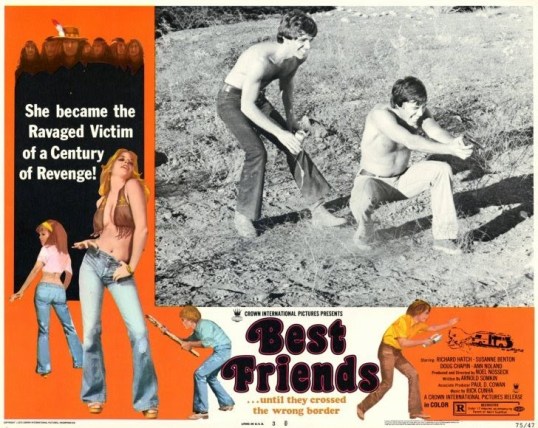
One of the strangest films ever released by Crown International, Best Friends is also one of the best. A road trip between two old friends goes terribly wrong when one of the friends turns out to be a total psycho. This well-acted and rather sad film definitely deserves to be better-known than it is.
Don’t Answer The Phone is not a particularly good movie but it certainly is effective. It made me want to go out and get a derringer or some other cute little gun that I could carry in my purse. That’s largely because of the performance of Nicholas Worth. Worth plays one of the most perverse and frightening murderers of all time and Worth throws himself into the role. It’s one of the best psycho performances of all time and certainly worthy of a Best Supporting Actor nomination.
 Frank Drebin is back!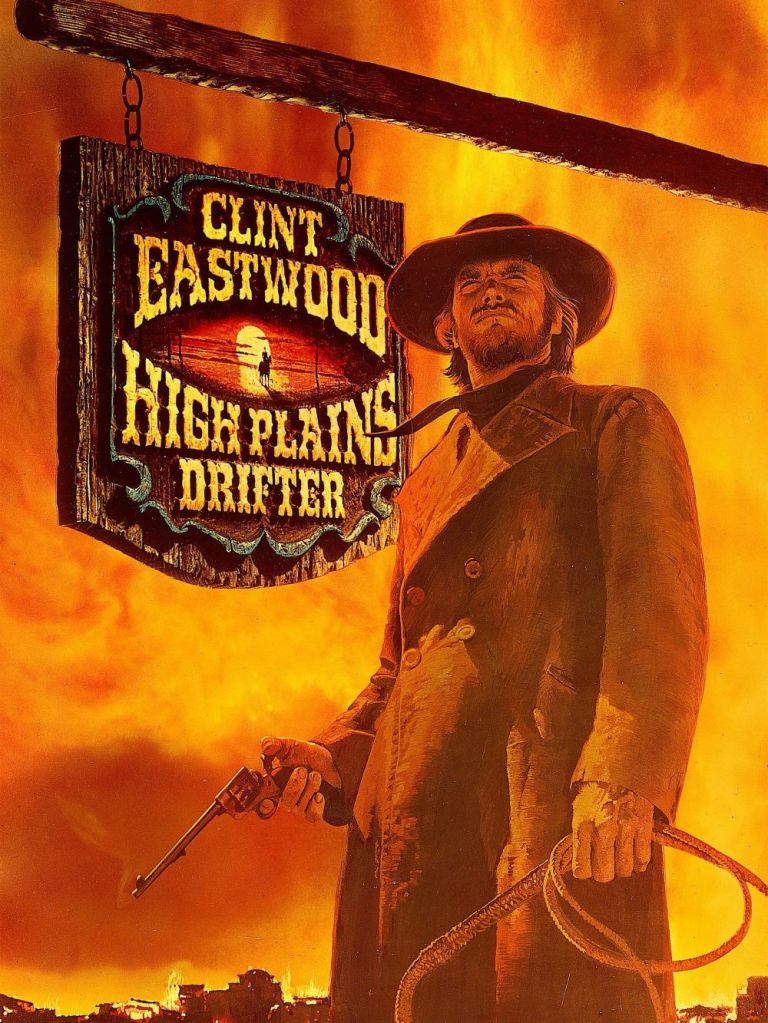


 Through the Shattered Lens