Music Film Review: Tommy (dir by Ken Russell)


“Tommy, can you hear me?”

That’s a question that’s asked frequently in the 1975 film, Tommy.  An adaptation of the famous rock opera by the Who (though Pete Townshend apparently felt that the film’s vision was more director Ken Russell’s than anything that he had meant to say), Tommy tells the story of a “deaf, dumb, and blind kid” who grows up to play a mean pinball and then become a cult leader.  Why pinball?  Who knows?  Townshend’s the one who wrote Pinball Wizard but Ken Russell is the one who decided to have Elton John sing it while wearing giant platform shoes.

Tommy opens, like so many British films of the 70s, with the blitz.  With London in ruins, Captain Walker (the almost beatifically handsome Robert Powell) leaves his wife behind as he fights for his country.  When Walker is believed to be dead, Nora (Ann-Margaret) takes Tommy to a holiday camp run by Frank (Oliver Reed).  Oliver Reed might not be the first person you would expect to see in a musical and it is true that he wasn’t much of a singer.  However, it’s also true that he was Oliver Reed and, as such, he was impossible to look away from.  Even his tuneless warbling is somehow charmingly dangerous.  Nora falls for Frank but — uh oh! — Captain Walker’s not dead.  When the scarred captain surprises Frank in bed with Nora, Frank hits him over the head and kills him.  Young Tommy witnesses the crime and is told that he didn’t see anything and he didn’t hear anything and that he’s not going to say anything.

And so, as played by Roger Daltrey, Tommy grows up to be “deaf, dumb, and blind.”  Various cures — from drugs to religion to therapy — are pursued to no avail.  As the Acid Queen, Tina Turner sings and dances as if she’s stealing Tommy’s soul.  As the Therapist, Jack Nicholson is all smarmy charm as he gently croons to Ann-Margaret.  Eric Clapton performs in front of a statue of Marilyn Monroe.  Ann-Margaret dances in a pool of beans and chocolate and rides a phallic shaped pillow. As for Tommy, he eventually becomes the Pinball Wizard and also a new age messiah.  But it turns out that his new followers are just as destructive as the people who exploited him when he was younger.   It’s very much a Ken Russell film, full of imagery that is shocking and occasionally campy but always memorable.

I love Tommy.  It’s just so over-the-top and absurd that there’s no way you can ignore it.  Ann-Margaret sings and dances as if the fate of the world depends upon it while Oliver Reed drinks and glowers with the type of dangerous charisma that makes it clear why he was apparently seriously considered as Sean Connery’s replacement in the roles of James Bond.  As every scene is surreal and every line of dialogue is sung, it’s probably easy to read too much into the film.  It could very well be Ken Russell’s commentary on the New Age movement and the dangers of false messiahs.  It could also just be that Ken Russell enjoyed confusing people and 1975 was a year when directors could still get away with doing that.  With each subsequent viewing of Tommy, I become more convinced that some of the film’s most enigmatic moments are just Russell having a bit of fun.  The scenes of Tommy running underwater are so crudely put together that you can’t help but feel that Russell was having a laugh at the expense of people looking for some sort of deeper meaning in Tommy’s journey.  In the end, Tommy is a true masterpiece of pop art, an explosion of style and mystery.

Tommy may seem like a strange film for me to review in October.  It’s not a horror film, though it does contain elements of the genre, from the scarred face of the returned to Captain Walker to the Acid Queen sequence to a memorable side story that features a singer who looks like a junior Frankenstein.  To me, though, Tommy is a great Halloween film.  Halloween is about costumes and Tommy is ultimately about the costumes that people wear and the personas that they assume as they go through their lives.  Oliver Reed goes from wearing the polo shirt of a holiday camp owner to the monocle of a tycoon to the drab jumpsuits of a communist cult leader.  Ann-Margaret’s wardrobe is literally a character of its own.  Everyone in the film is looking for meaning and identity and the ultimate message (if there is one) appears to be that the search never ends.

 

Film Review: Carnal Knowledge (dir by Mike Nichols)


First released in 1971, Carnal Knowledge is the story of two friends, Jonathan (Jack Nicholson) and Sandy (Art Garfunkel).

Jonathan and Sandy meet in the late 40s, when they’re both assigned to be roommates at Amherst College.  They’re both smart, handsome, and obviously from well-off families.  They both believe that they have a wonderful future ahead of them and why shouldn’t they?  World War II is over.  America is the leader of the world and Jonathan and Sandy both appear to be future leaders of America.  Sandy is shy and sensitive.  When he meets Susan (Candice Bergen), he struggles to talk to her and when they date, he doesn’t know how far he should go with her.  (When he tells Jonathan about getting a hand job from her, it’s obvious that Sandy didn’t previously realize such a thing was possible.)  Jonathan, on the other hand, is confident and aggressive.  He can be a braggart and he can be insensitive but there’s something undeniably attractive about someone who knows what he wants and is determined to get it.  Soon, Susan finds herself torn between the two roommates, though Sandy is clueless that Jonathan is even interested in her.

Carnal Knowledge is divided into three separate parts, each taking place in a different decade and each shot in its own individual style.  (The film was written by playwright Jules Feiffer and the script does very much feel like a three-act play.)  As a character, Susan disappears after the first act but her relationship with Jonathan and Sandy haunts every bit of the second and third acts.  By the end of the film, Sandy is no longer sensitive and Jonathan is no longer virile and one can’t help but feel that Susan, wherever she may be, is definitely better off without either one of them.

The second act is dominated by Jonathan’s relationship with Bobbie, played by Ann-Margaret.  Bobbie is beautiful and heart-breakingly insecure.  Her relationship with Jonathan starts with a dash of romance and then quickly becomes a trap for both of them.  Jonathan is not ready (or mature enough) to settle down.  Bobbie is desperate for him to marry her and willing to go to extremes to make that happen.  The scenes where Jonathan and Bobbie fight are some of the most powerful in the film, with both Nicholson and Ann-Margaret giving the viewer raw and honest portrayals of two insecure people who are totally wrong for each other but also incapable of getting away from each other.

By the time the third act comes around, Jonathan has been reduced to paranoid ruminations about “ball-breakers” and can only get it up when he’s feeling like he’s the one in power.  (Rita Moreno has a cameo as a very patient prostitute.)  Meanwhile, middle-aged Sandy is dating an 18 year-old (Carol Kane) and clearly trying to live the free-spirited youth that he never had.  Who is more pathetic?  Jonathan, who bitterly realizes he’s never going to be young again, or Sandy, who is trying to deny the fact that he’s getting older?

Carnal Knowledge is a dark film and indeed, it sometimes feels like it’s a bit too dark for its own good.  Even the worst people occasionally have a laugh.  The script is full of sharp lines and the characters are interesting, even if they are for the most part unlikable.  Still, there’s a staginess to the film’s narrative and director Mike Nichols never quite breaks free from it.  That said, I still highly recommend this film.  Not only is it a portrait of a culture-in-transition but it also features some wonderful performances, especially from Ann-Margaret and Jack Nicholson.  (In most ways, Jonathan is definitely worse than Sandy but we still have more sympathy for Jonathan because Jack Nicholson is a considerably better actor than Art Garfunkel.)  Ann-Margaret honestly portrays the heart-breaking insecurity that comes from being repeatedly told that you have nothing but your looks to offer.  Meanwhile, Nicholson throws himself into playing the charismatic but immature Jonathan.  We may not like Jonathan but we do, in the end, understand why he’s become the person that he has.  It takes a certain amount of courage to play a character like Jonathan and, in this film, Nicholson shows every bit of that courage.

A Scene That I Love: Jack Nicholson Sings In Tommy


Today’s scene that I love comes from 1975’s Tommy.  Based on The Who’s rock opera and directed by Ken Russell, Tommy featured several actors who weren’t necessarily known as singers.  Oliver Reed is the most obvious example.

And then there’s Jack Nicholson!  Jack’s role is pretty small.  He’s the therapist who examines Tommy and who eye flirts with Ann-Margaret.  And, of course, he gets his check.

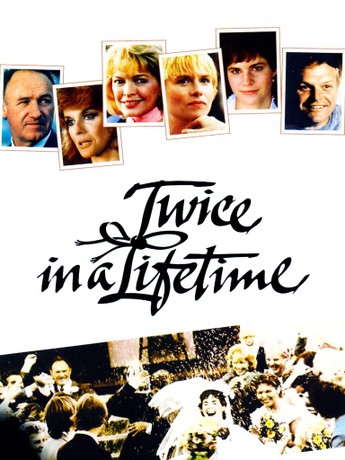
Twice In A Lifetime (1985, dir by Bud Yorkin)


Today, for obvious and tragic reasons, people everywhere have been thinking about their favorite Gene Hackman performances.  Hackman was an actor who always brought his all, even when he was appearing in a lesser film.  I think you could ask five different people for their five favorite Hackman performances and they would all give five different answers.  His performance as Lex Luthor in Superman and Superman II has always been one of my favorites.  Others will undoubtedly cite his award-winning performance as Popeye Doyle in The French Connection or his great work as Norman Dale in Hoosiers or his work in classic neo-noirs like The Conversation and Night Moves.  Let’s not forget his most unexpectedly great turn, as the blind man in Young Frankenstein.  Hackman gave so many great performances that some of them were for films that are not even remembered today.

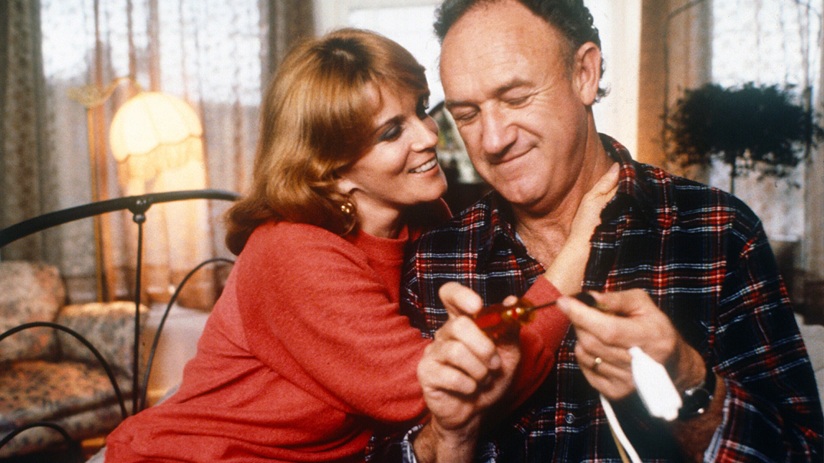
Twice In A Lifetime is one of those forgotten films but I think it features one of Hackman’s best performances.  He plays Harry Mackenzie, a steelworker who is married to Kate (Ellen Burstyn, made up to look frumpy) and who has two daughters (Amy Madigan and Ally Sheedy).  Harry is the type of everyman that Hackman excelled at playing.  He’s a hard worker, a good family man, and a good friend.  What no one, not even Harry realizes, is that he’s also having a midlife crisis.  On his 50th birthday, he goes out to the neighborhood bar with his buddies and falls for the new barmaid, Audrey (Ann-Margaret).  Harry ends up leaving his wife for Audrey, pursuing the spark that his marriage no longer gives him.  The movie follows Harry and Kate and their daughters as they adjust to their new lives and they plan for the younger daughter’s wedding.

Twice In A Lifetime was one of many 80s films that dealt with divorce and it has the same flaws that afflicted many of them.  These films, which were often made by middle-aged directors who had just gone through their own divorces, rarely played fair when it came to depicting why the marriage failed.  Twice In A Lifetime stacks the odds in Harry’s favor just by suggesting that Ann-Margaret would end up working at a bar frequented by steelworkers.  Harry has to choose between his plain and boring wife and Ann-Margaret.  That’s going to be a difficult choice!  The twist that Harry’s decision was ultimately the right thing for Kate doesn’t feel earned.

But damn if Gene Hackman isn’t great in this film.  Even though he was one of the most recognizable actors in the movie, Hackman is totally believable as both a steelworker and a man who worries that he’s destroyed his family.  It’s not just one moment or scene that makes this a great performance.  It’s the entire performance as a whole, with Hackman portraying all of Harry’s conflicted emotions both before and after leaving his family.  Hackman gives a performance that is more honest than the film’s script or direction.  The movie believes Harry did the right thing but Hackman shows us that Harry himself isn’t so sure.  Hackman captures the middle-aged malaise of a man wondering if his life is as good as it gets.  When the movie works, it is almost totally due to the emotional authenticity of Hackman’s performance.  Twice in a Lifetime may be a forgotten film but it’s also proof of how great an actor Gene Hackman really was.  There will never be another one like him.

Horror Film Review: Magic (dir by Richard Attenborough)


There have been many disturbing ventriloquist’s dummies over the years but I don’t know if there’s ever been one who is quite as hateful as Fats, the dummy that is used by Corky Withers (Anthony Hopkins).

Corky and Fats are at the center of the 1978 film, Magic.  When we first meet Corky, he’s an aspiring magician without a dummy.  He’s a talented magician and it’s obvious that performing is one of the only things that brings Corky happiness.  But, from the start, there’s something off about Corky.  There’s a desperation to him and his performance.  He craves the applause of the audience just a bit too much, as if he doesn’t know who he is unless people are clapping for him.  (This performance, from a youngish Anthony Hopkins, is quite a contrast to the characters that Hopkins is today known for playing.)  Corky is told that he needs to get a “gimmick” if he’s ever going to be a success and that gimmick turns out to be Fats, a ventriloquist dummy who is as confident as Corky is insecure.  Whereas Corky often seems to be struggling to find the right thing to say, Fats always has the perfect comeback ready.

Of course, Fats is Corky.  Fats is the self-absorbed and cocky “person” that Corky wishes he could be.  When Fats tells Corky that he’s a useless loser, it’s actually Corky saying that to himself.  When Corky argues with Fats, he’s arguing with himself.  With Fats, Corky has found a way to express himself but he’s also sacrificed half of his identity as a result.  Can Corky survive without Fats?  He’s not sure but he does know that Fats is a hit with audiences.

When Corky’s agent (Burgess Meredith) announces that he has gotten Corky a network television special, Corky panics.  Corky doesn’t want to take the medical or mental exams that the network would probably require before giving him a contract.  He flees to the Catskills, where he grew up.  (Corky’s obsession with performing makes sense when one realizes that he grew up in the Catskills, a region that played home to many aspiring comedians.)

Corky visits Peggy Ann Snow (Ann-Margaret), with whom Corky went to high school and who he had a huge crush on.  (Imagining Anthony Hopkins in high school — especially an American high school — is not particularly easy.)  Peggy is unhappily married to Duke (Ed Lauter) and she soon finds herself falling in love with Corky.  Corky appears to finally have a chance for happiness but Fats has other plans.  Murder follows and it says something about how well this film is done that we think of Fats as being the mastermind behind the murders even though we know that Fats is really just Corky talking to himself.

Magic is the definitive evil ventriloquist’s dummy film, one that is beautifully shot by Richard Attenborough and which features a great performance from Anthony Hopkins.  It’s a sign of the strength of his performance that we still feel sorry for Corky, even though he ends up killing one of the most likable characters in the film.  Of course, it’s a dual performance for Hopkins because he’s playing both Corky and Fats.  He is excellent and frightening in both roles.

The TSL’s Grindhouse: C.C. and Company (dir by Seymour Robbie)


As our long-time readers know, I’ve seen my share of bad movies but it’s been a while since I’ve seen one as bad as 1970’s C.C. and Company.

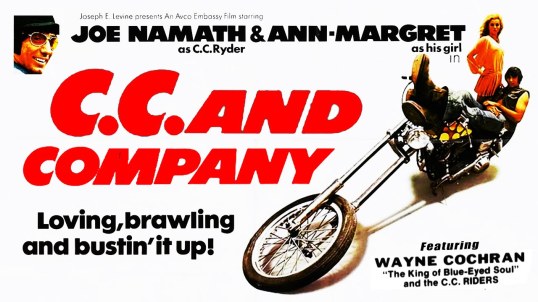
C.C. and Company is about a drifter named C.C. Ryder (played by Joe Namath, who was a pro football quarterback at the time).  Ryder rides through the desert on his dorky motorcycle.  He doesn’t have a job.  He doesn’t have much money.  He does have a lot of hair and he also has a lot of teeth.  We know that because it’s rare that there’s ever moment when C.C. isn’t smiling.  C.C. is perhaps the most cheerful amateur criminal that I’ve ever seen.  Even when C.C. really shouldn’t be smiling, he’s smiling.  There are moments when people try to kill C.C. and he responds with a smile.  This could be a sign of C.C.’s devil-may-care-attitude but I think it has more to do with Joe Namath being a really bad actor.

C.C. is apparently a member of a motorcycle gang.  I say apparently because no one in the gang seems to like him and they’re constantly beating up on him.  The leader of the gang is Moon (William Smith) and among the members of the gang is an intimidating figure named Crow (Sid Haig).  Smith and Haig were both professional actors and genuine tough guys.  They not only knew how to act on camera but they also knew how to throw a punch without faking it.  Having them act opposite Namath doesn’t really accomplish much beyond emphasizing just how terrible an actor Namath was.  Even though Moon is a Mansonesque creep, you still find yourself rooting for him whenever he and C.C. get into a fight because Smith creates an actual character whereas Namath…. well, he doesn’t.  I sat through this entire film and never once did I find myself wondering what C.C.’s initials stood for.  That’s how uninterested I was in C.C.’s life.

Anyway, C.C. meets the wealthy and chic Ann McCalley (Ann-Margaret) after Ann’s limo breaks down in the middle of the desert.  C.C. not only fixes the limo but he also saves Ann from Crow and Lizard (Greg Mullaney).  It’s love at first sight but, unfortunately, Ann has places to go so she drives off and C.C. returns to the biker camp and watches as Moon sends his girlfriend, Pom Pom (Jennifer Billingsley), out to make money on the highway.  As I watched all of this, I found myself wondering how everyone else in the gang got stuck with names like Moon, Lizard, Crow, Rabbit, Pom Pom, and Zit-Zit (my favorite) but somehow C.C. was able to keep his innocent initials.  The movie never explained the ritual behind receiving motorcycle gang names and I think that was a missed opportunity.

Eventually, C.C. trades in his dorky motorcycle for a Kawasaki, largely because Kawasaki apparently paid the film’s producers a lot of money.  C.C. enters a race and wins.  Ann sees him win and falls even more in love with him.  C.C. gets into a fight with the gang and then he and Ann head to …. well, it looked a lot like Reno but honestly, who knows for sure?  Eventually, Moon and the gang track C.C. and Ann down and it all leads to one last fight.  We never do find out if the “company” of the title referred to Ann and her rich friends or Moon and the gang.  Not even C.C. seems to know for sure.

So, there’s a lot of reasons why C.C. and Company doesn’t really work but mostly it all comes down to the lead non-performance of Joe Namath as C.C.  There’s nothing tough or intimidating or rebellious about Namath.  C.C. is the biker you can bring home to meet your parents.  William Smith and Sid Haig are a lot more fun but they’re playing totally disreputable characters.  Namath and Ann-Margaret have zero romantic chemistry and the entire film has the look of a cheap made-for-TV movie.  Between C.C. and Company and Altamont, 1970 was not a good year to be a biker groupie.

That said, there is one good scene in C.C. and Company, where C.C. and Ann go out dancing.  While Joe Namath awkwardly shakes his shoulders while flashing that ever-present grin, Ann-Margaret dances as if the fate of the world depended upon her.  One year after the release of this movie, she would prove herself as dramatic actress and receive her first Oscar nomination for Carnal Knowledge.

Any Given Sunday (1999, directed by Oliver Stone)


With Any Given Sunday, Oliver Stone set out to make the ultimate football movie and he succeeded.

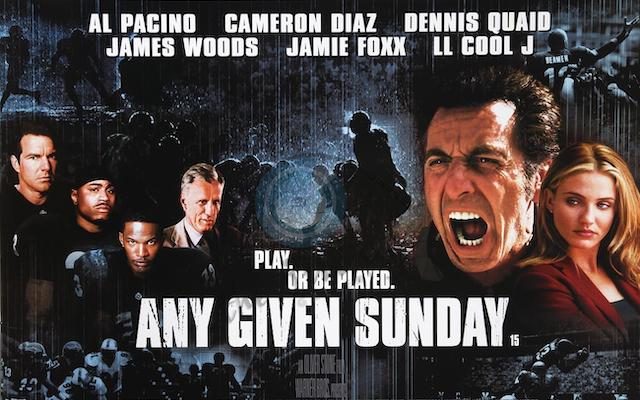
Any Given Sunday is not just the story of aging coach Tony D’Amato (Al Pacino).  It’s also the story of how third-string quarterback Willie Beamon (Jamie Foxx) allows celebrity to go to his head while the injured starter, Cap Rooney (Dennis Quaid), deals with his own mortality and how, at 38, he is now over-the-hill.  It’s also about how the team doctors (represented by James Woods and Matthew Modine) are complicit in pushing the players beyond their limits and how the owners (Cameron Diaz) view those players as a commodity to be traded and toyed with.  It’s about how the Sharks represent their home city of Miami and how cynical columnists (John C. McGinley plays a character that is obviously meant to be Jim Rome) deliberately set out to inflame the anger of the team’s fans.  It’s about how politicians (Clifton Davis plays Miami’s mayor and asks everyone to “give me some love”) use professional sports to further their own corrupt careers while the often immature men who play the game are elevated into role models by the press.  It’s a film that compares football players to ancient gladiators while also showing how the game has become big business.  In typical Oliver Stone fashion, it tries to take on every aspect of football while also saying something about America as well.

In the role on Tony D, Pacino famously describes football as being “a game of inches” but you wouldn’t always know it from the way that Oliver Stone directs Any Given Sunday.  As a director, Stone has never been one to only gain an inch when he could instead grab an entire mile.  (Stone is probably the type of Madden player who attempts to have his quarterback go back and throw a hail mary on every single play.)  Tony tells his players to be methodical but Stone directs in a fashion that is sloppy, self-indulgent, and always entertaining to watch.  One minute, Al Pacino and Jim Brown are talking about how much the game has changed and the next minute, LL Cool J is doing cocaine off of a groupie’s breast while images of turn-of-the-century football players flash on the screen.  No sooner has Jamie Foxx delivered an impassioned speech about the lack of black coaches in the league then he’s suddenly starring in his own music video and singing about how “Steamin’ Willie Beamon” leaves all the ladies “creamin’.”  (It rhymes, that’s the important thing.)  When Tony invites Willie over to his house, scenes of Charlton Heston in Ben-Hur are on TV.  Later in the movie, Heston shows up as the Commissioner and says, about Cameron Diaz, “she would eat her young.”

Any Given Sunday is Oliver Stone at both his best and his worst.  The script is overwritten and overstuffed with every possible sports cliché  but the football scenes are some of the most exciting that have ever been filmed.  Only Oliver Stone could get away with both opening the film with a quote from Vince Lombardi and then having a player literally lose an eye during the big game.  Stone himself appears in the commentator’s both, saying, “I think he may have hurt his eye,” while the doctor’s in the end zone scoop up the the torn out eyeball and put it into a plastic bag.  Only Stone could get away with Jamie Foxx vomiting on the field during every game and then making amazing plays while a combination of rap, heavy metal, and techno roars in the background.  Stone regulars like James Woods and John C. McGinely make valuable appearances and while Woods may be playing a villain, he’s the only person in the film willing to call out the coaches, the players, the owners, and the fans at home as being a bunch of hypocrites.  Stone’s direction is as hyper-kinetic as always but he still has no fear of stopping the action so that Foxx can see sepia-toned images of football’s past staring at him from the stands.  Stone directs like defensive lineman on steroids, barreling his way through every obstacle to take down his target.  No matter what, the game goes on.

Any Given Sunday is the ultimate football movie and more fun than the last ten super bowls combined.

A Movie A Day #316: 52 Pick-Up (1986, directed by John Frankenheimer)


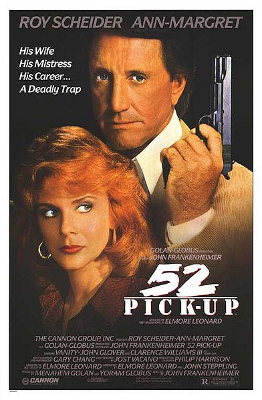
Harry Mitchell (Roy Scheider) is a businessman who has money, a beautiful wife named Barbara (Ann-Margaret), a sexy mistress named Cini (Kelly Preston), and a shitload of trouble.  He is approached by Alan Raimey (John Glover) and informed that there is a sex tape of him and his mistress.  Alan demands $105,000 to destroy the tape.  When Harry refuses to pay, Alan and his partners (Clarence Williams III and Robert Trebor) show up with a new tape, this one framing Harry for the murder of Cini.  They also make a new demand: $105,000 a year or else they will release the tape.  Can Harry beat Alan at his own game without harming his wife’s political ambitions?
Based on a novel by the great Elmore Leonard and directed by John Frankenheimer, 52 Pick-Up is one of the best films to ever come out of the Cannon Film Group.  Though it may not be as well-known as some of his other films (like The Manchurian Candidate, Seconds, Black Sunday, and Ronin), 52 Pick-Up shows why Frankenheimer was considered to be one of the masters of the thriller genre.  52 Pick-Up is a stylish, fast-paced, and violent thriller.  John Glover is memorably sleazy as the repellent Alan and the often underrated Roy Scheider does an excellent job of portraying Harry as a man who starts out smugly complacent and then becomes increasingly desperate as the story play out.

One final note: This movie was actually Cannon’s second attempt to turn Elmore Leonard’s novel to the big screen.  The first attempt was The Ambassador, which ultimately had little to do with Leonard’s original story.  Avoid The Ambassador but see 52 Pick-Up.

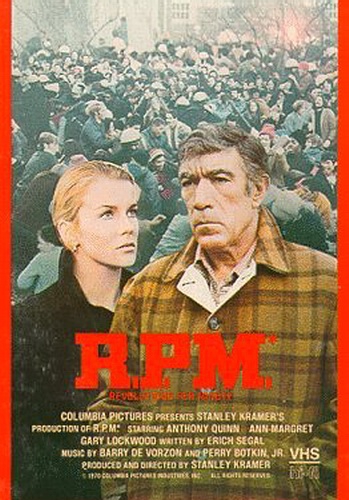
Lisa Goes Back To College: R.P.M. (dir by Stanley Kramer)


RPM

For my next return-to-college film, I ended up watching R.P.M.  Like both Getting Straight and Zabriskie Point, R.P.M. was released in 1970 and deals with political unrest on campus.

Directed by Stanley Kramer (who also gave us such respectable and middlebrow liberal films as Guess Who’s Coming To Dinner and Judgment at Nuremberg), R.P.M. takes place at prestigious college.  Students radicals led by Rossiter (Gary Lockwood) and Dempsey (Paul Winfield) have taken over a building on campus.  When the university’s president goes to confront the students, one of them yells out, “Buzz off!”  Well, you know how sensitive college presidents are.  He quickly resigns his post and the students demand that he be replaced either by Che Guevara, Eldridge Cleaver, or Paco Perez.

Unfortunately, Guevara is dead and Cleaver is in Algeria.  Fortunately, left-wing sociology professor Paco Perez (Anthony Quinn) is available and he just happens to teach on campus!  Perez is named interim president of the college.  Now, Perez has to bring peace to the campus, despite the fact that the protestors now see him as a sell-out because he accepted the position. Perez also has to deal with nonstop snarky comments from his girlfriend, a grad student named Rhoda (played by Ann-Margaret).

Especially when compared to Getting Straight and Zabriskie Point, R.P.M. is something of a forgotten film.  I haven’t found many reviews online and the majority of them mostly seem to focus on the fact that the film is dated and that director Stanley Kramer’s portrayal of the student protestors is incredibly negative.  And, in many ways, those criticisms are perfectly valid.  And yet, with all that in mind, I still loved R.P.M.  Of the three 1970 campus protest films that I watched last weekend, R.P.M. was my personal favorite.

Why do I so love R.P.M?

Well, let’s check out some of the dialogue.

When Paco first comes to see the protestors, one girl literally sings, “Look what the revolution dragged in!”

Later, another demonstrator is heard to philosophically ask, “Why is the good ass never radical and the radical ass never good?”  (And that’s certainly a question that was asked by everyone who drove by Occupy Dallas back in 2011.)

About the college administration, one girl announces, “They’ve got empty scrotes!”

When Paco tells Dempsey that the college is finally going to hire a black admissions offer, Dempsey replies, “How black?  Is this cat an oreo cookie?  Is he related to my uncle Tom?”

When Paco asks how long it will take for the protestors to peacefully leave the building, one of them loudly announces, “It would take to the 12th of never!”  Of course, everyone applauds.

And that’s not counting all of the times that random protestors say, “Right on!”

But even better than listening to the protestors is listening to Paco and Rhoda discuss their relationship.

When Rhoda tells Paco that she knows the real him because she sees him without his pajamas, Paco replies, “That’s not reality.  That’s flab.”  With a world-weary sigh, Rhoda replies, “Flab is reality.”

When Paco complains about Rhoda’s cooking, she sensibly tells him, “Next semester, hump a home economics major.”  Paco replies, “I did.  The food is great but the talk is lousy.”

After being taunted by a student, Paco asks Rhoda, “Did you tell the kids I was a lousy lay?”  Rhoda laughs and replies, “I may have thought it but I never said it!”

Finally, in one heart-warming scene, Paco informs Rhoda that, “The whole campus calls you Paco’s Pillow.”

Seriously, how can you not love a movie with dialogue this overwritten and over-the-top?  It’s obvious the Kramer and screenwriter Erich Segal were desperate to sound hip and contemporary and, as a result, nobody speaks like a normal person.  Instead, listening to R.P.M. is a bit like listening to a party to which every 60s stereotype has been invited.

And yet, it’s not just the dated dialogue that causes me to love R.P.M.  As opposed to the histrionic Getting Straight and the artistically detached Zabriskie Point, R.P.M. is an attempt to seriously deal with the issue of student protest.  For every three moments that ring false, there’s one that works and that’s a lot more than most films about campus unrest can say.  Anthony Quinn gives a good performance as a man who doesn’t realize quite how complacent he has become.  He and Gary Lockwood have a wonderfully tense scene together where they sincerely and intelligent debate their different worldviews.  It’s the best scene in the film and one that is so well-done that it excuses any previous missteps.

R.P.M. occasionally shows up on TCM.  Keep an eye out for it.

Antony Quinn and Ann-Margaret