I gotta admit, of everyone here, I am definitely the guiding light when it comes to anime. This doesn’t mean that I watch everything and my word is gospel (Ok, my word is always gospel, because I said so) but I do watch a decent amount of every year’s offerings, in the realm of 1/4 to 1/2 of everything that’s been released (but since there’s been 180 titles released this year alone, and I can manage to watch at the most 20 shows a season if I’m super diligent, which anyone here will admit I’m not) the best I can do is 80 shows. So it’s always possible that something has fallen through the cracks. But, I like to believe that I have a good finger on the pulse of things that are good. Hence, while I’ve long heard the cry for Re:ZeroHonestly, I hated the protagonist to death (anyone that’s watched the show sees what I did there) and I cannot in good faith pick that show as my favorite for the year. But if not this show, then whom? Yes, there have been multiple shows that are worthy of a high ranking.
Could I have gone with another highly rated show, Erased?
Well, since I’ve brought it up right now, everyone should know that no, this isn’t my top show. But, let me say that it was high on my list. The thing about anime is that shows that appear in the fall and winter seasons tend to be much more highly ranked because they are much more recent in the otaku consciousness. The fact that a show like Erased, which premiered in the winter of 2016, has managed to keep itself in my otaku brain, speaks volumes for it. However, as much as I loved this show, it still is not #1 for the year in my expert mind.
Frankly, I could lead you, the viewer, on through many, many more shows, and honestly you’d be better off knowing about them, but really, that’s just not my style. The last two shows I told you about are ones that I felt everyone reading this blog should experience, whether you’re a fan of anime or not. Anime fans will have watched all these shows and then some, because that’s what us otaku do. But for the otaku crowd, who may or may not have been reading this far to see what I think is the creme de la creme, my vote goes, without a doubt, to KonoSuba, or as it’s known in its full name, as Kono Subarashii Sekai ni Shukufuku o!
See, the thing about this show is, it has everything that a proper otaku loves, and it knows it. It’s a complete parody of the whole “Loser otaku gets transported to a fantasy world and manages to kick ass while he’s there” trope, but it still manages to play it off and make it fun. Totally different from Re:Zero, where the protagonist is flawed, to the point you hate his guts and want him dead. In KonoSuba, the protagonist is certainly flawed, but in a way that’s completely believable, yet hilarious. While with Re:Zero, naturally you can look at the situation and agree that, yes, if you or I were put in that situation, we’d likely behave in a very similar way, Konosuba instead says “To hell with realism, isn’t this how you’d want to act?” And the thing is, the vast majority of us don’t want actual realism in our anime. We want escapist fantasy. KonoSuba gives us that in spades. It’s a total parody of the whole “loser dropped into the fantasy world” premise that so many of us desire, without getting into the more realistic aspects that Re:Zero provides, like the fact that the loser dropped into the fantasy setting will remain a loser.
Again, let me tell you, this list is completely subjective. If you follow my god-like opinions, then KonoSuba is the obvious choice for Anime of the Year in 2016. However, if you’re a heretic, and would rather listen to the words that the godless believers would spout, then by all means, check out Re:Zero. It’s probably better than I plan on listing it, because I cannot stand the kind of protagonist they give us, but maybe you, the readers, have a lot more tolerance than I do.
Anime has been called many things by fans and detractors. It’s been called imaginative and disturbing. Some have called them hilariously inventive while others have called them horribly perverted. One thing it has never been described and accused of is being boring and bland. One could hate every type of anime ever created and most such people would still describe it as anything but boring.
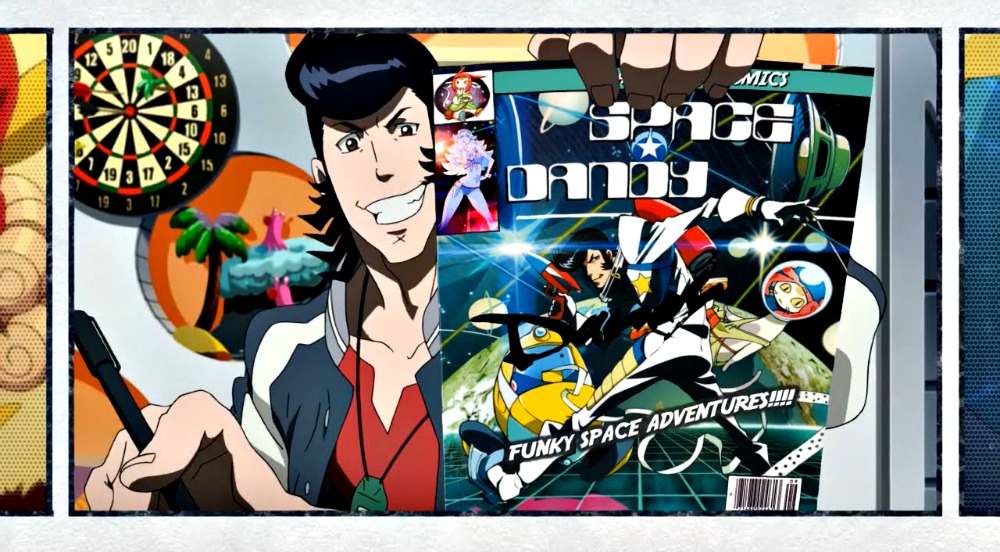
One such anime that fits the bill of being wildly imaginative is the series Space Dandy. If one was to describe it in non-anime terms then I could say it’s a space opera series that’s somewhat like the redheaded stepchild of Guardians of the Galaxy and Johnny Bravo who is then high on mushrooms and LSD.
The latest “AMV of the Day” was created by Shin and he makes perfect use of the Mark Ronson and Bruno Mars song “Uptown Funk”. The song doesn’t just fit the over-the-top lunacy of the chosen anime, but Shin also manages to use some complex video-editing magic to make it like the video was a comic book.
The song itself has been a staple for kitten videos where the little furballs will seemingly dance to the beat of the song. Now there’s another reason to listen to it and this AMV is one such reason.
Anime:Space Dandy
Song:“Uptown Funk” by Mark Ronson (feat. Bruno Mars)
It’s been quite a bit since I last picked an AMV to use as an example of why anime is such a collaborative piece of creative art.
The latest “AMV of the Day” splices together just the right scenes from three anime. There’s the classic Mamoru Hosada scifi/slice-of-life anime film The Girl Who Leapt Through Time. Then there’s the more recent and well-received 5 Centimeters Per Second by Makoto Shinkai. Lastly, there’s the Tatsuyuki Nagai directed series Ano Hana.
Binding all three together is the song “Clarity” (also happens to be the title of the video) by the group Zed.
It’s a video that focuses on the three anime’s and it’s use of heightened reality as a storytelling tool. In the end, I also happen to just love the work done by caramelloxify on this video.
Anime:The Girl Who Leapt Through Time, 5 Centimeters Per Second, Ano Hana
Latest “Song of the Day” comes from episode 11 of the ecchi anime series Binbougami ga! and comes at the very end. It’s simply called the “Song of Fanservice”. It’s a very brief song but one that goes straight to the point. It has been picked up by fans of the fanservice as the anthem that best describes why ecchi anime series are so beloved by many anime fans worldwide.
So, with this brief detour from all things horror, I present to you “Song of Fanservice” from Binbougami ga! and let your fanservice flag fly.
Hello again all you followers of TTSL. I could do my usual introduction of why I haven’t posted in forever, and reminder of who I am, blah blah, but for today, let’s forgo that and let me talk about an anime that I personally think is the best anime to come out in the past year. Depending on where you watched it, you’ll know it as either Gakkou Gurashi, or School Live.
To everyone that read any sort of synopsis for this anime, you all had an inkling of what to expect. But for those of use who read it months in advance and promptly forgot, episode 1 was a total shocker. Essentially all you have to know is that Yuki is batshit insane, or rather she’s in complete denial mode, and everything else makes a lot of sense. I try to avoid spoilers as much as I can here at TTSL, but as I said before, the very synopsis gives this part away, so let me be blunt. There are four girls basically battling for their lives in a zombie apocalypse in a school that was designed for that very purpose. Yes, in a very short time we are given the facts that the school they’re living in has solar panels to give them electricity, and water purifiers to give them fresh water from the ground, or as long as electricity remains, purified water from their waste. Hence the solar panels.
Now, these are not the kind of zombies that one would normally expect, no, rather these are Land of the Dead type zombies, where the zombies have some kind of idea as to the kinds of lives they lived before they turned. So since we’re all Land of the Dead mode, naturally the zombies here are choosing to remain at school, since that’s the most natural thing for them to do.
First thing that must be remembered is that Yuki is a nut job. Yes, she’s Miss Crazy Girl. Me harping on that is a minor spoiler, but only one that would last beyond episode 2. In most every zombie apocalypse, there’s at least one person who is going to deny it as long as they can. In this case, that is Yuki. She thinks she’s in school like normal and that everything is fine. We very easily find out in the first episode that that is not the case. We’re in full blown zombie apocalypse time, and most of the girls in the group know it and accept that fact.
Still, the fact that you know that I know that you know that we all know the full outcome of this, doesn’t change the fact that the girls here are trying their best to live a somewhat normal life. Yes, their school is abnormally stocked (it’s explained), and yes 3 out of 4 girls are very ready to accept this (not as well explained as the previous one), but who cares? This is one of the rare examples of cute girls doing cute things during a zombie apocalypse that kind of actually works. To all us zombie survivalists, does everything these girls do work out? Hell no. But, can we think that for the time being that maybe we could accept that they’d live as long as they did? Sure, why not? Because at the end of the day, we all want to hope that there are cute waifus waiting for us when 99% of humanity are shambling hordes. And really, isn’t that what we’re all hoping for? Well, I sure am, and if you’re not, then don’t come running to me when you’re bitten and turning. In fact, you’re not gonna come running to me, because the running zombie is nothing more than a Hollywood invention.
The latest AMV of the Day comes courtesy of one of my favorite amv creators. Vivifx created this particular video almost 5 years ago.
“Gravity” is a beautiful video and really does a great job pairing Sara Bereilles’ song “Gravity” with the more lovely and bittersweet emotions that brings up the relationship between Ahiru (Princess Tutu) and ballet dancer Mytho. It’s just one aspect of the the Princess Tutu anime, but one that show’s the animated series’ very mature storytelling.
I still find it amusing that when I mention anime to the uninitiated they look at me funny. They still think it’s just cutesy cartoons from Japan that only cater children or just cartoon porn (hentai). Producers of anime do make them for kids, but they also understand that kids have enough mental and emotional capacity within themselves to handle some of the mature themes and ideas being told through the very cutesy animation presented to them.
I wrote a couple years ago that one such anime that people should be watching is the series Princess Tutu and this video just reinforces that recommendation even more. When paired up with another AMV of the Day (Danse de Raven) that also uses the Princess Tutu series as a foundation it should more than make some curious to check out the anime.
I know Lisa will appreciate that it’s a video that doesn’t just have dancing, but ballet…
I can’t say that any entertainment franchise has given me more cause to think than Ghost in the Shell. It presents a mid-21st century post-apocalyptic earth in which society has more or less stabilized. Events revolve around Public Security Section 9, a counter-terrorism agency focused on investigating cyberterrorism, which is rather interesting because the original manga by Masamune Shirow launched in 1989, before cyberterrorism actually existed (or the modern internet, for that matter). Throughout their investigations, the team deals with the social and philosophical issues that arise in an age where society is fully integrated across a world-wide network and technology has been integrated directly into the body, rendering people intimately vulnerable to hacks and computer viruses.
I am as guilty as most of having never read the original manga. I became acquainted with Shirow’s world through Ghost in the Shell (1995) and Ghost in the Shell 2: Innocence (2004), both directed by Mamoru Oshii, and the 2002 anime series Ghost in the Shell: Stand Alone Complex, by Kenji Kamiyama. While the two directors take rather different aesthetic approaches–the movies present Section 9 as a harsh, disenchanted unit in a somewhat dystopian world, whereas the television series is lively and a bit cartoonish–both remain dedicated to questioning the impact of highly integrated technology.
Stand Alone Complex lies much closer to the root of my music series, because some of the key issues it tackles have since arisen online in the real world. Everyone is well familiar with the use of V for Vendetta-styled Guy Fawkes masks in protests originating from the internet, but there is a decent chance you have also caught a glimpse of an odd blue smiley face among the rabble. The Laughing Man image originates from Stand Alone Complex, where it functions as a mask employed anonymously by individuals taking public action independently of each other. At first, an advocate for social justice uses it to disguise himself while committing a ‘terrorist’ act, but the image quickly overreaches his motives. Others commit unrelated political sabotage under the guise. Corporations employ it to discredit their competitors. Pranksters use it as a sort of meme, forming the shape with chairs on a rooftop and cutting it into a field as a crop circle, for instance. The image has no concrete meaning, and everyone who uses it essentially ‘stands alone’, but the public perceive the Laughing Man as a single individual.
The actual anime gives a fairly shallow interpretation of this. The creator of the image, Aoi, explains that he never intended the mask to become a social phenomenon, and that its arbitrary usage dislodged the image from its original meaning. He sums this up by asking “Who knew that copies could still be produced despite the absence of an originator?” The ‘profoundness’ of this ties back to a long history of bad philosophy which assumes that signs have universal objective meaning in some sort of fundamental way which mystically transcends subjectivity of the mind. Basically, certain Greek ideas saw a resurgence of popularity in the late 19th and early 20th centuries, probably as a consequence of high society’s fascination with antiquities at the time. The plethora of ready-at-hand counterexamples to these archaic notions provided easy meat for countless grad students to earn their PhDs, so long as they did not throw the baby out with the bath water and ruin the game for everybody else.
But I digress. While the intended idea behind “Stand Alone Complex” is a bit naive, the Laughing Man does represent a unique sort of game that can only be played in the information age. To the public, the Laughing Man was a single individual, or at most a closely coordinated group, but the participants knew better. They knew that there was no real ‘Laughing Man’, but their independent actions were performed under the expectation that they would be written into ‘his’ public profile. The game was exclusive; you had to be aware of the mask in order to dawn it. The game also had rules; an action totally out of line with the Laughing Man’s pattern of behavior would be perceived as a fraud. (You could not, for instance, reveal the truth behind the Laughing Man.) By playing, you added a little piece of yourself to the puzzle, and it might slowly assimilate you in turn.
Ghost in the Shell has remained a uniquely relevant franchise in science fiction because it got so many ideas right. In 1989, at a time when internet was still a novelty of college libraries, the manga offered a world of total connectivity, where every human and device belonged to a global network. In 2002, Stand Alone Complex introduced the Laughing Man, and shortly afterwards the real world knew an equivalent. Whether this bodes well for the franchise’s dabblings into cyborg technology, only time can tell, but history has certainly made an inherently fascinating fictional world all the more compelling. In the Ghost in the Shell universe, science has fully bridged the gap between computers and neural systems, allowing electronic implants to directly convert wireless digital information into stimuli compatible with the senses. The average citizen possesses visual augmentations which allow them to directly browse the internet via voice command. More complex technology delves deeper, creating a sort of sixth sense whereby users can engage a network through thought command. Some individuals, especially accident victims with the means to afford it, might have their entire bodies replaced by neurally triggered machine components.
The 1995 Ghost in the Shell film gets especially creative in tackling this–enough that it became the chief inspiration for The Matrix four years later. It revolves around brain-mapping technology and its implications regarding sentience and identity. From the start of the film, the ability to copy and read brain data appears to be common. Presumably, these digital copies would remain stagnant until encoded back into a neural network, but as the government develops better software for interpreting and editing the massive content at its disposal, funny things start to happen. The software gains a sort of temporary sentience while performing its complex tasks, and eventually it uploads itself to a cyborg body in an act of self-preservation. This new entity possesses the capacity to read other augmented brains and incorporate them into its internal network. At least, that is how I’ve interpreted it. The movie does leave a lot to the imagination. Perhaps it is recycled from earlier science fiction, and far-fetched besides–I wouldn’t really know–but Ghost in the Shell presents it all as if it were right around the corner, not lost in a distant galaxy of Star Trek.
Ghost in the Shell is so steeped in ideas that it’s a wonder I don’t forget it is a collection of animations, not a book series. Stand Alone Complex is presented as rather typical–and relatively forgettable–anime, but the 1995 movie definitely denies dismissal. It is a real work of art. The city is dirty and a bit washed-out without feeling downright destitute; the masses still lead normal lives. Emptiness expands upward; the characters are perpetually surrounded by massive, sort of dusty-looking structures that feel vacant despite signs of life. The music is simultaneously vast and minimalistic. Generally, the artistic direction projects a feeling that the protagonists are isolated–cut off from the massive world surrounding them–perhaps by the knowledge they possess.
The score Kenji Kawai (川井憲次) crafted for Ghost in the Shell ranks among the best soundtracks I’ve ever encountered. Without it, the film might easily unravel. The plot really does take a lot of creative liberties. What amount of entertainment value could convince people to open up their brains to potential hacking? Or, if they are doing it to maintain memory backups, why is a brain hack so devastating? Can’t you just resume from your last save? Why would a hacker go to the trouble of replacing an entire memory system in the first place, if they could just encode an impulse into an existing one? To these questions, I say “shhhh!”, because Kawai has so utterly convinced me that my cyborg brain will be shipping in from Japan any day now. The music shrouds the film in imminent mystery. It is a moment of quiet awe, before the very foundations of human experience become uprooted and replaced by a higher state of computer-enhanced perception.
‘Interesting’ nerd note on Kawai: while the majority of his discography appears in anime and film, he is credited with arranging the TurboGrafx-16 port of Sorcerian, one of Yuzo Koshiro and Takahito Abe’s better 1980s NEC PC-8801 projects. I am pretty excited to dig that one up. Aren’t you? …Bueller?
If you are looking for a careful plot showcasing the new challenges of a technologically advanced, post-apocalyptic earth, then Katsuhiro Otomo’s 1988 classic Akira is not a great option. The film does not try to raise any questions, the story is vague, and it revolves around characters who are empowered supernaturally, not enhanced through technology. Akira‘s legacy lies in its music, art, and shock value.
Set in a dystopian Neo-Tokyo in 2019, 31 years after the ubiquitous cataclysm uproots every tenet of modern society, Akira displays a violent, futuristic world where law and order amounts to little more than brute force. The military police force is ruthless. Suspects are executed in public spaces with no concern for who might get caught in the cross-fire. When protests turn to riots, machine guns and tanks bulldoze down all opposition to the state. In one memorable scene, a group of protesters is bombarded with tear gas, and a choking helpless civilian staggers into an unclouded space that happens to be occupied by a policeman. After a moment’s pause, he blasts him in the stomach with a smoke grenade at point blank range. The incessant violence permeates everything. Within the first ten minutes, the hero, Kaneda, has murdered a half dozen members of a rival gang for entering his turf. The antagonist, Tetsuo, while certainly not evil, does not think twice about slaughtering the millenarian following attracted to his psychic powers.
Akira keeps you attentive with an endless escalation of weirdness and destruction. At every turn, events outpace your expectations, culminating in a transformation sequence that is not even worth trying to explain. I suppose it does raise one question, and only one: “What the fuck did I just watch?” It only works, though, because the art is so distinct that it leaves little to the imagination. Akira is a visual tour through everything that the most dystopian, vulgar cyberpunk city is supposed to be.
The soundtrack, composed by Tsutomu Ōhashi of Geinoh Yamashirogumi (芸能山城組), is inescapable throughout the film. It’s a bit of a counterbalance to the grim, futuristic visuals, relying heavily on Japanese and Indonesian traditional instrumentation and avant-garde vocals. It focuses more on capturing Akira‘s supernatural side, both in style and in strangeness. The opening track, “Kaneda”, does this while racing full speed into the heart of a towering metropolis.
I’ve been remiss about posting the winners of the Sakura-Con 2015 AMV Contest. This particular video won the “Fun” category and it’s a production from one of my favorite AMV creators, IleaiAMVs.
“Another Fanny Service Video” is a short, but to the point AMV that combines not just the romance-comedy anime series Kemeko Deluxke! but also the Jason Derulo song “Wiggle.” It’s a pairing made to order and just goes to show that an AMV doesn’t have to use an epic length song (though nothing bad about those).
Ileai has always been very using timed edits to her chosen song to tell the particular story her video are trying to tell. Whether the original intent of the anime being used comes across doesn’t matter. She could take a super serious anime and turn it hilarious through clever editing and the correct choice of music. This time around this video doesn’t stray too far from the comedic aspect of the anime Kemeko Deluxe! and instead highlights the ecchi sequences from the series.
The video has already won several AMV Contest awards reaching back to last year and all accolades Ileai’s way have been well-deserved.