I don’t know if we fully recognize all the sacrifices parents make for their kids. A person takes on ownership of a whole little being (be it through birth, adoption or the Cat Distribution System) and somehow tries their best to keep it fed, protected, educated and loved, all while still trying to figure out their own lives. It doesn’t always work out. Some parents evade the responsibility, leaving their kids to horrible fates, while others rise to the challenge, often without fully knowing what they need to do. They’re not perfect, but parents can be pretty awesome at times, especially the ones who didn’t have to do the job.
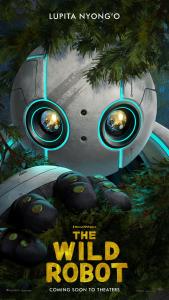
Dreamworks The Wild Robot may very well be the best Animated Feature this year. Nothing against Disney/Pixar’s Inside Out 2 (which was also wonderful) or Flow (which looks wonderful and took the Golden Globe for Best Animated Feature), but I spent a good part of this film sniffling. It’s a very simple, yet sweet story that moves at a very rapid pace. That’s understandable, given that it’s for children, but the story is accessible for just about any adult.
When a robot named Roz (Lupita N’yongo, A Quiet Place: Day One) crash lands in a forest, she studies her environment and tries to get to know the local habitat. The animals are naturally fearful of Roz, but she eventually begins to understand their dialects. While trying to phone home, Roz runs into some raccoon thieves and a rather large bear. The resulting chase causes her to accidentally crash into and destroy a goose nest, save for one egg. When the egg hatches, she finds herself having to take on a parent role for the gosling, though she’s not fully alone. Helping Roz out is a fox named Fink (Pedro Pascal, Gladiator II), who lives by his wits and provides some wildlife know-how for survival, while keeping himself well fed. Also along to assist is Pinktail, a possum who has a litter of her own to handle. As she adjusts to her new sense of motherhood, Roz meets tons of other animals that warm up to her. She finds a new task in taking care of Brightbill (Kit Connor, Ready Player One) and preparing him to fly South for the winter.
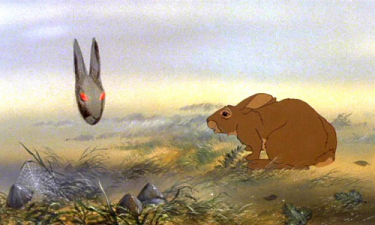
Directed by Chris Sanders (How to Train Your Dragon, Lilo & Stitch), The Wild Robot has elements for both kids and adults. The wilderness is a dangerous place, and the Circle of Life is rougher here than it ever was in Disney’s The Lion King (which Sanders also had a hand in). There are predators and prey, and the audience is made to understand this pretty quickly (though not as harshly as say, Watership Down). There’s a great deal of tenderness as well, focusing on Storytelling (which Roz learns), the friends and family we make along the way and some hardship in the way that Brightbill suffers some insensibilities with from other geese that he doesn’t quite fit in with.
I feel The Wild Robot‘s strongest points are the music and the art direction. The film looks like an actual watercolor painting, especially when viewed in the largest format possible. The pacing for the plot moved a little quicker than I expected, particularly in the lead up to meeting Brightbill. Musically, Kris Bowers (Netflix’s Bridgerton, The Haunted Mansion) has a great soundtrack that adds some weight to the scenes. With Trent Reznor and Atticus Ross out of the running for Challengers, Bowers is my hopeful pick for the Best Soundtrack Oscar.
At the time of this writing, The Wild Robot is available to watch on Universal’s Peacock service. Just make sure you bring a box of tissues and if at all possible, call or thank your Mom afterwards.
I absolutely love Love Death + Robots! Since the first Volume aired, I’ve been hooked on this series, which is produced by David Fincher. It feels like a mix between The Animatrix and MTV’s Liquid Television (which spawned Aeon Flux). I’ve been a bit out of the mix, so I forgot this was in production. Nine new short animated pieces using various styles will air when Vol 3 drops May 20, exclusively on Netflix.
I can’t quite remember how I found out about 1988’s Who Framed Roger Rabbit. Growing up, most of my movie news came from four major sources – Entertainment Tonight, Siskel & Ebert, the occasional movie poster you’d see at a bus stop or cinema. If you were really lucky, the production company would sometimes create a “Behind the Scenes”/”Making of” showcase a little after the movie premiered. If possible, I would read the billing block of a poster to see if I could recognize anyone familiar, Just seeing Amblin Entertainment meant you’d have Steven Spielberg, Kathleen Kennedy and Frank Marshall involved. Nothing new there. I knew Robert Zemeckis and Alan Silvestri from Romancing the Stone and Back to the Future. Movies have had mixes of animation and live action – Bedrooms & Broomsticks, Mary Poppins, etc., but the big buzz here was the film planned to somehow involve both the Disney and Warner Bros. animation studios. It was an alien concept for me, because they couldn’t be more different from each other. Historically, animation on the WB side of things were edgy and almost dared to be even raunchy if they could get away with it. Disney, on the other hand, was pristine and extremely kid friendly. Bugs Bunny and Mickey Mouse? Daffy Duck vs. Donald Duck, all on the same screen? It was the 1980’s equivalent of asking Marvel (which ironically, is owned by Disney now) and DC (which the WB has owned for decades) to write a single Justice League / Avengers crossover story.
At the time, Steven Spielberg was already well known for blockbusters like the Indiana Jones films and E.T., but did he really have enough clout to bring two major companies together like that? It blew my 13 year old mind and I became completely obsessed.
Around the time Who Framed Roger Rabbit came out, I picked up anything I could find about it. I had Alan Silvestri’s soundtrack, a poster, a stuffed Roger doll, and the video game when it came out. I even read Gary Wolf’s novel. I begged my parents to let me see it, and it was one of the rare times where my Mom took my sis and I to the movies instead of my dad (the major movie buff, who took us to see Robocop twice the year before). I think she went in part to shut me up, and to give herself a break from my nearly 2 year old brother. It remains one of the two best movie related memories I have of her.
In the world of Who Framed Roger Rabbit, humans and cartoons share the same space in Los Angeles. Cartoons live in Toontown, owned by Marvin Acme (Stubby Kaye). It’s the story of Eddie Valiant (Bob Hoskins – Hook, Mermaids), a Los Angeles Private Eye with a bit of a grudge against toons. For a quick buck, Valiant is hired by R.K. Maroon (Alan Tilvern – Firefox, Little Shop of Horrors) to snoop on Acme. Valiant’s work puts him in the path of Roger Rabbit (Charles Fleischer, Back to the Future Part II), after Eddie takes some racy pictures of Acme playing patty cake with Roger’s wife, Jessica (Kathleen Turner, Romancing the Stone). Roger angrily swears they’re still a happy couple and that Acme somehow coerced her before running off into the night. The next morning, Eddie is informed that the Marvin Acme’s been killed overnight. To make things worse, Acme’s Will is missing, leaving the fate of Toontown up in the air. All of the evidence points to Roger, but Roger asks for Eddie’s assistance in clearing his name. Can Eddie save Roger before Judge Doom (Christopher Lloyd, Back to the Future) and his pack of weasels get their hands on him?
The production for the film required jumping over a number of hurdles. Zemeckis, himself a cartoon fan, wanted to bring some of the Warner Bros. characters along with Disney characters. Even better, he also wanted to add some of Tex Avery’s classic style to the film. Similar to what he did with Ready Player One, Spielberg negotiated with some of the studios, and while he couldn’t get everyone, he did manage to get Disney, WB and a few others to commit. With this in place, they had to somehow merge animation with live-action in a way that made it look like the cartoons were interacting with their environment.
This would require one really huge magic trick, made up from an assortment of parts.
Since it was around 1986-1987, there really was no CG, yet.. James Cameron made 6 stuntmen in Alien suits look like 600 through the use of Oscar Winning Editing, and the technology that gave us the paradigm shifting dinosaurs of Jurassic Park wouldn’t occur for another 3 or 4 years. For Who Framed Roger Rabbit, the approach was a mix of robotics, puppetry, sleight of hand gadgetry, and a lot of imagination.
The art was handled by Richard Williams and his team, who would go on to win a Special Achievement Oscar for his contribution to the film. They had to draw every cell/frame by hand, on paper and then have them inked. These would then go to Industrial Light & Magic, who would add shadow, highlights and special effects To make things harder, the artists had to work around Zemeckis’ filming style and figure out how to fit the characters into each scene.
Take Jessica Rabbit’s performance of “Why Don’t You Do Right?”, sung by Amy Irving (Carrie, The Fury). At first glance, it seems a really easy shot. Girl steps on the stage, performs and leaves, right? However, there are so many things happening here on an effects level that I still don’t fully understand how they did it after all these years. ILM handled the lighting, from the sparkles in the dress, the use of the handkerchief and the great moment where Jessica blocks the spotlight in her walk from Acme to Valiant. I had to later explain to my mom that the “Wow” I whispered in the theatre during that scene had little or nothing to do with puberty. It was because I hadn’t seen anything like that before with a cartoon, and I’d hate the Academy forever if the movie didn’t win an Oscar for that.
Having cartoons on screen is one thing, but making it feel like they were interacting with people is another. Hoskins was the anchor that tied most of it all together. Having to work with nearly nothing – not even a green screen – and perform the physical actions required of the role was quite a feat compared to what some actors do with the motion capture rooms and digital walls we use today. Near lifesize models of Roger were created to help Hoskins handle some of the physical “grab and move” sequences, and actor Charles Fleischer actually spent time dressed as Roger on set (but off camera, of course) to feed his side of the conversation to Hoskins when filming a scene.
Puppeteers were brought on for moments were toon characters needed to hold objects, such as guns or knives. There is a moment of the movie where you can see one of the holes for the guns that the weasels, but it’s a pretty minute hiccup with all of the great work that was done. For the car sequences with Benny the Cab (also Fleischer), they used a special mini-car with a driver in the back. The car and driver were painted over (still, frame for frame) by the animators.
And ff course, it wouldn’t be a Zemeckis film without Alan Silvestri at the helm, musically speaking. Silvestri’s score for was a mix of detective noir and cartoony antics, which made for a perfect fit for the film. Overall, Who Framed Roger Rabbit is one of those films I cherished growing up, and it’s almost impossible for me to avoid recommending it.
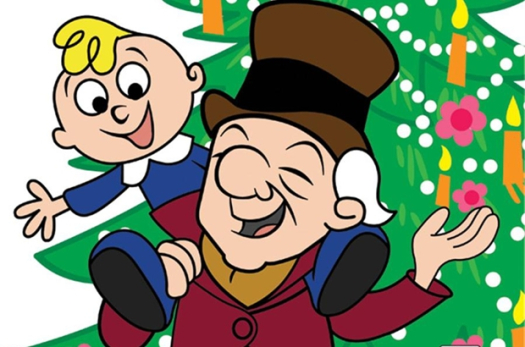
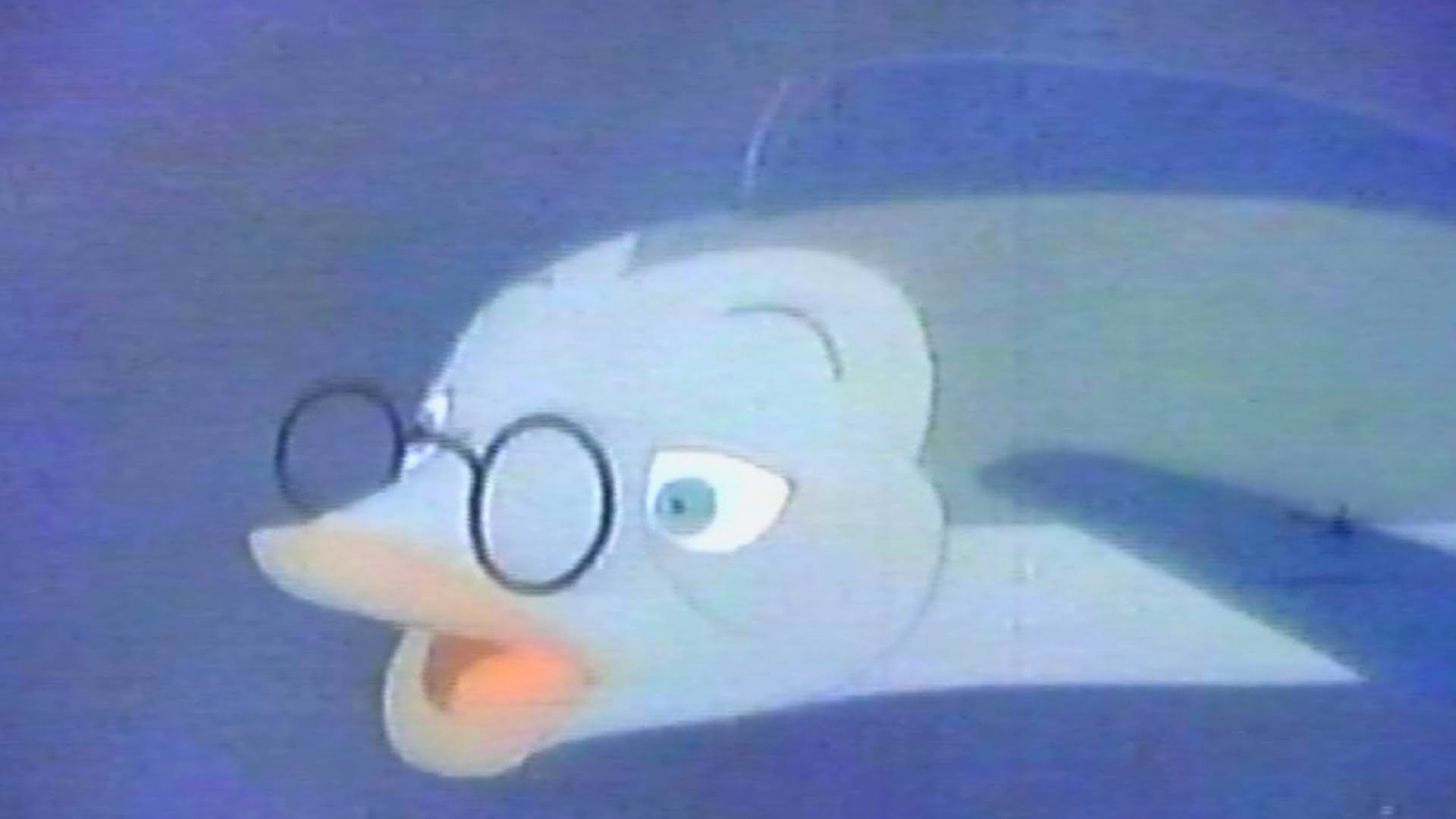
Before Rudolph, Charlie Brown, and The Grinch, nearsighted cartoon star Mr. Magoo (voiced by Jim Backus ) headlined the first animated Christmas special, MR. MAGOO’S CHRISTMAS CAROL. First broadcast on NBC-TV in 1962, the special is presented as a Broadway musical, with Magoo as Ebeneezer Scrooge. Directed by Chuck Jones acolyte Abe Levitow , it features songs by Jule Styne and Bob Merrill (FUNNY GIRL), and a voice cast that includes Morey Amsterdam , Jack Cassidy , Royal Dano, Paul Frees (of course!) , Jane Kean, and Les Tremayne. And yes, that is Magoo’s fellow UPA cartoon stablemate Gerald McBoing-Boing as Tiny Tim! Besides 1938’s Reginald Owen version , this may very well be my favorite adaptation of Dickens’ Christmas classic! So here’s my Christmas gift to you all, MR. MAGOO’S CHRISTMAS CAROL in its entirety!:
Where else can you see Parisian pussycats dancing the Can-Can at the Mewlon Rouge but in GAY PURR-EE? This animated musical feature from UPA Studios was a bit more adult themed than it’s Disney counterparts, at least by 1962 standards. It’s the story of Mewsette, a country cat in 1890’s Provincial France who dreams of living the life of a big city kitty in Paris. One day she decides to chuck it all and hops on her mistress’s sister’s coach to head for the City of Lights. Her boyfriend, the mouse-catching Jaune-Tom, and his amusing little pal Robespierre, set out to find her and rescue her from the clutches of the scoundrel Meowrice, who together with Madame Rubens-Chatte plan to train Mewsette in the ways of the world and sell her off to a fat American cat.
The vocal stars of GAY PURR-EE are Robert Goulet, fresh off his Broadway success in CAMELOT, and the…
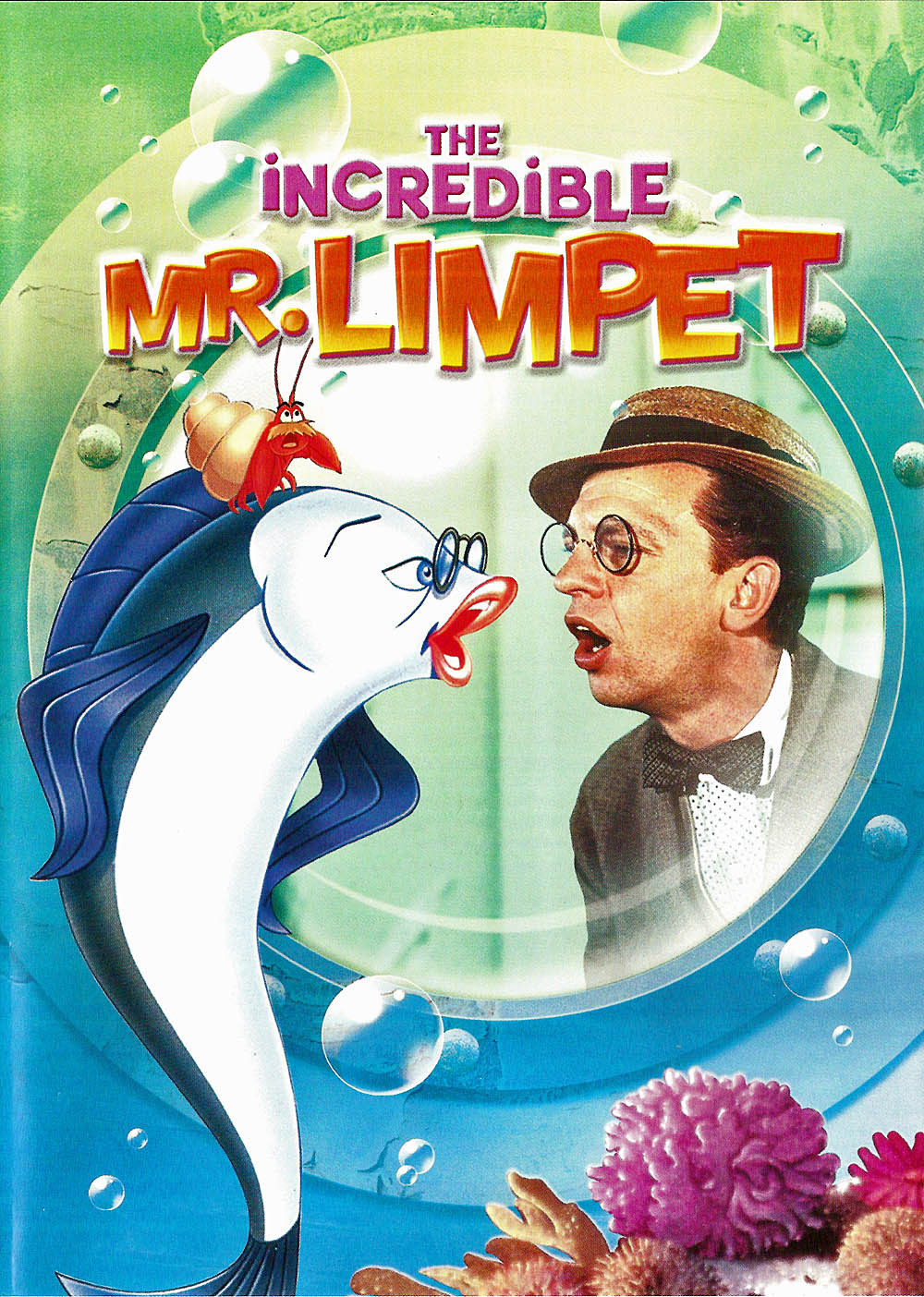
Don Knotts’ popularity as Deputy Barney Fife on TV’s THE ANDY GRIFFITH SHOW led to his first starring feature role in THE INCREDIBLE MR. LIMPET. Knotts plays milquetoast Henry Limpet, a hen-pecked hubby and military 4-F who longs to be a fish and magically gets his wish. This Disneyesque fantasy-comedy benefits greatly from Knotts’ vocal talents and the animation of “Looney Tunes” vet Robert McKimson. In fact, the whole film would’ve been better off as a complete cartoon, because the live-action segments directed by Arthur Lubin distract from the aquatic antics of Limpet as an animated fish.
Lubin was a former Universal contract director noted for five Abbott & Costello films (including their first, BUCK PRIVATES), the Francis the Talking Mule series, and TV’s MR. ED. You’d expect lots of slapstick with a resume like that, but no such luck. Instead, Knotts is put through some domestic paces with shrewish wife Carole Cook…
Brave already has a great review by Lisa Marie, check it out to get another insight into the film. One of the great things about the Shattered Lens is that even if a movie’s been reviewed once, another review can create a review as well.
Before Brave starts, Pixar presents their Oscar Nominated short film, La Luna, directed by Enrico Casarosa. La Luna is a simple piece about a little boy (Bambino) on a tiny boat who is taking on the Family Business. Sitting with his father and grandfather, they watch as a full moon rises high in the sky above them. Setting up a ladder, Bambino heads up to the moon, to find it littered with tiny glowing stars. The trio act as cleaners of the Moon. It’s a cute little story that for me, anyway, makes me smile when I look up at the Moon. I’m hoping Pixar maybe considers making a best of video with all their mini stories.
Brave is the story of Merida (brilliantly voiced by Boardwalk Empire’s Kelly MacDonald), a young princess in what appears to be Scotland, who is due to be married off to one of the children of her area’s neighboring lands. Granted, this isn’t something she’s looking forward to, as the wedding plans are being set up by her mother. Honestly, in watching Brave, I got the feeling that Merida really wasn’t into any of the Princess things she was supposed to be following (“No weapons on the table.”, “A princess is proper”, etc.), she seemed to just enjoy her freedom of being a young woman, of just living her life.
Brave marks the second film that wasn’t directed by one of the Pixar Majors (Pete Doctor of Monsters Inc., John Lassiter of Toy Story and Cars, Andrew Stanton of Wall-E, Finding Nemo and John Carter, and newcomer Brad Bird of Ratatouille and The Incredibles), the first being Toy Story 3. With all of the staff that Pixar has, it makes sense that eventually, the Pixar Babies would have to step up and try their hand at feature films – even if this means that Pixar breaks their streak of great animation and filmmaking.
If Brave is any indication, Pixar is in very good hands. Directors Brenda Chapman and Mark Andrews carry Chapman’s story far better than Lassiter did with Cars 2. It’s the story of a daughter, her mother and the connection between them. It’s of wanting to follow your own path vs. the paths that others want us to follow, and it manages to do all of this effortlessly. Like Tangled, our heroine takes charge of her own path, even if it means stumbling here and there. What makes Brave even better (and what my Mom would personally enjoy) is that Merida, much like Drew Barrymore’s character in Ever After, doesn’t need any guys rescuing her from her situation, save for perhaps one key moment that doesn’t count only because it’s family oriented anyway. There’s a great sense of strength in the character.
When Merida decides to fight for herself in an Archery test to ward off the would be suitors, she gets into a huge argument with her mother (Emma Thompson), that ends up with some harsh things being said. Merida eventually finds her way to a witch who lets her change her fate. Like Disney’s Brother Bear, the change in question is that her mother is turned into a bear. With Merida’s father (voiced by The Boondock Saints’ Billy Connolly) swearing vengeance against the black bear that took of his leg, Merida and her mother have to both keep away from him as well as fix the relationship between them or else the mother will stay a bear, forever.
This is where Brave shines. Between the communications between the Mama Bear and Merida and the gravity of their situation, Chapman creates some great emotional opportunities for them. An added touch was the notion that the longer the mother stays a bear, the more she loses her humanity and becomes a real bear. I took this to be similar to someone suffering from dementia or Alzheimer’s in a way, and that was where Pixar really got me on this one.
If there’s anything about Brave that I would change, it would be that there could have been a bit more back story on the legend that the mother told Merida (on the villain). I would have liked to know more about all of that, but in hindsight, the movie tells you all you really need to know, because the focus is still just on Merida and her Mother. There’s also just a hint of nudity, nothing terrible at all, but it’s a different route than other Pixar films have went. Additionally, kids may also find that the bear attack sequences may be a little too scary (at least the younger viewers might).
Overall, Brave’s a wonderful film and I’m ready to pick up the Blu-Ray the moment it comes out.
Since this weekend has turned into Green Lantern weekend due to the promotional blitz by Warner Brothers to hype up it’s upcoming live-action film of the same title I would be remiss not to include as part of his hype the upcoming animated film from Warner Premiere and DC Animation: Green Lantern: Emerald Knights.
This latest in DC animated films (all of which have been good to great. Not a stinker in them) is an anthology film which takes six stories of the greatest Green Lanterns and links them to the current danger threatening the Guardians (creator of the Green Lantern Corps), the GL Corps and the universe itself.
Before this weekend’s WonderCon footage for the live-action was shown I was more excited for Green Lantern: Emerald Knights than I was for the Ryan Reynolds live-action. It had a great voice cast with Nathan Fillion (fans’ first choice for live-action Hal Jordan) as Hal Jordan with Elisabeth Moss, Jason Isaacs, Kelly Hu, Henry Rollins and Steve Blum rounding out the ensemble cast.
I think with the batting average of the DC Animation being quite high I have high hopes that Green Lantern: Emerald Knights will follow in the footsteps of it’s predecessor and have critical and general success.
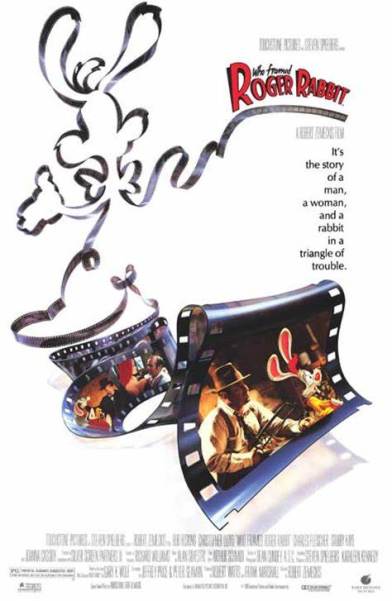 I can’t quite remember how I found out about 1988’s Who Framed Roger Rabbit. Growing up, most of my movie news came from four major sources – Entertainment Tonight, Siskel & Ebert, the occasional movie poster you’d see at a bus stop or cinema. If you were really lucky, the production company would sometimes create a “Behind the Scenes”/”Making of” showcase a little after the movie premiered. If possible, I would read the billing block of a poster to see if I could recognize anyone familiar, Just seeing Amblin Entertainment meant you’d have Steven Spielberg, Kathleen Kennedy and Frank Marshall involved. Nothing new there. I knew Robert Zemeckis and Alan Silvestri from Romancing the Stone and Back to the Future. Movies have had mixes of animation and live action – Bedrooms & Broomsticks, Mary Poppins, etc., but the big buzz here was the film planned to somehow involve both the Disney and Warner Bros. animation studios. It was an alien concept for me, because they couldn’t be more different from each other. Historically, animation on the WB side of things were edgy and almost dared to be even raunchy if they could get away with it. Disney, on the other hand, was pristine and extremely kid friendly. Bugs Bunny and Mickey Mouse? Daffy Duck vs. Donald Duck, all on the same screen? It was the 1980’s equivalent of asking Marvel (which ironically, is owned by Disney now) and DC (which the WB has owned for decades) to write a single Justice League / Avengers crossover story.




 Through the Shattered Lens