Days of Paranoia: Serpico (dir by Sidney Lumet)


In 1973’s Serpico, Al Pacino plays a cop who doesn’t look like a cop.

Indeed, that’s kind of the start of Frank Serpico’s problems.  He’s a New York cop who doesn’t fit the stereotype.  When we see him graduating from the Academy, he’s clean-shaven and wearing a standard patrolman uniform and he definitely looks like a new cop, someone who is young and enthusiastic and eager to keep the streets safe.  However, Serpico is an outsider at heart.  The rest of the cops have their homes in the suburbs, where they spend all of their time with their cop buddies and where they go also go out of their way not to actually live among the people that they police.  Serpico has an apartment in Greenwich Village and, as a plainclothes detective, he dresses like a civilian.  He has a beard.  He has long hair.  He has a succession of girlfriends who don’t have much in common with the stereotypical (and there’s that word again) cop’s wife.  Serpico is an outsider and he likes it that way.  In a world and a career that demands a certain amount of conformity, Frank Serpico is determined to do things his own way.

However, the real reason why Serpico is distrusted is because he refuses to take bribes.  While he’s willing to silently accompany his fellow officers while they collect their payoffs from not only the people that they’re supposed to be arresting but also from the storeowners that they’re meant to be protecting, Serpico refuses to take a cut.  Serpico understands that the small, everyday corruption is a way of forcing his silence.  The corruption may help the cops to bond as a unit but it also ensures that no one is going to talk.  Serpico’s refusal to take part makes him untrustworthy in the eyes of his fellow cops.

Serpico and Bob Blair (Tony Roberts), a politically-connected detective, both turn whistleblower but it turns out that getting people to listen to the truth is not as easy as Serpico thought it would be.  The Mayor’s office doesn’t want to deal with the political fallout of a police conspiracy.  Serpico finds himself growing more and more paranoid, perhaps with good reason.  When words gets out that Serpico has attempted to turn into a whistleblower, his fellow cops start to turn on him and, during a drug bust, Serpico finds himself deserted and in danger.

Serpico opens with its title character being rushed to the hospital after having been shot in the face.  This actually happened to the real Serpico as well.  What the film leaves out is that hundreds of New York cops showed up at the hospital, offering to donate blood during Serpico’s surgery.  That’s left out of the film, which at times can be more than a little heavy-handed in its portrayal of Serpico as an honest cop surrounded by nonstop corruption.  Filmed just three years after Serpico testified before New York’s Knapp Commission (which was the five-man panel assigned to investigate police corruption in the city), Serpico the movie can sometimes seem a bit too eager to idealize its title character.  (Vincent J. Cannato’s excellent look at the mayorship of John V. Lindsay, The Ungovernable City, presents far more nuanced look at the NYPD corruption scandals of the early 70s and Serpico’s role as a whistleblower.)  Director Sidney Lumet later expressed some dissatisfaction with the film and even made other films about police corruption — The Prince of the City, Q & A, Night Falls On Manhattan — that attempted to take a less heavy-handed approach to the subject.

That said, as a film, Serpico works as a thriller and as a portrait of a man who, because he refuses to compromise his ideals, finds himself isolated and paranoid.  Al Pacino, fresh from playing the tightly-controlled Michael Corleone in The Godfather, gives an intense, emotional, and charismatic performance as Serpico.  (One can see why the image of a bearded, hippie-ish Pacino was so popular in the 1970s.)  Sidney Lumet brings the streets of New York to vibrant and dangerous life and he surrounds Pacino with an excellent supporting cast, all of whom bring an authentic grit to their roles.  Serpico may not be a totally accurate piece of history but it is a good work of entertainment, one that works as a time capsule of New York in the 70s and as a portrait of bureaucratic corruption.  It’s also the film in which Al Pacino announced that he wasn’t just a good character actor.  He was also a movie star.
Late Night Retro Television Review: CHiPs 3.16 “Jailbirds”


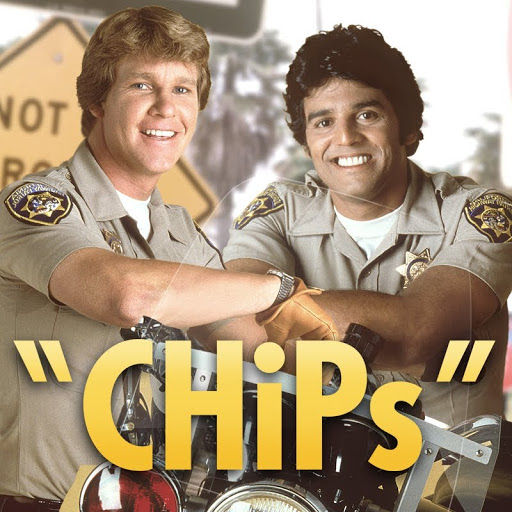
Welcome to Late Night Retro Television Reviews, a feature where we review some of our favorite and least favorite shows of the past!  On Mondays, I will be reviewing CHiPs, which ran on NBC from 1977 to 1983.  The entire show is currently streaming on Prime!

It’s a holiday week so tonight’s review is going to be a mini-review.  Let’s quickly talk about the time two highway patrolmen ended up in jail!

But first….

Episode 3.16 “Jailbirds”

(Dir by Bruce Kessler, originally aired on January 12th, 1980)

Ponch and Baker go to jail!

Actually, Baker goes to jail twice.  Ponch is only sent to jail once.  It’s all because they refuse to reveal the name of the confidential informant that allowed them get the drop on and arrest a smuggler named Nick Ferris (Ray Duke).  Getraer calls the Attorney General’s office.  Officer Turner drops by to check on Baker.  The Judge (Allan Rich) says that he sympathizes with the cops but unless they’re willing to name their informant, he’ll have to dismiss the charges and let Ferris go free due to insufficient evidence.

The idea of Ponch and Baker in jail has a lot of possibilities.  Ponch is always going on and on about how he used to be a juvenile delinquent so I was half-expecting him to run into an old friend in the holding tank.  That didn’t happen, though.  Instead, CHiPs gave us a jail that was remarkably clean, well-run, and full of friendly prisoners and nice cops.  I’ve often felt that CHiPs was essentially a commercial for Los Angeles tourism and the theme of this episode appeared to be, “L.A. …. even our jails are wonderful!”

Anyway. Getrear and the guys not in jail work to get more evidence so that they can put Ferris behind bars without revealing the name of Baker’s informant.  Good for them!  Teamwork, it’s what CHiPs is all about!

Insomnia File #39: Disclosure (dir by Barry Levinson)


What’s an Insomnia File? You know how some times you just can’t get any sleep and, at about three in the morning, you’ll find yourself watching whatever you can find on cable? This feature is all about those insomnia-inspired discoveries!

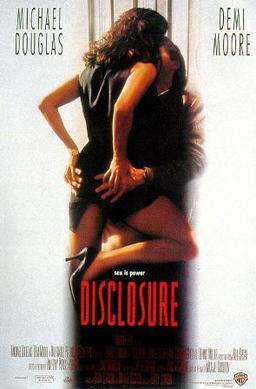
On Tuesday, if you were having trouble getting to sleep around one in the morning, you could have turned over to Cinemax and watched the 1994 film, Disclosure.

The majority of Disclosure takes place at DigiCorp, which is some sort of technology company that Bob Garvin (Donald Sutherland) founded because, as the movie explains it, he only has $100 million dollars but still dreams of being a billionaire someday.  With a huge merger approaching, Garvin announces that he will be promoting Meredith Johnson (Demi Moore) to run the new CD-ROM division.  This shocks a lot of people, as everyone was expecting the promotion to go to Tom Sanders (Michael Douglas).  However, Garvin explains that, ever since his daughter died, he’s wanted to promote a woman.

(Presumably, if a male relative had died, Tom would have gotten the promotion.  I have to admit that I kept waiting for the film to get back to the subject of Garvin’s dead daughter but, apparently, that was just an odd throw-away line.)

Tom and Meredith have a history.  They were once lovers, though Tom is now happily married to Susan (Caroline Goodall) and has a family.  Meredith takes one look at a picture of Susan and says that Tom must miss being able to take his lover from behind whenever he felt like it.  Tom says, “Mrs. Robinson,  you’re trying to seduce me.”  No, actually, he says, “No, no, no, no, no, no…..”  It all ends with Tom fleeing Meredith’s office while Meredith, in her bra, chases after him, shouting threats all the way.  The only witness to this is a cleaning lady who sadly shakes her head before returning to her dusting.

Tom is so traumatized by the experience that he has a bizarre nightmare in which Donald Sutherland says that he likes his suit and then attempts to lick his face.  Tom’s trauma continues when he goes to work the next day and discovers that Meredith has accused him of sexual harassment!  Tom responds by suing the company and it’s time for an epic courtroom battle, one that will deal with one of the most important issues of our time….

….except that never happens.  Here’s what is weird.  For all the talk about abuse of power and all the scenes of a remorseful Tom apologizing to both his wife and his secretary for his past behavior, the whole sexual harassment plot turns out to be a red herring.

Instead, the film turns into this weird techno thriller, one that involves Tom trying to figure out how to make a better CD-ROM.  That may have been a big deal back in 1994 but today, you watch the film and you think, “Who cares?”  (Even better is a scene where Garvin brags about how his company is on the cutting edge of fax technology.)  Once Tom realizes that Meredith only accused him of sexual harassment to keep him from building the perfect CD-ROM, we get a scene of him using a virtual reality headset to search through the companies files.  At one point, he spots a bot with Demi Moore’s face destroying files and he shouts out, “She’s in the system!”  It’s just strange.

The film’s plot is often incoherent but the cast keeps things amusing.  Michael Douglas spends the first half of the movie looking either annoyed or terrified.  Things pick up for him in the 2nd half of the movie.  Whenever he gets good news from his lawyer, he jumps up in the air and goes, “Yessssssss!” and it’s so dorky that it’s kind of endearing.  Meanwhile, Demi Moore doesn’t even try to make Meredith into a credible character, which is actually just the right approach to take to this material.  There’s no room for subtlety in a film as melodramatic as this.  Finally, Donald Sutherland is his usual avuncular self, smirking at all the right moments and suggesting that he finds the movie to be just as amusing as we do.  For all of its plot holes and problematic subtext, Disclosure is an entertainingly stupid film.  A lot of the credit for the entertaining part has to go to the cast.

As I said, Disclosure is just strange..  As with most films from the 90s, its sexual politics are all over the place.  On the one hand, Tom learns that even inadvertent sexism can make the women who wok with him feel unsafe.  On the other hand, the only woman with any hint of a personality is portrayed as being pure evil.  In no way, shape, or form is this a movie to be taken seriously.  Instead, this is just a weird film that cries out, “1994!”

Previous Insomnia Files:

  1. Story of Mankind
  2. Stag
  3. Love Is A Gun
  4. Nina Takes A Lover
  5. Black Ice
  6. Frogs For Snakes
  7. Fair Game
  8. From The Hip
  9. Born Killers
  10. Eye For An Eye
  11. Summer Catch
  12. Beyond the Law
  13. Spring Broke
  14. Promise
  15. George Wallace
  16. Kill The Messenger
  17. The Suburbans
  18. Only The Strong
  19. Great Expectations
  20. Casual Sex?
  21. Truth
  22. Insomina
  23. Death Do Us Part
  24. A Star is Born
  25. The Winning Season
  26. Rabbit Run
  27. Remember My Name
  28. The Arrangement
  29. Day of the Animals
  30. Still of The Night
  31. Arsenal
  32. Smooth Talk
  33. The Comedian
  34. The Minus Man
  35. Donnie Brasco
  36. Punchline
  37. Evita
  38. Six: The Mark Unleashed