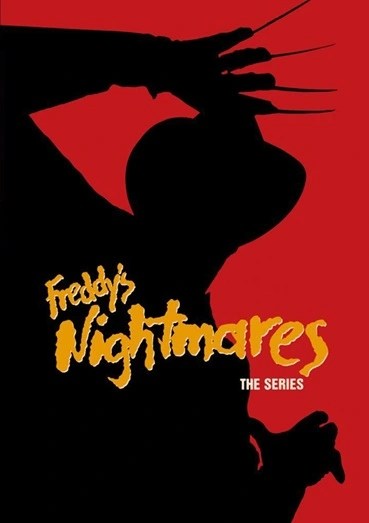
Welcome to Late Night Retro Television Reviews, a feature where we review some of our favorite and least favorite shows of the past! On Fridays, I will be reviewing Freddy’s Nightmares, a horror anthology show which ran in syndication from 1988 to 1990. The entire series can be found on Plex!
This week, dreaming saves the world.
Episode 1.12 “The End of the World”
(Dir by Jonathan R. Betuel, originally aired on January 15th, 1989)
Weird episode.
The first half of the episode featured Mary Kohnert as Amy Collins, a young woman who starts to have dreams about the past and discovers that she can change reality depending on what she does in her dream. Most of the dreams center around the accidental death of her mother. Amy sets about to save her mother’s life but she discovers that changing the past will always lead to unforeseen consequences.
Unfortunately, her psychiatrist (George Lazenby) rats her out to the CIA and Amy is soon being forced to work for the U.S. military. When she senses that a soldier is planning on launching a nuclear attack and plunging the world into war, Amy is forced to do a mind-meld of sorts with him. She watches as the army manages to break into his bunker and gun him down right before he launches the nukes.
I can’t complain about a show trying something different and I actually found it interesting how the two stories were totally different in style and tone. The second story featured a dream about a nuclear war that was pretty disturbing. On TV, Gumby and his horse melted from the atomic heat. That said, this episode suffered from the same flaw as many of the episode of Freddy’s Nightmares, in that it really didn’t have the budget necessary to achieve what it was hoping to accomplish.
Still, who can forget the image of Freddy Krueger riding a nuclear missile in the style of Slim Pickens at the end of Dr. Strangelove?
Along with having an interesting premise, this one also had some interesting guest stars. Along with George Lazenby and Gumby, Walter Gotell, Andrew Prine, and Albert Hall all made appearances. I guess when Freddy Krueger invites you, you don’t say no.
1979’s Apocalypse Now reimagines the Vietnam War as pop art.
Jim Morrison sings The End in the background as slow-motion helicopters pass in front of a lush jungle. The jungle erupts into flame while in a dingy hotel room, Captain Benjamin Willard (Martin Sheen) gets drunks, practices his karate moves, and smashes a mirror before collapsing to the floor in tears. The next morning, the hung-over and bandaged Willard ends up at a U.S. military base where he has a nice lunch with Lt. General Corman (G.D. Spradlin) and Col. Lucas (Harrison Ford) and a nearly silent man wearing an undone tie. Willard is asked if it’s true that he assassinated an enemy colonel. Willard replies that he did not and that the operation was classified, proving that he can both lie and follow military protocol. Willard is told that a Col. Walter Kurtz (Marlon Brando) has gone rogue and his mission is to go into Cambodia and terminate his command with “extreme” prejudice. It’s a famous scene that features G.D. Spradlin delivering a brilliant monologue about good and evil and yet it’s often missed that Willard is getting his orders from Roger Corman and George Lucas.
(Roger Corman was the mentor of director Francis Ford Coppola while the pre-Star Wars George Lucas was Coppola’s business partner. Indeed, Apocalypse Now was originally somewhat improbably planned to be a George Lucas film.)
Up the river, Willard heads on a patrol boat that is populated with characters who could have come out of an old World War II service drama. Chief (Albert Hall) is tough and no-nonsense. Lance (Sam Bottoms) is the goofy comic relief who likes to surf. Clean (Laurence Fishburne) is the kid who is obviously doomed from the minute we first see him. Chef (Fredric Forrest) is the overage, tightly-wound soldier who just wants to find mangoes in the jungle and who worries that, if he dies in a bad place, his soul won’t be able to find Heaven. The Rolling Stones are heard on the boat’s radio. Soldiers on the other patrol boats moon the boat and toss incendiary devices on the roof. It’s like a frat prank war in the middle of a war.
Colonel Bill Kilgore (Robert Duvall) is a badass calvary officer whose helicopter raids are legendary amongst the enemy and a dedicated surfer who tries to turn every night into the equivalent of an AIP Beach Party film. He’s a brilliant warrior who speaks with Malibu accent (“Charlie don’t surf!”) and who doesn’t flinch when a bomb goes off near him. “I love the smell a napalm in the morning,” he says and, for a few moments, you really wish the film would just abandon Willard so we could spend more time with Kilgore. “Some day this war is going to end,” he says with a reassuring nod, showing a non-neurotic attitude that is the opposite of Kurtz’s. Willard says that he could tell Kilgore was going to get through the war without even a scratch and it’s true. Kilgore doesn’t try to rationalize or understand things. He just accepts the reality and adjusts. He’s a true surfer.
The film grows progressively more surreal the closer the boat heads up the river and gets closer to Cambodia. A USO show turns violent as soldiers go crazy at the sight of the Playboy Bunnies, dressed in denim outfits and cowboy hats and twirling cap guns like the love interest in a John Wayne western. A visit to a bridge that is built every day and blown up every night is a neon-lit, beautiful nightmare. Who’s the commanding officer? No one knows and no one cares.
The closer Willard gets to Kurtz, the stranger the world gets. Fog covers the jungles. A tiger leaps out of nowhere. Dennis Hopper shows up as a photojournalist who rambles as if Billy from Easy Rider headed over to Vietnam instead of going to Mardi Gras. Scott Glenn stands silently in front of a temple, surrounded by dead bodies that feel as if they could have been brought over from an Italian cannibal film. Kurtz, when he shows up, is an overweight, bald behemoth who talks in riddles and who hardly seem to be the fearsome warrior that he’s been described as being. “The horror, the horror,” he says at one point in one of the few moments that links Apocalypse Now to its inspiration, Joseph Conrad’s Heart of Darkness.
Directed by near-communist Francis Ford Coppola and written by the unapologetically right-wing John Milius, Apocalypse Now is actually less about the reality of Vietnam and more about how the images of the war shaped pop culture the world over. It’s a reminder that Vietnam was known for being the first television war and that counterculture was not just made up of dropouts but also of writers, actors, and directors. Kurtz may say that Willard’s been sent by grocery store clerks but actually, he’s been sent by the B-movie producers who first employed and mentored the directors and the actors who would eventually become the mainstays of the New Hollywood. The film subverts many classic war film cliches but, at the same time, it stays true to others. Clean dying while listening to a tape recording of his mother telling him not to get shot and to come home safe is the type of manipulative, heart-tugging moment that could have appeared in any number of World War II-era films. And while Coppola has always said the film was meant to be anti-war, Col. Kilgore remains the most compelling character. Most viewers would probably happily ride along with Kilgore while he flies over Vietnam and plays Wagner. The striking images of Vietnam — the jungle, the explosions, the helicopters flying through the air — stay in the mind far more than the piles of dead bodies that appear in the background.
It’s a big, messy, and ultimately overwhelming film and, while watching it, it’s hard not to get the feeling that Coppola wasn’t totally sure what he was really trying to say. It’s a glorious mess, full of stunning visuals, haunting music, and perhaps the best performance of Robert Duvall’s legendary career. The film is too touched with genius to not be watchable but how one reacts overall to the film will probably depend on which version you see.
The original version, which was released in 1979 and was nominated for Best Picture, is relentless with its emphasis on getting up the river and finding Kurtz. Willard obsesses on Kurtz and really doesn’t have much to do with the other people on the boat. It gives the story some much-needed narrative momentum but it also makes Kurtz into such a legendary badass that it’s hard not to be disappointed when Willard actually meets him. You’re left to wonder how, if Kurtz has been living in the jungle and fighting a brutal and never-ending guerilla war against the communists, he’s managed to gain so much weight. Brando, who reportedly showed up on set unprepared and spent days improvising dialogue, gives a bizarre performance and it’s hard to view the Kurtz we meet as being the Kurtz we’ve heard about. As strong as the film is, it’s hard not to be let down by who Kurtz ultimately turns out to be.
In 2001 and 2019, Coppola released two more versions of the film, Redux and The Final Cut. These versions re-inserted a good deal of footage that was edited out of the original cut. Most of that footage deals with Willard dealing with the crew on the boat and it’s easy to see why it was cut. The scenes of Willard bonding with the crew feel out of character for both Willard and the rest of the crew. A scene where Willard arranges for Clean, Lance, and Chef to spend time with the Playboy bunnies seems to go on forever and features some truly unfortunate acting. Worst of all, Redux totally ruins Kilgore’s “I love the smell of napalm in the morning” monologue by having Willard suddenly steal his surf board. Again, it’s out of character for Willard and it actually feels a bit disrespectful to Duvall’s performance to suddenly turn Kilgore into a buffoon.
But then there are moments that do work. I actually like the lengthy French Plantation scene. By the time Willard, Lance, and Chef stumble into the plantation, the journey upriver has gotten so surreal that it makes a strange sort of sense that they would run into a large French family arguing politics while a clown tries to keep everyone distracted. The new versions of the film are undeniably disjointed but they also shift the focus off of finding Kurtz and place it more on Willard discovering how weird things are getting in Vietnam. As such, it’s less of a disappointment when Kurtz actually shows up. Much as with the French Plantation scene, the journey has become so weird that Kurtz being overweight and pretentious feels somehow appropriate.
What all the versions of the film have in common is that they’re all essentially a neon-lit dream of pop cultural horror. Is Apocalypse Now a horror film? Critic Kim Newman argued that it owed a lot to the genre. Certainly, that’s the case when Willard reaches the temple and finds himself surrounded by corpses and and detached heads. Even before that, though, there are elements of horror. The enemy is always unseen in the jungle and, when they attack, they do so quickly and without mercy. In a scene that could almost have come from a Herzog film, the boat is attacked with toy arrows until suddenly, out of nowhere, someone throws a very real spear. Until he’s revealed, Kurtz is a ghostly figure and Willard is the witch hunter, sent to root him out of his lair and set his followers on fire. If the post-60s American horror genre was shaped by the images coming out of Vietnam then Apocalypse Now definitely deserves to be considered, at the very least, horror-adjacent.
Apocalypse Now was controversial when it was released. (It’s troubled production had been the talk of Hollywood for years before Coppola finally finished his film.) It was nominated for Best Picture but lost to the far more conventional Kramer vs Kramer. Robert Duvall was the film’s sole acting nominee but he lost the award to Melvyn Douglas’s turn in Being There. Douglas was very good in Being There and I imagine giving him the Oscar was also seen as a way of honoring his entire career. That said, Duvall’s performance was amazing. In his relatively brief screen time, Duvall somehow managed to take over and ground one of the most unruly films ever made. The Oscar definitely should have gone to him.
As for the film itself, all three versions, flaws and all, are classics. It’s a film that proves that genius can be found in even the messiest of productions.
Welcome to Retro Television Reviews, a feature where we review some of our favorite and least favorite shows of the past! On Mondays, I will be reviewing Miami Vice, which ran on NBC from 1984 to 1989. The entire show can be purchased on Prime!
Things get weird this week.
Episode 2.13 “Definitely Miami”
(Dir by Rob Cohen, originally aired on January 10th, 1986)
This week’s episode of Miami Vice is all about heat.
Seriously, it literally starts with a shot of a solar flares erupting off the surface of the sun. The camera then pulls away, letting us see what the sun looks like a cloudless blue sky. Finally, we find ourselves in Miami, where the sky is clear and a heat wave is raging. The camera focuses on the beads of sweat forming on skin. Every pastel shirt is stained with sweat and everyone is wearing sunglasses. When a drug dealer drives out to a quarry to meet connection, the heat seems to radiate out of the screen. When he’s shot and killed by Charlie Basset (Ted Nugent — yes, the musician and gun enthusiast), the dust that rises up looks like smoke rising from a burning planet.
Sonny and Rico are working undercover as Burnett and Cooper, hanging out at a hotel pool and complaining about the heat. Their target is Sergio Clemente (Roger Pretto) but Sonny is actually more interested in Callie (Arielle Dombasle), a beautiful blonde who he spots laying by the pool. Callie sees Sonny watching her and brings him a drink. Sonny introduces himself as Sonny Burnett.
Clemente is willing to turn himself in but only if he can see his sister, Maria (Kamala Lopez), and know that she’s still alive. Maria testified against her brother at a trial and is currently in the witness protecting program. Joe Dalva (Albert Hall), an arrogant Department of Justice official, is willing to bring Maria to Clemente, despite the fact that Maria indicates that Clemente used to sexually abuse her. Castillo thinks that it’s a terrible idea and tries to use a decoy. In the end, the government orders Castillo to do what Dalva wants. Castillo stands in a corner and stares down at the ground, which viewers of the show know is something Castillo does whenever he knows just how badly things are going to turn out. When the meeting finally happens, Tubbs, Castillo, and Davla can only watch as Maria pulls a knife and stabs her brother to death.
Sonny is not there to see Clemente die. Callie has told him that her husband is physically abusive and she wants Sonny — as Burnett — to meet him in a quarry, make a drug deal with him, and then kill him. Sonny suspects that he’s being set up and he’s right. Callie’s husband is Charlie and he only hits her when she tells him to. Callie seduces drug dealers and then Charlie kills them. Sonny, however, is smart enough to bring Zito with him to the quarry. During a shoot out, Charlie ends up dead. While the police dig up the quarry and find body after body, Sonny goes to the beach so that he can arrest Callie. When Sonny approaches Callie, she’s making a sand castle that looks exactly like the quarry. At first, Callie thinks that Sonny is Charlie but then she forces herself to smile when she sees that Charlie is dead. She assumes Sonny will be her new partner. Instead, Sonny calls in a police helicopter and Callie is taken into custody by two cops. Callie flirts with one of the cops while she’s being led to the helicopter.
And the sun continues to burn in the sky….
This was an odd episode, one that put far more emphasis on vivid and sometimes surreal imagery than it did on telling a coherent story. That’s not a complaint, of course. This episode had a dream-like intensity to it that I really appreciated. It was weird but entertaining, with the grinning Ted Nugent popping up like a gleefully evil goblin. Sonny is targeted because Callie thinks that he’s a drug dealer when he’s actually a cop. The idea of Sonny being able to maintain his undercover identity despite having personally arrested or killed a countless number of Miami drug dealers has always been one of the stranger elements of Miami Vice. This episode, though, it makes a strange sense that Sonny could be mistaken for a drug dealer despite always acting like a cop. That’s definitely Miami.
Welcome to Retro Television Reviews, a feature where we review some of our favorite and least favorite shows of the past! On Sundays, I will be reviewing the made-for-television movies that used to be a primetime mainstay. Today’s film is 1984’s The Night They Saved Christmas! It can be viewed on Tubi and YouTube.
The Night They Saved Christmas argues that there are two types of people in the world.
There are people who still believe in Santa Claus and all that he represents and then there are the people who gave up their belief a long time ago. Those who believe in Santa Claus are still full of the Christmas spirit and, under the right circumstances, they might even get to meet the elves and the jolly old man himself. Those who do not believe are destined to waste their holiday on focusing on material things that aren’t really important.
Petroleum engineer Michael Baldwin (Paul Le Mat) doesn’t believe in Santa Claus and that’s why he had no trouble moving his entire family to the North Pole so that they could freeze while he headed up an oil exploration project. Michael and his boss, billionaire Sumner Murdock (Mason Adams), are determined to find oil and they’ve got an endless supply of dynamite with which to search for it.
Michael’s wife, Claudia (Jaclyn Smith), still believes in the spirit of Santa and she encourages their children to believe as well. For that reason, Ed the Elf (played by singer Paul Williams), is willing to take Claudia and the kids to North Pole City. They get to meet Santa (Art Carney) and they even learn how Santa uses satellite technology to deliver presents all over the world. The city is really quite impressive, with the movie making good use of matte paintings and miniatures to create the impression of a magical metropolis. And Santa turns out to be a pretty nice guy, even if he does tell the elves that he’s sick of them singing Jingle Bells.
Unfortunately, North Pole City is in danger! Every day, the oil company’s dynamite causes a mini-earthquake. With the dynamiting getting closer and closer to North Pole City, Santa and the elves worry that they might be on the verge of getting blown up! Can Claudia and the kids convince Michael to stop blowing up huge chunks of the North Pole before Christmas is ruined!?
Well, listen — I don’t think it’s a spoiler for me to tell you that Christmas is not ruined. It would be pretty cynical for the movie to end with Michael blowing up Santa Claus and cynical is one thing that TheNightTheySavedChristmas is not. This is a very earnest film, full of cheery elves, a paternal Santa, and lots of Christmas music. Even greedy old Mr. Murdock turns out to be not that bad of a guy. In the end, this film says that Santa and the spirit of Christmas is for everyone and that’s certainly not a bad message. It’s a likeable movie for the holiday season and Art Carney is a perfect Santa Claus, even if he does appear to be a little underweight for the role. As played by Carney, Santa is welcoming, good-humored, and still enthusiastic about his job, even after centuries of doing it. He’s exactly the way you would want Santa to be. This is a film that earns the right to wish everyone a merry Christmas!
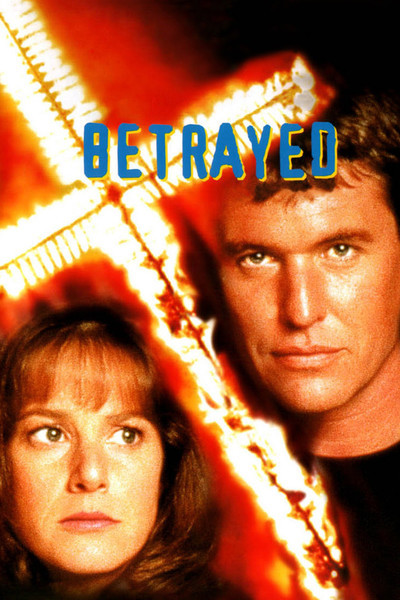
The 1988 film, Betrayed, starts out on a strong note but then quickly becomes annoying as Hell.
It opens with shots of a radio talk show host, an outspoken liberal named Sam Kraus (Richard Libertini). Kraus berates his callers. Kraus ridicules anyone who is to the left of Bernie Sanders. When a man with a rural-accent calls in and attacks Karus for being Jewish, Kraus calls the man an idiot. After he gets off the air, Kraus walks through a parking garage and stops in front of his car. Another car pulls up beside Kraus and suddenly, a masked man with a gun opens fire on Kraus, killing him. The gunman gets out of the car and spray paints, “ZOG” on Kraus’s car before then fleeing the garage.
(ZOG stands for Zionist Occupational Government. It’s a term used by the type of anti-Semitic dipshits who thinks that the Protocols of Elder Zion are real.)
From this shockingly brutal opening, we cut to panoramic shots of beautiful farmland and crops being harvested in the American midwest, the heartland. Gary Simmons (Tom Berenger) owns a farm. He’s a Vietnam vet who nearly received the medal of honor. He lives with his mother and he has two children. (He’s divorced and his ex-wife died as the result of a mysterious hit-and-run in California.) Almost everyone in his small hometown seems to worship Gary. They’re certainly curious about his new girlfriend, Katie Phillips (Debra Winger).
And really, they probably should be. Katie Phillips isn’t Katie Phillips at all. She’s actually an FBI agent named Cathy Weaver and she’s been sent undercover to investigate whether or not Gary was involved in the murder of Kraus. Cathy, who comes from a broken family and who we’re told has always been seeking some sort of deeper meaning in her life, is charmed by both Gary and his family. In fact, she falls in love with Gary. She tells her superior, Mike Carnes (John Heard), that there’s no way Gary is dangerous. Mike doesn’t believe her but, of course, Mike has a personal stake in this because he and Cathy used to be romantically involved.
(That’s right, everyone. Betrayed is so narratively lazy that it resorts to making Mike a scorned lover, even though the film’s plot would have worked just as well if he wasn’t.)
As I said, the first part of the movie works. Debra Wingers gives a strong performance and Tom Berenger is a charming roughneck. For the first half-hour or so, the film does a good job of showing why men like Gary and his friends are susceptible to conspiracy theories and why they feel that the entire world is stacked against them. You can understand why Cathy is so troubled by her assignment because Gary’s friends are hardly master criminals. For the most part, they’re farmers who feel like their entire way of life has been taken away from them.
Unfortunately, almost immediately after Mike refuses to allow her to end her investigation, Cathy returns to the farm and sleeps with Gary. Not only is this a plot development a disservice to everything that has previously been established about Cathy as a character but it also marks the point where the movie entirely falls apart. Immediately after sleeping with Cathy, Gary suddenly goes from being a complex but troubled character to being a cartoonish super villain. And listen — we’ve all been there. You meet a guy. He’s handsome. He says all the right things. He seems like he’s sensitive. He makes you feel safe. You let down your defenses for one night and the next morning, he’s yelling at you for wearing a short skirt in public. It happens. Of course, in Gary’s case, it means that he’s not only criticizing the way that Cathy dresses but he’s also taking her on a hunt where the prey is terrified person of color who Gary and his friends have kidnapped. It also means that Gary drags Cathy along on a bank robbery and then expects her to join him when he wants to assassinate a presidential candidate. Even after all that, Cathy remains conflicted about what to do with Gary. The problem is that it’s not like Gary’s a guy who needs sensitivity training or who spends too much time watching ESPN. Gary is a guy who is carting around weapons and talking about how he wants to kill “mud people.” That Cathy still has mixed emotions after all of that goes against everything that the film previously asked us to believe about her. Gary becomes too cartoonish to be plausible and, as a result, he drags down Cathy’s character as well.
Unfortunately, as the film’s narrative falls apart, so do the majority of the performances. While Debra Winger struggles to make her character’s motivations plausible, Tom Berenger is reduced to doing a lot of glaring. (Poor John Heard spends most of the movie shouting and bugging his eyes.) About the only actor who comes out Betrayed unscathed is John Mahoney, who plays Shorty. Shorty is one of Gary’s friends. He’s a friendly and personable guy who seems to sincerely care about everyone and who has a charmingly gentle smile. He’s also a total racist and the contrast between Shorty’s amiable nature and his hateful thoughts provide the latter half of Betrayed with its only powerful moments. Mahoney gets one big scene, where he talks to Cathy about how much he hates violence but, at the same time, he feels that the world has left him no other choice. Mahoney does a great job with his small role. It’s unfortunate that the rest of Betrayed couldn’t live up to his performance.


 Through the Shattered Lens