No title card; so, I used this as the title card. *sigh* This AI short gave me a little jump. It did have some suspense; so, I won’t feed the creator to the sharks. Sorry Sharks.
Woman alone brushing her teeth, but there is a malevolent force in there with her. The bathroom is by definition private and you’re almost always vulnerable. The film has some suspense and payoff. It is worth watching.
“So it’s a fucking coin toss? That’s what 50 billion dollars buys us?” — Secretary of Defense Reid Baker
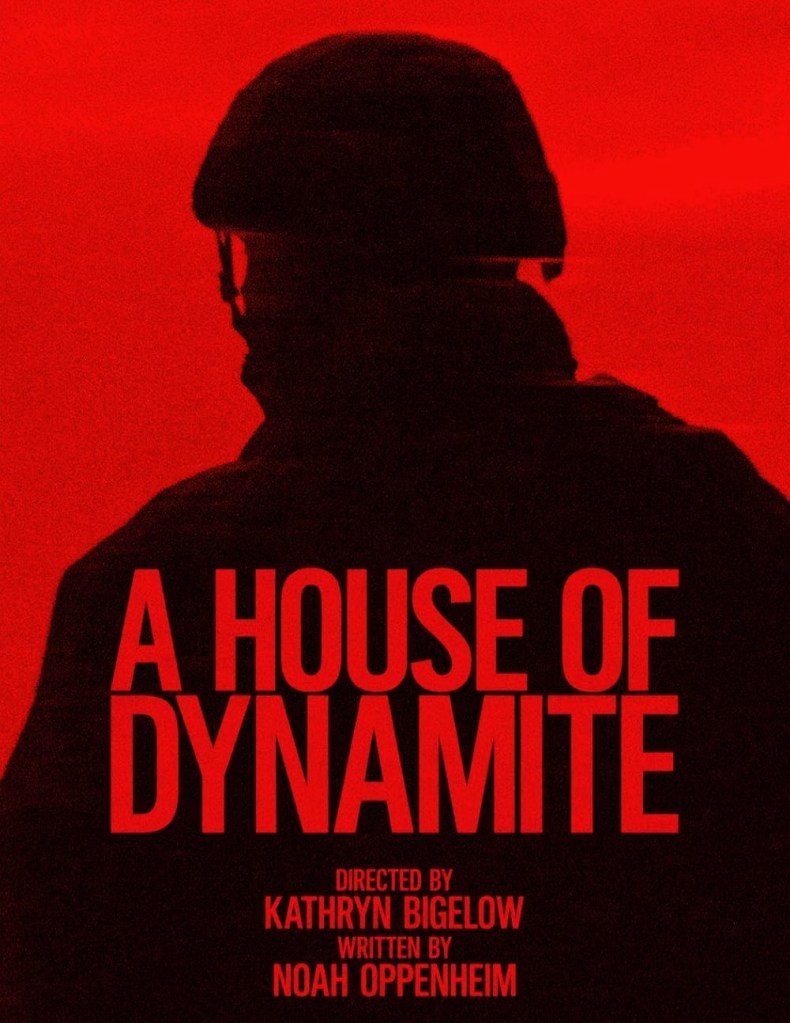
The end of the Cold War was supposed to close a chapter of fear. With the superpowers stepping back from the brink, the world briefly believed it had entered an era of stability. Yet that promise never held. The weapons remained, the rivalries adapted, and the global machinery of deterrence continued to hum beneath the surface. Kathryn Bigelow’s A House of Dynamite faces this reality head-on, transforming the mechanics of modern nuclear defense into something unnervingly human. On the surface, it plays as a high-tension political technothriller, but beneath that precision lies a deeply existential horror film—one built not on shadows or monsters, but on daylight, competence, and the narrow margins of human fallibility.
The premise is piercingly simple. An unidentified missile is detected over the Pacific. Analysts assume it’s a test or a glitch—another false alarm in a world overflowing with them. But within minutes, as conflicting data streams converge, what seemed routine begins to look real. The film unfolds in real time over twenty excruciating minutes, charting the reactions of those charged with interpreting and responding to the potential catastrophe. Bigelow divides the film into three interwoven perspectives: the White House Situation Room, the missile intercept base at Fort Greely, and the President’s mobile command aboard Marine One. The structure allows tension to grow from every direction at once, each perspective magnifying the other until the screen feels ready to collapse under its own pressure.
Capt. Olivia Walker (Rebecca Ferguson), commanding officer of the Situation Room, anchors the story with calm professionalism that gradually frays into disbelief. Ferguson’s performance is clear-eyed and tightly modulated—precise, disciplined, and quietly devastating. She stands as the rational center inside chaos, her composure the last gesture of control in a world that no longer follows reason.
Over her is Adm. Mark Miller (Jason Clarke), Director of the Situation Room, who represents the institutional embodiment of confidence. Clarke plays him with methodical restraint, a man who trusts procedure long after it stops earning trust. Miller’s authority is both comforting and horrifying: a portrait of leadership built on ritual rather than certainty.
At Fort Greely, Anthony Ramos brings an intimate immediacy as the officer charged with the missile intercept. His scenes hum with kinetic dread—the physical execution of decisions made thousands of miles away. Through him, the film captures the most primal kind of fear: acting when hesitation could mean extinction, knowing that success and failure are separated only by chance.
The President, portrayed by Idris Elba, spends much of the crisis in motion—first within the cocoon of the presidential limousine, and later, aboard Marine One as it carves through blinding daylight. Elba gives a performance of subtle, steady erosion. At first, he embodies unshakeable calm, a figure of poise and authority; but as the situation deepens, his steadiness wanes. Words become shorter, pauses longer. Every decision carries consequences too vast for resolution. It is a measured, understated portrait of power giving way to human uncertainty.
Bigelow’s direction is stripped of ornament and focused on precision. Barry Ackroyd’s cinematography heightens the claustrophobia of command centers—the sterile light, the reflective glass, the sense that every surface observes its occupants—while his exterior scenes pierce with harsh brightness, suggesting that no sanctuary exists under full exposure. Kirk Baxter’s editing maintains an unrelenting pulse, cutting with mathematical precision while preserving the eerie stillness of the moments where no one dares to speak.
A House of Dynamite also shows how even with the most competent experts—military, intelligence, and political—working to manage an escalating crisis, there is no path to victory. The professionals at every level stop seeking to prevent the worst and instead focus on saving what they can when the worst becomes inevitable. The film’s scariest revelation is not the potential for destruction, but the paralysis that intelligence creates. If the brightest, most disciplined people in the world cannot find an answer, what happens when power falls into the hands of those less prepared or less rational? In its quiet way, the film poses that question that we see more and more each day on the news and on social media and we are left with silence and realization of the horror of it all.
Despite its precision, the film isn’t without flaws. Bigelow’s triptych structure—cutting between the three perspectives—works brilliantly to escalate tension, yet the repetition of similar beats slightly blunts the impact. Each segment revisits the same crisis rhythms—a data discrepancy, an argument over authority, another uncertain update—sometimes slowing the natural momentum. While the repetition underlines the futility of bureaucratic systems in chaos, the transitions don’t flow as fluidly as the rest of the film’s airtight craftsmanship. The result is a film that is gripping overall, occasionally uneven in rhythm, but never less than absorbing.
When the final minutes arrive, Bigelow declines to deliver resolution. No mushroom clouds, no catharsis. The President sits in Marine One, head down with the weight of the world on his shoulders as he contemplates his options in the Black Book (options in how to retaliate) and knowing that he has no good choices in front of him. The world remains suspended between survival and oblivion, and the silence that follows feels heavier than sound. The ending resists closure because endings, in the nuclear age, are an illusion—the fear continues no matter what happens next.
In a year crowded with strong horror releases—Sinners, Weapons, The Long Walk and Frankenstein among them—A House of Dynamite stands apart. Dressed in the crisp realism of a technothriller, it’s a horror film defined by procedure, light, and silence. Bigelow builds terror from competence, from the steady voices and confident gestures of people trying to manage the unmanageable. This is not the chaos of fiction but the dread of reality, a reminder that the systems meant to preserve and protect might one day fail to deliver on its promise. For all its precision and restraint, A House of Dynamite shakes in the memory long after it ends—the year’s most quietly terrifying film.
Nuclear Close Calls: The situation and question brought up in the film has basis in history as there has been many instances of close calls and false alarms. The film itself doesn’t confirm that the missile detonated, but the implications in past confirmed events just shows how close the world has been to a completed catastrophe.
Whenever it’s time to share this film for Horrorthon, I have a little story that I like to tell:
Enter singing.
Little Shop.…Little Shop of Horrors.…Little Shop.…Little Shop of Terrors….
When I was 19 years old, I was in a community theater production of the musical Little Shop of Horrors. Though I think I would have made the perfect Audrey, everybody always snickered whenever I sang so I ended up as a part of “the ensemble.” Being in the ensemble basically meant that I spent a lot of time dancing and showing off lots of cleavage. And you know what? The girl who did play Audrey was screechy, off-key, and annoying and after every show, all the old people in the audience always came back stage and ignored her and went straight over to me. So there.
Anyway, during rehearsals, our director thought it would be so funny if we all watched the original film. Now, I’m sorry to say, much like just about everyone else in the cast, this was my first exposure to the original and I even had to be told that the masochistic dentist patient was being played by Jack Nicholson. However, I’m also very proud to say that — out of that entire cast — I’m the only one who understood that the zero-budget film I was watching was actually better than the big spectacle we were attempting to perform on stage. Certainly, I understood the film better than that screechy little thing that was playing Audrey.
The first Little Shop of Horrors certainly isn’t scary and there’s nobody singing about somewhere that’s green (I always tear up when I hear that song, by the way). However, it is a very, very funny film with the just the right amount of a dark streak to make it perfect Halloween viewing.
So, if you have 72 minutes to kill, check out the original and the best Little Shop of Horrors….
“Most of the laugh tracks on television were recorded in the early 1950’s. These days, most of the people you hear laughing are dead.” ― Chuck Palahniuk
This was one of the earliest music videos, featuring a band that seemed to be destined to take advantage of the format. The song was written a time when Jim Morrison was going through a period of depression. While watching the sunset at Robby Krieger’s house, he suddenly had the realization that “If you’re strange, people are strange.”
I was hoping that he might be, even though his name didn’t appear in the credits. Quite a few cast members from the first two films return for the third film. David A.R. White is back as Josh McManus, the former super soldier who now drives his souped-car through the wastelands of America. Bruce Marchiano is back, credited as the Stranger though we all know he’s actually Jesus. (Since Marchiano appeared in all three films, I can only assume the RevelationRoad films all take place in the same cinematic universe as TheEncounter films and Sarah’sChoice.) Brian Bosworth shows up briefly.
But there is no Eric Roberts. Not even Eliza Roberts appears in this film! It’s a shame and they are both missed.
However, Kevin Sorbo does show up.
Kevin Sorbo plays Honcho, a bandit leader who lives in the wastelands and who is worshipped by those who follow him. Honcho occasionally speaks with an Australian accent. Occasionally, the accent slips or disappears all together. At first, I thought this was a case of bad editing, bad dubbing, or maybe Sorbo not really being that into the character. However, there’s actually a rather clever moment in which Honcho tells Josh that he’s not actually from Australia. He just speaks with the accent because it impresses his followers. Without the accent, he’s just some guy who used to work at a gas station. With the accent, he’s a warlord.
It’s a moment that made me laugh, largely because it’s true. People love and fear accents. If you’ve got a posh British accent, most Americans will assume that you’re planning a heist of some sort and that Sylvester Stallone or Harrison Ford is somewhere nearby, trying to stop you. If you’ve got an Australian accent, the assumption amongst Americans is that you can survive harsh conditions, handle your alcohol, and jump out of a plane without a second thought.
However, Sorbo’s fake Australian accent also pays a sort of homage to the MadMax films. The RevelationRoad trilogy was obviously envisioned as being a faith-based version of the Mad Max films, with David A.R. White cheerfully stepping into the somber shoes of Mel Gibson and Tom Hardy. Using MadMax as a model for a faith-based apocalypse film actually isn’t that bad of an idea. Indeed, Gibson’s style of beatific madness opens up the original Mad Max trilogy to a similar interpretation. Unfortunately, RevelationRoad3 is at time a bit too faithful to the MadMax films, to the extent that it struggles to establish an identity outside of the films that inspired it. That’s one reason why Kevin Sorbo’s character stands out. He’s a character who genuinely surprises us.
As for the plot of RevelationRoad3, it finds Josh being sent on a mission to find The Shepherd (Robert Gossett), a mysterious figure who is gathering together a religious flock in the desert despite the fact that the new world government has outlawed things like religion and individual freedom. While Josh’s wounded companion waits in a town ruled over by Mayor Drake (James Denton), Josh searches the desert and occasionally sees a mysterious rider on a horse. The film mixes action and theology and the results are definitely mixed, with a few well-done chase scenes mixed with a lot of scenes of people talking. That said, at its best, TheBlackRider achieves a sort of desolate grandeur.
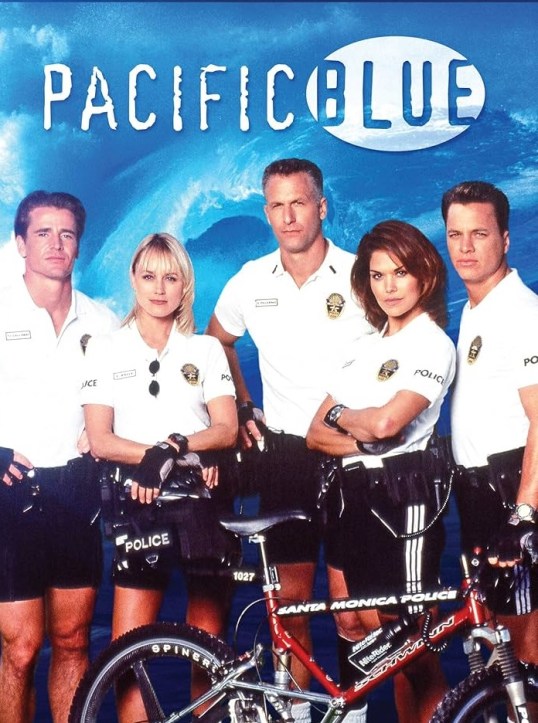
Welcome to Late Night Retro Television Reviews, a feature where we review some of our favorite and least favorite shows of the past! On Tuesdays, I will be reviewing Pacific Blue, a cop show that aired from 1996 to 2000 on the USA Network! It’s currently streaming everywhere, though I’m watching it on Tubi.
This week, the bike patrol is busy!
Episode 3.4 “Blood For Blood”
(Dir by Gary Winter, originally aired on August 24th, 1997)
Rapper Gangster 47 (Ross Leon) is gunned down while leaving a concert. Gangster 47’s daughter (Meagan Good) is convinced that the hit was ordered by Gangster 47’s rival, Trigger Dog (Ten’l Brunson). Now, I will just admit right now that I’m having a hard time writing this review because I can’t type out the name Trigger Dog without laughing. Even though everyone says that Trigger Dog’s feud with Gangster 47 was all for show, Gangster 47’s daughter is determined to shoot Trigger Dog.
Fortunately, noted gangsta rap fan Chris Kelly is on the case. Seriously, Chris is portrayed as being a fan of Gangster 47. Over the course of the previous 38 episodes, we have seen absolutely nothing about the very white and the very uptight Chris that would lead us to believe that Chris would be a fan of anything other than military marches but this episode opens with her rolling her eyes when TC says that rap isn’t real music. Chris tells TC that he needs to realize there’s more to music than the Bee Gees. Ouch! You tell him, Chris. And seriously, take that, Bee Gees! How Deep Is You Love now, huh!?
Chris and TC have been assigned to protect Gangster 47. Why exactly the bike patrol is protecting a celebrity who has been getting death threats — as opposed to real cops and real bodyguards — is never really addressed. Gangster 47’s daughter hates cops. When Gangster 47 is gunned down in a drive-by, it seems like his daughter has a point. Gangster 47 isn’t killed but he is in the hospital.
The show’s producers obviously figured out that it would be a little bit awkward for the show’s almost entirely white cast to be dealing with a case involving two gangsta rappers so we meet a supercool black detective named — I’m not making this up — Wishbone (Derek Morgan). Wishbone mainly exists to clasp hands with TC and to back-up Chris, as if the show is saying, “See? These two aren’t as dorky as they seem. Wishbone likes them!” With Wishbone’s help, they come to realize that Gangster 47 was shot by a white man and Trigger Dog is innocent.
The white man is a serial killer named Strob (Todd Cattrell) who is apparently trying to bring about the Biblical apocalypse by murdering celebrities or something. TC spots him on the beach but, in order to chase after him, he has to get on his bike and this leads to urgent close-up of TC dialing the combination of his bike lock. Hey, TC, if you had a car, you would have already arrested Streob by now!
While this is going on, Victor’s girlfriend, Linda (Vaitiare Hirshon) has witnessed a murder and, if she testifies, she may have to go into the witness protecting program! That’s a big deal but, of course, Palermo acts as if it’s nothing because Palermo never seems to get that people actually have lives outside of whatever he needs at any given moment. Victor doesn’t want to lose Linda. Conveniently, the murderer pulls a gun on Victor, which gives Victor the perfect excuse to gun him down. Palermo’s like, “Did he shoot first?” and Victor says, “Sure.” Victor then asks Linda to marry him.
Personally, I just find it interesting that, with all the crime happening in Santa Wherever This Show Takes Place, it just takes five people on bicycles to catch all the bad guys. I mean, if that works in Santa Monica, maybe it’ll also work in New York after Mamdani is elected. Let’s hope so!
For better or worse, Awards Season started today with the announcement of the Gotham nominations. The Gothams are supposed to honor independent films, though the line between studio and independent is now so thin that it’s sometimes difficult to tell which is which.
In the past, the Gothams honored obscure films and also low-budget films that captured the public’s imagination. This year, they gave the majority of their nominations to One Battle After Another, a big-budget film that starred a slew of Hollywood heavyweights. Meanwhile, Sinners, a genuinely independent feature, received one nomination.
It’s debatable how much of a precursor the Gothams are. They’re a critic-selected award and it’s always the guild awards that serve as the best precursors. Still, it always helps to be mentioned somewhere.
Here are the 2025 Gotham nominations!
Best Feature Bugonia East of Wall Hamnet If I Had Legs I’d Kick You Lurker One Battle After Another Sorry, Baby The Testament of Ann Lee Train Dreams
Best Director Mary Bronstein – If I Had Legs I’d Kick You Jafar Panahi – It Was Just an Accident Kelly Reichardt – The Mastermind Paul Thomas Anderson – One Battle After Another Oliver Laxe – Sirât
Outstanding Lead Performance Jessie Buckley – Hamnet Lee Byung-hun – No Other Choice Rose Byrne – If I Had Legs I’d Kick You Sopé Dìrísù – My Father’s Shadow Ethan Hawke – Blue Moon Jennifer Lawrence – Die My Love Wagner Moura – The Secret Agent Josh O’Connor – The Mastermind Amanda Seyfried – The Testament of Ann Lee Tessa Thompson – Hedda
Outstanding Supporting Performance Benicio Del Toro – One Battle After Another Jacob Elordi – Frankenstein Inga Ibsdotter Lilleaas – Sentimental Value Indya Moore – Father Mother Sister Brother Wunmi Mosaku – Sinners Adam Sandler – Jay Kelly Andrew Scott – Blue Moon Alexander Skarsgård – Pillion Stellan Skarsgård – Sentimental Value Teyana Taylor – One Battle After Another
Best Original Screenplay If I Had Legs I’d Kick You It Was Just an Accident The Secret Agent Sorry, Baby Sound of Falling
Best Adapted Screenplay No Other Choice One Battle After Another Pillion Preparation for the Next Life Train Dreams
Best International Feature It Was Just an Accident No Other Choice Nouvelle Vague Resurrection Sound of Falling
Best Documentary Feature 2000 Meters to Andriivka BLKNWS: Terms & Conditions My Undesirable Friends: Part I – Last Air in Moscow The Perfect Neighbor Put Your Soul on Your Hand and Walk
Breakthrough Director Constance Tsang – Blue Sun Palace Carson Lund – Eephus Sarah Friedland – Familiar Touch Akinola Davies Jr. – My Father’s Shadow Harris Dickinson – Urchin
Breakthrough Performer A$AP Rocky – Highest 2 Lowest Sebiye Behtiyar – Preparation for the Next Life Chase Infiniti – One Battle After Another Abou Sangaré – Souleymane’s Story Tonatiuh – Kiss of the Spider Woman




 Through the Shattered Lens