Game Review: The Last Half of Darkness (1989, SoftLab Laboratories)


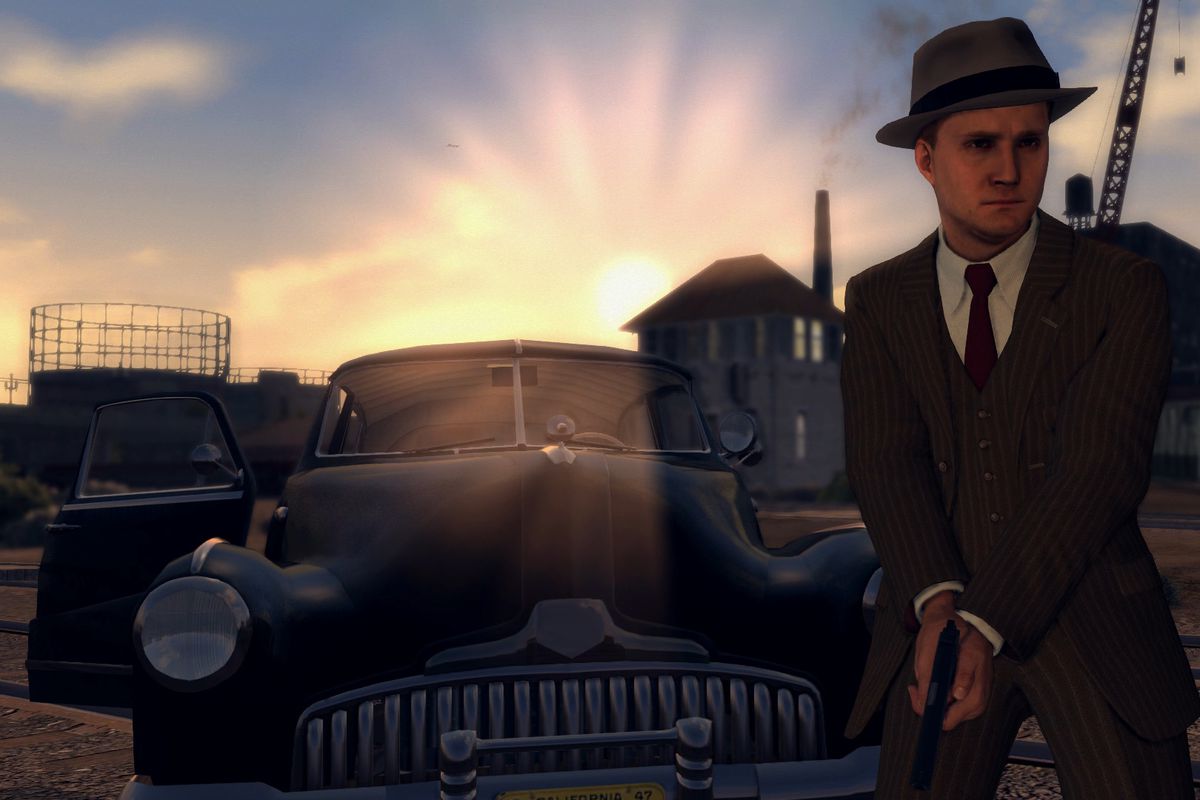
Today, I was planning to take a look back at L.A. Noire but, due to last night’s storms, I lost power right as I was about to start composing my thoughts.  The power has since come back but, rather than do a rush job on one of my favorite games, I’m going to hold off on posting about L.A. Noire until tomorrow or Wednesday.

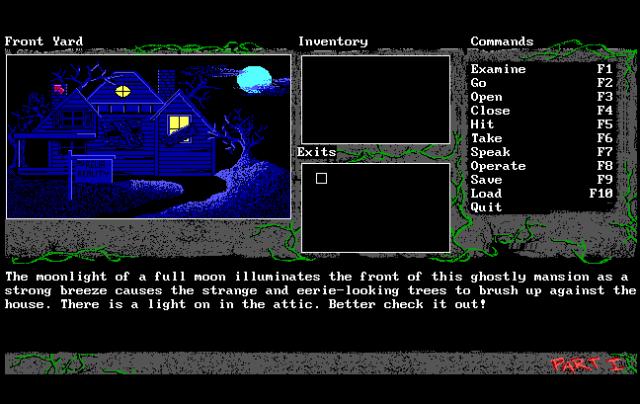
Instead, for today, I’ll recommend The Last Half of Darkness, a haunted house game that can be played at the Internet Archive.  In The Last Half of Darkness, you are searching the home of your late aunt.  Your aunt was a voodoo witch and you stand to inherit her considerable estate if you can finish the potions that she was working on and also solve the mystery of her death.  To do that, you are going to have to go through and search her home.  The problem is that you are not alone.  Open the right door and you will find the secret to returning life to the dead.  Open the wrong closet or cabinet and prepare to meet your fate at the fangs of a snake or the hands of an angry ghost.

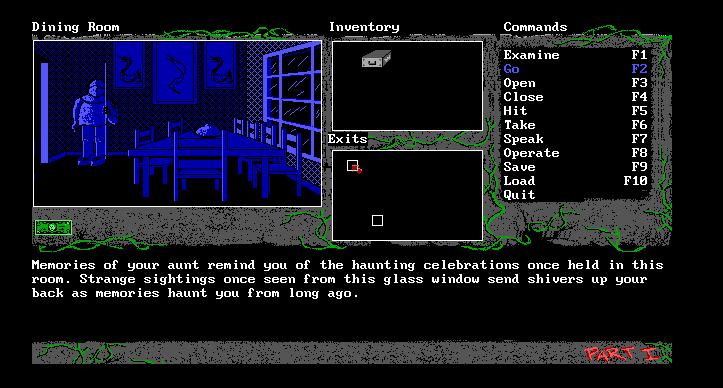
The Last Half of Darkness is a challenging game that is also a lot of fun, assuming that you can get the hang of the game’s point-and-click interface.  Instead of typing out your commands, you click on a list of options that are on the right side of the screen.  You then have to click on the picture of whatever object you want to pick up or direction you want to head.  It took me a while to get used to it but, once I did, it barely bothered me.

This is a good game, full of wit and atmosphere and puzzles that require some concentration but which are not impossible to solve.  For those of you like me who sometimes need to cheat to win a game, here’s a helpful walk-through.

The game itself can be played by clicking here.

Silent Hill Memories


I was sixteen when Silent Hill first came out for the Playstation.

From the first minute I played it, I was hooked and Silent Hill would go on to become the first video game that I ever seriously got into.  I would study the game.  I would go online, in those early days of the world wide web, to read the theories of other players and visit the occasional Geocities-hosted fan page.  I actually got very upset when innocent nurse Lisa Garland was lost to the town’s curse.  I was also amazed to discover that the game’s storyline and ending could change depending on whether or not I saved Cybil Bennett.  A video game with multiple endings that went beyond just “good” and “bad?”  This was a big deal back in 1999!

Looking back after all these years, there are four main things that I remember about Silent Hill.

First off, and I know I’m not alone,I remembered the opening and especially the music that played during the scenes of Harry Mason driving down that foggy road:

Secondly, I remember the scenes that played after the game’s ending, which featured all of Silent Hill‘s characters blowing their lines, missing their cues, and laughing about it.  Today the animation may look primitive but back in 1999, seeing this at least provided some comfort if you got one of the bad endings, especially the “bad” ending where you defeated the monster but your daughter died (“Thank you, Daddy … goodbye.”) and then you ended up dead in your car.

I remember the nearly legendary fifth ending of the game, in which Harry Mason ended up getting abducted by aliens.  In the days before YouTube, when you had to trust word-of-mouth, there were some people who insisted that this ending was just an urban legend while there were others who couldn’t stop bragging about how they had gotten the alien ending while the rest of us just had to settle for the “saved the world and your daughter” ending.  When I finally managed to get the UFO ending, I was so happy that I felt like I was the one who had been abducted by aliens.

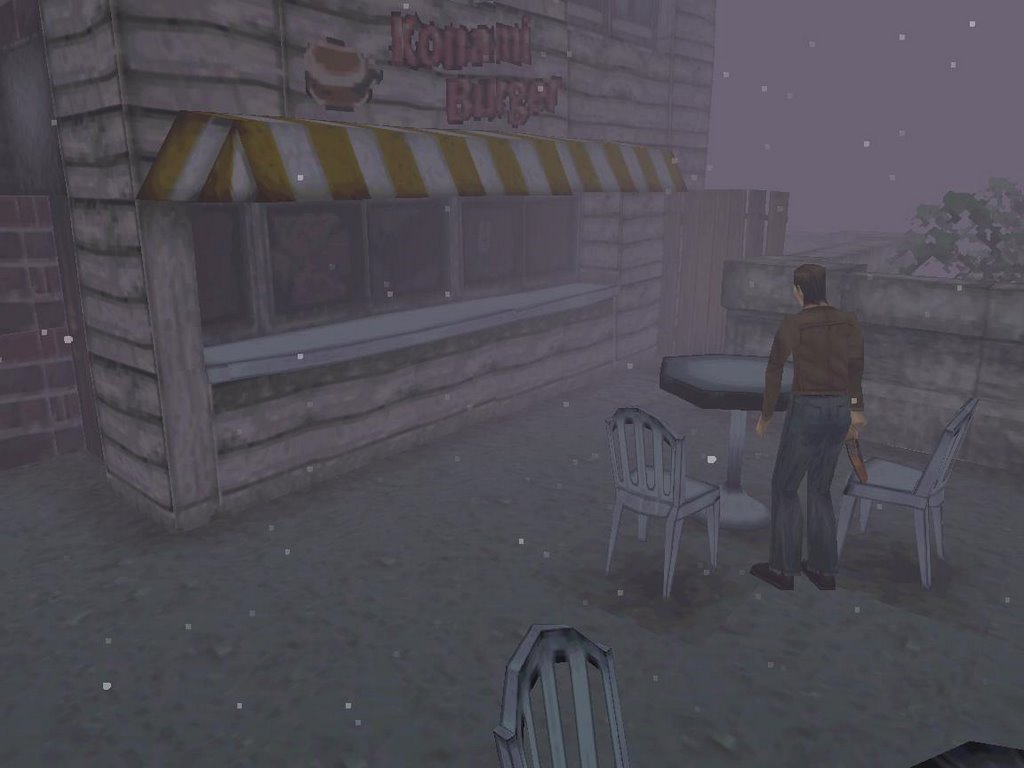
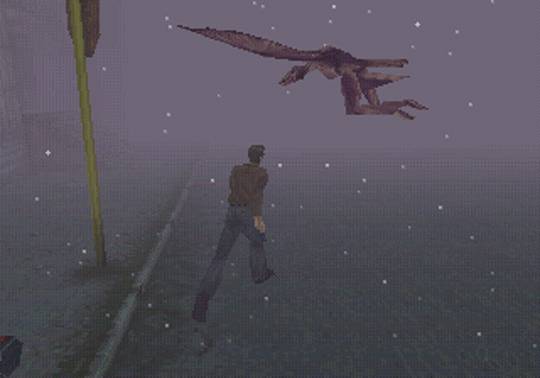
Finally, the main thing I remember about Silent Hill is that I was never very good at it.  I was the player who always ended up getting lost and walking around in a circle.  I can’t remember how many times I played before I managed to not die in the diner.  As soon as I heard the radio static that indicated that I was about to get attacked, I started to run because I know I wasn’t a good enough shot to fight off any of the game’s monsters.  Harry Mason was searching for his daughter and I was probably the worst possible person to lead him in that search because I somehow always managed to get Harry killed.  It didn’t matter how many times I played the game, I never really got good at it.  Even when I finally managed to get the best ending possible, it was only after saving and reloading the game a countless number of times.

I may have never been good at the game but I still enjoyed leading Harry to his death and occasionally to one of the good endings.  Silent Hill is what taught me that there was more to video games than just jumping and shooting and for that, I will be forever thankful.

Retro Game Review: Destroy All Humans! 2 (2006, THQ)


Yesterday, I wrote about how excited I am about the prospect of once again getting to play Destroy All Humans! when the remake of the game is rereleased in 2020.

But why stop with there?  Why not follow that up by remaking Destroy All Humans! 2?

Destroy All Humans! 2 picks up ten years after the end of Destroy All Humans!  It is now 1969 and the world is swinging.  The latest Crypto clone is still disguised as the President of the United States and he is having a ball.  Of course, then the KGB decides to ruin it all by launching a nuclear missile at the Furon mothership.

With the mothership destroyed and Pox reduced to being an ill-tempted hologram, Crypro must figure out not only what the KGB is planning but he must also get revenge for the destruction of the mothership and the death of his commander.  Destroy All Humans! 2 spans the globe, with Crypto going from San Francisco to London to Tokyo to Siberia with the game’s climax taking place on the moon.  Along the way, Destroy All Human! 2 parodies everything from hippies to Godzilla to James Bond.  This is a fun and humorous game that could be played all the way through in just a couple of sessions.  Along with having everything that the first game had, Destroy All Humans! 2 also has some new features.  My favorite was the ability to force hippies, schoolgirls, and other innocent bystanders to forget about me by making them suddenly hear acid rock.  Of course, it’s also a sandbox game so, if you don’t feel like concentrating on the plot, you can just focus your energies on destroying all humans!

Destroy All Humans! 2 is another game that I used to play nonstop on my Xbox.  My Xbox is still in working condition but my controller has seen better days so, whenever I play the game nowadays, I have to keep an eye on Crypto to make sure he doesn’t take off running towards the left side of the screen.

So, how about it?  If 2020 is going to be the year of the Destroy All Humans! remake, how about following up with a remake of Destroy All Humans! 2?

After all, we need Crypto now more than ever!


Retro Game Review: Destroy All Humans! (2005, THQ)


I’m looking forward to 2020 for one reason and one reason only and it’s not the presidential election.

No, I’m looking forward to 2020 because that’s when I’ll finally be able to play Destroy All Humans! again!  The classic alien invasion game will be getting a full remake in 2020 and, once again, players will be able to help Crypto steal Furon DNA and conquer the planet.  It probably won’t be a minute too soon, either.  If 2019 is any indication, 2020 is a year that’s probably going to inspire a lot of people to wish they could beam up to their spaceship and blow things up.  With the remake of Destroy All Humans!, they should have the opportunity to do just that without causing any real world damage!

Back in the day (the 2005 day), Destroy All Humans! was the best reason to have either an Xbox or Playstation 2.  Crypto was a little grey man who sounded suspiciously similar to Jack Nicholson.  He came to Earth in 1959, on a quest to harvest brain stems, blow up cows, disrupt pool parties, and battle a mysterious government agency known as Majestic.  Though the game had a storyline and missions, it was also a sandbox game.  Once a location was unlocked, you could revisit and blow it up whenever you wanted to.  I lost track of how many times I took out Turnipseed Farm.  Being an industrious race, the humans always rebuilt as soon as you flew away.  It never seemed to occur to them to add any extra security precautions, no matter how many times you returned.

Because the game was set in 1959, it featured a full-on barrage of pop cultural references.  Crypto could read minds and it turned out that people all over America were thinking about Marilyn Monroe, Elvis, and whether or not they really liked Ike.  Crypto could also temporarily disguise himself as a human but, after a certain amount of time, he always reverted back to his original form.  If he reverted back while surrounded by humans, panic would ensue as the humans shouted that they were being invaded by “space commies!”

Of course, Earth was a dangerous place in the 1950s and it was common for Crypto to get killed.  Luckily, every time he died, a new Crypto clone took over and was even more eager to destroy all humans!

This was my favorite game on the Xbox and it’s one of the few that I really miss playing.  (I still have the game and the Xbox.  While the Xbox works, the controller’s seen better days and, whenever I do play one my old Xbox games, it seems like I spend the majority of the game trying to keep characters like Crypto and Tommy Vercetti from running over to the left side of the screen.)  I’m looking forward to once again taking control of Crypto and invading this lousy planet!

Is it 2020 yet?

(By the way, Case Wright once reviewed Tom Abernathy, the writer of Destroy All Humans!  Read that interview here.)

Game Review: Don’t Fire Until You See The Yellow Of Their Niblets (1999, Dan Shiovitz)


“There is a sharp hiss, as if millions of kernels cried out in pain and then were suddenly silenced. And then it arises — dear god, it arises. Something like Venus arising from the waters, or your fat Uncle Albert arising from his arm-chair, the Yellow Beast of Corn draws itself up from the pile of stalks. The broom drops from your nerveless fingers as you contemplate the apparition that has appeared before you. “Why me, why now, why here?” you can’t help but ask yourself, even knowing that the question is futile. To kill, to kill, that is the purpose of the Nibleted One, and anyone in its path will perish.”

Don’t Fire Until You See The Yellow Of Their Niblets by Dan Shiovtiz

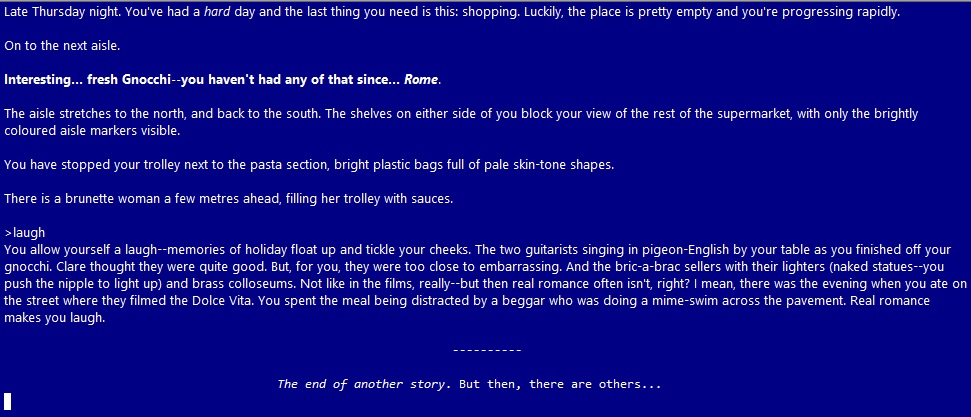
In this text adventure game, you are working the night shift at Big Foods Super Market.  You have just finished sweeping up the produce aisle and you are looking forward to finally getting off work when suddenly, the Yellow Beast of Corn rises up, looking to destroy you.  This may be because Big Foods has started receiving it’s corn from The Dark Brotherhood instead of Pete’s Produce Wholesalers.

You have three directions in which to run and two aisles in which to hide.  Each aisle features a different way to kill the Yellow Beast of Corn but you’ll have to figure it out quick.  Take too long and the day crew will only find a few pieces of you left in the morning.

Don’t Fire Until You See The Yellow Of Their Niblets is a game that was specifically designed to be played in less than a minute.  Figuring out how to destroy the corn monster is not difficult.  Instead, the challenge is making sure that you get to the aisle with enough time left to put a plan into action.  It’s a fun game and you may have already guessed that it’s not meant to be taken too seriously.

Don’t Fire Until You See The Yellow Of Their Niblets can be downloaded from here.  You’ll also need a TADs interpreter to play the game, which can be downloaded, for free, from TADS.org.

Video Game Review: Vacation Gone Away (2002, Milibus)


Vacation Gone Awry is an old-fashioned text adventure where you wake up on the first day of your vacation in Germany and you discover that your family has disappeared!

Searching your three-room cabin doesn’t do much good.  Your wife and your daughters are nowhere to be found.  Even looking under the bearskin rug doesn’t reveal the trap door that I had been led, by years of playing text adventure games, to expect.  Finally, I went outside, got in the car, and decided to just drive away.

Right, it’s not going to happen.  Your family may have abandoned you but you abandoning them is not an option.

If you do go back to the cabin, you will eventually discover what has happened to your family.  Like many of the puzzles in Vacation Gone Awry, the solution to this problem is to specifically look at everything.  That may sound easy but the cabin is do detailed that it can be easy to get distracted.  I wasted ten turns in the cabin’s bedroom, trying to open my wife’s makeup bag before I finally accepted that it wasn’t an important clue.

Once you discover what has happened to your family, you are free to once again get in your car and attempt to drive into town.  However, while driving, this happens:

It seems that aliens have accidentally lost a piece of their spaceship and now a group of research scientists are on the verge of opening it up and killing everyone in the vicinity, including you and your family.  You have no choice but to make your way through a blizzard, find the research station, and stop them!

Your enjoyment of Vacation Gone Awry will depend on how much patience you have for searching locations and solving puzzles.  This is one of those text adventures where no door can simply be opened.  Instead, you have to figure out how to unlock it.  Finding the solution will often depend on not only carefully reading the descriptions of the location but also taking a closer look at things that you may have already examined.  Especially when compared to more recent works of Interactive Fiction, Vacation Gone Awry is puzzle-driven instead of plot-driven.

It’s challenging but, if you’re a puzzle person, there is enjoyment to be found in the game.  Vacation Gone Awry is available for free on several sites.  I played it at the Internet Archive.

Good luck saving your family!

Video Game Review: Hamburger Hell (1986, J.P. Jansen)


In this game, you are working in a fast food restaurant.  Your goal is to make as many hamburgers as possible.  The more hamburgers you make, the more money the restaurant makes and the more your boss likes you.

Sounds simple, right?

Think again!

In this restaurant, it’s not just about knowing when to flip the burger.  Instead, you have to climb to the top of a ladder and push each ingredient down a level, one-by-one.  (That’s you, at the bottom of the third ladder.)  Making things extra difficult is that there’s a ghost running up and down the ladders.  The more hamburgers you make, the faster the ghost becomes.  If the ghost touches you, you die.  You come right back to life the first four times.  But after the fourth time, this happens:

This is an intentionally dumb but very addictive game.  You can play it at the Internet Archive.

Eat well and watch out for that ghost!

Video Game Review: The Count (1979, Adventure International)


You have just woken up in a bed in a Transylvanian castle.  Why are you there?  You’re on a mission.  What type of mission?  It’s Transylvania and the game is called The Count.  You figure it out.  You’ve got three days to figure out how to kill Count Dracula or you’ll suffer a fate worse than death.  Make a mistake and you might become a vampire during the night.  Try to leave the castle early and you’ll get torn apart by the angry villagers.

The Count is a very early text adventure game, one of the many that was created and designed by Scott Adams in the days when having a personal computer was considered to be a luxury instead of a necessity.  The Count has everything that you would usually expect from an Adams game: minimalist descriptions, silly humor (“The signs says ‘POSITIVE NO SMOKING ALLOWED’ signed Count Dracula.”), and puzzles that often take more than one run-through to solve.  It also has a simple two-word parser that, for modern players, might require some getting used to.

Historically, The Count is important because it was one of the first games to have a fixed time limit.  Timed challenges have always been my downfall, as anyone who has ever watched me play any of Spider-Man‘s side missions can tell you.  Solving The Count is not as challenging as catching Howard’s pigeons but it will still probably require a replay or two.

Like all of Scott Adams’s game, The Count has been adapted for other Interactive Fiction interpreters and can be downloaded for free..  The 1982 re-release, which came with graphics, can be played at the Internet Archive.


Video Games Are Not To Blame


When I was growing up, I used to love to play Castle Wolfenstein and Doom.  While playing those games, I fired every weapon that I could get my hands on and I killed a countless number of Nazis and demons.

In real life, I have never shot anyone nor have I ever been tempted to.

Later on, I discovered the Grand Theft Auto games.  While playing those games, I’ve stolen a countless number of cars and I’ve run down a lot of people.  Most of them I didn’t mean to run down.  Everyone knows how difficult it is to go in reverse when you’re playing Grand Theft Auto.

In real life, I have never stolen car and I’ve never never run anyone over.  Nor have I ever been tempted to.

That’s because I’ve always known that video games are not real life.  Even when I was a kid, I understood that if someone died in real life, they wouldn’t just respawn and continue playing the game.  I would say that’s true of 99.9% of all gamers.  As for the .1% that doesn’t understand the difference, they have problems that started long before the played their first game.

Whenever there’s a mass shooting or any other traumatic act of public violence, people demand to know how it could have happened.  Video games are always a convenient scapegoat.  Many video games are violent and gamers are easy targets for the media to pick on.  But this idea that little Johnny was perfectly normal until he played Call of Duty or Fortnite is ludicrous and everyone knows it.  When I hear about a school shooter who spent hours playing a violent video game, I don’t care about which game he was playing.  Instead, what I want to know is where were his parents while he was doing this?  Too often video games are blamed because no one wants to admit that they either ignored all of the obvious red flags or they didn’t have the courage to confront what they knew was happening.

Video games are not to blame and neither are gamers.  Using them as a scapegoat is not going to solve a thing.  People with a propensity for violence are always going to seek out ways to be violent.  Banning video games isn’t going to make that type of person any less violent.  It’s just going to inspire him to find a new way to express whatever it is that’s going on inside his head.

Until we get serious and stop looking for easy targets to blame, the shootings like we saw this weekend are going to continue and they’re going to keep getting worse.  Solely blaming video games — as if a mass-produced game is somehow more responsible for an individual’s actions than the individual himself — is not a serious response and anyone doing it is not a serious person.

A Late Review of PS4’s Spider-Man


It took me a little over a month to make my way through PS4’s Spider-Man.

I started playing around the middle of December and I finally completed the game on January 30th.  I didn’t play every day, of course.  There was one week when I was so busy with the real world that I didn’t play at all.  Most days, when I did play, I would spend maybe 60 to 90 minutes on the game, sometimes more and sometimes less.  All told, I’d estimate that it took about a total of 25 hours for me to finish the game’s story.  That’s not counting the time that I spent on side quests or the times when I would just swing through New York and appreciate the massive amount of work and detail that went into recreating Manhattan Island.

The first half of the game is probably one of the best advertisements for New York City that’s ever been put together.  Whether you’re swinging through Central Park or taking in the sights in Times Square, it’s hard not to get drawn into the game’s depiction of New York as being the most exciting city in the world.  Both Spider-Man and Mary Jane Watson get scenes in which they talk about how much they love New York.  At the start of the game’s third act, a major disaster happens and New York is suddenly trashed and no longer as friendly a place.  While the streets are controlled by the paramilitary mercenaries of Sable International, the rooftops are populated by snipers who think nothing of trying to shoot you while you’re trying to swing from mission to mission.  And yet, even when things are at their worst, the indomitable spirit of New York survives.  Even though a biological weapon has been detonated and there’s been a massive prison break, you can still find people taking a stroll through Central Park.  (Of course, now they’re wearing surgical masks and some of them are stopping to cough.)  Even after martial law is declared, you can still drop in on the quad at Empire U and find students hanging out.  J. Jonah Jameson (who, in this game, hosts Spider-Man’s favorite podcast) may be a braying fool most of the time but he’s right when he says that New York will never surrender.

(The game’s action is limited to Manhattan.  As much as I would have loved to have visited the Bronx, I understand that there’s only so much that one game can do.  When I tried to swim to Staten Island, I discovered that swimming is the one thing that Spider-Man does not do well.  When I tried to cross the Brooklyn Bridge, I got a warning telling me that I was “leaving the game.”  Maybe the sequel will take Spider-Man into the outer boroughs.)

Spider-Man is voiced by Yuri Lowenthal and, after playing this game, it’ll be impossible for me to ever think of Spider-Man as sounding like anyone else.  Whether he’s telling a bad joke or, when the game takes a detour into Spider-Man’s subconscious, battling his own demons, Lowenthal simply is Spider-Man.

The game features many of the members of Spider-Man’s supporting cast, with Yuri Watanabe, Mary Jane, Miles Morales, and Aunt May all making welcome appearances.  (Four of the story’s missions require the player to take on the roles of either MJ or Miles.)  As for the game’s villains, Doctor Octopus, Kingpin, Tombstone, Taskmaster, Norman Osborne, Mr. Negative, Electro, Vulture, Rhino, Scorpion, Screwball, and Shocker all play roles of varying importance.  Doctor Octopus is reimagined as being, before he goes bad, almost a surrogate father to Peter.  When Spider-Man battles him, he’s not only fighting Doctor Octopus but he’s also battling his own guilt.  We all know the old saying: “With great power, comes great responsibility.”  PS4’s Spider-Man is one of the few adaptations of the character that actually understands what that means.

While I liked the way that the villains were depicted and I think that this is one of the few Spider-Man adaptations to actually capture what makes Electro such an *ahem* electrifying character, I do wish that some of the boss battles had been more difficult.  While they do provide some challenge, they can also often be won just by pushing the dodge button until your opponents eventually tire themselves out.  For one battle, Spider-Man debuts a new suit designed to give him an advantage.  I won the battle without ever using the advantage.  Another battle can be won by finding a high place to perch on while your two opponents defeat themselves with friendly fire.

To anyone playing the game for the first time, my main warning would be to hold off on talking to a homeless man named Howard.  It’s tempting to go over and speak with him because his sidequest is located right next to the building where you go to visit Aunt May.  When you see the little blue diamond inviting you to visit with Howard, it’s hard to resist.  However, when you talk to Howard, you eventually end up agreeing to help him find all of his pet pigeons.  Those pigeons are located across the city and, as soon as you find yourself near any of them them, they’ll take off flying and, regardless of whatever else you may have going on, you’ll be expected to chase after them.  When it comes to Howard, hold off on talking to him until after you’ve taken care of the game’s main story.

Flaws aside, Spider-Man captures the spirit of its main character.  It’s not just about fighting crime, though there is a lot of that to do.  It’s also about making sure that Aunt May isn’t wearing herself out with her volunteer work.  It’s about trying to find time to cook dinner for MJ without neglecting the demands of being a super hero.  It’s about the sidequest where you rescue a civilian who, because he’s wandering around New York dressed like you, has attracted the wrong type of attention.  It’s about checking in on the research stations that Harry Osborne set up around the city before he mysteriously disappeared.  Sometimes, it’s just about taking the time to stop and take a selfie with a fan.  There’s plenty of action but, for me, the game was at its best when it was simply about Spider-Man swinging across Manhattan, looking for old backpacks and sometimes taking pictures of landmarks.

Spider-Man is one of the most enjoyable games that I’ve played in a while and I look forward to replaying it.  Next time, though, I’m telling Howard to collect his own pigeons…