If you study the history of the International Left in the years immediately following the death of Lenin, it quickly becomes apparent that the era was defined by the rivalry between Joseph Stalin and Leon Trotsky.
Trotsky, the self-styled intellectual who was credited with forming the Red Army and who many felt was Lenin’s favorite, believed that he should succeed Lenin as the leader of Communist Russia. Stalin, the ruthless nationalist who made up in brutality what he lacked in intelligence, disagreed. Stalin outmaneuvered Trotsky, succeeding Lenin as the leader of the USSR and eventually kicking Trotsky out of the country. Trotsky would spend the rests of his life in exile, a hero to some and a pariah to others. While Stalin starved his people and signed non-aggression pacts with Hitler, Trotsky called for worldwide revolution. To Stalin, Trotsky was a nuisance whose continued existence ran the risk of making Stalin look weak. When Trotsky was assassinated in Mexico in 1940, there was little doubt who had given the order. After Totsky’s death, the American Communist Party, which had already been weakened by the signing of the non-aggression pact between Hitler and Stalin, was further divided into Stalinist and Trotskyite factions.
Ideologically, was there a huge difference between Stalin and Trotsky? Many historians have suggested that Trotsky probably would have taken many of the same actions that Stalin took had Trotsky succeeded Lenin. Indeed, the idea that Trotsky was somehow a force of benevolence has more to do with the circumstances of his assassination than anything that Trotsky either said or did. In the end, the main difference between Stalin and Trotsky seemed to be Trotsky was a good deal more charismatic than Stalin. Unlike Trotsky, Stalin couldn’t tell a joke. However, Stalin could order his enemies killed whenever he felt like it and some people definitely found that type of power to be appealing. Trotsky could write essays. Stalin could kill Trotsky.
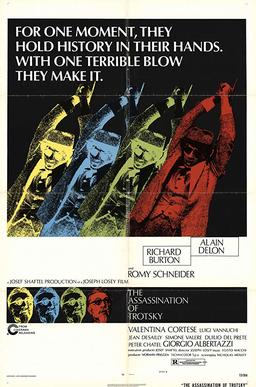
First released in 1972, The Assassination of Trotsky is a cinematic recreation of the events leading to the death of Leon Trotsky in Mexico. French actor Alain Delon plays Frank Jacson, the Spanish communist who was tasked with infiltrating Trotsky’s inner circle and assassinating him with a pickaxe. Welsh actor Richard Burton plays the Russian Trotsky, giving long-winded monologues about world revolution. Italian Valentina Cortese also plays a Russian, in this case Trotsky’s wife, Natalia. And finally, French actress Romy Schneider plays Gita Samuels, who is based on Jacson’s American girlfriend. This international cast was directed by Joseph Losey, an American director who joined the Communist Party in 1946 and who moved to Europe during the McCarthy era.
Losey was an interesting director. Though his first American feature film was the anti-war The Boy With Green Hair, the majority of his American films were on the pulpy side. Not surprisingly, his European films were far more open in their politics. Losey directed his share of undeniable masterpieces, like The Servant, Accident, and The Go-Between. At the same time, he also directed his share of misfires, the majority of which were bad in the way that only a bad film directed by a good director can be. The same director who gave the world The Go-Between was also responsible for Boom!
And then there’s The Assassination of Trotsky. It’s a bit of an odd and rather uneven film. Alain Delon’s performance as the neurotic assassin holds up well and some of his scenes of Romy Schneider have a true erotic charge to them. The scenes of Delon wandering around Mexico with his eyes hidden behind his dark glasses may not add up too much but they do serve as a reminder that Delon was an actor who could make almost any scene feel stylish.
But then we have Richard Burton, looking like Colonel Sanders and not even bothering to disguise his Welsh accent while playing one of the most prominent Russians of the early 20th Century. The film features many lengthy monologues from Trotsky, all of which Burton delivers in a style that is very theatrical but also devoid of any real meaning. As played by Burton, Trotsky comes across as being a pompous phony, a man who loudly calls for world revolution while hiding out in his secure Mexican villa. Now, for all I know, Trotsky could have been a pompous phony. He certainly would not have been the first or last communist to demand the proletariat fight while he remained secure in a gated community. The problem is that the film wants us to admire Trotsky and to feel that the world was robbed of a great man when Jacson drove that pickaxe into his head. That’s not the impression that one gets from watching Burton’s performance. If anything, Burton’s overacting during the assassination scene will likely inspire more laughs than tears.
The Assassination of Trotsky is one of those films that regularly appears on lists of the worst ever made. I feel that’s a bit extreme. The film doesn’t work but Alain Delon was always an intriguing screen presence. (Interestingly enough, Delon himself was very much not a supporter of communism or the Left in general.) The film fails as a tribute to Trotsky but it does make one appreciate Alain Delon.
Today is the 100th birthday of Edward D. Wood, Jr., the director who is often referred to as being “the worst director of all time.” Personally, I’ve never really agreed with that title. Ed Wood had a long career in Hollywood and yes, he may have worked exclusively in B-movies and yes, he eventually turned to softcore and then hardcore porn to pay the bills and yes, his life ended under rather tragic circumstances. But, unlike most truly bad directors, his films are still being watched today and, again unlike most bad directors, his style is immediately recognizable. You don’t need to see his name in the credits to know when a film was directed by Ed Wood. You just have to keep an eye out for stock footage, a few familiar actors, and a lot of angora.
If anything, Ed Wood was a director whose ambitions far outweighed the money that he could usually raise for his films. On the one hand, Plan 9 From Outer Space was a film where the strings holding the flying saucers were clearly visible and where a shower curtain was used to represent the door into an airplane’s cockpit. On the other hand, it was also a very sincere plea for world peace and a lament that humans would rather blow themselves up with Solarnite than work out their differences.
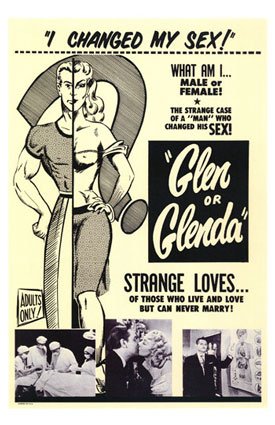
Or you take a film like 1953‘s Glen or Glenda. Ed Wood, who identified as a heterosexual and who was considered, by his friends, to be quite a womanizer (and it should be noted that young Ed Wood was strikingly handsome, though he was subsequently very badly aged by alcoholism and homelessness), also preferred to wear clothing designed for women and was open about it at a time when American culture was even more conformist-minded than usual. In Glen or Glenda, Wood plays the autobiographical role of Glen, who struggles to tell his fiancée (played by Wood’s real-life girlfriend, Delores Fuller) that he dreams of being able to wear her angora sweater. Glen’s story is told by a psychiatrist (Timothy Farrell) who is talking to a cop (veteran Hollywood character actor Lyle Talbot) who is investigating the death of a transvestite. Among other things, Glen or Glenda is known for its bad acting, stiffly delivered dialogue, and its occasional digressions about why men go bald while women do not. (It’s the tight-fitting hats, which cut-off blood flow to the head and not only cause men to lose their hair but also develop the Solarnite bomb.) But, at the same time, it’s a film in which Wood attempts to handle, with sensitivity and empathy, a subject that most films in the 50s would have either ridiculed or portrayed as being a threat to the American way of life. All of Wood’s films are sympathetic to those who are considered to be outsiders by conventional society. This is especially true of Glen or Glenda.
Of course, Glen or Glenda is also known for Bela Lugosi randomly appearing in a laboratory and shouting things like, “Pull ze string! Pull ze string!” As far as I can tell, Lugosi is supposed to be playing the creator, who is not portrayed as being a stereotypical God but instead as being a mad scientist who rants and raves in his library and his laboratory. And while it’s obvious that Bela was probably added to the film at the last minute and, more or less, allowed to do whatever the Hell he wanted, his presence adds a wonderfully bizarre touch to film’s dry style. (I would compare him to the mysterious burned man who appears at the start of David Lynch’s Eraserhead.) Whenever the film starts to get a bit too much like an educational film, Lugosi pops up and starts to literally shout at the audiences, frantically issuing a bunch of commands and nursery school rhymes that don’t really made any sense. It reminds one of H.P. Lovecraft’s insistence that the universe was created by a blind idiot God who had no idea that he was actually creating anything. The presence of Lugosi and a lengthy and increasingly surreal dream sequence in which Glen imagines himself being tormented by both his fiancée and the devil all suggest that, under different circumstances, Ed Wood could have been the American Buñuel.
Sadly, it was not to be. Ed Wood died in alcoholic poverty and was reportedly pretty miserable during the final years of his life. There was nothing pleasant about the end of Wood’s life. But, on his birthday, I think the least we can do is remove the title of “worst director” from his legacy. He was nothing of the sort.
The year is 1952 and one neighborhood in Brooklyn is on the verge of exploding.
A thug named Vinnie (Peter Dobson) holds court at a local bar. (His associates include the moronic Sal, who is played by a very young Stephen Baldwin.) Some nights, Vinnie and his associates mug people for money. Sometimes, they just attack people for fun.
A strike at the local factory has entered its sixth month, with management showing no sign of compromising and Boyce (Jerry Orbach), the head of the union, showing little concern for the men who are now struggling to feed their families. The local shop steward, Harry Black (Stephen Lang), is a self-important braggart who never stops talking about how he’s the one leading the strike. At home, Harry ignores his wife, with the exception of a violent quickie. On the streets, Harry embezzles money from the union and uses it to try to impress the men that he would rather be spending his time with. But even the men who Harry considers to be friends quickly turn on him when he is at his most pathetic.
Big Joe (Burt Young) is a proud union member who is shocked to discover that his teenage daughter (Ricki Lake) is 8-months pregnant. Despite being out-of-work and not caring much for Tommy (John Costelloe), Joe puts together the wedding that appears to be the social event of a shabby season. But even at the reception, violence lurks below the surface.
Georgette (Alexis Arquette) is a transgender prostitute who loves Vinnie, even after he and his idiot friends stab her in the leg while playing with a knife. Beaten at home by her homophobic brother (Christopher Murney), Georgette sinks into drug addiction.
Tralala (Jennifer Jason Leigh) is an amoral prostitute, one who specializes in picking up military men and then arranging from them to be mugged by Vinnie and his gang. Sick of being exploited by Vinnie, Tralala heads to Manhattan and meets Steve (Frank Military), an earnest soldier from Idaho. For the first time, Tralala is treated decently by a man but Steve is set to ship out to Korea in a few days and, as he continually points out, there’s a chance that he might not return. For all of the happiness she finds in Manhattan, Tralala is continually drawn back to her self-destructive life in Brooklyn.
First released in 1989 and directed by Uli Edel (who directed another film about desperation, Christiane F.), Last Exit To Brooklyn is based on a controversial novel by Hubert Selby, Jr. In fact, it was so controversial that the novel was banned in several countries and, for a while, was listed as being obscene by the U.S. Post Office. I read the novel in the college and it is indeed a dark and depressing piece of work, one that offers up very little hope for the future. It’s also brilliantly written, one that sucks you into its hopeless world and holds your interest no matter how bleak the stories may be. Due to its reputation, it took over 20 years for Last Exit to Brooklyn to be adapted into a film.
The film is actually a bit more positive than the book. One character who appears to die in the book manages to survive in the film. The wedding subplot was a minor moment in the book but, in the film, it’s made into a major event and provides some mild comedic relief. That said, the film is definitely dark. Almost every character is greedy and angry and those who aren’t are victimized by everyone else. Unfortunately, the film lacks the power of Selby’s pungent prose. As a writer, Selby held your attention even when you want to put the book away. When it comes to the film, the lack of Selby’s voice makes it very easy to stop caring about the characters or their stories. Even with the attempts to lighten up the story, the film is still so dark that it’s easy to stop caring. The non-stop bleakness starts to feel like a bit of an affectation.
And that’s a shame because there are some brilliant moments and some brilliant performances to be found in Last Exit To Brooklyn. An extended sequence where the police fight the striking workers is wonderfully directed, with the police becoming an invading army and the men on strike being transformed from just factory workers to rebels. The scene where Boyce informs Harry that he’s not as important as he thinks is wonderfully acted by both Jerry Orbach and Stephen Lang. As Tralala, Jennifer Jason Leigh gives a raw and powerful performance, whether she’s shyly accepting Steve’s kindness or drunkenly exposing herself to a bar full of lowlifes. In many ways, Tralala is the most tragic of all the characters to be found in Last Exit to Brooklyn. She’s tough. She’s angry. But, in the end, she’s ultimately the victim of men who are too stupid to understand anything other than aggression. The neighborhood applauds her when she confidently walks past a line of cops and strikebreakers but the same people who cheered for her later try to destroy her.
The film ends on an ambiguous note, with a peace that feels very temporary. The message seems to be that men are at their worst when they’re bored so perhaps it’s best to keep them busy, whether with a job or perhaps a wedding. It’s a flawed film but it sticks with you.
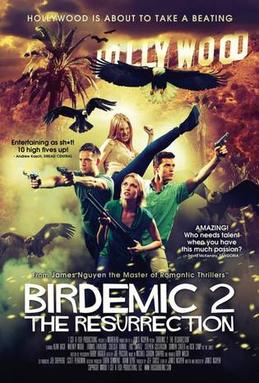
2013’s Birdemic 2 picks up four years after the end of the first film. Society has recovered from the vicious bird attacks. Humans and bird are once again living as friends. Actually, no one seems to have learned a thing from the last movie because global warming is still out of control, blood rain is falling in California, and a woman is attacked by what she calls a “giant jumbo jellyfish.” This can only mean that nature is getting ready to fight back once again.
Rod (Alan Bagh) was one of the few people to survive the previous Birdemic. He is still rich and he is still dating Nathalie (Whitney Moore). They adopted Tony (Colton Osborne), the little boy who they rescued during the first film. At one point, Tony mentions that his sister Susan is now dead, having died as a result of eating the fish that Rod caught in the first film. (Apparently, this was an ad lib from actor Colton Osborne and, since director James Nguyen doesn’t believe in multiple takes, it made it into the film.) Rod invests in a movie being directed by Bill (Thomas Favaloro) and starring Bill’s new girlfriend, Gloria (Chelsea Turnbo). In fact, Bill and Gloria pretty much act exactly the same way that Rod and Nathalie acted in the first film, which feels a bit redundant since Birdemic 2 already features Rod and Nathalie.
Anyway, there’s a lot of scenes in the film that are meant to act as a commentary on Hollywood, with craven studio people showing that they are not capable of understanding Bill’s artistic vision. At one point, Bill talks about how he directed a movie called Replica. He and Gloria also pay a visit to Tippi Hedren’s star on the Hollywood Walk of Fame because it wouldn’t be a James Nguyen film without a Tippi Hedren reference.
Unfortunately, a blood rain causes the resurrection of several birds and two cavemen from the La Brea tar pit and soon, filming on Bill’s movie is delayed by the cast and crew running for their lives. It’s pretty much the same as the first movie, except that the birds are now bad CGI as opposed to clip art and, for some reason, there are also zombies involved. Why are the zombies there? Who knows?
Birdemic 2 was made to capitalize on the camp success of Birdemic and several scenes from the original film are recreated for the sequel, right down to several pointless walking scenes, another boardroom celebration scene and another scene in which the female lead strips down to her underwear and asking her boyfriend if he likes what he sees. Damien Carter also makes another appearance, singing a different song and leading a new dance party. (Nathalie is still the best dancer in the Birdemic films.)
Birdemic 2 is a bit more self-aware than the first film, which means that some of the attempted humor is presumably intentional. Unfortunately, the charm of the first Birdemic was to be found in just how cluelessly earnest it was. James Nguyen sincerely believed he was making a good film with the first one. With the second one, he seems to be trying to re-capture something that he didn’t really realize that he had captured in the first place. That said, even with all of the deliberate camp, there’s enough lectures about climate change to leave little doubt that, at heart, Nguyen was still taking this film far more seriously than anyone else on the planet.
He certainly takes his films more seriously than the people who appear in them. Much as in the first film, Whitney Moore struggles to keep a straight face and it’s obvious that many of her co-stars were specifically hamming it up to see what they could get away with. Alan Bagh, for his part, remains as unexpressive but strangely likable as ever.
Birdemic 2 tries but, in the end, there’s no beating the original!
First released in 2010, Birdemic: Shock and Terror is a film that has a very specific reputation.
Chances are that, even if you haven’t watched the entire film, you’ve come across clips from Birdemic online. It’s the film where the birds attack humanity because of global warming. When the birds attack, they dive bomb the buildings below, exploding when they make contact. Whenever a bird attacks, it sounds like an airplane. Though the majority of the birds are described as being Eagles, they all sound like sea gulls. The birds themselves are all the result of cartoonish CGI, which leads to several scenes of the birds hovering in the air while the actors vainly shoot at them or try to wave them away with a clothes hanger.
Birdemic is famous for its bad acting. It’s famous for the conference room scene where a bunch of engineers and salespeople are told that they’ve all earned their stock options and they proceed to spend the next ten minutes or so applauding. Birdemic is famous for the scene where Damien Carter performs “Hanging With My Family” while the film’s stars dance in such a way that indicates that they couldn’t hear the song while they were filming. Birdemic is famous for director James Nguyen’s attempts to pay homage to Alfred Hitchcock, from the birds to the Vertigo-inspired scenes of people in San Francisco. Tippi Hedren is listed in the end credits, even though she only appears on television at one point.
Whenever I watch Birdemic, I’m struck by just how boring it is. Seriously, it takes forever to get to all of the stuff that the film is famous for. The birds don’t start attacking until nearly an hour into the film. Instead, the first part of the film is made up of awkward scenes of salesman Rod (Alan Bagh) dating aspiring model, Nathalie (Whitney Moore, giving the only adequate performance in the film). (In a typical example of their sparkling dialogue, Nathalie informs Rod that she’s just been hired by Victoria’s Secret. “I’m sure you’ll look great in their lingerie,” Rod replies.) We watch as Rod meets Nathalie’s mother and takes her to the movies and goes out to eat with her and eventually, they perform their infamous dance to Hanging With My Family. They also go to see An Inconvenient Truth, which really inspires Rod to think about what humanity is doing to the planet. Rod announces that he’s getting a hybrid.
The main thing that distinguishes Birdemic from other bad movies is just how seriously it takes itself. With all of its talk about the environment and how the birds are angry over what humans are doing to their planet, it becomes very obvious the Birdemic is a film with a message and James Nguyen sincerely believed that the solution to climate change was to get people to watch his movie. Birdemic was a film made to make people think, in much the same way that An Inconvenient Truth inspired Rod to think about getting a hybrid someday. Al Gore may have used a power point presentation to win an Oscar for himself. James Nguyen used some bad CGI birds and he didn’t win anything, other than the hearts of viewers.
It’s true that Birdemic is a film that caused people to think. Of course, few of those thoughts had to do with protecting the environment. Birdemic may have been too ambitious for its own good but it has still established a place for itself in our culture. Birdemic will never be forgotten.
In 2021, I finally saw the infamous film, The Bonfire of the Vanities.
I saw it when it premiered on TCM. Now, I have to say that there were quite a few TCM fans who were not happy about The Bonfire of the Vanities showing up on TCM, feeling that the film had no place on a station that was supposed to be devoted to classic films. While it’s true that TCM has shown “bad” films before, they were usually films that, at the very least, had a cult reputation. And it is also true that TCM has frequently shown films that originally failed with audiences or critics or both. However, those films had almost all been subsequently rediscovered by new audiences and often reevaluated by new critics. The Bonfire of the Vanities is not a cult film. It’s not a film about which one can claim that it’s “so bad that it’s good.” As for the film being reevaluated, I’ll just say that there is no one more willing than me to embrace a film that was rejected by mainstream critics. But, as I watched The Bonfire of the Vanities, I saw that everything negative that I had previously read about the film was true.
Released in 1990 and based on a novel by Tom Wolfe, Bonfire of the Vanities stars Tom Hanks as Sherman McCoy, a superficial Wall Street trader who has the perfect penthouse and a painfully thin, status-obsessed wife (Kim Cattrall). Sherman also has a greedy mistress named Maria (Melanie Griffith). It’s while driving with Maria that Sherman takes a wrong turn and ends up in the South Bronx. When Sherman gets out of the car to move a tire that’s in the middle of the street, two black teenagers approach him. Maria panics and, after Sherman jumps back in the car, she runs over one of the teens. Maria talks Sherman into not calling the police. The police, however, figure out that Sherman’s car was the one who ran over the teen. Sherman is arrested and finds himself being prosecuted by a power-hungry district attorney (F. Murray Abraham). The trial becomes the center of all of New York City’s racial and economic strife, with Sherman becoming “the great white defendant,” upon whom blame for all of New York’s problems can be placed. Bruce Willis plays an alcoholic journalist who was British in the novel. Morgan Freeman plays the judge, who was Jewish in the novel. As well, in the novel, the judge was very much a New York character, profanely keeping order in the court and spitting at a criminal who spit at him first. In the movie, the judge delivers a speech ordering everyone to “be decent to each other” like their mothers taught them to be.
Having read Wolfe’s very novel before watching the film, I knew that there was no way that the adaptation would be able to remain a 100% faithful to Wolfe’s lacerating satire. Because the main character of Wolfe’s book was New York City, he was free to make almost all of the human characters as unlikable as possible. In the book, Peter Fallow is a perpetually soused opportunist who doesn’t worry about who he hurts with his inflammatory articles. Sherman McCoy is a haughty and out-of-touch WASP who never loses his elitist attitude. In the film, Bruce Willis smirks in his wiseguy manner and mocks the other reporters for being so eager to destroy Sherman. Hanks, meanwhile, attempts to play Sherman as an everyman who just happens to live in a luxury penthouse and spend his days on Wall Street. Hanks is so miscast and so clueless as how to play a character like this that Sherman actually comes across as if he’s suffering from some sort of brain damage. He feels less like a stockbroker and more like Forrest Gump without the Southern accent. There’s a scene, written specifically for the film, in which Fallow and Sherman ride the subway together and it literally feels like a parody of one of those sentimental buddy films where a cynic ends up having to take a road trip with someone who has been left innocent and naïve as result of spending the first half of their life locked in basement or a bomb shelter. It’s one thing to present Sherman as being wealthy and uncomfortable among those who are poor. It’s another thing to leave us wondering how he’s ever been able to successfully cross a street in New York City without getting run over by an angry cab driver.
Because the film can’t duplicate Wolfe’s unique prose, it instead resorts to mixing cartoonish comedy and overwrought melodrama. It doesn’t add up too much. At one point, Sherman ends a dinner party by firing a rifle in his apartment but, after it happens, the incident is never mentioned again. I mean, surely someone else in the apartment would have called the cops about someone firing a rifle in the building. Someone in the press would undoubtedly want to write a story about Sherman McCoy, the center of the city’s trial of the century, firing a rifle in his own apartment. If the novel ended with Sherman resigned to the fact that his legal problems are never going to end, the film ends with Sherman getting revenge on everyone who has persecuted him and he does so with a smirk that does not at all feel earned. After two hours of being an idiot, Sherman suddenly outthinks everyone else. Why? Because the film needed the happy ending that the book refused to offer up.
Of course, the film’s biggest sin is that it’s just boring. It’s a dull film, full of good actors who don’t really seem to care about the dialogue that they are reciting. Director Brian De Palma tries to give the film a certain visual flair, resorting to his usual collection of odd camera angles and split screens, none of which feel at all necessary to the story. In the end, De Palma is not at all the right director for the material. Perhaps Sidney Lumet could have done something with it, though he would have still had to deal with the less than impressive script. De Palma’s over-the-top, set piece-obsessed sensibilities just add to the film’s cartoonish feel.
The film flopped at the box office. De Palma’s career never recovered. Tom Hanks’s career as a leading man was momentarily derailed. Bruce Willis would have to wait a few more years to establish himself as a serious actor. Even the normally magnanimous Morgan Freeman has openly talked about how much he hated being involved with The Bonfire of the Vanities. That said, the film lives on because De Palma allowed journalist Julie Salomon to hang out on the set and the book she wrote about the production, The Devil’s Candy, is a classic of Hollywood non-fiction. (TCM adapted the book into a podcast, which is how The Bonfire of the Vanities came to be featured on the station.) Thanks to Salomon’s book, The Bonfire of the Vanities has gone to become the epitome of a certain type of flop, the literary adaptation that is fatally compromised by executives who don’t read.
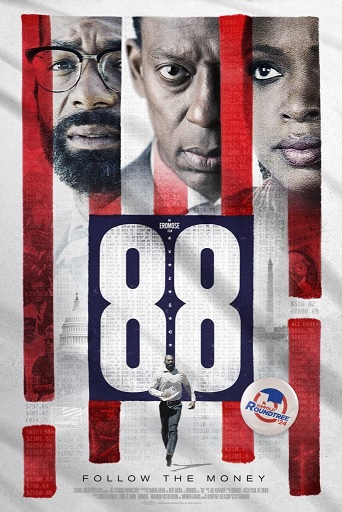
Femi Jackson (Brandon Victor Dixon) is a recovering alcoholic with a pregnant wife and a past-due mortgage who totally and completely believes in a presidential candidate named Harold Roundtree (Orlando Jones). A former baker-turned-politician, Roundtree is running for the 2024 Democratic presidential nomination on a platform of small government and personal responsibility. That really doesn’t sound like a platform for success in a Democratic primary but whatever. Let’s just go with it.
Femi has been hired as financial director for a SuperPAC that is raising money for the Roundtree campaign. Femi notices that many of the donations are being submitted in numbers that add up to 88. When he takes this news to his friend Ira Goldstein (Thomas Sadoski), Ira reveals that 88 is a code that Neo-Nazis use to identify each other. Femi and Ira do more digging and they discover that, throughout his entire life, Roundtree has been receiving financial aide from various rich men, all of whom sent Roundtree’s sums of money that all add up to 88. Femi questions why Neo-Nazis would do something that makes it so easy to identify them. Ira replies that they’re marking their territory.
While Howard Roundtree records an interview with a left-wing commentator (William Fichtner), Femi tracks down and meets with an elderly and repentant Neo-Nazi (Jonathan Weir), who now needs an oxygen tank to breathe and who lives in an isolated house with his black wife. Femi is later approached by a volunteer in the SuperPAC’s office, who informs him that the only way that White Supremacy can survive is by latching onto a black politician like Harold Roundtree. Femi and Ira prepare to meet with Rountree, with Femi still convinced that he has no idea who is secretly funding his campaign.
While this is going on, Femi’s wife (Naturi Naughton) tries to help an ex-con achieve a bank loan despite the opposition of her sister (who also works for the bank) while Femi’s son, Ola (Jeremiah King), gets in trouble at school for showing his classmates a video of a school shooting. It turns out that Femi’s brother-in-law is not only a cop but he’s also white and he agrees to drive Ola to school so that Ola can see that not all cops are bad. Ola’s obvious fear as he walks out to the squad car indicates that the experiment, no matter how well-intentioned, is probably not going to work.
88 is certainly an ambitious film and the opening minutes, which features Femi’s wife explaining why Black Panther is not the empowering and progressive film that Femi believes it to be, suggest that the film has the potential to be interesting. And throughout the film, there are little moments that do work, like the scene where Femi tells his son how to react if he’s ever pulled over by a cop. Unfortunately, the majority of the film is a clumsily-acted and talky mix of melodrama and heavy-messaging, one that tries to duplicate the style of Spike Lee’s agitprop but instead ends up feeling more like a secular and politically progressive version of the God’s Not Dead films than anything else. The film drags on for 2 full hours with Brandon Victor Dixon’s nerdy blandness failing to provide the narrative momentum to keep the action interesting. As well, Orlando Jones is perhaps the least convincing presidential front runner that I’ve ever seen in a film, speaking a cadences that appear to be specifically patterned on Barack Obama but suggesting none of the charisma that would be necessary to captivate a nation. Again, the film deserves some praise for having the ambition to actually be about something more than just selling toys and comic books but, in the end, it’s earnest dullness and heavy-handed messaging fails to hold one’s attention.
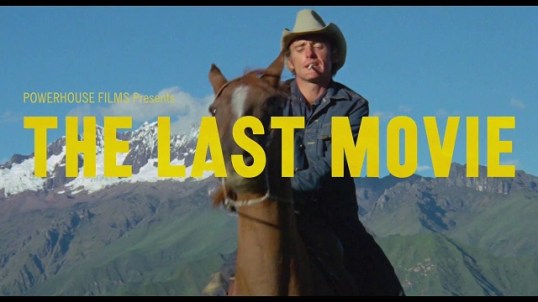
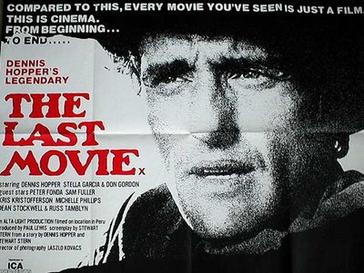
The story behind the making of 1971’s The Last Movie is legendary. It’s also a bit of a cautionary tale.
In 1969, Hollywood was stunned by the box office success of an independent, low-budget counter-culture film called Easy Rider. Easy Rider not only made a star out of Jack Nicholson but it was also the film that finally convinced the studios that the way to be relevant was not to continue to crank out big budget musical extravaganzas like Doctor Doolittle and Hello, Dolly! Instead, it was decided that the smart thing to do would be to hire young (or, at the very least, youngish) directors and basically just let them shoot whatever they wanted. The resulting films might not make much sense to the executives but, presumably, the kids would dig them and as long as the kids were paying money to see them, everyone would continue to get rich. Because Dennis Hopper had directed Easy Rider, he suddenly found himself very much in demand as a director.
Of course, almost everyone in Hollywood knew Dennis Hopper. Long before he became an icon of the counter-culture, Dennis Hopper had been a part of the studio system. John Wayne even referred to Hopper as being his “favorite communist.” Everyone knew that Dennis could be a bit arrogant. Everyone knew that Dennis was very much into drugs and that, as a result, he had a reputation for being a bit unstable. Everyone knew that Dennis Hopper deliberately cultivated an image of being a bit of a wild man and a revolutionary artist. But Dennis Hopper had just directed Easy Rider and Universal was willing to give Hopper some money to go down to Peru and direct his follow-up.
The Last Movie was a film that Hopper had been planning on making for a while. The film’s original script told the story of an aging and broken-down stuntman named Kansas who retires to Mexico and searches for a gold mine with a friend of his. Hopper first tried to get the film going in 1965, with Montgomery Clift in the lead role. After Clift died, Hopper tried to interest John Wayne in the starring role but, though Wayne enjoyed having Hopper in his films so that he could threaten to shoot him whenever Abbie Hoffman said something shocking, he had no interest in being directed by him. When Universal finally agreed to put up the money for the film, Hopper offered the lead role to Jack Nicholson. Nicholson turned it down and told Hopper that it was obvious that Dennis wanted to play the role himself. Dennis decided that he agreed with Nicholson and he cast himself as Kansas. Dennis also made the fateful decision to not only change the story’s setting to Peru but to also film on location.
Dennis and a group of friends flew down to Peru, which, at that time, was the cocaine capitol of the world. Drug use was rampant on the set, with Dennis reportedly being one of the main offenders. The cast and crew filmed during the day and partied at night and no one was particularly sure what the film was supposed to be about. Amazingly, Hopper finished filming on schedule and within budget but, much as he did with Easy Rider, he also overfilmed and ended up with 40 hours of footage. Not wanting to be bothered by the studios, Hopper edited the footage in his compound in Taos, New Mexico. Working slowly and continuing to consume a large amount of drugs and alcohol, Hopper still managed to put together a film that had a straightforward storyline. When Hopper showed his initial cut to filmmaker Alejandro Jodorowsky, the director of El Topo accused Hopper of being too conventional in his approach, which led to Hopper chopping up the film and reassembling it. Finally, after spending over a year working with the footage, Hopper turned in his final edit.
Universal had no idea what to make of the film that Hopper delivered to them. Still, they released it with the hope that the same crowd that loved Easy Rider would embrace The Last Movie. While the film did win an award at the Venice Film Festival, critics hated it and, even worse, audiences stayed away. The film’s reception was so overwhelmingly negative that Hopper found himself largely exiled from Hollywood, with only a few directors (like Francis Ford Coppola) willing to take the chance of working with him. It wasn’t until the 80s, when he finally got clean and sober, that Dennis Hopper was able to reestablish himself as a character actor and, ultimately, a beloved cultural institution.
But what about The Last Movie? Was is it really as bad as the critics claimed? Or was it, as some more recent reviewers have suggested, an unacknowledged masterpiece that was ahead of its time? I recently watched The Last Movie to find out for myself.
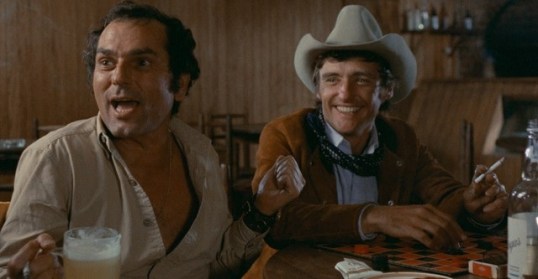
Despite its reputation, The Last Movie gets off to a pretty strong start. Samuel Fuller (playing himself) is directing a hilariously over-the-top and violent western in the mountains of Peru. Kansas (Dennis Hopper) is working as a stuntman. He’s fallen in love with a local sex worker named Maria (Stella Garcia). Kansas is meant to be an aging Hollywood veteran, someone who has broken a lot of bones and who carries a lot of aches as a result of his line of work. (One can see why Hopper initially imagined an actor like John Wayne in the role.) He knows that this is going to be his last job and, as we see over the first 25 minutes of the film, he feels alienated from the rest of the cast and crew. Admittedly, Hopper does appear to be a bit too young for the role. The ideal Kansas would have been someone like Ben Johnson, L.Q. Jones, or perhaps Warren Oates. But, still, Hopper does a good job of capturing Kansas’s mixed feelings about the western that’s being filmed around him.
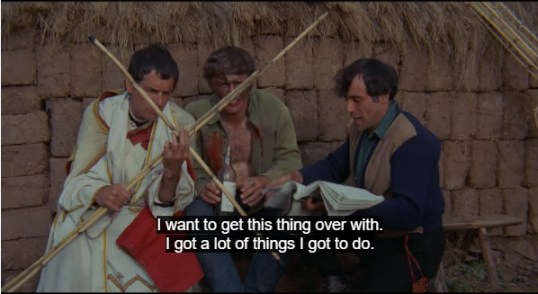
A lot of familiar faces pop up in the film’s fictional western. Dean Stockwell plays an outlaw. Jim Mitchum, Russ Tamblyn and Kris Kristofferson plays his associates. Peter Fonda is the youthful sheriff. Michelle Phillips is the daughter of the town’s banker and apparently, she’s also the girlfriend of one of the outlaws. We watch as the actors pretend to shoot guns and kill each other while the cameras are rolling, just to get up off the ground once “Cut” is yelled. When a local Indian who has been cast as an extra grows upset at the violence, an assistant director explains to him that no one really dies while the cameras are rolling. When shooting wraps, the film company goes home but Kansas stays behind with Maria. One day, the local priest (Tomas Milian) warns Kansas that the local indigenous people have moved into the abandoned film set and are trying to shoot their own movie. Kansas discovers that they have built wooden cameras and wooden boom mics and that their chief is giving orders in the style of Sam Fuller. They’re also firing the guns that the Americans left behind.
The first part of the film works quite well. Hopper’s camera captures the beautiful and isolated Peruvian landscape. The violent western is a pitch perfect and affectionate parody of a generic studio film. Though Hopper is a bit too young for the role, he still does a good job of capturing Kansas’s alienation from his fellow Americans. Even more importantly, the first part of the film seems to have an identifiable theme. The American film crew invaded an isolated part of Peru and changed the culture of the natives without even realizing it. Now, they’ve left but the natives are still dealing with the after effects of the American “invasion.” It’s easy to see, within that part of the story, a critique of both American culture and American foreign policy.
The second part of the film is where things start to fall apart. Kansas meets an old friend named Neville (Don Gordon). Neville has discovered a gold mine in the Peruvian mountains. With Kansas as his partner, he tries to get a businessman named Harry Anderson (Roy Engel) to invest in it. Kansas and Neville try to impress Harry and his wife (Julie Adams, best-known for being stalked by The Creature From The Black Lagoon). Kansas and Neville take the Andersons to a brothel and, in the process, Kansas offends Maria. Kansas then paws Mrs. Anderson’s fur coat and mentions that human beings are covered in hair. For all of their efforts, Harry will not invest, no matter how desperately Neville begs him to reconsider.
The second part of the film drags, with many of the scenes being obviously improvised between Hopper, Gordon, Garcia, Engel, and Adams. Unfortunately, the improved conversations aren’t particularly interesting and they tend to go on forever. Usually a reliable character actor, Don Gordon ferociously chews the scenery as Neville and it doesn’t take long before one grows tired of listening to him yell. (Gordon was far more impressive in Hopper’s Out of the Blue.) With the use of improvisation and overlapping dialogue, the second half of the film tries to feel naturalistic but instead, it’s a migraine-inducing method exercise gone wrong. It’s also during the second part of the film that a “scene missing” title card flashes on the screen, an indication that the discipline that Hopper showed as a director during the beginning of the film is about to be abandoned.
Finally, the third part of the film — well, who knows? The final 25 minutes of the film is collection of random scenes, some of which may be connected and some of which may not. The natives have decided that the only way to properly end their “film” is to kill Kansas. Kansas is shot several times and rides away on his horse. Suddenly, Kansas is back at his home and Maria is taunting him for getting shot. Then, Kansas is riding his horse again. Then suddenly, Dennis Hopper and Tomas Milian are laughing at the camera. A script supervisor tries to get Dennis to look at the shooting schedule while Dennis drinks. This happens:
Milian points out that the blood on Hopper’s shirt is dry. Hopper looks at his shoulder, where Kansas was previously shot, and says that someone needs to add his scar before he can shoot the scene. Ah! So, now we’re acknowledging that it’s all just a movie. Thanks, Dennis! Suddenly, Dennis is Kansas again and he’s collapsing over and over again in the dust. He appears to be dead but no, now he’s Dennis again and he’s standing up and smiling at the camera. And now, he’s singing Hooray for Hollywood. And now, suddenly, Kansas and Neville are talking about The Treasure of the Sierra Madre and then….
Well, let’s just say that it goes on and on before finally ending with a scrawled title card.
It’s a disjointed mess and it’s all the more frustrating because the first 30 minutes of the film is actually pretty good. But then, Dennis apparently remembered that he was supposed to be the voice of the counter-culture and he gave into his most pretentious impulses. Of course, just because a film is a mess, that doesn’t mean that it can’t be entertaining. And again, the first part of the film is entertaining and third part of the film is weird enough that it’ll hold most people’s attention for at least a few minutes. But the middle section of the film is so slow and pointless that it pretty much brings down the entire film.
In the end, what is The Last Movie about? In The American Dreamer(a documentary that was filmed while Hopper was editing The Last Movie in New Mexico), Hopper spends a lot of time talking about revolution and taking over Hollywood but The Last Movie is hardly a revolutionary film. The film is at its most alive when it is focused on the shooting of its fictional western. For all the satirical pokes that The Last Movie takes at the studio system, it’s obvious that Hopper had a lot of affection for Old Hollywood and for directors like Sam Fuller. Kansas may say “Far out,” but he’s hardly a hippie. Even the film’s jumbled finale seems to be saying, “It’s all Hollywood magic!” In the end, the film’s call for a new style of cinema is defeated by its love for the old style of cinema.
Instead, I think The Last Movie works best when viewed as a portrait of paranoia. Hopper himself admitted that he was naturally paranoid and the heavy amount of drugs that he was doing in the 70s didn’t help. One reason why Hopper filmed in Peru and edited in New Mexico was so the studios couldn’t keep track of him and, while directing, he worried about being arrested by the Peruvian secret police. As an actor, Hopper plays Kansas as being someone who views the world with caution and untrusting eyes. He doesn’t trust the other members of the film crew. He loves Maria but he’s still convinced that she’s going to betray him. Even the natives ultimately try to destroy him and the script supervisor tries to get him to stick to the shooting schedule. The film works best as a disjoined portrait of one man’s paranoid and fatalistic world view.
The Last Movie pretty much ended the studio’s attempts to harness the counter-culture by giving money to self-described revolutionaries. The new wave of directors — like Spielberg and Lucas — may have shared Hopper’s then-politics but they weren’t looking to burn down the system. (Hopper himself later became a Republican.) The Last Movie may not have been the literal last movie but it was, for a while at least, the last of its kind.
Ed Wood’s Plan 9 From Outer Space is the worst film of all time.
Everyone says it’s true
Well, you know what? Everyone is wrong! Plan 9 From Outer Space may be a low-budget film with some …. well, awkward performances. And the script may have some odd lines. And the story might not make any sense. And yes, there’s a scene in an airplane where the doorway to the cockpit is clearly a shower curtain. And yes, the spaceships are paper plates with strings attached. And Criswell’s campy narration makes no sense. And the guy that they brought in to serve as a stand-in for Bela Lugosi was clearly too tall and too young to be credible in the role. And the whole thing about bringing the dead back to life to keep Earthlings from developing the Solarnite bomb …. well, who knows where to even start with that? And….
Wait, where was I?
Oh yeah. Plan 9 From Outer Space. It’s not that bad, I don’t care what anyone says.
Here’s the thing with Plan 9. It’s about as personal an expression of an American director’s vision as we’re ever likely to get. Ed Wood was a pacifist who wanted to end the arm races. His way of trying to spread world peace was to make a movie about aliens so concerned about mankind’s warlike tendencies that they raised the dead. Somewhat subversively, Ed Wood makes it clear that he’s on the side of the aliens from the beginning. When the alien Eros explains that humans are about to build a bomb that can blow up sunlight and destroy the universe, the humans aren’t horrified. Instead, they’re intrigued. Eros says that humans are stupid and immature. The hero of the film promptly proves Eros to be correct by punching him out.
And so, the aliens fail. Even though they brought Tor Johnson, Bela Lugosi, and Vampira back from the dead, they still fail to change the terrible path of human history. Plan 9 From Outer Space is not just a weird sci-fi film. It’s a sad-eyed plea for peace and understanding. It’s a film that possesses it’s own unique integrity, one that sets it apart from all other cheap sci-fi films.
Of course, it’s also a lot of fun to watch on Halloween. Watch it, won’t you? And remember that Ed Wood, above all else, tried his best. Ed Wood wanted to save the world on a budget and, to do so, he made a science fiction film with his friends and he put a bunch of homemade UFOs on a string. He also wanted to give Bela Lugosi one great role and, indeed, Plan 9 would go on to become one of Lugosi’s best-known, non-Dracula films. Ed Wood had a lot of ambition and, in pursuing that ambition, he flew straight for the sun and dared the Solarnite bomb to take him down. Ed may have crashed into the sea but his vision will never be forgotten.
Plan 9 From Outer Space (1956, dir by Edward D. Wood, Jr)
4 Or More Shots From 4 Or More Films is just what it says it is, 4 shots from 4 of our favorite films. As opposed to the reviews and recaps that we usually post, 4 Shots From 4 Films lets the visuals do the talking!
This October, I’m going to be doing something a little bit different with my contribution to 4 (or more) Shots From 4 (or more) Films. I’m going to be taking a little chronological tour of the history of horror cinema, moving from decade to decade.
Today, we take a look at the late 50s!
8 Shots From 8 Horror Films: The Late 50s
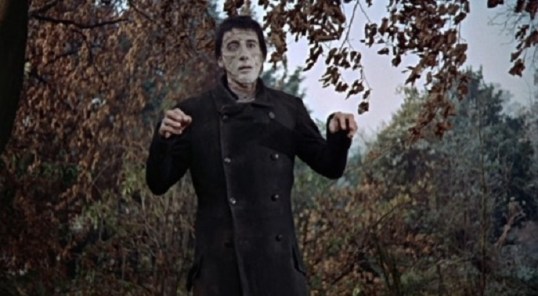
The Curse of Frankenstein (1957, dir by Terence Fisher, DP: Jack Asher)
Plan 9 From Outer Space (1957, dir by Edward D. Wood, Jr., DP: William C. Thompson)
Not Of This Earth (1957, dir by Roger Corman DP: John J. Mescall)
Horror of Dracula (1958, starring Christopher Lee as the Count, Dir by Terence Fisher, DP: Jack Asher)
Night of the Ghouls (1959, dir by Edward D Wood, Jr. DP: William C. Thompson)
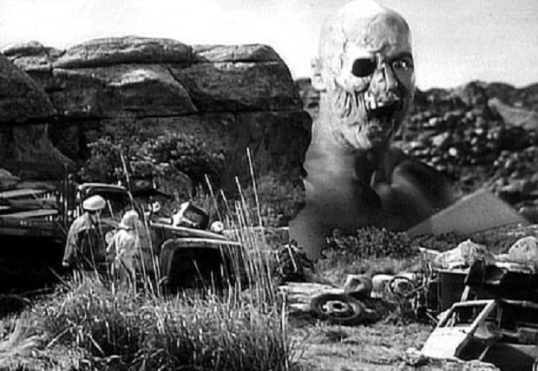
War of the Colossal Beast (1958, dir by Bert I. Gordon, DP: Jack A. Marta)
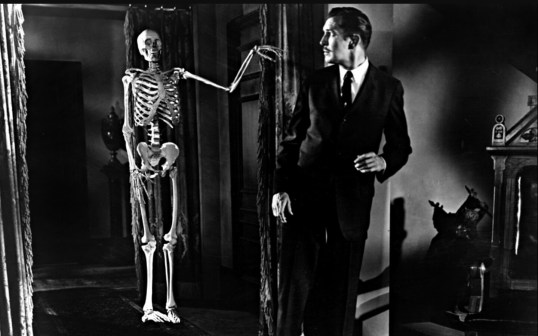
House on Haunted Hill (1959, dir by William Castle, DP: Carl E. Guthrie)
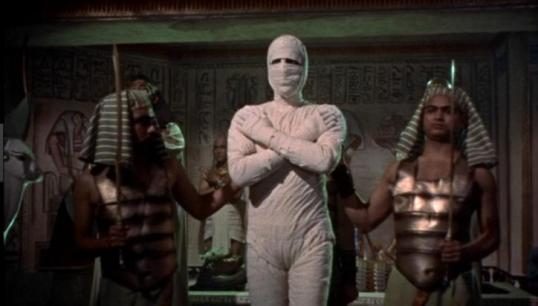
The Mummy (1959, dir by Terence Fisher, DP: Jack Asher)









 Through the Shattered Lens