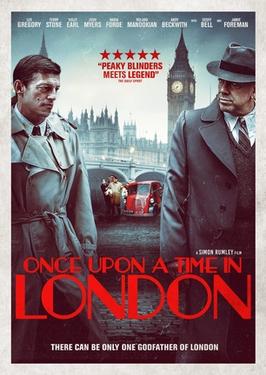
Once Upon A Time In London (2019, directed by Simon Rumley)


It’s not easy to make British gangsters seem boring but Once Upon A Time In London manages to do it.

Once Upon A Time In London deals with the period of time when British organized crime was still in its infancy, before the Krays came to power and made every London criminal with a good wardrobe into a minor celebrity.  The movie starts in the 30s with Jack Comer (Terry Stone) forming a crime syndicate out of a group of anti-fascists who originally came together to battle the members of Oswald Mosley’s pro-Nazi British Union of Fascists.  However, because that story would have possibly been interesting, the film then switches focus to Billy Hill (Leo Gregory), a younger gangster who used to work with Jack but who now wants to displace Jack as the top man in London organized crime.

It’s based on a true story and Jack Comer (or Jack Spot, as he was better known as) and Billy Hill were the type of flamboyant gangsters that could, in theory, be the subject of a really good movie.  Unfortunately, Once Upon A Time In London is not that film.  It’s a strange film, one that is overlong but which also feels as if it’s missing key scenes.  It’s often hard to follow why anyone is doing what they are doing.  The action skips from violent set piece to violent set piece but the film never takes the time to explain who is fighting who or for what reason so all of the violence doesn’t add up to anything.  The constant fights and torture scenes feel like they were lifted from other, better gangster films.  You’re never sure why Jack and Billy were working together in the first place so there’s no emotional stakes to their eventual rivalry.  That neither Terry Stone nor Leo Gregory gives a particularly interesting performance definitely does not help matters.

Once Upon A Time In London does deserve credit for its efforts to recreate the London of the 40s and 50s.  The clubs and the shabby suits all feel authentic and the dialogue is believably pungent, if not particularly interesting.  But, for all the care that went into recreating the era, the movie struggles to get us to care about any of it.

Once Upon A Time In London is disappointment.  There are many great stories to be told about British organized crime but this isn’t one of them.
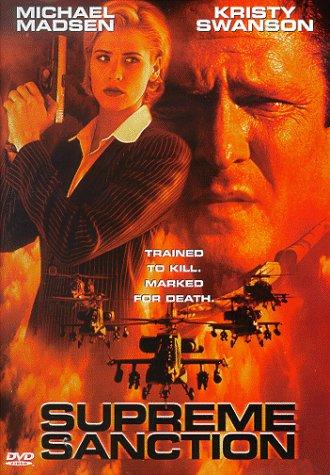
Cinemax Friday: Supreme Sanction (1999, directed by John Terlesky)


Jordan McNamara (David Dukes) is a world-renowned news reporter who is investigating why some U.S. Army helicopters were mysteriously shot down.  The sinister Director (Ron Perlman) doesn’t want McNamara to uncover the answers.  So, he dispatches Dalton (Michael Madsen) to take care of the problem.

Dalton leads a group of assassins but everyone knows that his best sniper is Jenna (Kristy Swanson).  Jenna has killed a countless number of people for Dalton but, when it comes to McNamara, she can’t bring herself to pull the trigger.  It’s because Dalton foolishly orders Jenna to take the shot while McNamara is on a beach with his daughter.  Jenna is not willing to kill a man in front of his daughter.  When Jenna refuses to pull the trigger, she becomes a target herself and she’s forced to go on the run with McNamara and her only friend, a hacker named Marcus (Donald Faison).

Supreme Sanction doesn’t feature any nudity or, for that matter, any sex but the presence of Michael Madsen and Kristy Swanson in the cast makes this feel like a late night Cinemax film nonetheless.  The movie starts out slow and David Dukes (a good actor who is strangely bland here) really isn’t believable as world-renowned journalist but things pick up once Jenna and McNamara go on the run.  The first time you see Kristy Swanson behind a sniper rifle, your instinct might be too laugh but she gives a surprisingly natural performance and, by the end of the movie, she’s actually a credible action heroine.  Meanwhile, in the role of Marcus, Donald Faison gets all of the good lines.  He’s a hacker and, since this movie was made in 1999, that means that he’s the comic relief who can do just about anything.

Not surprisingly, the movie is stolen by Michael Madsen.  Madsen gives a standard Madsen performance here, delivering all of his lines in a threatening whisper and smirking whenever anyone tries to talk back to him but, even if he doesn’t do anything new, he’s still entertaining to watch.  Madsen is one of the few actors who can easily switch between appearing in B-movies and major productions and that’s because it’s hard to think of anyone who can play a smug, overconfident villain as well as he can.

Supreme Sanction is an unapologetic B-movie and it’s pretty damn entertaining.

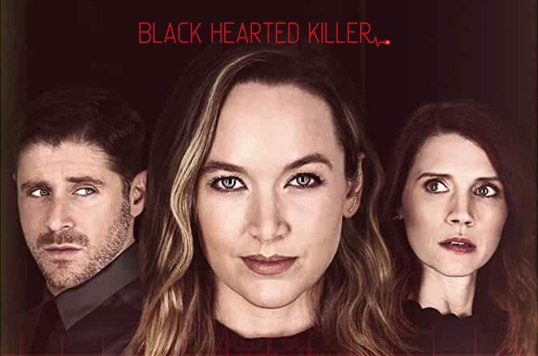
Cleaning Out The DVR: Black Hearted Killer (dir by Roxy Shih)


Earlier tonight, I continued my quest to clean out my DVR by watching the Lifetime film, Black Hearted Killer.  This originally aired on April 5th and I missed it because …. well, to be honest, I don’t remember why I missed it.  I mean, April 5th — that was like a month ago which, in 2020 time, is the equivalent of several years.  Well, whatever my reason for missing it was, I’m sure it was an acceptable one.  Fortunately, I set my DVR to record the film.

Black Hearted Killer tells the story of three people and one heart.  When their daughter is tragically killed in an auto accident, Juley (Julie McNiven) and Dennis (Jon Abrahams) agree to donate her organs.  They don’t want to know who is going to get their daughter’s organs but they do agree to allow the hospital to tell the recipients where the organs came from.  Months later, Juley and Dennis are approached by Vera (Kelley Jackle).  Vera tells them that she has their daughter’s heart beating away inside of her and that she owes her life to them.  Dennis is like, “That’s nice.  Go away now.”  Juley, however, invites Vera to become a part of their life.

Juley is still struggling to recover from her daughter’s death.  She’s still haunted by nightmares.  Having Vera around allows Juley to feel as if she’s close to her daughter.  Dennis, however, is more suspicious of Vera and the effect that she’s having on Juley.  Dennis suspects that Vera’s motives may not be pure.  Not surprisingly (because this is a Lifetime film after all), it turns out that Dennis is right.

Black Hearted Killer is an entertaining Lifetime film.  By this point, we all kind of know what the general plot of these films is going to be.  From the minute that Vera shows up, we know that she can’t be trusted just because she’s a stranger in a Lifetime films and strangers always turn out to be trouble in these films.  The fact that the plot is kind of predictable is really one of the main appeals of a film like this.  We don’t watch to be surprised.  Instead, we watch so we can shake our heads at characters who apparently haven’t seen as many Lifetime films as we have.  In this film, it didn’t really take Vera long to show her true nature and she was an entertaining psycho.  Kelley Jackle did a good job playing her and Julie McNiven and Jon Abrahams were both well-cast as the couple who she victimizes.  I also liked Juley and Dennis’s house which, as veteran Lifetime observes know, is a very important part of any successful Lifetime movie.  The nicer the house, the better the movie.

As I watched the film, I found myself thinking about organ donation.  I guess, if I died and my organs were donated to someone else, it wouldn’t bother me because I would be dead and I probably wouldn’t know what was happening.  A part of me does worry about getting stranded in Purgatory without my liver but I guess I’d make do.  Still, I would have to wonder who would end up with my mismatched eyes or my heart or my …. well, you get the idea.  I would hope it wouldn’t be anyone mean.  If you get one of my organs, treat it nicely.


Isle of Dogs (2010, directed by Tammi Sutton)


No, this is not the slow-moving Wes Anderson film from a few years back.

Instead, this is a film about a London crime boss named — don’t laugh — Darius (Andrew Howard).  Darius has an anger problem and it is not helped by all of the cocaine that he snorts at his club.  He also has a Russian wife named Nadia (Barbara Nedeljakova), a former prostitute who Darius says that he rescued.  Darius is insanely jealous.  When he suspects Nadia is having an affair, he takes the man who he suspects was her lover out to the countryside and, after a lot of yelling, eventually gets around to executing him.  The only problem is that Darius got the wrong guy!

Instead, Nadia’s lover is a low-level hood named Riley (Edward Hogg).  Nadia is waiting for Riley to show up at Darius’s country estate and take her away from her life as the trophy wife of an abusive psycho.  When a masked intruder shows up with a knife, things start to get more complicated.

Unfortunately, just because things get more complicated, that doesn’t mean that they get any more interesting.  For a film featuring frequent violence, graphic gore, and more than a little sex, Isle of Dogs is a remarkably dull affair.  A huge part of the problem is that the characters are never that interesting so you really don’t care when they lose a limb or are forced to commit a murder.  Darius, Nadia, and Riley are all stereotypes who will be easily recognized from other, better British gangster films.  At first, it seems like Andrew Howard’s energetic cursing might make bring some life to Darius but after a while, even Darius’s temper gets old.  I was hoping that the film would at least make good use of London but instead, the majority of the film takes place at Darius’s country estate, which looks like every other country estate.

There are some twists to the plot.  The film makes liberal use of flashbacks and flashforwards, though they don’t add up too much.  For some reason, there’s a scene of a naked Darius practicing his golf swing.  Someone loses an arm and barely flinches.  The film probably would have been better if Wes Anderson had directed it.  At least he would have brought along Bill Murray.

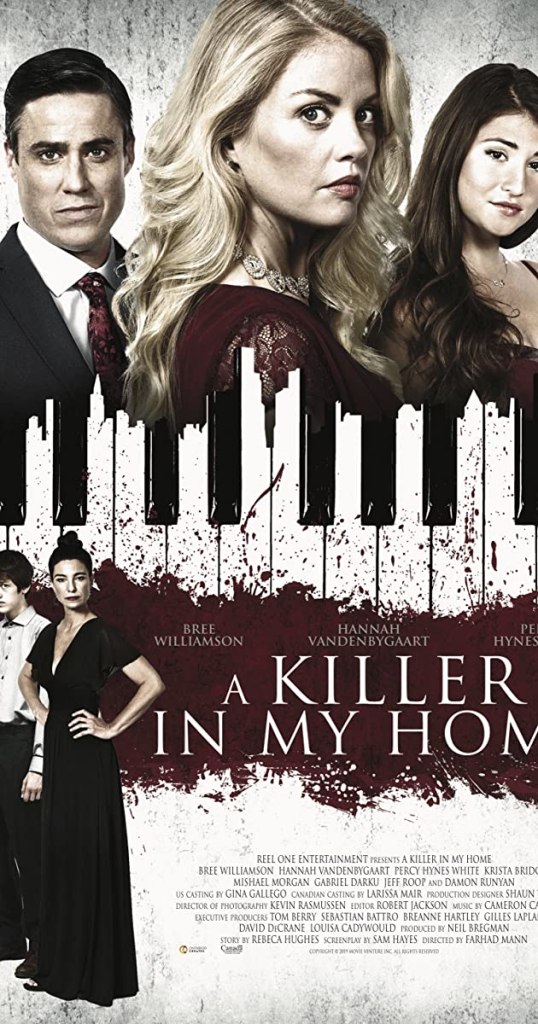
Cleaning Out The DVR: A Killer In My Home (dir by Farhad Mann)


When the lockdown was first announced down here in Texas, my initial reaction was, “Well, at least I can clean out my DVR now….”

Unfortunately, it didn’t really work out like that.  First off, I got caught up trying to work my way through my collection of DVDs and Blu-rays.  Then, I ended up getting distracted by my efforts to binge my way through The Sopranos, Oz, and Deadwood.  And suddenly, here we are!  It’s nearly June.  The lockdown is in the process of ending.  And I’ve barely made a dent on working my way through the 230 programs that I have on my DVR.

Earlier today, I decided to finally get to work by watching the Lifetime film, A Killer In My Home.  A Killer In My Home originally aired on the Lifetime Movie Network back in February.  I was on vacation at the time so my wonderful sister was nice enough to record it for me.  Watching it was an interesting experience, just because there weren’t any COVID-19-themed commercials.  Instead, there were a ton of commercials for Tom Steyer and Mike Bloomberg.  I mean, seriously — whenever you think about how bad 2020 may be right now, just remember that, even before everything shut down, we had to spend a month and a half dealing with the Tom and Mike charm offensive.

As for the film itself, it tells the story of Allison Wright (Bree Williamson) and her daughter, Hollie (Hannah Vandenbygaart).  Allison and Hollie appear to have the perfect life.  Not only do they live in a huge house but Hollie appears to have the perfect future ahead of her.  Soon, she’ll graduate high school, get a nice car, and go to a good college.  But then, Allison’s husband and Hollie’s father suffers a heart attack!  While he’s dying in the hospital, he’s visited by Jenna Fallon (Krista Bridges) and her withdrawn son, Joshua (Percy Hynes White).  When Allison demands to know why Jenna is visiting her dying husband, Jenna explains that she had an affair with Allison’s husband and Joshua was the result.  Apparently, Allison’s husband spent years visiting and financially supporting Jenna and Joshua.  Now that he’s dead, Jenna and Joshua have no one left to provide for them.

Now, if you were Allison, what would you do in this situation?

Would you say, “Tough shit, you whore.  Get out of here and take that bastard with you!”

Or

Would you say, “Why don’t you come live in our guest house?”

Now, to the film’s credit, Allison’s initial reaction is to tell Jenna and Joshua to go away.  However, a few weeks later, Allison has a change of heart and she allows Jenna and Joshua to move into the guest house.  Jenna and her son are supposed to stay away from the main house and out of Allison and Hollie’s lives.  Needless to say, things don’t work out like that.

Soon, strange things start to happen.  There’s a break-in at the house.  Despite her efforts to ignore him, Joshua still tries to talk his half-sister.  Jenna starts to throw biker-populated parties at the guest house.  Despite the fact that she claims to have no money, Jenna is able to buy her son an expensive jeep.  Allison comes to realize what we realized from the beginning: Jenna has sinister motives of her own!  The only question is whether or not Joshua shares those motives or if he’s just a pawn trapped in a game he didn’t intend to play.

A Killer In My Home is okay.  If I’m not as enthusiastic about it as I am about other Lifetime films, it’s because I never believed that Allison would 1) allow Jenna to stay in the guest house and 2) allow her to continue to stay in the guest house even after it became obvious that some seriously strange stuff was going on.  Allison lost my sympathy by doing that.  However, I did really like Krista Bridges’s performance as the unstable Jenna and I though Hannah Vandenbygaart gave a good and sympathetic performance as the daughter who is basically just sick of dealing with the adults in her life.  I could definitely relate.

Finally, the house was nice.  Lifetime movies always feature the nicest houses and A Killer In My Home featured one of the best!

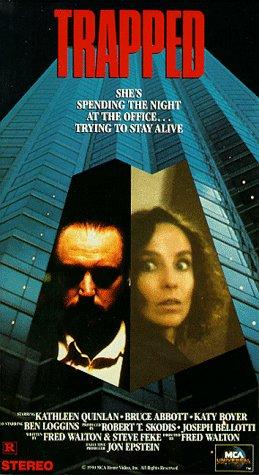
Trapped (1989, directed by Fred Walton)


A man (Ben Loggins) leaves his home one day, thinks about how his life has recently gone wrong, and then goes to an unfinished office building where he kills not only the people who he considers responsible but also anyone else who gets in his way.  Trapped in the building with him and trying to survive through the night until the doors automatically unlock in the morning are the building’s manager, Mary Ann Marshall (Kathleen Quinlan), and a corporate spy who is only willing to say that May Ann should call him John Doe (Bruce Abbott).

Trapped was produced for and originally aired on the USA network and it went on to become a USA mainstay for most of the 90s.  It’s a surprisingly violent and gory for a made-for-TV film from 1989 and the nearly-empty office building is an appropriately creepy setting.  Director Fred Walton does a good job of creating and maintaining a sense of suspense and he’s helped by three excellent lead performances from Kathleen Quinlan, Bruce Abbott, and especially Ben Loggins.  Loggins is credited as simply being “The Killer” and the film keeps his motives murky.  If you pay attention, you can discover what has driven him over the edge but the film is smart enough to concentrate on the cat-and-mouse game that he plays with Quinlan and Abbott.  One thing that sets Trapped‘s Killer apart from other psycho move stalkers is that Trapped‘s Killer is ambidextrous, carrying a dagger in one hand and a baseball bat in the other, making him even more intimidating than the typical movie psycho.  Kathleen Quinlan, an underrated actress who is probably best-known for playing Tom Hanks’s wife in Apollo 13, is also a feisty and likable heroine.

Don’t let its origin as a made-for-TV film scare you off.  Trapped is a good and suspenseful thriller.

The Things You Find on Netflix: The Stand at Paxton County (dir by Brett Hedlund)


The Stand at Paxton County, which is currently playing on Netflix, opens with an ominous title card warning us that what we’re about to see is “based on a true story.”

I may be alone in this but I find the term “based on a true story” to be fascinating.  It’s signifies that the film that we’re about to watch was inspired by something that actually happened but it’s not actually a recreation of that event.  It’s an invitation to watch and to try to figure out how much is true and how much is just a product of a screenwriter’s imagination.  “Based on a true story” is a real cinematic tease.

The Stand at Paxton County tells the story of Janna Connelly (Jacqueline Toboni), an army medic who is still haunted by her memories of serving in Afghanistan.  When her rancher father, Dell (Michael O’Neill), has a heart attack, Janna returns home to Paxton County, North Dakota.  What she discovers is that, after she left home, the ranch fell into disrepair.  Dell only has one ranch hand, a seemingly amiable doofus named Brock (Greg Perrow) and it doesn’t appear that Brock’s been doing a very good job.

When Sheriff Bostwick (Christopher McDonald) shows up to do a compliance check on the ranch, he finds a lot of problems.  When he returns with a cold-eyed veterinarian named Dr. Morel (Marwa Bernstein), Dell is informed that his ranch is in such disrepair that the sheriff can take away his livestock and essentially put Dell out of business!

How can the sheriff get away with this, Janna asks.  Dell explains that, years ago, the voters of the state voted down a proposition that would have given law enforcement the right to confiscate a rancher’s livestock.  However, a bunch of unelected lobbyists and left-wing activists went ahead and forced the law through the state legislature!  Now, the sheriff can pretty much do whatever he wants and anyone who tries to stand up for their Constitutional rights is subject to harassment and perhaps even murder!

While all of this is going on, Brock vanishes from the ranch.  It turns out that Brock is a professional bad employee who goes from ranch to ranch and goes out of his way to mess things up so that the ranchers lose their livestock.  The livestock is then sold to the highest bidder or sometimes the sheriff will just keep a horse for himself.  With Brock gone, Janna hires sexy Matt (Tyler Jacob Moore) to be the new ranch hand and then sets out to get justice for her father.

I had mixed feelings about The Stand at Paxton County.  On the one hand, I’m not a fan of the government regulation in general and I’m always happy to watch a libertarian-themed film.  Christopher McDonald’s smug and corrupt sheriff felt like a stand-in for all of the authoritarian-minded politicians and bureaucrats who have recently come out of the woodwork and used the COVID-19 pandemic to increase their own power.  (“Hey, it’s Clay Jenkins!” I said as soon as the sheriff showed up.)  So, on that level, I enjoyed the film.

Unfortunately, The Stand at Paxton County doesn’t just stick to criticizing the government for overstepping their authority.  Instead, it also portrays animal rights activists as being a part of a sinister financial conspiracy and that’s where it lost me.  It’s a lot easier to buy into the idea of a corrupt sheriff than it is to imagine the head of the PSCA sitting in a darkened war room and ordering his minions to torment one rancher, all so he can resell the rancher’s livestock.  That doesn’t mean that activists should be immune from criticism or that there isn’t a legitimate argument to be made that even well-intentioned regulations are vulnerable to abuse.  But the film’s portrayal of its central conspiracy just got a bit too cartoonish to be effective.  Once the villains went from being smug to being downright evil, it became impossible to take the movie seriously.  If the film had simply stuck to criticizing government overreach instead of imagining a shadowy conspiracy, it would have been a lot more effective.

The Stand at Paxton County has some lovely shots of the North Dakota countryside and Christopher McDonald is a wonderfully smarmy villain.  I always appreciate a film that has an anti-authoritarian subtext but The Stand At Paxton County is ultimately dragged down by its own heavy hand.

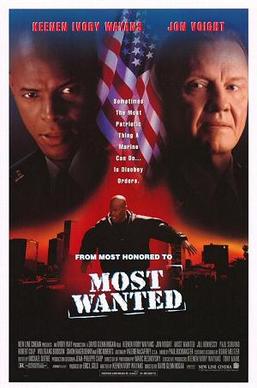
Most Wanted (1997, directed by David Hogan)


James Dunn (Keenan Ivory Wayans) is an army sergeant with a talent for getting framed for crimes that he didn’t commit.

During the Gulf War, Dunn’s superior officer orders Dunn to shoot a shepherd boy.  Dunn refuses and, when the two men get into a fight over a gun, his commanding officer is accidentally shot and killed.  The army refuses to listen to Dunn’s explanation.  He’s convinced of murder and sentenced to death.  However, while Dunn is on his way to Leavenworth, he is rescued by Col. Casey (Jon Voight).  Casey explains that he is giving Dunn a chance to join a super secret vigilante group that targets evil doers.  Yes, Dunn will be expected to assassinate people but they’ll all be bad.  With no other options available to him, Dunn agrees to work for Casey.

Dunn’s first target is the corrupt owner of a pharmaceutical company (played by Robert Culp) but — surprise — it turns out that the target was actually the First Lady and that the entire plan was to set up Dunn as a patsy!  Now a “most wanted” fugitive, Dunn is forced to go on the run with a doctor (Jill Hennessy) who recorded the assassination with a camcorder.  (Remember, Most Wanted was made during the days of the landline phones.)  With Casey and his second-in-command (played by Wolfgang Bodison) determined to kill him and with only Paul Sorvino (as the head of the FBI) doubting the official story, Dunn has to find a way to reveal the truth.

Though he was subsequently overshadowed by his brothers, Damon and Marlon, Keenan Ivory Wayans was a really big deal in the 90s.  As the man behind In Living Color, he proved that black comedians and writers could be just as funny (and, in many cases, funnier) than their white counterparts over at Saturday Night Live.  It can be argued Jim Carrey, Jamie Foxx, David Alan Grier, and Jennifer Lopez would not have the careers that they have today if not for Keenan Ivory Wayans.  (All of them first found fame as members of the In Living Color ensemble, Carrey, Foxx, and Grier as cast members and Lopez as a “fly girl.”)  Most Wanted was Wayans attempt to transform himself into an action hero (perhaps not coincidentally, a year before Most Wanted was released, Damon Wayans had a minor hit with Bulletproof).

Keenan Ivory Wayans not only starred in Most Wanted but he also wrote the script and it’s interesting just how straight the action is played.  It would be natural to expect Wayans to turn the movie into a spoof but there’s little intentional humor to be found in Most Wanted.  Most Wanted takes itself seriously and the end result is an adequate but hardly memorable action movie, with Wayans jumping off of buildings and fighting off the bad guys.  The action scenes are well-shot if not particularly imaginative but, unfortunately, Wayans doesn’t really have the screen presence necessary to be a believable action hero.  Both the character of James Dunn and Wayans’s performance are just too bland to really be compelling.  Far more interesting are Jon Voight and Paul Sorvino, who are both entertainingly hammy in their roles.

There’s one good scene in Most Wanted, where Dunn finds himself being chased by what appears to be the entire population of Los Angeles.  Otherwise, this one is adequate but forgettable.


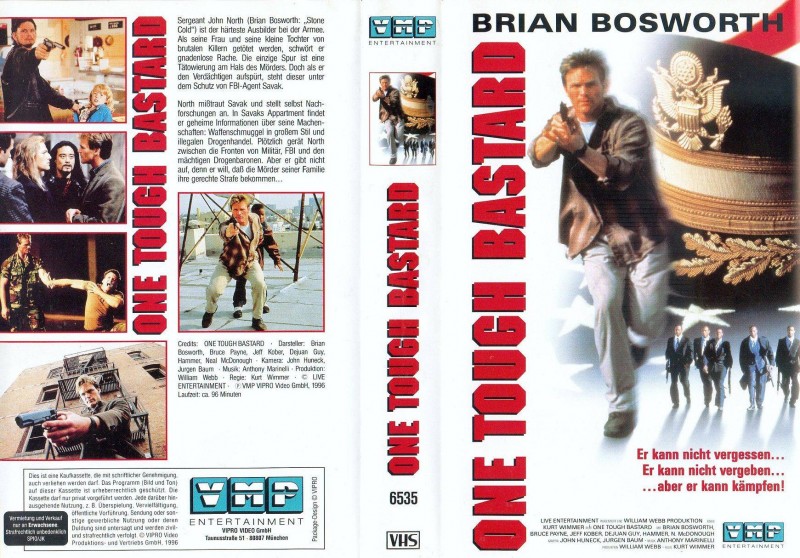
One Tough Bastard (1996, directed by Kurt Wimmer)


When the wife and the daughter of John North (Brian “The Boz” Bosworth) are gunned down by a mysterious gunman (Jeff Kober), North refuses to accept that they were just the victims of a robbery gone wrong.  Working with a tough street kid (DeJuan Guy) who needs a mentor to show him that violence is not the solution to all of the world’s problem, North sets out to discover the truth and get revenge in the most violent ways possible.  What North discovers is that the gunman who killed his family works for a corrupt FBI agent named Karl Slavak (Bruce Payne) and that Slavak is selling guns to a drug lord named Dexter Kane (played by … wait for it … MC HAMMER!)

You would think that any movie featuring M.C. Hammer as a drug lord would be worth seeing but the man who brainwashed a generation into making “U Can’t Touch This” jokes is actually pretty forgettable as Dexter.  This movie was made when Hammer had dropped the M.C. from his name and he was trying to reinvent himself as a harder-edged rapper.  That reinvention didn’t work because there’s absolutely nothing edgy about M.C. Hammer (much like Will Smith, he was the rapper whose music wouldn’t cause your parents to have an aneurysm) and One Tough Bastard proves it.

Instead, One Tough Bastard is worth seeing because of the epic meeting between two action stars who epitomized everything great about straight-to-video movies in the 90s, Brian Bosworth and Bruce Payne!  The Boz may have been a bust as a football player but he was a good action star, delivering one-liners and viscous beat downs with aplomb and, unlike some action stars (*cough* Seagal *cough*), he could play the dramatic scenes without embarrassing himself.  With his long hair and his nosering, Bruce Payne may be an unlikely FBI agent but he’s a great villain and he has no fear of shouting almost all of his dialogue.  Add in Jeff Kober and you’ve got a dumb but fun movie that’s enlivened by three actors who know how to be convincingly tough on camera.

One Tough Bastard lives up to the promise of its title.

Film Review: The American Dreamer (dir by Lawrence Schiller and L.M. Kit Carson)


Since today would have been Dennis Hopper’s 84th birthday, I decided to watch the 1971 documentary, The American Dreamer.

Filmed in 1970, between the success of Easy Rider and the release of Hopper’s infamous follow-up to that film, The Last Movie, The American Dreamer is a cinematic portrait of a very specific time in both Dennis Hopper’s life and American film history.  Dennis Hopper was 34 years old at the time The American Dreamer was shot and he was at the top of his career.  As a result of the success of Easy Rider, he was regularly touted as being the future of American film.  He was a self-styled revolutionary who specialized in spacey yet compelling monologues about how American movies were about to enter into a new age.  Eager to try to capture the same audience that had made Easy Rider a success, Universal Pictures gave Dennis Hopper a million dollars and allowed him to take the money to South America, where he used it to film The Last Movie, a film that was designed to show who Hopper truly was as a filmmaker.  The American Dreamer was filmed while The Last Movie was in post-production and we do see a few scenes of Hopper editing the film.

That said, Hopper doesn’t really seem to be too interested in talking about the specifics of The Last Movie.  He does talk a lot about how he’s leading a revolution that’s going to forever alter the American cultural scene but again, Hopper doesn’t really go into too many specifics when it comes to his artistic vision.  He’s more into slogans than details.  Fortunately, Hopper was a compelling speaker so he holds your attention regardless of how incoherent his frequent monologues are.  The American Dreamer may not convince you that Dennis Hopper was a great director but it does prove that he was a good actor.  In this film, he’s acting the role of being an outlaw and a visionary.

As vague as he is about his artistic vision, Hopper gets a bit more specific whenever he’s talking about his love of weed, sex, and guns.  In between leading encounter groups with all of the women who are living with him in New Mexico, Hopper brags about being such a considerate love that he’s a “male lesbian.”  In another scene, Hopper talks to three giggling girl in a bathtub.  He explains that free love is a part of the revolution and that he’s helping people get over their hang-ups.  It’s impossible not to cringe as Hopper comes across less like a lovable eccentric and more like one of those cult leaders who ends up living in a compound in Nevada and getting into a stand-off with the government.

Hopper’s a bit more likable when he’s filmed rolling a joint.  Watching the film, you can tell that he was a man who truly loved getting stoned and he actually lets down his guard a bit and grins once he’s ready to light up.  However, Hopper is probably at his most natural and likable when he’s shooting a gun in the desert.  Hopper spends a good deal of the film talking about his love for guns.  On the one hand, it’s a bit alarming as Hopper doesn’t exactly come across as being the most stable person on the planet.  On the other hand, Hopper appears to be having such a good time that it’s hard not to be happy for him.  Hopper explains that, when you’re an outlaw and you’ve living in New Mexico, you have to have guns for your own protection and he makes a pretty good argument.  One of the frequent misconceptions about Hopper is that he was a hippie.  (This despite the fact that Easy Rider more or less ridiculed the hippies.)  The American Dreamer, with its emphasis on individual freedom and the right to protect yourself, shows that, even during the height of the Hollywood counterculture, Hopper’s outlook was essentially libertarian.  Watching The American Dreamer, it’s easier to understand how Hopper went from directing Easy Rider to becoming one of the few Republicans in Hollywood.  Indeed, whenever the bearded and often unwashed Hopper is seen walking through the desert or firing a gun at a cross, he comes across less like the revolutionary visionary that he’s trying to be and more like an old soul in a new world.

With its frequent use of freeze frames and its intentionally ragged editing, The American Dreamer is very much a film of its era.  That’s actually the main appeal of The American Dreamer.  It captures a very unique and very specific point of time.  It captures an artist during the brief period between his biggest success and his greatest failure and while the film may be frustrating on a narrative level, it’s fascinating as a time capsule.  The film is probably more poignant when viewed today than it would have been back in 1971 because, today, we know that The Last Movie bombed and that Hopper’s revolution ended as quickly as it began.  It was not Dennis Hopper who determined the future of American film but instead Steven Spielberg and George Lucas.  Hopper struggled, both professionally and personally, through the rest of the 70s and the early 80s before finally kicking drugs and emerging as not just as an in-demand character actor but also something of a pop cultural icon.  Watching The American Dreamer, it’s fascinating to compare the older Hopper — the one who gave witty interviews and who joked about his past excesses — with the pretentious and self-serious Hopper of the early 70s.

Still, The American Dreamer shows that Dennis Hopper was always a compelling figure.  It’s impossible not to roll your eyes while watching and listening to the youngish Dennis Hopper but, nonetheless, you do continue to watch and listen.