Film Review: Speed (dir by Jan De Bont)


“Awwwww, Keanu and Sandra are so cute together!”

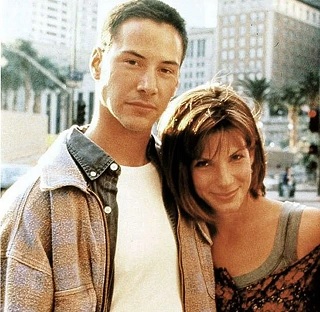
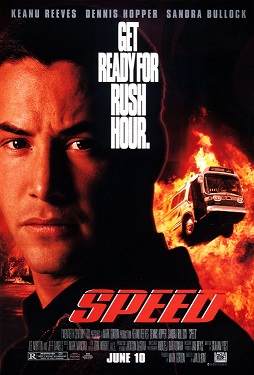
That was my main thought when I recently rewatched the 1994 film, Speed.  There’s a lot of reasons why Speed remains popular 28 years after it was initially released but I think a huge (if underrated) factor is that it’s just a good love story.  At this point, everyone knows that the film is about a bus that has been wired to explode if it goes under 50 miles per hour.  Most people know that Dennis Hopper plays Howard, the mad bomber, Keanu Reeves plays Jack, the cop who jumps on the bus and tries to figure out how to defuse the bomb, and Sandra Bullock plays Annie, the passenger who takes over driving the bus after the driver is incapacitated.  (If you’re fan of the work of John Hughes, you might also know that Speed was the film where Ferris Bueller‘s Alan Ruck broke free of his Cameron typecasting and established himself as a dependable character actor.)  Most people remember what the cops do in an attempt to trick Dennis Hopper and, for that matter, they also remember the one mistake that led to Hopper figuring out their ruse.

And yet, even though most viewers will know exactly what is going to happen, the film remains a fun watch because of the chemistry between Keanu Reeves and Sandra Bullock.  This was one of Sandra’s first major roles.  This was also one of Keanu’s earliest attempts to helm a big budget, major studio action picture.  (Director Jan de Bont insisted on casting him after seeing him in the film Point Break.  The studio preferred Tom Cruise.)  In Speed, both Keanu and Sandra are young, likable, attractive, enthusiastic, and they have smiles that light up the screen.  As soon as Sandra takes over driving and Keanu tells her that she cannot allow the bus to slow down under any circumstances, the two of them just seem to belong together.  The film’s enduring popularity is about more than just watching a bus try not to go under a certain speed.  The popularity of Speed is also about watching the characters played by Keanu and Sandra fall in love.

Who would have guessed it?  Well, certainly not whoever put together the film’s original theatrical trailer.  Check this out:

As you can see, the original trailer doesn’t feature much of Sandra Bullock.  For that matter, it’s not quite as Keanu-centric as you might expect it to be.  Instead, the trailer is dominated by things exploding and Dennis Hopper’s over-the-top performance as the bomber.  And make no doubt about it, Dennis Hopper is definitely an entertaining part of the film.  There’s not a subtle moment to be found in his performance and that makes him the perfect for the role of a man whose response to a cheap retirement present is to go on a bombing spree.  That said, the film belongs to Keanu and Sandra.

That said, it would be a mistake to ignore the other people on the bus.  One of the things that I like about Speed is that the other passengers on the bus come together to survive their ordeal.  They may start out as weary commuters but, by the end of the film, they’ve become a family.  They may get annoyed with each other but, when it comes time to climb from one bus to another, they hold on to each other and they hug one another on the other side.  The bomber, like all terrorists, thought that he could turn people against each other through his threats and his violence.  Instead, the people came together provided one another with comfort and protection.  There’s an important lesson there, one that’s even more important in 2022 than it probably was in 1994.

(On a personal note, I’m not usually a public transportation person.  However, in high school, I would occasionally catch the DART bus — that’s Dallas Area Rapid Transportation — if it was raining.  The buses were often not in particularly good shape.  One that I boarded actually had a hole in the floor and, since it was raining, the passengers would have to hold up their feet whenever the bus splashed through a puddle.  Personally, I was kind of amused by the weirdness of it all but I think I was the only one.  Would the passengers of that bus bonded together to defeat a mad bomber?  One can only hope.)

Speed may be a film about a bomb on a bus but, ultimately, it’s also a film about humanity at its best.  And that’s why, after all this time, it remains a classic.
International Film Review: Shanghai 13 (dir by Chang Cheh)


A Hong Kong-Taiwanese co-production that was first released in 1984, Shanghai 13 takes place during the early days of World War II in Asia, when the conflict was primarily viewed as being between Japan and China.  With the help of a thief named Black Hat (Jimmy Wang Yu), a low-level but patriotic Shanghai bureaucrat named Mr. Gao (Chiang Ming) steals a report that details the collaboration between Japan and a puppet regime that has been installed in Northern China.  Mr. Gao hopes to take the documents to Hong Kong, where he will be able to safely publish them and reveal just how corrupt the Chinese collaborators are.  Needless to say, the collaborators would rather this not happen and they are determined to assassinate Mr. Gao before he boards the last boat to Hong Kong.

Fortunately, Mr. Gao is not alone.  The 13 Rascals have been called in to protect Mr. Gao.  Who are the 13 Rascals?  They are a collection of talented marital artists and they are all patriots, determined to reveal the truth about what is happening in Northern China.  The 13 Rascals are played by an ensemble of Hong Kong and Taiwanese film veterans.  One appears after another, each getting their chance to show off what they can do while defending Mr. Gao.  Many of the rascals lose their lives to protect Mr. Gao but that seems to be the point of the film.  No sacrifice is too much when its done to protect the honor of one’s country.

To really understand what’s going on with Shanghai 13, it probably helps to know a bit about not only the Second Sino-Japanese War and the subsequent chain of events that led to the Republic of China relocating its central government to Taiwan.  My knowledge of these events is pretty much Wikipedia-level and I’m not going to present myself as being an expert.  That said, it’s pretty obvious that Mr. Gao, who is forced to leave his home city by a corrupt and ruthless government, is meant to serve as a stand-in for both Taiwan and Hong Kong (or, at least, Hong Kong before it was transferred to Chinese control).  Just as the Rascals will sacrifice their lives to protect Mr. Gao, they would do the same for Taiwan and Hong Kong.  The implication, of course, is that the audience should do the same.

Fortunately, if international politics are not your thing, Shanghai 13 can also be enjoyed as just a non-stop action film.  Admittedly, the film does get off to a bit of a slow start.  (If you’ve ever wanted to see every little detail of how to crack a safe, this is the film for you.)  Once the fighting begins, it’s pretty much nonstop and more than a little bloody.  Faces are kicked.  Bones are shattered.  Clawed gloves are worn.  One man carries a killer fan and laughs whenever anyone tries to remove it from his hands.  The film is full of Hong Kong and Taiwanese stars, all of whom get their chance to show off their moves and the majority of whom also get a dramatic death scene.  One man gets impaled a pole and still announces that he would rather die with honor than surrender.  (And, needless to say, he drops dead shortly afterwards.)  There’s enough slow motion to keep any slo mo of doom enthusiast happy.  The final battle takes place in a ship yard and features combatants jumping on top of shipping crates.  It’s exciting and weird.

Throughout it all, Mr. Gao stands in the background and watches.  Mr. Gao is not a fighter and he can only watch while everyone else in the movie sacrifices their lives so that Mr. Gao can reveal the truth about China’s puppet regime.  If this was an American film, I’m sure that the last-standing hero would probably get angry with Mr. Gao, much as Snake Plissken did with the President in Escape From New York.  But in Shanghai 13, all that matters is that Mr. Gao is a patriot.  He’s a man trying to protect his nation from a corrupt government and, for that reason, 13 people are willing to risk their lives to protect him.  We could use more people like the 13 Rascals.

4 Shots From 4 Films: Special Wes Craven Edition


4 Or More Shots From 4 Or More Films is just what it says it is, 4 shots from 4 of our favorite films. As opposed to the reviews and recaps that we usually post, 4 Shots From 4 Films lets the visuals do the talking!

83 years ago today, Wes Craven was born in Cleveland, Ohio.  Craven started his career as an academic, teaching high school English.  However, realizing that there was more money to be made in the film industry, Craven changed careers.  By his own admission, he started his career directing “hardcore, X-rated films” under a pseudonym and it has been rumored that he was a member of the crew of the first “porno chic” film, Deep Throat.  Eventually, Craven broke into the mainstream with some of the most influential and often controversial horror films ever made.  From being denounced for the original Last House On The Left to changing the face of horror with A Nightmare on Elm Street to becoming something of a revered statesman and a beloved pop cultural institution with the Scream franchise, Wes Craven had a truly fascinating career.

In honor his films and legacy, it’s time for….

4 Shots from 4 Wes Craven Films

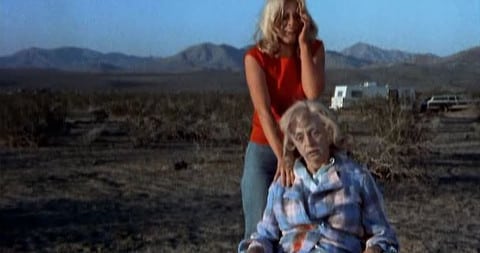
The Hills Have Eyes (1977, dir by Wes Craven, DP: Eric Saarinen)

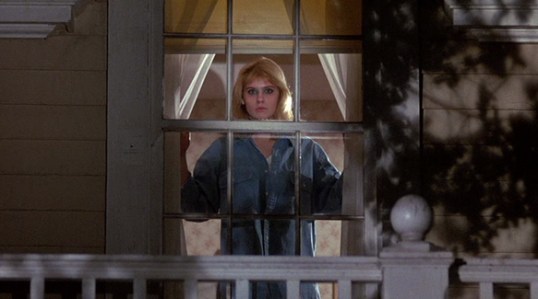
A Nightmare on Elm Street (1984, dir. by Wes Craven, DP: Jacques Haitkin)

Deadly Friend (1986, dir by Wes Craven, DP: Philip H. Lathrop)

The People Under The Stairs (1991, dir by Wes Craven, DP: Sandi Sissel)

Here’s The Trailer For Devotion


Just to state the obvious, this trailer definitely has a Top Gun feel to it.  I imagine that can be said about any film that features aerial combat.  Plus, Top Gun: Maverick‘s Glen Powell has a role in this film as well.  However, unlike Top Gun, Devotion is based on a true story and it takes place during the Korean War.

Devotion is due to be released in November, which is typically the Oscar season.  I have a feeling that, fairly or not, Devotion might be overshadowed by the monster success of Top Gun: Maverick but you never know.  Audiences might show their devotion to another film about planes and the pilots who fly them.

Here’s the trailer:

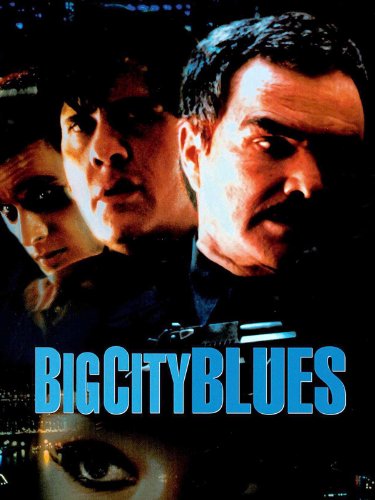
Big City Blues (1997, directed by Clive Fleury)


If you have ever wonder why Burt Reynolds, despite receiving an Oscar nomination for Boogie Nights and being a favorite of so many of the up-and-coming directors of the 90s and early 2000s, never made a real comeback, you only have to watch Big City Blues.

In Big City Blues, Burt plays a hitman who loves to watch and talk about old movies.  Over the course of one very long night, Burt and his partner (played by William Forsythe) drive through the city.  In between doing violent jobs for their boss, they talk.  Burt talks about movies.  Forsythe talks about how he doesn’t understand Burt’s love of the movies.  They talk nonstop and if this is making you think of Pulp Fiction, it’s probably intentional.  Today, I think people forget just how many Pulp Fiction rip-offs were released throughout the 90s, all featuring talkative criminals who were obsessed with pop culture.  Burt Reynolds and William Forsythe have got the equivalent of the roles played by John Travolta and Samuel L. Jackson.  Unfortunately, Reynolds and Forsythe don’t have the same chemistry as Travolta and Jackson.  You believed that Travolta and Jackson had been working together for years and, when they talked, that they were having an actual conversation.  Despite both of them being credited as executive producers on the film, Reynolds and Forsythe come across as being two talented actors who are phoning it in for a paycheck.

When the film isn’t focused on Reynolds and Forsythe, it follows two trans women (played by Giancarlo Esposito and Ayre Gross) as they walk around the city and debate whether or not Esposito should get sex reassignment surgery.  When it’s not following Esposito and Gross, it’s focusing on a sex worker (Georgina Cates) who wants to be a movie star and who keeps seeing evidence that she has a doppelganger who is living the respectable life that she craves.  Cates searches for her doppelganger while also servicing her clients, who are all typical middle-aged pervs.  (One gets off from listening to Cates sing Ol’ McDonald Had a Farm.)  Eventually, the paths of all the characters cross and Reynolds talks about how life is just celestial roulette.

Big City Blues doesn’t add up to much.  Like many 90s indie films, the characters are all talkative to the point of feeling like parodies.  (When the movie isn’t trying to rip-off Quentin Tarantino, it feels like a half-baked imitation of Richard Linklater.)  Even the likable performances of Cates, Esposito, and Gross can’t overcome how overwritten and derivative the script feels.  Beyond the script, the film just looks bad.  All of the scenes take place at night and the lighting is often so dark that it’s impossible to see what’s actually happening from scene to scene.  It feels amateurish.

So why was Burt Reynolds in this?  This was the first film that Reynolds made after the filming of Boogie Nights.  Probably thinking that Boogie Nights would flop, Reynolds signed up to appear in this Pulp Fiction knock-off, which is something that many former stars did in the 90s.  Instead of flopping, Boogie Nights turned out to be the film that reminded everyone that Reynolds could be a very good actor with the right material.  Unfortunately, Reynolds himself didn’t think much of the film and, perhaps even worse as far as Hollywood was concerned, he was open about not thinking much of the film.  As a result, even with that Oscar nomination, Reynolds didn’t get the type of career resurrection that John Travolta got from Pulp Fiction and Robert Forster and Pam Grier got from Jackie Brown.  That’s too bad.  Burt  Reynolds deserved better.

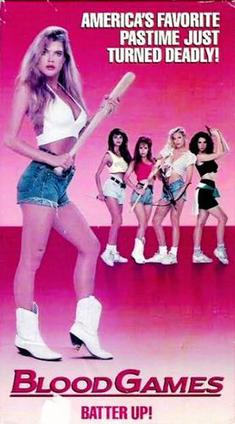
The TSL’s Grindhouse: Blood Games (dir by Tanya Rosenberg)


First released in 1990, Blood Games opens with a birthday celebration gone terribly wrong.

Somewhere in the rural South (at least, I assume it’s meant to be the South if just because of the big Confederate flag that appears in one scene), Roy Collins (Gregory Cummings) is celebrating his birthday.  Roy’s father, Mino (Ken Carpenter), has invited Babe and the Ball Girls, a women’s softball team, to come to town to play an exhibition game against Roy and the local boys.  When Babe (Laura Albert) and her team not only beat but also thoroughly humiliate the hometown team, Mino doesn’t take it well.  He yells at Roy and Roy and his idiot friend, Holt (Don Dowe), decide to get revenge.  After Roy is killed while trying to assault one of the girls, Mino gathers all of the rednecks together and declares, “I WANT JUSTICE!”  Everyone in town grabs a shotgun, jumps in a pickup truck, and heads off in pursuit of the Babe and the Ball Girls tour bus.

It shouldn’t come as a surprise to anyone that the bus itself breaks down in the middle of the woods and the team is forced to hike to safety while being pursued by Mino, Holt, and all of the rest of the shotgun toting locals.  It turns out that Mino is a deadly shot with a crossbow and Holt, at times, seems to be close to indestructible.  However, it also turns out that Babe and the Ball Girls are far tougher than any of the men expected.  The film reaches its bloody conclusion at a deserted farm, complete with a dramatically-scored flashback montage that reminds us of everyone whose life was lost during Roy’s birthday weekend.

Just to state the obvious, Blood Games is just as exploitive as it sounds.  This is the type of film where, early on, the action stops so the camera can linger on Babe and the Ball Girls in the locker room after they win their game.  (George “Buck” Flower shows up as the redneck who inevitably ends up peeking in at them.)  The team’s uniforms were probably popular with the film’s target audience but short shorts and crop tops don’t really seem practical for a game that would involve sliding through the dirt and the weeds on the way to home plate and, as a Southern girl who spent many a summer in the country while growing up, I cringed a bit when I thought about all the bugs that were probably in the grass and the dirt, waiting for a chance to hop onto a bare leg.  (It didn’t help that the game was apparently just being played in some random field.)

And yet, as exploitive as many viewers will undoubtedly find Blood Games to be, the film definitely works.  The rednecks are so loathsome and they overreact so severely to losing one game to a team of girls that it’s impossible not to cheer when Babe and the Ball Girls turn the tables on their pursuers.  “Batter up!” the film’s trailer announces and it is true that the Ball Girls use the same teamwork that won them the game to survive in the wilderness.  At the same time, they also use baseball bats, ropes, guns, and anything else they can get their hands on.

The acting is a bit inconsistent, though Don Dowe and Ken Carpenter are both well-cast as the main villains.  Dowe plays Holt as being someone who knows that he’s in over his head but who is too weak-willed to go against the mob.  The fact that he’s weak makes him all the more dangerous because a weak man will do anything to try to convince others that he’s strong.  Carpenter, meanwhile, is chillingly evil as Mino, who quickly goes from mourning his son to taking a sadistic pleasure out of hunting down human beings.  The film’s real strength is to be found in Tanya Rosenberg’s direction.  Along with keeping hte movie moving at a fairly steady pace, Rosenberg also captures the atmosphere of being lost in the country in the summer.  Watching the film, you can literally feel the heat rising from the ground and hear the cicadas in the distance.

Incidentally, I convinced my sister to watch this film with me because I assumed it was a baseball movie.  However, as Erin quickly pointed out to me, it instead turned out to be a softball movie.  I have no idea what exactly the difference is between baseball and softball but Erin assures me that there is one.  Well, no matter!  Whether it was softball or baseball, Babe and the Ball Girls did a good job striking out the hometown boys.

Batter up!

Film Review: Clue (dir by Jonathan Lynn)


It was a dark and stormy night in 1954….

The 1985 comedy, Clue, opens with a set of six strangers arriving at an ominous mansion in New England.  They’re meet by Wadsworth (Tim Curry), an oddly charismatic butler who explains that all six of the strangers have a few things in common.  They all work in Washington D.C.  They are all, in some way, involved with the government.  And they’re all being blackmailed by Mr. Boddy (Lee Ving), the owner of the house.

The six strangers have all been assigned nicknames for the night.

Miss White (Madeleine Khan) is the enigmatic widow of a nuclear physicist who may have had communist sympathies.  Actually, Miss White is a widow several times over.  All of her husbands died in circumstances that were a bit odd.  Is Miss White a black widow or is she just unlucky?  And what about the flames of jealousy that she occasionally mentions?

Professor Plum (Christopher Lloyd) is a psychiatrist who once worked for the World Health Organization and who has an unfortunate habit of sleeping with his patients.

Mr. Green (Michaele McKean) explains that he works for the State Department and that he is also secretly gay.  If his secret got it, he would be deemed a security risk or perhaps even a communist agent.

Mrs. Peacock (Eileen Brennan) is the wife of a U.S. Senator who forced to resign after getting caught up in a bribery scandal.

Colonel Mustard (Martin Mull) is a somewhat stuffy war hero-turned-arms dealer.

And finally, Miss Scarlet (Lesley Ann Warren) is Washington D.C.’s most powerful and most witty madam.

Once everyone is in the house, Wadsworth explains that the police have been called and will arrive in 45 minutes, at which point Mr. Boddy will be arrested and everyone’s secrets will be exposed.  Mr. Boddy’s solution is to suggest that one of the six kills Wadsworth.  After tossing everyone a weapon, Mr. Boddy turns out the lights.  When the lights come back on, Wadsworth is still alive but Mr. Boddy is not.  But who murdered Mr. Boddy?  And in what room?  And with what weapon?  And what to make of the other people who were either in the house or show up at the front door, like the maid, Yvette (Collen Camp), or the motorist (Jeffrey Kramer) who shows up to use the phone or the traveling evangelist (Howard Hesseman)?  Can the mystery be solved before the police show up and presumably arrest everyone?

Based on the old board game, Clue is a hilariously exhausting film, one that mixes smart wordplay and broad physical comedy to wonderful effect.  It’s not often that you see a film that gets equal laughs from two people colliding in a hallway and from characters accusing each other of being communists.  In fact, it’s so easy to marvel at the physical comedy (especially the lengthy scene where Tim Curry runs from room to room while explaining his theory about who committed the murders) that it’s easy to forget that the film is also a sharp satire on political corruption, national paranoia, 50s morals, and the McCarthy era in general.  Since all of the characters are already convinced that they’re either surrounded by subversives or in danger of being accused of being a subversive themselves, it’s not a great leap for them to then assume that any one of them could be a murderer.  I mean, if you’re willing to betray your country than who knows what you might be willing do in the study with a candlestick?

The cast is full of comedy veterans, all of whom know how to get a laugh out of even the mildest of lines and none of whom hold back.  Madeline Kahn, in particular, is hilarious as Miss White though my favorite suspect, in both the game and the movie, has always been Miss Scarlet.  Not only is she usually portrayed as being a redhead in the game but, in the movie, her dress is to die for.  In the end, though, it’s perhaps not a surprise that the film is stolen by Tim Curry’s energetic performance.  The film’s final 15 minutes are essentially a masterclass in physical comedy from Tim Curry but he’s just as funny when he’s delivering his frequently snarky dialogue.  Both Wadsworth the character and Tim Curry the actor appear to be having a blast, running from room to room and shouting out accusations.

When Clue was originally released, it was released with three different endings.  Apparently, the audience wouldn’t know which ending they were going to get before the movie started.  I guess that the idea was to get people to go the movie three times to see each ending but I imagine few filmgoers had the patience to do that and who knows how many viewers went to multiple showings just to discover that the randomly selected ending was one that they had already seen.  I’m surprised that I haven’t come across any reports of riots breaking out.  Fortunately, the version of Clue that is now available for viewing features all three endings.  Of course, none of the endings make much sense.  Hercule Poirot would demand a do-over, especially if he was being played by Kenneth Branagh.  But the fact that it’s all so ludicrous just adds to the comedy.  I watched Clue two Fridays ago with a group of friends and we had a blast.  It’s definitely a movie that’s more fun when you watch it with other people.

(That said, as far as incoherent solutions are concerned, the third one was my favorite and I think Poirot would agree.)

As for the board game itself, I used to enjoy playing it when I was a kid.  We had really old version from the 60s and I always used to imagine what all of the suspects were like when they weren’t being accused of murder.  I always imagined that Mr. Green and Miss Scarlet probably had something going on.  Today, I’ve got a special Hitchcock edition of the game.  It’s all good fun, this never-ending murder mystery.

Scenes That I Love: The Underground Chase From Skyfall


Today, the Shattered Lens wishes a happy birthday to director Sam Mendes!

Now, it’s true that Sam Mendes won an Oscar for directing American Beauty and he probably came close to winning a second one for his work on 1917.  However, my favorite Mendes film remains Skyfall.  Skyfall is one of the best of the Bond films and I say this as someone who was not really a fan of Daniel Craig’s mopey interpretation of the character.  Based on his previous films, Sam Mendes may not have been the first name that come to mind when people talked about someone who could make a great Bond film but, with Skyfall, he did just that.

Here, in a scene that I love, James Bond pursues Silva (Javier Bardem) through the London Underground.  It’s very suspenseful, very droll, and, most importantly, very British.

4 Shots From 4 Films: Special J. Lee Thompson Edition


4 Or More Shots From 4 Or More Films is just what it says it is, 4 shots from 4 of our favorite films. As opposed to the reviews and recaps that we usually post, 4 Shots From 4 Films lets the visuals do the talking!

108 years ago today, the director J. Lee Thompson was born in Bristol, England.  Thompson started his career making social realist films before he moved into making genre pictures.  He was nominated for Best Director for his work on 1961’s The Guns of Navarone.  That said, during his lifetime, Thompson was never exactly a critical favorite.  When they were first released, critics were dismissive of his entries in the original Planet of the Apes franchise and they were downright hostile to his work with Charles Bronson.  However, all of those films were better appreciated by audiences and they remain cult classics to this day.  Conquest of the Planet of the Apes, with its themes of protest and revolution, has especially been the subject of much recent critical reevaluation.  Thompson may have been a genre director but that didn’t mean that his film were devoid of subtext.  If anything, Thompson was a master of sneaking subversive themes into the least likely of works.

Thompson was a filmmaker who knew how to tell a story and who always did the best with whatever he had to work with.  To be honest, many aspiring and working directors could learn a lot from spending a weekend watching some of Thompson’s films.

In honor of the man and his legacy, here are….

4 Shots From 4 J. Lee Thompson Films

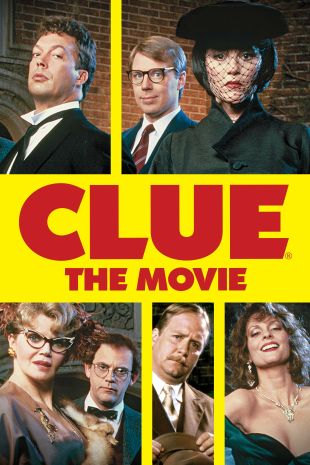
Cape Fear (1962, dir by J. Lee Thompson, DP: Sam Leavitt)

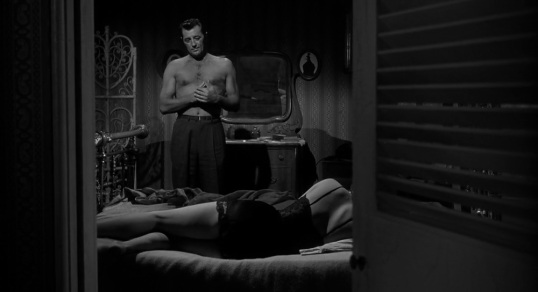
Conquest of the Planet of the Apes (1972, dir by J. Lee Thompson, DP: Bruce Surtees)

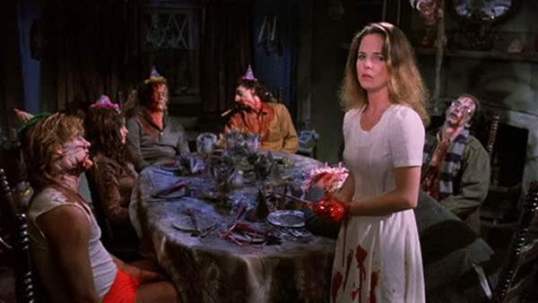
Happy Birthday To Me (1981, dir by J. Lee Thompson, DP: Miklos Lente)

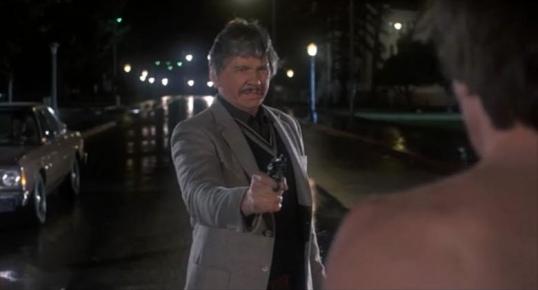
10 To Midnight (1983, dir by J. Lee Thompson, DP: Adam Greenberg)

Every Generation Gets The Spider-Man It Deserves


August 1st is Spider-Man Day.  Despite this being the day that observes Spider-Man’s first appearance in the 15th issue of Marvel’s Amazing Fantasy, the trash is still being collected and the mail is still being delivered.  Spider-Man Day is a holiday when no one gets any time off.  I’m sure that the web slinger himself would appreciate the irony.

The appeal of Spider-Man has always been that he’s the hero who never feels that he’s done enough.  He’s also the hero who is almost always unappreciated by the rest of the world.  He’s the hero who often resents having to do his job but who still feels a responsibility to try to make the world a better place.  Spider-Man is the superhero that almost everyone can relate to.

As far as television and movies go, every generation has gotten the Spider-Man that they deserved.

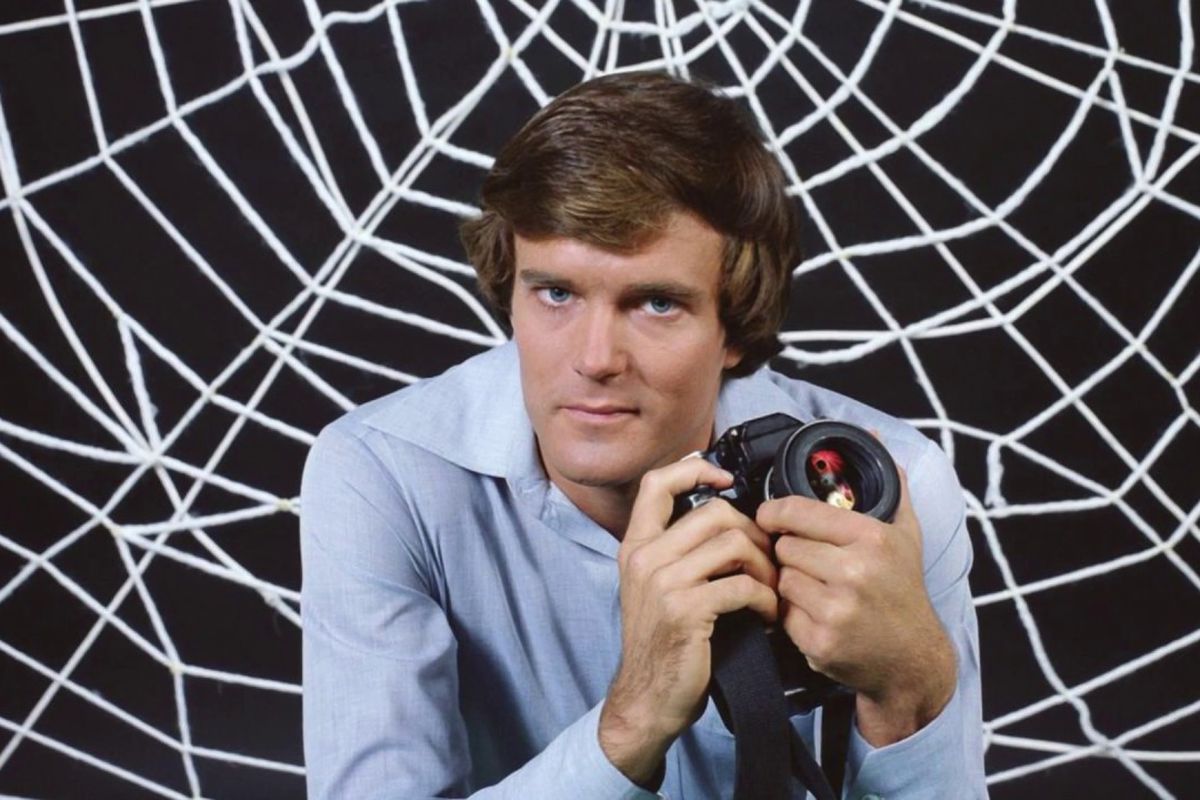
The boomers got Nicholas Hammond’s Spider-Man.  Hammond played Spider-Man for two seasons in the 70s.  He was a little boring but, from what I’ve seen, his show has a reputation for being worse than it was.  Like the best of the boomers, Hammond’s Spider-Man could be stuffy but he got the job done.

Generation X got Tobey Maguire, who played Spider-Man in three films that Sam Raimi directed in the aughts.  Like Generation X, Maguire’s Spider-Man was quiet but clever.  Despite his quick wit, he was frequently neurotic and more than a little introverted but he always came through in the end.

Then, Andrew Garfield played the millennial version of Spider-Man.  Angsty and awkward, Garfield’s Spider-Man was aware that society would never fully accept him, both as Peter and as Spider-Man.  At times, it seemed like his every attempt at making things better somehow only made them worse.

And finally, the Zoomers have got Tom Holland’s Spider-Man, an earnest idealist who struggles with the fact that the world is more complicated than it seems.  You can criticize him for being naïve but never doubt the sincerity of his beliefs.

All of the actors who played Spider-Man have done a good job and they all deserve praise.  My favorite is Tobey Maguire but that’s largely because, having been born in ’82, I’m on the dividing line between Generation X and Millennial and I’ve always leaned more towards the Generation X side of things.  Plus, I can relate to this:

Maguire, Garfield, and Holland all came together to appear in the previous Spider-Man film, which I thought was a nice touch.  I just wish Nicholas Hammond had been invited to join them.

Nicholas Hammond, as Peter Parker

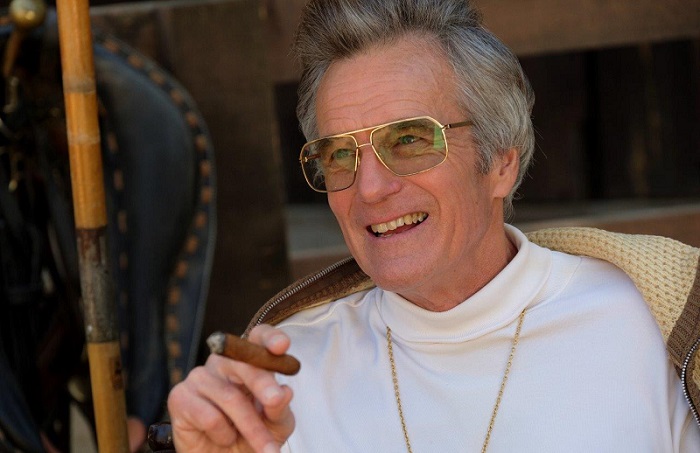
Nicholas Hammond, Today

Having an older, perhaps retired Spider-Man joining forces with the Maguire, Garfield, and Holland versions of the character would have provided an extra-dimension to the movie, much as used to happen on Doctor Who whenever any of the previous incarnations of the Time Lord would meet the newest version.

Regardless of who plays him or whether he’s Peter Parker or Miles Morales, Spider-Man remains the hero to whom we can all relate.  Spider-Man is all of us.

Happy Spider-Man Day to all!