Lisa Marie’s Take On Escape From New York (dir by John Carpenter)


I was a bit shocked to realize that I hadn’t reviewed Escape from New York for this site.  Leonard’s reviewed it.  Jeff’s reviewed it.  I’ve reviewed quite a few Italian films that were inspired by Escape from New York.  Last year, I devoted an entire day to how much I love Kurt Russell.  I’ve shared John Carpenter’s theme music, more than once.  I’ve reacted to Mamdani’s election by telling my friends that it’s time to escape from New York.  I’ve lost track of the number of times that I’ve told Leonard that it is “Time to leave the Bronx,” even though he doesn’t live in the Bronx.  (What do I know?  I live in Texas.)  But I’ve never actually reviewed Escape From New York.

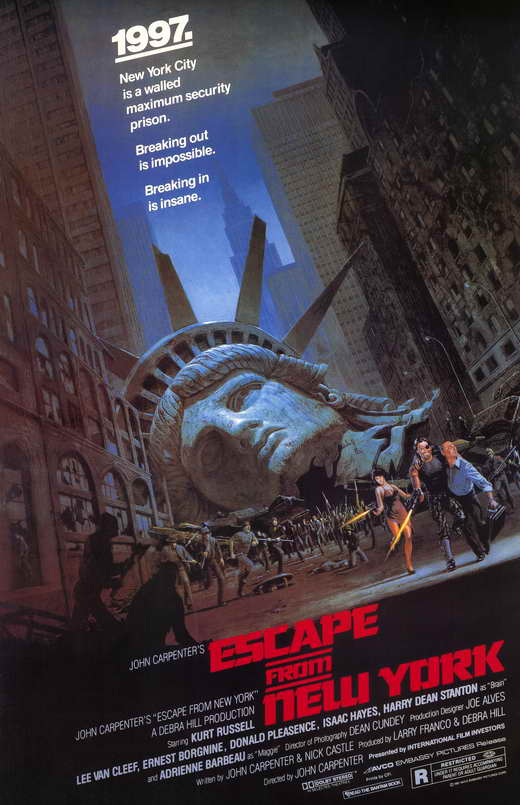
I love Escape from New York but I have to say that the film itself can’t live up the brilliant poster art.  The first time I watched Escape from New York, I was really disappointed that the Statue of Liberty’s head never appeared in the middle of a street in Manhattan.  If the film were made today, one imagines that the filmmakers would be able to do all sorts of things with the Statue of Liberty.  But Escape from New York was made in 1981, in the days before rampant CGI.  Escape from New York was made at a time when directors had to be somewhat clever and that definitely works to the film’s advantage.  The lack of big time special effects meant that Carpenter had to emphasize character and atmosphere.  Escape From New York might not feature the Statue of Liberty’s head but it does feature an amazing cast and a host of unforgettable characters.  When you manage to get Kurt Russell, Ernest Borgnine, Donald Pleasence, Harry Dean Stanton, Adrienne Barbeau, Lee Van Cleef, and Isaac Hayes all in the same film, there’s no way it isn’t going to be memorable.

We all know the plot.  Kurt Russell plays career criminal Snake Plissken.  (Everyone thought Snake was dead.)  When the President (Donald Pleasence) finds himself trapped on the prison island of Manhattan, Snake is the man who is sent to rescue him.  The fate of the world depends on rescuing the President.  If the President isn’t rescued, it could lead to nuclear war.  Snake doesn’t really care about the fate of the world.  He does care about the fate of himself, however.  He’s been injected with a poison that will kill him unless he receives the antidote in 24 hours.

(The doctor who gives Snake the poison is named Dr. Cronenberg.  Meanwhile, Frank Doubleday appears as a thug named Romero.  Lee Van Cleef’s police commissioner is named Hauk, as in Howard Hawks.  Tom Atkins plays Captain Rehme, as in producer Bob Rehme.  The film may be about the collapse and possible end of the world but John Carpenter’s having fun.  And, of course, so are we.)

The President has been captured by the Duke of New York (Isaac Hayes).  It doesn’t take Snake long to track down the Duke.  But rescuing the President and making it back to safety turns out to be far more difficult and violent than anyone was anticipating.  Snake gets some help, from characters like Cabbie (Ernest Borgnine), Brain (Harry Dean Stanton), and Maggie (Adrienne Barbeau).  Of course, that help is largely due to everyone’s self-interest.  The recurring theme is that no one really cares that much about whether or not the President or even Snake lives or dies.  Maggie loves Brain but, otherwise, there’s not much individual loyalty to be found in this film.  Instead, everyone just cares about getting the Hell out of New York.  In the end, even the President turns out to be a bit of a jerk.

(I do have to say that I absolutely love Donald Pleasence’s performance in Escape from New York.  The “You’re the Duke!  You’re the Duke!  A Number One!” scene?  That was Pleasence at his most brilliant.)

It’s a wonderfully acted and directed film, one that is often darkly humorous.  (While Kurt Russell delivers his lines with a endearing self-awareness, Carpenter has a lot of fun imagining the type of criminal society that would emerge on an isolated Manhattan.)  It’s also a film that understands the power of New York City.  Depending on who you ask, New York either represents the worst or the best of America.  That’s true today and, watching Escape from New York, it’s easy to guess that was probably true in 1981 as well.  There’s a power to the “New York” name and it’s why this film wouldn’t have worked if it had been called Escape From Houston or Escape From Spokane.  (One reason why Escape From LA failed was because the cartoonishness of Los Angeles couldn’t compete with the grit of New York.)  We all know the saying — “New York, New York: If you can make it there, you can make it anywhere.”  This film reminds us that it’s also true that if you can escape from there, you can escape from anywhere.  Escape from New York brilliantly captures the way that most of the rest of country view New York but, by limiting the action to Manhattan, it also presents a story that can be enjoyed by people in Brooklyn, the Bronx, Queens, and Staten Island.  I imagine the film is especially popular on Staten Island.

Escape From New York is a brilliant work of the pulp imagination.  It’s a film that will probably outlive the city.
Film Review: Assault on Precinct 13 (dir by John Carpenter)


Legend has it that, when John Carpenter originally offered the role of Dr. Sam Loomis to Donald Pleasence, Pleasence was reluctant to accept it.  To Pleasence, Halloween sounded like it would just be another forgettable horror film.

However, when Donald mentioned to his daughter, actress Angela Pleasence, that he had been offered a role in a film by a young director named John Carpenter, Angela immediately told him to accept.  She assured him that it would turn out to be a great film.  When Donald asked her why she was so sure about this, Angela replied that she had seen Assault on Precinct 13 at the Cannes Film Festival.

1976’s Assault on Precinct 13 was John Carpenter’s second feature film.  (The first was Dark Star, which started out as a student film and, even after being extended to feature length, still ended up feeling very much like a student film.)  The film takes place in Los Angeles, at an isolated police precinct house that is scheduled to be abandonedd.  When the father (Martin Lawson) of a girl (Kim Richards) who was murdered earlier in the day seeks refuge at the precinct, a Che Guevara-influenced street gang launches a relentless late night attack on the building.  (Frank Doubleday, who later played Romero in Escape From New York, appears as a member of the gang.)  Lt. Ethan Bishop (Austin Stoker) is forced to work with criminal Napoleon Wilson (Darwin Joston) to defeat the gang.

Assault on Precinct 13 (1976, dir by John Carpenter. DP: Douglas Knapp)

John Carpenter later said that Assault of Precinct 13 was his attempt to make a Howard Hawks-style western and, despite taking place in the modern era, it is very much a western.  Ethan Bishop is the strong and moral lawman who refuses to allow the untamed land around him to change who he is and what he believes.  Napoleon Wilson is the outlaw who finds redemption.  In most westerns, the attackers would represent the last gasp of the lawless frontier fighting against encroaching civilization.  In the case of Assault on Precinct 13, the opposite is true.  The attackers represent the collapse of society and the people in the precinct find themselves fighting not only for their lives but also the ideals of modern civilization.  With their relentless drive to attack, the members of the street gang resemble the zombies from George Romero’s Night of the Living Dead.  They’re so nihilistic and destructive that even a hardened criminal like Napoleon Wilson knows that they have to be stopped.  The film’s ultimate message seems to be that, even if Bishop and Wilson and Leigh (Laurie Zimmer) survive the night, the assault on Precinct 13 will never truly end.  In a way, we’re all trapped in that abandoned precinct house.

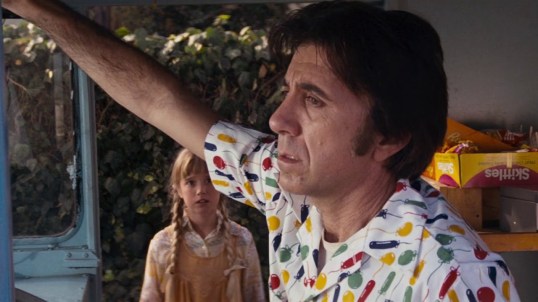
Wow, that sounds pretty grim!  And really, it is a grim film.  This, after all, is the film in which little Kim Richards is graphically shot in the chest while trying to buy ice cream.  (From the start, Carpenter understood the importance of shocking the audience.)  That said, there are unexpected moments of dark humor to be found in the film.  (Even Kim Richards’s indignation over being given the wrong flavor ice cream is rather humorous, up until she asks for a replacement and gets shot as a result.)  Both Bishop and Wilson make for compelling heroes.  As Angela Pleasence realized when she saw the movie at Cannes, John Carpenter was and is a natural-born storyteller.  Assault on Precinct 13 is a film that wastes no time in getting started and is relentless in both its suspense and its action.

Assault on Precinct 13 has been overshadowed by Carpenter’s subsequent successes but it’s still one of Carpenter’s best films.  Without Assault on Precinct 13, we would never have gotten Donald Pleasence as Dr. Sam Loomis.  That alone is reason enough to celebrate the film.

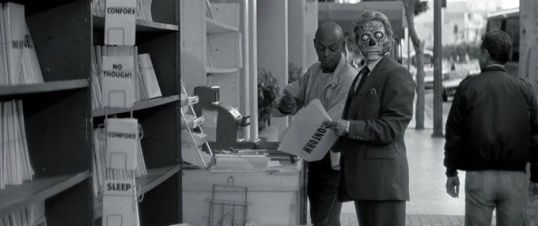
Scenes That I Love: John Nada Sees The Truth in They Live


The brilliance of this scene is that it pretty much speaks for itself.  It doesn’t need to be overanalyzed.  It doesn’t need to be carefully explained.  It works because it captures what almost everyone has always suspected, even if they didn’t necessarily have the courage to say so aloud.

From John Carpenter’s 1988 film They Live:

6 Shots From 6 Films: Special John Carpenter Edition


4 Or More Shots From 4 Or More Films is just what it says it is, 4 shots from 4 of our favorite films. As opposed to the reviews and recaps that we usually post, 4 Shots From 4 Films lets the visuals do the talking!

Today, the Shattered Lens wishes a happy 78th birthday to one of this site’s favorite filmmakers and a patron saint of the independent spirit, the great John Carpenter!

In honor of the man and his legacy, here are….

6 Shots From 6 John Carpenter Films

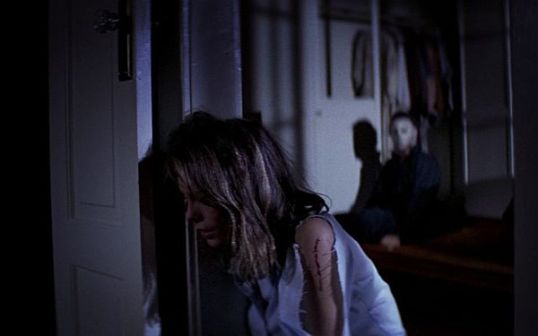
Halloween (1978, dir by John Carpenter. DP: Dean Cundey)

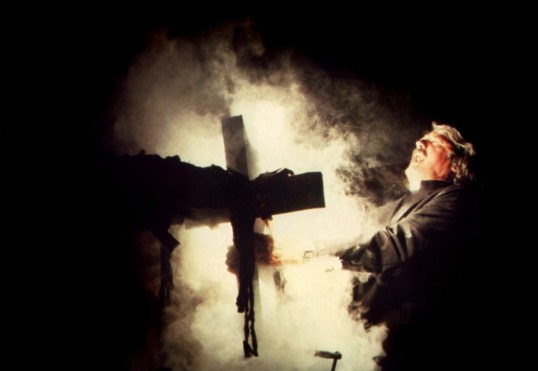
The Fog (1980, dir by John Carpenter, DP: Dean Cundey)

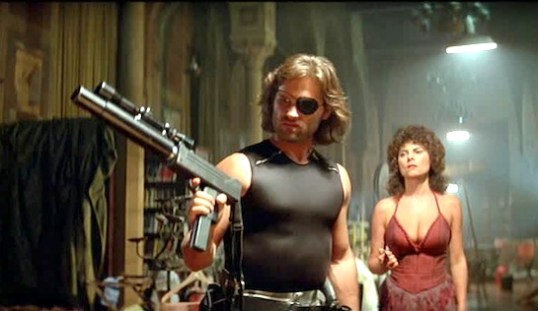
Escape From New York (1981, dir by John Carpenter, DP: Dean Cundey)

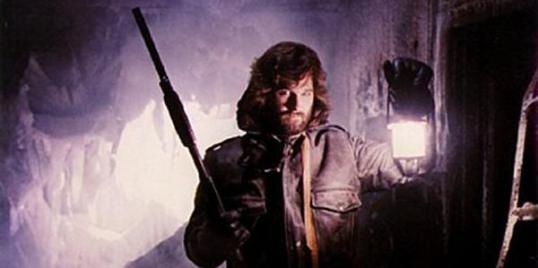
The Thing (1982, dir by John Carpenter, DP: Dean Cundey)

They Live (1988, dir by John Carpenter, DP: Gary B. Kibbe)

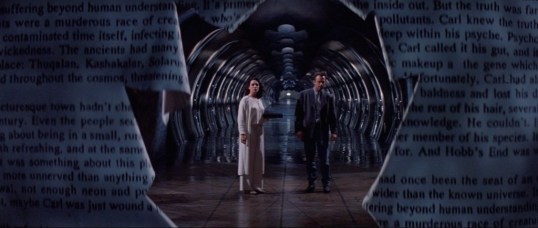
In The Mouth of Madness (1994, dir by John Carpenter, DP: Gary B. Kibbe)

Live Tweet Alert: Join #FridayNightFlix for Jurassic Domination!


As some of our regular readers undoubtedly know, I am involved in a few weekly watch parties.  On Twitter, I host #FridayNightFlix every Friday and I co-host #ScarySocial on Saturday.  On Mastodon, I am one of the five hosts of #MondayActionMovie!  Every week, we get together.  We watch a movie.  We tweet our way through it.

Tonight, at 10 pm et, I will be hosting #FridayNightFlix!  The movie?  2022’s Jurassic Domination!

If you want to join us this Friday, just hop onto twitter, find Jurassic Domination on Prime, start the movie at 10 pm et, and use the #FridayNightFlix hashtag!  I’ll be there happily tweeting.  It’s a friendly group and welcoming of newcomers so don’t be shy.

See you there!

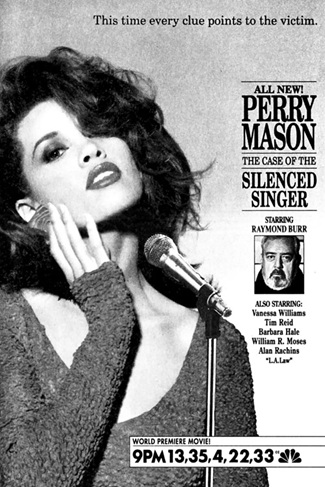
I Watched Perry Mason: The Case of the Silenced Singer (1990, Dir. by Ran Satlof)


When singer Terri Knight (Vanessa Williams) is shot and murdered, her husband and manager, Jack (Tim Reid), is arrested.  It’s a good thing that Jack’s professor in law school was Perry Mason (Raymond Burr)!  Perry and Ken Malansky (William R. Moses) take the case and investigate to see who silenced the singer.  (Does Perry know anyone who hasn’t been accused of murder?  Someone even tried to fame Della!)

This Perry Mason movie was slightly different than those that came before it.  It was full of flashbacks, showing how Terri became a star and went from being nice and innocent to being a diva.  Every time that Perry or Ken would interrogate someone, it would lead to scene of Vanessa Williams wearing a wig and playing Terri at a different time in her life and career.  There was also a lot singing and the movie actually seemed to be more focused on the music and showing Terri’s rise to fame than it did on solving the actual mystery.  It was was if Perry Mason got dropped into the middle of a production of Dreamgirls.  It didn’t really work for me because Terri wasn’t an interesting enough character to carry the flashbacks but it was still interesting to see a Perry Mason movie trying to do something different.

The most memorable thing about this movie was Angela Bassett, playing a fellow singer and a former friend of Terri’s. She even told off Perry Mason at one point!  It was early in her career but it was easy to see that, from the start, Angela Bassett was obviously going to be a star.

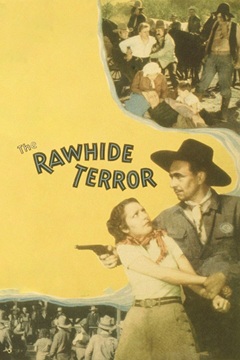
The Rawhide Terror (1934, directed by Jack Nelson and Bruce Mitchell)


There are some Poverty Row westerns that even I can’t defend.

A group of bandits, disguised as Indians, attack a pioneer family.  The father and the mother are killed but their twin boys survive.  One wanders into the wilderness while the other stays with the remains of his family and waits for help.  Years later, the town of Red Dog is thriving, with the former bandits as its leading citizens.  Someone has been gunning down the former bandits.  The townspeople demand that Sheriff Luke (Edmund Cobb) do something about the man that they’ve nicknamed the Rawhide Killer.  First, however, Luke has to deal with Jim Briggs (William Barrymore), who has been abusing his son (Tommy Bupp).  It also turns out that Jim Briggs is the Rawhide  Killer and he’s looking for vengeance against those who killed his parents.  Jim’s brother also lives in the town.  Guess who!

The Rawhide Terror gets off to a good start with the bandit attack but it falls apart soon afterwards.  I don’t know if it was just because I was watching a bad print but the sound quality was terrible and the lack of an original score really highlighted just how boring it is to watch men silently ride their horses from one side of the screen to the other.  This movie was only 47 minutes long and half of it was made up of shots of people riding horses.  Add some really bad acting and you’ve got a western that was bad even by the standards of a 1934 second feature.

Two men are credited with directing the film, though the production was actually supervised by Victor Adamson, the father of the notorious schlock filmmaker, Al Adamson.

Scenes That I Love: The Concorde …. Airport ’79


Today’s scene that I love comes from 1979’s The Concorde …. Airport ’79.  

Under attack from a drone, George Kennedy does what any responsible pilot would do.  He opens up the cockpit window — while in flight! — and fires off a flare gun.  Meanwhile, Alain Delon does some Top Gun-style moves with a commercial airliner.  No wonder Eddie Albert and Jimmie Walker look so alarmed!  Beyond the “don’t try this at home” narrative logic, this scene is definitely worth it for the shots of the passengers reacting.

4 Shots From 4 Films: Special Disaster Edition


4 Shots From 4 Films is just what it says it is, 4 shots from 4 of our favorite films. As opposed to the reviews and recaps that we usually post, 4 Shots From 4 Films is all about letting the visuals do the talking.

Today, we pay honor to one of my favorite genres, the disaster film!

It’s time for….

4 Shots From 4 Disaster Films

The Poseidon Adventure (1972, dir by Ronald Neame, DP: Harold E. Stine)

The Towering Inferno (1974, dir by John Guillermin and Irwin Allen, DP: Fred J. Koenekamp and Joseph Biroc)

Airport 1975 (1974, dir by Jack Smight, DP: Philip H. Lathrop)

The Swarm (1978, dir by Irwin Allen, DP: Fred J. Koenekamp)