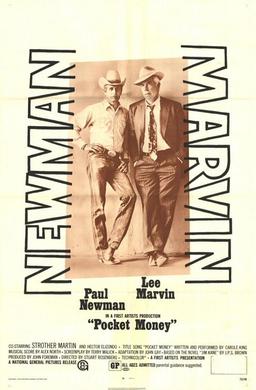
In this slow but amiable film, Paul Newman plays Jim Kane. Kane is a down-on-his luck cowboy who finds himself in Arizona with nearly a dollar to his name. Because Kane’s a likable sort, he has people who are willing to help him out but eventually, he finds himself with no choice but to accept a job offer from Stretch Russell (Wayne Rogers) and shady rancher Bill Garrett (Strother Martin). Kane agrees to Mexico to round up a heard of cattle. Helping Kane out on the job is an old friend by the name of Leonard (Lee Marvin).
Pocket Money was the last script to be written by Terrence Malick before Malick began his own directing career and the script’s dialogue shows off Malick’s skill at capturing the unique dialect and sound of the Southwest. It’s an episodic film, where the emphasis is more on the journey than the destination and it could be argued that the movie never really reaches its destination. The plot is far less important than the way Kane and Leonard talk to each other and view the world around them. Pocket Money is not for everyone. It’s the type of movie that will inspire some to complain that nothing really happens. For fans of Newman and Marvin, though, there’s a lot of enjoyment to be found. Newman and Marvin reportedly did not get along during shooting but that didn’t do a thing to harm their chemistry in their scenes together. This film reunites Paul Newman with Cool Hand Luke director Stuart Rosenberg and and also with two co-stars from that film, Strother Martin and Wayne Rogers. Newman gives a relaxed and likable performance. Lee Marvin gets to show his skill with comedy. If you’ve ever wanted to see Lee Marvin ride a horse while wearing a suit, this is the film for you.
Pocket Money was the first film to be produced by First Artists, a production company that was started by Paul Newman, Sidney Poitier, Barbra Streisand, Steve McQueen, and Dustin Hoffman. The company closed its doors in 1980 but not before giving the world not just this movie but also The Getaway, Straight Time, The Gauntlet, An Enemy of the People (starring Steve McQueen), The Life and Times of Judge Roy Bean, and The Gumball Rally, amongst others.
No Other Choice grabs you right away with its wild premise—a loyal company man gets canned and decides to literally eliminate his job competition to claw his way back up. It’s one of the standout international films from last year, popping up on countless top films of 2025 lists for its gutsy mix of workplace rage and murderous absurdity. Park Chan-wook delivers a dark, twisty ride blending sharp satire with outright farce, and while it doesn’t always stick the landing perfectly, that bold energy and uncomfortable laughs make it a must-watch.
The story kicks off in a picture-perfect suburban home where Man-su, a longtime paper factory manager played by Lee Byung-hun, basks in the comforts of a solid middle-class life. He’s got the big house, loving wife Mi-ri, two kids, and even those flashy dogs that scream success. Everything feels polished and stable, almost too good to be true, which is exactly the point. Then the axe falls—layoffs hit, and suddenly Man-su’s years of service mean nothing in a brutal job market stacked against him. Every opening has a ranked list of candidates, and he’s always near the bottom. Desperation sets in, and he hatches a grim plan: take out the guys ahead of him one by one.
What makes this setup pop is how Park turns a simple “what if” into a mirror for real-world frustrations. Man-su’s logic spirals from understandable rage to unhinged obsession, repeating his mantra of having “no other choice” like it’s gospel. Each target he stalks feels like a warped reflection of himself—aging has-beens clinging to relevance or eager young hotshots with families of their own. It’s not just about the kills; it’s the quiet horror of seeing your own fears staring back. The film nails that sinking feeling of obsolescence, where loyalty gets you nowhere and the system chews people up without a second thought.
The action sequences are where Park’s signature style shines brightest. That first murder attempt is a masterclass in chaos—a shaky standoff with an antique pistol turns into a frantic, slapstick melee in some oversized wooden house. Blood flies, furniture shatters, and it’s all choreographed with such precision it borders on balletic. He mixes genuine tension with cartoonish escalation, making you laugh even as things get gruesome. It’s the kind of over-the-top violence that recalls his classics like Oldboy, but lighter, almost playful in its excess. You never know if the next swing will end it or devolve into more absurdity, and that unpredictability keeps the pulse racing.
At home, though, the real damage unfolds. Mi-ri, brought to life by Son Ye-jin in a quietly devastating turn, starts as the supportive spouse but cracks under the strain. They cut back on luxuries like tennis lessons and fancy music classes, but it’s the growing paranoia that poisons everything. Snide arguments erupt, kids get tangled in cover stories for the police, and the once-idyllic house feels like a pressure cooker. Park smartly shifts focus here, showing how one man’s breakdown ripples out to fracture his family. Mi-ri’s mix of worry, resentment, and tough love grounds the madness, reminding us this isn’t just a lone wolf tale—it’s about collateral damage in the pursuit of “normalcy.”
As a jab at corporate culture, the movie lands some solid punches. Those sterile job interviews and endless applicant lists capture the dehumanizing grind perfectly, where workers are just numbers on a spreadsheet. Man-su’s humiliation builds layer by layer, from polite rejections to outright indifference, culminating in a factory scene that’s equal parts poetic and punishing. He ends up as the last human holdout amid a sea of machines, a stark symbol of misplaced faith in the grind. Park doesn’t pretend to offer solutions, but he forces you to confront how capitalism turns colleagues into rivals and dignity into a luxury good.
That said, the film isn’t content to just indict the system—it digs into Man-su’s flaws too. He’s no innocent victim; he’s vain, stubborn, and blinded by pride. Moments of potential redemption pop up—a heartfelt chat with a fellow job-seeker, a glimpse of empathy for a rival dad—but he barrels past them every time. This refusal to pivot makes him compellingly human, a portrait of wounded ego that stops short of full villainy. Lee Byung-hun sells it all with subtle shifts: the forced smile in interviews, the twitchy hands during stakeouts, the hollow justifications whispered to himself. He’s magnetic, drawing sympathy even as you root for his comeuppance.
Visually, Park pulls out all the stops. Bold camera moves, clever framing, and those vintage thriller tricks—fancy dissolves, sharp cuts—give it a retro flair amid modern polish. Conversations crackle with visual wit, turning mundane chats into tense standoffs. The color palette swings from warm domestic glows to cold, shadowy nights, mirroring Man-su’s slide. It’s indulgent stuff, the kind of filmmaking that demands a big screen, though it occasionally tips into showiness when the plot needs room to breathe.
The supporting cast fleshes out the world nicely. Victims aren’t faceless; each gets a quick, vivid sketch that humanizes the body count. Detectives poke around with dry humor, adding a procedural edge without stealing focus. Son Ye-jin steals scenes effortlessly, her Mi-ri evolving from enabler to antagonist in the subtlest ways— a raised eyebrow here, a weary sigh there. It’s ensemble work that elevates the whole, making the satire feel lived-in rather than preachy.
Where it stumbles is in the pacing and bloat. The cat-and-mouse games repeat a bit too faithfully—stalk, scheme, screw-up, repeat—and by the third or fourth loop, the formula shows. Subplots with cops and side characters tangle up the momentum, diluting the core spiral. Park juggles a lot: farce, thriller beats, family drama, economic allegory. It mostly coheres, but you sense he’s wrestling to tie it all together. The ending, while punchy, leans hard on irony, which might leave some wanting deeper catharsis or ambiguity.
Still, flaws and all, No Other Choice pulses with invention and earned its spot as one of 2025’s best international gems, racking up mentions across year-end top lists from critics worldwide. It’s a timely gut-punch for anyone who’s felt the job market’s cruelty, wrapped in enough dark humor and style to linger. Not Park’s tightest, but his wildest in years—a messy, mean-spirited blast that dares you to laugh at the abyss. If you’re up for a thriller that treats resumes like kill lists and HR as the true horror, dive in. Just don’t expect tidy morals or easy outs; this one’s as complicated as real desperation gets.
First released in 1990, Ski Patrol is the story of a …. well, a ski patrol.
They’re not a very good ski patrol, not really. Their martinet leader is short and annoying and he’s played by Leslie Jordan. A young George Lopez is a member of the ski patrol and he keeps trying to do stuff that I assume was from his 1990 stand-up act. Future director Paul Feig plays Stanley, who is nerdy but can dance and is willing to dress up like Tina Turner when the Ski Patrol needs to raise some fast money. T.K. Cater is Iceman, who sings at every party and is a part of every prank. Suicide (Sean Sullivan) wears a crazy mask and an evil mask as he debates which dangerous thing he should do. And then there’s Jerry Cramer (Roger Rose), who is handsome and a great skier. He’s technically the hero of the film but he’s kind of smarmy. He does own a cute bulldog, though.
Eccentric or not, the ski patrol is dedicated to Pops (Ray Waltson), the fair-minded and kind-hearted owner of a mountain ski lodge. Unfortunately, an evil developed named Maris (Martin Mull) wants Pops’s land so he and Lance (Corbin Timbrook) and Lance’s evil friends conspire to cause the lodge to fail its annual inspection. Before you know it, mice are running loose, George Lopez is getting thrown in jail, and an avalanche causes a hot dog stands to careen out of control. Since this movie was made in 1990, the solution to all of these problems is to party, party, and party some more!
This is not exactly a good movie. It has its share of cringey moments and jokes that have not aged particularly well. Roger Rose tries to pull off the whole charming smartass routine but he doesn’t really have the screen presence to do it. One gets the feeling that filmmakers may have noticed that while filming because it’s hard not to notice that, despite being the film’s nominal star, Rose doesn’t really do much. And yet, there’s enough odd little moments that the film itself is often more likable than it has any right to be. These scenes might not add up to much but it’s hard not to smile when Paul Feig starts dancing or when Suicide starts arguing with himself. There’s a lot of lovely scenery (the ski lodge really does look like a nice place to visit) and even the bulldog is genuinely cute.
As for T.K. Carter (whose passing earlier this month really didn’t get the attention that it deserved), this film was typical of the majority of the films in which he appeared and, as was often the case, he’s brings a lot of life to material that probably wouldn’t have worked without his energy. Of course, it’s always interesting to see Carter in a silly comedy like this and then to consider his performances in The Thing and Southern Comfort, two excellent films that definitely were not comedies. Indeed, after The Thing, it’s hard not to feel that Carter had earned a chance to appear in a film featuring snow in which everyone survives.
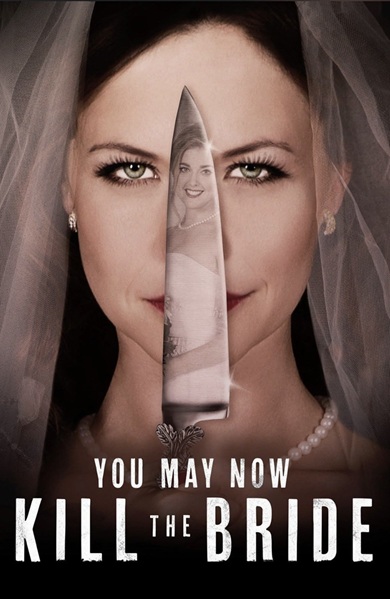
Hi, everyone! Tonight, on twitter, I will be hosting one of my favorite films for #MondayMania! Join us for 2016’s You May Now Kill The Bride!
You can find the movie on Prime and Tubi and then you can join us on twitter at 9 pm central time! (That’s 10 pm for you folks on the East Coast.) See you then!
Because today is Paul Newman’s birthday, I figured today’s song of the day should come from one of his films. There’s a tendency amongst some critics to be dismissive of the use of Raindrops Keep Fallin’ On My Head in Butch Cassidy and the Sundance Kid and it’s true that it’s not really the type of song that brings to mind robbing trains and dying in South America.
(Though we all know that Butch Cassidy — and maybe the Sundance Kid, too — actually survived and eventually returned to America. We all know that, right?)
But, you know what? It’s a song that really gets stuck in your head and somehow, it just feels appropriate for Paul Newman, an actor whose life wasn’t always happy (his son overdosed in 1976) but who was still almost always described as being one of the nicest guys around. Plus, look at Paul on that bicycle! How can you dislike this song?
Today would have been Bob Uecker’s birthday. Here he is in Major League, delivering a line that I’ll probably be repeating a lot once Spring Training begins!
Every team should have a Bob Uecker in their corner!
4 Shots From 4 Films is just what it says it is, 4 shots from 4 of our favorite films. As opposed to the reviews and recaps that we usually post, 4 Shots From 4 Films lets the visuals do the talking!
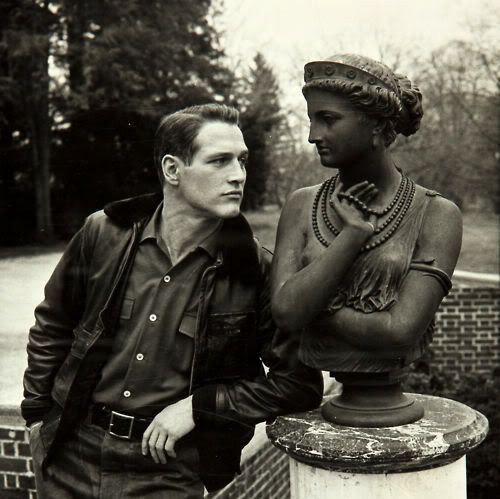
101 years ago today, Paul Newman was born in Shaker Heights, Ohio. He would go on, of course, to become one of America’s greatest film stars, an acclaimed actor who was active from the mid-part of the 20th century to the beginning of our current century. He made his film debut in 1954 with The Silver Chalice(and subsequently paid for an ad in which he apologized for his performance in the film, which I think was a bit unnecessary as he wasn’t really that bad in the film) and he made his final onscreen appearance in 2005 in Empire Falls. (He did, however, subsequently provide the voice of Doc Hudson in Cars, along with narrating a few documentaries.) Time and again, he proved himself to be one of the best actors around. According to most report, he was also one of the nicest. When he died in 2008, the world mourned.
In honor of his cinematic legacy, here are….
4 Shots From 4 Paul Newman Films
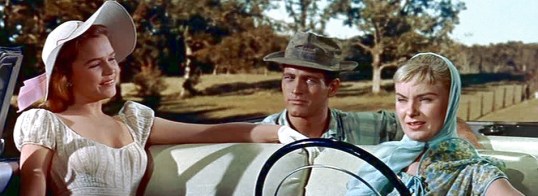
The Long Hot Summer (1958, dir by Martin Ritt, DP: Joseph LaShelle)
Hud (1963, dir by Martin Ritt, DP: James Wong Howe)
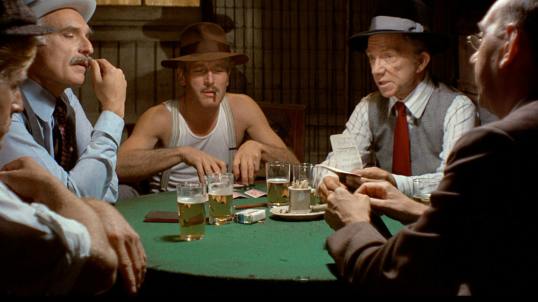
The Sting (1973, dir by George Roy Hill, DP: Robert Surtees)
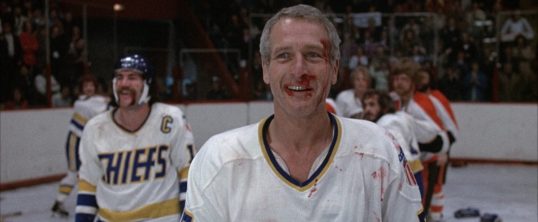
Slap Shot (1977, dir by George Roy Hill, DP: Victor Kemper)
As some of our regular readers undoubtedly know, I am involved in hosting a few weekly live tweets on twitter and occasionally Mastodon. I host #FridayNightFlix every Friday, I co-host #ScarySocial on Saturday, and I am one of the five hosts of Mastodon’s #MondayActionMovie! Every week, we get together. We watch a movie. We snark our way through it.
Tonight, for #MondayActionMovie, the film will be 1986’s Assassin!
It should make for a night of fun viewing and I invite all of you to join in. If you want to join the live tweets, just hop onto Mastodon, find the movie on YouTube and hit play at 8 pm et, and use the #MondayActionMovie hashtag! The watch party community is a friendly group and welcoming of newcomers so don’t be shy.
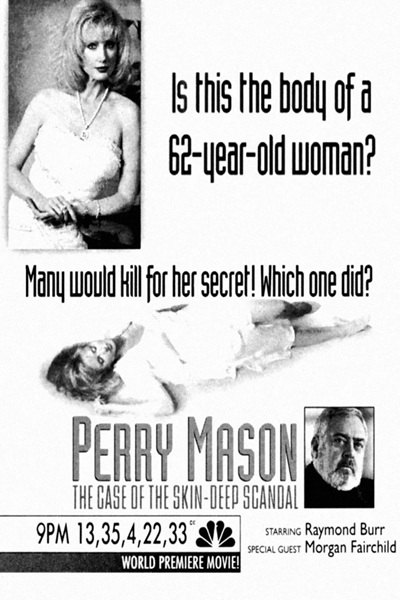
Alana Westbrook (Morgan Fairchild), the ruthless owner of a cosmetics company, is murdered after she announces that she is actually 60 years old and owes her youthful appearance to a miracle skin cream. Her husband (Patrick O’Neal) is charged with the crime but he’s lucky enough to have Perry Mason (Raymond Burr) as his attorney. Perry thinks that the murderer is an eccentric gigolo (David Warner) but, for once, Perry might be wrong. Meanwhile, Ken Malansky (William R. Moses) gets involved with a corporate spy (Lauren Lane) who might know more than she says.
Lisa and I watched this one earlier today. We really enjoyed it! It’s the most soapy of all the Perry Mason films that I’ve watched so far. Morgan Fairchild was great as the murder victim and all of the suspects were enjoyably weird. What I really enjoyed about this movie was that it featured people who appeared, in different roles, in other Perry Mason films. Patrick O’Neal went from being the victim in Perry Mason Returns to being the accused here. David Warner went from being the victim in The Case of the Poisoned Pento being a suspect here. This was also a second Perry Mason film for Jonathan Banks but instead of being a tough guy like he was the first time, he was a skin cream creator this time. This movie understood that people will kill for clear skin.
This was one of the last of Raymond Burr’s Perry Mason films (it aired the same year that he died) and, with the returning actors, it feels like a tribute to Burr and the role that he made his own.
4 Shots From 4 Films is just what it says it is, 4 shots from 4 of our favorite films. As opposed to the reviews and recaps that we usually post, 4 Shots From 4 Films lets the visuals do the talking!
Today, on what would have been his 83rd birthday, the Shattered Lens pays tribute to Texas’s own, Tobe Hooper!
The Austin hippie who redefined horror and left thousands of yankees terrified of driving through South Texas, Tobe Hooper often struggled to duplicate both the critical and the box office success of The Texas Chainsaw Massacre. It’s only been in the years since his death that many critics and viewers have come to truly appreciate his unique and subversive vision.
Down here, in Texas, we always believed in him.
It’s time for….
4 Shots From 4 Tobe Hooper Films
The Texas Chainsaw Massacre (1974, dir by Tobe Hooper, DP: Daniel Pearl)
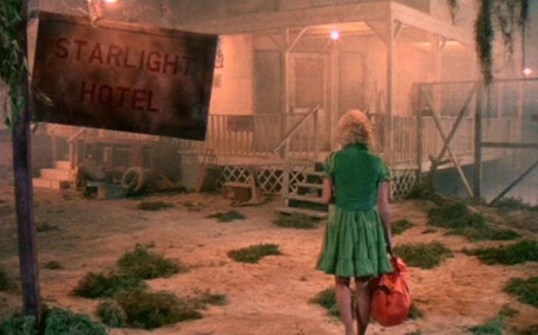
Eaten Alive (1976, dir by Tobe Hooper. DP: Robert Caramico)
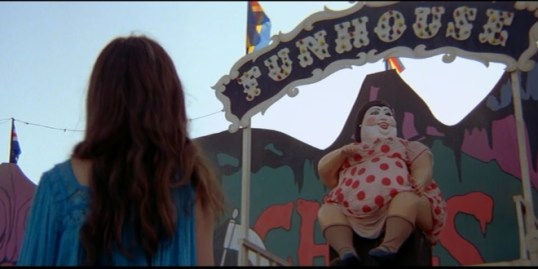
The Funhouse (1981, dir by Tobe Hooper. DP: Andrew Laszlo)
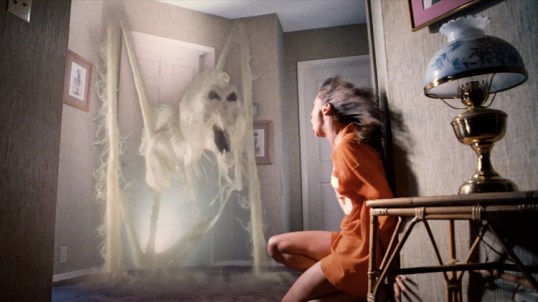
Poltergeist (1982, dir by Tobe Hooper, DP: Matthew Leonetti)
 In this slow but amiable film, Paul Newman plays Jim Kane. Kane is a down-on-his luck cowboy who finds himself in Arizona with nearly a dollar to his name. Because Kane’s a likable sort, he has people who are willing to help him out but eventually, he finds himself with no choice but to accept a job offer from Stretch Russell (Wayne Rogers) and shady rancher Bill Garrett (Strother Martin). Kane agrees to Mexico to round up a heard of cattle. Helping Kane out on the job is an old friend by the name of Leonard (Lee Marvin).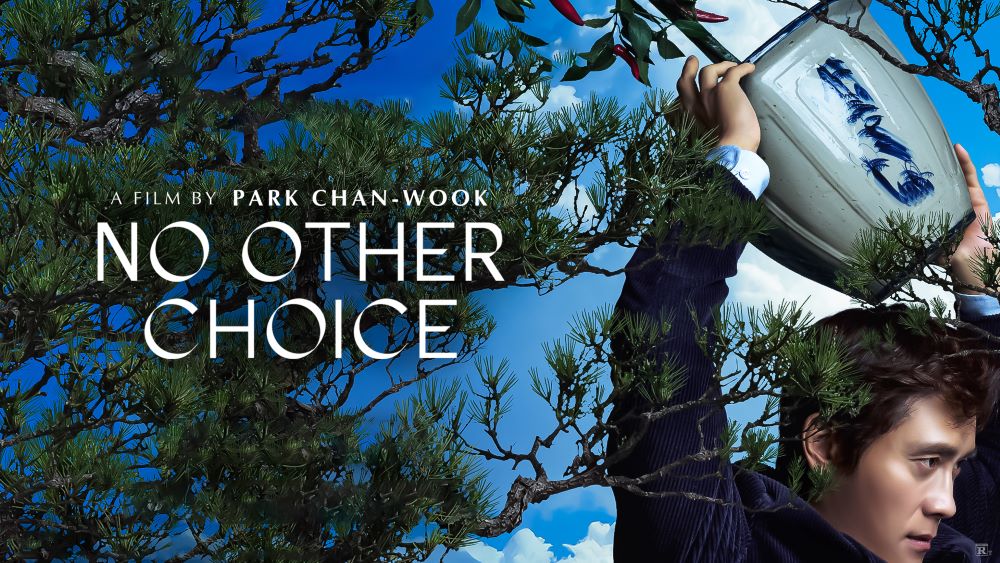


 Through the Shattered Lens