The Hong Kong Film Corner – THE MISSION (1999), directed by Johnnie To!


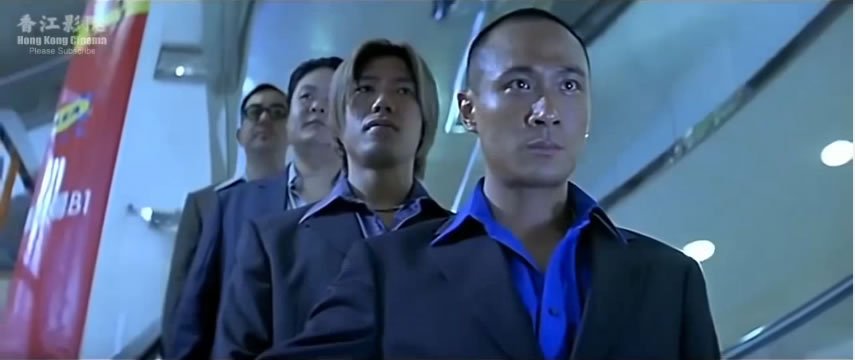
(Bottom to Top) Francis Ng, Roy Cheung, Lam Suet, and Anthony Wong!

THE MISSION is the 1999 film that helped me fall back in love with Hong Kong cinema after many of its great actors and directors had left for Hollywood in the mid 90’s. With Chow Yun-Fat, Jackie Chan, Jet Li, and John Woo no longer working in Hong Kong, there was a huge void, and Director Johnnie To stepped in and helped fill it with some of the best Hong Kong crime films ever made. Through his Milkyway Image production company, To directed THE LONGEST NITE (1998), EXPECT THE UNEXPECTED (1998), A HERO NEVER DIES (1998), RUNNING OUT OF TIME (1999), ELECTION (2005), and MAD DETECTIVE (2007), to name a few, all of which are crime film masterpieces in my opinion, and feature some of the best actors still working in Hong Kong at that time. I put Johnnie To’s body of work up against the best directors working anywhere in the world in the last 40 years. The quality and volume of his movies are outstanding, and they’re prime to be discovered for the uninitiated!

THE MISSION has a relatively simple plot…five bodyguards are assembled to protect Hong Kong triad boss, Lung (Eddy Ko), after assassins try to take him out while he’s having dinner at the Super Bowl restaurant. Lung’s brother, Frank (Simon Yam), puts together quite the badass group: Curtis (Anthony Wong), a completely trusted former associate who’s now working as a hairdresser; James (Lam Suet), a firearms expert and nonstop eater of pistachios; Roy (Francis Ng), a super busy guy who seems to be rising in the ranks as a local criminal leader; Shin (Jackie Lui), Roy’s underling and the inexperienced, weak link of the team; and Mike (Roy Cheung), a guy who’s awesome with a gun and currently stuck in the pimp game. We follow this group as they protect their boss from repeated attempts on his life, and also try to help figure out who’s ordered the hits. Needless to say, their mission takes a few detours along the way, and the men will ultimately have to decide where their true loyalty lies! 

THE MISSION is a crime film masterpiece, and I give Johnnie To most of the credit. Clocking in at just 84 minutes, the film is so simple, and yet it creates such a distinctive vibe that you can’t take your eyes off of the screen. To seems most interested in building the relationships between his main characters during the boring downtimes of their mission. We see them go from not talking to each other, to begrudgingly acknowledging each other, to finally playing soccer with a paper ball as they wait for their boss to leave his office. Just as we’re really getting to know and like our characters, the film will spring an intense action sequence out of nowhere. The director’s signature restraint is on full display in these limited action scenes, which are built around our characters’ professional expertise and a rising spacial tension with the would-be assassins. The action is incredible without relying on the over the top action sequences expected of the genre. As a matter of fact, I rank the “mall shootout” from THE MISSION as one of the best action scenes that Hong Kong cinema has to offer.
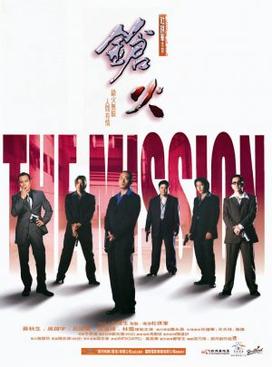
The cool poster for THE MISSION (1999)

The writing is also top notch in THE MISSION, which is not a real surprise because Nai-Hoi Yau has written almost all of Johnnie To’s best films. Yau and To have quite the working relationship as the screenplay, like the movie, hints at way more than it says. The audience isn’t spoon fed everything that happens, but it’s easy to look back upon repeat viewings and see that the clues are there based on what we know of the characters. There are also some interesting surprises sprinkled throughout the film. For example, a character shown as a coward in the opening scene re-emerges later in the film and redeems himself in a completely unexpected way. These moments are fun and exciting even for a film that is often relatively still and quiet. One other technical credit I want to mention is the film’s musical score by Chi Wing Chung. I’m not the kind of reviewer to spend too much time on a score, but I haven’t been able to get THE MISSION’s theme out of my head from the first time I saw it. Like the rest of the film, it’s simple, but it is the perfect synthy, background music for men walking and looking cool. I absolutely love it. 

Last, but not least, I have to highlight the cast that Johnnie To assembled for THE MISSION. It’s full of Hong Kong film award winners, beginning with five time winner Anthony Wong, and then Francis Ng and Simon Yam, also single winners of the Hong Kong Film Award for Best Actor. Each of these guys are outstanding here, with Anthony Wong and Francis Ng as the standouts of the movie. Anthony Wong, known for so many over the top characterizations in the classic Hong Kong films of the 90’s, delivers a perfectly understated and subtle performance here, which makes him that much more powerful when he needs to be. Francis Ng has a lot more dialogue, but his underlying sense of frustration and boiling-over intensity is the perfect counterpoint to Wong’s patience and calm. Roy Cheung, Lam Suet, Eddy Ko, and Tian-Lin Wang (Wong Jing’s dad) are all perfectly cast and bring excellent characterizations to the table. My only complaint about the cast is the fact that Lau Ching-Wan isn’t in the film. He’s been the star of so many of To’s best films, that I wish there would have been a part for him here.

Overall, THE MISSION is an incredible crime drama with a simple plot that primarily focuses on loyalty and betrayal within the triad underworld, punctuated by intense and precise action sequences, and performed by many of the very best actors in the Hong Kong film industry. It gets my highest recommendation and is well worth searching out. 

I’ve included a trailer for THE MISSION below. I honestly don’t think it’s a great representation for the movie itself, but it appears to be the best we’ve got!
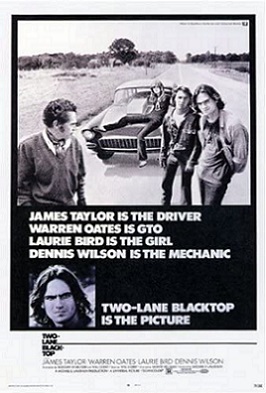
The Unnominated #18: Two-Lane Blacktop (dir by Monte Hellman)


Though the Academy of Motion Picture Arts and Sciences claim that the Oscars honor the best of the year, we all know that there are always worthy films and performances that end up getting overlooked.  Sometimes, it’s because the competition too fierce.  Sometimes, it’s because the film itself was too controversial.  Often, it’s just a case of a film’s quality not being fully recognized until years after its initial released.  This series of reviews takes a look at the films and performances that should have been nominated but were, for whatever reason, overlooked.  These are the Unnominated.

The 1971 road film, Two-Lane Blacktop, is a movie about four people whose real names are never revealed.  Indeed, their names are never as important as what they’re driving.

Named after his car, GTO (Warren Oates) is a talkative man who likes to brag on himself and who picks up hitchhikers so he can talk to them.  We don’t learn much about GTO’s background.  For someone who talks as much as he does, GTO doesn’t reveal much about who he is when he’s not driving.  It’s easy to imagine him as a salesman, traveling across the country and desperately trying to make his quota before the sun goes down.  With the way that he picks up hitchhikers and his need to convince everyone of his own skill and prowess behind the wheel, it’s easy to imagine that he’s probably recently divorced and still dealing with suddenly being on his own.  He seems to have something to prove, not only to everyone around him but especially to himself.  One gets the feeling that the life he had suddenly collapsed and he took to the road to escape it all but he still hasn’t reached the point where he can handle truly being alone.  For all of his talk, it doesn’t take long to notice that GTO isn’t quite as worldly as he claims he is.

A chance meeting leads to GTO getting into a cross-country race with The Driver (James Taylor) and the Mechanic (Dennis Wilson), two young men who are driving a 1955 Chevy and who make their money by engaging in street races.  (They’re also quick to steal a license plate when no one’s looking.)  The Driver and the Mechanic don’t talk a lot and, when they do, it’s in terse and somewhat awkward sentences.  (Both Taylor and Wilson were musicians who made their acting debut with this film.  Their natural stiffness and lack of emotion works well for their characters.)  The Driver and the Mechanic seem to communicate solely through driving.  They pick up The Girl (Laurie Bird) and both the Driver and the Mechanic seem to have feelings for her but it’s pretty obvious that their true love will always be for their car.

Two-Lane Blacktop is a road movie, a movie that really doesn’t have much of a plot (the cross-country race soon ceases to be a real race) but which does have some beautiful footage of America in 1971 and an outstanding performance from the great character actor, Warren Oates.  Easy Rider was advertised as being a film about a man who looked for America and couldn’t find it.  That’s actually a better description of Two-Lane Blacktop, a film about three uniquely American men who have embraced the car culture that is at the center of life in America but who are still, more or less, lost in their home country.  Oates, always talking and refusing to give up or even acknowledge the fact that he doesn’t really know much about how cars work, represents the so-called silent majority.  Wilson and Taylor are the next generation, their long-hair branding them as outsiders while their skill with a car and their desire win represents what we’re told is the best of the American competitive spirit.  What makes the film unsettling is the feeling that all three of them are using their cars as a way to avoid dealing with the reality of their lives.

Two-Lane Blacktop may sound a bit pretentious and it is.  The metaphors get a bit heavy-handed.  That said, as directed by Monte Hellman, it’s both a gorgeous travelogue and a valuable time capsule, a document of life in the late 60s and early 70s.  Hellman directed the film on the road.  When we see the Mechanic stealing a license plate so no one down south will know that he and the Driver are actually from California, it’s a powerful scene because it was actually filmed on location, in the South.  This isn’t a film that was shot on a backlot.  This is a film that was shot across America and it captures the country at a time when, much like today, no one was really sure what the future held for its politics or its culture.  It may be a film about three men who are obsessed with cars but it’s also a portrait of a country in an almost directionless state of turmoil.

Two-Lane Blacktop was promoted as being the next Easy Rider but it turned out to be a notorious box office failure.  James Taylor and Dennis Wilson never did another movie.  Warren Oates continued as a busy character actor while Laurie Bird died of an intentional drug overdose in 1979.  Director Monte Hellman’s directorial career continued but his days of being courted by the major studios were over.  However, as the years passed, audiences started to discover Two-Lane Blacktop and now, it’s considered to be a cult classic.

Given its failure at the box office, Two-Lane Blacktop was ignored by the Academy.  The Oscar for Best Picture went to another film that featured a memorable car chase, The French Connection.  While Two-Lane Blacktop may not have deserved to win Best Picture (not over nominees like The French Connection, The Last Picture Show, Fiddler on the Roof, and A Clockwork Orange), it certainly is far more memorable movie than the fifth film nominated that year, Nicholas and Alexandra.  If nothing else, Warren Oates deserved a nomination for his supporting performance.  The Academy may not have embraced Two-Lane Blacktop but, fortunately, film lovers eventually would.

Previous Entries In The Unnominated:

  1. Auto Focus 
  2. Star 80
  3. Monty Python and The Holy Grail
  4. Johnny Got His Gun
  5. Saint Jack
  6. Office Space
  7. Play Misty For Me
  8. The Long Riders
  9. Mean Streets
  10. The Long Goodbye
  11. The General
  12. Tombstone
  13. Heat
  14. Kansas City Bomber
  15. Touch of Evil
  16. The Mortal Storm
  17. Honky Tonk Man

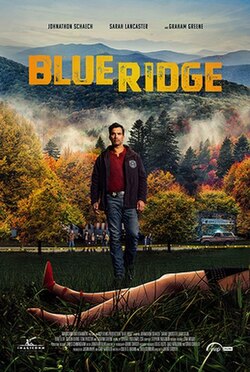
Blue Ridge (2020, directed by Brent Christy)


Former Green Beret Justin Wise (Johnathon Schaech) is the new sheriff of the small mountain town of Blue Ridge.  Sheriff Wise is so good at his job that he can just step inside of a gas station and figure out that it’s been robbed just by observing that the millennial behind the counter isn’t look at his phone.  The sheriff has a phone-obsessed millennial daughter (Taegen Burns) and a supportive ex-wife (Sarah Lancaster), who works as a waitress.

He also has a big mystery on his hands when the daughter of Cliff McGrath (Graham Greene) is found murdered.  The McGraths thinks that the Wade family is responsible.  The Wades have a long-standing grievance against the McGraths.  Sheriff Wise and Deputies Dobson (Lara Silva) and Thompson (Ben Esler) have to solve the mystery before a full-out war breaks out in town.

I was not surprised to discover that this was a pilot for television series.  The movie has the homey feel of the type of mystery show that your parents or grandparents would watch every Friday night.  Sherriff Wise may not be as old as my parents but he definitely shares their feelings about phones and trying to understand what’s wrong with the kids today.

It’s an old-fashioned movie but it’s mildly diverting and it does hold your attention.   Johnathon Schaech gives a strong performance as the sheriff who can beat up three people at once but who still gets nervous before asking a woman out on a date.  Graham Greene and Tom Proctor both give good performances as the rival family patriarchs and the mystery takes some interesting turns.  Blue Ridge did a good job of brining its small town setting to life.  Blue Ridge is good enough to be a pleasant afternoon diversion.

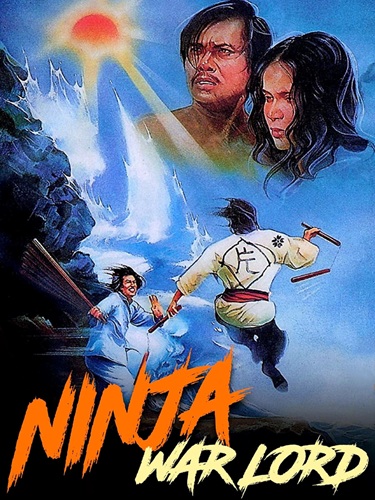
The TSL Grindhouse: Rage of Wind (a.k.a. Ninja War Lord) (dir by Ng See-Yuen)


Also known as Ninja War Lord, 1973’s Rage of Wind takes place during the Japanese occupation of China during the Second World War.

A Chinese fishing village is controlled by the ruthless Taka (Yasuaki Kurata), who terrorizes the town with his Hawaiian-shirt wearing henchmen and who deals with dissent by hanging people in the town square and then refusing to allow their loved ones to take down the bodies.  When boxer Chan Kwong (Chan Sing) returns to the village after pursuing a successful fighting career in the United States, the village rejoices.  Finally, there is someone who can stand up to Taka!  And the villages needs help because Taka has just instituted a new fishing tax!

Oh, Taka, you fool!  Don’t you realize that raising taxes never solves anything?  I realize that this film is taking place at a time when Milton Friedman was still working for the government and also long before the Laffer Curve was drawn on that napkin but still, raising taxes is always the last refuge of the unimaginative.  When the people in the village express their displeasure at having to pay more in taxes, Taka decides to seize their boats.  Hey, Taka, you dumbass commie — how are they going to make the money to pay your taxes if they don’t have their boats!?  Fortunately, Chan Kwong isn’t going to let the taxman get away with this.

(It’s interesting that this film features a Chinese hero fighting on the side of free enterprise.)

Here’s a few things that I liked about Rage of Wind.

First of all, it didn’t waste anytime getting to the good stuff.  The film’s first fight broke out within the first five minutes of its running time and, from that moment on, people were either fighting or preparing to fight.  This film didn’t feature any slow spots.  The fights were exciting to watch and, even more importantly, they distracted the viewer from asking too many questions about the plot.  At times, it felt like everyone in the film would have been well-served to just stop fighting and negotiate but that wouldn’t have been as much fun to watch.

Second, Taka wore a cape.  His henchmen may have dressed like tourists in Hawaii but Take wore a red cape!  And what’s even more impressive is that Taka totally pulled off the look.  Seriously, if someone can wear a cape and not look like an idiot, that’s when you know that person is a total badass.

Third, both the bad guys and the good guys got their own annoying sidekick.  The bad sidekick was constantly popping up and laughing.  The good sidekick had no teeth.  Both sidekicks died, which is an example of this film giving the viewers what they want.

Fourth, the musical score was made up of stolen riffs from Pink Floyd and the Theme From Shaft.  (I didn’t recognize the Pink Floyd riffs but everyone that I was watching the film with was like, “How did they get Pink Floyd!?”)  Apparently, the film “borrowed” the music without paying.  I love the shamelessness of old school Hong Kong cinema.

Fifth, the final fight between Taka and Chan Kwong is absolutely brutal!  Seriously, when you’re watching a film about people who are incapable of settling their conflicts through talking, this is exactly the type of fight you want to see.

Finally, once again, all of the conflict could have been avoided if they hadn’t tried to tax everyone to death!  I love films that are anti-taxation.  Watching a double feature of Rage of Wind and Harry’s War might become my new Tax Day tradition!


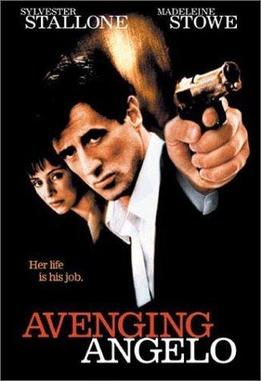
Avenging Angelo (2002, directed by Martyn Burke)


When mob boss Angelo (Anthony Quinn) is assassinated on the orders of the son of a former rival, bodyguard Frankie Delano (Sylvester Stallone) takes it upon himself to protect Angelo’s daughter, Jennifer (Madeleine Stowe).  The problem is that Jennifer, who was adopted by a normal couple, doesn’t know that she is the daughter of a mobster.  Her life and her marriage are already falling apart even before Frankie reveals the truth to her.  All she wants to do is disappear into the pages of a romance novel written by her favorite writer, Marcello (Raoul Bova) but Marello is not quite what he seems.

Sylvester Stallone has had a long career, full of high points (Rocky, First Blood, The Expendables, Creed) and low points (too many to list).  Avenging Angelo, made at a time when it was assumed that the aging Stallone would never again play Rocky Balboa or John Rambo, is a moderate low point.  It’s no Rocky but it’s still better than Stop!  Or My Mom Will Shoot!  Overall, it’s not very good and a lot of the humor falls flat but Stallone and Madeleine Stowe are both likable and they have a few moments that display what seems like genuine chemistry.  It’s still a slow movie that awkwardly mixes comedy and action but it was not the disaster that I was expecting it to be when I first found it on Tubi.  It’s more forgettable than bad.  If there is anything to really regret when it comes to Avenging Angelo, it’s that Anthony Quinn did not get a more memorable swan song.

Avenging Angelo was Stallone’s second movie to go straight to video.  It’s easy to forget not but the conventional wisdom in 2002 really was that Stallone was washed up.  There were jokes about whether or not he would follow Schwarzenegger’s lead and go into politics.  Stallone, however, proved all the naysayers wrong, proving that he could still throw punches as Rocky Balboa and John Rambo while The Expendables revealed a Stallone who could finally laugh at himself.  Avenging Angelo turned out to be not the end of Stallone’s career but instead just a detour.  Say what you will about the man and his movies, Sylvester Stallone is an American institution.

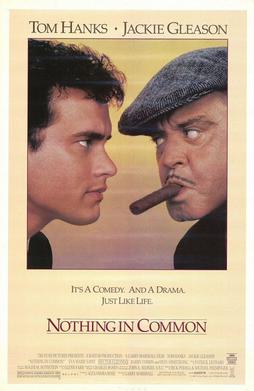
Nothing In Common (1986, directed by Garry Marshall)


Tom Hanks plays David Basner (Tom Hanks), an advertising executive whose immature lifestyle gives him insight into what sells but has also left him totally unprepared to deal with the fallout when his mother (Eva Marie Saint) leaves his father, Max (Jackie Gleason).  David, who is struggling to come up with the perfect commercial for a demanding client (Hector Elizondo), has to come to terms with both his father’s bad health and his history of infidelity.

This isn’t my favorite Tom Hanks movie.  It comes from that awkward period when Hanks was trying to make the transition from comedy to drama and its attempt to mix the two genres is not always successful.  The scenes of Hanks at the ad agency are often so cartoonish that they don’t seem like they belong in a movie where Jackie Gleason loses a foot to diabetes and realizes that he spent his entire marriage emotionally abusing his wife.  The movie, though, is worth watching for the teaming of Hanks and Gleason, two comedic actors who eventually proved themselves to equally as skilled at playing it serious.  Gleason, especially, gives a strong performance.  This was his final film and Garry Marshall convinced him to take it by asking, “Do you really want to go out on Smokey and the Bandit 3?”  Gleason would die a little over a year after the release of Nothing In Common and this film, even if it wasn’t perfect, gave the world a chance to see what a good actor he really was.

This film is often cited as the the movie that started Hanks on the way to becoming a dramatic actor.  Like Punchline, Nothing In Common played a role in Hanks becoming more than just a comedian but  I think Big was ultimately the better showcase for Hanks’s ability to mix pathos with laughs.  Nothing In Common was directed by Garry Marshall and, as was usually the case with Marshall, he often doesn’t trust the audience to figure things out for themselves.  He goes overboard trying to force an emotional response instead of just trusting the material.  Tom Hanks still does a good enough job in Nothing In Common.  Hanks is as likable as always and you can see the dramatic actor emerging in Hanks’s performance even if Hanks still wasn’t totally comfortable with it.

Nothing In Common is flawed but it was definitely a better swan song for Jackie Gleason than Smokey and the Bandit 3.

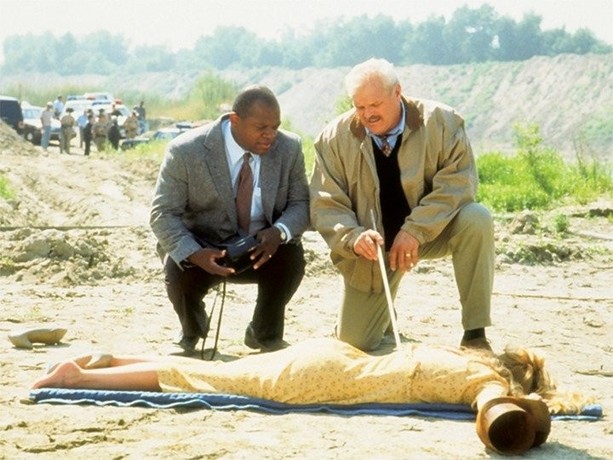
Brad reviews JACK REED: A SEARCH FOR JUSTICE (1994), starring Brian Dennehy!


Brian Dennehy directed, co-wrote and starred in this made-for-TV movie about Chicago homicide detective Jack Reed. This is the third TV movie based on Reed’s exploits, following 1992’s DEADLY MATRIMONY, and 1993’s BADGE OF HONOR. In A SEARCH FOR JUSTICE, Jack Reed (Brian Dennehy) investigates the murder of pregnant stripper Lorelei Bradley (Marjorie Monaghan), who also happens to love children, even running a daycare center in the trailer park she lives in. Reed’s investigation quickly identifies the politically connected businessman and strip club owner, Win Carter (Miguel Ferrer), as the prime suspect. As if trying to solve the murder isn’t tough enough, Reed must also deal with corrupt superiors within his own department and train his new boss Charles Silvera (Charles S. Dutton), the latest in a long line of men to be promoted over him. No matter what obstacles Reed encounters, he remains determined to bring the killer to justice!

JACK REED: A SEARCH FOR JUSTICE, is my first “Jack Reed” film, and I enjoyed it. The character of Jack Reed is based on real life Cook County, Illinois Sheriff John “Jack” Reed, with each of the different movies loosely based on cases that Reed investigated throughout his career. As you might imagine, Brian Dennehy is excellent in the lead role as the tough, principled cop who will stop at nothing to catch criminals. The Chicago backdrop adds a nice wrinkle to the proceedings with its strong reputation for corruption, something that plays strongly into this installment and makes Reed’s job that much harder. I also really like Charles S. Dutton’s character, Lieutenant Charles Silvera. Initially promoted due to the color of his skin, and as a way to stick it to Reed, Silvera turns out to be an incorruptible lawman who develops a great working relationship with Reed. I’ve always been a fan of Dutton as an actor, mainly because of his ability to project decency and integrity on screen, and I’m looking forward to seeing them work together in future installments. Miguel Ferrer is also a good villain. He doesn’t go over the top here, rather he plays the part as low key, politically connected, amoral, and ultimately, very dangerous. It’s a good choice.

The fact that JACK REED: A SEARCH FOR JUSTICE is based on real life cases helps bring a little more realism than you might get in most TV movie cop movies of the time. As an example, our cops are more concerned about putting together solid evidence and getting a conviction over anything else. There is some action, but after watching this installment, I realize that these movies are just as likely to end with lawyers cutting a deal than with a big shootout. On the flip side, there are elements of the story that don’t seem realistic at all, such as Reed’s wife Arlene (Susan Ruttan) doing her own undercover work at one point, and our victim’s unlikely dual life as a stripper and daycare operator. What can I say, it’s not a perfect movie, but if you enjoy 90’s TV cop dramas like I do, you should enjoy this film and this series. The cast is good, and the characters are men of integrity trying to bring justice to a corrupt world. That’s a recipe for enjoyment as far as I’m concerned, and I’m looking forward to watching the rest of the film series! 

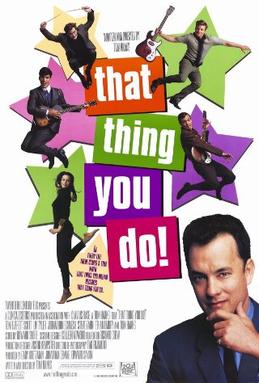
That Thing You Do! (1996, directed by Tom Hanks)


That Thing You Do! is the story of a one-hit wonder.

In 1964, an aspiring Jazz drummer named Guy (Tom Everett Scott) is a last minute addition to the a local band called the Oneders.  (It’s meant to sound like Wonders but almost everyone mispronounces it as O-Needers.)  The band’s egotistical leader, James (Jonathon Schaech) has written a slow ballad called That Thing You Do! but when Guy’s drumming causes the band to perform the song at a faster tempo, they end up with a local hit on their hands.  That local hit becomes a national hit when The Oneders are signed by Play-Tone Records.  First, Mr. White (Tom Hanks), their new manager, officially changes the name to The Wonders.  Secondly, he makes sure that every teen in America is dancing to That Thing You Do!  Third, he tells Guy to always wear sunglasses.  Fourth, he tells James that he will record and perform what Play-Tone tells him to.  Guitarist Lenny (Steven Zahn) and the unnamed Bass Player (Ethan Embry) are happy to be along for the ride but James chafes at his lack of artistic freedom.  Guy, meanwhile, falls for James’s girlfriend (Liv Tyler, at her loveliest) and dreams of meeting his idol, jazzman Del Paxton (Bill Cobbs).

That Thing You Do! was Tom Hanks’s directorial debut and, with its careful recreation of a bygone era and its collection of authentic sounding early 60s rock on the soundtrack, it was obviously a labor of love.  Considering the number of times that the song is played in the movie, it helps that it is a very good song.  That Thing You Do! is a catchy tune, one that you can’t help but tap your feet to.  At the same time, it also sounds like a one hit wonder.  It’s good but not so great as to make you expect much else from The Wonders.

Not surprisingly, Tom Hanks gets great performances from the entire ensemble cast.  Johnathon Schaech and Tom Everett Scott have never been better.  Liv Tyler is lovely and vulnerable as James’s unappreciated girlfriend.  Familiar faces like Peter Scolari, Kevin Pollak, Chris Isaak, and Clint Howard make welcome appearances.  Hanks himself is surprisingly intimidating as Mr. White.  When he says that the band will cover something the Play-Tone catalogue, it’s obvious that he’s not making a request.

The film is a tribute to being young and to loving music bit it’s also a study in the disillusionment of discovering that everything is ultimately a business.  James is frequently an arrogant jerk and he treats his girlfriend terribly but it’s hard not to sympathize with him when he says that he wants to do more than just cover songs from the Play-Tone catalogue.  To James and Guy, the Wonders are about self-expression and their love of music.  To Mr. White, the Wonders are just another band that came up with one catchy tune and who probably aren’t ever going to be heard from again.   That Thing You Do! pays tribute to all of the one-hit wonders out there, the bands who you forget about until you just happen to hear that one song on the radio or in a movie and suddenly, all the memories come flooding back.


Film Review: Cast Away (dir by Robert Zemeckis)


“WILSON!”

Seriously, I’m usually pretty well-behaved when I watch a movie but every time I see the 2000 film Cast Away, I find myself thinking, “Protect Wilson!  You must protect Wilson!”  And then, every time, I feel the sting of tears in my eyes as Wilson, with that red-face and that understanding attitude, goes floating away.

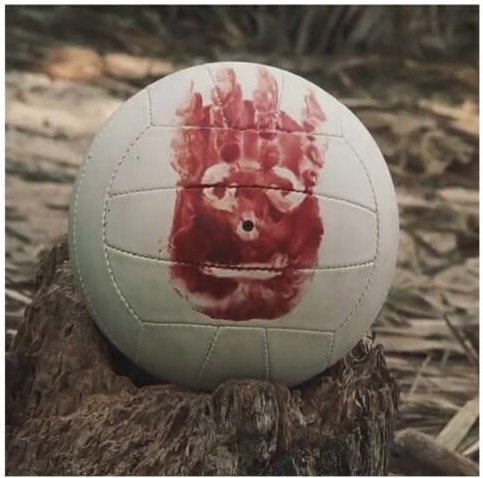
Wilson is a volleyball.  When a FedEx executive named Chuck Noland (played by Tom Hanks) finds himself stranded on a desert island, Wilson becomes his only companion.  A stain from Chuck’s bloody palm creates something that resembles a face on Wilson’s rubber surface and Chuck spends a lot of time talking to Wilson.  It’s how Chuck maintains his sanity, even as he loses weight, sheds most of his clothes, and grows a beard.

Chuck learns how to make fire.  He learns how to catch fish.  He is able to survive due to the supplies that he gathers from the FedEx packages that were being carried on the plane that crashed into the island.  But Chuck never stops dreaming of returning home to his girlfriend (Helen Hunt).  Eventually, Chuck finds the courage to try to make the journey back to civilization.  He brings Wilson with him but ultimately, this is something that Chuck is going to have to do on his own.  Of course, Chuck has failed to consider that he’s been gone for years.  He is presumed dead.  On the Island, time seemed like it was frozen.  For the rest of the world, life has continued.

Cast Away is a film that a lot of people, especially online film commentators, tend to criticize.  The complaint is usually that the film is essentially a commercial for FedEx, that it’s not believable that Tom Hanks could survive on that island for as long as he did, and that the film itself has a weak ending.  I’ll concede that the film does make FedEx look like the nicest corporation on Earth.  (FedEx’s CEO appears as himself, which should tell you something about how the company is presented.)  And I will admit that the film’s time-advancing jump cut, which abruptly takes Hanks from being clean-shaven and husky to being thin and bearded, does leave a lot of unanswered questions.  But I will always defend the film’s ending.  The film ends on a note of ambiguity but how else could it have ended?  Everyone thought Chuck Noland was dead.  His girlfriend had every right to get on with her life and, in fact, it would have been psychologically unhealthy for her if she hadn’t.  As for that final shot, it’s an acknowledgment that Chuck doesn’t know what lies ahead of him in the future.  All he knows is that he life isn’t over yet.  It’s a melancholy ending.  It’s a frustrating ending.  But it’s also the only way the film could have ended and therefore, it’s a perfect ending.

Cast Away is a film that I will always defend and it’s also a film that really only could have worked with Tom Hanks in the lead role.  He plays Chuck as being the ultimate everyman, an affable guy who was just trying to do his job and whose survival of the initial plane crash was largely due to luck.  Hanks is one of those actors who is instantly sympathetic and Cast Away uses his screen persona to good effect.  You want him to survive because he’s Tom Hanks.  He may be playing a character named Chuck Noland but ultimately, he’s Tom Hanks.  He survived being trapped in space.  Surely, he can survive being stranded on an island.  The majority of the film is just Hanks talking to himself.  This would have brought out the worst in so many actors but Tom Hanks makes it work.  And yes, he’ll bring tears to your eyes as he watches Wilson float away.  That’s the power of a good actor.

As for Wilson, I like to think that he washed up in Pensecola.  Recently, I played a little volleyball on a beautiful Florida beach.  Was that you, Wilson?


Lethal Tender (1997, directed by John Bradshaw)


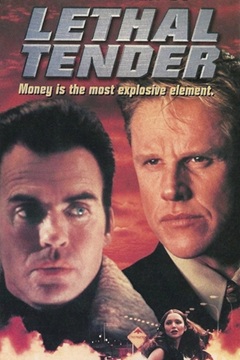
Montessi (Kim Coates) and his men have taken over a water filtration plant, are holding hostages, and keep threatening to poison the water supply.  Rogue cop David Chase (Jeff Fahey) and Melissa Wilkins (Carrie-Anne Moss) sneak around the plant and try to stop the terrorists.  David Chase is set up to be a John McClane type but instead, he only kills one terrorists and then lets everyone else do most of the work.  Of course, the whole water filtration hostage situation is just a distraction so Mr. Turner (Gary Busey) can steal a bunch of bonds.  Busey sits behind a computer for most of the movie, lending his name but not much else.

A good cast is wasted in what is definitely one of the worst of the many Die Hard rip-offs to come out in the 90s.  There’s not enough action, with Jeff Fahey as a passive hero and even the great Kim Coates reduced to standing around and doing a lot of yelling for most of his time on screen.  Gary Busey is the big star here but it’s obvious that he was only on the set for a few hours and his plan for stealing the bonds never makes sense.  Whenever anyone questions his plans, he says that it involves computers.  In the 90s, I guess that was enough.

Watching this last night, I realized that I had seen it on Cinemax back in the day.  It didn’t make much sense back then either.