Unidentified, Short Film Review by Case Wright


I was unable to find anything on IMDB for this film; so, I used this photo from a previous review where it looked like they were going for a Santa Pedo vibe. Read that review below:

https://unobtainium13.com/2021/10/23/creepshow-time-out-the-things-in-oakwoods-past/: Unidentified, Short Film Review by Case Wright

Unidentified is about an ordinary guy who sees an alien invasion. This concept is so overdone that it is really its own subgenre of suckiness. Some random schmoe sees aliens and is unable to do anything about it accept die?! Mr. Filmmaker of Unidentified, why you are bothering me this garbage? Who cares?!

Hear me, it’s one thing if the ordinary person is heroic or we are setting up the story or he causes a resolution, but when it’s just some doofus driving around for 60% of the short, you are wasting my time! Mr. Filmmaker of Unidentified, I understand that creating a story is hard like how you must be always confused when you try to get the mail or turn on your phone, but that doesn’t mean you should pursue the art of film. Instead of making these terrible shorts that lack even a basic story let alone an ending, how about working on a simplistic craft? I’ll even consider putting it on my fridge! Really, my fridge has some prime real estate on it: magnets, shopping list sticky notes, and stains if it’s my housecleaning day.

If this terrible film did pique your interest…..somehow, the story is a British man in a sedan who drives for several minutes and sees a big monster- yep, that’s it. UGHHH. Maybe Alex Magana has a British cousin?

October Positivity: Holyman Undercover (dir by David A.R. White)


In 2010’s Holyman Undercover, David A.R. White plays Roy.  Roy is an 18 year-old Amish dude from Kansas.  It’s time for him to experience Rumspringa, a period in which he can live life amongst “the English” and decide whether or not he wants to commit to being Amish.  Roy decides to go Los Angeles so he can track down his uncle and work with him as a missionary.

Roy struggles in Los Angeles.  Giving money to one homeless man leads to him nearly getting mugged.  When he meets his uncle, he discovers that Brian (also played by David A.R. White) is now a struggling actor who has a taste for cocaine.  (Brian claims that he’s a holyman working undercover.)  Accompanying Brian to an audition leads to Roy getting cast as Satan on a primetime soap opera.  His wife is played by vapid supermodel Tiffany Towers (Jennifer Lyons).  Meanwhile, the show’s producer is a former country girl named Annie (Andrea Logan White) and soon, Roy is having fantasies about Annie dressing up like an Amish woman and dancing in a field with him.  However, the head of the network (Fred Willard) wants Roy to date Tiffany because it’ll be good publicity for the show.

Throughout it all, Roy remains innocent and confused about the modern world.  He’s never watched television.  He doesn’t know how to use a phone.  He doesn’t understand what a credit card is.  He’s earnest and honest to a fault and, even after Tiffany makes out with him, he continues to insist that he only has eyes for Annie.

Of course, in reality, I imagine that the typical Amish person knows how to use a phone.  I imagine that they probably also know what a television is and they probably even understand that you’re expected to pay your credit card debt.  The Amish may choose to reject a good deal of the modern world but that doesn’t mean that they don’t know what the modern world is.  But this film isn’t meant to be a realistic portrayal of the Amish or of Hollywood or of really anything.

Indeed, I’m not really sure what to make of this film.  It’s faith-based and it ends with Roy delivering a simple message about loving others but the film’s humor is often rather mean-spirited and there’s several jokes that are more than a little racist and homophobic.  (Japanese tourists take pictures while shouting, “Godzilla!”  When Brian ends up in jail, his cellmate is a hulking black man who says his name is Beef because “it’s what’s for dinner.”)  David A.R. White is not bad as Roy but his performance as Brian is incredibly shrill and there’s really no reason, beyond ego, for director White to have cast himself in both roles.

Probably the best thing that one can say about the film is that the name actors — Fred Willard, Clint Howard, Edie McClurg, and Staci Keanan — all manage to survive with their dignity intact.  Indeed, the highlight of the film is, believe it or not, John Schneider earnestly playing himself as the actor who replaces Roy as Satan and who then promptly launches a presidential campaign.  “The country’s going to Hell anyway!” he says, with just the right amount of self-awareness.

Interestingly enough, the film does end with one particularly prophetic scene, as Roy and Annie leave Hollywood to produce an Amish dating show.  Tiffany moves with them to the farm and a group of Amish men compete for her hand in marriage.  Farmer Wants A Wife, anyone?
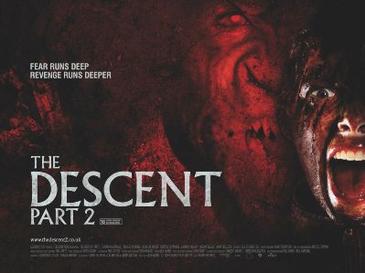
So, I Watched The Descent Part 2 (2009, Dir. by Jon Harris)


The Descent Part 2: Back to the Cave!

That’s what I would have called it.

Sarah (Shauna Macdonald) goes back to the caves that she barely escaped from during the first Descent to help the police look for the remains of her friends.  Sarah is suspected of killing all of them so I don’t think the police would have gone into a narrow cave with her.  Sarah was also traumatized by what happened in the cave so I don’t think she would voluntarily go back down there either.  As soon as they enter the cave, they get attacked by the crawlers.  What did they think would happen?

I loved the first Descent because it was a horror film that featured interesting and multi-layered women who weren’t just put on screen to be whimpering victims.  When I watched The Descent, I was just as invested in the personal drama as I was the horror in the caves.  I also liked that the first Descent left it open to interpretation about what actually happened in the cave.  The sequel didn’t really do that and it also didn’t add anything to the story.  Juno (Natalie Mendoza) returns but I’m not sure how considering what happened during the first movie.

The Descent Part 2 also shows a lot more of the crawlers than the first film did.  They’re much more visible and much more busy but they aren’t as scary once you can actually see them.  Plus revealing the crawlers as much as this movie does also ruins the ambiguity that I loved about the first Descent.

The Descent Part 2: More Splatter, Less Heart.

I should get a job writing tag lines.


Wizards of the Lost Kingdom (1985, directed by Hector Olivera)


The kingdom has been conquered by an evil sorcerer named Shurka (Thom Christopher).  Young Simon (Vidal Peterson), the son of the king’s wizard, barely escapes with his best friend and pet, the white fur-covered Gufax (Eugenio Martin).  In the wilderness, they meet warrior Kor (Bo Svenson), who teams up with them to free the kingdom.

This is another Roger Corman-produced sword and sorcery film from Argentina.  Corman did a lot of these in the 80s.  Wizards of the Lost Kingdom stands out by being considerably more kid-friendly than the rest of them.  There’s no nudity.  The violence is not excessive and is largely directed at fake looking giant insects.  There’s no nudity and no scenes of the bad guys forcing themselves on women.  The hero even has a toy-friendly companion!

Wizards of the Lost Kingdom also has a lot of stock footage.  The entire pre-title sequence is stock footage lifted from movies like Death Stalker to explain how “King Tyler” came to control the kingdom.  (King Tyler sounds like someone who would be the kegger king of the local college.)  Wizards of the Lost Kingdom is a short movie with a barely 72-minute run-time.  Fourteen of those minutes is footage from other movies.

Wizards of the Lost Kingdom takes a lighter approach to the sword-and-sorcery genre and it pays off with a simple and easy-to-watch movie featuring swords, magic, and monstrous insects.  It’s not a film that demands much of the audience and Bo Svenson looks convincing grunting and carrying a sword.  It wasn’t a box office hit but found a second life on video.  Of course, it got a sequel.  None of the original cast returned.

October True Crime: Karla (dir by Joel Bender)


When it comes to true crime cases, few are as disturbing as the story of Paul Bernardo and Karla Homolka.

Paul and Karla were a young, married couple who lived in Ontario.  They were both attractive.  They were both popular.  They were both superficially charming, in the style of someone who you might have taken a class with but the only thing you can really remember about them is their smile.  And they were both killers.  Paul Bernardo, a wannabe rapper who had previously made his money by smuggling cigarettes and who was also a serial rapist, murdered at the least three teenage girls, including Karla’s sister, Tammy.  When Paul was arrested, Karla told prosecutors that she had helped Paul with his murders but only because he threatened and abused her.  Prosecutors, perhaps moved by a picture that Karla’s friend took of her bruised face after one of Paul’s beatings, made a deal with her for her testimony.  In return for testifying against Paul Bernardo, Karla was convicted only of manslaughter and given a 12-year prison sentence.  (She was 23 at the time and would only be 35 when released from prison, assuming that she served the full sentence.)  However, during the trial, video tapes of the murders were uncovered and showed that Karla had been a far more active participant in the murders than she had originally admitted.  That included the murder of her sister, Tammy.

There were calls to rescind Karla’s plea bargain and to try her for murder but since her plea bargain had only required her to provide enough evidence to convict Paul, it was ruled that she had upheld her end of the bargain.  While Paul Bernardo is currently serving his life sentence, Karla Homolka is now free and living somewhere in Canada.

Needless to say, the case drew international attention, both due to the circumstances of Karla’s plea bargain and also to Paul and Karla’s image of being the “Ken and Barbie Of Serial Killers.”  It’s a case that continue to haunt Canada, an example of how the accused was ultimately treated with more respect than the victims.  For her part, Karla continues to claim that it was all Paul and that she was forced into helping.  Paul claims that he and Karla were equal partners and that the actual murders were all committed by Karla.  Personally, I think they’re both lying.

2006’s Karla stars Laura Prepon as Karla Homolka.  The film opens with her already in prison and being interviewed by a psychiatrist (Patrick Bauchau) who has been assigned to determine if there’s a risk of her reoffending.  As Karla tells her story, we see flashbacks of Karla’s life with Paul (Misha Collins).  Prepon and Collins are both chillingly believable as the soulless Paul and Karla.  Laura Prepon plays Karla as being a narcissistic sociopath who is incapable of understand that she’s not the victim in this story.  I imagine that Prepon’s performance probably captures the essence of the real Karla, even if Prepon doesn’t really look like her.

That said, the film itself is largely a surface level exploration of the case.  The film’s script attempts to maintain some ambiguity as to whether or not Karla Homolka was a voluntarily participant in the murders or if she actually was just too scared of Bernardo to stop him.  Prepon plays her as being a sociopath but the script still tries to play both sides of the debate and, as a result, the film falls flat.  The film may be called Karla but it doesn’t really get into her head and, as a result, it has all the depth of an Investigative Discovery special.  In the end, the film feels like it’s trying to exploit the notoriety around a famous case without taking a firm position on the case’s biggest controversy.  When it comes to the crimes of Karla Homolka, that’s not an option.

Watch Your Back (AI Short Film), Review by Case Wright


What film would Alex Magana make if he were a robot? This is a question that no one wanted answered, but Elevate Studios said, TOUGH, you are gettin it! And get it we did!

Many worry that AI will take over the world and our jobs; well, I’m here to tell you that you are 50% correct! AI will likely take your job, but not the world because it’ll just be too busy making boring/terrible short films.
Hey Robots, look I get that you feel like you got a full head of steam here, but why make terrible movies? We have people for that and those are jobs that are too good for you.
This short is about a priest called into perform and exorcism and he proceeds to punch the possessed woman and the demon leaves her. Yes, that was the whole film. I feel less now that I have seen this.

I put together a short myself using AI to show what it will be like when AI displaces humans:

Will the Robot unalive us all? I don’t know, but they will sure try to bore us to death!

Horror On The Lens: Teenage Caveman (dir by Roger Corman)


Future serious actor Robert Vaughn made his film debut in 1958’s Teenage Caveman.  Directed by Roger Corman, Teenage Caveman tells the story of a rebellious young man (that’s Robert Vaughn) who chooses to defy his father’s warnings and venture beyond the caves and into “the forbidden zone.”  He’s told that monsters roam in the forbidden zone and indeed, at least one of them does.  However, neither the Teenage Caveman nor his father are prepared for what lies at the heart of the forbidden zone.

(What will he find out there, Dr. Zaius?)

Robert Vaughn later said that, out of all the bad films that he made, this was the worst.  Personally, I think he was being a bit too hard on the film.  It’s not good but it is definitely fun.  Along with watching all of the dinosaur stock footage, you get to wonder how a caveman — especially a teenage caveman! — could possibly have such perfect hair.  Even more importantly, if you stick with it, this film has a twist ending that has to be seen to be believed.

Here is Teenage Caveman:


October Positivity: Allison’s Choice (dir by Bruce Marchiano)


In 2015’s Alison’s Choice, Chanel Marriott plays Alison.

Alison is a teenager who has a difficult relationship with her father.  He holds back his emotions from her.  She’s been left feeling insecure as a result and is perhaps a bit too dependent upon validation from other men.  For instance, her no-good boyfriend, Rick (Julian Alexander), bullies her into having sex in his tiny car.  When Alison later discovers that she’s pregnant, Rick’s response is to tell her to get rid of it.  He tells her to go find a clinic and have an abortion and then talk to him later.  Rick makes it clear that he will not paying for the procedure.  He also leaves it up in the air as to whether or not he’ll even come to the clinic to support Alison.

Classy guy, that Rick.

At the clinic, Alison finds herself having doubts.  Does she really want to get an abortion?  The clinic’s rather harsh and antiseptic atmosphere doesn’t make things any easier.  One nurse (Liz Randall) tries to pressure Alison to go through with her abortion.  The doctor (Britt Prentice) confesses that he can’t guarantee that abortion isn’t murder.  At the front desk, Ms. Glo (Bunny Gibson) asks Alison is she’s really sure she wants to go through with the procedure.  A pushy social worker named Marta (Amy Lydon) assures Alison that it’s not big deal.  Lecretia (Alicia Monet Caldwell) makes fun of Alison for being a first-timer.

And, of course, Jesus (Bruce Marchiano) shows up as a janitor and encourages Alison not to get an abortion.  Actually, he encourages everyone all over the world not to get an abortion and, whenever anyone does, he starts crying.  He says that he’s been working as a janitor since 1973.  That, of course, was the year of Roe v Wade.

Bruce Marchiano has played Jesus in a number of films.  He played Jesus in The Encounter, which is something of a guilty pleasure of mine.  Marchiano has a calm and soothing voice and his eyes tend to radiate kindness, which makes him a good choice to play Jesus.  From what I’ve seen of him in various faith-based productions, he’s not a bad actor at all.  He can deliver his lines without looking straight at the camera and he’s capable of showing emotion.  By the standards of many faith-based films, that makes him almost Brandoesque.

Unfortunately, Alison’s Choice is so heavy-handed and awkwardly acted by everyone else in the cast that Marchiano’s characteristically good and empathetic performance can’t really save it.  I’m not going to get into the specifics of whether or not the film is correct about abortion, beyond saying that this is not a film that is going to change anyone’s mind about the issue.  It’s a heavy-handed pro-life tract.  (Then again, there’s also been more than a few heavy-handed pro-choice tracts.)  What I will say is that Alison, as a character, is so indecisive and, quite frankly, annoying that it didn’t take me long to lose interest in her.  Even after she becomes convinced that she’s actually talking to Jesus, she still can’t decide whether or not she loves her boyfriend.  Girl, Jesus just told you that your boyfriend is no good.  I don’t care what anyone thinks about abortion.  If Jesus suddenly shows up and tells you to dump your boyfriend, you do it.

Eh.  I’m going to go watch The Encounter again.

The Human Duplicators (1965, directed by Hugo Grimaldi)


Who’s an android and who’s not!?

It’s hard to keep track in The Human Duplicators.  Dr. Kolos (Richard Kiel) is an alien who is sent down to Earth.  He thinks that he’s not an android but how can he be sure?  He goes to the laboratory of Dr. Vaughan Dornheimer (George Macready) and tells Donheimer that they will be working together to create androids that are perfect duplicates for humans and that Kolos will be the “master.”  But then an android is built of Dornheimer himself and android Dornhiemer declares that he is the master.  Kolos is distracted because he’s fallen in love with Dornhiemer’s daughter, a blind pianist named Lisa (Dolores Faith).

Glenn Martin (George Nader) of the National Intelligence Agency is assigned to figure out what is happening at the Dornhiemer mansion and, wouldn’t you know it, there’s already an android version of Glenn.  Glenn’s girlfriend is played the brassy Barbara Nichols, a comedic actress who was briefly groomed to be the next Marilyn Monroe and who comes on like the star of a burlesque show.  Glenn’s boss is Austin Wells and he’s played by Hugh Beaumont, which makes this film feel like a weird episode of Leave It To Beaver where Wally has to save the world.  I don’t think the bad guys ever duplicate Hugh Beaumont and that’s good because real trouble could be created by an evil version of Ward Cleaver.

The presence of Richard Kiel and Hugh Beaumont is really the only thing that The Human Duplicators have going for it.  There are plenty of fights between Glenn and the androids but it turns out that the androids are easy to beat into oblivion so there’s not much suspense or excitement to be found.  At times, it feels as if it’s trying to be an episode of The Avengers just without the wit of Patrick Macnee or the charm of Diana Rigg.  The Human Duplicators seems to take itself very seriously and I’m not sure why.

After The Human Duplicators, Richard Kiel later went on to play Jaws in The Spy Who Loved Me and Moonraker.  Hugh Beaumont retired from the movies.

October True Crime: Looking for Mr. Goodbar (dir by Richard Brooks)


In 1977’s Looking for Mr. Goodbar, Diane Keaton plays Theresa Dunn.

A neurotic and single woman who has never emotionally recovered from her childhood struggle with scoliosis, Theresa is trying to find herself in the wild and promiscuous world of the 1970s.  After losing her virginity to a condescending college professor (Alan Feinstein), Diane goes on to have relationships with a needy social worker (William Atherton) and an hyperactive petty criminal (Richard Gere).  During the day, she teaches deaf children and she’s good at her job.  She even manages to win over the distrustful brother (Levar Burton) of one of her students.  At night, she hits the bars.  She buys drugs from the neighborhood dealer (Julius Harris).  She tries to read the book that she always carries with her.  (Some nights, it’s The Godfather and other nights, it’s something else.)  She picks up strange men and takes them to her roach-infested apartment.  One of those men, Gary (Tom Berenger), turns out to both be a bit insecure about his masculinity and also totally insane….

Looking for Mr. Goodbar is an adaptation of a novel that was inspired by the real-life murder of a New York school teacher named Roseann Quinn.  The book was best seller and, just as he had with a previous best-selling true crime novel, director Richard Brooks bought the rights and both wrote and directed the film.  Diane Keaton, who at that point was best-known for playing Kay Adams in The Godfather and for appearing in Woody Allen’s comedies, took on the demanding role of Theresa and, whatever one may think of the film itself, it can’t be denied that Keaton gives a brave performance as the self-destructive Theresa.  In fact, I would say it’s one of Keaton’s best performances, outside of her work with Woody Allen and The Godfather Part II.  If she had been played by a lesser actress, Roseann could have been unbearable.  As played by Diane Keaton, though, she’s everyone’s best friend who just need some time to find herself.  The viewer worries about her and wants to protect her as soon as they see her, making her ultimate fate all the more tragic.

As for film itself, I’ve watched Looking For Mr. Goodbar a few times and I’m always a little bit surprised by how bad the movie actually is.  The film actually gets off to a strong start.  The scenes between Theresa and the professor make for a sensitive portrait of a repressed young woman finally getting in touch with her sexuality and, in the process, discovering that she deserves better than the man she’s with.  But once Theresa moves into her apartment and starts hitting the bars at night, the film takes on a hectoring and moralistic tone that leaves the viewer feeling as if the film is blaming Theresa for the tragedy that’s waiting for her at the end of the story.  Diane Keaton and Tuesday Weld (who plays her sister) both give excellent performances but everyone else in the film either does too much or too little.  This is especially true of Richard Gere, who is very hyperactive but still strangely insubstantial in his role.  (Whenever Richard Gere appears on screen, one gets the feeling that they could just walk right through him.)  A scene where Gere jumps around the apartment is meant to be disturbing but it’s more likely to inspire laughter than chills.

It’s an overly long film and the moments in which Theresa has dark, sexually-charged fantasies are never quite as powerful as the film obviously meant for them to be.  (Brian Dennehy makes his film debut as a doctor who kisses Theresa’s breast during one of her fantasies.)  As opposed to the empathy that he brought to In Cold Blood, one gets the feeling that director Richard Brooks didn’t like anyone in this movie and that he was more interested in Theresa as a cautionary tale than as a human being.  With this film, Brooks seemed to be standing athwart the Sexual Revolution and shouting, “Stop!”  That said, the film’s final moments are genuinely disturbing and difficult to watch.  It’s the one moment where Brooks’s lack of subtlety pays off.  Those last minutes are about as horrific as anything you could expect to see.

As for Roseann Quinn, her killer was eventually arrested.  John Wayne Wilson hung himself in prison, 5 months after murdering her.