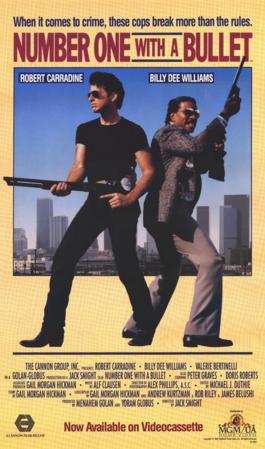
A Movie A Day #308: Number One With A Bullet (1987, directed by Jack Smight)


Number One With A Bullet is the story of two cops.  Nick Barzack (Robert Carradine) is so crazy that the all criminals have nicknamed “Beserk.”  (Who says criminals aren’t clever?)  Nick’s partner, Frank Hazeltine (Billy Dee Williams) is so smooth that jazz starts to play whenever he steps into a room.  Nick keeps a motorcycle in his living room, wants to get back together with his wife (Valerie Bertinelli), and has an overprotective mother (Doris Roberts).  Hazeltine is Billy Dee Williams so all he has to worry about is being the coolest man on Earth.  Their captain (Peter Graves!) may want them to do things by the book but Nick and Hazeltine are willing to throw the book out if it means taking down DaCosta, a so-called respectable citizen who they think is actually the city’s biggest drug lord.

It is natural to assume that, because of the whole crazy white cop/centered black cop storyline, this movie was meant to be a rip-off of a well-known film starring Mel Gibson and Danny Glover but actually, Number One With A Bullet was released a week before Lethal Weapon.  As well, while Carradine’s Nick is almost as crazy as Mel Gibson’s Riggs, it is impossible to imagine Billy Dee Williams ever saying that he’s “too old for this shit.”  Williams is having too good a time listening to jazz and picking up women.  Whenever Hazeltine shows up, Number One With A Bullet feels like a Colt 45 commercial that somehow costars Robert Carradine.  Whenever the film is just Carradine, it feels like an unauthorized sequel to Revenge of the Nerds where Lewis gets really, really pissed off.

Number One With A Bullet is a Cannon film and entertaining in the way that most late 80s Cannon films are.  There is a lot of action, a little skin, and some dated comedy, much of it featuring Robert Carradine having to dress in drag.  There is also a mud wrestling scene because I guess mud wrestling was extremely popular back in the 80s.  They may not be Gibson and Glover but Carradine and Williams still make a good team and they both seem to be having a ball.  For fans of cheap 80s action films, there is a lot to enjoy in Number One With A Bullet.
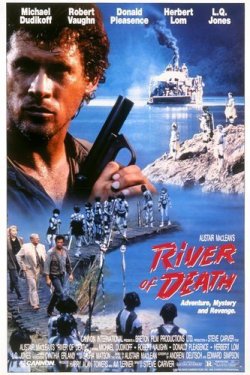
A Movie A Day #307: River of Death (1989, directed by Steve Carver)


In the Amazon, natives are dying of a mysterious disease.  Could it have anything to do with a German war criminal named Wolfgang (played by Robert Vaughn) who is living in a cave that is decorated with a Nazi flag?  A scientist (Victor Melleney) and his daughter, Anna (Sarah Maur Thorp), are determined to find out.  They hire a tough explorer, John Hamilton (Michael Dudikoff), to lead them up the river but John does not do a very good job because the scientist ends up dead and Anna ends up kidnapped.
Everyone tells John to forget about Anna.  Colonel Diaz (Herbert Lom) says that she is dead.  John’s best friend, an arms dealer named Eddie (L.Q. Jones), says that she’s dead.  John refuses to accept that and he organizes an expedition to help track them down.  A strange man (Donald Pleasence) and his assistant (Cynthia Erland) approach John and offer to help.  What John does not know is that the man is actually Heinrich Spaatz, yet another Nazi war criminal.

River of Death is a ridiculous movie but it is entertaining in a way that only a late 80s Michael Dudikoff movie can be.  Though River of Death was a Cannon film, it was produced by the legendary Harry Alan Towers, which is probably why the production standards are higher than the average Menahem Golan quickie.  Dudikoff does a passable imitation of Indiana Jones (and he even gets to do some Apocalypse Now-style narrating) but the real reason to watch the film is to watch veteran actors like Robert Vaughn, Donald Pleasence, Herbert Lom, and L.Q. Jones ham it up.  Vaughn doesn’t even attempt to sound German while Pleasence gives a performance that is strange even by his own considerable standards.

One final note: River of Death was the second-to-last film directed by Steve Carver, who also did Capone, and Big Bad Mama, along with helping to make Chuck Norris a star by directing Lone Wolf McQuade and An Eye For An Eye.

Lifetime Film Review: Oscar Pistorius: Blade Runner Killer (dir by Norman Stone)


The latest Lifetime “true crime” movie goes a little something like this:

We start with a clip from a South African news program.  The anchorman talks about how much everyone loves Oscar Pistorius, the man who lost his legs when he was 11 months old and then went to compete in both the Paralympics and the Olympics.  In both his home country and abroad, Oscar is known as the Blade Runner.

Cut to:

Oscar Pistorius (played by Andreas Damm) running across South Africa.  A man in a pickup truck honks at him.  Oscar holds up his hand in greeting.  A group of children stop playing soccer long enough to watch Oscar run by.  No matter what, Oscar never stops running.

Cut to:

Oscar in his kitchen, on the day before Thanksgiving.  A title card tell us that we are seeing “the day before Reeva’s death.”  Reeva Steenkamp (Toni Garrn) is Oscar’s girlfriend and a model.  They talk, they laugh, they make love on a kitchen counter.  It seems like the perfect relationship.

Cut to:

Night.  The outside of Oscar’s house.  There are gunshots.  Reeva screams for help.  Oscar shouts “No!”

Cut to:

The morning after Reeva’s death and Oscar telling the police how he accidentally killed his girlfriend.

Cut to:

A few months before Reeva’s death.  Reeva tells her mother that she wants to move in with Oscar.

Cut to:

A few more months before Reeva’s death.  Reeva meets Oscar Pistorius and, for Oscar, it’s obsession at first sight.

And so the movie goes from there, hopping back and forth through time and telling the story of Oscar and Reeva’s ill-fated relationship.  Oscar turns out to be jealous and controlling.  Reeva is always a bit too quick to accept the blame for all of Oscar’s tantrums.  Oscar confesses to her that he’s always felt like he’s been alone in the world.  Reeva’s friends tell her that they think Oscar is creepy.  Reeva says that they don’t know him the way that she does.  Reeva mentions that she smoked weed while doing a shoot in Jamaica.  Oscar totally freaks out, as if he simply cannot believe that someone would smoke weed while in Jamaica.  (I mean, wouldn’t it be rude not to?)

And eventually, it all leads to Oscar shooting Reeva and the trial that captivated the world.  Did Oscar intentionally shoot her while in a jealous rage or, as he claimed, did he accidentally shoot her?  The film refuses to give us a definitive answer, leaving it up to the viewer to decide.  That seems to be a bit of a cop-out but then again, that’s the way it usually is with these true crime films.  They never definitely validate one side or the other.  It’s just like how last week’s Robert Durst movie couldn’t come right out and show Durst killing his wife even though everyone knows that’s probably what happened.  Ambiguity can be good but sometimes, you just want the movie to have the courage to offer up an answer.

Anyway, as for the rest of Blade Runner Killer, it was a bit too slow and disjointed to really work.  As I watched the film, I couldn’t help but feel that, unlike the Durst case, there really wasn’t enough to the Pistorius case to justify an entire, 90-minute movie.  Though the script never really dug far beneath the surface, both Andreas Damm and Toni Garrn did a good job as Oscar and Reeva.  Otherwise, this one was pretty forgettable.

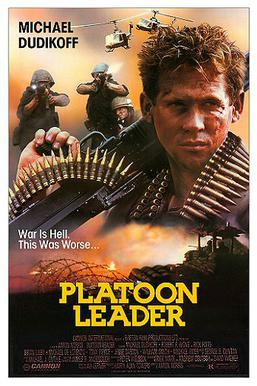
A Movie A Day #306: Platoon Leader (1988, directed by Aaron Norris)


Having just graduated from West Point, Lt. Jeff Knight (Michael Dudikoff, the American Ninja himself) is sent to Vietnam and takes over a battle-weary platoon.  Lt. Knight has got his work cut out for him.  The VC is all around, drug use is rampant, and the cynical members of the platoon have no respect for him.  When Lt. Knight is injured during one of his first patrols, everyone is so convinced that he’ll go back to the U.S. that they loot his quarters.  However, Knight does return, determined to earn the respect of his men and become a true platoon leader!

Though Cannon was best known for making B action movies (many of which starred either Chuck Norris or Charles Bronson), they occasionally tried to improve their image by releasing a prestige film.  Platoon Leader is somewhere in the middle between Cannon’s usual output and their “respectable” films.  It is based on a highly acclaimed memoir and, though the film was made in South Africa, it does a good job of recreating the look of Vietnam.  For instance, Platoon Leader‘s version of Vietnam is more convincing than what Cannon later presented in P.O.W.: The EscapePlatoon Leader also spends some time developing its characters.  Lt. Knight is more than just a stoic action hero, which already distinguishes it from 90% of Cannon’s usual output.  At the same time, Platoon Leader was directed by Chuck Norris’s brother, Aaron, and he doesn’t hold back on the explosions and the gunfire that everyone had come to expect from a Cannon war film.  The end result is an enjoyably hokey film that has a few more layers than the typical Cannon production but not too many.

This film was originally titled Nam but, after the success of Platoon, the title was changed to Platoon Leader.  In typical Cannon fashion, Platoon Leader plays like a more jingoistic and even less subtle version of Stone’s film.  The main difference is that Platoon‘s Lt. Wolfe never won the respect of his men and ended up getting killed with almost everyone else while Lt. Knight beats back the VC and shares a celebratory embrace with his sergeant.

One final note: keep an eye out for genre vet William Smith, who starred in The Losers (a film about a group of bikers who are recruited by the CIA and sent to Vietnam), in the role of Dudikoff’s superior officer.  If Platoon Leader had been made in the 70s, Smith would have played Dudikoff’s role so his appearance here is almost a passing of the B-movie torch.

Special Veteran’s Day Edition: THE STORY OF G.I. JOE (United Artists 1945)


gary loggins's avatarcracked rear viewer

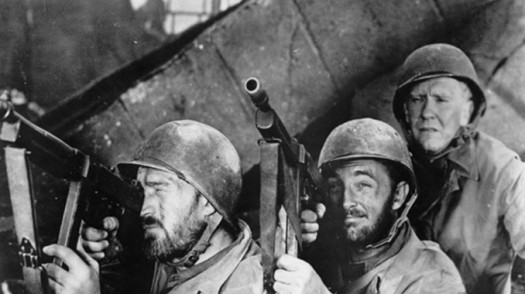
William Wellman’s THE STORY OF G.I. JOE tells the tale of boots-on-the-ground combat soldiers through the eyes of war correspondent Ernie Pyle, Pulitzer Prize winning syndicated columnist for Scripps-Howard newspapers. The film was one of the most realistic depictions of the brutality of war up to that time, and made a star out of a young actor by the name of Robert Mitchum . In fact, this was the one and only time Mitchum ever received an Oscar nomination – a shocking fact given the caliber of his future screen work.

Burgess Meredith  plays Pyle, who embeds with the 18th Infantry’s ‘C’ Company in order to give his stateside readers the grim realities of war from the soldier’s point of view. The men accept him, affectionately calling him ‘Pop’, as he shares their hardships, heartbreaks, and victories. Meredith’s voice over narrations are taken directly from Pyle’s columns, detailing the cold nights, dusty…

View original post 497 more words

Cleaning Out The DVR: Off The Rails (dir by David Jackson)


(Hi there!  So, as you may know because I’ve been talking about it on this site all year, I have got way too much stuff on my DVR.  Seriously, I currently have 205 things recorded!  I’ve decided that, on January 15th, I am going to erase everything on the DVR, regardless of whether I’ve watched it or not.  So, that means that I’ve now have only two months to clean out the DVR!  Will I make it?  Keep checking this site to find out!  I recorded Off The Rails off of the Lifetime Movie Network on March 26th!)

Oh, poor Nicole (Hannah Barefoot)!

When we first meet her, Nicole is recovering from amnesia.  She knows that she was injured in a catastrophic train derailment.  She knows that she’s married to Mark (Thomas Beaudoin), who seems like the perfect husband.  She knows that her therapist is Dr. Teres (Andrea Cirie).  She knows that she’s oddly obsessed with maps and that she teaches at the local college.  However, she is still not totally sure what her life was like before the accident.  And sometimes, she wonders if she can actually trust Mark.  For instance, she suspects that, while she was in her coma, Mark added onto the deck in the back yard.  Mark swears that it was her idea but why would she want to do that?

Nicole is also convinced that she has never had a Facebook account.  She swears that she’s never been on Twitter.  She doesn’t even know what Instagram is!  “You call me a Luddite!” she says to one of her friends, “I do remember that!”  But, if that’s true, why do all of her friends swear that they’ve talked to her on Facebook?  And why are all sorts of sleazy men approaching her, all claiming that they met her online?

That’s not all Nicole has to worry about.  There’s also the weird visions that she’s having, many of them involving being watched by a menacing-looking raven.  And then there’s the French Canadian photographer (Andreas Damm).  Nicole is not sure who he is but she sure did take a lot of happy pictures with him.  Could it be that she wasn’t as happy in her marriage as both Mark and her therapist insist?

There were some parts of Off The Rails that I really liked.  The story was, at times, genuinely intriguing and I always appreciate it whenever Lifetime films mix a little surrealism in with the melodrama.  The first part of the film does a very good of creating a properly ominous atmosphere and Hannah Barefoot does a good job portraying Nicole’s confusion and paranoia.  Obviously, it demanded a considerable suspension of disbelief to buy into the idea that Nicole could possibly be so ignorant of social media in 2017 but then again, that’s Lifetime for you.  Social media is always the source of all evil in the world of Lifetime.

Unfortunately, there’s a twist at the end of Off The Rails that simply does not work and it actually cheapens the film a bit.  I understand that it’s a Lifetime film and that, therefore, things can never end on too dark of a note but, in this case, the movie’s story demanded and deserved an ending that was just a bit more bittersweet.

Still, I’d recommend Off the Rails.  Up until that final shot, it’s a nicely done Lifetime mystery.  You’ll probably figure out the solution early but it’s still entertainingly melodramatic and just weird enough to be worthwhile.


Cleaning Out The DVR: Secrets In Suburbia (dir by Damian Romay)


(Hi there!  So, as you may know because I’ve been talking about it on this site all year, I have got way too much stuff on my DVR.  Seriously, I currently have 205 things recorded!  I’ve decided that, on January 15th, I am going to erase everything on the DVR, regardless of whether I’ve watched it or not.  So, that means that I’ve now have only two months to clean out the DVR!  Will I make it?  Keep checking this site to find out!  I recorded Secrets in Suburbia off of Lifetime on April 15th!)

Welcome to the Hell that is Lifetime suburbia!

Seriously, whenever you come across a Lifetime movie that has the word “suburbia” in the title, you know exactly what you’re getting: nice houses, nice clothes, beautiful people, adulterous affairs, and usually a little bit of murder.  Secrets in Suburbia features all of that and it’s an enjoyably over the top little movie.

We open with a nice house in a nice neighborhood on a nice night.  A party’s being thrown.  It’s a divorce party!  (Divorce parties, by the way, are super fun!  I’ve been encouraging all of my married friends to get divorced, just so we can all get together for the party afterward.)  The recently divorced wife gives a long and sarcastic speech.  Suddenly, her ex-husband shows up.  He’s waving a gun and rambling incoherently.  Then he shoots himself, which totally ruins the party.

(Choice dialogue: “I don’t need a dead body in my house!”)

We return to the party four more times over the course of the film, each time from the perspective of a different character and each time, we learn a little bit more about what happened on that night.  It’s a nicely done technique, one that forces us to pay close attention to the action unfolding on screen.  It certainly adds a layer of narrative complexity that one might not usually expect to find in a Lifetime film.

The majority of the film deals with Gloria (Brianna Brown) and her husband, Phil (Joe Williamson).  Gloria has a nice house, nice children, and a nice dog.  Phil has a lot of charm and a massive chip on his shoulder about the fact that, unlike most of his friends and neighbors, he wasn’t born rich.  Phil, it quickly turns out, has more than a little trouble being a faithful husband.  No need to be shocked by that.  It’s Lifetime and it’s suburbia.

One day, Gloria comes home to discover that her dog has been poisoned.  While she rushes the dog to the vet, she gets into a serious car accident.  It’s hard not to notice that, underneath all of his charm, Phil doesn’t seem to be that concerned about his wife.  Maybe it’s the fact that he keeps ignoring the doctor’s advice.  Maybe it’s the fact that he doesn’t seem to care about the dead dog.  Or maybe it has something to do with the antifreeze that he keeps putting in her drinks…

This is a movie that’s all about revenge, especially after Gloria learns that Phil has been cheating with her friends.  To be honest, the plot doesn’t make a whole lot of sense.  Things get pretty crazy towards the end of the film.  That’s not a complaint, of course.  In general, the more melodramatic and crazy a movie like this gets, the better.  Secrets in Suburbia goes totally batshit crazy, which is exactly what it needed to do.  It’s all terrifically entertaining and in the end, that’s all that really matters.

A Movie A Day #305: Go Tell The Spartans (1978, directed by Ted Post)


One of the best films ever made about Vietnam is also one of the least known.

Go Tell The Spartans takes place in 1964, during the early days of the Vietnam War.  Though the Americans at home may not know just how hopeless the situation is in South Vietnam, Major Barker (Burt Lancaster, in one of his best performances) does.  Barker is a career military man.  He served in World War II and Korea and now he’s ending his career in Vietnam, taking orders from younger superiors who have no idea what they are talking about.  Barker has been ordered to occupy a deserted village, Muc Wa.  Barker knows that occupying Muc Wa will not make any difference but he is in the army and he follows orders.

Barker sends a small group to Muc Wa.  Led by the incompetent Lt. Hamilton (Joe Unger), the group also includes a drug-addicted medic (Dennis Howard), a sadistic South Vietnamese interrogator (Evan C. Kim) who claims that every civilian that the men meet is actually VC, a sergeant (Jonathan Goldsmith) who is so burned out that he would rather commit suicide than take command, and Cpl. Courcey (Craig Wasson).  Courcey is a college-educated idealist, who joined the army to do the right thing and is now about to discover how complicated that can be in South Vietnam.  At Muc Wa, the soldiers find a cemetery containing the graves of French soldiers who died defending the hamlet during the First Indochina War.  The inscription as the cemetery reads, “Go tell the Spartans, stranger passing by, that here, obedient to their laws, we lie.”  

Because the film strives for realism over easy drama, Go Tell The Spartans has never gotten the same attention as some other Vietnam films.  Unlike The Deer Hunter, Platoon, Coming Home, and Born on the 4th of July, Go Tell The Spartans received no Oscar nominations.  It is still a brilliantly acted and powerful anti-war (but never anti-soldier) film.  It starts out as deceptively low-key but the tension quickly builds as the soldier arrive at Muc Wa and discover that their orders are both futile and impossible to carry out.  Vastly outnumbered, the Americans also find themselves dealing with a land and a culture that is so unlike their own that they are often not even sure who they are fighting.  Military discipline, as represented by Lt. Hamilton, is no match for the guerilla tactics of the VC.  By the film’s end, Vietnam is revealed to be a war that not even Burt Lancaster can win.

A Movie A Day #304: Code of Silence (1985, directed by Andrew Davis)


It’s life and death in the Windy City.  It’s got Chuck Norris, Henry Silva, Dens Farina, and a robot, too.  It’s Code of Silence.
Chuck plays Eddie Cusack, a tough Chicago policeman who is abandoned by his fellow officers when he refuses to cover for an alcoholic cop who accidentally gunned down a Hispanic teenager and then tried to place a gun on the body.  This the worst time for Cusack to have no backup because a full-scale gang war has just broken out between the Mafia and the Comachos, a Mexican drug gang led by Luis Comacho (Henry Silva).  When a cowardly mobster goes into hiding, Luis targets his daughter, Diana (Molly Hagan).  Determined to end the drug war and protect Diana, Eddie discovers that he may not be able to rely on his brothers in blue but he can always borrow a crime-fighting robot named PROWLER.

Despite the presence of a crime-fighting robot, Code of Silence is a tough, gritty, and realistic crime story.  Though Chuck only gets to show off his martial arts skills in two scenes (and one of those scenes is just Eddie working out in the gym), Code of Silence is still Norris’s best film and his best performance.  The film draws some interesting comparisons between the police’s code of silence and the Mafia’s omerta and director Andrew Davis shows the same flair for action that he showed in The Fugitive and Above the LawCode of Silence‘s highlight is a fight between Chuck and an assassin that takes place on top of a moving train.  Norris did his own stunts so that really is him trying not to fall off that train.

Davis surrounds Norris with familiar Chicago character actors, all of whom contribute to Code of Silence‘s authenticity and make even the smallest roles memorable.  (Keep an eye out for the great John Mahoney, playing the salesman who first introduces the PROWLER.)  Norris’s partner is played by Dennis Farina, who actually was a Chicago cop at the time of filming.  After Code of Silence, Farina quit the force to pursue acting full time and had a busy career as a character actor, playing cops and mobsters in everything from Manhunter to Get Shorty.  As always, Henry Silva is a great villain but the movie is stolen by Molly Hagan, who is feisty and sympathetic as Diana.  To the film’s credit, it doesn’t try to force Eddie and Diana into any sort of contrived romance.

Unfortunately, none of Chuck Norris’s other films never came close to matching the quality of this one.  Code of Silence is a hint of what could have been.

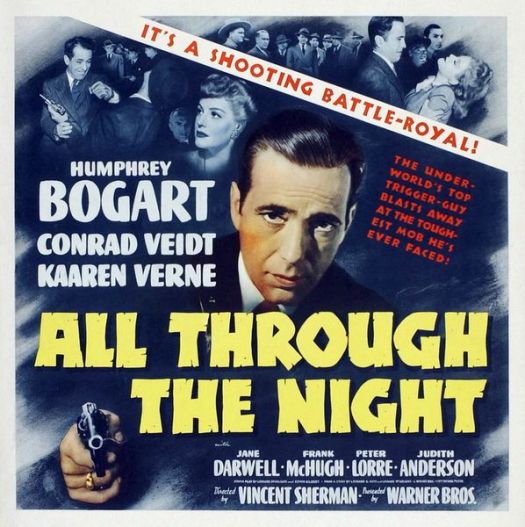
Hoods vs Huns: ALL THROUGH THE NIGHT (Warner Brothers 1942)


gary loggins's avatarcracked rear viewer

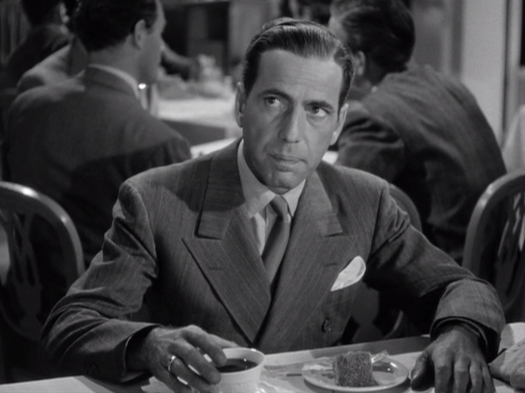
A gang of Runyonesque gamblers led by Humphrey Bogart take on Nazi spies in ALL THROUGH THE NIGHT, Bogie’s follow-up to his breakthrough role as Sam Spade in THE MALTESE FALCON. Here he plays ‘Gloves’ Donovan, surrounded by a top-notch cast of character actors in a grand mixture of suspense and laughs, with both the action and the wisecracks coming fast and furious in that old familiar Warner Brother style. Studio workhorse Vincent Sherman, whose directorial debut THE RETURN OF DOCTOR X also featured Bogart, keeps things moving briskly along and even adds some innovative flourishes that lift the film above its meager budget.

Bogie’s gangster image from all those 1930’s flicks come to a humorous head in the part of ‘Gloves’. He’s a tough guy for sure, but here the toughness is humanized by giving him a warm, loving mother (Jane Darwell ) and a fondness for cheesecake…

View original post 562 more words