Lisa Reviews A Film That Was Not Nominated For Any Oscars: Mr. Billion (dir by Jonathan Kaplan)


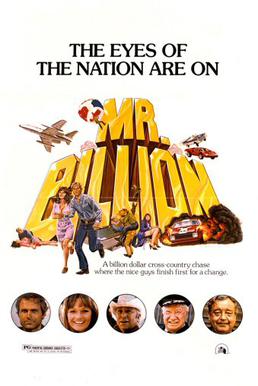
The 1977 film Mr. Billion tells the story of Gudio Falcone (played by Terence Hill, whose real name is Mario Girotti).  Guido has got a pretty good life going in Italy.  Everyone in his village loves him.  He works as an auto mechanic.  When we first see him, he speeding around in a red sportscar.  When he returns to the garage, he smiles and says, in Italian, “Just like Steve McQueen.”  Guido may not be rich but he’s happy.

But that’s all about change!

Well, not the happy part.  Guido is pretty much always happy.  But he’s about to get rich.  It turns out that Guido is the last surviving relative of Antonio Falcone.  Years ago, Antonio immigrated to America and founded Falcon Motors.  The company eventually made Antonio one of the richest men in the world.  Unfortunately, the big Falcon Motors sign eventually fell off the company’s headquarters and it landed right on top of Antonio.

Everyone’s upset about Antonio’s death.  Well, everyone but the company’s vice president, John Cutler (Jackie Gleason).  John was naturally expecting that he would be named Antonio’s successor and that he would also inherit all of Antonio’s money.  Instead, Antonio’s will leaves everything to Guido!

Why?

Because, apparently, Guido never asked Antonio for anything more than a “pair of American cowboy boots.”

Cutler and his sleazy attorney (William Redfield) are soon on the next flight to Italy.  When they find Guido, they make sure to compliment him on his cowboy boots.  They explain to Guido that he has twenty days to go San Francisco and sign the proper papers.  If he’s any later than 20 days he’ll lose the money.  Of course, that shouldn’t be a problem since Guido can fly over anytime that he wants…

Except Guido refuses to fly!  No, he says that if he’s going to go to America, he’s going to arrive there the same way that Antonio did.  He is going to take a boat to New York City and then ride a train all the way to California.

Did you guess that the very next scene would be Guido standing on the dock of a cruise ship, staring at the Statue of Liberty?  And did you also also guess that, upon disembarking, he would immediately find himself besieged by reporters, one of whom declares him to now be the world’s most eligible bachelor?  If so, good work.

But here’s the big question.  Did you also predict that John Cutler would attempt to sabotage Guido’s trip to California and that the sabotage would involve hiring a private detective (Valerie Perrine)?  Even more importantly, did you predict that the detective would eventually end up falling in love with simple but honest Guido?

Because that’s totally what happens!

At the time that Mr. Billion was made, Terence Hill was a huge star in Europe but was barely known in the United States.  He was best known for appearing in a series of comedic Spaghetti Westerns with Bud Spencer, the majority of which featured Hill as a lazy but likable ne’er do well.  In Mr. Billion, Hill is cast as the exact opposite, as an earnest man-of-the-people who is so nice that it’s almost painful.  Add to that some major tone problems (the film cannot make up its mind if it wants to be a comedy, an action film, or a romance) and you have a pretty forgettable movie.

And that’s kind of a shame because Terence Hill showed some legitimate charm in the lead role.  The role may have been underwritten but all Hill had to do is flash that winning smile and it didn’t matter.  It’s unfortunate that Hill didn’t get a more appropriate vehicle for his American debut.
Sick of Reading About The Oscars? Here’s the Son of Godzilla (dir by Jun Fukuda)


Hi!  Are y’all sick of reading about the Oscars yet?  I mean, here at the Shattered Lens, we love the Oscars but I’m sure, by this point, some of our readers are ready to move on.  Well, don’t worry!  We haven’t forgotten about you!

And neither has … Minya, the son of Godzilla!

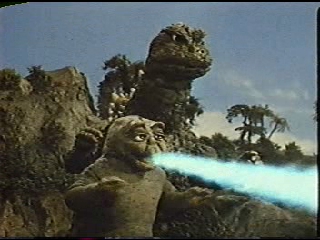
Oh my God, it’s Minya!

Now, as you can probably tell from this picture above, Minya doesn’t bear that much of a resemblance to his father.  I’m going to guess that he got his looks from the mother’s side of the family.  We really can’t say for sure because we don’t really get the exact details of how Minya came to be.  We get to watch as Minya hatches out of an egg but we’re never sure who laid the egg.  For all we know Godzilla laid the egg.

Then again, there’s also some debate as to whether or not Godzilla is actually Minya’s father.  When Minya hatches out of the egg, Godzilla shows up on the island to protect him but, before that, it’s not like we ever saw Godzilla actually taking care of the egg or anything.  In fact, right before Minya hatched, a bunch of giant preying mantis things were on the verge of eating the egg…

That means that Godzilla is either a really crappy father or this movie is about Godzilla kidnapping a baby monster.

Oh well, it’s probably best not to think too much about it because Minya is absolutely adorable!  He can’t really roar that well.  And when he tries to breathe atomic fire, he just ends up producing some atomic smoke rings instead.  Fortunately, Godzilla does get off his lazy ass long enough to teach Minya how to create flame.

It’s a pretty good thing that Godzilla shows up because remember those giant preying mantises that I mentioned earlier?  Well, they are literally everywhere.  Minya is definitely going to need Godzilla’s help if he’s going to defeat those things!

Now, admittedly, 1967’s Son of Godzilla may be fun and cute but it shares a flaw in common with a lot of Godzilla movies.  There’s way too many humans involved!  Seriously, when you watch a movie like this, you’re watching because you want to watch the monsters go at each other.  No one cares if Tokyo gets leveled as a result.  You just want to see a rubber monster fight.

But these later Godzilla films always seem to make the mistake of bringing in a bunch of humans who act shocked whenever the monsters show up.  With the number of times that Godzilla’s destroyed Japan, I would think that people would start taking a more nonchalant attitude towards him.  “Oh, it’s Godzilla again.  I’ll lock the door.  What’s for dinner?”  In this case, the humans are a bunch of weather scientists who are hanging out on the island.  There’s also a mysterious woman, a native of the island, who shows up because almost every Japanese monster movie made in the 60s and 70s had a mysterious woman living on an island.

Anyway, the humans aren’t important.  What’s important is the bond between Godzilla and his son, Minya!  Just check these two out!

Awwwwww!

Lisa Reviews An Oscar Nominee: Zorba The Greek (dir by Michael Cacoyannis)


The 1964 film, Zorba the Greek, tells the story of two very different friends.

Basil (Alan Bates) is a writer.  (“Poetry, essays,” he diffidently says when asked what he writes.)  Basil is British-Greek but, having been raised in the UK, he allows his British side to dominate.  In this film, that means that Basil is very polite and very reserved.  He’s not the type to attempt to flirt with someone who he doesn’t know.  He has never spontaneously broken into dance.  When he is offered a drink, he asks for tea and is shocked to receive rum instead.  If the film was taking place a few decades later, one gets the feeling that Basil would describe Love, Actually as being an okay movie “for people who like that sort of thing.”

And then there’s Zorba (Anthony Quinn).  Unlike the wealthy and well-educated Basil, Zorba is a peasant and he’s proud of it.  He works hard but he plays hard too and there’s nothing that Zorba loves more than the sound of good music.  Zorba not only drinks rum but makes sure that everyone else gets their fill as well.  Zorba dances whenever he feels like it.  Zorba is larger than life, an unfailingly enthusiastic man who is determined to enjoy whatever time he has left in his life.

When Zorba and Basil first meet, Basil is heading to Crete where he’ll be trying to reopoen a mine that was left to him by his father.  As for Zorba, he’s looking for work and, as he explains it, he has tons of experience working as a miner.  Though Basil is, at first, reluctant to hire someone who he’s just met, Zorba talks him into it.  As quickly becomes apparent, the exuberant Zorba can talk people into almost anything.

You can probably guess where all of this is going.  Zorba teaches Basil how to embrace life, which in this film means embracing the Greek side of his heritage.  It takes a while, of course.  Basil is an extremely reluctant protegé and a good deal of the film’s humor comes from just how uncomfortable Basil occasionally gets with his newfound friend.  That said, you don’t have to be a psychic to guess that eventually, the two of them will share a dance on the beach.  It may be predictable but that’s not to say that Zorba the Greek isn’t a good film.  It’s a very good and entertaining movie, featuring a justifiably famous soundtrack and also one of Anthony Quinn’s best and most exuberant performances.

In fact, Quinn is so perfectly cast as Zorba that he occasionally tends to overshadow Alan Bates, who is equally good but in a different way.  In fact, I would say that Bates probably had the more difficult role.  Whereas Zorba (and Quinn) spends the entire movie instigating, Basil (and Bates) spends the entire movie reacting.  It’s difficult to make passivity watchable but Bates manages to do it.

Of course, Zorba isn’t just a comedy about an unlikely friendship.  About halfway through the film, there’s a moment of shocking brutality involving a young widow played by Irene Pappas.  It took me totally by surprise and it left me a bit shaken.  (It also reminded me a bit of another European film featuring Irene Pappas, Lucio Fulci’s Don’t Torture A Duckling.)  It’s a scene that serves as a reminder that 1) not every peasant is Zorba the Greek and 2) friendship and love cannot end darkness but it can make it all a little more bearable.

Zorba the Greek was nominated for Best Picture but it lost to My Fair Lady.

Lisa Reviews An Oscar Nominee: Lost Horizon (dir by Frank Capra)


Long before there was Lost, there was Lost Horizon!

Much like the famous television show, the 1937 film Lost Horizon begins with a group of strangers on an airplane.  They’re people from all walks of life, all with their separate hopes and dreams.  When the plane crashes, they find themselves stranded in an uncharted land and, much like the Lost castaways, they are shocked to discover that they are not alone.  Instead, they’ve found a semi-legendary place that is ruled over by a man who has lived for centuries.  Much as in Lost, some want to return to civilization while others want to remain in their new home.  Both Lost and Lost Horizon even feature a terminally ill woman who starts to recover her health after becoming stranded.

Of course, in Lost, everyone was just flying from Australia to America.  In Lost Horizon, everyone is trying to escape the Chinese revolution.  Among the passengers on the plane: diplomat Robert Conway (Ronald Colman), his irresponsible brother, George (John Howard), a con artist named Henry (Thomas Mitchell), a paleontologist (Edward Everett Horton), and the very ill Gloria (Isabel Jewell).

While Lost featured a plane crash on a tropical island, Lost Horizon features a plane crash in the Himalayas.  In Lost, the sinister Others sent spies to infiltrate the survivors.  In Lost Horizon, the mysterious Chang (H.B. Warner) appears and leads the survivors to a place called Shangri-La.

Shangi-La is a lush and idyllic valley that has somehow flourished in one of the most inhospitable places on Earth.  The happy inhabitants inform the survivors that they never get sick and they never fight.  They’re led by the High Lama (Sam Jaffe), a philosopher who explains that he is several hundred years old.  The valley is full of magic and the Lama tells the survivors that Shangri-La is their new home.

Now, I’ve seen enough horror movies that I spent most of Lost Horizon waiting for the Lama to suddenly reveal that he was a vampire or an alien or something.  Whenever anyone in a movie seems to be too good to be true, that usually means that he’s going to end up killing someone about an hour into the story.  But that didn’t happen in Lost Horizon.  Instead, the Lama is just as wise and benevolent as he claims to be and Shangri-La is as much of a paradise as everyone assumes.  I guess we’re just naturally more cynical in 2018 than people were in 1937.

Of course, the Lama isn’t immortal.  Not even the magic of Shangri-La can prevent the inevitably of death.  The Lama is looking for a successor.  Could one of the survivors be that successor?  Perhaps.  For instance, Robert absolutely loves Shangri-La.  Of course, his brother George is determined to return to the real world.  He has fallen in love with one of the inhabitants of Shagri-La and plans to take her with him, despite the Lama’s warning about trying to leave…

Frank Capra was a huge fan of James Hilton’s book, Lost Horizon, and he spent three years trying to bring it to the big screen.  Based on Capra’s previous box office successes, Colombia’s Harry Cohn gave Capra a budget of $1.25 million to bring his vision of Shangri-La to life.  That may not sound like much today but, at the time, that made Lost Horizon the most expensive movie ever made.  The production was a notoriously difficult one.  (The original actor cast as the elderly Lama was so excited to learn he had been selected that he dropped dead of a heart attack.)  As a result of both its ornate sets and Capra’s perfectionism, the film soon went overbudget.  When Capra finally delivered a first cut, it was over 6 hours long.  Capra eventually managed to edit it down to 210 minutes, just to then have Harry Cohn order another hour taken out of the film.  When Lost Horizon was finally released, it had a running time of 132 minutes.

Seen today, Lost Horizon is definitely an uneven work.  With all the cutting and editing that went on, it’s hard to guess what Capra’s original vision may have been but, in the final version, much more time is devoted to the characters discussing the philosophy of Shangri-La than to the characters themselves.  (It’s always good to see Thomas Mitchell but he really doesn’t get much to do.)  Since you never really feel like you know what any of these characters were like outside of Shangi-La, it’s hard to see how being in Shagri-La has changed them.  You just have to take their word for it.  That said, it’s a visually stunning film.  Capra may have gone over budget creating the look of Shangri-La but it was money well-spent.  If I ever find myself in a magic village, I hope it looks half as nice as the one in Lost Horizon.

Despite all of the drama that went on behind the scenes and a rather anemic box office reception, Lost Horizon was nominated for best picture.  However, it lost to The Life of Emile Zola.

What Lisa Watched Last Night #176: Bad Tutor (dir by Jeff Hare)


Last night, I watched the latest Lifetime film, Bad Tutor!

Why Was I Watching It?

After you watch enough Lifetime films, you come to learn a few things.  For instance, any film that’s called Bad Something is probably going to be worth watching.  Over the years, there have been Bad Students, Bad Teachers, Bad Doctors, Bad Husbands, Bad Assistants, and Bad Realtors.  Really, it was only a matter of time until they got around to a Bad Tutor.

(My hope is that they will follow this up with a film called Bad Tudor, just because I assume all sorts of crazy stuff was going on with the court of Henry VIII.)

What Was It About?

It’s a simple film about three people who have hopes and problems.

For instance, Kelly (Vanessa Marcil) is a widow who is hoping to find a new husband but who also has a rebellious teenage daughter.

Emily (Alex Frnka) is Kelly’s daughter.  She hopes to become a famous singer but first, she has to pass her chemistry midterm.  When the movie starts, she’s currently on the road to getting a D in that class.  Emily says that people are going to be too busy responding to her music to care if she passed chemistry.  Kelly worries that Emily won’t be able to get into a good college with that D following her around.

Devon (Charles Hittinger) is a chemist who claims to be a former teacher.  Devon hopes that he’ll be able to get Emily to fall in love with him, largely because Emily looks just like his dead girlfriend.  Devon’s problem is that he’s batshit insane and the only reason his girlfriend is dead is because he pushed her off of a cliff.

When Kelly meets Devon, she decides that he would be the perfect tutor for Emily.  Little does she suspect that Devon is actually … a bad tutor!

What Worked?

Vanessa Marcil gave a pretty good performance as Kelly.  I liked the fact that, as opposed to the typical perfect Lifetime mother, Kelly not only made mistakes but also owned up to them.

The film’s opening, which started with Devon proposing to his girlfriend and ended with him pushing her off of a cliff, was well-handled.

What Did Not Work?

Here’s the thing: when it comes to Lifetime movies, we all agree, to an extent, to suspend our disbelief.  We accept the fact that characters will sometimes act stupidly and we try not to hold that against them.

But, sometimes, you run into a character who is just so utterly stupid that, try as you may, you just can’t forgive them.  That was the case with Emily in Bad Tutor.  Not only was Emily something of a spoiled brat but she also turned out to be amazingly gullible.  After spending the first half of the movie making fun of the nerdy Devon, Emily changed her tune when Devon claimed to have a friend in the recording industry.  Never did Emily ask for any proof or anything.  Instead, she just ran away from home with Devon.  Looking over her actions, I have to say I’m surprised that she was only failing one class.

Finally, Emily did sing a few times and … well, let’s just hope that she gets into a good college.

“Oh my God!  Just like me!” Moments

I related to Emily, largely because I too was a rebellious teenager who couldn’t sing.

Lessons Learned

I didn’t learn anything because he was a bad tutor.

Queen of the Outlaws: CAT BALLOU (Columbia 1965)


gary loggins's avatarcracked rear viewer

Lee Marvin  didn’t get many chances to show his comedic side; in fact, I can only think of two off the top of my head: the John Wayne/John Ford outing DONOVAN’S REEF (1963) and the 1976 spoof THE GREAT SCOUT AND CATHOUSE THURSDAY (I’ll be charitably silent about 1969’s PAINT YOUR WAGON!).  Then there’s the comedy western CAT BALLOU, for which Marvin won an Oscar in the dual roles of drunken, broken down outlaw Kid Shelleen and hired killer Tim Strawn. Marvin’s marvelous, but if the truth be told, it wasn’t much of a stretch for Marvin to play a hard drinker and a macho tough guy… there’s a little bit of Lee in both personas!

We know we’re in for a good time right off the get-go when the fabled Columbia Torch Lady morphs into an animated, six-gun packin’ cowgirl, a sure sign not to take things too seriously…

View original post 626 more words

4 Of My Favorite Fictional Oscar Winners!


For 9 decades, the Oscars have been an important part of American life.  As I’ve said on this site many times, Oscar Sunday is as much of an unofficial holiday as Super Bowl Sunday.  For many of us, the new year doesn’t even begin until the morning after the Oscars.

However, some of the most memorable Oscar winners didn’t even exist!  The Academy Awards have been used as a plot device in any number of movies.  Here are four of my favorite fictional Oscar winners:

  1. Johnny Fontane (Al Martino) in The Godfather (1972)

Oh, Johnny Fontane.  He had such a good singing career going until he started to lose his voice.  But, fortunately, there was a part for him in an upcoming picture.  As Johnny explained it, the part was a guy just like him.  “I wouldn’t even have to act.”  The only problem was that studio head Jack Woltz didn’t want to give him that role.

It’s a good thing that Johnny had a Godfather like Vito Corleone.  And it’s a good thing that the Godfather had a lawyer like Tom Hagen, a lawyer who didn’t mind arranging for a horse to be beheaded.  Khartoun may not have survived but Johnny Fontane got his part and his Oscar.

(Johnny’s adventures at the Oscars are detailed in all their loving glory in Mario Puzo’s novel.  Perhaps not wanting to harm its own Oscar chances, the film left out the majority of Johnny’s Hollywood adventures.)

2. Margaret Elliott (Bette Davis) in The Star (1953)

“C’mon, Oscar!  Let’s get drunk!”

Listen, you may think that winning an Oscar means that you’re set for life but often, the exact opposite is true.  Winning an Oscar has killed many a career.  They even have a name for it: The Oscar Curse.

Take Margaret Elliott for instance.  She won an Oscar.  And now, just a few years later, she’s broke, drunk, and deeply in denial.  Can her daughter (Natalie Wood) convince Margaret that it’s time to stop drinking and admit that fame is a hideous bitch goddess?  Or will Margaret continue to get drunk with her Oscar staring at her in judgment?

3. Vicki Lester (Judy Garland) in A Star is Born (1954)

Sadly, Vicki is better remembered for what happened during her acceptance speech than for the speech itself.  When her husband, notorious alcoholic Norman Maine (James Mason), took the stage and struck his wife while drunkenly motioning, it shocked Oscar watchers everywhere.  But Vicki never stopped loving him and, after his tragic death, she let the world know that, “This is Mrs. Norman Maine.”

4. Jerilee Randall (Pia Zadora) in The Lonely Lady (1983)

“I don’t suppose I’m the only one whose had to fuck her way to the top.”

Greatest fake Oscar acceptance speech ever!

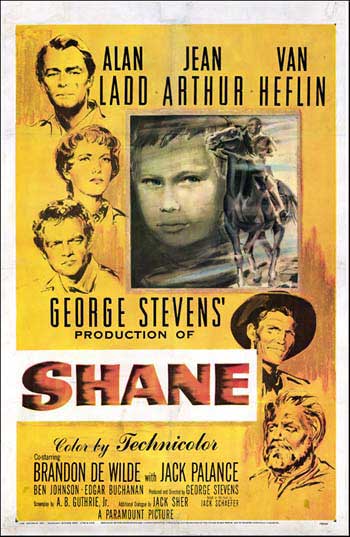
Lisa Reviews An Oscar Nominee: Shane (dir by George Stevens)


“Hey, Shane!  Come back, Shane!”

There’s a few ways in which you can view the 1953 film, Shane.

The more popular view is that it’s a Western about a man named Shane (Alan Ladd) who rides into town and gets a job working for the Starretts, Joe (Van Heflin) and Marian (Jean Arthur).  Joe is a farmer who is determined to hold onto his land, despite the efforts of cattle baron Rufus Ryker (Emile Meyer) to force him off of it.  While we don’t learn much about Shane’s background, it becomes apparent that he’s a man who can fight.  That comes in handy when Ryker brings in a sinister gunfighter named Wilson (Jack Palance).

Another view is that Shane is the story of a man who just wants to settle down but, instead, finds himself continually hounded by an annoying little kid, to the extent that he finally gets involved in a gun battle just so he’ll have an excuse to leave town and get away from the little brat.  Little Joey Starrett (Brandon deWilde) idolizes Shane from the minute that he comes riding up.  When he hears that Shane refused to get into a fight at the local saloon, Joey demands to know whether it was true.  He tells his mom that he loves Shane almost as much as he loves his father.  When Shane does get into a brawl with all of Ryker’s men, Joey stands in the corner and eats candy.  And then, when Shane tries to leave town, Joey runs behind him shouting, “Come back, Shane!  Come back!”

Myself, I think of it as being the story of Frank Torrey (Elisha Cook, Jr.).  Frank is the farmer that’s been nicknamed “Stonewall,” due to his status as a former Confederate and his quick temper.  Stonewall may be smaller than the other farmers but he’s usually the quickest to take offense.  Still, it’s impossible not to like him, largely because he’s played by Elisha Cook, Jr.  When Wilson feels the need to put the farmers in their place, he does so by picking a fight with Torrey.  Standing on a porch in the rain, looking down on the smaller man, Wilson starts to insult both him and the South.  When Torrey finally starts to reach for his gun, Wilson shoots him dead.  While Torrey lies in the mud, Wilson smirks.  It’s a shocking scene, all the more so for being shown in a long shot.  (By forcing those of us in the audience to keep our distance from the shooting, the film makes us feel as powerless as the farmers.)  If you didn’t already hate Wilson and Ryker, you certainly will after this scene.

Shane is a deceptively simple film, one in which many of the details are left open for interpretation.  We never learn anything about Shane’s background.  He’s a man who shows up, tries to make a life for himself, and then leaves.  He’s a marksman and an obviously experienced brawler but, unlike Ryker’s men, he never specifically looks for violence.  In fact, he often seems to avoid it.  Why?  The film doesn’t tell us but there are hints that Shane is haunted by his past.  Shane seems to want a chance to have a life like the Starretts but, once he’s forced to again draw his gun, he knows that possibility no longer exists.

Is Shane in love with Marian Starrett?  It certainly seems so but, again, the film never specifically tells us.  Instead, it all depends on how one interprets the often terse dialogue and the occasional glances that Marian and Shane exchance.  When Shane and Joe get into a fist fight to determine who will face Ryker and Wilson, is Shane really trying to protect Joe or is it that he knows Marian will be heart-broken if her husband is killed?

One thing’s for sure.  Little Joey sure does love Shane.  “Come back, Shane!”  Little Joey follows Shane everywhere, with a wide-eyed look on his face.  To be honest, it didn’t take too long for me to get sick of Little Joey.  Whenever director George Stevens needed a reaction shot, he would cut to Joey looking dumb-founded.  Brandon deWilde was 11 years when he appeared in Shane and he was nominated for an Oscar but he’s actually pretty annoying in the role.  Elisha Cook, Jr. was far more impressive and deserving of a nomination.

I know that many people consider Shane to be a classic.  I thought it was good, as long as the action was focused on the adults.  Alan Ladd plays Shane like a man who is afraid to get too comfortable in any situation and the film works best when it compares his reticence to Wilson’s cocky confidence.  Whenever Joey took center stage, I found myself wanting to cover my ears.

Shane was nominated for Best Picture but lost to From Here To Eternity.

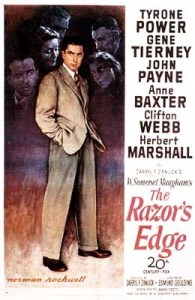
Lisa Reviews An Oscar Nominee: The Razor’s Edge (dir by Edmund Goulding)


Oh, 1919!  What a year.  The Great War had ended, leaving much of Europe devastated.  American soldiers were coming home and, scarred by the horrors they had experienced, becoming members of a lost generation.  The Spanish Flu was infecting millions, on the way to eventually wiping out 3% of the world’s population.  It was a grim time so it’s no surprise that many chose to close their eyes and pretend like everything was fine.  Only a few people were willing to look at the world and say, “There has to be something more.”

The 1946 film The Razor’s Edge tells the story of one such man.  Before the war, Larry Darrell (Tyrone Power, Jr.) was like most of his friends back in Chicago.  He was carefree.  He was wealthy.  He was engaged to marry the beautiful but self-centered Isabel (Gene Tierney).  But then he went off to fight in World War I and the experience changed him.  On the final day of the war, another soldier sacrificed his life to save Larry and Larry is now haunted by that man’s death.  No longer sure about his place in the world, Larry announces that he’s rejecting his former life.

Of course, that’s an easy thing to do when you’re rich.  Larry is lucky enough to have an inheritance that he can live off for a few years.  All of his former friends think that Larry’s just struggling to adjust to being back home and they expect that he’ll get over it soon enough.  Isabel’s uncle, Elliott (Clifton Webb), thinks that Larry’s acting like a total fool.  For Larry’s part, he no longer cares what any of them think.  He’s going to travel the world, seeking enlightenment.

While Larry’s searching, life goes on without him.  Isabel ends up marrying one of Larry’s friends, Gray Maturin (John Payne).  Larry’s best friend from childhood, Sophie (Anne Baxter), suffers a personal tragedy of her own and, when Larry next meets her, she’s living as a drunk on the streets of Paris.  Larry keeps searching for the meaning of it all.  He works in a coal mine.  He discusses philosophy with a defrocked priest.  Eventually, he ends up in the Himalayas, where he studies under a Holy Man (Cecil Humphreys).

It’s an intriguing idea and still a relevant one.  Unfortunately, the movie doesn’t really work because Larry tends to come across as being a little bit full of himself.  I could imagine someone like Henry Fonda working wonders with the role but Tyrone Power seems totally miscast as Larry.  When you look at Power, you find it hard to believe that he’s ever had a bad day, much less a need to spend months hiding in the Himalayas.  He comes across as the last person you would necessarily want to take spiritual advice from.  The fact that Webb, Tierney, Payne, and Baxter are all perfectly cast only serves to enforce just how miscast Power is.  It’s a well-intentioned film with nice production values but it’s never quite compelling.

The Razor’s Edge was based on a novel by W. Somerset Maugham.  Interestingly, the film features Maugham as a character, played by Herbert Marshall.  Even more interesting is the fact that the film was apparently remade in 1984, with Bill Murray cast as Larry Darrell.  I’ve never seen the remake so I have no idea if Murray is an improvement on Power.

(Also, since I’ve been pretty critical of Power in this review, let me recommend Witness For The Prosecution, in which Power is much better cast.)

The Razor’s Edge was nominated for Best Picture but lost to another film about returning vets, The Best Years of Our Lives.

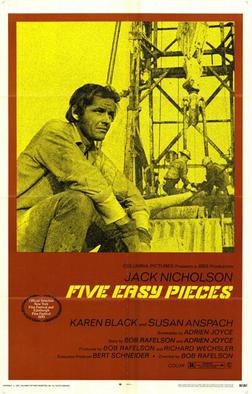
Lisa Reviews An Oscar Nominee: Five Easy Pieces (dir by Bob Rafelson)


First released in 1970, Five Easy Pieces tells the story of a lost man named Bobby Dupea (Jack Nicholson).

When we first meet Bobby, he’s working at a California oil field.  He likes to go bowling.  He has a girlfriend named Rayette (Karen Black), who is a country music-obsessed waitress.  His best friend is Elton (Billy “Green” Bush), a friendly redneck with a memorable laugh.  Bobby may have a girlfriend and Elton may be married but that doesn’t stop either one of them from going out at night, getting drunk, and trying to pick up women.

Bobby seems to be just another blue-collar guy with a grudge against the bosses but it doesn’t take long to realize that there’s something different about him.  Bobby may be friends with Elton but it’s obvious that the two of them come from very different background.  No matter how much he tries to hide it, Bobby is smarter than everyone else around him.  When he and Elton get stuck in a traffic jam, Bobby spots a piano sitting on the back of a pickup truck.  Getting out of his car, Bobby yells at everyone who is honking and then climbs up to the piano.  He sits down, he puts his fingers to the keys and he starts to play.  Knowing Bobby, you’re expecting him to just bang the keys and make noise.  Instead, he plays beautiful music.

Later, Bobby steps into a recording studio.  Paritia (Lois Smith), a neurotic woman, is playing the piano.  The recording engineers joke about her lack of talent.  Bobby glares at them, annoyed.  It quickly becomes apparent why Bobby is so protective.  Paritia is Bobby’s sister.

Bobby, it turns out, comes from a wealthy family of musicians.  Everyone in the family has dealt with the pressure to succeed differently.  Paritia continues to play, despite not having much talent.  Bobby’s older brother, the buffoonish Carl (Ralph Waite), plays violin and has staid home with their father (William Challee).  Bobby, on the other hand, ran away from home.  He’s spent his entire life trying to escape from both his talent and his family.  However, when Paritia explains that their father has suffered from two strokes and might not live much longer, Bobby reluctantly decides to return home and try to make some sort of peace with his father.

It’s not as easy a journey as Bobby would have liked.  For one thing, Rayette demands to go with him.  On the drive up to Washington, they pick up two hitchhikers (Helena Kallionetes and Toni Basil), one of whom is obsessed with filth.  In the film’s most famous scene, an attempt to get a simple lunch order modified leads to Bobby losing control.

See, that’s the thing with Bobby.  In many ways, he’s a jerk.  He treats Rayette terribly.  While his family is hardly perfect, the film doesn’t hide from the fact that Bobby isn’t always the easiest person to deal with.  And yet, you can’t help but sympathize with Bobby.  If he seems permanently annoyed with the world … well, that’s because the world’s annoying.  And, to Bobby’s credit, he’s a bit more self-aware than the typical rebel without a cause.  When one of the hitchhikers praises his temper tantrum at the diner, Bobby points out that, after all of that, he still didn’t get the order that he wanted.

In Washington, Bobby tells Rayette to stay at a motel and then goes to see his family.  Bobby seems as out-of-place among his wealthy family as he did hanging out in the oil fields with Elton.  He ends up cheating on Rayette with Carl’s fiancee, a pianist named Catherine van Oost (Susan Anspach).

And then Rayette shows up for dinner…

Five Easy Pieces is a sometimes funny and often poignant character study of a man who seems to be destined to always feel lost in the world.  Bobby spends the whole movie trying to find a place where he can find happiness and every time, reality interferes with his plans.  Nicholson gives a brilliant performance, playing Bobby as a talented guy who doesn’t really like himself that much.  Bobby’s search for happiness leads to a rather haunting ending, one that suggests that some people are just meant to spend their entire life wandering.

Five Easy Pieces was nominated for Best Picture but lost to Patton.