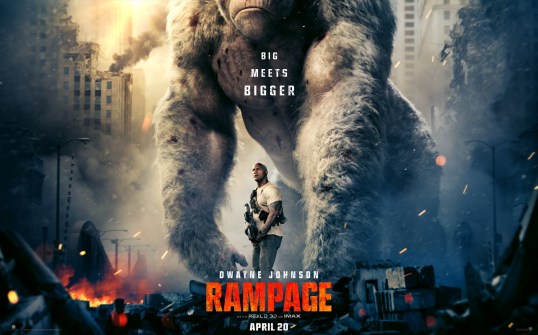
I thoroughly enjoyed this film!! Why? Because it’s a Dwayne Johnson movie. He’s an actor, a brand, and you know what you’re going to get. EVERY. SINGLE. TIME. Did it have a couple of slow moments? Yep. Were the characters, especially the villains, one dimensional or 8-Bit? Sure. But, so what? Rampage is fun and sometimes it’s great to take a bath in nostalgia and see some shit blow up.
A Dwayne Johnson movie is really a sub-genre all its very own. I won’t compare it to other movies. His movies are also fun because we just like Dwayne Johnson so much as a Man that we feel like he’s a friend. It becomes reflexive that we hear Dwayne Johnson has a movie out, it’s as if one of our friends just made one. I told a guy at work that I was going to see a Dwayne Johnson movie, he knew exactly what I meant, and he referred to Dwayne Johnson as a National Treasure. Yes, we’re now getting married in the fall and are registered at Pottery Barn.
I played Rampage when I was a wee bairn. In fact, with the help of my friend Robbie, we stayed up all night and destroyed the whole country. Congratulations! I, like every boy in the Y-Generation, was excited for this film. Sidenote: sorry everyone, Millenials are no more, you’ve been folded into Y, but take heart – “Even children get older, I’m gettin older …too.”
An Evil Corporation, run ostensibly by Ivanka Trump and her Generic Trump brother, create a virus that mutate ordinary animals into genetically spliced super-creatures that run amok. That’s it- that’s the plot- and like the video game upon which it was based, Rampage the Film is beautifully Wabi Sabi.
The film begins with The Rock who is closed off from people because after seeing their terrible acts in war and poaching, he just can’t let them in. *sniff* The Rock’s best friend is George- an albino gorilla- who can sign. Soon, the Trump family look alikes’ experiment accidentally infects George, a wolf, a crocodile, and a partridge in a pear tree. The Partridge Monster doesn’t actually destroy anything, but he blatantly re-gifts Christmas presents; therefore, he’s the worst monster of all because he destroys your self-esteem.
George, the wolf, and crocodile get BIGGER, the government – embodied by Jeffrey Dean Morgan- try to stop the monsters, but can’t. Jeffrey becomes an ally of The Rock, helping him along the way with helicopter keys, air strikes, and lending him his edger so The Rock can really make his lawn POP for barbecue season. The Trumps put out a signal to draw the monsters to Chicago, hoping they’ll kill each other off. The Trumps hope that they’ll be able to take a sample of the monster flesh, replicate it, and sell it to whomever. It doesn’t go well. The monsters go nuts. I’m not going to spoil anything. Needless to say, the last 40 minutes of the film are amazingly satisfying.
Congratulations! Dwayne you’ve done it! The Video Game Curse is Broken.
Milos Forman passed away yesterday in Danbury, Connecticut. He was 83 years old.
When the news of Forman’s passing first broke, many commentators focused on the fact that, over the course of his career, Forman accomplished something that few other directors have. Forman not only directed two movies that won the Academy Award for Best Picture but he also won two directing Oscars. On the surface level, One Flew Over the Cuckoo’s Nest and Amadeus may have looked like two very different films but both of them dealt with a nonconformist and the people who sought to destroy him. Time and again, that was a theme to which Forman would return.
Loves of a Blonde (1965)
Even before Forman won his first Oscar, he had established himself as an important director. As a young man, Forman survived the two greatest evils of the 20th Century, Nazism and Communism. Both his mother and the man who he originally believed to be his father died in concentration camps during World War II. After the war ended, Forman would discover that his real father was Otto Kohn, a Jewish architect who was also a survivor of the Holocaust.
The Fireman’s Ball (1967)
Forman started his film career working in the Czech Republic, which at that time was communist-controlled and known as Czechoslovakia. Forman was one of the leading directors of the Czech New Wave, making films that took a satirical look at life under the communist regime. It was during this time when he received his first two Oscar nominations, both for Best Foreign Language Film. In 1968, Forman was fortunate enough to be in Paris when the Russians decided to invade Prague and put an end to all that subversive individual freedom. While the new Czech goverment kept itself busy by banning all of his films, Forman moved to the United States.
Taking Off (1971)
Forman’s first film in the States was a satire called Taking Off, which failed at the box office but has since developed a cult following. Despite the box office failure of Taking Off, Forman was hired to direct 1975’s One Flew Over The Cuckoo’s Nest, a film in which an authoritarian institution reacts to a nonconformist by ripping out part of his brain. Not only did this film win the Academy Awards for picture and director but it also won awards for actor, actress, and screenplay. One Flew Over The Cuckoo’s Nest was the first film to win the big five awards since It Happened One Night.
One Flew Over The Cuckoo’s Nest (1975)
Forman continued to make films about nonconformists. Hair was a film adaptation of the famous hippie musical. Ragtime looked at early 20th century America through the eyes of a proud black man who refused to bow under the prejudice of the time. Amadeus portrayed Mozart as a rock star and Salieri as a man who declared war on God, all the while trying to please a culturally illiterate ruler. Later films like Valmont, The People vs. Larry Flynt, and The Man In The Moon were a bit more uneven but all of them featured moments that celebrated the right of the individual to refuse to go along with the crowd.
Ragtime (1981)
A master director of actors, Forman directed Jack Nicholson, Louise Fletcher, and F. Murray Abraham to Oscar wins while Brad Dourif, Howard Rollins, Eizabeth McGovern, Tom Hulce, and Woody Harrelson were all nominated for performances that they gave in Forman films.
Milos Forman may be gone but his films will live on.
During a torrential rainstorm on a dark, bone-chillingly cold night, a band of men guarding a cache of gold are all murdered by a masked outlaw gang. The marauders then enter the home of the leader, a married man with a family. He is the first to die, and after his wife and young daughter are brutally raped, they too are killed. But the marauders haven’t seen the little boy hiding in the shadows, witnessing his family’s violent demise. The house is burned to the ground, but the boy lives, storing the memory of the men who destroyed his family, until fifteen years pass, and the boy has become a man with an unquenchable thirst for revenge…
This dark, disturbing scene sets the stage for DEATH RIDES A HORSE, a gem of a Spaghetti Western directed with style by Giulio Petroni, made in 1967 but not released stateside until 1969…
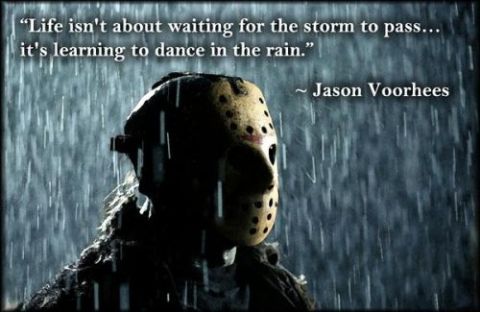
As we all know, with one notable exception, the majority of the cast of the original Friday the 13th didn’t exactly go on to greater heights of stardom. The movie may have made a lot of money but it didn’t lead to bigger roles for Laurie Bartram and Mark Nelson. When the movie was released in 1980, Betsy Palmer was the best known member of the cast and, according to the book Crystal Lake Memories, the cast of Friday the 13th Part 2 used to joke that maybe the cast of the first film actually had been murdered in the woods because no one ever saw them again.
Of course, today, no one can watch Friday the 13th without saying, “Oh my God, Kevin Bacon’s wearing a speedo!” but, at the time he was cast as doomed Jack, he was just another struggling actor. However, if things had gone as originally planned, today Bacon would not be the only respected actor with Friday the 13th on his resume. When the film was in pre-production, director Sean Cunningham originally tried to get a star to play the role of Alice, the only camp counselor to make it out of Camp Crystal Lake alive.
Who was that star?
Sally Field.
The future multiple Oscar-winner was seriously pursued for the role of Alice. She did not, as some sources claim, audition for the role. Instead, she merely turned it down and went on to win her first Oscar for Norma Rae. Once it became obvious that Field had no interest in going to Camp Crystal Lake, Cunningham decided to go with a cast of unknowns and Adrienne King was given the role of Alice.
Personally, I think that worked out for the best. Not only was Adrienne King perfect for the role but the use of unknowns undoubtedly made the film more effective when it was released. After all, everyone knows that a star is going to survive. (That’s one reason why, when seen today, it’s still jarring to see Kevin Bacon get dispatched.)
Here’s a few more bits of trivia to make your Friday the 13th a good one:
2. After the success of Friday the 13th, Adrienne King was stalked by an obsessed fan and, when she was asked to return for 1981’s Friday the 13th Part 2, she requested that her role be as small as possible. As a result, Alice showed up just long enough to be killed off. Amy Steel replaced King as the film’s heroine. Steel would later go on to star in another classic slasher film, April Fool’s Day.
3. Originally, 1982’s Friday the 13th Part 3 was envisioned with Steel returning to play Ginny. However, Steel turned down the chance to return, leading to the filmmakers instead simply remaking the first film (in 3D!). After being cast in the lead role, Dana Kimmel requested that the sex and drugs featured in the original script be toned down. That’s just one of many reasons why many consider Friday the 13th Part 3 to be the worst film in the series.
4. Even if she didn’t return for Part 3, Amy Steel was instrumental in convincing her friend, actor Peter Barton, to appear in 1984’s Friday the 13th — The Final Chapter. Barton’s likable performance as the handsome but definitely doomed Doug was a highlight of the film. Another highlight was Ted White’s performance as Jason. As opposed to the character he played, White once threatened to quit the film because he didn’t like the way the director was treating the film’s cast.
5. The working title for 1985’s Friday the 13th: A New Beginningwas Repitition. Having killed Jason at the end of The Final Chapter, Corey Feldman returned for a cameo that he shot at the same time that he was filming The Goonies for Richard Donner. Along with the first film, this is the only one to not feature Jason Voorhees committing any murders (unless you count the ones that he committed in Tommy’s nightmare) and the film’s ending was specifically set up so that Tommy could take over Jason’s murderous ways. However, the film’s disappointing box office reception led to Jason returning as a zombie in the next film.
6. With its intentional comedy and its emphasis on action over blood, 1986’s Friday the 13th: Jason’s Lives is a rarity in that it was a Friday the 13th film that actually got somewhat good reviews. John Shepherd, who played Tommy in a New Beginning, was offered a chance to return to the role but turned it down, saying that the film’s went against his religious beliefs. As a result, Thom Matthews was cast as Tommy. Matthews also played the lead in another horror comedy, Return of the Living Dead.
7. 1988’s Friday the 13th Part VII: The New Blood was originally envisioned as being a cross-over with A Nightmare on Elm Street. However, when Paramount (who held the rights to Jason) and New Line Cinema (who held the rights to Freddy) could not come to an agreement, the project was temporarily abandoned. According to Crystal Lake Memories, the film’s executive producer, Barbara Sachs, wanted Friday the 13th Part VII to be the first Friday the 13th to win an Academy Award and came with an extremely ambitious storyline that she envisioned being directed by none other than Federico Fellini. Cooler heads prevailed and, instead, The New Blood found Jason battling a young woman with psychic powers.
8. The initial working script for 1989’s Friday the 13th Part VIII: Jason Takes Manhattanwas entitled “Ashes to Ashes.” The film’s anemic box office convinced Paramount to sell the franchise to New Line Cinema.
9. After New Line purchased the franchise, the first film’s director, Sean S. Cunningham, returned to produce 1993’s Jason Goes To Hell: The Final Friday. Much like The New Blood, this was originally envisioned as being a Freddy vs. Jason film but that plan was, again, abandoned. Freddy Krueger does make one brief appearance, when his clawed hand appears and drags Jason’s hockey mask to Hell. Director Adam Marcus also included a shot of a book that was meant to be the Necronomicon as an attempt to link Jason to the Evil Dead universe as well. Because New Line did not own the rights to Evil Dead, Marcus did not tell them what he was planning to do and instead asked Sam Raimi if he could borrow the prop. Raimi thought it was a great idea. Less amused was Tom Sullivan, the man who actually created the prop and who received no money for its use in Jason Goes To Hell.
10. The 8 year gap between the release of Jason Goes To Hell and 2001’s Jason Xwas a result of Freddy vs. Jason being stuck in development Hell. Jason X was largely produced to keep audiences from forgetting about Jason. Screenwriter Todd Farmer appeared in Jason X, playing a character named Dallas (a nod to the original Alien).
11. After spending two decades in development, 2003’s Freddy vs Jason finally brought the two infamous serial killers together. Kane Hodder, who had played Jason in every film since New Blood, was not asked to return for Freddy vs. Jason, supposedly because the film’s director wanted Jason to tower over Freddy and it was felt that Hodder was not tall enough. At one point, Freddy vs. Jason was envisioned as ending with Pinhead appearing and defeating both of them but New Line could not secure the rights to the Hellraiser character.
12. 2009’s Friday the 13thwas meant to reboot the series. Perhaps the less said about it, the better. Plans for a sequel to the reboot are currently trapped in the same development Hell that once imprisoned Freddy vs. Jason.
Clint Eastwood is posing as a preacher in a small Montana town, giving his Sunday sermon. Meanwhile, carefree Jeff Bridges steals a Trans Am off a used car lot and goes for a joyride. Clint’s sermon is interrupted by a hit man who opens fire in the church, chasing Eastwood down through a wheat field, when Bridges comes speeding along, running the killer down. Clint hops in the Trans Am, and the two become fast friends, setting up THUNDERBOLT AND LIGHTFOOT, a wild and wooly tale that’s part crime caper, part character study, and the directorial debut of Michael Cimino.
Clint plays Korean War veteran John Mahoney, a criminal known as “The Thunderbolt” who pulled off a successful half-million dollar armory robbery. His ex-gang members (George Kennedy ,Geoffrey Lewis ) think he betrayed them, and are out to kill him, but not before finding out where the loot is…
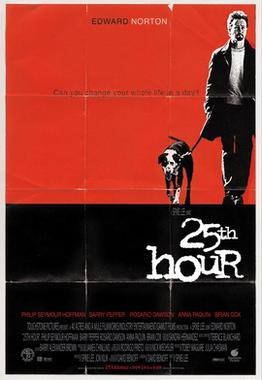
First released in 2003, 25th Hour is one of those films that gets better and better with each subsequent viewing.
Monty Brogan (Edward Norton) may have done some very bad things in the past but nearly everyone has benefited. His childhood friends, a trader named Frank (Barry Pepper) and a teacher named Jacob (Philip Seymour Hoffman), both get to live vicariously through their friend, even if neither one of them is quite willing to admit it. Monty’s father (Brian Cox) is a retired fireman who now owns a bar that was largely purchased with the money that Monty made from dealing drugs. Monty’s girlfriend, Naturelle (Rosario Dawson), is “living high” off of the profits of Monty’s drug deals. For that matter, so is Monty. Monty has a nice apartment, a loyal dog, and a supportive boss named Uncle Nikolai (Levan Uchaneishvili).
Of course, Monty understands that he’s in the business of destroying lives. When Monty first met Naturelle, he had just completed a transaction with a well-dressed businessman. Years later, when Monty is sitting on a bench with his dog, that same man approaches him and begs for more drugs. The man’s no longer wearing a suit. Now, he’s apparently homeless and so addicted that he takes it personally when Monty informs him that he’s no longer in the drug-selling business.
Why is Monty no longer selling? Someone told on Monty. When the DEA showed up at his apartment, it didn’t take long for them to find the packages that he had hidden in the cushions of the couch. For all of his swagger and confidence, it would appear that Monty wasn’t quite as clever as he thought he was. Monty was arrested and subsequently sentenced to seven years in prison.
The majority of 25th Hour takes place during Monty’s final night of freedom, a night that he’s planning on spending it with Frank and Jacob, both of whom could have made the same mistakes that he did but, for whatever reason, they didn’t. Needless to say, Monty’s got a lot on his mind. For all of his attempts to hide it, Monty isn’t as tough as he pretends to be. He knows that it’s not going to be easy for him to do seven years in confinement. He’s terrified of getting raped in prison and he worries that he’s going to be locked in a holding cell with 200 other criminals. Both he and his friends know that, even if he does survive, he’ll be a different man when he gets out. Frank suggests that he and Monty could open a bar when Monty is released but they both know this is an empty promise. Not only is Monty is scared of the future but he’s haunted by the past. Is he getting what he deserves? What if he had made different choices? Will Nautrelle wait for him or, as some of his associates suggest, is she the one who betrayed him in the first place?
Over the course of the night, both Frank and Jacob are also forced to deal with their feelings towards Monty. Frank is a Type A personality, the one who spends his day screaming into telephones and who eagerly looks forward to exploiting bad economic news for his own financial gain. Frank says that Monty is getting what he deserves but, as the film progresses, it becomes obvious that Frank knows that he has more in common with Monty than he wants to admit. Jacob, on the other hand, is a socially awkward teacher who is struggling to deal with a crush that he’s developed on one of his students (Anna Paquin). If Frank fears that he’s more like Monty than he wants to admit, Jacob wishes he could be more like him. At first, it’s hard to imagine that these three men could ever have been close friends but, as soon as you see them together, it all makes sense.
As directed by Spike Lee, one of American cinema’s greatest provocateurs, 25th Hour is more than just the story of one man’s last night of freedom. Over the course of the film, Monty becomes a symbol of not just New York City but of America itself. Driven by self-interest, Monty has spent his life ignoring the consequences of his actions and, now that he has no choice but to confront them, it’s too late. During the film’s most famous scene, Monty stares in a mirror while his reflection rants against every single neighborhood and ethnic group in New York City. The rant is such a powerful scene that it’s easy to miss the most important point. Only at the end of the rant does Monty’s reflection admit that he’s as much to blame for his life as any of them.
Oh yes, the Rant. The Rant is so famous that I was almost tempted to not mention it in this review, just because it doesn’t seem as if there’s much left to be said about it. Even people who dislike the film seem to be in agreement that the Rant is one of the most powerful and incendiary moments in early 21st century cinema. The Rant gives us a portrait of a divided and angry society in collapse and it’s a portrait that is probably even more relevant today than it was when the film was first released. The Rant feels like such a classic Spike Lee moment that it’s surprising to discover that the Rant was included in the script even before Lee was attached to the film.
A few things about the Rant:
The film deliberately leaves it ambiguous as to whether or not Monty is actually speaking. We see the back of his head and his reflection but the movement of his head rarely seems to match the movement of his reflection. Regardless of whether Monty is actually speaking or just imagining the rant, the scene does make clear that, even on his way to prison, Monty can only truly express himself while alone. Of course, once he’s locked up, Monty’s not going to be alone for at least seven years.
“Enron!” I have to admit that, when I recently rewatched film, I laughed when Monty started ranting about Enron. I can vaguely remember a time when everyone was obsessed with Enron and Halliburton and all that other stuff so I found it funny that I briefly had to struggle to recall just what exactly Enron was. 16 years from now, I wonder if people will watch old movies and TV shows and say, “Why are they all so obsessed with Russia?”
As well-done and brilliantly acted as it may be, the Rant has tended overshadow an even better moment. It has been said that the key to a successful work of art is a good ending. As a writer, I can tell you that endings are a hundred times more difficult than beginnings. Fortunately, 25th Hour has an absolutely brilliant ending.
After having finally convincing Frank to beat him up (in an effort to make himself look tougher once he arrives in prison), Monty is being driven to the prison by his father. As they leave New York City, Monty takes one final look at the city and it’s citizens enjoying freedom that he’ll never again have. (This is such a New York City that you can’t help but feel that it’s adding insult to injury that Monty’s going to have to serve his time upstate.) As he drives, Monty’s father begins to talk…
It’s all about decisions and consequences. Monty made his decisions years ago. Over the course of Monty’s last night of freedom, Frank, Jacob, Naturelle, and even Uncle Nikolai made their decisions. And now, as he drives his son to prison, Monty’s father is forced to make a decision of his own. There’s so much great acting to be found in 25th Hour but, during that final soliloquy, Brian Cox upstages all of them. Brian Cox is one of those character actors who seems as if he’s been around forever. He’s the type of dependable actor who, much like Monty’s father, is often taken for granted. If nothing else, you have to be thankful for a film like 25th Hour because it gives everyone a chance to be reminded of just how brilliant an actor Brian Cox truly is.
(Here’s a random bit of a Brian Cox trivia. While everyone knows that, in Manhunter, Brian Cox was the first actor to play Hannibal Lecter, he also played Winton Churchill the same year that Gary Oldman won an Oscar for playing the same role in Darkest Hour.)
25th Hour is not an easy film to watch. At times, it’s one of the most depressing films ever made. It’s tempting to say that, as bad as things ultimately turn out for him, you’re glad that Monty has his father and his friends but that’s really not true. No matter how much his friends care about him or how much Naturelle and his father love him, Monty’s going to prison and his story is simply not going to have a happy ending.
And yet, 25th Hour is one of those films that you can’t look away from and, after you watch it, you simply can’t forget. Every time I watch 25th Hour, I find new details to appreciate. With each subsequent viewing, the pungent dialogue becomes even more multi-layered. With each subsequent viewing, Monty becomes even more of an intriguing and tragic figure. This is a film that makes you appreciate the brilliance of Edward Norton and mourn the fact that Barry Pepper rarely gets roles as good as his role here. With each viewing, 25th Hour reminds you of what a great talent we lost when we lost Philip Seymour Hoffman. It’s film that gets better with each viewing.
Assuming that Monty survived and managed to stay out of trouble, he should be out of prison by now. Hopefully, wherever he is, he’s doing okay.
On Sunday night, immediately after watching Twin Betrayal, I watched and, working with TSL contributor Case Wright, live tweeted a film called Evil Doctor!
Why Was I Watching It?
The first reason was an obvious one. It was a Lifetime movie and, as our regular readers know, there’s no way that I would ever miss the chance to watch a Lifetime film.
The other reason was that the film was named Evil Doctor, which made it sound like the origin story of perhaps the greatest MCU villain of all time. As a general rule, any Lifetime film that has the word “evil” in the title is going to turn out to be good. Evil is right up there with “Bad,” “Confessions,” and “…at 17” as far as words in Lifetime movie titles are concerned.
What Was It About?
Everyone wants something.
Aubrey Lewis (Jen Lilley) just wants to have her baby in peace.
Aubrey’s husband, Matt (Corin Nemec), wants to be a respected television writer, even if he is stuck writing for a sitcom called Family Phun.
And what does Dr. Natalie Barnes (Dina Meyer) want? She wants to have a baby and she wants a baby now! She also wants to deal with all of the unresolved issues that she had with her dead father, who happened to look just like Matt! What better solution to Natalie’s problems than seduce Matt, steal Aubrey’s baby, and kill anyone who gets in her way?
Seriously, she’s not called an evil doctor for nothing.
What Worked?
Obviously, with a film like this, success is going to depend on how effectively the title character is played. Fortunately, Dina Meyer really threw herself into the role of the evil doctor, kidnapping babies, seducing starlets, and murdering anyone who looked at her the wrong way. Dina Meyer has always done a good job when she’s been cast as a Lifetime movie psycho and Evil Doctor was no different. As well, Corin Nemec and Jen Lilley were likable as the objects of her obsession.
Evil Doctor was one of those Lifetime films that showed no hesitation about going totally and completely over-the-top. Between the evil doctor plotting and the wayward husband trying not to get caught and the poor wife just trying to have her baby in peace, there was not one ounce of drama that this film did not explore. It was outlandish, flamboyant, silly, and a hell of a lot fun!
What Did Not Work?
I think that the film missed a huge opportunity by not recruiting Eric Roberts to reprise his character from Stalked By My Doctor in a cameo appearance. I would have ended the film with Matt and Aubrey going to see their new doctor and discovering Dr. Beck waiting for them in his office. That would have been a legendary ending!
(For the record, according to the imdb, Eric Roberts currently has 57 films that are either currently filming or in post-production. That has nothing to do with Evil Doctor but it is a fun piece of trivia.)
Other than the glaring lack of Eric Roberts, everything worked in Evil Doctor. I mean, let’s be honest. When you watch a film with a title like Evil Doctor, you know what you’re going to get. You watch a film like this because you want to embrace the melodrama and you’re looking forward to trying to predict every outlandish twist. Evil Doctor delivered exactly what it promised.
“Oh my God! Just Like Me!” Moments
I totally related to Janelle (Kelsey Griswold), who was Aubrey’s sister and who moved in to help around the house while Aubrey was pregnant. Janelle had this wonderfully sarcastic, no-bullshit approach to life, to which I totally related. Janelle disliked almost everyone who came by the house and never made any attempt to hide that fact.
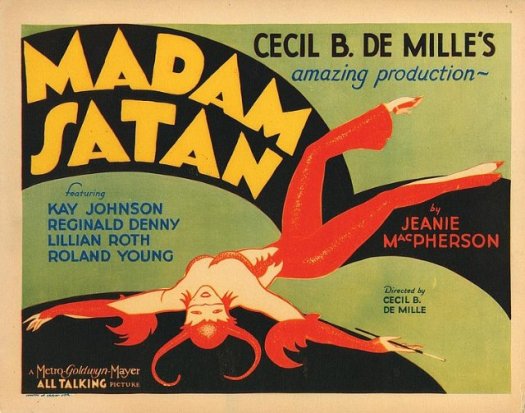
It’s wild! It’s weird! It’s Cecil B. DeMille’s MADAM SATAN, a movie I’ve heard about for decades, but never had the chance to catch, until now. It’s got a little something for everybody, from drama to comedy to musical numbers to half-naked women to jazz baby Lillian Roth! Was it worth the wait, Dear Readers? Well… read on!
Better hold on to your seats though, as MADAM SATAN shifts abruptly in tone throughout it’s running time. It’s slow going the first few minutes, starting out as a stiff drawing-room drama. Angela Brooks (Kay Johnson) is worried about her dissipating marriage to Bob, who neglects her and stays out all night. Now here comes comedy, with Bob (Reginald Denny ) and his pal Jimmy (Roland Young) trying to sneak in at dawn, two wasted wastrels drunk as the proverbial skunks. Suddenly, out of nowhere, the maid (Elsa Peterson) breaks out…
On Sunday night, I watched the latest Lifetime premiere, Twin Betrayal!
Why Was I Watching It?
The obvious answer is that it was on Lifetime. However, I also have a weakness for films about evil twins. Don’t ask me why, I just do.
What Was It About?
Poor Jessica Klint (Jen Lilley)! Not only is she struggling financially but her estranged husband (Peter Douglas) wants custody of their daughter. We know her husband is a bad guy because he wears a suit even when he’s at home and his name is Lars. Never in a Lifetime film has anyone good been named Lars. (Before anyone mentions Lars and the Real Girl, allow me to point out that 1) that’s not a Lifetime film and 2) even if it was, it would be the exception to the rule.)
However, following a business trip to Dallas, Jessica’s problems get even worse! After having a one-night stand with a cowboy named Henry (Nick Ballard), Jessica finds herself being blackmailed! Where can she get the money? Her wealthy father isn’t going to be much help. How about from her twin sister, Alessandra (Jen Lilley)? Sure, Jessica and Alessandra have a strained relationship and haven’t spoken in years but surely one twin will help the other, right?
And surely, no matter what personal issues there may be, one twin would definitely never try to frame the other for murder, right?
Right?
Watch the film to find out!
What Worked?
I enjoyed this one because, as any film about a twin betrayal should be, it was totally melodramatic, over-the-top, and very self-aware. Whenever I give a film like this a good review, I always seem to get at least one comment from someone complaining that the film was too silly or implausible but I think those people are missing the point. You don’t watch a film like Twin Betrayal because you want to see a serious exploration of what it’s like to be a twin. You watch a movie like this because you want to have fun! Twin Betrayal promised twisty entertainment and it delivered and, in the end, that’s all that really matters.
Jen Lilley obviously had a blast playing the twins, especially the wonderfully decadent Alessandra. Alessandra had obviously been waiting for years for the chance to make her sister uncomfortable and she did not let the opportunity pass her by.
What Did Not Work?
On the one hand, I was really happy that part of the film took place in Dallas. I don’t know if they actually filmed in Dallas but, at the very least, they at least included a shot of the Dallas skyline. (Whenever a movie spends any time in Dallas, you always know that you’re going to get at least one shot of Reunion Tower and one shot of Bank of America Plaza.) However, in reality, it’s doubtful that Jessica would have met any cowboys in Dallas. Football aside, cowboys are really more of a Fort Worth thing.
“Oh my God! Just like me!” Moments
Much like Jessica Klint, I have a weakness for cowboys. Seriously, who doesn’t? I’m also close to my sisters but, fortunately, none of us are twins. If there’s anything that I’ve learned from watching Lifetime films, it’s that you can always depend on your sister unless she’s your twin sister. Sadly, there’s always one evil twin and it seems like the good twin always ends up getting framed. Hopefully, Lifetime will continue to explore this theme whenever they get around to making the inevitable Mary-Kate and Ashley biopic.
Actually, I guess if I was a twin, I probably would end up being the evil one. Seriously, it just seems like it would be too much of a temptation to resist…
Lessons Learned
As I stated above, one twin will always be evil. The trick is figuring out which one.
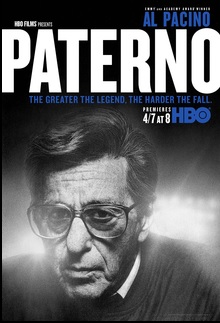
There’s a great scene that occurs about an hour into HBO’s latest original film, Paterno.
Joe Paterno (Al Pacino), the legendary and aging Penn State football coach, has been accused of knowing and failing to report that one of his former assistant coaches, Jerry Sandusky (Jim Johnson), was a pedophile. With Paterno and his family plotting out strategy behind closed doors, a group of Penn State students gather outside of the Paterno home. Instead of being angry that children were molested at their college, they’ve come to show their support for Paterno.
“JOE PATERNO!” they chant.
Scott Paterno (Greg Grunberg) hears the chants. Scott is a lawyer and appears to be the only member of the Paterno family to truly understand the seriousness of the accusations. Scott steps outside.
“JOE PATERNO!” the crowd continues to chant.
Scott thanks them for their support but then says that they also need to show the same support to all of Sandusky’s victims…
“JOE PATERNO!” the chant continues.
Struggling to be heard, Scott again asks them to remember that the children molested by Sandusky are the ones who need the most support…
Suddenly, the chant changes. “SCOTT PATERNO!” the crowd starts to chant. It’s not because they’ve heard anything that Scott’s said. Instead, it’s because Scott’s a Paterno and, in the eyes of the crowd, that makes him royalty. As the crowd continues to chant his name, Scott gives up and reenters the house.
Paterno could have used more scenes like that, scenes that explicitly showed the danger of blind hero worship as opposed to just telling us about it. For the most part, Paterno feels like a well-written Wikipedia article. You can’t deny the skill with which the film was made but, at the same time, it’s difficult not to get frustrated by Paterno‘s refusal to really dig too far underneath the surface of the story.
Some of the problem is with the film’s structure. The film primarily takes place over the final six days of Paterno’s career. Paterno spends the majority of the film locked away in his house, passive aggressively avoiding the question of what he knew and when he knew it. His wife (Kathy Baker) and his other son, buffoonish Jay (Larry Mitchell), make excuses for him while Scott tries to get everyone to understand that the accusations aren’t just going to go away. This is the part of the Paterno story that, in most films, would be summed up by an end credits title card.
As a result, Paterno never really deals with why Joe Paterno not only didn’t report Sandusky but also apparently protected him and that, to be honest, is the most important and troubling part of the story. Since Sandusky is only briefly seen, we never get any insight into his relationship with Paterno and we never understand why Paterno would go to bat for an assistant who he, at one point, refers to as being “a pain in the ass.” Was Paterno truly clueless about what was happening or did he just think he could sweep it under the rug and nobody would say anything because he was Joe Paterno? Were Paterno’s actions the result of willful blindness or hubris? It’s not so much a problem that the film leaves certain questions unanswered as much as it’s a problem that the film itself doesn’t seem to be all that concerned with the answers.
When the film isn’t concentrating on the Paternos, it’s concentrating on the reporter, Sara Ganim (Riley Keough), who originally broke the story. However, these scenes are never quite as compelling as the film seems to think they are. Riley Keough, who was so great in American Honey, seems miscast here. For the most part. Sara seems to be there so that she can witness the Penn State students rioting and chanting, “Fuck the Media” after Paterno loses his job.
The best thing that Paterno has going for it is the lead performance of Al Pacino. Pacino plays Paterno as a man who is very comfortable with the routine that he’s built up for himself. His life revolves around Penn State, his team, and finally his own legend. When the Sandusky story first breaks, Paterno can’t understand why he even has to be concerned about it. He’s got a game against Nebraska coming up! Awkward even around his adoring family, Paterno only seems to be truly comfortable when he’s coaching. Pacino plays Paterno as a fragile and sickly man, a once ferocious lion brought down by a combination of cancer and scandal. When we first see him, Paterno is coaching his team to a record-setting victory and he seems like a larger-than-life figure. By the end of the movie, Paterno seems much smaller, a confused man who still can’t seem to bring himself to deal with why everyone is getting so upset. It’s a great performance in an uneven film.







 Through the Shattered Lens