Have you ever noticed how movies about teenagers always treat the rules of the “Never Have I Ever” game like they’re some sort of legally binding contract?
Seriously, I’ve seen this happen in so many movies. Someone has a deep, dark secret that they don’t want to reveal. They know that if they reveal the secret, a lot of bad stuff will happen as a result. Feelings will be hurt. Friendships will be crushed. Lives will be lost.
But then the minute somebody says, “Never have I ever fucked my best friend’s boyfriend,” they always drink up. Half the time, they’re the only person to take a drink. And, during all of the drama that unfolds, it never occurs to anyone to say, “Why didn’t you just not take the drink!? It’s just a game, after all!”
Something like this happens in the 2016 film, Nocturne. Nocturne takes place at perhaps the saddest high school graduation party of all time. All of the cool kids have gone to another party, which means that only seven people show up at this party. From that humble beginning, things quickly go downhill as the graduates hang out in the hot tub, play the Never Have I Ever game, and listen to Gabe (Jake Stormeon) ramble about religion and philosophy and stuff. Gabe also demonstrates some card tricks so yeah …. that’s definitely the way to end your high school career.
Anyway, bad parties always seem to lead to people trying to contact the dead and that’s what happens here. Gabe sets up a makeshift séance and the graduates ask the dead a lot of questions that they probably shouldn’t have asked. (Seriously, I’ve been to a few bad parties in my lifetime and you an always tell that the party is officially dead once people actually try to talk to the …. well, dead.)
Needless to say, this leads to someone getting possessed and just about everyone else dying. The other party was probably a lot more fun.
So, on the plus side, Nocturne is fairly well-acted and some of the death scenes were clever. The film’s chronology is a bit jumbled, which is one of those storytelling tricks that can be really annoying but which is justified here by the fact that demon exists beyond our conventional understanding of time and space.
On the negative side, a cat dies about halfway through the film and, as I discussed years ago in my review of Drag Me To Hell, it’s hard for me to endorse any film in which a cat is killed. I mean, honestly, I would think most supernatural beings would appreciate the fact that a cat can sleep through just about anything. Whereas a dog would be barking and throwing a fit over all the murders being committed, a cat would probably just relax in a corner and play with a toy mouse or something. In this film, there was really no reason to kill the cat and it felt a bit gratuitous. It was hard not to tell that the only reason the cat was put in the film was so it could be killed. My point is, if you want to me to like your movie, don’t kill the cat.
Anyway, Nocturne is a rather uneven film. If you can see past the dead cat, you might find this one interesting. It has its creepy moments, even if it’s hard not to feel that the overall movie doesn’t really work.
The year is 1974 and there’s nothing more dangerous than being a hippie in Baja California. That’s because psychotic business Sam Farragutt (played by Andy Griffith!) is on the loose. Sam likes to describe himself as being a hippie himself. “A hippie with money,” Sam puts it as he waves a hundred dollar bill in the face of a hippie without money,
Actually, there is one thing more dangerous than being a hippie in Baja California and that’s being an ad executive. Once again, Sam Farragutt is to blame. He’s willing to give his business to three ad execs but first they have to agree to go down to Baja and ride around with him on their motorcycles. The three ad execs are Terry Maxon (former child evangelist Marjoe Gortner!), Paul McIllvain (former Brady Bunch star Robert Reed!), and suicidal burn-out Warren Summerfield (William Shatner!). Warren is having an affair with Paul’s wife (Angie Dickinson!) but he’s still planning on committing suicide in Mexico.
However, going to Mexico gives Warren a new lease on life. After Warren discovers that Farragutt is responsible for the death of two hippies, he becomes determined to make sure that justice is served. Soon, Andy Griffith (!) is chasing William Shatner (!) across the Mexican desert. Someone’s going to die. Is it going to be Sheriff Taylor or Captain Kirk?
Pray For The Wildcats was a made-for-TV movie that aired the same year as Savages. Both movies were a part of Andy Griffith’s attempt to change his image after playing the folksy Sheriff Taylor on The Andy Griffith Show. Griffith is a good villain but the main appeal of Pray for the Wildcats is the chance to see William Shatner doing his thing. Shatner has a juicy role here, playing a man who is at first suicidal and then righteously indignant. He overemotes with the self-serious intensity that was Shatner’s trademark in the years before he finally developed a sense of humor about himself. The movie itself gets bogged down with unnecessary flashbacks and dated dialogue but the spectacle of Griffith vs. Shatner makes it all worth it.
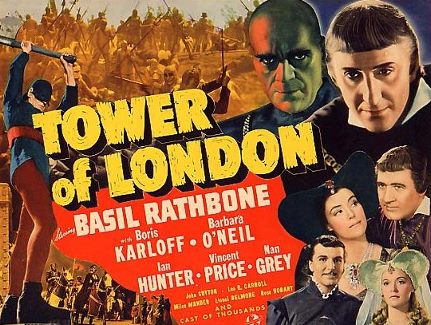
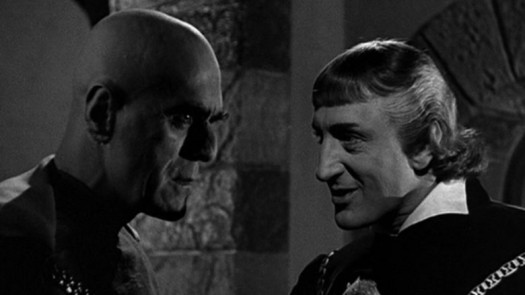
Rowland V. Lee followed up his successful SON OF FRANKENSTEIN with TOWER OF LONDON, reuniting with stars Basil Rathbone and Boris Karloff in a take on the story of Richard III that mixes historical drama with horror. This “Game of Thrones” is filled with political machinations, royal court intrigue, and murder most foul as the crook backed Richard kills his way to the top of England’s heap, aided by his chief executioner Mord.
You won’t find any Shakespeare here or historical accuracy, but Lee and his screenwriter brother Richard N. Lee craft a tale of bad intentions to capitalize on the renewed interest in the horror genre. Rathbone exudes evil from every pore as Richard, the Duke of Gloucester, who along with his brother King Edward VI, has seized power by imprisoning the feeble-minded Henry IV. But there are six heirs standing in Richard’s way to succession, and he keeps…
Lucio Fulci’s 1981 masterpiece, The House By The Cemetery, begins as so many slasher movies have begun.
A teenage couple fools around in the basement of the deserted Oak Mansion. Just from listening to them talk, we can surmise that the mansion has a reputation for strange events. Suddenly, the boy vanishes. The girl looks for him, telling him that whatever he’s doing stopped being funny a long time ago. Suddenly, a knife is driven through the back of her head, the blade eventually exiting through the girl’s mouth. Fans of Italian horror and Fulci films in particular will not be shocked by this grisly turn of events, mostly because the girl was played by Daniela Doria. Doria appeared in several Fulci films and, in each film, her character was brutally murdered. The House By The Cemetery was her third Fulci film. She would later appear and get killed in Fulci’s The New York Ripper.
From that rather conventional horror movie opening, The House By The Cemetery goes on to become progressively more bizarre and surreal.
The Boyles — Lucy (Catriona MacColl), Norman (Paolo Malco), and their young son, Bob (Giovanni Frezza) — are to spend the next six months living in a mansion in New England. It’s all so Norman can work on a research project. His colleague, Peterson, previously stayed at the house and basically went crazy, killing his family, his mistress, and himself. This doesn’t seem to particularly disturb Norman. Before they leave New York, Bob stares at a picture in his father’s office. It’s a black-and-white picture of a dilapidated house. There’s a young girl staring out the window of the house.
Suddenly, we can see and hear the girl (Silvia Collatina) as she yells at Bob to stay away from the house.
In the small town of New Whitby, the girl — who is named Mae — stands on a sidewalk. She’s clutching a doll and it doesn’t appear that anyone else can see her. Mae stares into the window of tailor’s shop. One of the mannequins has fallen over and its head has become detached. Mae watches a dark blood oozes out of the plastic head.
Sitting in the back seat of his parent’s car, Bob watches Mae. Mae turns to stare at him. Despite the fact that there’s a road in between them, Mae and Bob are able to calmly speak to each other. Again, Mae tells Bob that he shouldn’t have come.
When the family arrives at their new home, Lucy says that the Oak Mansion looks a lot like the house in the picture in Norman’s office. Norman shrugs it off as a coincidence. As for the house itself, it turns out to be a bit of a dump. Yes, it’s big but the inside of the house is covered in dust and cobwebs and there’s a particularly nasty bat living in the basement. However, what really upsets Lucy is the fact that there’s a tombstone in the middle of the front hallway. Norman dismisses her concerns, saying that it used to be very common for people to be buried in their homes.
Much as how Jack Torrance was “always the caretaker,” everyone in town seems to be convinced that they’ve met Norman before. Norman swears that he’s never been to New Whitby before. Meanwhile, Lucy grows more and more anxious inside the house. Sometimes, she thinks she can hear noises in the walls. Are they alone or is there someone else living in the house? Bob spends his time playing with his new friend Mae, who shows him a nearby headstone for someone named Mary Fruedstein. “She’s not really buried there,” Mae tells him.
Things get stranger. A mysterious young woman named Ann (Ania Pieroni, who has previously played The Mother of Tears in Dario Argento’s Inferno) shows up and says that she’s the new babysitter. A real estate agent (played by Dagmar Lassander) comes by the house while the Boyles are out and is promptly murdered. Lucy wakes up one morning to discover Ann scrubbing a huge blood stain and says nothing about it.
Norman’s research reveals that the house once belonged to a Dr. Jacob Freudstein, a Victorian-era scientist who conducted illegal experiments. Could that have something to do with all of the strange things that have happened in the house? Norman goes to New York to do further research and once again, he finds himself dealing with people who are convinced that they’ve seen him before….
In an interview, Lucio Fulci once described The House By The Cemetery as being his answer to Stanley Kubrick’s adaptation of The Shining and there are some obvious similarities, from the ghostly girl to the little boy who appears to have psychic powers. Fulci said that he didn’t feel The Shining was dark enough and make no mistake about it, The House By The Cemetery is a very dark film. Even by the standards of Lucio Fulci, there is very little hope to be found in The House By The Cemetery.
As a follow-up to both The City of the Living Dead and The Beyond, it’s also the concluding chapter of Fulci’s Beyond trilogy. When Mae offers Bob a chance to escape to a safe place, those who have viewed The Beyond will immediately realize that she’s talking about the same dimension that was visited by David Warbeck and Catriona MacColl at the end of Fulci’s previous film. And while Mae may be offering Bob an escape from what’s happening the House, those who have seen the entire trilogy know that the Beyond is just as dangerous as our world. The end of the film seems to suggest that there is no escape from the horrors of the world. At best, there’s just a temporary delay to the inevitability of doom.
The House By The Cemetary is Fulci at his most atmospheric as he combines the gothic visual style of City of the Living Dead with the aggressive dream logic of The Beyond. In much the same way that the The Beyond indicated that the price for discovering the truth about the world was blindness, The House By The Cemetery indicates that the longer the Boyles remains in the house, the more incapable they are of seeing the horror right in front of their faces.
And what horror! When Dr. Freudstein does make his appearance, he’s a monster straight out of Lovecraft, a mix of Frankenstein, Freud, and the Great Old Ones. And yet, the film’s real horror is not to be found in the monster but in the disintegration of the family living in the house. In the end, Bob is stalked not only by the monster in the basement but also by his parent’s increasingly unhappy marriage.
Giovanni Frezza actually does a pretty good job in the role of Bob, though you might not notice because he’s been so atrociously dubbed. (Far too often, in Italian horror films, children were dubbed by adults speaking in squeaky voices and that seems to be what happened here.) Frezza would later appear in Fulci’s perplexing Manhattan Baby while Paolo Malco would play another arrogant academic in The New York Ripper. And then there’s Catriona MacColl, appearing in her third and final Fulci film. Fulci was often criticized for the way women were portrayed in his films but MacColl gave strong lead performances in The City of the Living Dead, The Beyond, and The House By The Cemetery and, most importantly, her instantly relatable presence helped to provide some grounding for Fulci’s surreal vision. Even if the films didn’t always make perfect logical sense, audiences would continue to watch because they wanted things to turn out well for whichever character MacColl was playing. (Of course, they rarely did.)
The House By The Cemetery was the third and final part of Fulci’s Beyond trilogy and one of his strongest films. Lucio Fulci passed away in 1996 but, like the inhabitants of the Beyond, his films live forever.
The Eyes of Laura Mars opens with Barbra Streisand singing the theme song, letting us know that we’re about to see one of the most 70s films ever made.
Laura Mars (played by a super intense Faye Dunaway) is a fashion photographer who is known for the way that her work mixes sex with violence. Some people say that she’s a genius and those people have arranged for the publication of a book of her work. (The book, naturally, is called The Eyes of Laura Mars.) Some people think that Laura’s work is going to lead to the downfall of civilization. And then one person thinks that anyone associated with Laura should die.
And that’s exactly what starts to happen.
Laura has visions of her friends being murdered. Some people believe that makes her a suspect. Some people think that she’s just going crazy from the pressure. John Neville (Tommy Lee Jones), the detective assigned to her case, thinks that Laura is a damaged soul, just like him. Neville and Laura soon find themselves falling in love, which would be more believable if Dunaway and Jones had even the least amount of chemistry. Watching them kiss is like watching two bricks being smashed together.
There’s plenty of suspects, each one of them more a 70s cliché than the other. There’s Donald (Rene Auberjonois), Laura’s flamboyant friend. There’s Michael (Raul Julia), Laura’s sleazy ex-husband who is having an affair with the gallery of the manager that’s showing Laura’s photographs. And then there’s Laura’s shift-eyed driver, Tommy. Tommy has a criminal record and carries a switchblade and he always seem to be hiding something but, to be honest, the main reason Tommy might be the murderer is because he’s played by Brad Dourif.
If there’s one huge flaw with the film, it’s that the film never explains why Laura is suddenly having visions. Obviously, the film is trying to suggest that Laura and the murderer share some sort of psychic connection but why? (I was hoping the film would reveal that Dunaway had an evil twin or something like that but no.) The other huge problem that I had is that one of the more likable characters in the film is murdered while dressed as Laura, specifically as a way to distract the killer. So, that kind of makes that murder all Laura’s fault but no one ever points that out.
Personally, I think this film missed a huge opportunity by not having Andy Warhol play one of the suspects. I mean, how can you make a movie about a pretentious fashion photographer in the 70s without arranging for a cameo from Andy Warhol?
The other missed opportunity is that the script was written by John Carpenter but he wasn’t invited to direct the movie. I suppose that makes sense when you consider that Carpenter actually sold his script before he was hired to direct Halloween. (Both Halloween and The Eyes of Laura Mars came out in the same year, 1978.) That said, Carpenter would have directed with more of a sense of humor. Director Irvin Kershner takes a plodding and humorless approach to the material. When you’ve got a film featuring Faye Dunaway flaring her nostrils and Tommy Lee Jones talking about how sad his childhood was, you need a director who is going to fully embrace the insanity of it all.
With the glamorous background and the unseen killer, The Eyes of Laura Mars was obviously meant to be an American giallo. Occasionally, it succeeds but again, it’s hard not to feel that an Italian director would have had a bit more fun with the material. In the end The Eyes of Laura Mars is an interesting misfire but a misfire nonetheless.
Today’s horror on the lens is a 1972 made-for-TV movie, Haunts of the Very Rich!
What happens when a bunch of rich people find themselves on an airplane with no memory of how they got there? Well, first off, they land at a luxury resort! But what happens when the resort suddenly turns out to be deserted and the guests discover that there’s no apparent way out!?
In the 1989 horror film, I, Madman, Jenny Wright stars as Virginia. Virginia’s an aspiring actress who makes ends meet by working in a used bookstore. (I’m not sure how much money the typical used bookstore employee makes but I have to say that Virginia’s apartment is absolutely to die for.) Virginia is also dating a police detective named Richard (Clayton Rohner), who is handsome and sweet and looks good in a suit. In fact, the only problem with Richard is that he thinks that Virginia spends too much time reading trashy horror novels. According to him, they give her nightmares and they cause her imagination to run wild.
Richard’s not going to be happy to discover that Virginia has a new favorite author. His name is Malcolm Brand and, despite the fact that Virginia says that he’s better than Stephen King, he’s a mysteriously obscure author. In fact, no one but Virginia seems to have ever heard of him. Virginia has just finished reading Brand’s first book, Much of Madness, More of Sin. Now, she simply has to find his second book, which was called I, Madman.
(Personally, I think Much of Madness, More of Sin is a brilliant title. I, Madman on the other hand is a little bit bland, as far as titles go.)
When Virginia finally tracks down a copy of the book, she discovers that it is all about this mad scientist who falls in love with an actress. Because the scientist is horribly disfigured, the actress rejects him. So, the scientist starts killing people and stealing pieces of their faces, all so he can patch together a new face for himself.
It’s while she’s reading the book the strange things start to happen in Virginia’s life. For instance, the people around her start dying. When she witnesses one of her neighbors being murdered, she swears that the murder was committed by a man who had no nose …. just like in the book! Richard thinks that she’s letting her imagination run wild but Virginia soon comes to wonder if maybe she’s being stalked by the real Malcolm Brand….
I, Madman is an entertaining little horror film, one that sometimes comes across as being an extended episode of something like Tales From The Crypt. From the minute the movie started with Virginia curled up on her couch in her underwear, reading a trashy novel with her oversized reading glasses on and a storm raging outside, I was like, “Oh my God, they made a movie out of my life!” And really, this is one of the reasons why I, Madman makes such a good impression. As played by Jenny Wright, Virginia serves as a stand-in for every horror fan who has ever read a scary novel and immediately imagined themselves as either the protagonist or the victim. If you’ve ever had a nightmare after reading Stephen King or watching a horror movie, you’ll be able to relate to Virginia. Both Jenny Wright and Clayton Rohner give likable and quirky performances in the lead role and they’re surrounded by capable of character actors.
The film itself is a bit of an homage to the suspense classics of the past. It’s easy to compare Malcolm Brand’s novel to The Phantom of the Opera while a scene in which Virginia watches her neighbor play piano brings to mind Hitchcock’s Rear Window. When Virginia imagines herself as a character in one of Brand’s stories, the film even manages to work in some stop-motion animation. All in all, I, Madman is an entertaining horror film, perfect for October and any other season.
Q stands for Quetzalcoatl, a winged-serpent that was once worshiped by the Aztecs. In New York someone has been performing ritual sacrifices, flaying victims of their skin. As a result, Q has flown all the way to New York City and has taken residence in the Chrysler Building. She’s also laid an egg, from which a baby Q will soon emerge.
Now, I’ve always heard that it’s next to impossible to surprise a New Yorker. Apparently, living in New York City means that you’ve seen it all. And that certainly seems to be the case with this film because no one in New York seems to notice that there’s a winged serpent flying over the city. Somehow, Q manages to snatch up all sorts of people without anyone noticing. When Q beheads a window washer, Detectives Shepard (David Carradine) and Powell (Richard Roundtree) aren’t particularly concerned by the fact that they can’t find the man’s head. Shepard just shrugs and says the head will turn up eventually.
Q is really two films in one. One of the films deals with a winged serpent flying over New York and killing people. This film is a throwback to the old monster movies of the 50s and 60s, complete with some charmingly cheesy stop motion animation. The film is silly but undeniably fun. Director Cohen is both paying homage to and poking fun at the classic monster movies of the past and both Carradine and Roundtree gamely go through the motions as the two cops determined to take down a flying monster.
But then there’s also an entirely different film going on, a film that feels like it belongs in a totally different universe from the stop-motion monster and David Carradine. This second film stars Michael Moriarty as Jimmy Quinn, a cowardly but charming criminal who would rather be a jazz pianist. Quinn may be a habitual lawbreaker but he always makes the point that he’s never carried a gun. He does what he has to do to survive but he’s never intentionally hurt anyone. In Quinn’s eyes, he’s a victim of a society that has no room for a free-thinker like him.
However, when Quinn stumbles across Q’s nest, he suddenly has an opportunity to make his mark. As he explains it to the police, he’ll tell them where to find the serpent and her eggs. But they’re going to have to pay him first….
In the role of Quinn, Michael Moriarty is a jittery marvel. Whenever Moriarty is on screen, he literally grabs the film away from not only his co-stars but even his director and makes it his own. Suddenly, Q is no longer a film about a monster flying over New York City. Instead, Q becomes a portrait of an outsider determined to make the world acknowledge not only his existence but also his importance. After spending his entire life on the fringes, Jimmy Quinn is suddenly the most important man in New York and he’s not going to let the moment pass without getting what he wants. Thanks to Moriarty’s bravura, method-tinged performance, Jimmy Quinn becomes a fascinating character and Q becomes far more than just another monster movie.
It makes for a somewhat disjointed viewing experience but the film still works. With its charmingly dated special effects and it’s surprisingly great central performance, Q is definitely a film that deserves to be better-known.
Ben (Sam Bottoms) is a gullible college student working at a gas station in the Mojave desert. Horton Madec (Andy Griffith) is a wealthy attorney from Los Angeles who walks with a limp and who fancies himself a big game hunter. Madec hires Ben to serve as his guide through the desert. Madec says that he’s hunting a ram but instead, he ends up shooting and killing an old prospector. Even after Madec offers to pay him off, Ben wants to go to the police. Madec gives it some thought and decides to hunt Ben himself.
After forcing Ben to strip down to his shorts, Madec sets him loose in the desert. As Ben tries to make his way back to civilization, Madec follows close behind and uses his rifle not to kill Ben but instead to keep him from drinking water or taking shelter from the sun.
Savages deserves to better known than it is. The film does a good job of making you feel as if you’re trapped out in the desert with Ben, trying your damndest to survive while some maniac follows close behind, taunting you and refusing to allow you to get any relief. Horton Madec is pure evil, a maniac who brags about how he can do anything he wants because he has money and he knows people. That he’s played by Andy Griffith makes him even more dangerous because you know there’s no way anyone would believe that Andy Griffith took you out to the desert tried to kill you.
After playing the folksy and friendly Andy Taylor for nine seasons on The Andy Griffith Show, Griffith tried to leave Mayberry behind by taking on villainous roles in made-for-TV movies like this one and Pray For The Wildcats. Though he actually started off his film career by playing a villain in A Face In The Crowd, it was still probably a shock for audiences in 1974 to turn on Savages and see Andy Griffith cruelly drinking a martini while another man nearly died of dehydration in front of him. Griffith goes full psycho in the role of Horton Madec and is totally convincing. (Of course, audiences preferred the folksy side of Griffith which is why, even after ten years straight of playing bad guys, Griffith still ended up starring in Matlock.)
Even though it’s Griffith’s show, Sam Bottom does okay in the role of Ben. He has the right look for the character and that’s really all that the part requires. For the majority of the movie, it’s just Griffith and Bottoms but eventually, James Best shows up as Sheriff Bert Williams. Five years later, Best would achieve a certain immortality when he was cast as Sheriff Roscoe P. Coltrane on The Dukes of Hazzard.
Savages has never gotten an official DVD release but it can be viewed on YouTube, along with Griffith’s other villainous turn from 1974, Pray for the Wildcats.
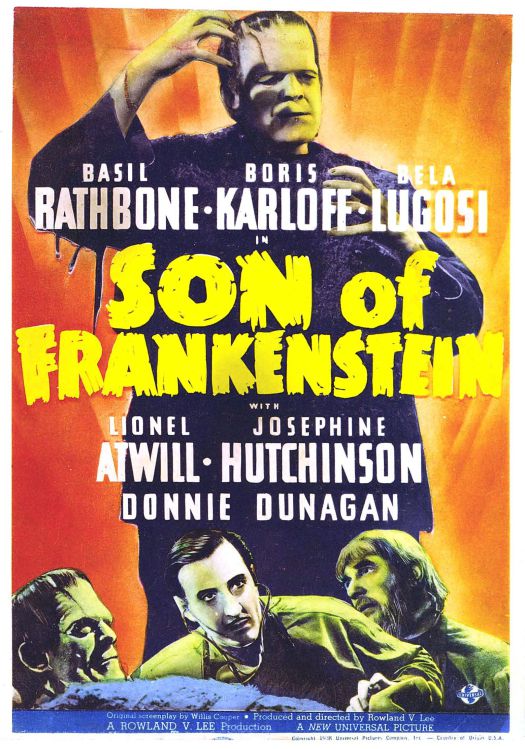
Horror films took a hiatus from Hollywood from 1937 to 1939. The British Horror Ban forbid monster movies from being screened without an X rating, curtailing the export of terror-inducing tales. The Production Code was in full effect, with Joseph Breen and his censorship minions clamping down on what they considered wasn’t suitable for the public. Lastly, Carl Laemmle Sr. (and his son) were ousted from Universal Studios, the company he founded, with J. Cheever Cowdin taking over as Chairman. Cowdin was a money man with a tight hold on the bottom line for the cash-strapped Universal.
Then in 1938, a Los Angeles theater desperate for business featured a triple-bill consisting of FRANKENSTEIN , DRACULA , and KING KONG , playing to sold-out crowds, and a nationwide rerelease saw similar box-office success. The Universal Monsters were back in business, and a third sequel to their profitable series based on Mary…

 The year is 1974 and there’s nothing more dangerous than being a hippie in Baja California. That’s because psychotic business Sam Farragutt (played by Andy Griffith!) is on the loose. Sam likes to describe himself as being a hippie himself. “A hippie with money,” Sam puts it as he waves a hundred dollar bill in the face of a hippie without money,



 Ben (Sam Bottoms) is a gullible college student working at a gas station in the Mojave desert. Horton Madec (Andy Griffith) is a wealthy attorney from Los Angeles who walks with a limp and who fancies himself a big game hunter. Madec hires Ben to serve as his guide through the desert. Madec says that he’s hunting a ram but instead, he ends up shooting and killing an old prospector. Even after Madec offers to pay him off, Ben wants to go to the police. Madec gives it some thought and decides to hunt Ben himself.
 Through the Shattered Lens