Lisa Reviews An Oscar Nominee: Darkest Hour (dir by Joe Wright)


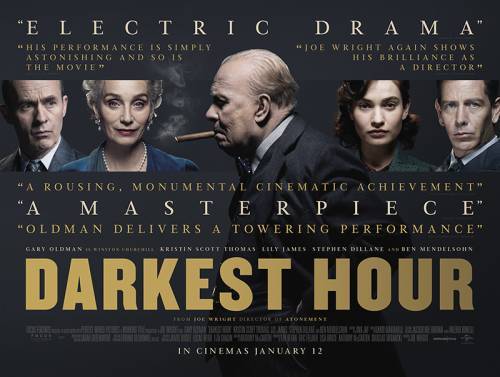
The 2017 best picture nominee, Darkest Hour, opens with Europe at war.

While the United States remains officially neutral, the Nazi war machine marches across Europe.  After years of appeasement, the United Kingdom has finally declared war on Germany but the feeling in Parliament is that Prime Minister Neville Chamberlain (Ronald Pickup) is not strong enough to take on Hitler.  When the Opposition demands that Chamberlain resign, Chamberlain does so with the hope that he’ll be replaced by Lord Halifax (Stephen Dillane).  Like Chamberlain, Halifax continues to hold out hope for some sort of negotiated peace with the Germans.  However, Halifax declines, saying that it’s not yet his time.  Instead, Chamberlain’s successor is Winston Churchill (Gary Oldman), the only Conservative that the Opposition is willing to accept as Prime Minister.

(This is a bit of invention on the part of the filmmakers.  In reality, the Opposition did demand Chamberlain’s resignation but they did not stipulate that he could only be replaced by Churchill.)

No one is particularly enthusiastic about the idea of Winston Churchill becoming prime minister.  Chamberlain and Halifax both view him as being a war monger who is so determined to prove himself as a military strategist that he’ll sacrifice thousands of British lives just for his own glory.  The King (Ben Mendelsohn) worries that Churchill is an unreliable radical and he still resents Churchill for defending the marriage of Edward VIII and Wallis Simpson.  Churchill is regularly described as being a buffoon and an eccentric.  He’s quick-tempered and obsessive about things that many people would consider to be of no importance.  When we first see Churchill, he’s making his new assistant (played by Lily James) cry because he’s discovered that she single-spaced a memo as opposed to double-spacing it.  The only people who seem to like Winston are the member of his family and even his loyal wife (Kristin Scott Thomas) is frequently frustrated with him.

Churchill’s enemies are not impressed by his first actions as prime minister.  They listen in disgust as he lies about the prospects of victory in France.  They are shocked by his refusal to even consider a negotiated peace.  They are horrified by his ruthless pragmatism as he willing sacrifice a thousand British soldiers in order to save several thousand more at Dunkirk.  An aristocrat who has been rejected by his peers, Churchill is betrayed by those serving in his government but beloved by the people who ride the Underground and who are being asked to potentially sacrifice everything to defeat Hitler’s war machine.

As directed by Joe Wright, Darkest Hour plays out like a dream, with 1940s Britain recreated in hues of black and gray.  The film’s visual palette is so dark that, at times, Gary Oldman’s Winston Churchill appears to literally emerge out of the shadows, an almost mythical figure who symbolizes a society in transition.  In many ways, Churchill is an old-fashioned Edwardian who nostalgically remembers the glory days of the British Empire.  At the same time, Churchill is enough of a realist to see that the world is changing and, regardless of who wins the war, that it will never be the same.  Churchill is enough of an aristocrat to be unaware of what a backwards V-sign means but also enough of a commoner to laugh uproariously upon learning its meaning.

Churchill spends a good deal of the film bellowing and, at times, it’s easy to see why many initially dismissed him as being a buffoon.  Indeed, in Darkest Hour, Churchill frequently is a buffoon.  But he’s also a pragmatic leader who truly loves his country and its people.  Oldman has a lot of scenes where he’s loud but he also has other scenes in which he reveals Churchill to be a thoughtful man who loves his country and who is determined to win a war that many believe to be unwinnable.  When he’s reduced to calling the United States and has to pathetically beg President Roosevelt to honor a treaty, you feel for Churchill and you share his frustration as he tries to get the flaky FDR to understand the reality of what’s happening in Europe.  When Churchill explains why he’s willing to sacrifice a thousand in order to save 41,000 more, Oldman delivers his lines with a steely certainty.  As played by Oldman, Churchill knows what has to be done, even if no one else has any faith in him.

It’s a good film, even if it ultimately feels more like a showcase for one actor than a cohesive narrative.  The rest of the cast does a good job, especially Ronald Pickup as the haunted and dying Neville Chamberlain.  But ultimately, Darkest Hour is Gary Oldman’s show.  That’s appropriate.  Much as how Churchill dominated British politics, Gary Oldman has dominated British acting.  Not surprisingly, Gary Oldman won his first Oscar for playing Winston Churchill in Darkest Hour.  The film was also nominated for best picture but it lost to Shape of Water.
 

What Lisa Watched Tonight #204: Escaping My Stalker (dir by Linden Ashby)


Tonight, I watched the first Lifetime movie of 2020 — Escaping My Stalker!

Why Was I Watching It?

Because it was the first Lifetime film of 2020, of course!

Seriously, though, 2019 was not an easy year for me as a reviewer.  I got busy.  My time management skills mysteriously fell apart.  As a result, I missed a few Lifetime films and I also didn’t always have time to review quite a few of the ones that I did see.  One of my resolutions for 2020 is to not let that happen again.

I mean, don’t get me wrong.  If I’m not going to be at home when the movie airs, I’m going to set the DVR.  But, this year, I’m not going to let movies pile up on my DVR before I watch them and, even more importantly, I’m not going to get behind on my reviews.  That’s my 2020 resolution and if I break it, I’m blaming everyone who follows me on social media.

Those are the stakes, my friends.

(For the record, I will be watching and hopefully reviewing the remaining Lifetime films on my DVR this weekend.)

What Was It About?

Up until a year ago, 17 year-old Taylor (Ezmie Garcia) was homeless.  Fortunately, she was eventually taken in and adopted by Larry (Linden Ashby) and his wife, Sandy (Alexandra Paul).  Now, Taylor has a job at the local skatepark and her life appears to be heading in the right direction.  However, Taylor also has a stalker!  When that stalker breaks into Taylor’s home and shoots Larry in the leg, Taylor realizes that her new life isn’t as secure as she thought it was.

It’s no spoiler to tell you that Taylor’s stalker is Miles (Andrew James Allen).  Miles lives with his grandmother (Mariette Hartley) and it quickly turns out that grandma is actually encouraging Miles!  Miles and grandma have got their own reasons for wanting to destroy Taylor’s new family, reasons that only become clear as the film progresses.

What Worked

It all worked!

Seriously, Escaping My Stalker was a perfect way to start the new year.  The story was interesting.  The film was well-directed by Linden Ashby.  Ezmie Garcia did a great job playing a character who was a bit tougher than the average Lifetime teenager.  Meanwhile, Mariette Hartley appeared to be having a lot of diabolical fun in the role of the Grandma from Hell.  Even though Miles was not necessarily a sympathetic character, it only took one look at Grandma to understand why Miles turned out the way that he did.

Also, Escaping My Stalker featured a Clu Gulager shout-out!  When Taylor first meets Clu Dunsten (Pedro Correa), she asks him if he’s named after the great character actor Clu Gulager.  They even spend a few minutes talking about Return of the Living Dead!  If that isn’t the best way to start off 2020, I don’t know what is.

Finally, this was not just a Lifetime melodrama.  It was also a film about the homeless situation, which is getting worse day-by-day (and not just on the West Coast, either).  This was a Lifetime film with a conscience.

What Didn’t Work

As I said, it all worked.  This was exactly the type of film that one hopes to see while watching the Lifetime Movie Network.

“OH MY GOD!  JUST LIKE ME!” Moments

To be honest, I could only hope to be as tough and resourceful as Taylor.

Lessons Learned

There are still people out there who appreciate a good Living Dead film.

Delta Force 2: The Colombian Connection (1990, directed by Aaron Norris)


Cocaine is flooding the United States and only one man is to blame!  Ramon Cota (Billy Drago) is so evil that, after killing a group of DEA agents, he appears on closed-circuit television just so he can taunt their superior, John Page (Richard Jaeckel).  When Ramon drives through his home country of San Carlos, he kills the peasants, rapes their women, and murders their babies, just because he can.  He’s one bad dude.

Ramon is untouchable as long as he stays in San Carlos but occasionally he does have to leave the country so he can conduct business.  A frequent flyer, Ramon always buys every seat in first class so that he and his bodyguards can have privacy.  However, what Ramon didn’t count on, was Delta Force’s Col. Scott McCoy (Chuck Norris!).  McCoy and his partner, Maj. Chavez (Paul Perri), aren’t intimidated by that curtain separating first class from the rest of the plane.  As soon as Ramon’s flight enters American air space, they burst out of coach, knock out Ramon’s bodyguards, and then toss Ramon out of the plane.  Being an experienced skydiver (not to mention that he’s also Chuck Norris), Col. McCoy is able to catch up to Ramon and grab him before he plummets all the way to the Earth.

Unfortunately, arresting Ramon in America means that you run the risk of a liberal, Carter-appointed judge setting a low-enough bail that Ramon can go free.  Having taken advantage of America’s own legal system, Ramon murders Chavez and returns to San Carlos, leaving Col. McCoy and the rest of the Delta Force to seek vengeance for their fallen comrade.

Only Chuck Norris returns for this sequel to the greatest movie ever made.  Unfortunately, Lee Marvin died shortly after the release of the first Delta Force.  Even though John P. Ryan (as General Taylor) and Richard Jaeckel both seem to be attempting to channel Marvin’s grim, no-nonsense spirit in their performances, it’s just not the same.  What made the first Delta Force so memorable was the mix of Marvin’s cool authority and Chuck Norris’s general badassery.  Norris is as tough as always but the film still has a Lee Marvin-size hole in the middle of it and, without Marvin glaring at the bad guys and barking at the Washington pencil pushers who think they know how to keep America safe, Delta Force 2 could just as easily be a sequel to one of Norris’s Missing In Action films.  This is a Chuck In The Jungle movie, with drug dealers replacing the usual Vietnamese POW camp commandants.

If you can see past the absence of Lee Marvin, Delta Force 2 is an okay Chuck Norris action movie.  It’s typical of the movies that he made for Cannon but the fight scenes are well-directed by Chuck’s brother and Billy Drago is a loathsome drug lord who gets what he deserves.  Chuck gets a few good one-liners and you’ve got to love the film’s final shot.  Delta Force 2 never comes close to matching the original but at least it’s got Chuck Norris doing what he does best.

Lisa Reviews An Oscar Nominee: Coming Home (dir by Hal Ashby)


Well, here we are!  It’s January 1st.  In just a few days, the Oscar nominations will be announced and then, on February 9th, the winners will be revealed!  From now until the day of the ceremony, I will be taking a look at some of the films that were nominated for and won Oscars in the past.  As of this writing, 556 films have been nominated for best picture.  I hope that, some day, I will be able to say that I have seen and reviewed every single one of them.

Let’s start things off with the 1978 Best Picture nominee, Coming Home!

Coming Home takes place in California in 1968.  While hippies stand on street corners and flash peace signs, teenagers are being drafted and career military men are leaving for Vietnam and people continue to tell themselves that America is doing the right thing in Indochina, even though no one’s really sure just what exactly it is that’s going on over there.  At the local VA hospital, the wounded and the bitter try to recover from their wartime experiences while struggling with an often heartless bureaucracy and feelings of having been abandoned by their country.

When Marine Corps. Capt. Bob Hyde (Bruce Dern) is deployed to Vietnam, he leaves behind his wife, Sally (Jane Fonda).  Told that she can no longer live on the base while her husband is overseas, Sally gets an apartment, a new car, and eventually a new hairdo.  She also gets a new friend, Vi Munson (Penelope Milford).  Vi smokes weed and is critical of the war in Vietnam.  It doesn’t take long for Sally to start to enjoy the idea of being free and not having to cater to Bob’s every whim.  Sally even ends up volunteering at the local VA hospital.

That’s where she meets Luke (Jon Voight, looking youngish and incredibly sexy), a bitter but sensitive vet who, having gone to Vietnam and returned to the U.S. as a paraplegic, is now outspoken in his opposition to the war.  Luke is also friends with Billy (Robert Carradine), who is Vi’s shell-shocked brother.  When Luke and Sally first meet, they collide in a hallway and Sally gets a bag full of urine spilled on her.  It’s only later that Luke and Sally realize that they knew each other in high school and soon, they’re having an affair.  Luke, who is as gentle a lover as Bob is brutish, brings Sally to her first orgasm in a sensitively-directed scene that should be studied by any and all aspiring filmmakers.

Unfortunately, the problem with having an affair while your husband is away is that, eventually, your husband’s going to come back.  Bob returns from Vietnam and he’s no longer the confident and gung ho officer that he was at the start of the film.  He now walks with a pronounced limp and, like Luke, he’s angry.  However, whereas Luke has channeled his anger in to activism, Bob tries to keep his emotions bottled up.  (He does take the time to give the finger to a few protesters and, considering how obnoxious most of the protesters in this film are, you can’t help but feel that Bob may have had a point.)  When Bob discovers that Luke and Sally have been having an affair, he snaps….

Meanwhile, Billy is having a hard time readjusting to life, Vi is getting picked up by sleazy men in bars, and there’s a ventriloquist who shows up a few times.  There’s a lot going on in Coming Home and, at times, it feels like the film’s trying to cram in too much.  The film often seems a bit disjointed, with semi-documentary footage of Voight hanging out with real paraplegic vets awkwardly mixed in with didactic scenes of Sally turning against the war.

That the love story between Sally and Luke is so effective has far more to do with the performances of Jane Fonda and especially Jon Voight, than it does with anything in the film’s script.  Indeed, the script itself doesn’t seem to be too concerned with who Luke and Sally were before they collided in that hallway and it also doesn’t seem to be all that interested in who they’ll be after the end credits role.  As written, they’re just plot devices, specifically created and manipulated to express the film’s antiwar message.  But then you see Jon Voight’s haunted eyes while he’s listening to a group of vets discuss their experience or you hear the pain in his voice while he talks to a bunch of high school students and it’s those little moments and details that tell you who Luke is.  By that same token, Jane Fonda does a good job of showing each stage in Sally’s liberation, even if you can’t help but feel that the main reason Sally becomes an anti-war feminist is because she’s played by Jane Fonda.

Of course, in the end, the entire film is stolen by Bruce Dern.  You actually end up feeling very sorry for Bob Hyde (and, to the film’s credit, you’re meant to).  It would have been very easy to just portray Bob as being a close-minded pig but the film respects his pain just as much as it respects Luke’s anti-war activism and Sally’s need to be free.  In the end, you actually feel worse for Bob than you do for either Luke or Sally.  Bob is as much a victim of the war as anyone else in the film.

Coming Home was one of the first films about Vietnam to ever be nominated for best picture.  Jane Fonda and Jon Voight both won Oscars but the film itself lost to a far different look at the war in Vietnam, The Deer Hunter.

Lifetime Film Review: Deadly Hollywood Obsession (dir by Daniel Ringey)


Ah, Hollywood!

Hollywood is where people to go to become a star.  It’s also where people go to marry a star or, depending on which movie you’re watching, maybe get murdered by a star.  And, of course, it’s also where every unbalanced stalker goes so that they can …. well, stalk a star!

Sam Austin (Jon Prescott) is a star.  He’s a star of the magnitude that merely speaking to him can cause TMZ to suddenly materialize outside of your house.  Sam Austin’s living the dream and if you have any doubt, you should just see his house.  I mean, this is a Lifetime film and it’s pretty much established that everyone in the world of Lifetime lives in a mansion but, even by the standards of the typical Lifetime home, Sam has got one impressive house!  I especially liked his pool, which small but stylish.

Still, even with the nice house and the movie stardom, Sam’s life is not perfect.  The dream is occasionally a nightmare.  For instance, his wife was mysterious murdered about a year ago and the perpetrator has never been caught!  It’s assumed that his wife was murdered by someone who may have developed an obsession with Sam….

Someone like Lynette (Hannah Barefoot)!  Lynette lives with her mom and never seem to be happy, unless she’s watching Sam Austin on TV or following Sam around California.  When Lynette approaches Sam’s son, Jack (Brady Bond), and tries to convince him to go off with her, the only thing that keeps her from pulling off the perfect kidnapping is a teacher named Casey (Sarah Roemer).  After Casey chases off Lynette, Sam is so thankful that he hires her to be his son’s home school teacher!

Suddenly, Casey’s a celebrity and she even gets her own “5 Things You Need To Know About” profile.  The paparazzi are asking her questions.  Everyone wants to know if Casey and Sam are now a couple and it doesn’t take long before they are.

Uh-oh.  Lynette’s not going to be happy about that….

Deadly Hollywood Obsession was a lot of fun.  There’s a neat little twist about two-third through the film, one that reveals that none of the characters are quite who we originally assumed them to be.  Jon Prescott and Sarah Roemer are both well-cast as Sam and Casey but the film is truly stolen by Hannah Barefoot, who really tears into the role of the unstable yet not totally unsympathetic Lynette.  Barefoot has been in quite a few Lifetime films and she plays Lynette with the right combination of anger and sadness.  You get the feeling that, even if she wont admit it, Lynette secretly knows that her obsession has pretty much ruined her life but she’s now in so deep that she really has no other option but to continue down her self-destructive path.

And, it bears repeating, Sam’s home is absolutely gorgeous!

Seriously, don’t discount the power of a nice house.

It’s Not Christmas Without Treevenge….


We have a tradition here at the Shattered Lens.

Every December 25th, we watch the the movie that Arleigh Sandoc has often declared to be the greatest holiday movie ever made …. Treevenge!

With Christmas coming to a close, now seems like a good time to do just that!

So here, for your holiday enjoyment …. it’s Treevenge!

Happy holidays, everyone!

(And Happy Birthday to the Shattered Lens, which is ten years old today!  Formal celebration begin on January 1st, 2020 and will run all the way through December 31st of that year.  Hope to see you there!)

Playing Catch-Up With The Films Of 2019: The Dead Don’t Die (by Jim Jarmusch)


Uh-oh, the dead are rising again.

Seriously, I’ve lost track of how many zombie films I’ve seen over the past ten years.  This last decade was the decade when zombies went mainstream and I have to admit that I have mixed feelings about it.  Zombies have become so overexposed that they’re no longer as scary as they once were.  I mean, there’s even PG-rated zombie movies now!  How the Hell did that happen?  Everyone’s getting in on the act.

There were a brief flurry of excitement when Jim Jarmusch announced that his next film would be a zombie film.  Myself, I was a bit skeptical and the release of a terrible trailer didn’t really help matters.  The fact that the film was full of recognizable names also made me uneasy.  Would this be an actual zombie film or would it just be a bunch of actors slumming in the genre?  The film opened the Cannes Film Festival and received mixed reviews.  By the time it opened in the United States, it seemed as if everyone had forgotten about The Dead Don’t Die.  It was widely chalked up as being one of Jim Jarmusch’s rare misfires, like The Limits of Control.

Last month, I finally watched The Dead Don’t Die and you know what?  It’s a flawed film and yes, there are times when it even becomes an annoying film.  That said, I still kind of liked it.

In The Dead Don’t Die, the Earth’s rotation has been altered, the result of polar fracking.  No one seems to be particularly concerned about it.  Instead, they’re just kind of annoyed by the fact that the sun is now staying up in the sky a bit longer than usual.  Cell phones and watches stop working.  House pets abandon and occasionally attack their owners.  In the rural town of Centerville, the dead rise from their graves and start to eat people.  Whether or not that’s connected to the Earth’s rotation is anyone’s guess.  (I like to think that the whole thing about the Earth’s rotation being altered was Jarmusch’s homage to Night of the Living Dead‘s suggestion that the zombies were the result of space radiation.)

We meet the inhabitant of Centerville.  Zelda (Tilda Swinton) is the enigmatic mortician.  Bobby (Caleb Landry Jones) is the horror movie expert.  Farmer Miller (Steve Buscemi) is the red-hatted farmer who hates everyone.  Zoe (Selena Gomez) is the traveler who is staying at the run-down motel with two friends.  Cliff Robertson (Bill Murray) is the police chief who wants to save everyone but Farmer Miller.  Ronnie (Adam Driver) and Mindy (Chloe Sevigny) are police officers.  They’re all in the middle of a zombie apocalypse but very few of them seem to really be that surprised by any of it.

Throughout the film, we hear Sturgill Simpson singing a wonderful song called The Dead Don’t Die.  Cliff demands to know why the song is always one the radio.  Ronnie replies that it’s the “theme song.”  Ronnie, we discover, has an answer for almost everything.  He explains that he knows what’s going to happen because he’s the only one that “Jim” allowed to read the entire script.  Cliff isn’t happy about that.

That’s the type of film that The Dead Don’t Die is.  It’s an elaborate in-joke, a zombie movie about people who know that they’re in a zombie movie but who are too detached to actually use that information to their advantage.  The script has been written so they have no choice but to do what the script says regardless of whether it makes them happy or not.  It’s a clever conceit, though a bit of a thin one to build a 103-minute movie around.

As I said, the film can occasionally be an endurance test.  Everyone is so deadpan that you actually find yourself getting angry at them.  But, whenever you’re on the verge of giving up, there will be a clever line that will draw you back in or the theme song will start playing again.  Bill Murray and Adam Driver are fun to watch and Driver reminds us that he’s actually a good comedic actor.  (In the year of Marriage Story and Rise of Skywalker, that can be easy to forget.)

It’s a flawed film and definitely not one of Jim Jarmusch’s best.  At the same time, though, The Dead Don’t Die is not as bad as you may have heard.

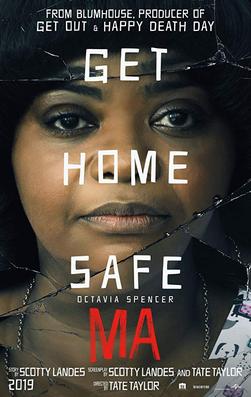
Playing Catch-Up With The Films of 2019: Ma (dir by Tate Taylor)


Oh, Ma!  I had such high hopes for you!

When I first saw the trailer, I assumed that Ma would be kind of a silly horror film where Octavia Spencer plays a woman who buys beer for a bunch of teenagers and then develops an unhealthy obsession with them and then freaks out when all the teenagers are like, “We don’t want to spend all of our time hanging out with a 50 year-old.”  I thought it would be a nicely simple little film and I was looking forward to it because Octavia Spencer is a great actress who, far too often, gets typecast as everyone’s surrogate maternal figure.  I really wanted a chance to see her just go crazy on film.

And, make no mistake about it, Spencer does get to go crazy in Ma and that’s fun to watch but the film itself gets weighed down by a plot that’s a hundred times more complicated than it needs to be.  It turns out that Ma isn’t just someone who is a little bit too clingy for her own good.  No, instead, Ma has got an elaborate scheme going so that she can get revenge on the children of the people who humiliated her in high school and …. well, who cares?  I mean, this is a good example of a film that could have been a lot of fun except for the fact that someone decided to try to make a statement.

(Tate Taylor previously directed Spencer in The Help and if you think that there’s little in The Help that would suggest that the future director of Ma had an affinity for or understanding of the horror genre, you’re right.)

Octavia Spencer is obviously having a lot of fun with the role of Ma but the film, for some reason, spends a lot of time following a host of other characters, none of whom are as interesting.  It all come down to yet another Saw-style torture chamber and that sort of thing really hasn’t been interesting for a while.  In the end, Ma is a missed opportunity.

Oh well.

Playing Catch-Up With The Films of 2019: Yesterday (dir by Danny Boyle)


It’s a bit of an odd film, Yesterday is.

Himesh Patel plays Jack Malik, a singer-songwriter who has struggled to find much success.  The only person who believes in him is his manager, a school teacher named Ellie Appleton (Lily James).  (Given the film’s subject matter, Ellie’s last name is a significant one.)  One night, the entire world is hit by a brief blackout.  Jack misses most of the excitement because he’s in a coma, having been hit by a bus.

When Jack wakes up from his coma, he’s shocked to discover that he’s lost several teeth and now looks kind of silly whenever he speaks, sings, or even smiles.  However, he also eventually discovers that he is now apparently the only person in the world who remembers The Beatles!

Somehow (it’s never explained how), that global blackout changed history.  It’s not that the Beatles ceased to exist as individuals.  In one of the film’s more affecting scenes, Jack drives out to the country and meets John Lennon (Robert Carlyle), who never became a superstar and who, as a result, was never assassinated.  However, in this new world, the Beatles never came together as a group and, as a result, some of the most beloved songs in history were never written.  Only Jack knows the lyrics and music for Eleanor Rigby, Yesterday, The Long and Riding Road, Let It Be, Back in the USSR, and …. well, everything!

(Oddly enough, the Beatles no longer existing has also led to several other things no longer existing.  It’s impossible not to laugh when Jack discovers that, without the Beatles, there was never an Oasis.  At the same time, there’s also no Coke or Harry Potter books.  I guess the Beatles weren’t around to inspire J.K. Rowling but why Coke would vanish is a bit more confusing.  Since Coke predates the Beatles by a century, perhaps the the film is less about how strange the world is without Sgt. Pepper’s Lonely Hearts Club Band and instead about how we owe everything good in the world to John Pemberton.)

Needless to say, this leads to Jack becoming a huge star.  He’s soon touring with Ed Sheeran and recording his debut album.  And yet, through it all, Jack is haunted by the fact that the music isn’t truly his.  Will Jack continue to plagiarize his way to stardom?  And will Jack and Ellie ever realize that they’re in love and totally meant to be together?  Watch to find out, I suppose!

As I said at the start of this review, Yesterday is a bit of an odd film.  Directed by Danny Boyle and written by Richard Curtis, it’s a meeting of two talents that you wouldn’t necessarily expect to compliment each other.  Surprisingly enough, though, the mix of Curtis’s sentimentality and Boyle’s more subversive instincts works well.  This is to especially be found in the scene where Jack meets John Lennon.  On paper, the scene shouldn’t work but it does work because Boyle is enough of a contrarian to direct his actors to play the scene with a wistful sadness.  The script may have intended the scene to prove that Lennon would have found happiness no matter what but Boyle directs it as if to say, “It probably would have been better for John if the Beatles has never existed….”  Stylistically, Boyle is too much of a cheerful anarchist to fully embrace Curtis’s romcom-style love of the Beatles.  At the same time, Curtis’s more earnest dialogue often undercuts Boyle’s more excessive instincts.  The end result is a sweet-natured movie with an edge.

Making his feature film debut, Himsh Patel is likable as Jack, even if he doesn’t quite have rock star charisma.  (Then again, that’s also a part of the film’s humor.  On his own, Jack is destined to forever be the opening act, the acceptable performer who is forgotten as soon as the headliners show up.  It’s only after the Beatles are wiped from everyone’s memory that Jack is able to become a star.)  Lily James does her best with an underwritten role and Ed Sheeran plays a hilariously vapid version of himself.

Yesterday is a good-natured tribute to the power of music and one band in particular.

Catching Up With The Films of 2019: Late Night (dir by Nisha Ganatra)


Molly Patel (Mindy Kaling) has just gotten a new job.  A struggling comedienne who, up until now, has been forced to test out her best material on her coworkers at a chemical plant, Molly is hired to join the writing staff of late night talk show host, Katherine Newbury (Emma Thompson).  Even though Molly knows that she was largely hired so that the show could claim to have a diverse writing staff (all of the other writers are white males), she is still thrilled to be working for Katherine.  Why wouldn’t she be?  Katherine is a notoriously difficult boss who can’t even be bothered to learn the names of most of the people working for her but Katherine is also a legend, one of the first women to ever host her own late night talk show.

Of course, all legends have to come to an end and Katherine’s career as a late night talk show host appears to be in its final days.  Katherine’s rating have been in a steep decline for several years and her nonthreatening monologues and habit of booking guests like Doris Kearns Goodwin are not doing much to reverse the trend.  Safely hidden away in her mansion and continually worried about the health of her Parkinson’s-stricken husband, Walter (John Lithgrow), Katherine has grown out of touch.  Making matters even worse, the president of the network (played by Mindy Kaling’s Office co-star, Amy Ryan) hates Katherine and is eager to replace her with an obnoxious, Dane Cook-style comedian named Daniel Tennant (Ike Barinholtz).

Molly’s new job is a struggle at first.  The other writers dismiss Molly as merely being a “diversity hire” while Katherine often seems to be put off by Molly’s cheerful earnestness.  Over time, Molly proves herself and soon, she’s inspiring Katherine to refuse to leave her show without a fight.  Gone are bland monologues and boring presidential historians, replaced by politically charged humor and YouTube stars.

Late Night, as you may remember, was a huge hit at Sundance back in January.  Amazon Studios paid 13 million for the distribution rights.  The film was released in June to generally positive reviews and …. well, it made very little money.  Despite an extensive advertising campaign and a deluge of think pieces that literally begged audiences to see the film, Late Night flopped at the box office and it is estimated that, taking into account the film’s ad campaign, Amazon lost about 40 million dollars on the film.

Why wasn’t Late Night a bigger success at the box office?  At the time, the popular answer was misogyny.  While one should never discount that, I think that the film’s failure had more to do with the fact that the ad campaign made Late Night look more like the latest Netflix series than an actual cinematic experience.  Like a lot of movies about TV, Late Night was a film that seemed like it could wait for television.  I mean, I am the film’s target audience and even I waited to watch the film on Prime.

As for the film itself, it’s flawed but likable.  Along with co-starring in the film, Mindy Kaling wrote the script and the dialogue is consistently witty, even if the plot occasionally struggles to keep up.  At its best, this is a fun movie to listen to.  Visually, the film’s a bit flat and there’s a big third act development that feels a bit forced but, for the most part, the film works.  Not surprisingly, Emma Thompson is perfectly cast as Katherine and she delivers her razor sharp lines with the right mix of scorn and pathos.  Mindy Kaling effortlessly holds her own opposite Thompson and even John Lithgow, who can usually be counted upon to chew every piece of scenery available to him, is effective in his small but important role.  In the end, it’s kind of a sweet film and there’s something touchingly naive about the film’s steadfast belief that a late night talk show can actually be worth all the trouble.

Late Night is available on Prime so check it out.