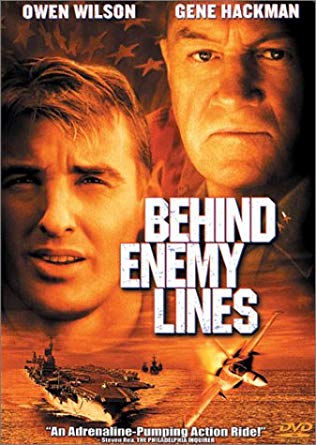
Behind Enemy Lines (2001, directed by John Moore)


When hotshot Navy flight officer Chis Burnett (Owen Wilson) is shot down while doing a reconnaissance mission over Bosnia, he finds himself stranded behind enemy lines.  While Burnett tries to avoid being captured by a Serbian general and find evidence of illegal military operations in yje demilitarized zone, Admiral Leslie Reigart (Gene Hackman) tries to mount a rescue operation.  Standing in his way are the NATO bureaucrats who would rather just leave Burnett to his fate than run the risk of disrupting the peace process.

Behind Enemy Lines was released early in Owen Wilson’s acting career and, after years of watching him in buddy comedies and eccentric character roles, it can be strange to see him playing a traditional leading man, much less an action hero.  Burnett has his goofball moment but, for the most part, this is probably as dramatic a role as you’re ever going to see Owen Wilson perform.  Once you get over the fact that he’s Owen Wilson and still speaking in the same stoner cadences that he’s used in everything from Bottle Rocket to Inherent Vice, Wilson actually gives a decent performance as Burnett.  The fact that he’s not a traditional leading man actually makes the film’s action scenes more exciting.  If Burnett had been played by someone like Brad Pitt or Tom Cruise, you would never have any doubt about his survival.  With Owen Wilson in the role, you’re no longer quite as sure that he’s going to be able to make his way to safety.

Gene Hackman also gave a good performance, even if he didn’t really do anything with the role that he hadn’t already done with all of the other authority figures that he played from Unforgiven on.  Hackman’s intimidating as Reigart.  When Burnett says that he wants to retire from the Air Force, Reigart looks like he’s about to reach over and rip off his face.  But Hackman has so much natural authority that you understand why his men automatically respect Reigart and follow his every order.  Burnett is lucky to have him on his side because there’s no way Reigart’s going to let someone from NATO push him around.

When Behind Enemy Lines first came out, it was not loved by the critics.  They complained that the movie was heavy-handed and predictable.  They were right but it really didn’t matter.  Behind Enemy Lines made a lot of money because it was a legitimate crowd pleaser.  I remember seeing it when it first came out.  This was less than month after 9-11 and the theater was packed with people who, like me, were still dealing with the greatest national trauma of our lifetime.  When Owen Wilson killed the men who were trying to kill him, the audience cheered.  When Reigart said that there was no way he going to abandon an American behind enemy lines, the audience applauded.  By the time the film ended, everyone was on their feet and chanting “USA!  USA!”  (At least, that’s the way I remembered it.)  Critics be damned, at that time, Behind Enemy Lines was the movie that we needed.

Behind Enemy Lines was a huge box office success so, of course, it got a sequel that wasn’t as good.  I’ll review Behind Enemy Lines: Axis of Evil tomorrow.

Lisa Reviews An Oscar Nominee: The Snake Pit (dir by Anatole Litvak)


The 1948 film, The Snake Pit, tells the story of a writer named Virginia Cunningham.

Virginia (Olivia de Havilland) is a patient at the Juniper Hill State Hospital, a psychiatric hospital that only treats female patients.  Some days, Virginia knows where she is and some days, she doesn’t.  Some days, she knows who she is and other days, she doesn’t.  Sometimes, she hears voices and other times, the silence in her head is her only companion.  Sometimes, she’s paranoid and other times, she’s quite lucid.

Virginia has been admitted against her will.  Her husband, Robert (Mark Stevens), visits frequently and sometimes, she knows him and sometimes, she doesn’t.  Through flashbacks, we see how Virginia and Robert first met.  Robert worked at a publishing house.  Virginia was a writer whose work kept getting rejected.  Robert and Virginia fell almost immediately in love but Virginia always refused to consider marrying him.  In fact, she even disappeared at one point, because things were getting too serious.  However, one day, Virginia suddenly declared that she wanted to get married.  Afterwards, her behavior became more and more erratic.

In the hospital, Virginia is treated by Dr. Kik (Leo Genn), who is depicted as being a compassionate and progressive psychiatrist, even as he puts Virginia through electroshock treatment.  (Remember, this film was made in 1948.)  With Dr. Kik’s guidance, Virginia starts to piece her life together and get to the cause of nervous breakdown.  Unfortunately, it often seems like every step forward leads to two steps back and Virginia still reacts to every bit of pressure by acting out, even biting one unhelpful doctor.

The hospital is divided into levels.  With each bit of progress that a patient makes, she’s allowed to move to a new level that allows her just a bit more freedom.  Everyone’s goal is to make it to the final level, Level One.  Unfortunately, Level One is run by Nurse Davis (Helen Craig), a tyrant who is in love with Dr. Kik and jealous of the amount of time he spends on Virginia.  Davis starts to goad Helen, trying to get her to lose control.  And what happens if you lose control?  You end up in the Snake Pit, the dreaded Level 33.  Being sent to Level 33 means being abandoned in a padded cell, surrounded by patients who have been deemed untreatable.

At the time that it was released, The Snake Pit was a groundbreaking film, the first major American studio production to deal seriously and sympathetically with mental illness.  Seen today, it’s still effective but you can’t help but cringe at some of the techniques that are used in Virginia’s treatment.  (Electroshock treatment, for instance, is portrayed as being frightening but ultimately necessary.)  The film works best as a showcase for Olivia de Havilland, who gives an absolutely brilliant and empathetic performance as Virginia.  Neither the film not de Havilland shies away from the reality of Virginia’s condition nor does it make the mistake of sentimentalizing her story.  For me, de Havilland’s best moment comes when she learns that she bit another doctor.  At first, she’s horrified but then she starts to laugh because the doctor in question was such a pompous ass that he undoubtedly deserved it.  de Havilland handles the character’s frequent transitions from lucidity to confusion with great skill, without indulging in the temptation to go over-the-top.  Arguably, The Snake Pit features de Havilland’s best lead performance.

(Olivia de Havilland is, at 103 years old, still with us and living, reportedly quite happily, in France.)

Olivia de Havilland was nominated for Best Actress but she lost to Jane Wyman in Johnny Belinda.  (A year later, De Havilland’s won an Oscar for The Heiress.)  The Snake Pit was also nominated for Best Picture but ultimately lost to Laurence Olivier’s adaptation of Hamlet.

Cinemax Friday: Dead By Dawn (1998, directed by James Salisbury)


Tim Marsh (Bill Ferrell) makes a lot of money and is married to the sexy and beautiful Wendy (Shannon Tweed) but he still thinks of himself as being a loser.  He’d much rather have the life of his old high school buddy, Don White (Ted Prior).  Don is a former baseball player who is opening his own car dealership and is married to a much younger woman named Kim (Jodie Fisher).

One day, Don lets Tim drive his BMW, which Don brags was a gift from Ed McMahon.  Tim loves the car and, while driving it, feels more alive than he has in years.  Don then offers to allow Tim to sleep with his wife.  Tim says that there’s no way that he would ever cheat on Wendy but Don insists.  Eventually, after a party to celebrate Don’s new business, Tim takes Don up on his offer.  The next morning, after Tim has returned home to Wendy, someone murders Kim in her sleep.

Guess who the police suspect?

Dead By Dawn is typical of the low-budget, erotic thrillers that used to dominate late night Cinemax.  Most of these films had plots that could best be described as neo-noir and Dead By Dawn is no different.  Not much happens in Dead By Dawn.  Since there are only four main characters and one of them dies about an hour into the movie, it’s pretty easy to figure out who is double crossing who.  The main problem with the film is that it asks us to believe that Tim would cheat on Shannon Tweed instead of getting down on his knees every day and thanking God that a loser like him managed to marry … well, Shannon Tweed.

Not surprisingly, Shannon Tweed gives the film’s best performance.  Because of her background as a Playboy playmate and her relationships with Hugh Hefner and Gene Simmons, it’s often overlooked that Shannon Tweed was a fairly good actress who had the ability to be both sexy and believable.  She had a down-to-Earth quality to her that was lacking in most of the other direct-to-video vixens of the 90s.  She was the sex symbol who you could imagine running into at the grocery store.

When compared to some of the other films that we all remember from late night Cinemax, Dead By Dawn is fairly tame but aficionados of Shannon Tweed’s film career should enjoy it.

Lisa Reviews An Oscar Nominee: Raging Bull (dir by Martin Scorsese)


This is not my favorite Martin Scorsese film.

I feel like I have to make that clear from the start because, for many people, this is their favorite Scorsese film.  Though it may have gotten mixed reviews when it was first released, it is now regularly described as being the high point of Scorsese’s fabled collaboration with Robert De Niro.  This was also the first film that Scorsese made with not only Joe Pesci but at also Frank Vincent as well.  (In fact, the whole scene in Goodfellas where Pesci and De Niro nearly stomp Vincent to death is a bit of an homage to a scene in Raging Bull.  Of course, Vincent got his revenge on Pesci in Casino.)  This film earned Martin Scorsese his first Oscar nomination for best director and it’s regularly cited as being one of the greatest film ever made.

Even more importantly, 1980’s Raging Bull has been described — by none other than the director himself — as the film that saved Martin Scorsese’s life.  Like a lot of his contemporaries, Scorsese got hooked on cocaine during the 70s.  He even nearly died of an overdose.  De Niro, who has been on Scorsese to direct Raging Bull for years, visited him in the hospital, brought him the script, told him to clean up his act, and make the film.  When Scorsese started to work on the film, he assumed it would be his last.  Whether Scorsese thought he would be dead or if he just thought he’d retire, I’m not sure.  Still, if Raging Bull had not rejuvenated Scorsese’s love of cinema, he wouldn’t have subsequently directed some of the greatest films ever made.  So, regardless of anything else, we have to be thankful that De Niro kept pushing Scorsese to direct Raging Bull.

The film itself is a biopic of Jake LaMotta (Robert De Niro), a brutal boxer who destroys opponents in the ring while destroying everyone who loves him outside of the ring.  He’s the type of guy who takes joy in destroying one opponent’s face just because his wife, Vicki (Cathy Moriarty), said that the guy was handsome.  When he’s forced to take a dive in order to win a title shot, he sobs in the locker room and it’s as close to being sympathetic as Jake gets.  The rest of the movie, he spends his time terrorizing his wife and taking out his frustrations on his loyal brother, Joey (Joe Pesci).

Most boxing films tend to present boxers as being lovable lugs, guys who might not be too smart but who have found the one thing that they’re good at.  (Think of the pre-Creed Rocky films.)  In Raging Bull, there’s nothing lovable about Jake.  He’s an animal, an angry man who fights because that’ the only way that he knows how to relate to the world.  He’s the type of guy who spends all of his time looking for an excuse to get mad and throw a punch.  The most dangerous thing you can do is make a joke in the presence of Jake LaMotta because, as portrayed in this film, he’s such an idiot that his reaction will always be to see it as a provocation.  From beginning to end, he’s a loathsome figure but the young De Niro was such a charismatic actor that you keep watching because — much like Vicki — you keep hoping that you’ll see some glimmer of humanity and some chance of redemption.

Reportedly, Scorsese and De Niro feel that the end of Raging Bull does provide Jake with some redemption.  Having lost everyone that ever loved him, an overweight Jake runs a sleazy nightclub and makes a fool of himself reciting dramatic monologues.  The production actually shut down so that De Niro could overeat and gain all the extra weight and it is shocking to see him go from being a handsome, athletic man to a fat slob whose shirt can’t even cover his belly.  No longer a boxer, Jake is now a faded D-list celebrity.  Now that he can’t fight and he can’t make money for the mob and the gamblers, no one cares about him.  That’s unfortunate for Jake but I have to say that I’ve never seen much redemption in Jake’s fate.  If anything, I was just happy that Vicki finally got away from him.

Raging Bull is a film that’s easier to admire than to actually like.  It’s impossible not to appreciate the black-and-white cinematography or the performances of De Niro, Pesci, and Cathy Moriarty.  As directed by Scorsese, the boxing scenes are horrifying brutal, to the extent that you find yourself wondering how anyone could enjoy the sport.  (When a spray of Jake’s blood hits the people in the first row, you can’t help but think that they’re all getting what they deserved.)  That said, the film’s never been a favorite of mine because, as well done as it is, Jake LaMotta never seems like he’s worth spending two hours with.

Obviously, a lot of people disagree with me on that.  Raging Bull received 8 Oscar nominations.  Robert De Niro won Best Actor.  Raging Bull, itself, lost Best Picture to Robert Redford’s Ordinary People.

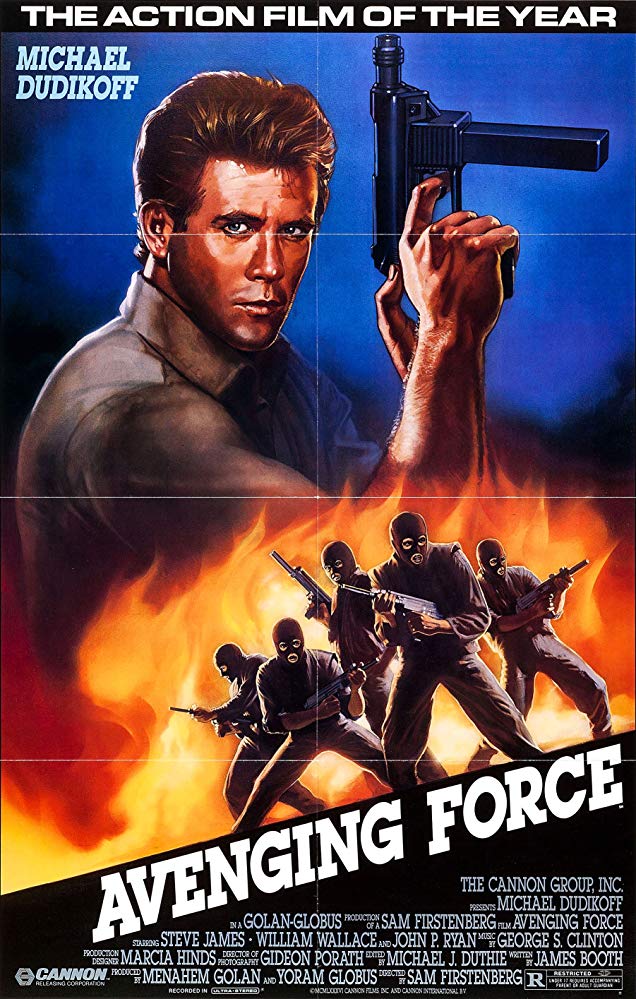
Avenging Force (1986, directed by Sam Firstenberg)


If you think this year’s elections are messed up, just watch Avenging Force and see what happens when two martial artists run against each other for a seat in the U.S. Senate.

Steve James plays Larry Richards, a former military commando who is now running for the Senate in Louisiana.  His opponent is Wade Delaney (Bill Wallace), who is described as being “the South’s youngest senator” and who is also secretly one of the world’s greatest martial artists.  Wade is a member of Pentangle, a Neo-Nazi cult that is made up of wealthy businessmen and other politicians.  When Larry and his family are invited to ride a float in the most sedate Mardi Gras parade of all time, the Pentangle attempts to assassinate him.  While Larry escapes injury, his oldest son does not.

Larry’s best friend, Col. Matt Hunter (Michael Dudikoff), is also in town and Hunter just happens to be another one of the world’s greatest martial artists.  (This film leave you wondering if there’s anyone in Louisiana who isn’t secretly a ninja.)  Matt tries to protect Larry and the remaining members of his family from Pentangle.  Matt fails miserably.  With Larry and the entire Richards family now dead, Matt goes deep into the Louisiana bayou, seeking both to rescue his sister (who has been kidnapped and is set to be sold at some sort of Cajun-run sex auction) and avenge Larry’s death.

As you probably already guessed, Avenging Force is a Cannon Film and it’s crazy even by that company’s fabled standards.  It’s not often that you come across a movie about a U.S. Senator who is also a neo-Nazi ninja who spends his spare time stalking people through the bayous.  What makes this plot point even more memorable is that no one in Avenging Force seems to be shocked by it.  Matt isn’t surprised in the least when an elected official suddenly lunges out of the fog and attempts to drown him in swamp water.  Of course, Senator Delaney isn’t the only villain in the film.  In fact, he’s not even the main bad guy.  That honor goes to Prof. Elliott Glastenbury (John P. Ryan), who lives in a huge mansion and who sees himself as a real-life version of The Most Dangerous Game‘s General Zaroff.  He not only wants to secretly rule the world but he also wants to hunt human prey in the bayou.  When Matt shows up at Glastenbury’s mansion, he is greeted by a butler who complains that Matt hasn’t bothered to wipe the blood off his shirt before showing up.

Avenging Force was originally planned as a sequel to Invasion U.S.A., with Chuck Norris reprising the role of Matt Hunter.  When Norris declined to appear in the film, the connection to Invasion U.S.A. was dropped and Michael Dudikoff of the American Ninja films was cast in the lead role.  (Of course, they didn’t bother to change anyone’s name in the script so the hero of Avenging Force is still named Matt Hunter, even if he’s not meant to be the same Matt Hunter from Invasion U.S.A.)  What Dudikoff lacked in screen presence, he made up for in athleticism and Avenging Force features some Cannon’s best fight scenes.  The plot may be full of holes but the idea of ninjas in the bayou is so inherently cool that it carries the film over any rough patches.

The critics may not have loved Avenging Force when it was first released but it holds up well as a fast-paced and weird action film.  It is perhaps the best Cajun ninja film ever made.

Lisa Reviews An Oscar Nominee: In Which We Serve (dir by Noel Coward and David Lean)


“This is the story of a ship….”

The 1942 British war film, In Which We Serve, opens with footage of the HMS Torrin, a destroyer, being constructed in a British shipyard.  When the Torrin is finally finished, the men who worked on it cheer as it leaves on its maiden voyage.  The film then abruptly jumps forward to the year 1941.  The Torrin is sinking, the victim of German bombers.  The surviving members of her crew float in the ocean, holding onto debris and watching as their home for the past few years capsizes and slowly goes underneath the surface of the water.  Even as the Torrin sinks, German planes continue to fly overhead, firing on the stranded men and killing several of them.

As the men fight to survive both the ocean and the Germans, they remember their time on the Torrin.  Captain Kinross (Noel Coward, who also wrote the script and co-directed the film) thinks back to 1939, when he was first given command of the Torrin.  He remembers the early days of the war and the time that he spent with his wife (Celia Johnson) before leaving to do his duty.  As the captain of the ship, Kinross was a tough but compassionate leader.  He expected a lot out of the men but he also came to view them as his second family.  Meanwhile, Shorty Blake (John Mills) thinks about his wife and his newborn son back in London.  Everyone on the Torrin has left their families behind.  Some of them even lose their loved ones during the war, victims of the relentless German Blitz.  But, even as they float in the ocean, everyone continues to fight on, knowing that there will be bigger ships to replace the Torrin and that Britain will never surrender.

In 1942, British film producer Anthony Havelock-Allan approached Noel Coward and asked him if he would be interested in writing the screenplay for a morale-boosting propaganda film.  Coward agreed, on the condition that he be given complete control of the project and that the film deal with the Royal Navy.  Though one might not immediately think that the author of drawing room comedies like Easy Virtue and Private Lives would be the obvious choice to write a war film, Coward’s family actually had a long tradition of serving in the Navy and Coward based a good deal of the film’s action on the wartime exploits of his friend, Lord Mountbatten.  Though there was initially some concern about Coward’s insistence that he should play the lead role on top of everything else, the Ministry of Information fully supported the production of In Which We Serve.

However, Corward knew that he would need help directing the film.  He asked his friend, John Mills, for advice and Mills suggested that Coward should bring in, as co-director, “the best editor in Britain,” David Lean.  Though Lean was initially only meant to handle the action scenes, Coward quickly discovered that he didn’t particularly enjoy all of the detail that went into directing a film.  As a result, David Lean ended up directing the majority of the film.  This would be Lean’s first film as a director and he would, of course, go one to become one the top British directors of all time.

(Also of note, frequent Lean collaborator Ronald Neame served as the film’s cinematographer.  Neame later went on to have his own career as a director.  In 1972, Neame directed another film about a capsized ship, The Poseidon Adventure.)

As for the film itself, In Which We Serve is an unapologetic propaganda film, carefully crafted to inspire the British people to support the war effort and also to win over the sympathy of American viewers.  (During the film’s production, America had finally entered the war but there were still skeptics, at home and abroad.)  Along with being a war film, In Which We Serve is also a rather touching and heartfelt tribute to the strength and determination of the British people.  Though it’s a rather grim film at times and it doesn’t shy away from the fact that lives are going to be lost in the battle to defeat Hitler, it’s also a rather inspiring film.  The sacrifice will be great, In Which We Serve tells us, but it will also be worth it.  The entire ensemble — including future director Richard Attenborough, making his film debut as a frightened sailor — does an excellent job of creating memorable characters, some of whom only appear for a few fleeting moments before meeting their fate.

In Which We Serve was a box office hit in both the UK and the US.  It was Oscar-nominated for Best Picture of the year, though it ultimately lost to another film about World War II, Casablanca.

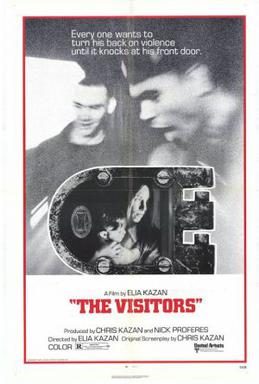
The Visitors (1972, directed by Elia Kazan)


Haunted by his experiences in Vietnam, Bill Schmidt (James Woods) lives in an isolated farmhouse with his girlfriend, Martha (Patricia Joyce), their young son, and Martha’s tyrannical father, Harry Wayne (Patrick McVey).  Harry is a hard-drinking writer who is proud of his previous military experiences and who is frustrated by Bill’s reluctance to talk about his time in Vietnam.  Harry views Bill as being a wimp who lost a war that America should have won.

One wintry night, two visitors show up at the house.  Mike (Steve Railsback) and Tony (Chico Martinez) served in Bill’s platoon.  The three of them were once friends but then something happened in Vietnam that changed all that, something that Bill refuses to talk about.  Harry is happy to welcome Mike and Tony into the household and he enjoys hearing their war stories.  While the hapless Bill watches, Mike flirts with Martha.  However, as the night continues, it becomes obvious that Mike and Tony aren’t paying an innocent visit on a friend.  Instead, they’re looking for revenge.  Bill testified against Mike at a court-martial and, in the process, ruined both of their lives.

The idea of “bringing the war home” was a popular one in the late 60s and the early 70s.  Radical groups like the Weathermen justified their terroristic actions by saying that they were forcing complacent Americans to face what every day was like in Vietnam.  Books like David Morrell’s First Blood featured psychologically damaged vets waging war on an America that they felt had abandoned them while the new wave of counterculture filmmakers made films that were groundbreaking in their portrayal of death and violence.  The Visitors, which features one traumatized vet being victimized by two other angry vets, was one of those films that was meant to bring the war home.

Directed by Elia Kazan and written by Kazan’s son, Chris, The Visitors is a simple film that sometimes seems more like a stage play than a movie.  The script is talky and heavy-handed, the characters are thinly drawn, and the film’s portrayal of Martha comes close to being misogynistic.  Chris Kazan’s script is openly critical of the United States’s role in the Vietnam War but Elia Kazan is more concerned with presenting Bill as a martyr.  Elia was a former communist who infamously named names during the McCarthy era and, from On the Waterfront on, every film that he made was more or less an attempt to justify his actions.  Like Waterfront‘s Terry Malloy. Bill loses everything because he testifies.  Unlike Malloy, no one comes to Bill’s aid afterwards, which suggests Kazan’s bitterness only grew over the years following his testimony.

The Visitors is a lesser film in Kazan’s filmography but notably, it was the first film for both James Woods and Steve Railsback.  Railsback plays Mike as a charismatic brute, giving a performance that owes more than a little to Marlon Brando’s performance as Stanley Kowalski in Kazan’s A Streetcar Named Desire.  James Woods brings his nervous intensity to the role of Bill, making him a far more intelligent but no less victimized version of Brando’s Terry Malloy.  Though The Visitors was Kazan’s second-to-last film, both Woods and Railsback would go on to emerge as two of the most interesting character actors in Hollywood.

Lisa Reviews An Oscar Winner: Green Book (dir by Peter Farrelly)


Set in 1962, the 2018 film Green Book tells the story of two men.

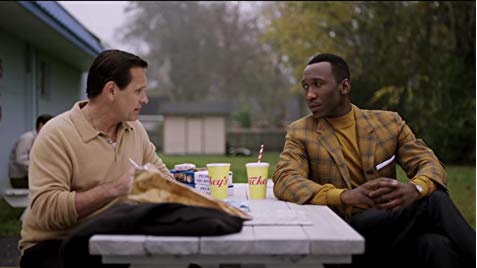
Dr. Don Shirley (Mahershala Ali) is a world-acclaimed pianist who lives a regal life.  How regal is Dr. Shirley’s life?  He’s got a throne in his living room!  Being both black and gay, Shirley knows that he’s destined to always be on the outside of American society but he refuses to allow anyone to take away his dignity or devalue his intelligence.  Shirley is scheduled to do a concert tour in the Midwest and the Deep South and his record company knows that he’s going to need protection during his trip.  For that matter, he’s also going to need a driver.

Tony Lip (Viggo Mortensen) is actually named Frank Vallelgona but everyone calls him Tony Lip because he can talk his way out of almost any situation.  He’s a casually prejudiced Italian who lives in the Bronx.  He’s a professional bouncer and he can drive a car too!  He’s in desperate need of money and he doesn’t want to have to go to work for the Mafia.  When Shirley’s record company contacts him about spending two months as Shirley’s driver and bodyguard, it could be the solution to all of his financial problems.

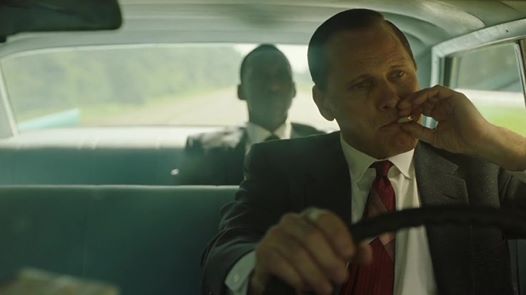
Soon, Tony is driving Shirley through the South.  Tony smokes in the car and Shirley snaps at him.  Shirley doesn’t appreciate fried chicken so Tony convinces him to try it.  Tony punches a cop and ends up in jail so Shirley calls his friend Bobby Kennedy.  Eventually, Tony and Shirley even become friends and together….

THEY SOLVE CRIMES!

No, not really.  Instead, Tony encourages Shirley to loosen up and enjoy life a little bit more.  Meanwhile, Shirley teaches Tony how to write a decent letter to his wife.  Tony introduces Shirley to rock and roll.  Shirley introduces Tony to high society.  At the end of the film, we’re told that, in real life, Shirley and Tony remained friends until the end of their days.

It’s a crowd-pleasing ending.  It’s also one that’s been described as being inaccurate.  While it is true that Tony Lip (who later had a career as a character actor in gangster films) did drive Don Shirley around the South during his 1962 concert tour, Shirley’s family maintained that Shirley never considered him to be a friend but instead just viewed him as being an employee.  At the time of the film’s initial release, it was also pointed out that, while the script was co-written by Tony Lip’s son, no one bothered to reach out to Don Shirley’s family during the production.

When Green Book was nominated for best picture, a lot of observers assumed that the controversy over its accuracy would keep the film from winning the top prize.  The fact that Peter Farrelly was not nominated for best director was also seen as an indicator that Green Book was not a serious contender.  Of course, to the shock (and, it must be said, anger) of many, Green Book did win the Oscar for Best Picture, defeating Roma, BlackKklansman, Black Panther, A Star is Born, The Favourite, Vice, and Bohemian Rhapsody.  During the days immediately after the Oscars, there was a definite feeling of embarrassment in the air.  No one, it seemed, could quite accept that — out of all the films released in 2018 — the Academy had declared Green Book to the best.

Why was Green Book such an unpopular winner?  Setting aside the controversy over the film’s historical accuracy (or lack thereof), Green Book is just a painfully conventional movie.  At a time when many directors were testing the limits of narrative and taking cinema in new and different directions, Green Book was a film that was almost defiantly old-fashioned and predictable.  At a time when filmmakers were being praised for their willingness to keep audiences off-balance, Peter Farrelly crafted about as blatant a crowd pleaser as had ever been released.  Not since Alan Arkin shouted, “Argo fuck yourself!,” had a film been so obvious about its desire to be loved.  Even the film’s best scenes have a generic quality to them.  You never find yourself thinking, “Only a cinematic visionary like Peter Farrelly could have made a film like Green Book!”

Beyond that, Green Book is another film that deals with the issue of race in America in the safest and most anodyne way possible.  Tony Lip starts out as prejudiced.  Then he spends two months driving around a black man and suddenly, he’s not prejudiced anymore.  This the type of approach that may drive intersectional film critics crazy on twitter but audiences tend to like it because it leaves them feeling good about the state of the world.  “Yes,” the film says, “things aren’t perfect but all we have to do is spend two months in a car together and everything will be okay.”

The first time I watched Green Book, I thought it was blandly pleasant, predictable and a bit forgettable.  I also thought it was well-acted.  Last night, I rewatched the film for this review and …. well, my feelings pretty much remain the same.  Sometimes, a conventional film will benefit from the intimacy of the small screen but that’s not the case with Green Book.  If anything, watching this film in my living room (as opposed to in a theater with a gigantic screen) made me realize that, when I first saw Green Book, I was perhaps a bit too kind in my evaluation of the film’s lead performances.  Viggo Mortensen and Mahershala Ali are good, charismatic actors and that natural charisma serves them well in Green Book.  But neither one of them really gives that interesting of a performance.  Despite their roles being based on real people, they’re both playing cliches and, as a result, you never really go emotionally involved with either one of them.

I can understand why Green Book won best picture.  It’s competently made, conventionally liberal, and full of good intentions.  Given that the Academy uses rank-choiced voting, it’s probable that Green Book won not because it was everyone’s favorite movie but because it was everyone’s 2nd or 3rd choice.  Hopefully, this year, the Academy will pick something a little bit more interesting for its top prize.


Cyborg (1989, directed by Albert Pyun)


The time is the future and the world has seen better days.  As a result of solar flares and war, Earth has been reduced to a barren wasteland where only the strong survive.  Making things even worse is that a plague has broken out and is threatening to wipe out what remains of the world’s population.

A cyborg named Pearl Prophet (Dayle Haddon) has been sent to New York to retrieve the information on how to cure the plague from a computer system.  Now that she has the information, it’s all a matter of safely returning to the Center for Disease Control in Atlanta, Georgia.  She’s being pursued by the evil Fender (Vincent Klyn), a pirate who says that he loves the new world and who wants to be the one to decide who does and who does not get the cure.  When a mercenary named Gibson (Jean-Claude Van Damme) offers to protect her on her journey back to Atlanta, Pearl declines.  She says that Gibson is not strong enough to defeat Fender and that she’ll take her chances with the pirates.  (Pragmatically, Pearl says that her allies in Atlanta can kill Fender themselves.)

However, Gibson is not willing to take no for an answer.  Gibson is less concerned with saving humanity and more concerned with avenging the death of his lover, who was murdered by Fender.  Working with Nady (Deborah Richter), another sole survivor of one of Fender’s massacres, Gibson sets out to track down and destroy the pirate.

When Cyborg started, I was really looking forward to watching Jean-Claude Van Damme play a cyborg but it turned out that Van Damme was playing a human.  I thought that Fender might be a cyborg but he’s also just a human.  There’s only one cyborg in this film and she’s often superfluous to the action.  I imagine that this movie was called Cyborg in order to capitalize on the popularity of movies like Terminator and Robocop but Cyborg actually has more in common with the Mad Max films.  Van Damme is a haunted loner, just like Max Rockatansky, while Fender and his crew feel as if they could have stepped out of the Road Warrior.  Even the lengthy scene where Gibson is crucified in the desert feels tailor-made for Mad Max and Mel Gibson’s habit of playing characters who undergo lengthy torture scenes.  (And is it coincidence that Mel Gibson and Jean-Claude Van Damme’s haunted hero both share the same last name?)

Jean-Claude Van Damme, with his pun-worthy name and his reputation for bad behavior off-screen, never got much respect but he was one of the best of the Arnold Schwarzenegger imitators of the 80s and 90s.  He was a genuine athlete and he was a far better actor than someone like Steven Seagal.  When Van Damme was under contract with Cannon Films, he was offered his choice of starring in three films: Delta Force 2, American Ninja 3, and Cyborg.  He chose Cyborg, playing a role that was originally envisioned for Chuck Norris.  As a film, Cyborg will never win any points for originality but the fight scenes are kinetic and exciting and, even more importantly, this is a movie that lets Van Damme be Van Damme.  There are no attempts at character development or any sort of self-aware winking at the audience.  Instead, Van Damme shows up and fights.  Matching Van Damme blow for blow is the imposing Vincent Klyn, whose opening monologue (“I like the death! I like the misery! I like this world!”) is a classic of its own.

Cyborg would be followed by two sequels, which were largely unrelated to the first film.  Jean-Claude Van Damme would not return for either of them.

Lisa Reviews An Oscar Nominee: All That Jazz (dir by Bob Fosse)


“Bye bye life….

Bye bye happiness….

Hello loneliness….

I think I’m going to die….”

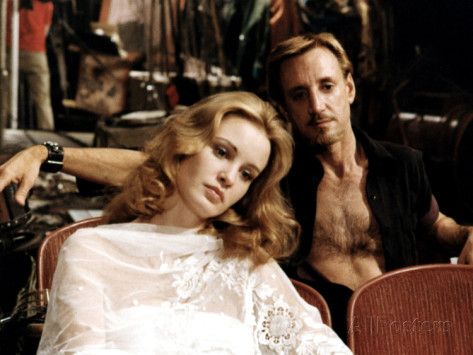
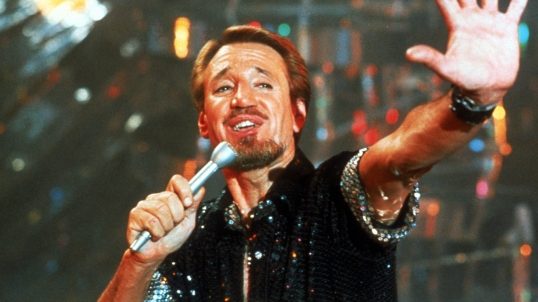
So sings Joe Gideon (Roy Scheider) at the end of the 1979 film, All That Jazz.  And he’s right!  It’s hardly a spoiler to tell you that All That Jazz ends with Joe Gideon in a body bag.  It’s not just that Gideon spends a good deal of the film flirting with the Angel of the Death (Jessica Lange).  It’s also that, by the time the film ends, we’ve spent a little over two hours watching Joe engage in non-stop self-destruction.  Joe is a director and a choreographer who is so in love with both death and show business that his greatest triumph comes from choreographing his own death.

Joe wakes up every morning, pops a handful of pills, stares at himself in the mirror and says, “It’s showtime!”  He spends his day choreographing a Broadway play.  He spends his nights editing his latest film, a biopic about Lenny Bruce called The Stand-Up.  He’s particularly obsessed with a long monologue that Lenny (played by Cliff Gorman) delivers about the inevitability of death.  When he’s not choreographing or editing, he’s smoking, drinking, and cheating on his girlfriend (Ann Reinking).  It’s obvious that he’s still in love with his ex-wife (Leland Palmer) and that she loves him too but she’s also too smart to allow herself to get fully sucked back into his self-destructive orbit.  He loves his daughter (Erzsébet Földi) and yet still ignores her when she begs him not to die.

Joe and the Angel of Death

When Joe has a heart attack and ends up in the hospital, he doesn’t change his behavior.  Instead, he and the Angel of Death take a look back at his youth, which was spent hanging out in strip clubs and desperately trying to become a star.  Joe Gideon, we see, has always know that he’s going to die early so he’s pushed himself to accomplish everything that he can in what little time he has.

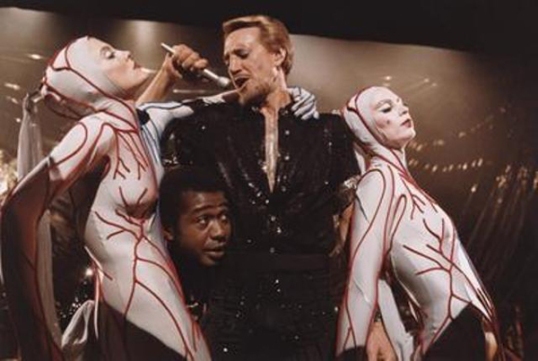
As a result of his drive and his refusal to love anyone but himself, Gideon is widely recognized as being an artistic genius.  However, as O’Connor Flood (Ben Vereen, essentially playing Sammy Davis, Jr.) puts it, “This cat allowed himself to be adored, but not loved. And his success in show business was matched by failure in his personal relationship bag, now – that’s where he really bombed. And he came to believe that show business, work, love, his whole life, even himself and all that jazz, was bullshit. He became numero uno game player – uh, to the point where he didn’t know where the games ended, and the reality began. Like, for this cat, the only reality – is death, man. Ladies and gentlemen, let me lay on you a so-so entertainer, not much of a humanitarian, and this cat was never nobody’s friend. In his final appearance on the great stage of life – uh, you can applaud if you want to – Mr. Joe Gideon!”

Now, of course, Connor doesn’t really say all that.  Gideon just imagines Connor saying that before the two of them launch into the film’s final musical number, Bye Bye Life.  It should be a totally depressing moment but actually, it’s exhilarating to watch.  It’s totally over-the-top, self-indulgent, and equally parts sincere and cynical.  It’s a Bob Fosse production all the way and, as a result, All that Jazz is probably about as fun as a movie about the death of a pathological narcissist can be.  This is a film that will not only leave you thinking about mortality but it will also make you dance.

All That Jazz was Bob Fosse’s next-to-last film (he followed it up with the even darker Star 80) and it’s also his most openly autobiography.  Roy Scheider may be playing Joe Gideon but he’s made-up to look exactly like Bob Fosse.  Like Joe Gideon, Bob Fosse had a heart attack while trying to direct a Broadway show and a film at the same time.  Gideon’s girlfriend is played by Fosse’s real-life girlfriend.  The character of Gideon’s ex-wife is clearly meant to be a stand-in for Gwen Verdon, Fosse’s real-life ex-wife.  When the film’s venal Broadway producers make plans to replace the incapacitated Gideon, Fosse is obviously getting back at some of the producers that he had to deal with while putting together Chicago.  It’s a confessional film, one in which Fosse admits to his faults while also reminding you of his talent.  Thank God for that talent, too.  All that Jazz is self-indulgent but you simply can’t look away.

It helps that Gideon is played by Roy Scheider.  Originally, Scheider’s Jaws co-star Richard Dreyfuss was cast in the role but he left during rehearsals.  Dreyfuss, talented actor that he was, would have been all-wrong for the role of Gideon.  One can imagine a hyperactive Dreyfuss playing Gideon but one can’t imagine actually feeling much sympathy for him.  Scheider, on the other hand, brings a world-weary self-awareness to the role.  He plays Gideon as a man who loves his talent but who hates himself.  Scheider’s Joe Gideon is under no illusions about who he is or how people feel about him.  When Fosse’s own instincts threatens to make the film unbearably pretentious, Scheider’s down-to-Earth screen presence keeps things grounded.

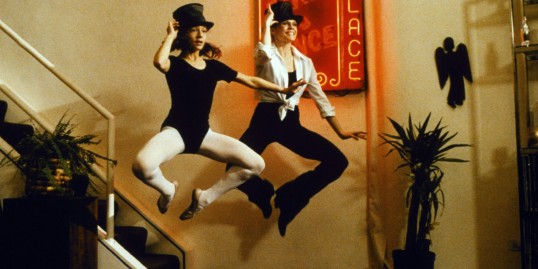
I love All That Jazz.  (Admittedly, a good deal of that love is probably connected to my own dance background.  I’ve known my share of aspiring Joe Gideons, even if none of them had his — or Bob Fosse’s — talent or drive.)  It’s not for everyone, of course.  Any musical that features actual footage of open heart surgery is going to have its detractors.  For the record, Stanley Kubrick called All That Jazz “the best film I think I’ve ever seen.”  It won the Palme d’Or at Cannes and it was nominated for Best Picture, though it ultimately lost to the far more conventional Kramer vs. Kramer.

All that Jazz would be the last of Fosse’s film to receive a best picture nomination.  (Fosse directed five features.  3 of them were nominated for Best Picture, with the other two being Cabaret and Lenny.)  8 years after filming his cinematic doppelganger dying during heart surgery, Fosse would die of a heart attack.  Gwen Verdon was at his side.