Late Night Retro Television Review: Hunter 2.9 “The Big Fall”


Welcome to Late Night Retro Television Reviews, a feature where we review some of our favorite and least favorite shows of the past!  On Thursdays, I will be reviewing Hunter, which aired on NBC from 1984 to 1991.  The entire show is currently streaming on Tubi and several other services!
This week, Hunter and McCall are assigned to keep an important witness from dying.  Of course, they fail.

Episode 2.9 “The Big Fall”

(Dir by James Whitmore, Jr, originally aired on November 23rd, 1985)

Hunter and McCall have been assigned to babysit Gustav Fabro (Vic Polizos), an obnoxious witness against a mobster. Working with them are Detectives Gary Krewson (Jonathan Banks, youngish and with hair) and Ray Longmire (Mills Watson). Guarding Fabro is no one’s first concern. Longmire is an alcoholic who desperately wants a drink. McCall is thinking about leaving the police force so that she can start a family. Hunter is realizing that he’s attracted to McCall. And Krewson is more concerned with throwing Fabro out of a window. When Longmire is out getting a drink and Hunter is busy talking to McCall in a separate hotel room, Krewson sends Fabro flying.

Because Hunter was the one who was supposed to be watching Fabro, he finds himself suspended. Captain Wyler assures Hunter that everyone knows Fabro committed suicide and that the suspension is only temporary. Hunter, however, thinks that Krewson murdered Fabro, and he’s right. And, it must be said, it really doesn’t take much effort to get Krewson to confess. He just has to hold Krewson out of a window. Krewson is so scared of being dropped that he confesses to not only killing Fabro but also killing Longmire. Personally, I think it would have been smarter for Krewson to just let Hunter drop him. Now he’s going to be an ex-cop on death row.

This episode felt pretty minor. The story was nothing special. It was really just a chance to do more will-they-won’t-they with McCall and Hunter, but if they had done anything, it would have thrown off the show’s tone. Fred Dryer and Stepfanie Kramer definitely have chemistry, but so far at least, it feels more like really good friend chemistry than anything else.

And there’s nothing wrong with that! Friends are important.
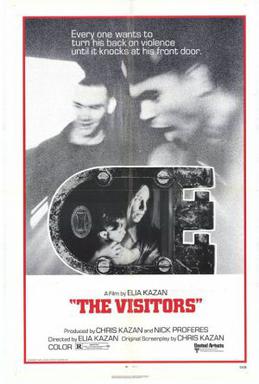
The Visitors (1972, directed by Elia Kazan)


Haunted by his experiences in Vietnam, Bill Schmidt (James Woods) lives in an isolated farmhouse with his girlfriend, Martha (Patricia Joyce), their young son, and Martha’s tyrannical father, Harry Wayne (Patrick McVey).  Harry is a hard-drinking writer who is proud of his previous military experiences and who is frustrated by Bill’s reluctance to talk about his time in Vietnam.  Harry views Bill as being a wimp who lost a war that America should have won.

One wintry night, two visitors show up at the house.  Mike (Steve Railsback) and Tony (Chico Martinez) served in Bill’s platoon.  The three of them were once friends but then something happened in Vietnam that changed all that, something that Bill refuses to talk about.  Harry is happy to welcome Mike and Tony into the household and he enjoys hearing their war stories.  While the hapless Bill watches, Mike flirts with Martha.  However, as the night continues, it becomes obvious that Mike and Tony aren’t paying an innocent visit on a friend.  Instead, they’re looking for revenge.  Bill testified against Mike at a court-martial and, in the process, ruined both of their lives.

The idea of “bringing the war home” was a popular one in the late 60s and the early 70s.  Radical groups like the Weathermen justified their terroristic actions by saying that they were forcing complacent Americans to face what every day was like in Vietnam.  Books like David Morrell’s First Blood featured psychologically damaged vets waging war on an America that they felt had abandoned them while the new wave of counterculture filmmakers made films that were groundbreaking in their portrayal of death and violence.  The Visitors, which features one traumatized vet being victimized by two other angry vets, was one of those films that was meant to bring the war home.

Directed by Elia Kazan and written by Kazan’s son, Chris, The Visitors is a simple film that sometimes seems more like a stage play than a movie.  The script is talky and heavy-handed, the characters are thinly drawn, and the film’s portrayal of Martha comes close to being misogynistic.  Chris Kazan’s script is openly critical of the United States’s role in the Vietnam War but Elia Kazan is more concerned with presenting Bill as a martyr.  Elia was a former communist who infamously named names during the McCarthy era and, from On the Waterfront on, every film that he made was more or less an attempt to justify his actions.  Like Waterfront‘s Terry Malloy. Bill loses everything because he testifies.  Unlike Malloy, no one comes to Bill’s aid afterwards, which suggests Kazan’s bitterness only grew over the years following his testimony.

The Visitors is a lesser film in Kazan’s filmography but notably, it was the first film for both James Woods and Steve Railsback.  Railsback plays Mike as a charismatic brute, giving a performance that owes more than a little to Marlon Brando’s performance as Stanley Kowalski in Kazan’s A Streetcar Named Desire.  James Woods brings his nervous intensity to the role of Bill, making him a far more intelligent but no less victimized version of Brando’s Terry Malloy.  Though The Visitors was Kazan’s second-to-last film, both Woods and Railsback would go on to emerge as two of the most interesting character actors in Hollywood.