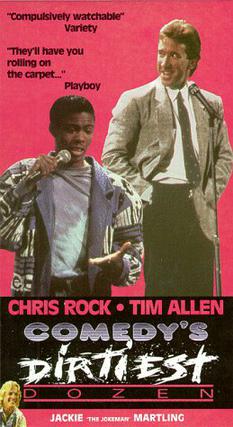
Comedy’s Dirtiest Dozen (1988, directed by Lenny Wong)


If you ever wanted to see Tim Allen snap, “Fuck you!” at a room full of yuppies, Comedy’s Dirtiest Dozen might be for you.

Comedy’s Dirtiest Dozen was a stand-up comedy concert film, featuring 12 comedians who all “worked blue.”  In the 80s, that meant a lot of cursing and a lot of jokes about oral sex and setting farts on fire.  Some of the jokes are funny but, as far as being dirty, not a single comic on the stage comes anywhere as close to being as filthy as Bob Saget was in The Aristocrats.  Today, Comedy’s Dirtiest Dozen is best-known for featuring early appearances from not only Tim Allen but also Chris Rock, Jackie Martling, and Bill Hicks.  The audience goes crazy when Hicks is introduced and Hicks does his trademark act, pacing the stage while smoking a cigarette and encouraging everyone to not shoot the John Lennons of the world but instead the assholes who sit at a stoplight with their right turn signal blinking.  At the time that this film was shot, Chris Rock was all of 21 but he already knew how to take over and control a stage.  Rock effortlessly goes from talking about little old white ladies dialing 9-1 whenever they see him on the street to the Jesse Jackson presidential campaign to the difficulty of living at home with a mother who regularly throws away his dirty magazines.

Some of the jokes are funnier than others.  When you’re watching 12 comedians making jokes from the vantage point of 32 years in the future, it is to be expected that the end results might seem uneven.  Since this was filmed in 1988, there’s a lot of dated jokes about cocaine, AIDS, the Olympics, and Ronald Reagan.  The jokes that seem to work the best are the ones about men being immature and women getting sick of them, which just proves that universal truths never go out of fashion.

It seems like whenever you watch a comedy concert film from the 80s, you have to ask yourself whether or not these comedians would be able to perform on a college campus today.  (Chris Rock, for instance, has said that he refuses to perform on campus because students are too sensitive.)  Bill Hicks would get kicked off stage for daring to light up a cigarette and Jackie Martling would probably cause a riot.  As for the rest of the performers, their acts in this film are frequently more profane than controversial.  For the most part, though, they’re still funny and that’s the important thing.

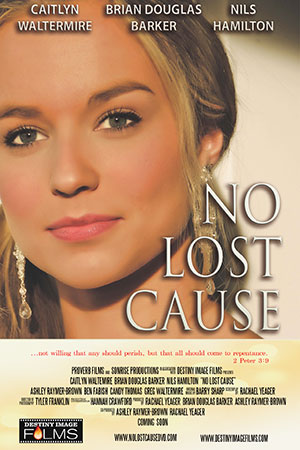
Love On The Shattered Lens: No Lost Cause (dir by Ashley Raymer-Brown and Rachael Yeager)


I’d like to start this review by quoting one of my favorite episode of King of the Hill.

Church Hopping, which aired during King of the Hill‘s 10th season, found Hank and his family searching for a new church after the reverend of their old church blows off Hank’s suggestion that seating should be assigned.  Peggy wants the family to start attending the new mega-church but Hank worries that it might be too big for him.  However, after the Hills have tried out every other church in town and found them to be not quite right for their needs, Peggy tells Hanks that they only have two options — go to the new megachurch or “live the empty barren existence of secular humanism.”  Hank finally agrees to give the megachurch a try.

At first, Hank loves the place.  He appreciates that the church broadcasts Cowboys games on Sunday.  He gets along with all of the members.  But, quickly, the church starts to dominate every aspect of his life.  As he feared, it is simply too big for him.  As he tells his nephew-in-law, Lucky, “My old church wouldn’t pay attention to me and my new church won’t leave me alone.”  When Hank announces that he will no longer be attending church and will instead look for some other way to worship, Peggy brings the church’s pastor to the house to counsel him.

After struggling for a bit to explain why he’s not comfortable at the megachurch, Hank finally exclaims, “No offense, but your church just keeps coming at you.”

Luckily, things work out in the end.  The Hills return to their old church and are spared from secular humanism.  It’s heart-warming in the way that the best episodes of King of Hill often were.  And that line about the church has always stuck with me.

I have to admit that, as I watched the 2011 film No Lost Cause, I found myself thinking about Hank’s lament.  No Lost Cause is about a young college student named Beth Ann Collins (Caitlyn Waltermire) who is paralyzed as the result of a car accident.  Making matters even worse for Beth Ann is that, after her accident, she finds herself living with her father, a farmer named Billy (Brian Douglas Baker).

Billy is an outspoken Christian.

Beth Ann is a bitter agnostic.  (This is one of those films where it’s pretty much taken for granted that all nonbelievers are bitter about something.)

Together …. THEY SOLVE CRIMES!

No, actually, they fight a lot.  Beth Ann does not want Billy in her life and she’s not amused when he keeps insisting that she comes to church with him.  Billy is not happy when Beth Ann announces that she just wants to stay in her bedroom and work on vaguely defined college work.  I know that the film expected us to automatically sympathize with Billy but I have to admit that I was on Beth Ann’s side the entire time.  It’s not just that Beth Ann had every right to be angry about her situation.  It’s also that Billy’s church just keeps coming at her.

Billy tells Beth Ann that they’re going to the church potluck.  While everyone else eats, Beth Ann sits in a corner and does some ill-defined term paper work.  Nick (Nils Hamilton) approaches her and asks why she’s at the potluck if she’s not going to eat.  And I’m just like, “BECAUSE HER DAD MADE HER COME!  Now leave her alone and let her write her paper!”

(I also have to admit that, by the end of the whole potluck scene, I was yelling at the characters in the film, “Say ‘potluck’ one more time!  GO ON, I DARE YOU!”  Seriously, potluck is just an annoying word.)

Later, at the house, Beth Ann is again trying to get work on her paper done when Billy shows up and announces that he’s invited the entire church over for dinner.  Suddenly, the house is full of people and while Beth Ann sits in a corner and tries to do her work, people keep sitting down at the table with her and talking to her.  Beth Ann has no desire to speak to anyone and actually does have some important work to do but that doesn’t matter to the members of Billy’s church.  They just keep coming at her.

“Seriously,” I found myself yelling at the screen, “leave Beth Ann alone!  She doesn’t want to talk to you!”

(I may have been projecting because it seems like whenever I’m in the middle of doing something important, I get interrupted.)

Anyway, the film gets off to a pretty rough start but it does get better.  Beth Ann does eventually grow comfortable about living with Billy and she even falls in love with Nick.  It’s predictable but occasionally sweet and Caitlyn Watermire gives a good and sympathetic performance as Beth Ann.  Unfortunately, the film also has Beth Ann suddenly regain the ability to walk, with the suggestion being that it’s all due to her newly found faith but that only forces the audience to wonder about all of the faithful who have a better attitude than Beth Ann but still don’t get healed.  It’s hard not to feel that the film would have been more effective if it had focused on Beth Ann coming to terms with being in the wheelchair as opposed to falling back on a miracle.

As a love story, No Lost Cause works a bit better than you might expect.  Caitlyn Watermire and Nils Hamilton have a likable chemistry and you do hope find yourself hoping the best for them, even if Nick does come across as a bit pushy about the whole potluck thing.  This is one of those film’s that will probably be best appreciated by people who already share the film’s view of the world but, as far as religious-themed films are concerned, No Lost Cause is better acted than most and it features some nice shots of the countryside.  That said, it’s still hard to watch the film without feeling that Beth Ann occasionally deserves some time to herself.
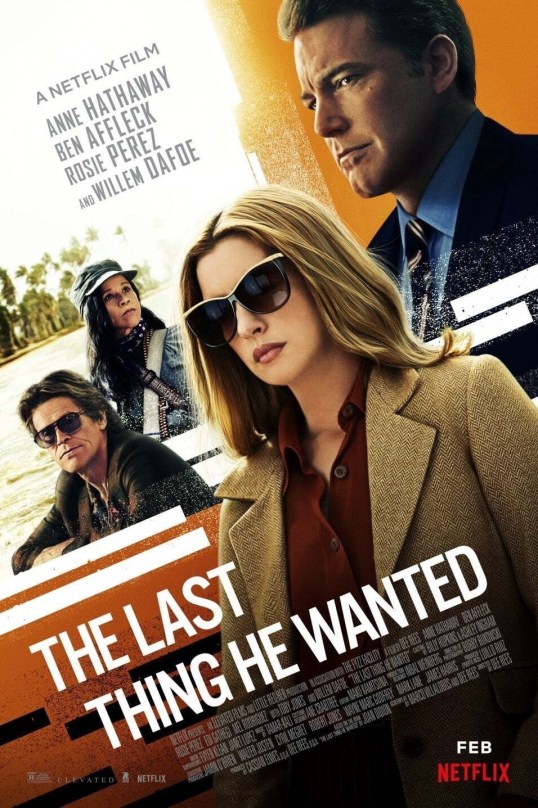
The Things You Find On Netflix: The Last Thing He Wanted (dir by Dee Rees)


As I watched The Last Thing He Wanted on Netflix, it occurred to me that smoking cigarettes and slamming down phones is no substitute for a personality.

The Last Thing He Wanted stars Anne Hathaway as Elena McMahon and, over the course of the movie, she smokes a lot of cigarettes and slams down a lot of phones.  That’s because Elena is supposed to be a veteran D.C. journalist.  She works for The Atlantic Post, which is an awkward name for a newspaper.  (In the novel on which this film was based, Elena worked for The Washington Post but I assume that plot point was changed to avoid upsetting Jeff Bezos.  That’s the sort of thing that gets this film off to a bad start.)  Hathaway is never exactly believable as a hard-boiled journalist who is known for uncovering government scandals and reporting from war zones.  She is, however, believable as a talented but miscast actress who watched a lot of old journalism movies before showing up on the set of The Last Thing He Wanted.  The end result is a performance that feels like cosplay.

Anyway, the film itself is a mess.  It takes place in 1984 and starts out with Elena getting yanked off of her usual Central America beat and assigned to instead cover the presidential campaign.  This leads to a lot of scenes of Elena lighting cigarettes and slamming down phones while talking about how difficult it is to be a journalist when you’re working for a spineless organization like the Atlantic Post.

Elena is estranged from her father, a dissolute drunk named Dick.  Dick is played by Willem DaFoe, who deals with the fact that he really doesn’t have much of a character to play by chewing up every piece of scenery that he can get his hands on.  (At times, it seems like Willem DaFoe has been replaced by someone doing a poorly conceived Willem DaFoe impersonation.)  Dick is suffering from dementia and he keeps forgetting that his wife is dead.  Dick needs Elena to do something for him.  It turns out that Dick has set up a “huge deal.”  Elena assumes that it must be a drug deal but it turns out that Dick is actually a small-time arms dealer.  So now, Elena is transporting weaponry through Central America and — surprise! — it all links back to the very story that her editors at the Atlantic Post didn’t want her to cover in the first place.

Soon, Elena is flying all over the place and meeting a rogue’s gallery of anti-communist rebels and arms dealers.  In a different film, they would all be fascinating characters but, in this one, it just comes across as being more cosplay.  Ben Affleck shows up a few times, playing some sort of Washington D.C. fixer and he’s absolutely the worst actor to cast in a film like this because the film’s vaguely-defined liberalism brings out his worst instincts as a performer.  The character’s written to be an enigmatic rogue but Affleck appears to be incapable of playing him as being anything other than just a one-note Republican.  (Whenever Affleck is cast in a role like this, you can see him thinking, “How would Matt Damon play this scene?”)  Toby Jones also makes an appearance and you’re excited to see him until you realize that he’s just going to be recycling his Truman Capote imitation from Infamous to no great effect.  There’s a lot of good performers in The Last Thing He Wanted but they’re left stranded by a script that doesn’t seem to know why any of them are there.  It all leads to an absolutely terrible ending, one that proves that combining voice over narration with slow motion is not always the brilliant narrative technique that some directors believe it to be.

The Last Thing He Wanted was directed and co-written by Dee Rees and it has all of the flaws but none of the strengths of Rees’s previous Netflix film, MudboundMudbound was frequently ponderous and predictable but it was redeemed by some beautiful images and some unexpectedly nuanced performances.  The Last Thing He Wanted is ponderous without being much else.

Mardi Gras Film Review: On Hostile Ground (dir by Mario Azzopardi)


Uh-oh!  New Orleans might be in trouble!

In the 2000 film, On Hostile Ground, John Corbett plays a geologist named Matt Andrews.  Matt has been asked to investigate why two giant sinkholes have suddenly opened in New Orleans.  The mayor’s press secretary, George Regan (Peter Stebbins), hopes that Matt will just do a perfunctory investigation and then declare the sinkholes to be no big deal.  After all, it’s nearly time for Mardi Gras and it would be an economic disaster to cancel this year’s celebration.  One can only assume that, like most movie bureaucrats, Regan has never seen Jaws and therefore doesn’t understand the folly of saying, “We can’t close the city during tourist season!”

However, Matt’s a geologist and he holds himself up to a higher standard.  He doesn’t care about whether or not people get to celebrate Mardi Gras or not.  In fact, just listening to him talk and watching him work, you get the feeling that Matt was probably the guy who, during previous Mardi Gras celebrations, would say, “You guys go without me.  I’ve got to get some work done.”  Anyway, Matt does some investigating and discovers that New Orleans is basically about to collapse into the Earth.  It could happen tomorrow or it could happen 3,000 years from now but it will happen.  Matt also points out that, even if the entire city manages to not sink into the Earth, the sinkholes could cause the levees to collapse and then the entire city would be flooded.  (This movie was made before Katrina.)

Regan hears Matt out and then decides to hide all of his evidence and let Mardi Gras go on as planned.

Can you guess what happens?

There’s a few things that I immediately noticed about On Hostile Ground.

First off, my family lived in Louisiana for about a year and a half.  I’ve been to New Orleans during Mardi Gras.  I can usually tell when a film has actually been shot in Louisiana as opposed to some place nearby like, say, Georgia.  Watching On Hostile Ground, I noticed that it appeared that at least a few of the Mardi Gras scenes had actually been filmed in New Orleans.  There wasn’t quite as much Mardi Gras footage as I was expecting but what there was appeared to be authentic.  However, whenever the action moved outside of the French Quarter, I couldn’t help but notice that the surroundings looked very Canadian and that very few of the extras sounded like they had ever spent any time anywhere near the Big Easy.  In short, it quickly became obvious that the majority of this made-for-television film was shot in Montreal and Toronto.  Canada really can’t pass for Louisiana, much as how they could have never shot an episode of Degrassi in New Orleans.

The other thing I noticed is that, despite New Orleans being below sea level, Matt and his fellow geologists had no trouble finding dry underground caverns underneath the city.  It reminded me a bit of that old X-Files movie where the kids find an underground cavern right outside of Dallas.  Some things just aren’t going to happen, okay?

Anyway, this is one of those low-budget disaster films where everyone refuses to listen to the scientist and disaster follows.  This is the type of film that, nowadays, would probably be made by the Asylum for the SyFy Network.  That said, the Asylum version would probably be a lot more fun because there would be probably be like a sea serpent or killer Mardi Gras floats or something.  This one is just kind of dull and spends too much time on build-up without enough pay-off.

On Hostile Ground is not really worth sacrificing any beads for.


Love On The Shattered Lens: Xanadu (dir by Robert Greenwald)


“What the Hell did I just watch?” I asked myself as the end credits rolled for the 1980 film, Xanadu.

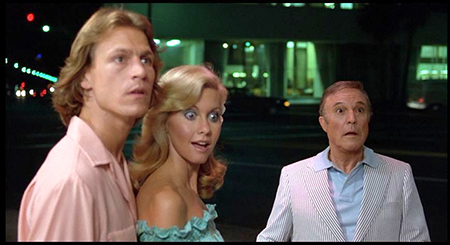
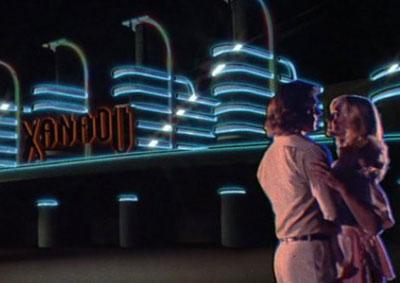
Xanadu is one of those films where words just fail you.  It’s a musical and it stars Olivia Newton-John, who has a good voice even if she’s also kind of a bland screen presence.  The music is really good.  I love the main song and it’s definitely one that has gotten stuck in my head every time that I’ve heard it.  Of course, for the longest time, I thought Olivia was singing, “One-a-due.”  (Seriously, I’m the worst when it comes to mishearing lyrics.)  But no, I later discover that she was singing about Xanadu and who would have guessed that Xanadu would turn out to be a roller disco?

Yes, it’s a very strange movie.

Xanadu starts out with a mural of nine women coming to life.  The 9 women are the Muses.  You may remember them from Greek mythology.  They exist to inspire artists who inevitably end up falling in love with him without realizing that a muse is not allowed to love back.  This leads to a lot of great art but also to a lot of broken hearts.  Olivia Newton-John plays a muse named Terpsichore but she prefers to be known as Kira because …. well, wouldn’t you?  For centuries, Kira has inspired great works of art.  She’s worked with Michelangelo and probably a few poets as well.  As someone who majored in Art History, I’m thankful for Kira because, without her, my degree would be totally useless as opposed to just slightly.  In the year 1980, Kira has again entered the mortal world so that she can inspire …. a roller disco.

Yeah, okay.

Listen, I could probably go on for about a thousand words about how disappointed I would be to go from inspiring the Mona Lisa to inspiring a tacky roller disco in Malibu.  But it doesn’t seem to bother Kira so good for her!  Of course, Kira is a bit distracted because she’s broken the number one rule of being a muse.  She’s fallen in love with an artist!

Sonny Malone (Michael Beck) is a painter whose job involves painting larger versions of album covers so that they can be displayed in the windows of record stores.  Sonny dreams of being an independent artist but instead, he’s stuck recreating the works of others.  He feels like his life and his work are going nowhere.  However, once he sees a picture of Kira, he is immediately inspired.  And then, when Kira skates up behind him and kisses him, he’s in love!

Yay!

The only problem, of course, is that Sonny is a human being and Kira is a mythological creature.  If Sonny was destined to fall in love with a creature from Greek mythology, I guess he should be happy that it was one of the muses and not Medusa.  But anyway, Kira says that she’s not allowed to be with Sonny so Sonny tries to talk Zeus and Hera into changing the rules.  Whether or not he succeeds is kind of left up in the air.  I think a bigger problem would be the fact that Kira is immortal whereas Sonny comes across like he’ll probably end up snorting too much cocaine before the 80s are over.  But that’s never really brought up in the film.

Around the same time that Sonny meets Kira, he also meets Danny (Gene Kelly!), who is a former big time band leader who now spends his time hanging out on the beach and dreaming about opening up a roller disco.  It turns out that, when Danny was a young man, he was also inspired by Kira.  Danny and Sonny join forces and soon, Xanadu is a reality!  Danny fantasizes about a 1940s style nightclub.  Sonny fantasizes about a generic “rock club.”  They may have two different visions but fortunately, they both agree one one thing: everyone has to wear roller skates.

Xanadu is one of those films where not much really happens but it’s still incredibly busy.  Danny keeps on dancing.  Sonny keeps on painting and bitching about how his life isn’t going anywhere.  Kira keeps on roller skating through everyone’s life.  As I said, the music’s great but the storyline …. well, to be honest, I thought the film’s story was fun as an example of something that could only have seemed logical in the late 70s.  I mean, it’s an incredibly stupid film but Gene Kelly’s in it and, even at the age of 68, he was still such a dedicated old trouper that you can’t help but smile whenever he breaks out a few moves.  Add to that, Michael Beck and Olivia Newton-John do make for a cute couple, even if both of them were reportedly miserable during filming.  They just look like they belong together, in a California beach community sort of way.

Xanadu’s a big mess of a movie but it’ll make you dance and it’ll make you sing.  All together now: One-a-due, One-a-due something want to do….*

Cinemax Friday: Killing Streets (1991, directed by Stephen Cornwell)


Most of the time, late night Cinemax was dominated by noirish films starring Shannon Tweed but, occasionally, the network did slip in a low-budget action flick.  Killing Streets is a typical example of one of those films.

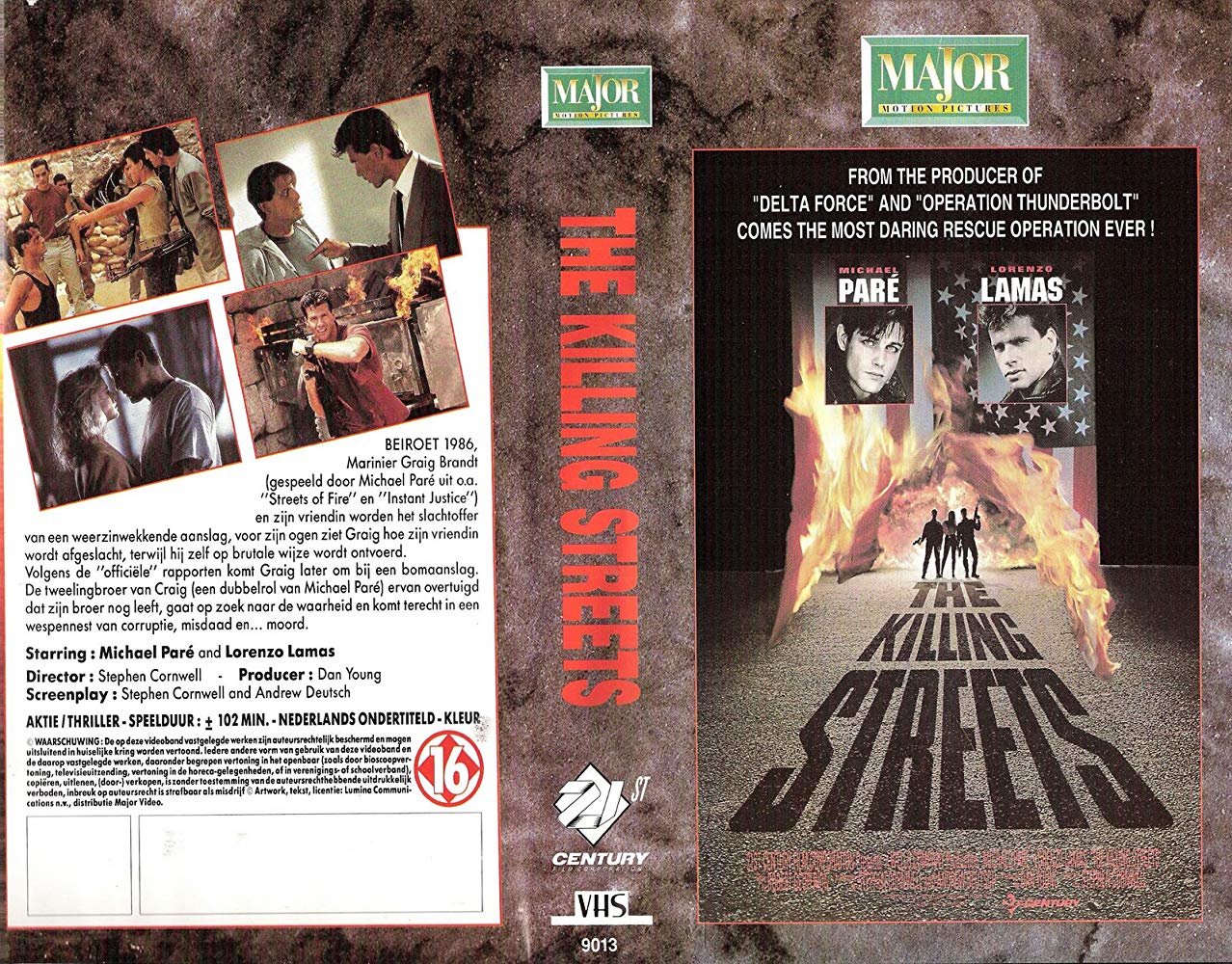
A Marine named Craig Brandt (Michael Pare) has disappeared in Beirut so his twin brother Chris (also played by Michael Pare) flies all the way over from Dayton, Ohio to search for him.  Even though everyone says that Craig’s dead, Chris knows that it isn’t true because, as a twin, he and Craig have a psychic connection.  It turns out, of course, that Chris is right.  Craig is being held prisoner by terrorist leader Abdel (Alon Aboutboul).  Chris is determined to rescue Craig, even though Charles (Lorenzo Lamas), an official at the American embassy, orders him to leave the country.  Chris may just be a high school basketball coach but that doesn’t stop him from going all Jack Bauer on every terrorist that he meets.  With the help of diplomat Sandra Ross (Jennifer Runyon) and Gilad (Gabi Amrani), the Middle East’s most helpful taxi driver, Chris sets out to rescue his brother.

When I started watching Killing Streets, I was excited because, according to the opening credits, it starred Lorenzo Lamas and it was produced by Menahem Golan.  Unfortunately, for the most of the movie, Lamas doesn’t get to do much other than bark out orders in one of the least convincing Southern accents that I’ve ever heard.  Instead, the first part of the movie is all about Michael Pare.  Michael Pare usually isn’t capable of showing enough emotion to be convincing as one character.  Now, imagine him playing two characters.  While one Michael Pare is walking around Beirut and searching for clues, the other Michael Pare is sitting in a cell and getting beaten and, since they both always have the same blank expression on their face, the only way you can tell which Michael Pare is which is by paying attention to who has more blood on them.  The whole time, you just want Lorenzo Lamas to show up and start showing off his Renegade skills but instead, he’s stuck telling one of the Michael Pares that he better get on the next plane back home.

Luckily, towards the end of the movie, the two Michael Pares team up with Lorenzo Lamas and they spend about ten minutes shooting guns and blowing stuff up and doing all of the other things that we want to see happen in a film like this.  It just takes a while to get there and while Menahem Golan may have produced this film, he didn’t direct it so, even though the ending is exciting, most people will probably lose interest before they get there.  As far as action films about rescuing hostages in the Middle East are concerned, this is no Delta Force.

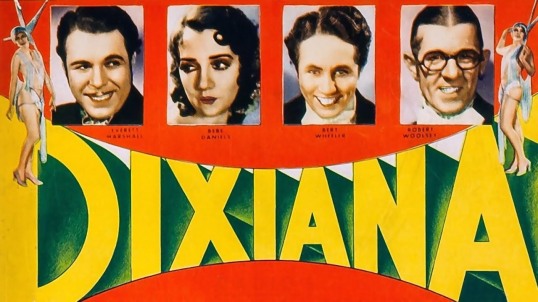
Mardi Gras Film Review: Dixiana (dir by Luther Reed)


Mardi Gras in New Orleans has always been a legendary party.

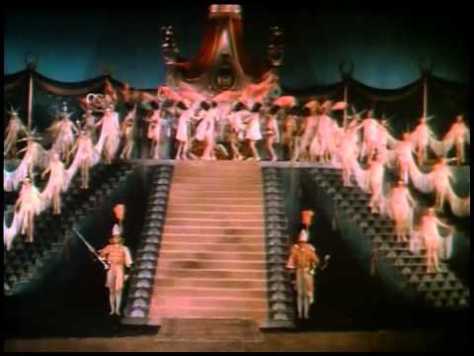
If you doubt me on this, just watch the 1930 film, Dixiana.  Dixiana is all about Mardi Gras.  I mean, there is a plot of sorts but it’s pretty easy to guess that, for audiences in 1930, the promise of a spectacular Madi Gras finale (filmed in technicolor, I might add) was the main appeal of this film.  Dixiana itself takes place in the 1840s so there you have it.  90 years ago, RKO Pictures made a lavish movie about a Mardi Gras celebration that had happened nearly 100 years earlier.  That’s quite a legendary party, no?

As with many pre-Code films about the Antebellum South, it can be a bit awkward to watch Dixiana today.  This is a film that opens on a plantation, with Cornelius Van Horn (Joseph Cawthorn) and his son, Carl (Everett Marshall), discussing how much they enjoy listening to the slaves sing about the Mississippi River.  They’re amazed that the slaves can sing so beautifully about water.  (It doesn’t occur to them that the song was actually about going up the river and finding freedom.)  Cornelius and Carl, we discover, are actually from Pennsylvania.  Cornelius has recently remarried, to the snobbish Birdie (Jobnya Howland) and both he and his son have only recently moved down to her native Louisiana.  Carl and Cornelius are still getting used to life in and the customs of the South.  Cornelius, for instance, explains that he regularly frees some of his slaves and he imagines that’s why they’re always so happy.  But if he really wants them all to be happy why doesn’t he just free them all and maybe stop buying slaves all together?  Let’s just say that Dixiana is not the film to watch if you’re looking for an honest look at American life before the Civil War.

Anyway, if you’re still interested in seeing the film after reading all of that, the majority of Dixiana takes place in New Orleans.  Carl goes into town, does some gambling, and sees a show.  He is immediately smitten with a performer named Dixiana (Bebe Daniels) and he asks her to marry him.  Even though her two best friends, Peewee and Ginger (played by the comedy team of Wheeler and Woolsey), are weary, Dixiana accepts his proposal.  Carl takes Dixiana back to the plantation with him.  Unfortunately, he also takes Peewee and Ginger and they soon let slip that they’re all circus performers.  Birdie is scandalized.  There’s no way her stepson is going to bring shame on the family by marrying a circus performer!

So, Dixiana and her friends head back to New Orleans.  The circus no longer wants her so Dixiana is forced to work in a gambling hall that’s owned by smarmy Royal Montague (Ralf Harolde).  Montague has his own personal interest in Dixiana but she’s still in love with Carl.  So, Royal plots to not only have Dixiana crowned as the Queen of Mardi Gras but also to trick Carl into accept a duel with him.  Montague, of course, plans to pull an Aaron Burr and cheat.  Meanwhile, Peewee and Ginger steal money, kick each other in the backside, and fight a duel of their own….

And really, none of that matters.  In the end, the film’s storyline is mostly just busywork.  The main reason that anyone would want to see this film is for the final 20 minutes, which is when the grainy black-and-white cinematography is replaced by gloriously vibrant technicolor and the Mardi Gras celebrations begin.  There’s singing.  There’s dancing.  There’s even Bill “Bojangles” Robinson, making his film debut and dancing up a storm.  Seriously, 1840s Mardi Gras looked like it would have been fun to attend, even if it does sometimes seem more like a lively cotillion as opposed to the orgy of alcohol poisoning that everyone knows and loves today.

Dixiana is one of those films that’s fallen into the public domain and, as such, it tends to turn up in a lot of cheap DVD boxsets.  There’s quite a few prints out that are completely in black-and-white and which don’t feature the sudden change to color.  That’s a shame because, whatever flaws this film may have, it does make good use of that technicolor during the final 20 minutes.  It’s big and lavish and gorgeous to look at and it’s easy to imagine the valuable escape that it provided for audiences at the start of the Depression.

Today, Dixiana is probably most interesting as a historical document.  It’s not quite as racy as one might expect from a pre-code film but it’s a good example of the type of lavish musicals that were popular among audiences who, in the 30s, used the film as a way to escape from the grimness of reality.  And, if nothing else, it’s proof that Mardi Gras in New Orleans has always been a big deal.

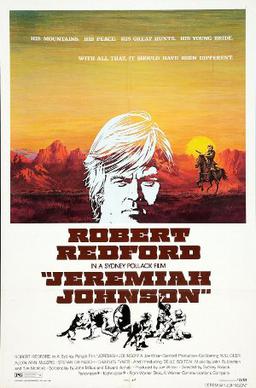
Jeremiah Johnson (1972, directed by Sydney Pollack)


In the 1840s, Jeremiah Johnson (Robert Redford) is a veteran of the Mexican War who wants to get away from civilization.  He sets up an isolated life for himself in the Rocky Mountains and looks to support himself by working as a trapper.  At first, he struggles but eventually he gets some much-needed help from a veteran trapped named Chris Lapp (Will Geer).  Along the way, Johnson discovers that life in the mountains can be harsh and violent.  He adopts a mute boy named Caleb, whose family has been killed by Blackfoot warriors.  Later, the chief of the local Flathead tribe “gives” Jeremiah his daughter.  Despite the language barrier between him and his new wife, Jeremiah is soon the head of a happy family.

One day, when the U.S. Calvary shows up and requests that Jeremiah guide them through the mountains so that they can rescue some starving missionaries, Jeremiah reluctantly leaves behind his family and helps them.  However, Lt. Mulvey (Jack Colvin) insists that Jeremiah lead them through a sacred Crow burial ground.  The Crow retaliate by killing Jeremiah’s family.  Driven mad by grief, Jeremiah sets out to kill every Crow that he can find.

Jeremiah Johnson is really two movies in one.  The story starts out with Jeremiah as a proto-hippie who wants to get away from the hypocrisy and violence of modern society.  Jeremiah takes care of the land, makes friends with other outcasts, and makes a good life for himself.  After Jeremiah’s family is killed, the movie turns into a Death Wish-style revenge thriller, with Jeremiah losing himself in his rage and killing almost everyone that he sees.  Redford is surprisingly convincing as the insane, murderous Jeremiah and the sudden outbursts of violence provide a strong contrast to the relatively peaceful first half of the film.

Jeremiah is a like a lot of the early American settlers.  He wants to get away from the world and start an entirely new life for himself.  He’s seen what the civilization has to offer and he would rather just build a cabin in the mountains and pretend that the rest of the world doesn’t exist.  If Jeremiah had been born earlier, he probably could have pulled it off.  But, by the time Jeremiah tries to go off the grid, it’s already too late.  Society is growing too fast for him to escape from it.  Jeremiah discovers that it’s impossible to truly cut yourself off from humanity. In the end, he’s much like the Crow Indians that he’s declared war upon.  His way of life is ending, whether he’s ready for it or not.  When he and the Crow chief greet each other with a raised open hand (meaning that they come in peace), they are both acknowledging that they are bonded as men whose time is coming to an end.

Jeremiah Johnson was the second of Robert Redford’s many collaborations with director Sydney Pollack and it’s one of their best.  This may be an epic film but it never loses its humanity and, for once, Redford plays someone who isn’t a cut-and-dried hero.  Jeremiah Johnson has recently been rediscovered because of a popular meme of a bearded Redford looking at the camera and nodding but people should know that it’s also a damn fine film on its own.


Love on the Shattered Lens: Coffy (dir by Jack Hill)


It may seem odd to describe Coffy as being a love story.

After all, this is a film that is perhaps best known for a scene in which Pam Grier (as Nurse Coffin, a.k.a. Coffy) shoots her lying boyfriend in the balls.  Coffy is often described as being the epitome of 70s grindhouse, a film in which Pam Grier takes on drug dealers, the Mafia, and a corrupt political establishment with a combination of shotguns and shanks.  Coffy is perhaps Grier’s best-known films and it features one of her best performances.  There’s nothing more empowering than watching Pam Grier take down some of the most corrupt, arrogant, and disgusting men to ever appear in a movie.  It’s a violent and gritty film, one that opens with a drug dealer’s head literally exploding and never letting up afterwards.  There are many different ways to describe Coffy but it’s rarely called a love story.

But here’s the thing.  A film about love doesn’t necessarily have to center around romantic love.  Coffy is about love but it’s not about any love that Coffy may have for her boyfriend, the duplicitous politician Howard Brunswick (Booker Bradshaw).  Instead, the love at the center of this film is the love that Coffy has for her sister, who died from a heroin overdose.  It’s her sister’s death that leads to Coffy first seeking revenge but that’s not the only love that motivates Coffy.  There’s also the love that Coffy feels for her community.  Throughout the film, we hear about how the black community is being destroyed by the drugs that are being pushed into their neighborhoods by white mafia dons like Arturo Vitronia (Allan Arbus, who was once married to the iconic photographer, Diane Arbus).  It’s not a random thing that, for all of Coffy’s anger, she saves her most savage revenge for the members of her community who are working with the white mobsters, men like the pimp, King George (Robert DoQui), and her own boyfriend, Howard.

Throughout the film, Coffy says that she feels like she’s “in a dream” and Pam Grier gives an intelligent performance that suggests that, even after her mission is complete, Coffy will never be the same.  She’s not a natural killer.  She’s a nurse and it’s her job to save lives.  But when she sets out to get revenge on those who killed her sister and who are destroying her community, Coffy shows no mercy.  When she violently interrogates another victim of the drug trade, Coffy shows the junkie no sympathy because sympathy isn’t going to solve the problem.  Coffy is determined and the reason why she succeeds is because none of her victims realize just how serious she is.  Coffy uses her beauty to distract them and then, when they aren’t looking, she strikes.  By the end of the film, she’s walking alone on the beach and the viewer is left to wonder what’s going on inside of her head.  After all the people that Coffy has killed, can she ever go back to simply working the night shift at the ER?  After you’ve seen life and death at its most extreme, can things ever go back to the way that they once were?

And listen, I’m generally a pacifist and I’m not a huge fan of real-life vigilante justice and I’ve signed many petitions against the death penalty but it’s impossible not to cheer for Coffy.  Pam Grier gives such a committed performance that it’s impossible not to get sucked into her mission.  (It helps, of course, that most of the people who she targets are legitimately terrible human beings.)  The brilliance of Grier’s performance comes in the quiet moments.  Yes, she’s convincing when she has to shoot a gun and she delivers vengeful one-liners with the best of them.  But the film’s best moments are the ones were Grier thinks about how her life has become a dream of violent retribution and where she allows us to see the love for her sister and her community, the same love that is motivating all of the bloodshed.

Coffy is a rightfully celebrated film.  For once, a cult film actually deserves its cult.  It’s one of the best of the old grindhouse films and, in fact, to call it merely an exploitation film actually does a disservice to how effective a film Coffy actually is.  It’s just a great film period.

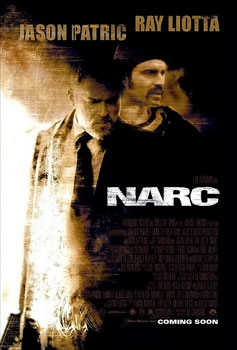
Narc (2002, directed by Joe Carnahan)


Nick Tellis (Jason Patric) is an undercover narcotics agent who has spent the last year under investigation for a shooting that went wrong.  Nick was firing his gun at a fleeing drug dealer but he hit a pregnant woman instead.  After 18 months of being caught in administrative limbo, Nick is made an offer.  It’s thought that, with his knowledge of Detroit’s crime and drug scene, that he might be uniquely suited to investigate the murder of another undercover agent, Michael Calvess.  Nick agrees but, in return, he wants a desk job.  He’s got a wife and a baby and he’s tired of putting his life on the line for nothing.  Nick also wants to work with Detective Henry Oak (Ray Liotta).  Oak was one of the original investigators of Calvess’s murder.  Nick is warned that Oak has a reputation for being unstable and out-of-control.  Nick isn’t fazed because he has the same reputation.

Oak turns out to be more than just out of control.  He is the epitome of a bad cop, beating suspects and thinking nothing of threatening to kill a man unless he confesses.  However, Oak gets results.  Oak suggests that you can’t fight crime in Detroit if you play by the rules and Narc is the type of grim and gritty film that doesn’t give you any reason to think that Oak is incorrect.  Oak and Nick investigate Calvess’s death and both of them discover that the department would rather just sweep the case under the rug than actually discover what really happened.  The department just wants someone that they can pin the crime on, not the truth.  Even after the case is officially declared as being closed, Nick and Oak continue their investigation.  Nick, however, starts to suspect that Oak knows more about Calvess’s death than he’s willing to admit.

Narc opens with an amazingly shot chase scene that will leave you breathless and then it just keeps going without once letting up on the intensity.  Narc is a grim and violent film about two damaged men trying to solve a case that no one else cares about.  Jason Patric has never been better than he was in Narc and, while Ray Liotta has played his share of unstable cops, he takes things to whole other level with Narc.  Director Joe Carnahan does such a good job of capturing the decay and desperation of life in Detroit that, even while you’re worried that both Nick and Oak are going to end up going too far in their pursuit of what they consider to be justice, you still can’t help but feel that they’ve both got a point.  Who plays by the rules when the world’s on fire?