18 Days of Paranoia #18: Nineteen Eighty-Four (dir by Rudolph Cartier)


Well, here we are at the end of both March and the 18 days of paranoia.  We started things off with a review of The Flight That Disappeared and now, we end things with a look at the 1954 BBC production of Nineteen Eighty-Four.
“Orewllian” is a term that gets tossed around a lot nowadays, largely by people who the real George Orwell probably would have viewed rather dismissively.  Ever since the election of Donald Trump, for instance, it’s become rather common for certain people of twitter to say that “Orwell was right” or that we’re living in an “Orwellian nightmare.”  I remember after Trump’s press secretary blatantly lied about the size of the crowd at the inauguration, there was even a commercial that featured Zachary Quinto giving a hilariously overwrought reading of the final passage of George Orwell’s 1984.  “He …. LOVED …. BIG …. BROTHER!” Quinto declared while staring grimly at the camera.

Interestingly enough, many of the same people who complain about Trump’s lies being Orwellian never used the term during the previous 8 years, when we were being constantly told that a permanent recession was actually a sign of a strong economy and that if people liked their doctor, they could keep them.  The fact of the matter is that, for a lot of people, “Orwellian” is just a term that they use whenever a politician from the other side does something that they dislike.  It makes you wonder how many of them have actually read 1984 because, if they had, they would surely know that — if we truly were living in the world depicted in Orwell’s novel — no one would be allowed to acknowledge it and, in fact, Orwell and his books would have vanished down the memory hole.  Just the act of saying that we’re living in 1984 without getting sent to a reeducation camp is proof that we’re not (or, at least, we’re not just yet).

That’s not to say that 1984 isn’t an important work of literature.  In fact, it’s probably one of the most important books ever written, which is why it does it such a disservice to glibly toss around the term Orwellian.  Even if we aren’t living in Orwell’s world right now, it’s probably easier than ever to imagine a scenario where we eventually could.  The Coronavirus pandemic, for example, is just the sort of thing that could lead to the people accepting the idea that the government is meant to be a Big Brother and that those who disagree deserve to be reported for the good of the people.  It’s easy to imagine a future where people believe that history started with the Coranavirus and that everything that happened before the pandemic was just a hazy rumor, like Europe before the Renaissance.  As such, even if the term Orwellian is overused, 1984 is still a book that needs to be read and understood.

There have been several film adaptations of 1984, some of which are better than others.  My personal favorite is the 1985 film, which was directed by Michael Radford and which starred John Hurt and Richard Burton.  Running a close second, however, would be the version that was made for the BBC in 1954.

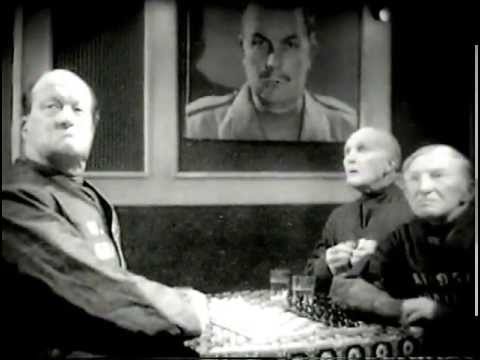
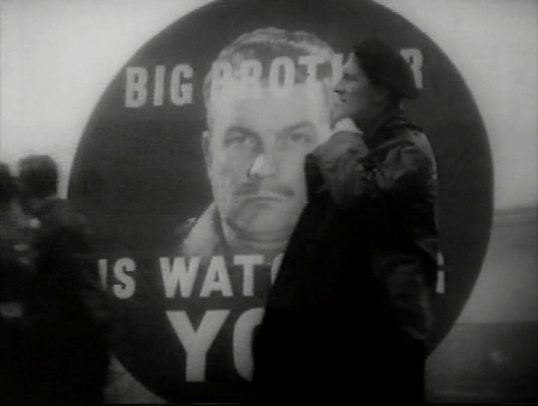
This version sticks closely to Orwell’s novel, though it downplays the book’s sexual themes.  (This is not surprising considering that this version was made for 1950s television.)  Though it condensed Orwell’s story, it hits all of the important points.  Winston Smith (Peter Cushing) is a member of the Outer Party who works at the Ministry of Truth and who lives a rather drab existence in London, “the chief city of Airstrip One.”  He is a citizen of Oceania, which has always been at war with Eurasia.  Winston lives under a system of government called Ingsoc and every day, he spends two minutes hating a mysterious figure named Goldstein.  All around him are posters of Big Brother, watching him and judging.

On the outside, Winston is a loyal party man but on the inside, he has questions and doubts.  How can he not when he works for the Ministry of Truth?  His job is to change history to reflect whatever the current version of it may be.  Some of his co-workers, like Symes (Donald Pleaseance), are openly cynical about what they do.  Others, like O’Brien (an imposing Andre Morell), seem as if they might be sympathetic to Winston’s doubts but Winston cannot be sure.  Meanwhile, Winston has found himself obsessed with Julia (Yvonne Mitchell), who is a member of the Anti-Sex League but who might have doubts of her own.  (Then again, she could also be a member of the Thought Police.)

When Winston is finally arrested for being a thoughtcriminal, it leads to a harrowing interrogation where he learns that truth doesn’t matter, the numbers add up to whatever the party says that they add up to, and that no one is strong enough to survive the ordeal of Room 101.

The BBC adaptation of Nineteen Eighty-Four was, for the most part, a live performance with a few filmed scenes inserted into the action.  Still, the fact that the majority of the actors were delivering their lines lives brings a certain immediacy to the film.  Everyone seem nervous and edgy.  In real life, that could have been due to the fear that they would miss a line but it also feels appropriate for people who spend every day of their life being watched and judged by Big Brother.  The entire production does an excellent job of creating a world where every minute is suffused in an atmosphere of dread and fear.  From the minute we first see him, Winston seems to know that he’s doomed.  The fact that Big Brother would rather torture and brainwash him rather than just make him disappear just makes things worse.

The production is full of actors — like Cushing, Morrell, and Pleasence — who would go on to become leading figures in the British horror industry and all of them do an excellent job bringing Orwell’s horror to life.  Peter Cushing, with his mix of intelligent features and neurotic screen presence, makes for the perfect Winston Smith and Andre Morrell is just as perfectly cast as the fearsome O’Brien.  The scene in which Winston is forced to confront Room 101 is still a harrowing one and this film perfectly nails the novel’s famous ending, doing so in a low-key manner that’s far more effective than the overwrought approach that other adaptations have brought to the final scene.

Nineteen Eighty-Four can currently be viewed on Prime.  The print is a bit grainy but that only adds to the film’s power.  It comes to us like a hazy vision of the future.
Other Entries In The 18 Days Of Paranoia:

  1. The Flight That Disappeared
  2. The Humanity Bureau
  3. The Private Files of J. Edgar Hoover
  4. The Falcon and the Snowman
  5. New World Order
  6. Scandal Sheet
  7. Cuban Rebel Girls
  8. The French Connection II
  9. Blunt: The Fourth Man 
  10. The Quiller Memorandum
  11. Betrayed
  12. Best Seller
  13. They Call Me Mister Tibbs
  14. The Organization
  15. Marie: A True Story
  16. Lost Girls
  17. Walk East On Beacon!

Sahara (1983, directed by Andrew V. McLaglen)


The year is 1927 and famed automobile designer R.J. Gordon (Steve Forrest) dies before he can enter his latest creation into the Trans-African Auto Race across the Sahara Desert.  Wishing to keep her father’s dream alive and prove that she’s just as good a driver as the boys, R.J.’s daughter, Dale (Brooke Shields), enters the race in his place.  Since women are not legally allowed to compete, Dale has to pretend to be a man.  She does this by wearing a fake mustache, which she tosses off as soon she drives over the start line.  It has to be seen to be believed.

Dale and her team set out on the race and they quickly get caught up in a tribal war between two separate factions of Bedouins.  Dale is captured by the lascivious Rasoul (John Rhys-Davies), who attempts to have his way with her.  Fortunately, Dale is rescued by Rasoul’s nephew, Sheikh Jafar (Lambert Wilson).  Jafar is enchanted by Dale’s beauty and wants her to marry him.  Dale eventually agrees but, the morning after the wedding, she sneaks out of Jafar’s tent, jumps back in her car, and rejoins the race.  When she gets captured by the other Bedouins, they force her to stand on a rock while surrounded by panthers.  Like Brooke with a mustache, it has to be seen to be believed.

Sahara was produced by Cannon Pictures.  Menahem Golan, who gets a story credit along with his usual producers credit on this film, was a self-described fan of Rudolph Valentino and Sahara was his attempt to pay homage to Valentino’s performance in The Sheik, as well as cashing in on the adventure zeitgeist that had been launched by the box office success of Raiders of the Lost Ark.  With a budget of $15 million, Sahara was one of Cannon’s most expensive films and the end result was a mix of high production values and typical Golan-Globus goofiness.  The desert cinematography may be impressive but this is still a strangely old-fashioned movie starring Brooke Shields as a race car driver who speeds through the desert without once getting a hair out of place.  As attractive as she was, Brooke was never much of an actress and requiring her to show more than one emotion at a time, as Sahara often does, seems like the ultimate act of hubris.  Say what you will about the films that Cannon made with Bronson and Norris, the two Chucks always seemed like they were perfectly cast.  Shields also has no chemistry with Lambert Wilson, who looks embarrassed at having to pretend to be Rudolph Valentino.  On the plus side, Raiders of the Lost Ark alumni Rhys-Davies and Ronald Lacey are both present in the film and seem to know better than to take any of it seriously.  Rhys-Davies especially always seems to be on the verge of laughing at his terrible dialogue.

Though the view may be impressive, the script is bad and the lead actors are lost.  Avoid Sahara at all costs.

18 Days of Paranoia #17: Walk East On Beacon! (dir by Alfred L. Werker)


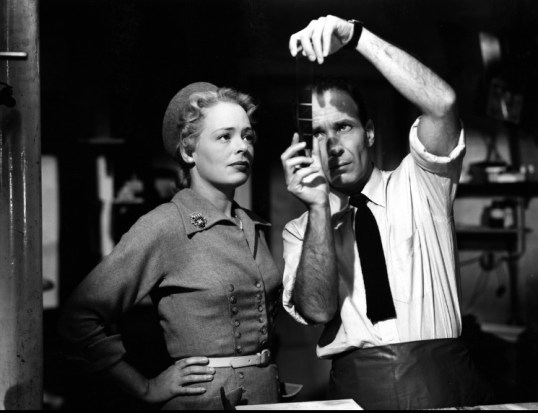
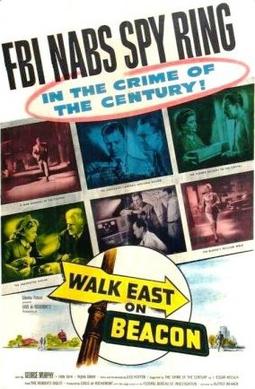
From 1952 comes Walk East On Beacon, a mix of spy thriller and film noir that highlights the efforts of the FBI to expose and take down a communist sleeper cell working right in the United States of America!  (Cue the dramatic music.)

One need only check out the opening credits to see what type of film Walk East On Beacon is going to be.  We’re told early on that the film was “suggested” by a Reader’s Digest article that was written by none other than the director of the FBI, J. Edgar Hoover. The title of that article was “The Crime of the Century: The Case of A-Bomb Spies” and it dealt with the FBI investigation that led to the arrest, conviction, and controversial execution of two Russian spies, Julius and Ethel Rosenberg.  I haven’t read the article but judging by the fact that it was written by Hoover and published in Reader’s Digest, I think it’s fairly safe to guess that it wasn’t particularly concerned with things like protecting the First Amendment, civil rights, or the freedom to hold any ideological belief regardless of how unpopular it may be with the general public.  (Of course, I would be remiss if I didn’t also point out that most historians now agree that, despite what many on the Left claimed over the decades, the Rosenbergs were indeed guilty of being spies and they played a very central role in the Russians discovering the secret to making atomic bombs.)

In the film, George Murphy plays an FBI agent named Jim Belden.  According to J. Hoberman’s book, An Army of Phantoms, the FBI specifically requested that Murphy be cast in the lead role because Murphy was an outspoken anti-communist.  (Murphy would also later be elected to the U.S. Senate.)  Project Falcon, a super-secret U.S. program, has been infiltrated by spies and Belden has been assigned to track down and capture their ringleader.  He does this by using a number of techniques that were probably considered pretty high tech back in 1952, stuff like hidden cameras and secret microphones.  He even brings in a group of lip readers to watch silent footage of two possible spies speaking so that they can tell him what the spies are talking about.  You don’t have to worry about a thing with Jim Belden on the case!

As for the members of the spy ring, they’re a mixed bunch.  Some of them are just bad people who have betrayed their country just because it’s the evil thing to do.  Others are people who idealistically joined the Communist Party years ago because they wanted to help their fellow man and, instead, they’ve now found themselves forced to spy against their country.  Prof. Albert Kafer (Finlay Currie) doesn’t want to betray America but he’s been told that his son will be executed if he doesn’t cooperate.  Kafer goes to the FBI.

As you can probably guess, this is not a particularly subtle film.  The communists are all evil and the FBI is doing its best to protect the loyal citizens of America and, if you’re going to question the legality or the ethics of their methods …. well, why don’t you just move to Russia and tell Stalin about it, okay!?  Interestingly enough, the film is shot like a film noir, with an emphasis on shadows and dark streets and desperate men trying to escape their fate.  But it has none of the moral ambiguity that one usually expects to find in a film noir.  Instead, it presents a thoroughly black-and-white view of the world.  All of the communists are either neurotic or cruelly evil while the FBI is professional, bland, and rather humorless.  There’s really only one moment — where a blackmailed spy admits to his wife that he’s been trapped into betraying his country — where the film seems to come to life.  Otherwise, this is a rather dry film, one that even comes with officious voice over narration.

While the film may not work as a thriller, it is somewhat fascinating as a historical document.  The film was shot on location in Boston and, while I realize this may just be the history nerd in me talking, it’s still somewhat interesting to see what an major American city looked like in 1952.  (It looks remarkably clean.)  As well, the film really delves into the minutia of stuff that today seems mundane but which probably took audiences by surprise in 1952, stuff like wiretapping, drop points, and how even a condolence card could be used to send a secret message.  If nothing else, the film’s portrait of a world where anyone — from a cab driver to an atomic scientist — could be a spy certainly provides a interesting snapshot of 1950s paranoia.

Other Entries In The 18 Days Of Paranoia:

  1. The Flight That Disappeared
  2. The Humanity Bureau
  3. The Private Files of J. Edgar Hoover
  4. The Falcon and the Snowman
  5. New World Order
  6. Scandal Sheet
  7. Cuban Rebel Girls
  8. The French Connection II
  9. Blunt: The Fourth Man 
  10. The Quiller Memorandum
  11. Betrayed
  12. Best Seller
  13. They Call Me Mister Tibbs
  14. The Organization
  15. Marie: A True Story
  16. Lost Girls

What Lisa Watched Last Night #211: Remember Me, Mommy? (dir by Michelle Ouellet)


Last night, I watched the premiere of one of the greatest Lifetime films of all time, Remember Me, Mommy?

Why Was I Watching It?

It was on Lifetime.  I’ve been ordered to shelter in place.  What else could I do?

Then again, even if I wasn’t on lockdown, I probably still would have watched it because this is one of those Lifetime films that takes place at a private school and features a teacher with a secret in her past and those are typically my favorite Lifetime films.  There’s just something irresistible about the mix of super snobs and dark secrets!

What Was It About?

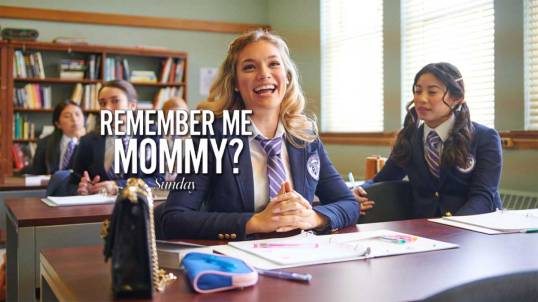
Elena Walker (Sydney Meyer) is the newest student at Clark Academy!  She’s a scholarship student, which means that she has to deal with a lot of hazing from all of the rich kids.  It turns out that most of the students at Clark Academy have known each other for their entire lives so Elena is definitely an outsider.

However, fear not!  Elena loves to write and the school’s creative writing teacher, Rebecca (Natalie Brown), is a former scholarship student herself.  In fact, Rebecca is so impressed with Elena’s essays that she even arranges for Elena to meet with an Ivy League recruiter.  So …. yay for the scholarship students, I guess.

Except …. well, Elena may not be who she claims.  In fact, it turns out that Elena has a bad habit of killing people who get on her nerves.  It also turns out that it’s not just a coincidence that Elena showed up at Clark Academy and immediately went out of her way to bond with Rebecca.

What is Elena’s plan?  What is Rebecca’s secret?  I’m not going to spoil anything, especially since the title of the film already does that.

What Worked?

It all worked!

Seriously, this is one of the best Lifetime films that I’ve seen in a while.  Though you’ll probably guess Rebecca’s secret long before the film actually reveals it, Remember Me, Mommy? is still a lot of fun.  In the tradition of the best Lifetime films, Remember Me, Mommy? fully embraces the melodrama.  Elena never stops plotting, Rebecca never stops teaching, and the pace never slackens.

And I have to admit that, as evil as Elena was, it was hard not to like her.  She was an agent of chaos, dropped in the middle of a bunch of complacent snobs and she reacted by disrupting the status quo.  Of course, it would have been nice if she could have resisted the temptation to kill but still….

What Did Not Work?

It all worked!

“Oh my God!  Just like me!” Moments

Like Elena, I always got along with my creative writing teachers.  They were some of my favorite people.

At one point in the film, Elena is accused of plagiarism and I have to admit that brought back some memories of high school math class.  I’ve always sucked at math.  It’s just not my thing.  Fortunately, I had an older sister who had taken the class a year before me and who had saved all of her tests so, whenever I had to take a test, I would just copy all the answers and …. well, technically, I guess I was cheating.  My plan, if I was ever caught, was to argue that I wasn’t so much cheating as I was just plagiarizing my sister’s answers.  Fortunately, I never got caught so I didn’t actually have to find out whether or not that argument would have worked.

Lessons Learned

Be nice to scholarship students!

Fast-Walking (1982, directed by James B. Harris)


Frank Miniver (James Woods) is the prison guard that everyone calls Fast-Walking.  He’s involved in almost every vice that a man living in a small town in Oregon can be involved in.  He takes bribes.  He usually shows up for work stoned and what he doesn’t smoke, he sells to the prisoners and the other guards.  He’s got a second job, running a trailer park brothel behind his cousin’s general store.

Frank’s cousin, Wasco (Tim McIntire), has been incarcerated and he expects Frank to help him take over the prison.  At first, Frank has no problem working with Wasco and letting his cousin have free reign of the cell block.  Wasco has soon established himself as the most powerful man behind bars.  When a black power activist named Galliot (Robert Hooks) arrives at the prison, Wasco wants to arrange for him to be assassinated.  Meanwhile, Galliot has offered Frank even more money to help him escape from the prison.

While Frank tries to keep both sides happy and make off with some money for himself, he’s also sleeping with Wasco’s accomplice on the outside, Moke (Kay Lenz).  Originally, Wasco ordered Moke to seduce Frank in order to keep Frank in line but, as Moke and Frank’s relationship continues, Wasco starts to get jealous and starts plotting to put Frank back in his place.

Fast-Walking is a gritty film that features a good deal of dark humor.  Unfortunately, the film’s many different parts never really come together and the film never strikes the right balance between comedy and drama.   James Woods is perfectly cast as Frank and the underrated Kay Lenz does wonders with an underwritten role but Tim McIntire is a less than ideal Wasco.  McIntire was a good actor but, physically, he’s all wrong for a character who is supposed to be so intimidating that he can walk into a prison and automatically take it over.  Wasco is written and played as being such a cartoonish character that it’s difficult to take him or his plots seriously.  The movie works best when it’s just focuses of James Woods’s nervy performance and Frank’s attempts to keep the other prison guards (including M. Emmett Walsh) from discovering his own racket.

18 Days of Paranoia #16: Lost Girls (dir by Liz Garbus)


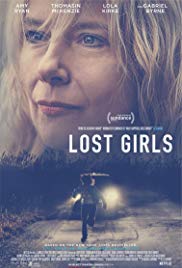
Lost Girls tells the true and infuriating story of Mari Gilbert and her search for her oldest daughter, Shannan.

Mari Gilbert is a single mother who is works as a waitress and struggles to give her children the best life that she can.  She’s still haunted by a decision that she made years ago to temporarily put her three daughters into foster care.  Though she eventually reclaimed two of her daughters, her eldest — Shannan — has basically been on her own since she was sixteen.  Shannan, who is now 24, visits her mother and her sisters on a semi-regular basis.  Despite the fact that Shannan claims that she’s just a waitress (like her mother), Shannan always seems to have a lot of money on her.  Mari has her suspicions about what Shannan’s doing to make that money but she keeps them to herself.

Then, one day in May, Shannan disappears.  Mari can’t get the police to take her seriously when she says her oldest daughter has vanished.  They say that Shannan left on her own and will probably return at some point.  They dismiss Mari’s concerns, telling her that her daughter was a prostitute and therefore, by their logic, unreliable.  Even when Mari gets strange phone calls from a doctor who lives in a gated community in Long Island, the police refuse to take her seriously.

However, Mari then discovers that Shannan called 911 the night that she disappeared.  Despite the fact that Shannan sounded panicked, the police waited an hour before responding to her call and, by the time they arrived, Shannan had disappeared.  It’s only when Mari goes to the media that the police actually start to search the area of Long Island where Shannan disappeared.  The police discover the bodies of several sex workers, all murdered by the same unknown killer.

However, they still don’t find Shannan’s body.  Though Mari and her daughter, Sherre (Thomasin McKenzie), are convinced that Shannan is one of the killer’s victims, the police continue to insist that Shannan probably just ran off on her own.  In fact, the local police commissioner (Gabriel Byrne) finds himself being pressured to do something about Mari because her now constant presence on TV is making the entire community look bad.

Meanwhile, Mari finds herself caught up in a personal feud between two men who live in the gated community, an amateur investigator (Kevin Corrigan) and a shady doctor (Reed Birney) who has a history of making inappropriate phone calls….

Lost Girls is an interesting but frustrating film.  Some of that is because the story on which the film is based did not have a happy ending.  The Long Island serial killer has never been identified or captured.  The most obvious suspect was never charged with anything and subsequently moved down to Florida.  Mari never got justice for Shannan and, sadly, was eventually murdered by her youngest daughter.  (The murder is acknowledged via a title card but it is not actually depicted in the film.)  As a result, the film itself doesn’t really offer up any of the payoff that you would normally expect to get after devoting 90 minutes of your life to it.  It’s frustrating but, at the same time, its understandable.

Amy Ryan gives a great performance as Mari.  That shouldn’t shock anyone.  She makes you feel Mari’s pain, fury, and guilt.  To its credit, the film does shy away from the fact that Mari often looked the other way when it came to how exactly Shannan was making the money that she regularly sent back to her family and Amy Ryan perfectly captures Mari’s struggle to not only get justice for her daughter but also to forgive herself.  Unfortunately, the film is a bit less convincing when it deals with the police and the suspects.  The film, for instance, can’t seem to decide whether or not Gabriel Byrne’s character is indifferent, incompetent, or just overwhelmed by a bad situation.  By that same token, the doctor and his neighbor both seem oddly underwritten and underplayed.  Obviously, the film can’t just come out and accuse a real, living person of murder (especially when that person hasn’t been charged with anything) but it still makes for a frustrating viewing experience.

Where Lost Girls succeeds is at creating a properly ominous atmosphere.  Every scene seems to be filled with dread and, from the minute that Mari starts her investigation, you feel nervous for her.  She’s taking a true journey into the heart of darkness.  The film leaves you angry that the police refused to search for Shannan.  Sex workers are regularly preyed upon and, because of what they do for a living, society often looks the other way.  That’s how you end up with killers like The Green River Killer and the Long Island serial killer.  They don’t get away with their crimes because they’re clever.  They get away with it because, far too often, society refuses to care about their victims.  Lost Girls is an imperfect film but its heart is in the right place and its message is an important one.

Other Entries In The 18 Days Of Paranoia:

  1. The Flight That Disappeared
  2. The Humanity Bureau
  3. The Private Files of J. Edgar Hoover
  4. The Falcon and the Snowman
  5. New World Order
  6. Scandal Sheet
  7. Cuban Rebel Girls
  8. The French Connection II
  9. Blunt: The Fourth Man 
  10. The Quiller Memorandum
  11. Betrayed
  12. Best Seller
  13. They Call Me Mister Tibbs
  14. The Organization
  15. Marie: A True Story

What Lisa Watched Last Night #210: A Mother Knows Worst (dir by Robert Malenfant)


Last night, I watched the latest Lifetime premiere, A Mother Knows Worst!

Why Was I Watching It?

Because it was on Lifetime!

Plus, I loved that title.  A Mother Knows Worst!  I’m seriously hoping that, once this lockdown ends, I’ll run into a really obnoxious woman who is carrying around a baby so that I can snap at her, “A mother knows worst!”

What Was It About?

Okay, so this is kind of a complicated movie and there’s no way for me to totally tell you what it was about without spoiling some of the film’s biggest twists.  So, I’ll just tell you what it pretends to be about while assuring you that there’s a few twists and turns that make this film a bit more interesting than you might think from just reading a rudimentary plot description:

Olivia (Kate Leclerc) and Brooke (Victoria Barabas) both gave birth on the same night.  According to the hospital, Olivia’s baby died while Brooke’s survived.  6 months later, Olivia’s husband, Harry (Jeff Schine), has a job working for Brooke’s husband, Glen (Todd Cahoon).  When Olivia sees Brooke’s daughter, she says that she felt an instant connection to the baby, a connection that Brooke feels that she has yet to establish.  While Brooke is happy with the idea of Olivia helping to look after her daughter, both Harry and Glen are concerned that Olivia may be forming an unhealthy obsession with Brooke’s daughter.

Meanwhile, there’s a murderer on the loose and….

Well, that’s all I can really tell you.  I know it sounds like a typical Lifetime baby kidnapping film but you’ll just have to take my word for it that it’s actually a bit more complicated than that.

What Worked?

This film was full of twists and turns!  Seriously, I love Lifetime film but it’s rare that they take me by surprise.  In fact, one of the appeals of the movies they show on Lifetime is that they tend to be predictable.  A Mother Knows Worst, however, had some pretty effective surprises and it definitely kept you guessing as to who could be trusted and who should be feared.

Katie Leclerc and Jeff Schine both did a great job playing Olivia and Harry.  In fact, the whole film was pretty well-acted.  Everyone did a good job of keeping the viewers off-balance.

I loved Brooke and Glen’s house!  That pool was to die for.

What Did Not Work?

Unfortunately, towards the end of the film, there’s a lot of flashbacks and they tend to kind of bog down the film’s finale.  Though it’s a cliche, sometimes it’s best to just have the villain give a monologue explaining all of their evil deeds, especially when the other option is stopping all the action for a lengthy flashback.

“Oh my God!  Just like me!” Moments

Olivia had red hair just like me so, of course, I totally related to her and was on her side.  It’s a scary world out there and those of us blessed with the best hair color in the world have to stick together.

Lessons Learned

Take nothing for granted, not even the plot of the latest Lifetime film.

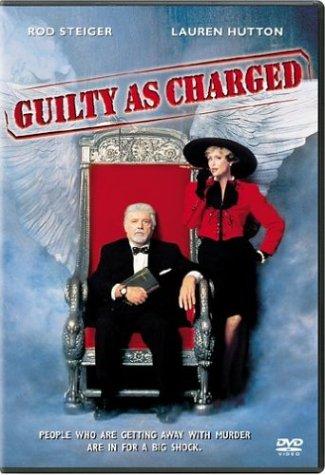
Guilty As Charged (1991, directed by Sam Irvin)


Stop me if you’ve heard this one before.

Kalin (Rod Steiger) is a crazy old religious fanatic who is rich enough to own a meatpacking plant and hire goons to work for him.  Underneath the meatpacking plant, he has a secret prison and an electric chair that he uses to electrocute people who he feels have escaped justice.  Helping out Kalin is a crazy preacher, played by Isaac Hayes (!), who waxes philosophically about how much he loves the smell of burning flesh.

While Kalin and the gang are executing people below ground, parole officer Kimberly (Heather Graham) is above ground and wondering why so many ex-cons are mysteriously vanishing.  Kimberly is worried that someone may be executing them but then she gets distracted by a politician named Stanford (Lyman Ward).  Stanford wants Kimberly to work on his campaign because she looks like Heather Graham and he’s a sleazy politico.

Meanwhile, a man named Hamilton (Michael Beach) has escaped from prison.  Hamilton claims that he was framed for a murder that he didn’t commit but no one is willing to believe him.  However, Hamilton is telling the truth and the murder was actually committed by Stanford!  The only people who know that Stanford is the murderer are Stanford, his wife (Lauren Hutton!!), and his maid (Zelda Rubinstein!!!).

It all leads to one question: How did all of these talented people all end up in this crappy film!?

The strange thing about Guilty As Charged is that, even though the film is centered around the death penalty, the film itself doesn’t seem to have any opinion on the issue.  Kalin and his followers are crazy religious fanatics who claim that they’re doing God’s work by executing people and Hamilton is an innocent man who has been marked for death so you would think that the movie is against the death penalty.  But then, in a twist that makes no sense, Kalin reveals that he knows that Hamilton is innocent and he’s only using him to get to Stanford and suddenly, the film is for the death penalty.  Kimberly is worried that someone is targeting ex-cons but, by the end of the movie, she’s targeting ex-cons herself even though nothing’s happened that should have made her change her mind.

Guilty as Charged is technically a comedy, though most of the jokes are too thuddingly obvious to provoke even the slightest of a smile.  Hayes wins some laughs, just because he seems like he’s having fun.  Rod Steiger bellows as if he’s getting paid by the decibel and doesn’t seem to be having any fun at all.  Guilty as Charged isn’t funny and it’s not thought-provoking but at least it’s got Isaac Hayes.

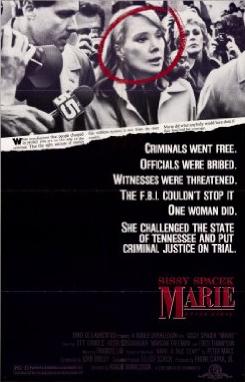
18 Days of Paranoia #15: Marie (dir by Roger Donaldson)


The 1985 film, Marie, tells a true story.

(In fact, the film’s official title is Marie: A True Story, just in case there was any doubt.)

The film opens in Tennessee, in the early 70s.  Marie Ragghianati (Sissy Spacek) has left her alcoholic and abusive husband and is now living with her mother and trying to raise three children, one of whom is chronically ill, on her own.  Though she manages to win a scholarship to Vanderbilt University, she quickly discovers that having a degree does not necessarily translate into getting a job.  However, while Marie was a student, she became acquainted with Eddie Sisk (Jeff Daniels), a seemingly friendly lawyer who now has a job as the counsel for the newly elected governor of Tennessee, Ray Blanton (Don Hood).  Marie goes to see Eddie and she soon finds herself working in the governor’s office.

With Eddie’s support, Marie rises up through the ranks.  Of course, he does get a little bit annoyed whenever Marie asks him why the governor is so eager to offer clemency to certain criminals.  At first, Eddie claims that it’s because the governor is against the death penalty and he doesn’t want to send anyone to die in “Old Sparky.”  Later, Eddie claims that it’s because the state has been ordered to do something about prison overcrowding.  And finally, Eddie admits that, on occasion, it’s done as a political favor.  It appears that some of the children of Tennessee’s wealthiest families have a really bad habit of getting arrested for some very serious crimes.

Eventually, there’s an opening on the state parole board and Eddie recommends that Marie be appointed the board’s new chairperson.  As Eddie explains it, the governor wants to put a Democrat on the board and he wants to appoint a woman.  (Despite the governor’s insistence that he wants to bring more women into state government, the film makes it clear that the Blanton administration was essentially a boys club.)  Marie agrees and soon, she’s making over a hundred dollars a day!  (That was apparently an unusual thing in the 70s.)

No sooner has Marie moved into her new position than she is informed that some of the governor’s aides have been selling pardons.  When Marie goes to Eddie about the situation, his charming facade disappears as he gets angry with her and accuses her of trying to ruin his career.  When rumors get out that she may have gone to the FBI, Marie becomes a pariah.  The governor demands her resignation, which she refuses to give.  She finds herself being followed by strange cars and harassed by the police.  (At one point, she is arrested for drunk driving despite being sober.)  Meanwhile, people start to show up dead.

When Blanton fires Marie on trumped-up corruption charges, she decides to take the governor to court.  Fortunately, Marie is friendly with a lawyer named Fred Thompson.  The future U.S. Senator and presidential candidate plays himself in this film and he gives such an authoritative performance that he went on to have a busy career as a character actor whenever he wasn’t running for or serving in office.

Marie is a strangely disjointed film.  On the one hand, you’ve got Sissy Spacek, Fred Thompson, and Jeff Daniels all giving excellent performances and you’ve also got an inspiring true story.  On the other hand, the film attempts to combine so many different genres that it sometimes feels as if you’re watching multiple films at once.  The film starts out as the story of a single mom trying to restart her life and then it becomes a workplace drama as Marie has to deal with gossip about her relationship with Eddie and hostile co-workers like fellow board member Charles Traughber (Morgan Freeman, in a small role that would probably be forgettable if it was filled by anyone other than Morgan Freeman).  Then it becomes a courtroom drama, with Fred Thompson cross-examining witnesses and giving final arguments.  Meanwhile, at the same time, it’s also a political thriller in which two men are brutally murdered before they can testify against the governor.  And then finally, it’s also a crime drama as detectives try to track down a career criminal who has friends in the governor’s office.  It’s a film of many good parts but those parts don’t always seem to easily fit together and the end result is somewhat awkward whole.

(Interestingly enough, some of the film’s moments that seem as if they’re most likely to be fictionalized are actually based on fact.  For instance, two men who could have brought down Blanton were mysteriously murdered at the same time that Marie was suing the state.)

In the end, Marie doesn’t really come together but it has a good cast and a good lesson: Never trust a politician.

Other Entries In The 18 Days Of Paranoia:

  1. The Flight That Disappeared
  2. The Humanity Bureau
  3. The Private Files of J. Edgar Hoover
  4. The Falcon and the Snowman
  5. New World Order
  6. Scandal Sheet
  7. Cuban Rebel Girls
  8. The French Connection II
  9. Blunt: The Fourth Man 
  10. The Quiller Memorandum
  11. Betrayed
  12. Best Seller
  13. They Call Me Mister Tibbs
  14. The Organization

Cinemax Friday: The Rowdy Girls (2000, directed by Steve Nevius)


When I started watching The Rowdy Girls, I had high hopes for it because it was a western starring two of my favorite actresses, Shannon Tweed and the late Julie Strain.

Unfortunately, that hope vanished as soon as I saw the words “Lloyd Kaufman and Michael Herz presents.”  Yes, The Rowdy Girls is a Troma film and it begins with the dreaded Troma skyline.  Even among connoisseurs of crappy films, the Troma logo is often considered to be troubled.  Lloyd Kaufman may be one of the most likable and interesting people working in the indie film world and he deserves credit for being a pioneer of sorts but he and his company are also famous for distributing films that are often so bad as to be nearly unwatchable.

Rowdy Girls takes place in 1886.  Shannon Tweed, Julie Strain, and Deanna Brooks play three different but often unclothed women who all end up on the same stagecoach.  Tweed plays Velvet McKeznie, a prostitute who is disguised as a nun because she’s just ripped off one of her clients.  Brooks plays Sarah Foster, who is trying to escape from an arranged marriage.  And finally, Julie Strain plays Mick, the ruthless girlfriend of the outlaw Billy Poke (Daniel Murray), who is about to hold up the stagecoach, kill the local sheriff, and take everyone hostage.  Fortunately, the dead sheriff’s brother is close by so he sets off in pursuit of the outlaws and their hostages.  Throughout it all, a minstrel (Mark Adams) wanders through the film, playing a guitar and singing songs about the women and the old west.  The film also uses old school title cards to inform us of certain plot developments, which would make more sense if the rest of the film was shot in any way like a silent western.

The Rowdy Girls is a cheap Troma production through-and-through but, when compared to some of the other films that Troma has forced on the world, it’s not that bad.  It’s a cheap and abysmally-paced film but, at the same time, it also features Shannon Tweed dressed like a nun and Julie Strain playing an evil, whip wielding outlaw.  This is not a film for anyone looking for a serious or believable western but fans of Shannon Tweed and Julie Strain will get their money’s worth.  Tweed even gets to do a little bit of serious acting, when Velvet explains to Sarah why she’s pretending to be a nun.  As always, Tweed proves herself to be better than her material.