Since today is Guillermo del Toro’s birthday, it only seems appropriate that today’s scene that I love comes from my favorite del Toro film.
In this scene from Crimson Peak, Thomas bring Edith to Allerdale Hall for the first time and it’s both hauntingly beautiful and rather frightening at the same time. The same thing can be said for this film itself and perhaps all of del Toro’s work. I just love the gothic atmosphere of the location. Edith is determined to see the positive. Thomas’s personality is already starting to change as the weight of returning to Allerdale starts to push in on him. The mansion has already started to sink back into the Earth. It’s just a wonderfully put-together scene, one that sets the mood for the rest of this sadly underrated film.
In this 1972 Italian film, Edwidge Fenech plays Jane Harrison. Jane is haunted by both the murder of her mother and a more recent car accident, one that caused her to miscarry. Jane has nightmares, featuring violent murders and lots of spilt blood. Whenever Jane leaves her apartment, a mysterious man with piercing blue and perfect hair (played, of course, by the owner of the best head of hair in Italian cinema, Ivan Rassimov) follows her and threatens her. Is the man real or is he just a figment of her imagination? Her sister, Barbara (Susan Scott) insists that Jane see a psychiatrist. Meanwhile, Jane’s boyfriend, Richard (the ruggedly handsome George Hilton) insists that the two of them can work through it.
However, Jane’s new neighbor, Mary (Marina Malfatti) has a suggestion that involves neither therapy nor love. Mary suggests that Jane attend a black mass. Jane agrees and …. wait, what? A black mass? Out of all the solutions that have been suggested, Jane decides to go with Satanism? That seems like a bit of an extreme solution but then again, it was the 70s and it was Italy and maybe things were just different back then. I’m just saying that I, personally, would not join a cult but obviously, some people do. Maybe that’s how the Silent Hill cult got started. Someone tried to be helpful by saying, “Let’s go to a black mass,” everyone said, “Sure!” Who knows?
Anyway, Jane attends a few rituals, all of which will seem familiar to anyone who has seen Rosemary’s Baby. She drinks the blood of a dog. She takes part in an orgy. Or does she? The scenes are shot in such a fashion that we’re left to wonder whether they’re real or if they’re just taking place inside of Jane’s mind. With her paranoia growing, Jane herself isn’t sure what’s really happening either. All she knows is that it seems as if the members of the cult are everywhere and that the mysterious man still appears to be following her. When people start dying in various gruesome ways, who is responsible? Jane or the cult or someone else entirely?
All The Colors of the Dark is a favorite of mine, a stylish giallo with an insane plot, lots of sex and death, and killer performances from giallo regulars like Fenech, Hilton, and Rassimov. The solution to this film’s mystery is actually pretty clever and — in a rarity for the giallo genre — it actually hold together when you think about it after the movie ends. Visually, director Sergio Martino does a great job of creating an atmosphere of unease and suspicion and Jane’s dreams and visions are wonderfully executed. My favorite moment is when Jane suddenly realizes that everyone around her is a member of the cult. Are they really or is Jane just hallucinating? Watch the movie to find out!
In October, it’s always nice to make some time for a good giallo, especially ones that feature George Hilton looking handsome and Ivan Rassimov looking dangerously intriguing. All the Colors of the Dark is definitely one of the better ones.
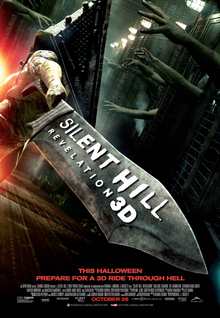
The 2012 video game adaptation, Silent Hill: Revelation, is gloriously silly.
It’s also a sequel to the first Silent Hill. While many members of the original cast do return and while the sequel’s plot does directly follow up on the first film, Silent Hill: Revelation still feels like an all-together different film. Whereas the first Silent Hill was atmospheric and, with its 2 hour plus running time, a bit ponderous, the sequel is short, direct, and …. well, I hate to use that word again, a bit silly. It’s also undeniably entertaining.
Sharon (Adelaide Clemens) is now 18 and is currently using the name Heather. With her father, Harry (Sean Bean), Sharon/Heather has spent the last several years of her life moving from place to place and trying to keep one step ahead of the Order, the Silent Hill cult. Heather — let’s just use that name — tries to make the best of her situation but she is 18 and she would like a chance to do normal teenager stuff as opposed to just spending her life on the run.
Good luck with that! When Harry mysteriously vanishes, Heather finds a message telling her to go to Silent Hill. Teaming up with her classmate, the enigmatic Vincent (Kit Harrington), Heather heads back to Silent Hill. She hopes to find both Harry and Rose (Radha Mitchell) but the Order has other plans. Soon, Heather and Vincent are back in the alternate dimension, dealing with monsters and stabby blind nurses.
As is typical of horror films about cults, there’s a lot of talk about sacrifices and using blood to bring about a new age and everyone worships some mysterious God who doesn’t sound all that pleasant. Whenever I watch a movie like this, I find myself wondering how the cult got started in the first place. Who woke up one day and said, “I’m going to follow the demon that regularly kills all of his followers. Now, let’s go alter some adoption records!” I also can’t help but notice that cults can never do anything the simple way. Instead, there’s always some alternate dimension or some extremely complex ritual that has to be performed and it all has to be done at a certain time of the year. Maybe if they just simplified things, they wouldn’t have so much trouble getting stuff done. Maybe instead of always trying to steal new souls, they could just be happy with the ones they have. I mean, it’s just common sense.
But anyway, back to Silent Hill: Revelation. Silent Hill: Revelation usually gets dismissed as an inadequate sequel but I was entertained. The plot moves quickly and the film features some memorably gory scenes. The scene where Heather suddenly hallucinates about Silent Hill while walking through a mall was enjoyably gruesome. At the same time, I couldn’t help but regret that Revelation never quite succeeded in duplicating that ominous atmosphere of the first film. If the first film felt like a nightmare-come-to-life, Revelation feels more like the season finale of a long-running, supernatural-themed television show. It’s fun to watch but it’s not particularly challenging. That said, Adelaide Clemens gave a sympathetic performance as Heather, Sean Bean’s natural gravitas was put to good use, and Malcolm McDowell made a brief appearance. The film kept me entertained.
Since tomorrow’s the great man’s birthday, it seems appropriate that today’s horror film on the lens is Edward D. Wood’s 1955 epic, Bride of the Monster.
(Much like Plan 9 From Outer Space, around here, it is a tradition to watch Bride of the Monster in October.)
The film itself doesn’t feature a bride but it does feature a monster, a giant octopus who guards the mansion of the mysterious Dr. Vornoff (Bela Lugosi). Vornoff and his hulking henchman Lobo (Tor Johnson) have been kidnapping men and using nuclear power to try to create a race of super soldiers. Or something like that. The plot has a make-it-up-as-you-go-along feel to it. That’s actually a huge part of the film’s appeal.
Bride of the Monster is regularly described as being one of the worst films ever made but I think that’s rather unfair. Appearing in his last speaking role, Lugosi actually gives a pretty good performance, bringing a wounded dignity to the role of Vornoff. If judged solely against other movies directed by Ed Wood, this is actually one of the best films ever made.
What happens if you’ve moved on, but your ex hasn’t? Ok, I won’t lie- This short scared me. Really. Usually, these films are from the women’s perspective, BUT as someone who dated his share of psychos, this one got to me. No one believes you until you play them the threatening voicemails or point out the ex who is out standing outside.
At it’s heart, Sleepless is love turned inward. The ultimate closure for the ex is the ultimate ending for her once true love. So, Earth, Wind, and Fire- After the love is gone- she’s going to kill you!
One of the amazing things about this short is that EVERYONE involved got a well-deserved great career. The directing and writing pulled me in. I was legit thrilled and scared. Peter Huang (director), Aaron Abrams (male lead), Anna Hopkins (female lead), Jenny Raven (female lead) all went on to bright careers. A lot of the shorts are sad that way- you see hidden gems who remain hidden.
The film is 6 minutes and change; so, think about that- the writer/director and actors gave me more thrills and fear in 6 minutes than a feature length has in 120 minutes. This is truly excellent acting and filmmaking.
What if OK GO went psycho? This short explores that premise. The protagonists Milton and Paul are much like OK GO, talented, yet a tiny bit pompous. Although OK GO hasn’t murdered anyone…yet, I’m sure that if they did start a life of murderin’ that they would murder like this.
Milton and Paul have just been laid before getting tenure. This fact made me like them less because I despise professors. I’m sure that some are not lazy, sanctimonious, garbage-people, but they must be in hiding or retired because even this week, one of my professors just didn’t show up for class- Just didn’t feel like it. I assuming his thoughts were as follows: Too bad, so sad lowly students – I’m going to roll around in my unearned money now like the thief that I am…. or something like that.
Try getting these holier than thou gasbags held to account and it will take you a year to get your money back and this wasn’t a For Profit school either- NO NO NO…These were public schools; so, take that taxpayer. In my case, it was Uncle Sam’s money that I demanded back because a calculus professor didn’t show up for the entire quarter for either of his classes; yet, he still expected to be and WAS paid. For me, hearing that two professors got fired in this film, made me wonder if I was watching fantasy and if a dragon would appear any minute. I swore heavily in an earlier draft, but I held back for you.
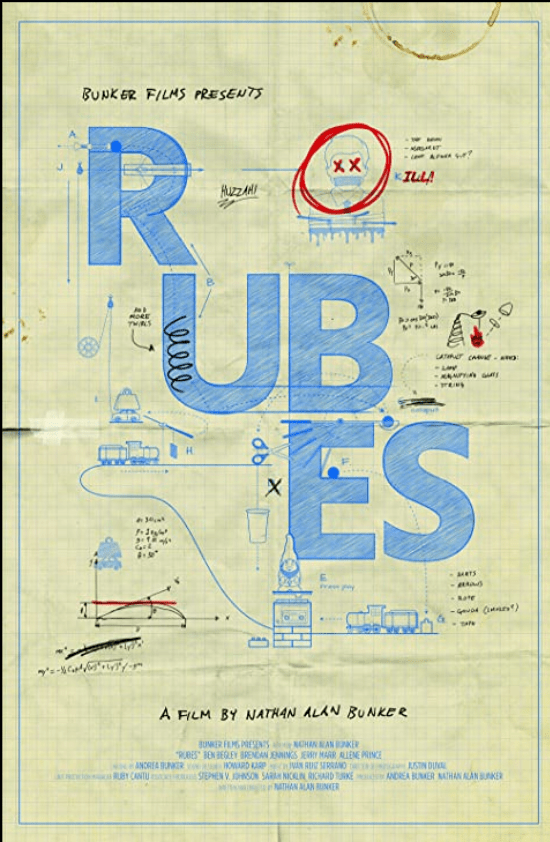
These two professors were fired and decided to kidnap those whom fired them and kill them using Rube Goldberg machines. My main critique is not the jokes or writing- those were fine; overall, the short was entertaining. No, my problem was that they didn’t spend enough time making the Rube Goldberg machine complex enough. Try harder, but then again, perhaps that lent some realism to the film because there is nothing lazier or worse than a college professor. We could put them on the same Herpes-Infected-Horny-Racoon-Island (HIHRI) where I’d like to put all of the sanctimonious politicians. Now, that is a platform we can all get behind!
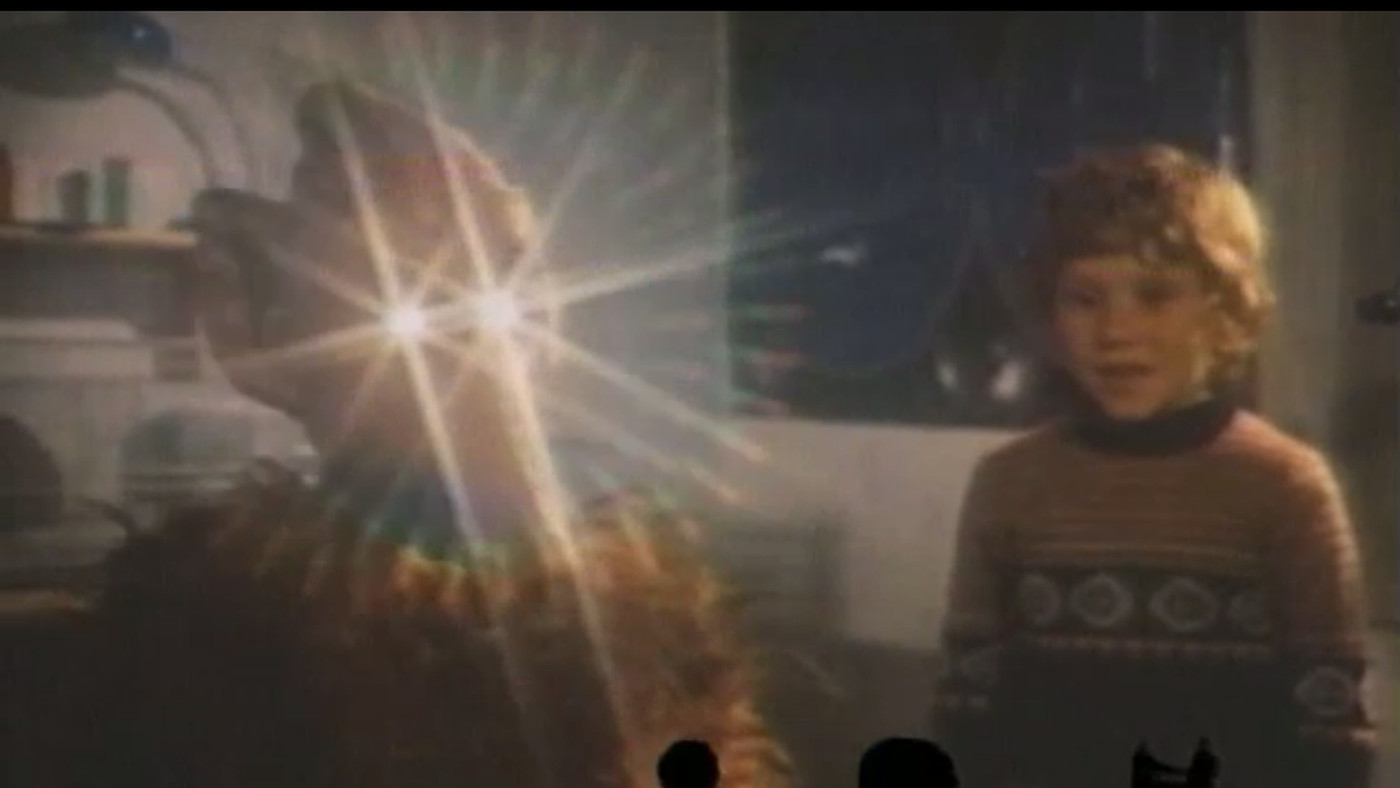
Everyone knows about Trumpy, the snorkel-nosed alien with telekinetic powers who befriend a lonely boy and a really bad band while his mother killed people in the forest. He was one of the stars of Pod People, which was famously lampooned by Mystery Science Theater 3000 in 1991. It became one of MST 3K’s most beloved episodes. Audiences loved the the attempts to by Joel and the Bots the decipher the song that the band is first seen performing. Was it Idiot Control Now or Tires Are Ready To Roll Now? They also loved Trumpy showing off his cool but ultimately useless powers. But why was Trumpy so good but Trumpy’s mom was so evil?
The reason is because Trumpy wasn’t originally supposed to be in the movie. Originally, the movie was just going to be about Trumpy’s mom killing poachers and stalking the band when their van broke down in the woods. But then a little movie called E.T. became a worldwide hit and the film’s backers decided that the movie needed a cute alien. Director Juan Piquer Simon, best known for the relentless gore fest that was Pieces, created Trumpy and had him befriend a child. The film became the only killer alien film made for a family audience. Families came for the cuteness of Trumpy and stayed for the scenes of Trumpy’s mom stalking a woman while she took a shower.
Weird, weird film. Have you ever tried to watch Pod People without Joel and the Bots to help you make you way through it? It’s not recommended but it can be done. A non-MST 3K version has been released on DVD under the film’s original title (Extra Terrestrial Visitor) but the movie is really boring without anyone making jokes. You can make your own jokes, I guess. You probably will.
No, Pod People is a film to watch with the Satellite of Love crew. With them, it’s a classic.
Jim Jarmusch’s The Dead Don’t Die is a film that has definitely grown on me. When I first watched it, I thought it was intriguing but perhaps a bit too cutesy and enamored with itself. However, I’ve subsequently come to realize that, actually, Jarmusch finds just the perfect tone for his look at our zombie-saturated culture.
In the scenes below, Bill Murray, Chloe Sevigny, and the wonderful Adam Driver all deal with the inevitability of doom that comes with being a character in a zombie film.
Watch today’s Horror on the Lens and find out! From 1959, it’s Teenagers From Outer Space! In this film, a bunch of teenage-looking aliens come to Earth so that they can raise lobsters. Things don’t really go as planned, of course. The teens have ray-guns that can transform anyone intto a perfectly preserved skeleton. It’s sad to think that they could come up with the technology to power their ray-guns and to pilot their spaceshiip but not to raise lobsters on their own planet.
It’s a damn shame.
Anyway, I hope you’re ready to cry because it’s time for …. TEENAGERS FROM OUTER SPACE!
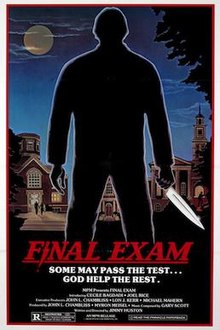
The 1981 slasher film, Final Exam, opens with a familiar scene. A couple is making out in a car. A man (played by Timothy L. Raynor) comes along and kills them both.
Why does the man do this? Is he an escaped mental patient, like the killer who always appear in the urban legend about the man with the hook? Is he an angry father, upset that students have been parking near his farm and corrupting his children with their sinful ways? Is he an occultist, hoping that a blood sacrifice will bring about the end of the world? Is he a jilted lover or an unemployed day laborer or a zombie or an international assassin or a former fat boy looking for vengeance on the students who pulled the prank that caused him to drop out of college? Seriously, what is this guy’s deal!?
We never find out. That, in itself, makes Final Exam unique. The Killer is not only not given a motive, he’s not even given a name! He’s just someone who shows up and starts killing. No one knows him and he doesn’t appear to know anyone that he kills. The fact that he’s so anonymous is actually a factor in the film’s favor. The flamboyant motivations that are given to most slasher villains tend to serve as a distancing device for the audience. It’s easy, for instance, to dismiss Jason Voorhees because we know that the idea of him drowning and then somehow showing up in the woods just doesn’t make any sense. The convoluted backstory of Michael Myers (or at least the Myers who was present in the original, pre-reboot Halloween films) eventually became so ludicrous that it made it easier for audiences to say, “Well, it’s just a move.” Final Exam‘s motiveless killer is actually far more true to life. In real life, it’s rare that we ever learn the motives behind the crimes. By making the Killer anonymous, Final Exam takes away one of the tools that the audience can use to assure themselves that it’s only a movie.
Unfortunately, the scenes following the opening murder are so inept that the audience is instantly reminded that they’re just watching a movie and not a particularly well-made one at that. It’s final exam time on campus but several students aren’t ready to take their Chemistry exam. So, a fraternity fakes a shooting spree — yes, you read that correctly — and manages to get the exam delayed for a day. That means that, while all of the other students have gone home, the chemistry students stay on campus so that they can study for their final exam. And, of course, the killer is on his way to the campus as well….
While the killer makes his way to campus, we sit through several scenes of campus hijinks. It’s a weird mix of horror and comedy. We meet a few students who are obviously destined to victims. Neurotic Radish (Joel S. Rice) is likably nerdy. Lisa (DeAnna Robbins) is having an affair with one of her professors, but at least she has a great first name. The frat boys are doing steroids and tying each other to trees. Apparently, spending the night tied to a tree is some sort of initiation ritual. That’s not a good situation to find yourself in when there’s a killer stalking the surrounding area.
Yes, the killer does eventually arrive on campus but it seems to take him forever. Once he does arrive, he starts killing everyone that he meets and, again, his lack of motivation makes him far more disturbing and frightening than he has any right to be. It really is the ultimate nightmare. Not only is someone trying to kill you but he’s doing it just because. There’s no reason for his actions and therefore, there’s no way to talk him out of it. There’s no secret to distracting or stopping him. You just have to run and hope you can escape. Cecile Bugdadi plays Courtney, who is pretty obviously destined to be the final girl. She gives a good performance and you definitely want her to escape but again, the film is so poorly paced that, by the time she gets her chance to face the Killer, the majority of the audience will probably have checked out, either mentally or physically.
Final Exam has a cult following, which I kind of understand. It really is the epitome of what people imagine when they imagine a typical, low-budget, early 80s slasher film. It represents an era. But for me, it’s just too uneven to work.