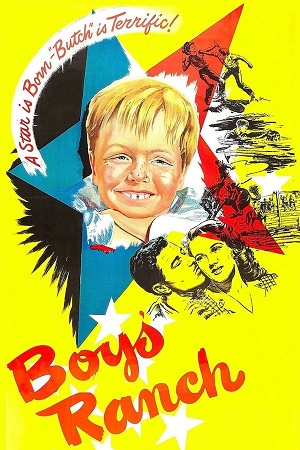
I Watched Boys’ Ranch (1946, dir. by Roy Rowland)


I watched Boys’ Ranch because it was described as being a baseball movie. And it is for the first few minutes.

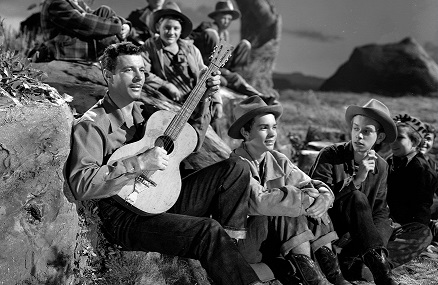
Dan Walker (James Craig) is a baseball player who learns that he’s going to be benched for the rest of the season. He used to be great but his time has passed and there are younger players who deserve a shot so, with no hard feelings, Dan announces his retirement. His two biggest fans — teenage delinquents Knuckles (Skip Homeier) and Hank (Darryl Hickman) — give him a knife so that he will always remember them when he returns to his ranch in Texas. Just before Dan is going to leave, he learns that the knife was stolen! Knuckles and Hank have been arrested and they’re going to end up in juvenile hall! Dan wins their freedom by offering to take them to Texas with him.

That’s where the baseball stuff ends. The rest of the movie is about Dan and his wife, Susan (Dorothy Patrick), running a ranch where they reform juvenile delinquents by teaching them how to take care of horses and how to be responsible. At first, the locals aren’t happy about having a bunch of bad city kid in town but Dan wins them over. His toughest challenge though is trying to reform Butch (Jackie “Butch” Jenkins), who is tough and a bad influence on the other boys.

Obviously, I was disappointed when Boys’ Ranch turned out to have very little baseball action. That’s the whole reason I was watching the movie! It could have used some more baseball action because the ranch action wasn’t that interesting. When the movie was made, I bet the idea of sending out of control teens to a ranch was a new one but today, it’s not that unique and everyone’s heard all the horror stories about what really goes on at those ranches. Of course, the bad boys in Boys’ Ranch didn’t really seem that bad either. They all just needed someone to tell them to drop the attitude and clean the stalls. Those boys may have had problems but at least they never tried to throw the World Series!

I miss baseball.
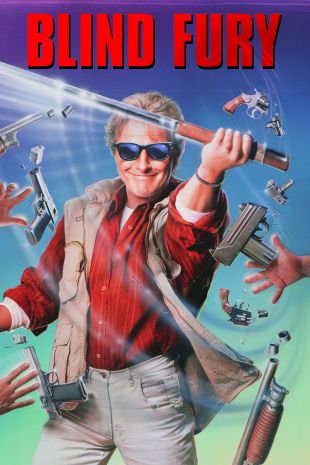
The TSL’s Grindhouse: Blind Fury (dir by Philip Noyce)


Nick Parker (Rutger Hauer) may have lost his sight in Vietnam but he gained something else.  With the help of surprisingly friendly villagers, Nick learned how to master his other senses.  He also became a proficient and deadly swordsmen.  Why would the villagers go out of their way to help an American soldier who, in all probability, they viewed as an intruder?

Does it matter?

Of course not!  All that matters is that 1990’s Blind Fury features Rutger Hauer as a blind swordsman who, 20 years after returning home from Vietnam, decides to to go to Florida to pay a visit on his old service buddy, Frank (Terry O’Quinn).  Frank, however, has developed a gambling problem and is currently in Reno, Nevada.  While Nick is getting to know Frank’s ex-wife, Lynne (Meg Foster), and Frank’s bratty son, Billy (Brandon Call), Slag (Randall “Tex” Cobb) shows up with two corrupt cops.  As you can probably guess from his name, Slag is a bad guy.  He’s looking for Frank.  Nick manages to kill the cops and run off Slag but, in the process, Lynne is killed.  With her dying breath, Lynne asks Nick to take Billy to his father.  Nick, of course, agrees.

The rest of this fast-paced film follows Nick and Billy as they head across the country.  Following them along the way is Slag and his men.  Frank has obviously made some pretty big mistakes and gotten on the bad side of some pretty dangerous people and it’s now up to Nick to save Frank, if just so Billy doesn’t end up an orphan.  At first, Billy is resentful and does things like demanding a window seat on the bus that they’re taking to Nevada.  (As Billy rather rudely puts it, it’s not like Nick has any use for the window.)  Billy also laughs when Nick trips in a puddle and then tries to trick Nick into eating a rock.  However, Nick soon proves himself to be more than capable of defending both himself and Billy.  Soon, Billy is calling him “Uncle Nick” and Nick …. well, Nick still seems to be wondering what he ever did that was so wrong that a part of his punishment was to get stuck with such a little brat.  But, that is a part of Nick’s charm.

And, indeed, Nick has a lot of charm.  That’s not particularly surprising, given that he’s played by the charismatic Rutger Hauer.  Hauer is convincing as both a blind man and a fighter and he bring a lot of sly humor to the role.  Nick may be a warrior but he’s definitely a warrior with a certain joie de vivre.  Beyond his own talents as an actor, Hauer was just one of those performers who had enough natural athleticism to look totally credible while swinging a sword at his enemies. One of the things that makes Blind Fury so enjoyable is that you never doubt that Hauer could actually do all of the things that we see him do.

Blind Fury is a fast-paced and entertaining film.  Director Philip Noyce keeps the action moving quickly and he’s smart enough to avoid getting bogged down with trying to convince the audience that film’s plot makes any more sense than it does.  Blind Fury is a B-action movie that’s proud to be a B-action movie and, as a result, it’s a lot of fun.  The film ends with a battle between Hauer and Sho Kosugi that is genuinely exciting to watch.  It also ends with the promise of a sequel, one that was sadly never made.

As I watched the film tonight (and, with the temperature currently being below freezing and a good deal of ice still being on the ground outside, I definitely enjoyed the escape that the film provided), it occurred to me that I’ve recently viewed many Rutger Hauer films.  I’ve seen a few bad films starring Rutger Hauer but I have never seen a bad Rutger Hauer performance.  Hauer always gave 100%, regardless of what else might be going on with the movie.  That’s why he was a great actor and one who is definitely missed today.

Blind Fury is definitely a very good Rutger Hauer film.  Watch it the next time you need to see that, with a little determination, anything is possible.

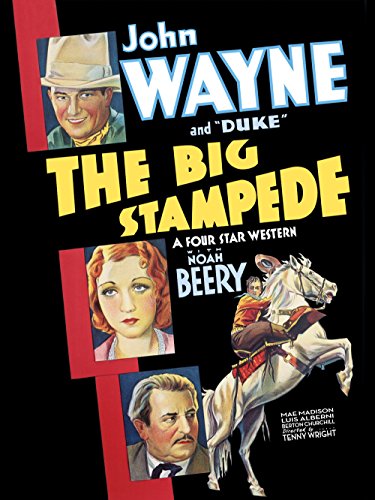
The Big Stampede (1932, directed by Tenny Wright)


On the New Mexico frontier, war is breaking out behind rancher Sam Chew (Noah Beery) and rustler Sonora Joe (Luis Alberni).  Both want to control the land and the cattle that graze upon it and innocent settlers are getting trapped in the middle!  The governor decides to send a young sheriff named John Steele to maintain order.  No sooner has Steele arrived then he meets a young woman (Mae Madison) and her father, who have both been attacked by and had their cattle stolen by Sam Chew.  After Sonora Joe and his gang save his life from Sam’s men, Steele realizes that Sam is more malicious and dangerous than Sonora Joe so he decides that the best way to handle the situation is to deputize Joe and team up with him to stop Sam and his men.  It’s a tall order but John Steele is just the man to handle it because John Steele is John Wayne!

This was one of the many B-westerns that the former Marion Morrison made in the decade before John Ford made him a star by casting him in Stagecoach.  Wayne was always a good hero, even in a 54-minute programmer like this one.  Though there is, as the title promises, an impressive stampede, Wayne is the main attraction here, with Noah Beery serving as a good heavy as always.  Perhaps the most interesting thing about this movie, if you’re a western or a John Wayne fan, is that Wayne’s horse is named Duke.  This was one of six films that Wayne made with Duke. Back in the 30s, the horses were often as a big a star as the men who rode them and, from the posters I’ve seen, it does appear that The Big Stampede was advertised as starring, “John Wayne and DUKE!”  At least Wayne was still able to get top billing.

The Big Stampede had previously been made as a silent film and the remake reuses a lot of old footage from the original.  John Wayne, needless to say, did not star in the original film, though he did wear the same costume that Ken Maynard wore in an attempt to keep people from noticing that the footage didn’t always match.  It’s not a totally successful ploy, though undemanding audiences in 1932 probably accepted it.  The Big Stampede would be remade one more time, in 1936, with Dick Foran taking the starring role.

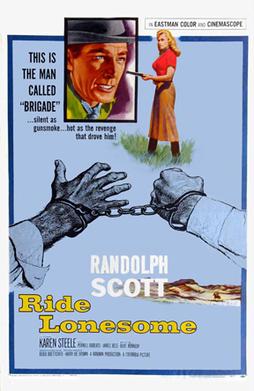
Ride Lonesome (1959, directed by Budd Boetticher)


In the western Ride Lonesome, Randolph Scott plays Ben Brigade. Brigade is a bounty hunter. The only thing that really differentiates him from the outlaws that he captures is that he gets paid for what he does. When Brigade arrests a young outlaw named Billy John (James Best), he gives Billy just enough time to send word to his older brother, Frank (Lee Van Cleef). And when Brigade starts to lead Billy John back to the town of Santa Cruz, he takes his time and fails to cover his tracks, almost as if he is intentionally making time for Frank to eventually catch up to him. Along the way, Brigade meets up with three others, a woman named Carrie (Karen Steele) and two outlaws named Boone (Pernell Roberts) and Whit (James Coburn). Carrie is searching for her husband while Boone and Whit want to arrest Billy John themselves so that they can turn him in and get a pardon for their own crimes.

Ride Lonesome is one of the best of the many films that Randolph Scott made with director Budd Boetticher.  Boetticher specialized in making fast-paced westerns that had deceptively simple plots.  Nobody in a Boetticher western was totally good or totally bad and that’s certainly the case with Ride Lonesome, which may seem like a typical western but which is actually a character study of 6 very different people.  Brigade is often only the hero by default and his actions are often as ruthless as those of the men who are tracking him.  It’s only after he meets and gets to know Carrie that he starts to seriously consider that his plans could lead to innocent people getting hurt. Billy John may be a wanted killer but, underneath his bravado, he’s just someone trying to live up to his brother’s example.  Meanwhile, Boone and Whit may be outlaws but they turn out to be the most morally upright characters in the film.  Ride Lonesome takes a serious look at frontier justice and suggests that maybe black-and-white morality isn’t all that it’s cracked up to be.

Needless to say, the cast is great.  Randolph Scott was one of the great western heroes and Karen Steele, Pernell Roberts, Lee Van Cleef, and James Best all turn in memorable performances.  Best of all is James Coburn, making his film debut and showing that, even at the start of his career, he was already the epitome of cool.  Ride Lonesome is one of the best of of the Boetticher/Scott westerns and a true classic of the genre.


2021 In Review: Lisa Marie’s Picks For The 26 Best Films of 2021


Without further ado, here is the list that we’ve all been waiting for!  Here are my picks for the 26 best films of 2021!  Why 26?  Because Lisa doesn’t do odd numbers!

(Also, be sure to check out my picks for 201020112012201320142015201620172018, 2019, and 2020!  Wow, I’ve been doing this for a while!)


1. Nightmare Alley
2. Licorice Pizza
3. The Tragedy of Macbeth
4. Mass
5. Shiva Baby
6. Belfast
7. CODA
8. The Last Duel
9. The Power of the Dog
10. The French Dispatch
11. The Father
12. West Side Story
13. Pig
14. Dear Comrades
15. Another Round
16. Dune
17. Spider-Man: No Way Home
18. Val
19. Wild Indian
20. Romeo and Juliet
21. East of the Mountains
22. Summit of the Gods
23. A Quiet Place Part II
24. Passing
25. The Lost Daughter
26. Swan Song

Lisa Marie’s 2021 In Review:

  1. 10 Worst Films
  2. 10 Favorite Songs
  3. 10 Top Non-Fiction Books
  4. 10 Top Novels
  5. The Best of Lifetime
  6. 10 Good Things I Saw On Television

In The Line of Duty: Siege at Marion (1992, directed by Charles Haid)


After bombing several Mormon centers in Utah, religious extremist and polygamist Adam Swapp (Kyle Secord) has barricaded himself inside of a farm house with his wives and supporters. The FBI, led by Bob Bryant (Dennis Franz), have the house surrounded and are trying to convince Swapp to peacefully surrender. Swapp, however, has no intention of going down without a fight.

In the 1990s, NBC did a whole series of made-for-TV miniseries about real-life law enforcement operations that inevitably led to the death of at least one of the officers involved. They made so many of them and they churned them out so quickly that NBC even aired a movie about the Branch Davidian stand-off while it was still going on. Siege at Marion, the fourth of the In The Line of Duty films, feels like a precursor to what was eventually happen in Waco. Just as happened in Waco and with the attempts to arrest Randy Weaver at Ruby Ridge, critics claimed that the government came on too strong while the government claimed that they were merely enforcing the law.

Siege at Marion is the least interesting of all of the In The Line of Duty movies, mostly because the Marion siege was neither as mismanaged as what happened in Waco or as egregiously heavy-handed and disturbing as what happened in Ruby Ridge. Though based on a true story, Siege at Marion is a standard stand-off film with the only suspense coming from the film’s distasteful attempts to build up suspense as to whether it’ll be Dennis Franz, William H. Macy, or Ed Begley, Jr. who is killed in the line of duty. Since only one of them is given a backstory and a family, it’s easy to guess which one it will be.

The best thing about Siege of Marion is the cast. Dennis Franz was born to play cops and it’s interesting to see a pre-Fargo William H. Macy playing a non-nervous character. Kyle Secor is convincingly fanatical and unhinged as the messianic Adam Swapp. Secor would go on to star as Tim Bayliss on the much-missed Baltimore-set cop show, Homicide: Life on the Street. Speaking of classic cop shows, Siege at Marion was also directed by Charles Haid, who played Andy Renko on Hill Street Blues. As for the In The Line of Duty films, the last one was made in 1994 but they all live on in syndication.

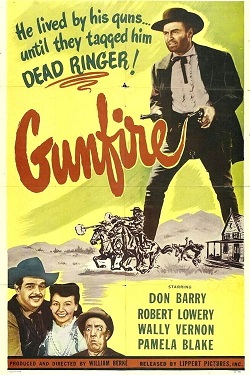
Gunfire (1950, directed by William Berke)


Years after the death of his brother Jesse, Frank James (Don “Red” Barry) has settled down in Colorado and is living a peaceful life as a rancher.  He is even friends with the town’s sheriff, John Kelly (Robert Lowery).  Unfortunately, it’s not always so easy to escape the past, especially when you are one of the few surviving members of one of the Old West’s most notorious gangs.  A former member of the James Gang, Mundy (Claude Stroud), shows up at Frank’s cabin and tries to talk Frank into joining up with him, the Ford brothers (Gaylord Pendleton and Roger Anderson), and their new leader, Bat Fenton (Don “Red” Barry, playing a second role).  When Frank refuses and makes clear that he still wants revenge on the Ford brothers for the murder of Jesse James, the gang goes on a crime spree.  Because he and Fenton look exactly alike, the entire town thinks that Frank is responsible.  Can Frank clear his name and avenge the death of his brother?

There were a lot of poverty row B-westerns produced in the early 1950s and most of them are pretty bad.  However, occasionally you come across a diamond in the rough and that’s the case with Gunfire.  Gunfire tells an interesting story, it has exciting gunfights, and it also features not one but two good performances from Don “Red” Barry!  Barry is equally convincing as both the good Frank and the bad Fenton and the movie uses the double plot as a way to illustrate how difficult it is to escape the sins of the past.  Frank has been “born again” but every time he sees Fenton, he sees not only who he used to be but also who many will always believe him to be.  Gunfire is a good western that shows that you don’t need a huge budget to tell an engaging story.

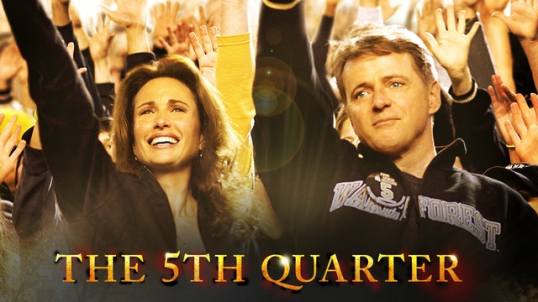
I Watched The 5th Quarter (2010, dir. by Rick Bieber)


The 5th Quarter is the story of the Abbate Brothers.  Luke Abbate (Stefan Guy) is a high school football star who has his entire life ahead of him.  Jon Abbate (Ryan Merriman) is a student at Wake Forest University and is a linebacker on their football team.  When Luke is killed in a horrific car accident, Jon considers dropping out of football but instead, with his parent’s encouragement, he decides to keep playing and to dedicate the season to the memory of his little brother.  Wearing his Luke’s No. 5 jersey, Jon inspires both the team and the fans.

Sometimes you really want to like something but you just can’t.  That’s the way that I felt about The 5th Quarter.  The movie is based on a true story and its heart is in the right place but it’s just too predictable too really work.  It needed more drama and at least a little suspense about whether or not Wake Forest would be able to win all of the games that they won.  I did think that Aidan Quinn and Andie MacDowell (who I thought was Jennifer Garner for most of the movie) were pretty good as Luke and Jon’s parents.  The movie needed more scenes like the one where Andie MacDowell got mad at the woman who asked her how she was doing right after she had buried her youngest son.  Otherwise, The 5th Quarter meant well but it was just too predictable.

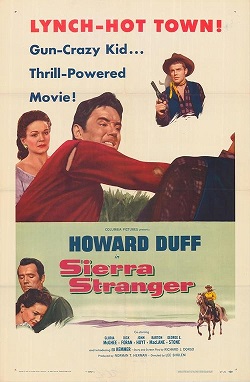
Sierra Stranger (1957, directed by Lee Sholem)


Sierra Stranger starts with a familiar western situation.  Jess Collins (Howard Duff), a penniless but honorable drifter, comes across two men tying another man to the back of a horse.  The two men claim that Sonny Grover (Ed Kemmer) is an outlaw and a claim jumper and not to be trusted. Sonny says that he’s innocent and the two men are actually the claim jumpers.  Jess does what many a western hero has done.  He sides with the underdog and saves Sonny.  To thank him, Sonny gives Jess a part of his claim.

Jess rides into the nearby town to claim his new property.  He meets and befriends Sonny’s half-brother, Bert (Dick Foran).  He also meets and falls in love with Bert’s fiancée, Meg (Gloria McGeehee).  However, soon after arriving, Jess discovers that he made a mistake and he saved the wrong man.  Sonny really is the dangerous outlaw that everyone says he is.  After Sonny robs a stagecoach and murders the driver, Jess risks his new friendship with Bert by trying to bring Sonny to justice.

Howard Duff appeared in his share of B-westerns in the 50s.  He was always a solid hero, even if he didn’t really have the screen presence of some of the other stars of the genre.  He’s pretty good in Sierra Stranger and the fact that, for once, the town is right while the drifter is wrong is an interesting twist on an otherwise standard story.  This is the rare western where the hero makes a pretty big mistake and then has to spend the rest of the movie trying to make up for it.  If you’re not a western fan, this is not the type of B-movie that’s going to change your mind.  But, for those who do like the genre, it’s an interesting twist on what we’ve been led to naturally expect.

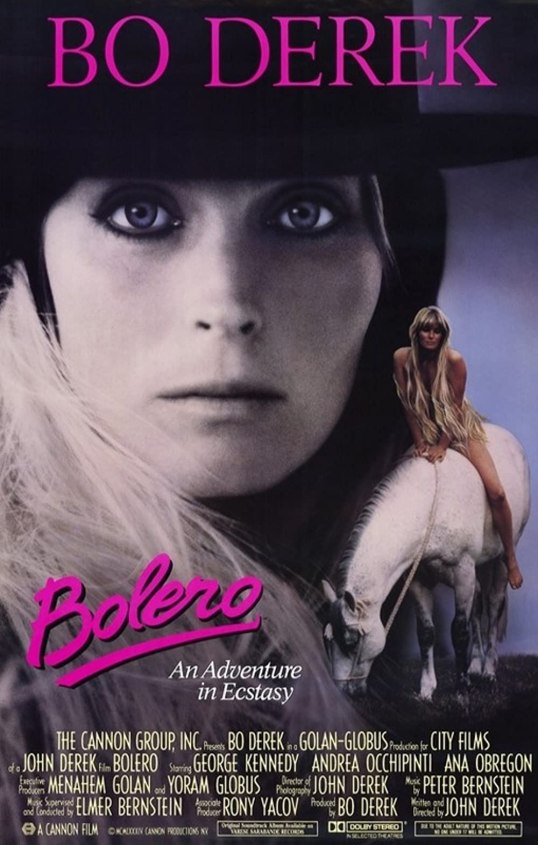
The TSL’s Grindhouse: Bolero (dir by John Derek)


The 1984 film, Bolero, tells the story of  Ayre “Mac” MacGillvary (Bo Derek) and her best friend, Catalina (Anna Obregon).  They’re young, they’re rich, they’ve just graduated from college, and, despite the fact that they both appears to be in their early 40s, they’re determined to lose their virginities to the most perfect lovers that they can find.

Because the film is taking place in the 1920, Mac and Catalina first travel to the Middle East in hope of finding a Rudolph Valentino-style sheik.  Accompanying them is Mac’s chauffeur and protector, Cotton (a clearly embarrassed George Kennedy).  Though Mac does manage to find a sheik (played by Greg Benson), her efforts to lose her virginity to him prove to be a failure.  Though the Sheik is willing, he indulges a bit too much with his hookah and ends up passing out right before the consummating the act.

Well, if a sheik can’t do it, how about a bullfighter?  Mac and Catalina leave the Middle East for Spain and it’s there that Mac catches the eyes of Angel (Andrea Occhipinti), a celebrated bullfighter.  Mac decides that Angel will be the one to take her virginity but it turns out that, once again, nothing as is easy as it should be.  It turns out that Angel already has a lover and he’s been with her since she was a teenager.  And a 14 year-old Gypsy named Paloma (played by Olivia d’Abo) has already decided that she is going to be Angel’s next lover, which is incredibly icky even before the film makes it even ickier,  

While Mac is trying to seduce Angel, Catalina is trying to seduce a Scottish attorney named Robert Stewart (Ian Cochrane).  “What do you wear under your skirt?” Catalina asks.  “It’s a kilt!” Stewart yells because he’s Scottish.  Anyway, Catalina eventually does get an answer to her question so yay Catalina!

As for Mac, she does eventually manage to win Angel’s attention but then …. OUCH!  Angel gets gored by a bull and yes, he gets wounded exactly where you think that he gets wounded.  Suddenly, Angel can no longer get it up but fear not.  “We’re going to make that thing work,” Mac says, before she then takes up bullfighting herself.  It all eventually leads to a scene that makes heavy use of dry ice and a neon light that misspells the word ecstasy. 

Bolero is one of those sex-obsessed films that tries so hard to be erotic that it actually goes in the opposite direction and becomes so firmly anti-erotic that one gets the feeling it could be used as a torture device in a George Orwell novel.  “The Anti-Sex League sentences you to watch Bolero!”  A huge part of the problem is that, even though everyone in the film is certainly attractive, there’s still next to no chemistry between Bo Derek and any of her potential lovers.  The film was directed by Bo’s then-husband, John Derek and, somewhat perversely, John continually films her in the least flattering ways possible.  John also tries to introduce some humor into the film — at one point, it turns into a silent film, complete with title cards — but it all falls flat.  Finally, the gored bullfighter is played by a very handsome Italian actor named Andrea Occhipinti who I immediately recognized as being the same actor who played the killer in Lucio Fulci’s The New York Ripper.  Though it was a bit unfair to Occhipinti (whose likable blandness was exactly what made him such a subversive choice to play the killer in Fulci’s film), I was worried every moment that Mac was left alone with him.  (Occhipinti is now one of Italy’s most respected film producers.) 

Produced by Cannon Films, Bolero was apparently a huge flop when it was released.  Bolero was considered to be so bad that it led to MGM announcing that they would no longer help to distribute any other Cannon Films.  I can’t really blame MGM.  Even when viewed decades later, Bolero is a dull romp that’s fit only for the Anti-Sex League.