Although I’ve watched a number of Godzilla movies growing up, I’ve only gone to the movies for two. There was Roland Emmerich’s 1998 Godzilla, which was fun for the effects and cringe worthy for the acting. There was also Gareth Edwards 2014 Godzilla, that focused so heavily on the humans, it dodged fighting sequences until the last 30 minutes. Takashi Yamazaki’s Godzilla Minus One is an amazing piece of work that gives the audience a small group of humans to focus on versus a beast that’s a true terror to behold. I laughed, cheered, and gasped at times with this one.
Godzilla Minus One takes place over the course of a few years. When Kamikaze fighter pilot Koiji Shikishima lands on a secret refueling island, the soldiers there discover he’s been trying to dodge his responsibilities. Before anyone can react, however, a large beast arrives, laying waste to the entire base and only leaving Shikishima and head mechanic Tashibana alive.
A year later, Shikishima returns to his home villiage, which is damaged from the war. He happens upon a young woman, Noriko (Minami Hamabe, Shin Kamen Rider) and a little girl named Akiko. He takes them in and gives them shelter, but is haunted by nightmares of the beast. Can Shikishima confront his fears? Can Godzilla be stopped?
The script is one of Godzilla Minus One‘s best strengths. It does borrow from a number of different films, true. There are homages to Jaws, King Kong and even Dunkirk, but at the heart of it all are characters to cheer for (Doc was the stand out for me). Granted, there’s only so many storylines you can come up with when it comes to Kaiju stampeding through a city. Godzilla Minus One keeps things simple enough to make one wonder why their story angle wasn’t tried in any of the recent American adaptations. While I won’t say that American filmmakers don’t know how to handle Godzilla – Godzilla: King of the Monsters was enjoyable as well as Godzilla vs. Kong to a degree – Japan knows how to get the best of their creation, and it shows here.
Working off of a budget of about $15 Million (with some speculation that it’s less than that), Takashi Yamazaki also spearheaded the visual effects, along with Kiyoko Shibuya. The effects are used sparingly, and there are moments where you could think that maybe you’re looking at a guy in a suit. Still, the effects run that line between appearing practical and fully CGI. Some of it gets to be a little wild in the film’s 3rd act, but there’s so much fun involved that you might not notice any inconsistancies with the plot (“He’s just gonna stand there for all this?”, my cousin quipped as I relayed the movie to her scene by scene). From a sound and music standpoint, the film keeps all the classic Godzilla themes you know and love while varying things up a bit. The Godzilla screams are all there, as well. No real surprise there, of course.
Overall, Godzilla Minus One is a fun watch, raising the bar for what Godzilla films could be and puts Takashi Yamazaki’s name on the radar for future projects.
Having had a rough day, I decided that I needed to watch a crowd-pleaser tonight.
Gran Turismo: Based on a True Story is definitely that. The film may have an unwieldy title and it might not really break any new ground as far as sports films are concerned but it’s still definitely a film that will leave viewers feeling satisfied. It tells the story of Jann Mardenborough (Archie Madekwe), who gets a chance to turn his love for and skill at the Gran Turismo video game into a real life career when he is selected for GT Academy, a school in which the world’s best simulation drivers are trained to be real-life racers. Though GT Academy may have started out as a PR stunt that was masterminded by executive Danny Moore (Orlando Bloom), both Jann and his trainer, Jack Salter (David Harbour), are determined to prove that the simulation drivers deserve to be taken seriously.
Gran Turismo hits all of the expected moments. Jann’s father (Djimon Hounsou) is a former professional soccer player who worries that his son is going to waste his life pursuing an impossible dream. Jann’s mother (played by my favorite Spice Girl, Geri Halliwell-Horner) worries that Jann is going to be one of the drivers who wrecks his car and doesn’t emerge from the remains. Jann has a pretty and supportive girlfriend named Audrey (Maeve Courtier-Lilley). Jann has a quirky love for the music of Kenny G and Enya. Jann has to win everyone’s respect, including Jack’s. Jann has to deal with arrogant rivals. Jann has to conquer his own insecurities before he can win and Jack has to conquer his own past before he can truly help to lead Jann to victory.
And, of course, Jann is involved in a massive car wreck that causes him to lose his confidence right before the big race. The wreck is actually based on something that truly did happen to Jann Mardenborough, though it occurred two years into his racing career as opposed to at the beginning of it. Tragically, in both the movie and in real life, the crash resulted in the death of a spectator. One can understand why the car crash was moved (because otherwise, Jann would have been too confident going into the big race and there wouldn’t be as much suspense as to whether or not he would be able to conquer his fears) while also feeling that it was a bit of a tacky thing to do. The film reducing a real-life tragedy to a plot point feels all the more gauche when you consider that the filmmakers could have just made up some incident to cause Jann to lose his confidence. I mean, we all know that “based on a true story” doesn’t actually mean that a film’s story is 100% (or even 10%) true.
If you can overlook that bit of narrative tackiness, Gran Turismo is a well-made and likable sports film. Not a single moment really took me by surprise but, more often than not, I still found myself smiling whenever Jann proves the naysayers wrong and finished strong. Director Neill Blokamp made a huge splash with his first film, 2009’s District 9, but, his subsequent films have struggled to recapture the energy and narrative verve of his debut. Gran Turismo proves that Blokamp is still capable of directing a crowd-pleaser.
That’s one of the many questions posed by Todd Haynes’s latest film, May December.
Elizabeth Berry (Natalie Portman) is an actress who comes to Savannah, Georgia in order to research her next role. We don’t learn much about Elizabeth’s career as an actress but it appears that, while it has brought her a certain amount of fame, it hasn’t exactly been full of acclaimed work. One person mentions seeing a picture from a film that she did in which she was involved in a blood sacrifice. (“I googled ‘naked Elizabeth Berry,'” he explains.) Several other people mention how much they love her TV show, Norah’s Ark, in which Elizabeth plays a veterinarian. Elizabeth’s latest film features her playing a real person, someone who was at the center of a scandal 20 years previously and who has since faded from the public view. Elizabeth seems to believe that this role could redefine her career.
(Hey, it worked for Margot Robbie in I, Tonya.)
Elizabeth is going to play Gracie Atherton-Woo in an upcoming indie film. Way back in 1992, the real-life Gracie (Julianne Moore) was 36 years old and married when she was caught having sex with a 13 year-old named Joe in the back of a pet store. Joe was a classmate of Gracie’s son and Gracie was the one who was responsible for him getting hired at the pet store in the first place. Gracie was sent to prison, where she gave birth to Joe’s daughter. During her trial, Gracie and Joe were both tabloid mainstays. The nation was transfixed by their affair before eventually moving on to the next scandal. When Gracie was eventually released from prison, she married Joe. Now, decades after appearing on the front of every trashy magazine, Gracie and Joe (Charles Melton) are still married and they now have three children. They live in a big house in Savannah, Gracie has a career as a pastry maker, and, from the outside, they would appear to have a perfect domestic life together.
Wearily, Gracie and Joe allow Elizabeth to spend time with the family so that she can research her role. Elizabeth interviews other people who were effected by Gracie’s actions. Gracie’s ex-husband (D.W. Moffett) is surprisingly forgiving. Gracie’s children are considerably less forgiving. Georgie (Cory Michael Smith), who was Gracie’s son from her first marriage and a schoolmate of Joe’s, is bitter and describes his mother as being mentally unbalanced while, at the same time, trying to leverage his knowledge of Gracie’s past into a job on the film. As for Gracie and Joe’s first daughter (Piper Churda), she states that she doesn’t want the film to be made.
Cracks start to appear in the perfect image that Gracie and Joe present to the world. Gracie can be rigid and controlling while insisting that Joe was the one who initiated the encounter in the pet store. Gracie talks about growing up with four brothers, two of whom were older and two were younger. Gracie mentions that one of her brothers is an admiral and it’s implied that she grew up in an atmosphere where failure was not an option. Gracie’s daughter talks about how, when she graduated, her mother gave her a scale as a graduation gift. When someone cancels an order for a cake, Gracie takes it as a personal rejection and breaks down into tears. Gracie is friendly towards Elizabeth but never totally lets down her guard.
As for Joe, he emerges as well-meaning but confused, someone who is still often treated like a child by bother his wife and, eventually, the woman who is studying his wife. Whenever we see Joe with any other adults, he’s awkward as if he’s not sure how to behave. (When he tells his elderly father that he can hardly believe that all of his children will soon be in college, the old man’s silence tells us everything that we need to know about their relationship.) Joe is nearly forty but it’s clear that a good deal of his emotional development stopped when he was thirteen, leaving him desperate for approval. When he catches his teenage son smoking a joint, Joe isn’t angry as much as he’s curious. Smoking weed is one of the many things that Joe never did when he was younger. When Joe get high, he becomes a paranoid and emotional mess as all the feelings that he’s repressed for 23 years come spilling out. At the same time, when Gracie has a breakdown, Joe knows exactly what to say to help her through it.
Do Gracie and Joe truly love each other or is their marriage just their way of denying the reality of what happened? Did Gracie groom Joe or, as Gracie insists, was their affair consensual? At first, the audience’s natural tendency is to sympathize with Elizabeth and to expect her to play some sort of role in clarifying what actually happened in that pet store. But Elizabeth soon proves herself to be a rather detached observer, a mimic who copies the emotions of others but who, even after she gets to know Gracie and Joe as human beings, still views them as just being characters in a story. In the end, Elizabeth can’t help us understand what happened in the pet shop because, the film suggests, not even the people who were actually there understand what happened. All Elizabeth can do, as an actress and an observer, is try to recreate what she imagines happened.
It’s a well-made film, with Haynes deftly mixing scenes of high drama with the awkward comedy of people trying to rationally discuss the irrational. It can also be a frustrating viewing experience, if just because Haynes often does not seem to be sure what he’s trying to say about the characters or why we should even care about either Gracie or Elizabeth. Fortunately, the film is lucky enough to have a wonderful cast. While Moore and Melton gets the big, dramatic scene, it’s Portman who takes the audience by surprise, giving a performance that goes from being likable to being rather chilling as Elizabeth transforms herself more and more into Gracie. For all the film’s themes about conformity, morality, and tabloid culture, it’s main message may very well be to never trust a method actor.
May December sticks with you, even if it’s not up to the level of Haynes’s Carol. It’s a film about what happens after the infamy, with Gracie, Joe, and Elizabeth destined to be forever defined by what happened over the course of a few minutes in the backroom of a pet store.
The saga of the world’s most boring and tedious couple finally comes to an end in After Everything.
When last we checked in on Tessa Young (Josephine Langford) and Hardin Scott (Hero Fiennes Tiffin), they were probably both wondering how they ended up with the type of names that most people would expect to find attached to fake profiles on a dating app. Tessa had also just left Hardin, upset that he used the details of their relationship to write his first novel, After.
After Everything opens with best-selling, voice-of-his-whiny-generation Hardin being pressured to come up with a follow-up novel but he has writer’s block because Tessa won’t even return his texts. As he explains it, he’s lost his muse and he can’t write anything without her. (Maybe he should send her some of the money that he made off of her life story then.) Despondent, Hardin starts drinking again. This would be a big plot point if not for the fact that, in every After film, the alcoholic Hardin starts drinking again. Hardin has gotten sober and given up his sobriety so many times that, at this point, it’s more about being indecisive than anything else. Either be a drunk or don’t be a drunk but make up your freaking mind.
Hardin does what any struggling writer would do when confronted with writer’s block. He goes to Portugal and reunites with a woman whose life he ruined. Natalie (Mimi Keene) had a scholarship and a promising future until Hardin filmed himself having sex with her in order to win a bet. When Hardin’s friends made the film public, Natalie was humiliated, she lost her scholarship, and she spent years mired in depression before she escaped to Portugal. In a plot twist that is not only dumb but also rather offensive, she’s surprisingly forgiving of Hardin when he shows up in Lisbon. Sure, he took her virginity to win a bet and sent a video to all of his friends without her consent but hey, Hardin’s had a rough life as the privileged child of two wealthy people who give him everything that he wants. Natalie’s life may have been ruined, the film tells us, but Hardin has recently spent a few weeks feeling bad about it so they’re even. Natalie introduces him to all of her friends. (It doesn’t take long because Natalie only has two.) Everyone is really impressed to discover that Hardin wrote After.
“I hear they’re making a movie!” one friend says.
“Harry Styles should play you!” the other friend shouts, a reference to the fact that the whole damned After franchise started as Harry Styles fan fiction.
(It’s a moment so awkwardly executed and so self-congratulatory that it reminded me of the moment in the second film when the author of the original book made a cameo appearance. “What do you write?” she was asked. “Oh,” she replied, smirking directly at the camera, “this and that.” I threw a shoe at my TV but, fortunately, I have terrible aim.)
If Natalie forgiving Hardin isn’t bad enough, Hardin also decides to write a book about the time that he ruined her life, a book that he cleverly entitles Before. You really do have to wonder if Hardin has ever met anyone that he didn’t end up exploiting in some terrible way. Having learned his lesson with Tessa, Hardin allows Natalie to read the book before sending it off to the publisher. Natalie happily gives her consent for it to be published because what girl wouldn’t want the guy who sexually humiliated her to use the memories of that humiliation as a way to make money for himself?
As you may have noticed, Tessa is not present for the majority of After Everything, though she does appear in several flashbacks to the earlier films. She shows up briefly at the beginning and then the end of the film and there’s a point about halfway through the film where she wakes up and discovers that Hardin has sent her a weepy text. When Hardin gives his best man speech at his half-brother’s wedding reception and, as usual, makes it all about himself, there’s a shot of Tessa looking moved. But, for the most part, this installment is all about Hardin thinking about the past and saying stuff like, “I’m trying to be a better person.” Of course, we do still get the franchise’s signature overheated but discreetly-shot sex scenes, though one of them is just Hardin having a dream about a flight attendant while most of the rest are just flashbacks.
(This film has so many flashbacks to the previous films that it’s hard not to notice that the franchise’s makeup artists could never quite remember the exact locations of all of Hardin’s tattoos.)
Unfortunately, Hero Fiennes Tiffin’s bland performance as Hardin has always been one of After’s biggest problems so basing an entire movie around his petulant screen presence was perhaps not the best way to go. We are continually told that Hardin Scott is the most exciting writer in the world but there’s nothing about Tiffin’s performance that suggests that Hardin can even think in complete sentences, let alone write them down. Hardin spends a lot of time whining and a lot of time drinking and there comes a point where you just want someone to say, “You’re a twenty-something alcoholic who is still bitching about stuff that most people get over when they’re 16. Grow up.” Unfortunately, no one does say that. However, about 52 minutes into the film, Hardin totally gets his ass kicked by some beach bullies. That was emotionally satisfying to watch.
In the end, Hardin and Tessa are reunited. After five movies, Josephine Langford and Hero Fiennes Tiffin still do not have a shred of romantic chemistry. It’s nice that Hardin and Tessa worked everything out but I would still dread getting stuck in a conversation with either one of them.
Apparently, this is the last of the After films and that’s probably for the best. At this point, I think the only place left to go would be After Life, with Tessa and Hardin boring everyone in Purgatory with their story about how they first bonded over their shared love of an obscure novel called The Great Gatsby. Writing this review, I was shocked to discover that this franchise is only 4 years old. Seriously, I thought had been suffering for at least ten years because of these two.
A series of murders have occurred at Harrison State Prison in California. What better way to investigate the crimes and catch the guilty than to send in an undercover cop? Who can enter a California prison and investigate the crime without drawing too much attention to himself? It would have to be someone who could blend in with the population without seeming out of place.
How about Jean-Claude Van Damme?
Van Damme, in one of his early films, stars as Louis Burke, a Canadian with a Belgian accent who comes to Los Angeles to track down a serial killer known as the Sandman (Patrick Kilpatrick, who was last seen running for governor of California in 2021) and then just sticks around. Burke enters the prison and somehow, he is not immediately tagged as being a B-movie star who is working for the police. I guess California prisons are full of Belgian kickboxers.
A realistic portrait of prison and police work, this is not. But it is Van Damme at his most berserk, flexing his muscles and shouting at his enemies and getting hit in the head by a flying wrench at one point. To the surprise of no one, the Sandman eventually ends up in the prison with Burke and it leads to an epic showdown that takes place in the middle of a prison riot. The fight is exciting because Van Damme and Kilpatrick were two tough actors who, at that point in their careers, had nothing to lose by going all out on screen.
(Of the three major B-action stars of the 90s, Dolph Lundgren was the one you watched because he could actually act. Steven Seagal was the one you watched because you hoped someone would beat him up. Jean-Claude Van Damme was the one you watched because he could actually do everything he did in the movies in real life as well.)
There are many good actors to be found in Death Warrant, playing paper-thin characters. Robert Guillaume is the one-eyed clerk who takes Burke under his wing. Larry Hankin is the biggest weasel in the prison. Art LaFleuer is the prison guard from Hell. George Dickerson is the obviously corrupt official. Abdul Salaam El-Razzac is the voodoo priest who watches over the prison. Cynthia Gibb is the attorney who pays Burke a conjugal visit. It’s good to see them all.
Death Warrant is a dumb and entertaining B-movie that doesn’t take itself too seriously. It’s not Van Damme’s best but it’s not his worst either. It’s Damme fun.
The latest addition to the quasi-franchise that started with 2020’s Top Gunner, 2023’s Top Gunner: America vs Russia takes place in the near future.
Russia’s war with Ukraine has led to a stalemate. When the United States starts to take a more active role in defending Ukraine and arming the dissidents in Russia, it leads to a coup in Russia. President Vasiliev (Alex Veadow) wants to bring about a new era of peace but, when he’s assassinated, the new president of Russia, the evil Borovsk (Pavel Kuzin), accuses the United States of being behind the murder and declares war on the U.S.A. Soon, Russian jets are invading the airspace of Washington D.C. and blowing up the Washington Monument. (The White House gets hit by a bomb as well but, fortunately, it’s not a very impressive bomb.) Borovsk is such a fanatic that he is even prepared to launch his country’s nuclear arsenal against America. Such an action would, of course, lead to the end of the world.
Fortunately, America is not just going to roll over and accept defeat. (Or, at least, it’s not going to accept defeat in the movies. In the real world, it seems to be a different story.) America has fighter pilots, like Footloose (Andrew Rogers) and Firefly (Kayla Fields), who are dedicated to defending the nation. America has a super-secret new jet than can even fly into deep space so it can fire missiles at a Russian satellite. America has got CIA operatives like Veronica Vachs (Simone Posey) operating in Moscow. America has got a Vice President (Gary Poux) who believes in the country’s destiny. And, perhaps most importantly of all, America has got Eric Roberts.
Eric Roberts also appeared in the first Top Gunner, though he was playing a different character in that film. In Top Gunner, Eric Roberts was a flight instructor. In Top Gunner: America vs Russia, Eric Roberts is …. PRESIDENT OF THE UNITED STATES!
As President Jeremiah Stewart, Eric Roberts gives orders and refuses to be pushed around and always puts America first. When he hears that Washington D.C. might soon be attacked, he doesn’t show a hint of fear. He doesn’t run off to a bunker. He doesn’t whine about not being popular. He doesn’t desert America’s allies. Seriously, he’s one of the best president that I’ve ever seen and I would certainly vote for Jeremiah Stewart in 2024 before I even considered casting a ballot for any of the other jokers that are running. Just by casting Eric Roberts as the President, Top Gunner: America vs Russia wins the war. When Roberts says that he doesn’t care what the official protocol is, you believe him. I bet when he’s not fighting the Russians, President Stewart is working to repeal the 16th Amendment. (That’s the one about income tax.) Seriously, I want to see this guy on Mt. Rushmore.
Anyway, this is a typical Asylum film. The special effects are cheap but it seems like everyone had fun working on the film and it’s hard not get swept up in the silliness of it all. I mean, at one point, a fighter plane literally flies into space without a bit of concern for stuff like oxygen or heat shields or anything else. It’s so shamelessly absurd that it feels rather churlish to nitpick. Most importantly, it’s a movie about how America kicks ass and, in these troubled times, who can’t appreciate that? I mean, how could we not kick ass with Eric Roberts leading us?
Previous Eric Roberts Films That We Have Reviewed:
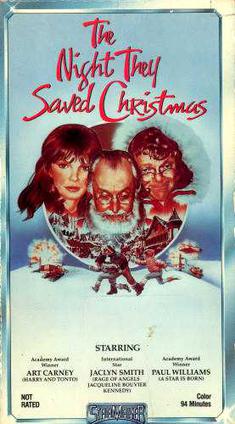
Welcome to Retro Television Reviews, a feature where we review some of our favorite and least favorite shows of the past! On Sundays, I will be reviewing the made-for-television movies that used to be a primetime mainstay. Today’s film is 1984’s The Night They Saved Christmas! It can be viewed on Tubi and YouTube.
The Night They Saved Christmas argues that there are two types of people in the world.
There are people who still believe in Santa Claus and all that he represents and then there are the people who gave up their belief a long time ago. Those who believe in Santa Claus are still full of the Christmas spirit and, under the right circumstances, they might even get to meet the elves and the jolly old man himself. Those who do not believe are destined to waste their holiday on focusing on material things that aren’t really important.
Petroleum engineer Michael Baldwin (Paul Le Mat) doesn’t believe in Santa Claus and that’s why he had no trouble moving his entire family to the North Pole so that they could freeze while he headed up an oil exploration project. Michael and his boss, billionaire Sumner Murdock (Mason Adams), are determined to find oil and they’ve got an endless supply of dynamite with which to search for it.
Michael’s wife, Claudia (Jaclyn Smith), still believes in the spirit of Santa and she encourages their children to believe as well. For that reason, Ed the Elf (played by singer Paul Williams), is willing to take Claudia and the kids to North Pole City. They get to meet Santa (Art Carney) and they even learn how Santa uses satellite technology to deliver presents all over the world. The city is really quite impressive, with the movie making good use of matte paintings and miniatures to create the impression of a magical metropolis. And Santa turns out to be a pretty nice guy, even if he does tell the elves that he’s sick of them singing Jingle Bells.
Unfortunately, North Pole City is in danger! Every day, the oil company’s dynamite causes a mini-earthquake. With the dynamiting getting closer and closer to North Pole City, Santa and the elves worry that they might be on the verge of getting blown up! Can Claudia and the kids convince Michael to stop blowing up huge chunks of the North Pole before Christmas is ruined!?
Well, listen — I don’t think it’s a spoiler for me to tell you that Christmas is not ruined. It would be pretty cynical for the movie to end with Michael blowing up Santa Claus and cynical is one thing that TheNightTheySavedChristmas is not. This is a very earnest film, full of cheery elves, a paternal Santa, and lots of Christmas music. Even greedy old Mr. Murdock turns out to be not that bad of a guy. In the end, this film says that Santa and the spirit of Christmas is for everyone and that’s certainly not a bad message. It’s a likeable movie for the holiday season and Art Carney is a perfect Santa Claus, even if he does appear to be a little underweight for the role. As played by Carney, Santa is welcoming, good-humored, and still enthusiastic about his job, even after centuries of doing it. He’s exactly the way you would want Santa to be. This is a film that earns the right to wish everyone a merry Christmas!
Yes, there is such a thing. First released in 1993, Little Miss Millions tells the story of a cynical but good-hearted private investigator named Nick Frost (Howard Hesseman) who is hired to track down a 9 year-old runway named Heather (Jennifer Love Hewitt, making her feature debut at the age of 12). Nick is hired by Heather’s stepmother, Sybil (Anita Morris), who only wants Heather back because she’s worth several million dollars. After Sybil hires Nick, she also decides to frame him for kidnapping Heather so that she can both get back her stepdaughter and get out of having to pay any reward money. Soon, Nick has two federal agents (played by James Avery and Robert Fieldstell) on his trail. For her part, Heather just wants to find and live with her birthmother, Susan (Terri Treas).
It’s a pretty simple film, one that borrows heavily from It Happened One Night (minus the romantic element, of course) and every single Christmas film that has ever been made. This is one of those rather corny family films where you will pretty much be able to guess everything that is going to happen before it happens but that’s not necessarily a bad thing. It’s a holiday film and no one watches a holiday film to get depressed. They watch holiday films for the sentimental moments and the heart-warming comedy and the moments that create an idealized portrait of life during the holiday season. For all of the violence to be found in them, bothDie Hard and Die Hard 2 end with John McClane being reunited with his wife for the holidays. As dark as It’s A Wonderful Life occasionally is, it still ends with that bell ringing and Clarence getting his wings. Miracle on 34th Street never answers for sure whether or not Kris Kringle is who he says he is but Natalie Wood still gets her house with a tree in back. A Christmas Story‘s Ralphie does not shoot his eye out. Lethal Weapon‘s Riggs finds a new family. And don’t even get me started on Santa Claus Conquers The Martians. We watch holiday movies for holiday cheer and, in its unpretentious way, Little Miss Millions is full of that cheer.
Of course, it’s still a Jim Wynorski film. So, while this is definitely a family film without many of the things that are typically associated with the Wynorski brand, Little Miss Millions still finds time for a sudden rainstorm that leaves everyone drenched. And, of course, Nick and Heather stop off at a biker bar that is inhabited by Rick Dean, Toni Naples, and wrestler Queen Kong. Peter Spellos, who played the much-abused Orville Ketchum in Sorority House Massacre 2 and Hard To Die, shows up as a bus driver. It’s still a Wynorski film but it’s also a sweet-natured film, featuring likable performances from Howard Hesseman and Jennifer Love Hewitt. It’s not a holiday classic but it’s diverting enough for those looking for something with which to pleasantly pass the time.
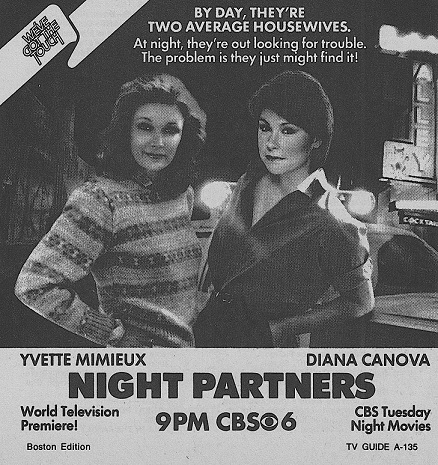
Welcome to Retro Television Reviews, a feature where we review some of our favorite and least favorite shows of the past! On Sundays, I will be reviewing the made-for-television movies that used to be a primetime mainstay. Today’s film is 1983’s Night Partners! It can be viewed on Tubi.
Lauren Hensley (Diana Canova) is a divorced mother who has a nice house in Bakersfield, California. Her best friends and neighbors are housewife Elizabeth McGuire (Yvette Mimieux) and Elizabeth’s husband, a cop named Glenn (Arlen Dean Snyder). One night, after spending the day with the McGuires, Lauren returns to her home and is attacked by three burglars.
For Lauren, the crime is not even the worst part of the night. The worst part is when the police don’t even seem to care that much about her suffering and instead take a “just-the-facts” approach to getting the details to what she’s been through. Glenn attempts to explain to both Lauren and Elizabeth that cops see terrible things every day and, if they seem desensitized to it all, that’s just their way to handling the stress of the job. Lauren, however, feels that the cops need a unit that provides the same support for victims that the criminals receive from their lawyers and social workers.
At a community meeting, Lauren proposes her idea to the police chief, John Wilson (Larry Linville). When Wilson replies that there is no money in the budget, Lauren suggests that maybe the program could be staffed by volunteers. She then proceeds to volunteer herself and Elizabeth. Wilson agrees, but on the requirement that Lauren and Elizabeth first attend the police academy and train with the officers. Under the watchful eye of the gruff but kindly Joe Kirby (M. Emmet Walsh), the two middle-aged housewives run obstacle courses and learn about conflict resolution. And while the conflict resolution lessons make sense, I’m not sure what the point of having them do the obstacle course was.
Eventually, Lauren and Elizabeth become quite good at their jobs, providing comfort to the victims and getting information that helps the police put away criminals, like the serial rapist (a young M.C. Gainey) who has been stalking the streets of Bakersfield. Of course, it takes them a while to get good at the job. When Elizabeth and Lauren are first sent out on the streets, they can’t even keep the police codes straight and they accidentally call in a robbery code when they’re instead just letting the dispatcher know that they’re on break. Bizarrely, when Lauren and Elizabeth are not at a crime scene talking to a victim, they’re just supposed to drive around in a beat-up patrol car. Neither one of them has the power to arrest anyone because they’re just volunteers. In fact, they’re supposed to stay out of the way until the police specifically call for them to come to a crime scene. So, why are they patrolling the city like real cops? It seems like that would basically be a lawsuit waiting to happen.
Night Partners was obviously designed to serve as a pilot for a series where Laruen and Elizabeth would comfort victims and help to solve crimes. The two lead actresses are likable and M. Emmet Walsh is particularly effective as their supervisor. That said, the film itself can’t decide if it wants to be a hard-hitting crime drama or a comedy about two housewives trying to make it as cops. Of course, there’s no reason why it couldn’t be both. Some of the best cops shows have had elements of dark, gallows humor. But this film’s tone is so inconsistent that the comedic scenes seem to be taking place in an entirely different universe from the dramatic scenes.
As someone who strongly believes that the right of the victims need to be given as much weight as the rights of the criminals, I appreciated the film’s message. I just wish it had been delivered a bit more effectively.
Assassin tells the story of Alexa (Nomzamo Mbatha), a soldier whose husband (Mustafa Shakir) was a member of secret government program in which people would allow their minds to be transferred into the bodies of strangers so that those strangers could then be used to assassinate America’s enemies. When Alexa’s husband ends up in a coma as a result of trying to assassinate Adrian (Dominic Purcell), Alexa is forcefully recruited into the program and is sent to complete her husband’s mission.
That may sound like it would make for an intriguing film but Assassin is pretty dull. Neither Nomzamo Mbatha nor Dominic Purcell give particularly interesting performances and the film’s plot and themes were far better explored in Brandon Cronenberg’s Possessor. Watching the film, I found it impossible to have much sympathy for Alexa because she was not only murdering people but she was also ruining the lives of the innocent people who she ended up possessing. The fact that her husband was in a coma didn’t excuse any of that. If anything it made Alexa even less sympathetic. After seeing what being an assassin did to her husband, why would Alexa want any of that?
Towards the end of the film, one of Alexa’s targets realizes that Alexa is possessing someone else’s body. Alexa’s handler announces that she’s going to pull Alexa out of the body and then “get the wet team to take this guy out.” If you have a team that can do it, why are you wasting time with possessing other people’s bodies? Why would you decide to use the most complicated plan available when you could just simply send in a team and or have a drone blow up the guy’s house? It’s almost as if the program is designed to be too complex to work. As I watched the film, I suddenly started to understand why the CIA was never able to take out Castro. Sometimes, people just make things complicated for no reason.
Sadly, Assassin is also the final film of Bruce Willis. Willis plays Valmora, the guy who is in charge of the Assassin program. As was typical of Willis’s final films, he only gets a few minutes of screen time and he spends most of that time either sitting down or standing in a corner. Willis, even though he obviously wasn’t in the best of health when he shot this film, still projects enough natural authority to be believable as Valmora. Even though it’s obvious that he’s repeating lines that were fed to him just a few minutes before shooting, Willis still gives the most (and perhaps only) credible performance in the film.
Assassin is a sad note for Bruce Willis to go out on. Of Willis’s final batch of films, the best were Gasoline Alley, Corrective Measures, and Wire Room. Assassin, however, is just dull and anyone tempted to watch it just because of Willis’s presence would be better served to go rewatch Die Hard, Pulp Fiction, The Sixth Sense, 12 Monkeys, or …. well, really, any other movie that Bruce Willis ever appeared in. Bruce Willis was one of our greatest movie stars and nothing, not even films like Assassin, can change that.





 Through the Shattered Lens