Retro Television Reviews: Suddenly Single (dir by Jud Taylor)


Welcome to Retro Television Reviews, a feature where we review some of our favorite and least favorite shows of the past!  On Sundays, I will be reviewing the made-for-television movies that used to be a primetime mainstay.  Today’s film is 1971’s Suddenly Single!  It  can be viewed on YouTube.
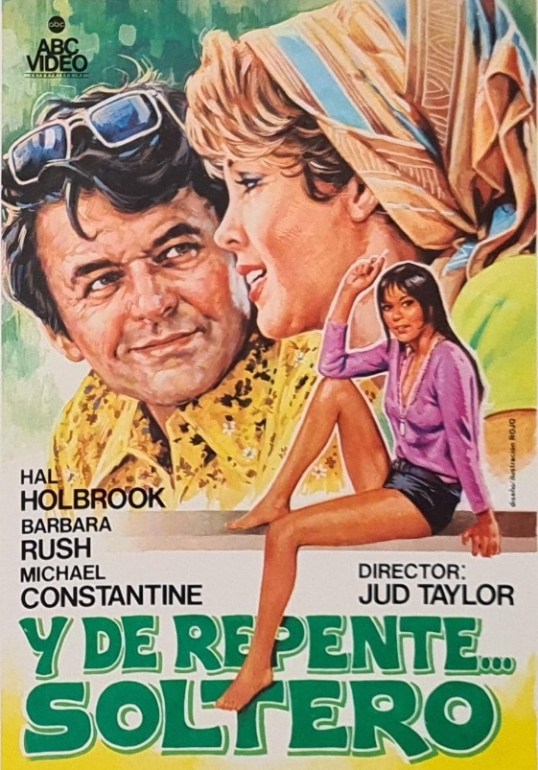
Suddenly Single opens with middle-aged Larry Hackett (Hal Holbrook) loading his suitcases into the back of his car.  His neighbors (David Huddleston and Pamela Rodgers) come over to say goodbye.  Larry has just gotten divorced and, as a result, he’s lost his perfect house in the suburbs.  Now, he’s going to have to move into the city and start a new life but he assures his neighbors that he’ll be okay and that there aren’t any hard feelings between him and his ex, Joanne (Cloris Leachman).  Sometimes, marriages just don’t work out….

Then Joanne shows up….

With her new husband, Ted (Fred Bier)!

While Larry can only watch, Ted insists on picking up Joanne and carrying her over the threshold of what used to be Larry’s house.  As it dawns on him that Joanne was having an affair during the final days of their marriage, Larry is understandably miffed.

Larry just isn’t ready to find himself in the world of the early 70s.  He’s an extremely conservative pharmacist who will now have to deal with hippies and the single scene.  His co-worker (Harvey Korman) encourages Larry to hit the bars.  Marlene (Agnes Moorehead) encourages him to figure out what he wants to do with his life.  His new and much younger neighbor, Jackie (Margot Kidder), tells him that he needs to get a gym membership and be more open-minded.  At first, Larry pursues a relationship with the classy Evelyn Baxter (Barbara Rush) but then he’s drawn to Jackie.  And Jackie, oddly enough, is drawn to him….

Quicker than you can say Breezy, Larry is dating the much younger Jackie and he’s starting to wear hip clothes and hang out with cool, long-haired people.  When he runs into his old neighbors on the street, he discovers that he no longer has much in common with them.  However, Larry still finds himself becoming jealous and possessive of Jackie, who is not the type of to give up her freedom for a relationship.  In the end, Larry is forced to admit that, while he has become more open-minded following his divorce, he still can’t magically change who he is.

Suddenly Single has a great cast and it’s not surprising that it’s a well-acted film.  At the same time, Larry can be a bit of a jerk.  Evelyn is the nicest person in the entire movie and Larry basically breaks her heart so that he can pursue an obviously doomed relationship with the younger Jackie.  It’s a bit sad to watch because everyone but Larry can see what he’s doing.  Larry may be wiser by the end of the film but that’s small solace to Evelyn.  Suddenly Single is about flawed characters and, as such, it can be easy to get annoyed with Larry and Jackie while also appreciating the fact that, like all of us, they’re just trying to figure out life as they go along.

Suddenly Single acts as a bit of time capsule and watching it is as probably as close as one can get to 1971 without a time machine.  It’s a trip to the past with some of the best actors of the era.
Film Review: A Stranger In The Woods (dir by József Gallai)


“My humor is a bit abstract.”

— Victor Browning (Bill Oberst, Jr.)

“He’s a very strange guy.”

— Edith (Laura Ellen Wilson)

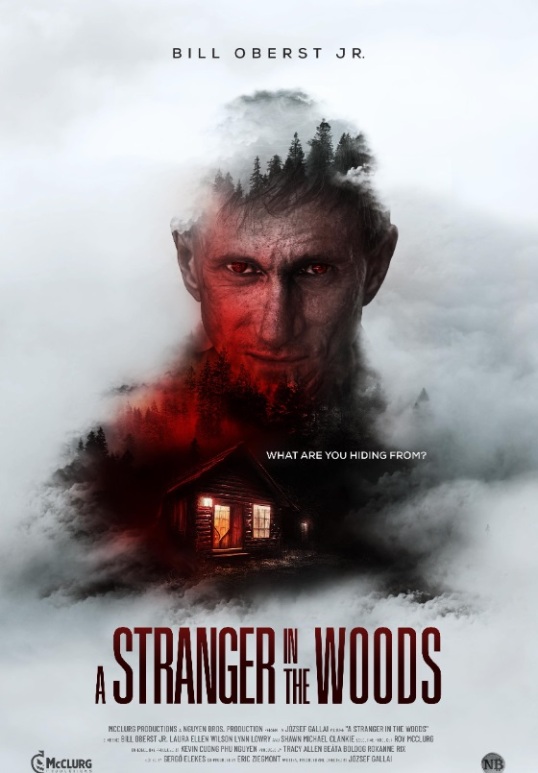
A Stranger In The Woods opens with a car driving into the woods.  The skies are cloudy.  The road is isolated.  It’s unsettling because, other than the driver of the car, there aren’t any other people around.  Other than the road, there are no signs of civilization.  It’s the type of image that causes the viewer to consider just how much we take for granted the idea of interacting with other people and living in a world where our needs are taken care of.  Today, we view anyone who would separate themselves from civilization as being an eccentric.  In the past, though, that was how most people lived.  They lived alone in home that they built for themselves and visitors and strangers were viewed with suspicion.  It’s a way of life that many people had forced upon them from 2020 to 2021 and it led to the anger and societal anxiety that is still shaking the world today.  Living in isolation is not easy for most people in the modern world, which is perhaps why we are so fascinated with people who can actually handle it.

Driving the car is Edith (Laura Ellen Wilson), a 20-something film student who has been given a tip by one of her professors.  There is a man named Victor Browning (Bill Oberst, Jr.) who lives by himself in the woods.  He’s known for being a bit off-key but he is considered to be generally harmless.  He lives in a cabin, spending his time in what appears to be self-imposed exile from the world.  He only occasionally leaves his cabin so he can get supplies.  Victor has agreed to be interviewed by Edith for a student documentary.

The first meeting with Victor is a bit awkward but he soon starts to open up to Edith.  Victor seems to be friendly and polite, even if he does appear to be a bit haunted by things that happened in the past.  Then again, Edith has things in her past that haunt her as well.  However, as Edith’s stay with Victor continues, she starts to notice some odd and eventually disturbing things about Victor and his isolated existence….

A Stranger In The Woods is a found footage film, playing out as a combination of the footage that Edith shot for her documentary and audio recordings of phone calls that she placed to various people.  As a result, we learn about Victor’s secrets along with Edith.  Like Edith, we start the film liking Victor for his shy manners and his seemingly gentle sense of humor and, just like Edith, we are shocked to witness his sudden changes in mood and his seeming reluctance to discuss certain aspects of his life.  Bill Oberst, Jr. gives a performance that keeps you guessing about just who Victor is and what he’s doing out in the woods.  Oberst is sometimes likable and sometimes frightening and he always keeps the audience from getting too complacent while watching the story unfold.  Victor Browning’s name brings to mind such Universal horror icons as Victor Frankenstein and director Tod Browning and, like the characters who appeared in those classic horror films, he is compelling even when we’re not sure what’s going on inside his head.

A Stranger In The Woods is an atmospheric film, one that understands that there’s nothing scarier than being alone in the middle of nowhere in the dark.  Victor is a fascinating character and fans of 70s horror will want to watch for Lynn Lowry’s cameo during the second half of the film.  A Stranger In The Woods is an effectively creepy portrait of a very strange guy.

Retro Television Reviews: The Hippie Temptation (dir by Warren Wallace)


Welcome to Retro Television Reviews, a feature where we review some of our favorite and least favorite shows of the past!  On Sundays, I will be reviewing the made-for-television movies that used to be a primetime mainstay.  Today’s film is 1967’s The Hippie Temptation!  It  can be viewed on YouTube.

“This is a hippie,” a sober and serious voice says over the image of a rather clean-cut young man sitting in a park.

So starts the 1967 CBS news documentary, The Hippie Temptation.  Hosted by a white-haired and distinguished voiced journalist named Harry Reasoner, The Hippie Temptation takes a look at the subculture that, in 1967, was taking the youth of America by storm.  Reasoner walks through the Haight Ashbury neighborhood of San Francisco, followed by a group of hippies who hang on every word.

Hippies, Harry explains, their very name suggests that they are hip!

Harry Reasoner talks about how the hippies are predominantly liberal and say that they are dropping out of a society that they consider to be hypocritical.  They have no interest in what their straight parents are concerned with.  Harry’s tone goes from being gently condescending to rather alarmed as he explains that hippies use a new illegal drug called LSD to try to open up their minds.  The bad trip, Harry says, is always a possibility and suddenly, the screen is full of Dutch angle images of San Francisco.

The majority of this documentary focuses on the dangers of LSD.  A pipe-smoking scientist shows a diagram of a chromosome of a repeated LSD user.  The repeated use of LSD is compared to having epilepsy.  Harry says that LSD is illegal in California but it’s still easy to find in San Francisco.  No mention is made of marijuana or heroin or any of the other drugs that may have been a part of the Haight Ashbury scene.

Harry is a bit surprised that the hippies are not particularly concerned about what the scientists think about LSD.  The Hippie Temptation is to not care about consequences and to instead do whatever you want.  Harry discusses how the hippies claim not to care about money or material things but, as he points out, some people are getting rich in Haight Ashbury.  He drops in to visit a local band called the Grateful Dead “who appear to be living in affluence.”  The members of the band admit that they also use LSD and other drugs.  Harry shows us a performance of the Grateful Dead performing and comments on how the light show is designed to imitate a psychedelic experience.

(Along with the Grateful Dead, future actor Peter Coyote also appears briefly, giving out free food as a member of a collective called The Diggers.)

Hippies can make money, Harry says, if they can find an employer who doesn’t mind long hair and strange clothing.  It’s hard not to smile at this comment because, by today’s standards, the hippies in this documentary look remarkably preppy and almost conservative.  Turtlenecks, colorful shirts, and neck length hair no longer come across as being the height of rebellion.  The majority of the hippies that Harry talks to look like they could be accountants.

This is one of those documentaries where the older generation tries to figure out why their kids are so weird.  It’s hard not to smile at the sight of a clearly uncomfortable Harry Reasoner being surrounded by a bunch of future accountants and middle managers.  That said, this documentary was an interesting time capsule.  It was a chance to see a firsthand account of what people were worried about in 1967.

Ghosts of Sundance Past: Living in Oblivion (dir by Tom DiCillo)


As we all know, this year’s Sundance Film Festival started yesterday.

To me, Sundance has always signified the official start of a new cinematic year.  Not only is it the first of the major festivals but it’s also when we first learn about some of the films that we’ll be looking forward to seeing all year.  It seems like every year, there’s at least one successful (or nearly successful) Oscar campaign that gets it start at Sundance.  For instance, it is probable that Past Lives will receive an Oscar nomination for Best Picture on Tuesday and its campaign started with how it was received at the 2023 Sundance Film Festival.

My plan for this year is to spend the last few days of January looking at some of the films that have won awards or otherwise created a splash at previous Sundance Film Festivals.

Like 1995’s Living in Oblivion for example….

Living in Oblivion centers around the filming of an independent movie called, appropriately enough, Living in Oblivion.  The film is being directed by Nick Reve (a youngish and, I’ll just say it, hot Steve Buscemi), a filmmaker whose indie cred does not protect him from the difficulties of shooting a movie with next to no budget.  His cinematographer is Wolf (Dermot Mulroney), who is talented but pretentious and who is dating the first assistant director, Wanda (Danielle von Zerneck).  The film stars Nicole (Catherine Keener), a struggling actress who is best known for appearing in a shower scene in a Richard Gere movie.  Also appearing in the movie is Chad Palomino (James LeGros), an up-and-coming star who is appearing in Nick’s film to build up his critical reputation.  (He also assumes that Nick is friends with Quentin Tarantino.)

We don’t really learn much about the plot of the film-within-a-film.  It appears that Nicole is playing Ellen, a woman who is trying to come to terms with her abusive childhood and her romantic feelings towards her friend, Damien (played by Chad Polomino).  The scenes of the film that we see alternate between being insightful, melodramatic, and pretentious.  We see Ellen confronting her mother about her abusive childhood but we also see a dream sequence in which Ellen, who is dressed as a bride, attempts to grab an apple from Tito, a person with dwarfism (played, in his film debut, by Peter Dinklage).

To talk too much about the film’s narrative structure would be to spoil one of Living In Oblivion‘s most clever twists.  What I can safely say is that, much as with Truffaut’s Day For Night, Living In Oblivion is more concerned with the production than the film that’s being shot.  Nick struggles to keep his cool.  Nicole struggles with her fear that she’ll always just be known as the “shower girl” and with the difficulty of keeping her performance fresh through multiple retakes.  Wolf makes a point of wearing an eyepatch after claiming Wanda injured his eye and turns sullen when Nick says he doesn’t want to shoot a scene with a hand-held.  A smoke machine first produces too little smoke and then too much.  When Chad does show up on set, he is passive-aggressively tries to change the blocking of one of the film’s most important scenes.  As for the dream sequence, it’s threatened when Tito denounces the scene and his role in it as being an indie film cliche.  Throughout, director Tom DiCillo contrasts the studied structure of a finished film with the chaotic reality that goes into shooting.

Living In Oblivion is an affectionate satire, one that pokes fun at the indie film scene while also celebrating all of the hard work and different personalities that are involved in making a movie.  Steve Buscemi and Catherine Keener give heartfelt performances as two people who understand that every movie could be their last while Dermot Mulroney scores some of the biggest laughs as the self-important Wolf.  James LeGros is hilariously shallow and vain as a character who is rumored to be based on one of the biggest movie stars of the past 30 years.  (“I want an eyepatch!” Chad declares while looking at Wolf.)  Living In Oblivion is a movie that celebrates the beautiful madness of trying to shoot an important film for next to no money in a grubby warehouse.  Throughout the film, the film’s crew is forced to compromise but, at the same time, there are also the small and unexpected moments that make it all worth it.

Living In Oblivion‘s witty script deservedly won the Waldo Salt Screenwriting Award at the 1995 Sundance Film Festival.  Living in Oblivion is a celebration of both cinema and independence.

Retro Television Review: Thief (dir by William A. Graham)


Welcome to Retro Television Reviews, a feature where we review some of our favorite and least favorite shows of the past!  On Sundays, I will be reviewing the made-for-television movies that used to be a primetime mainstay.  Today’s film is 1971’s Thief!  It  can be viewed on Tubi and YouTube.

Neal Wilkinson (Richard Crenna) would appear to be living a great life.  He has a nice house in the suburbs.  He has a beautiful girlfriend named Jean Melville (Angie Dickinson).  As he heads into middle-age, he is still fit and handsome and charming.  He dresses well, or at least well by the standards of the early 70s.  (By the standards of today, a few of his ties are a bit too wide.)  Everyone believes that Neal has a nice and comfortable job as an insurance agent.

Of course, the truth is far different.

Neal is a veteran con man and a thief.  He’s just recently been released from prison and his deceptively friendly parole officer (played by the great character actor, Michael Lerner) is convinced that Neal will screw up again eventually.  And, of course, Neal has screwed up.  A gambling addict, he is $30,000 in debt.  Can Neal steal enough jewelry from enough suburban homes to pay off his debt?  Can a man like Neal change his ways?

This is a surprisingly somber made-for-TV movie.  Just from the plot description and the film’s first few minutes, you might expect Thief to be a light-hearted caper film in which Neal and Jean work together to pull off one last heist so that Neal can retire.  Instead, Neal spends almost the entire film lying to Jean and there’s hardly a light moment to be found.  Neal says that he wants to retire from his life of crime but, as the film makes clear, that’s a lie that he’s telling himself.  Neal cannot stop stealing and gambling because he’s as much of an addict as the wild-haired junkie (Michael C. Gwynne) who briefly confronts Neal at the parole office.  At one point, Jean tells Neal, “The more I know you, the less I know you,” but the truth of the matter is that Neal is so deep in denial about the futility of his life that he doesn’t even know himself.

It’s not a particularly happy film.  Richard Crenna is ideally cast as Neal, playing him with enough charm that the viewer can buy that he could talk his way out of being caught in a stranger’s backyard but with also with vulnerability that the viewer can see his fate, even if he can’t.  Thief also provides a rare opportunity to see Cameron Mitchell playing a sympathetic role.  Mitchell is cast as Neal’s attorney, who continually tries to get Neal to stop messing up but who ultimately knows that his attempts to reform Neal are just as futile as Neal’s attempts to go straight.

The movie ends on a surprisingly fatalistic note, one that suggests that there’s only one way to truly escape from a life of crime.  I can only imagine how viewers responded in 1971, when they turned on their television and found themselves watching not a light-hearted caper film but instead a bleak examination of criminal ennui.  It’s not a happy film but it is more than worth watching for Richard Crenna’s lead performance.

Catching Up With The Films of 2023: Nyad (Dir by Elizabeth Chai Vasarhelyi and Jimmy Chin)


64 year-old swimmer Diana Nyad swimming all the way from Cuba to Florida (and making it on her fifth attempt) is one of those inspiring stories that I totally missed when it happened.  I can’t remember for sure exactly what was going on in my life in 2013 but paying attention to inspirational sports stories was apparently not high on the agenda.

Fortunately, any amazing true story will eventually be turned into a film and that film will eventually premiere on Netflix in time for Oscar consideration.  That’s certainly the case with Nyad, which stars Annette Bening as the title character and Jodie Foster as her best friend and coach, Bonnie Stoll.  The film follows Nyad as she spends four years of her life trying to make it from Cuba and Florida and prove the naysayers wrong.  Along the way, she learns about humility, she learns to value her friends, and she also starts to deal with the various traumas of her youth.

It’s not a bad film.  It may sound like a traditional sports biopic and, in many ways, it is.  The directors are documentarians making their feature debut and they do have a tendency to rely a bit too much on archival footage of network news reporters announcing that Nyad will be making another attempt to make the swim.  The film (and the characters) unquestioning love for Cuba can be a bit hard to take, considering that the story takes place at a time when Raoul Castro was still ruling the country.  (The amount of “Visit Cuba” shirts felt more than a little excessive.  Don’t visit Cuba as long as Jose Daniel Ferrer is being detained.)  That said, the cinematography is gorgeous and the film does a wonderful job of showing just how physically and mentally exhausting Nyad’s accomplishment was.  It’s not just that Diana is physically drained from the experience.  She also occasionally suffers hallucinations as a result of exhaustion and exposure and, often times, she’s unaware of how far along she is in her journey.  While Diana swims, Bonnie and the rest of her team steer her, trying to keep her moving with the unpredictable current.  This is a film that will leave you respecting professional swimmers and their support teams.

The film’s cast does a great job bringing the story to life.  As portrayed in the film, Diana Nyad can be a bit of a pain to deal with and, to her credit, Annette Bening doesn’t try to soften any of the character’s rough edges.  Nyad is a egotistical, grandiose, impractical, demanding, and frequently self-centered and it says a lot of about Bening’s performance that the audience still ends up sympathizing with her and her desire to not be dismissed as obsolete at the age of 60.  That said, the film truly belongs to Jodie Foster and Rhys Ifans, playing Nyad’s coach and her navigator.  While Nyad rails against age and insists that her destiny is to successfully make the swim,  it falls to the characters played by Foster and Ifans to just keep Diana alive.  Foster is the film’s heart, playing Bonnie as a tough but caring coach who understands that, even though they drive each other crazy, she and Nyad are meant to make the journey together.  While the film portrays Nyad’s accomplishment, what it truly celebrates is her friendship with Bonnie.  We should all be so lucky to have a friend and supporter like Bonnie in our lives.

It may not break any new cinematic ground but Nyad still does a good job of telling a worthy story.

Catching Up With The Films of 2023: The Equalizer 3 (dir by Antoine Fuqua)


Robert McCall (Denzel Washington), the Equalizer, is killing people again.

This time, he goes to Sicily, where he invades a local winery, kills all of the guards, and then shoots the winery’s owner in the ass while the already wounded man pathetically crawls away.  Admittedly, everyone that McCall killed was bad and the winery owner would have killed McCall if things had worked differently but still, it’s an awful lot of death and violence just to retrieve some money that was stolen in a cyber-heist.

As McCall leaves the winery, he sees the owner’s young son and he declines to kill a child because, in the movies, adults only kill other adults.  Otherwise, the viewer might lose sympathy for them.  The kid, however, does not live under the rules of Hollywood so he grabs a shotgun from his father’s car and shoots McCall in the back.  McCall falls to the ground and attempts to shoot himself in the head.  However, his gun is out of bullets.

That’s right, our hero nearly shot himself in the head.  If he had succeeded, the movie would have been much shorter.  But since he wasted all of his bullets on the guards at the winery, McCall just passes out from the shock.  Eventually, he is found and taken to a village doctor named Enzo (Remo Girone).  Enzo removes the bullet.  When McCall awakens, Enzo asks him if he’s a good man or a bad man.  Enzo later says that McCall’s inability to answer was all the proof the he needed to know that McCall was a good a man.

McCall recuperates in the village and soon, he becomes an accepted member of the community.  He starts to contemplate leaving behind his life of violence and, in a well-done sequence, is haunted by the memory of how many people he killed at the winery.  But when the local Camorra starts to harass the villagers and threaten McCall’s new friends, it’s time for McCall to once again go to action.

If I sound a bit snarky, it’s because I’ve lost track of the number of films that I’ve seen about stoic former intelligence agents who kill a lot of people.  The Equalizer 3 is actually a well-made film, one that makes good use of its star’s charisma and the beautiful Sicilian scenery.  Denzel Washington isn’t getting any younger but he’s still believable as someone who could take down an army single-handedly and, even more importantly, he does a good job of portraying what a life of violence would do to a man’s soul.  Appropriately enough given the Sicilian setting, the film is full of religious imagery and The Equalizer 3, at its best, becomes a story about a man searching for redemption and a higher calling.

That said, the film is entertaining and it holds your interest (and I’m thankful that this is one mainstream film that does not feature an excessive running time) but the plot is undeniably formulaic and the villains aren’t particularly interesting.  There’s a subplot featuring Dakota Fanning as a young CIA agent that feels tacked on.  On a personal note, I find myself growing weary of CGI violence and stories about one-man killing machines.  (When I was younger, I could easily celebrate a hundred henchmen getting taken out by our hero.  Now, I found myself saying, “He probably had a family.”)  The film ends on a note of redemption for McCall and I hope he takes it for all it’s worth.

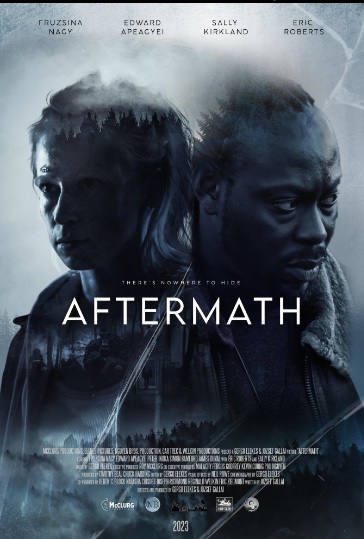
Film Review: Aftermath (dir by Jozsef Gallai and Gergö Elekes)


A woman named Kate (Fruzsina Nagy) drives down a road.  We don’t know where she is driving to but we can tell that she’s driving quickly and she’s not in the mood for any delays.  It’s the way that someone drives when they’re trying to escape but they’re not sure where they want to go.  It’s way you drive when you just want to convince yourself that you can somehow leave everything behind.

We hear what sounds like an accident and suddenly, Kate is waking up in a forest.  Her car is nowhere to be seen and Kate has no idea how she came to be in the forest.  In fact, she’s not even sure who she was before she woke up.  She has no memories of her past life, beyond fleeting visions that don’t always seem to fit together.  Eventually, she meets another apparent amnesiac, Bubba (Edward Apeagyei).  Bubba wears a locket around his neck and there’s a picture of a woman in the locket but he doesn’t seem to be quite sure who she was.

Bubba and Kate are not alone in the forest.  There are other wanderers and then there’s a group of men who appear to be soldiers, wearing crude uniforms and gas masks and carrying machine guns.  (The sight of the soldiers, with their crude uniforms, bring to mind the horrific militias that often spring up in the aftermath of a war and attempt to seize power out of the chaos.)  Receiving cryptic orders from their leader (Eric Roberts), the soldiers patrol the forest and execute anyone that they come across.  Their leader repeatedly tells them that they have to track down and execute everyone because the future of the world depends upon it.  Failure is not an option.

Aftermath deals with a very real fear.  The idea of suddenly waking up and discovering that you have not only lost your identity but also control over your own fate is at the heart of many horror stories and it’s also a reflection of the way many people feel about living in today’s world.  One wrong word, thought, or move and you can find yourself exiled into both a real and metaphorical wilderness.  When Kate wakes up with little memory of what the world was like before she ended up in that forest, she’s feeling what a lot of people have felt when they try to remember the world and their lives before the lockdowns of 2020 and all of the political and societal events that followed.  We live in a world that seems to change from day to day and, as result, everyone has had that moment when, like Kate, they’ve struggled to understand what’s happening.  From the minute that Kate wakes up with the feeling that she has no control over what’s happening to her, she becomes an instantly relatable character.  The audience not only wants to know what’s happening to her but they also want her to regain control of her fate.  If Kate can regain control, then those watching in the audience can also regain control.

The film’s cinematography emphasizes both the grandeur and the ominous atmosphere of the forest, making it a place that manages to be beautiful and threatening at the same time and the deliberate pace builds up suspense as Kate tries to discover why she is in the forest.  Fruzsina Nagy and Edward Apeagyei both give sympathetic and relatable performances as Kate and Bubba and the audience does care what happens to them.  Aftermath is both an intriguing thriller and a meditation on life and love.

Aftermath will be released on digital and blu-ray by Bayview Entertainment on January 30th.


Catching Up With The Films of 2023: Golda (dir by Guy Nattiv)


In Golda, Helen Mirren stars as Golda Meir, the 4th Prime Minister of Israel and the first woman to lead a government in the Middle East.

The film opens in 1974, with a visibly unwell Golda Meir braving a line of protestors as she testified before a commission that is investigating the events that led to the 19-day Yom Kippur War.  Sitting before the members of the commission, Meir lights a cigarette and, as the smoke forms around her, she speaks with a confidence that belies her physical frailness.  It’s the first of many cigarettes that we will see Golda Meir smoke throughout this film.  While Golda Meir was known for being a chain-smoker in real life, her smoking also plays an important thematic role in the film.  Golda Meir is terminally ill throughout the film, secretly undergoing chemotherapy and continually being told that her high-stress job, her cigarettes, and her coffee are not helping her health.  Golda, however, knows what she has to do to keep herself focuses and to handle the stress of being the leader of a small country that is surrounded by enemies and for her, that means drinking a lot of coffee and smoking a lot of cigarettes.  Much like Israel, she is not going to be told what to do by people who do not understand what she has to deal with on a daily basis.  Throughout the film, Golda willingly sacrifices her physical health for Israel, telling her more trusted aide (Camille Cattin) that the only thing that worries her is developing dementia in her old age.  A leader who cannot think cannot lead.

The majority of the film takes place in 1973, during the 19-day Yom Kippur War.  Israel is caught off-guard by a surprise attack led by Egypt and Syria.  Vastly outnumbered, the IDF struggles to repel the invaders.  While dealing with not only her own bad health but also the personal and ideological conflicts within her government, Meir also reaches out to the U.S. Secretary of State, Henry Kissinger (Liev Schreiber) for help.   Unfortunately, Washington D.C. is more concerned with Watergate than with the latest war in the Middle East and, as Meir quickly deduces, there is also worry that Saudi Arabia will cut off its supply of oil to any country that supports Israel.  Though Meir uses a combination of charm and shrewd political gamesmanship to convince Kissinger to put pressure on the Nixon administration, Meir still finds herself being pressured to accept an internationally-brokered ceasefire rather than pursue a strategy of forcing Egypt into negotiations….

Does this sound familiar?  A vicious surprise attack is launched on Israel during a holy day.  The Israeli Prime Minister, who is loved by some and vilified by others, is accused of not being sufficiently prepared for the attack.  Israel is initially isolated from the world, just to be pressured to accept a ceasefire as soon as it starts to prove its resiliency and humiliate its enemies.  Golda completed production before the October 7th attacks but the film feels like a direct response to them, a reminder that Israel has always had to fight for its existence and that it has always proven itself to be stronger than its enemies realize.

Much like Darkest Hour, another film about a leader who was underestimated, Golda plays out like a dream of history, with the emphasis being on Golda Meir moving from one meeting to another, somehow managing to hold everything together while the world sometimes seem to be falling apart around her.  A good deal of the film’s tension comes from the moments when Golda and her advisors wait to hear whether or not their latest move has been a success.  One of the film’s most harrowing scenes features Golda listening over a radio as a group of Israeli volunteers are wiped out by the invading Egyptians.  It’s a scene that reiterates the human cost of war, regardless of which side wins.  (The film makes good use of historical footage of the war, mixing it with scenes of Golda and her cabinet planning their strategy.  Again, it serves to remind the audience that there are real consequences to every decision.)  Held together by Mirren’s intelligent and authoritative performance, Golda is a film full of details that stick with you.  I’ll always remember the scenes of Golda being led through an underground morgue so that she can secretly be treated for the cancer that is slowly killing her.  With each trip, the morgue become more and more filled with bodies.

Though Mirren’s performance was acclaimed, Golda itself opened to mixed reviews.  I suppose in today’s political atmosphere, that’s to be expected.  After all, Golda is not only a pro-Israel film but it’s also a film that portrays Henry Kissinger as being something other than a one-dimensional Bond villain.  For many of today’s very online film reviewers, all of that is heresy.  At a time when some so-called educated people are driven to a rage at just the sight of posters of abducted Israeli children, Golda‘s reception is not a surprise.  At a time when people are making excuses for terrorists who would attack farmers and concert-goers, a films as otherwise different as You Are So Not Invited To My Bat Mitzvah and Golda can feel like acts of beautiful cultural defiance.

History repeats itself, Golda tells us.  Golda may largely take place in 1973 but, ultimately, it’s a film about 2023 and 2024.

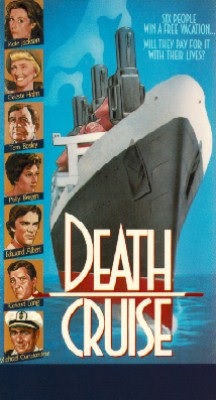
Retro Television Reviews: Death Cruise (dir by Ralph Senesky)


Welcome to Retro Television Reviews, a feature where we review some of our favorite and least favorite shows of the past!  On Sundays, I will be reviewing the made-for-television movies that used to be a primetime mainstay.  Today’s film is 1977’s Death Cruise!  It  can be viewed on Tubi and YouTube.

The thing with the Love Boat is that it promises something for everyone.  It’s a place where you set a course for adventure and put your mind on a new romance.

The same cannot be said of the Death Cruise.

Death Cruise opens with three couples winning an all-expenses paid trip on a luxury liner.  None of the couples are in a happy marriage.  Sylvia Carter (Polly Bergen) is tired of her husband, Jerry (Richard Long), and his philandering ways.  Elizabeth Mason (Celeste Holm) is frustrated with David Mason (Tom Bosley) and his loud dinner jackets.  Mary Frances Radney (Kate Jackson) is fed up with James (Edward Albert) and his smug refusal to start a family.  Of course, it’s not just martial problems that connects these passengers.  It’s also the fact that someone on the boat is stalking and killing them, one-by-one.  Can Dr. Burke (Michael Constantine) and Captain Vettori (Cesare Danova) track down the killer before it’s too late?

Death Cruise is an enjoyably twisty little murder mystery.  It aired in 1974, a good two years before the first Love Boat pilot film appeared on television.  However, both Death Cruise and The Love Boat were produced by Aaron Spelling so the two productions definitely have a shared DNA.  The Love Boat is basically Death Cruise with the addition of a laugh track and considerably less murder.  That said, I have my doubts as to whether Doc Bricker would have been as effective a detective as Dr. Burke.

One of the most interesting things about Death Cruise is how little anyone on the boat really seems to care about the fact that the passengers are turning up dead.  In fact, one widower is asking a widow to be his date to dinner within a few hours of the deaths of their spouses.  Of course, the murderer makes sure that dinner date is canceled but it’s still hard not to wonder whatever happened to an appropriate time of grieving.  Then again, I guess if you’re on a boat for a weekend, you just do whatever feels right at the moment.

(And certainly, if they were on The Love Boat, the walking HR nightmares that was Doc Bricker wouldn’t have wasted any time asking the widows to come by his office for a examination.)

Of the victims and suspects, Richard Long and Edward Albert are memorably sleazy while Tom Bosley plays up just how annoyed he is with the whole situation.  Michael Constantine is a good detective and the movie’s final twist is nicely executed.  Personally, when it comes to cruises, I will always prefer the safety and romance of The Love Boat but Death Cruise was an entertaining nautical diversion.