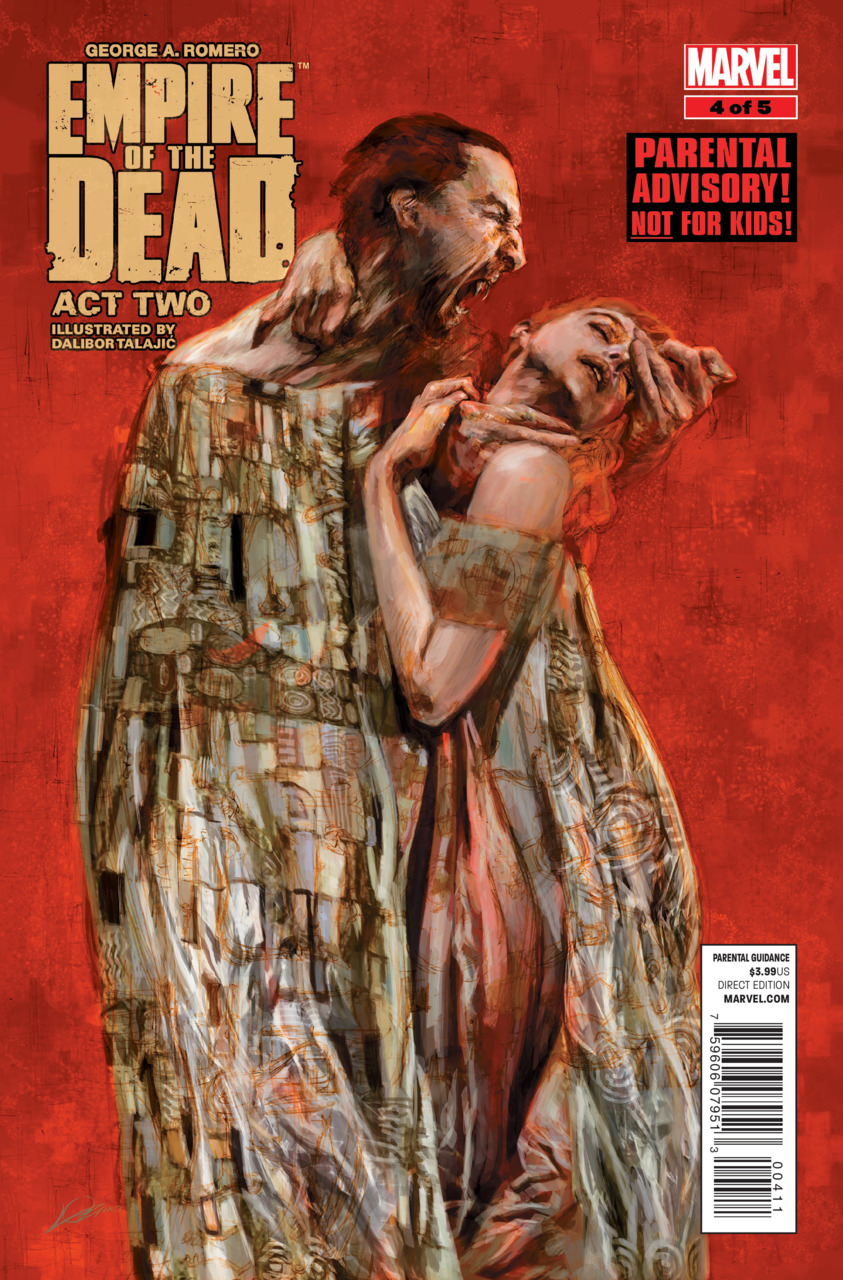
And so we find ourselves at the close of another act of what is proving to the longest-form epic to ever come from the mind and pen of the father of the modern zombie genre with George Romero’s Empire Of The Dead Act Two #5, and underneath Alexander Lozano’s absolutely superb pulp-inspired cover painting we find that the guy who started it all is ending this one on a decidedly more small-scale — and downbeat — note than the “looming disaster” finale he gave us in his first act.
Not that disaster isn’t still looming — it certainly is, and it’s more mystery-shrouded than ever, but just when everything — and I do mean everything — seems to be boiling over in this issue, Romero takes a side-step, dials back on the danger, and gives us a genuinely personal and frankly tragic cliffhanger to send this five-issue arc out on.I won’t say much more about the finale beyond that since the book just came out today and the few of you out there who are, like myself, following this comic in singles every month may not have had a chance to read it yet, but you may want to prepare yourself to get a little bit choked up come the last page.
What’s most surprising to me about the contrasting tones between the finales of the premier and secondary acts of this developing story, though, is how much more free-flowing, naturalistic, and dare I say even nochalant the fifth issue of Empire Act Two is in comparison to the fifth issue of Empire Act One. There was a sense during the in the concluding chapter of the first arc that Romero was rushing to fit a number of pieces into place and making up for lost time due to some early floundering he engaged in, script-wise, in issues two (especially) and three, whereas here his approach has been a lot more calm and methodical. He’s trusting his characters to take us along with them rather than shoe-horning them into place, and while that may result in a somewhat less “stupendous” conclusion this time around, it means that the entirety of the second act has played out much more evenly than the first. In short, he’s getting a little bit better at this as he goes.
Yeah, okay, the “big revelation” Paul Barnum finally clues Dr. Penny Jones in on is something that we all saw coming from a mile off, but there are still a few surprises to be had here, most notably in the discslosure of a prior relationship between Barnum and somebody extremely close to Mayor Chandrake , and Chandrake proves himself to be an even bigger bastard than we already thought in one scene, so it’s not like everything here is cut-and-dried predictable up until those final few panels. Chandrake’s entire world seems to be in serious danger of crumbling down around him, in fact, as his inability to deal with rival candidate “Chilly” Dobbs calls into question how much efficacy he really has left in him while the investigations of Detective “Bucky” Perez are getting closer and closer to unraveling the thread that might undo the whole ball. The main question our dogged cop is now pursuing : why are kids being loaded up onto buses when there are no more public schools (guess Chandrake’s a Republican) — and why are they never coming back?
Getting back to those aforementioned final few panels for a moment — one thing that does reduce their impact somewhat is the inking. While I’ve just about gotten used to Dalibor Talajic’s pencil art on this series, and have generally welcomed the addition of inker Rick Magyar, apparently Magyar ran into some deadline trouble with this issue (hey, it happens) and the last four pages are inked by Goran Sudzuka, who employs a mush heavier and less detailed approach with his brush that results in a more blocky, “cartoonish” style. For a few pages here and there I wouldn’t gripe much, but Sudzuka’s work seriously detracts from the impact of the heart-wrenching cliffhanger here, and that’s a real shame.
So — I guess we’ll see where this book goes, art-wise, when it returns for Act Three in April, but I’m feeling more confident than ever in Romero’s storytelling. There are big things ahead, folks, and if you haven’t been following along, catching up with this series by way of trade paperback —the second of which comes out next month — is definitely a smart move, as the next arc promises to be out-and-out explosive.