The latest pick for “song of the day” happens to come from a game I just completed playing a first playthrough. The game is BioWare’s latest and the first sequel to their critically-acclaimed fantasy rpg game, Dragon Age: Origins. This time the song is what I would call the “Lelianna’s Song” of Dragon Age 2.
“Rogue Heart” is the song which begins playing once the end credits for Dragon Age 2 begins. The song is once again composed by the same composer who did the music for the first game, Inon Zur. Inon Zur brings back singer Aubrey Ashburn to handle the song. If there was ever a song which I say truly encompassed the relationship of the character I created and played through in the game, Lisamarie Hawke, it would be this song. It’s not just typified the character but the relationship she had with one of the party members that was recruited. The pirate rogue Isabela (the character artwork in the video is Isabela) would be Lisamarie’s companion the moment the two met and would see the game right through to its climactic and ominous ending.
It’s only appropriate that both Lisamarie Hawke and Isabela were rogues thus this song fit them like bodyhugging gear. The game was better than I thought and I would say the same to its accompanying soundtrack and “Rogue Heart” is another example why rpg soundtracks always typified the best of any game soundtracks.
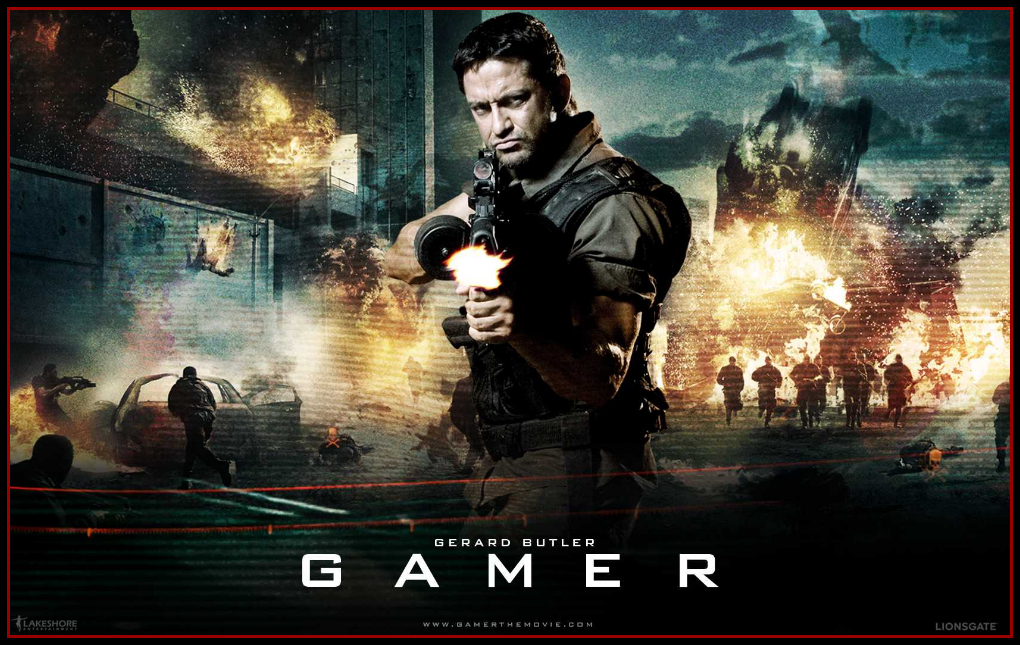
No one will ever mistake the writer-director duo of Neveldine/Taylor (Mark Neveldine and Brian Taylor) as the next Coen Brothers, but they definitely have made their mark in creating entertaining films which some have called exploitative, pandering to the lowest common denominator and exercises in excess. Maybe these critics are right, but they also seem to view the films by these two filmmakers through the narrow-minded lens of their elistist and so-called cineaste sensibilities. They won’t be the next Coen Brothers but they’re way ahead of other so-called filmmaker duos such as The Spierig Brothers (Undead and the pretentious and awful Daybreakers) or The Strause Brothers (AvP: Requiem and the awful Skyline). They came onto the scene with their cult classic action thrillers Crank and it’s sequel, Crank: High Voltage.
Their third film took the gaming influences so inherent in their first two films (which for all intents and purpose were video games that happened to be film) and went the next step. Gamer is all about a near-future world where two games with on-line social media foundations have become the rage of the entertainment world. One is a game called “Society” that looks to be the nightmare evolution of privacy advocates everywhere to the on-line virtual world Second Lifeand The Sims. It is the other game in this film which makes up the foundation of the film’s plot. “Slayers” takes the ultra-popular multiplayer on-line experiences of games such as Call of Duty and HALO to the next level by allowing gamers to actually control real people (inmates sentenced to death) to act as their avatars in a real-life battlefield arena with real weapons and real deaths.
These games which have become the obsession of hundreds of millions of people worldwide are the brainchild of the film’s antagonist. Michael C. Hall plays the creator of these games and his performance looks to combine the sociopathic charm of his Dexter character with that of Steve Jobs is the latter was openly honest about his douchebag tendencies. Playing his opposite is the character of Kable who happens to be the reigning champion of the game Slayers and who knows a secret that could tear down the billion-dollar empire created by Castle. Gerard Butler plays the desperate but very capable inmate Kable who just wants to survive past the final match and earn his freedom thus return to his wife and young daughter on the outside.
Gamer posits the question of how far are we willing to go to experience realism in our games and entertainment. With the game Society people pay to be able to control other people in a social setting (albeit in a controlled area). These so-called avatars will do anything and everything their real-life controllers tell them to do. In the film these avatars get paid to become virtual slaves and with most people signing up for the job being the socially desperate. Their situation is not so dissimilar from the condemned inmates who populate the game Slayers. The film hits the audience with a sledgehammer that these virtual entertainments have become popular worldwide because people have stopped looking at these “volunteers” as real people. Morality has been replaced by the need for instant gratification by way of these virtual on-line systems.
The film doesn’t make any apologies for the heavyhanded delivery of it’s message and also doesn’t skimp on the entertainment side of the equation. Neveldine/Taylor have shown that they have a certain flair for creating visual chaos and action on the screen. Their unique visual style does look like something out of a video game especially those from hyperrealistic shooters such as Call of Duty and its ilk. The filmmakers have always accomplished the high-quality visual look of their films despite the low to modest budget given to them by the studios they’re working for. Gamer is no exception and the film benefits from the decision by these two filmmakers to continue working with the Red One digital cameras thus allowing them to add in the visual effects right into the shot scenes the very same day of shooting.
It’s this very style of hi-tech guerrilla filmmaking which makes Neveldine/Taylor this current era’s Cormans. Unlike most low-budget filmmakers they don’t use the size of their budget to dictate how their films turn out visually, aurally and narratively. The first two this film succeeds in ways that makes an audience think the film was higher budgeted than it really was. The third would depend on the viewer whether the film succeeds or not. For those who seem intent on viewing every film as if they were made to be worthy of high awards and accolades would probably dismiss and hate this piece of exploitation cinema. Gamer succeeds in a narrative sense because it delivers on the promise of telling a story about a world where free will has been seconded to control in the need of a population in search of a the next virtual playground. It’s a heady premise that has been explored in past films such as the Matrix Trilogy and another film similar to this one which came out weeks later in Surrogates.
Gamer doesn’t have the philosophical and existential sermoning in combination with futuristic action sequences as the Wachowski Brothers’ trilogy, but it does have the same visceral action DNa as those three films and also more entertaining than the Bruce Willis vehicle Surrogates. This film will appeal to the very people who it condemns as sheep to the rising tide of on-line control in entertainment, but then that’s what all exploitation films tend to do best. Cater to the very people it uses as examples of what’s wrong in society and build an entertaining film around them and what they represent.
The film’s cast revolves around Gerard Butler and Michael C. Hall and the roles they play. Whether its Amber Valletta playing Kable’s desperate wife who has sold herself to become a controllable avatar in Society to try and earn enough to get her young daughter back or to Logan Lerman playing the role of Simon the gamer who controls Kable during the Slayer matches. They all do enough with their roles to keep their characters from becoming less than one-notes. Again, for some having a film with characters that are quite basic and one-note might make for a bad film, but when put into context of the story being told they’re quite good and needed to become motivators for Butler’s character.
In the end, Neveldine/Taylor have made a modern day exploitation and grindhouse film in Gamer without having to resort to the visual tricks used in the Rodriguez/Tarantino grindhouse homage film Grindhouse. A film doesn’t need to have film scratches, overexposed film stock, scratchy audio track or missing film reels to be grindhouse. It just have to espouse the very nature of the films which made up the kind of films which became prime example of grindhouse/exploitation cinema. Gamer won’t win any awards, but I suspect that more people who saw it were entertained by it’s blatant, in-your-face entertainment than would normally admit to it. It’s a film that has cult status and guilty pleasure written all over it.
Plus, this film is definitely worth at least a curiosity viewing if just to see the musical number performed by Michael C. Hall at the climactic sequence near the end of the film. I don’t think any film has ever combined gratuitous violence, musical dance numbers using bloodied death row inmates and Michael C. Hall singing Frank Sinatra’s “Ive Got You Under My Skin“. That sequence alone is worth a rental or Netflix Instant streaming.
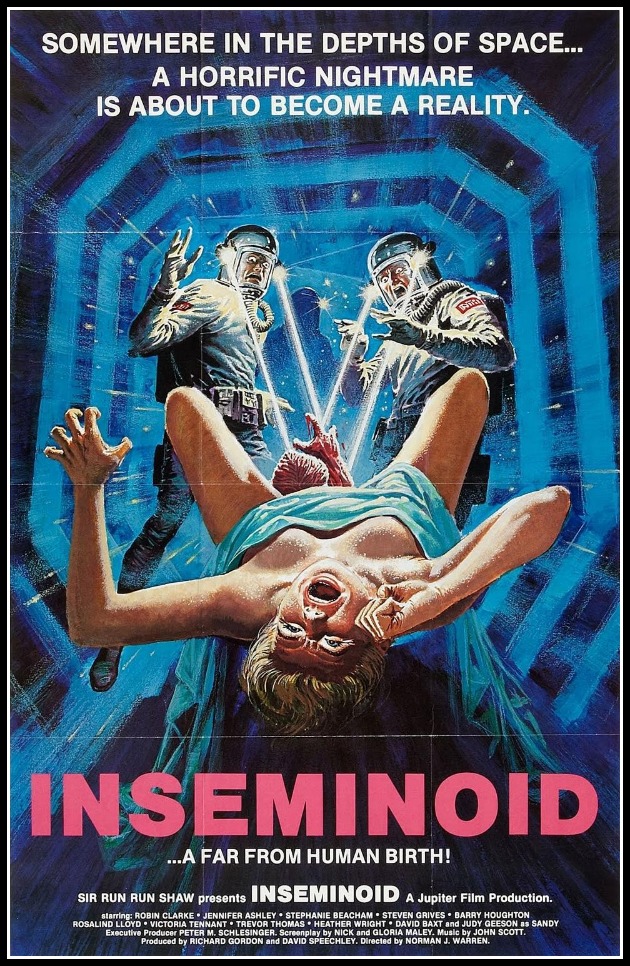
The latest daily grindhouse comes straight out of the UK from the early 80’s. It’s a sci-fi horror flick which came about as part of the exploitation wave of Alien rip-offs and imitation of the past several years since Ridley Scott’s scifi-horror masterpiece stormed through Hollywood. While it’s director, Norman J. Warren and it’s producers do not think it’s grindhouse or an exploitation film of any stripe I beg to differ.
Inseminoid (renamed for a U.S. release as Horror Planet) screams grindhouse right from that title alone. It’s a film about a group of scientists landing on an unknown and desolate planet in search of evidence that an alien civilization existed once upon a time on the planet. The whole thing was either filmed inside a studio-built spacecraft set or in a cavern complex near the studio in the UK. It’s once one of the scientists (as always with grindhouse horror it happened to be a female scientists) has become impregnated by a remnant of the planet’s long-dead civilization that the horror truly begins.
It’s that very scene of rape and alien impregnation which got this film labeled as a “video nasty” in the UK which made it’s release on video near-impossible to make without editing out that pivotal scene early in the film. That scene also got the flick compared to another grindhouse scifi-horror released the same year by low-budget auteur Roger Corman called Galaxy of Terror. Outside of both films using a rape scene by alien means the two films really had nothing in common plot-wise so I think the filmmakers of Inseminoid and Galaxy of Terror just happened to think of a similar idea at the same time.
This film is not great or even good, but like all true grindhouse the people involved in the film took their roles and task seriously to try and make the best film their budget allowed them to. It’s not a horrible film and when seen now it’s actually quite a fun little scifi-horror flick that showed a glimpse into an era of cheap, exploitation films that would last well into the late 80’s.
When I first saw John Hillcoat’s film The Proposition I was literally shocked and dumbstruck with what I had just witnessed. As a long-time aficionado of the horror genre I could say that part of me has become desensitized to onscreen violence and nothing really shocks me. Even though I’ve seen films with more violence throughout its running time, The Proposition just had a heavy sense of despair, moral ambiguity, and a Miltonian feel throughout. The film felt like how it would be if one accepted an offer from one of the damned to stroll down to the Nine Circles of Hell. As much as I didn’t want to accept that offer the curiosity of what I might see won out. That’s how I was able to sit through the entirety of Hillcoat’s ultra-violent and nihilistic tale of lawless and amoral individuals in the untamed wilderness of 1880’s Australian Outback.
I must agree with several critics who have said The Proposition seemed to mirror another dark and violent tale. Hillcoat’s film shares so much the same themes and tone as Cormac McCarthy’s brutal novel, Blood Meridian, that one almost wondered if the film was adapted from McCarthy’s great novel. But similarities aside, Hillcoat and Nick Cave’s (director and writer respectively) film can clearly stand on its own two bloody legs.
The film begins with a bloody siege and shootout and we’re soon introduced to two of the three Burns’ brothers. We soon find out that both brothers, Charlie (played by Guy Pearce) and Mikey (played by Richard Wilson), are outlaws wanted for a multitude of heinous crimes with a recent one the senseless rape and murder of the Hopkins family. One Capt. Stanley (Ray Winstone) who acts as law in this particular area of the Outback also happens to be friends of the unfortunate Hopkins clan. When he finally apprehends the two brothers after the siege gives older brother Charlie a proposition. He’ll spare the younger brother’s life from the hangman’s noose if Charlie finds their older brother Arthur (played with Kurtz-like menace by Danny Huston) and kills the outlaw leader. The quest is set as Charlie accepts and sets out to find his elder brother. Whether Charlie will go through with killing his older brother Arthur is one thing the audience won’t find out until the final minutes of the film. Even though there’s no love-lost between Charlie and Arthur, there’s still the traditional bond of family that makes Charlie’s quest a complex one.
We realize early on that Charlie is very protective of his simpler, younger brother Mikey and would do anything to save his life. Guy Pearce does a great performance as the conflicted and brooding Charlie Burns. There’s a quiet intensity in Pearce’s performance. He’s pretty quiet through most of the film, but one could feel the palpable rage just roiling beneath his brooding countenance. Pearce’s Charlie is one who is only a trigger away from exploding into outright violence. Charlie is definitely a child and creation of the lawless Outback the film is set in.
Arthur Burns on the other hand comes in introduced as an almost warrior-poet (though in this story it would be more like a charismatic-sociopath) who would watch the sun set and spout poetry as easily as gun down an innocent or slice a man’s throat without missing beat. Danny Huston does a bravura performance as the charismatic and wholly amoral Arthur. His performance easily matches that of Pearce’s scene for scene. Another performance that I must point out as being very strong in the film is Ray Winstone as Capt. Stanley, the Ahab of the tale with his obsession to bring civilization to the lawless Outback and to bring Arthur Burns to ultimate justice even if it means dealing with the lesser evil that is Charlie Burns.
The Proposition will be talked about alot for its unflinching look at violence onscreen. Though there’s been films that have more violence per hour than Hillcoat’s film, but the extreme brutality of the killings, maimings and rape in The Proposition has such an air of realism to it that one cringes at every gunshot wound and knife slashing. Like Aronofsky’s Requiem for a Dream, this film’s scenes of violence makes one want to rush into the shower and cleanse off the dirt, grime and stink of the film. It’s in this unflinching and realistic portrayal of death and violence that the film shares alot with McCarthy’s Blood Meridian. The images are difficult to watch, but our curiosity makes us look through squinted eyes to see the full breadth of the violence. In time, just through the audiences acceptance of the oncreen violence do we soon become complicit in whats going on the screen.
It is a shame that The Proposition had such a limited release in the US. Even since it’s release on video it’s a film that still seems to be underappreciated. I think this film would’ve done as well as Eastwood’s Unforgiven in giving the audience a different, darker side of the Old West mythology (though its really the Australian Old West). John Hillcoat has crafted himself a brutal and nihilistic film that’s very hard to watch but also difficult to ignore. The Proposition is a film I highly recommend as it is the type of film that helps redefine a whole genre.
There’s a film called Black Death that came out sometime around 2010 that seems to have fallen below the radar of most everyone. It’s a British historical horror film from upcoming genre filmmaker Christopher Smith. The film stars Sean Bean in the role of a knight during the Black Death era of Europe.
From what I’ve seen of the trailer and read about the film it seems to be a horror film that looks at the Black Death era of history with a slightly supernatural bent to it. Even the trailer gives gives the film a certain Wicker Man vibe to it. Holy warriors of the Christian faith coming into a village untouched by the Black Death. A village whose inhabitants might be dabbling with powers from a much older and earthy religion to keep the village safe. It definitely sounds like this film might have been influenced by that classic horror film starring Edward Woodward.
I like the look of the film as seen through the trailer. It almost looks black and white with splashes of vibrant colors here and there. Black Death hasn’t been announced as having a North American theatrical release date so this film looks like it will be a blu-ray release for me to finally see it.
The last couple years have seen the return of an old trend from the 50’s and and 60’s. Those decades were what one would call the Golden Age of alien invasion films and stories. We had alien invasion films both serious and comedic. They ranged from classics like The Day the Earth Stood Still and The Thing to the awful like Plan 9 From Outer Space and tons of titles I could barely put down. In 2009 we had an alien-themed film which one could call the return of the genre back to the forefront. District 9 by South African filmmaker Neil Blompkamp was universally hailed as one of the best scifi films of the decade and even got nominated for an Academy Best Picture.
Then there’s the other alien-invasion film from 2010 which covers the low-end of the equation. The Strause Brothers’ own Skyline was universally panned by critics and audiences alike. While some did enjoy the film for it’s “so bad, it’s good” quality (I use that term as loosely as redlight hooker). This film was everything that was opposite of District 9. While I did enjoy that film because it was bad I don’t look back at it too fondly.
The latest film in this alien-invasion resurgence is from another South African filmmaker and one whose body of work is mostly genre films of the low-budget variety. Jonathan Liebesman’s own entry into this scifi genre is Battle: Los Angeles and it lands smack dab between District 9 and Skyline in regards to overall execution. It’s a workman-like film which takes an epic alien invasion war and brings it down into the pavement. We see the film through the eyes of a rifle squad of Marines and that’s where the film really becomes a really fun experience.
Battle: Los Angeles begins in medias rea with the war between the unknown alien invaders already having made their initial surprise landings and the U.S. military making it’s countermoves. We learn from a hasty news conference held by a military commander that the alien forces have landed at over a dozen or so coastal cities around the world have begun to move inland. I was somewhat discouraged to find out that San Francisco didn’t even last half a day and was lost. With Los Angeles the last major coastal city on the west coast that still had a viable military presence we hear one of the film’s tagline in that they cannot lose Los Angeles.
After this brief intro we go back 24 hours before the battle begins to get the character introductions sorted out. We see the Marines who will make up the squad the audience will follow through the rest of the film get their brief time to get introduced with some basic backstory to give them some personality. The one which stood out from all the war film archetype characters was Aaron Eckhart’s grizzled and retiring Staff Sgt. Nantz. He becomes the anchor that holds all the players into a cohesive unit and who also keeps the film from spiraling out into Skyline territory. Some of the cookie-cutter characters we meet would be the commanding officer straight out of Officer Training School who has never seen combat but is eager to lead his men and sees the combat-experienced SSgt. Nantz as someone who might usurp his authority. We also get the Marine whose previous combat tour has left him psychologically damaged and tries to earn his mind back into fighting state. We even get the young Marine who everyone sees as the little brother and who also happens to be a virgin.
To say that the characters in Battle: Los Angeles looked like they came out of old-school World War 2 war film casting call would be an understatement. The film just gives these characters (outside of Eckhart’s veteran noncom) enough personality that we’re able to distinguish one jarhead from another. Characterization is not one of this film’s strong suit, but once the bullets and alien stuff begin to start flying the need to get more character moments from these individuals really go out the window and the audience just holds on as they follow this Marine rifle squad into combat with an enemy force better equipped.
The film borrows much from battle sequences from Ridley Scott’s Black Hawk Down and Spielberg’s Saving Private Ryan as director Liebesman opts to use a cinema verite style to give the audience a documentary, imbedded reporter look to the whole proceeding. The shaky cam look this filmmaking style uses may turn off some people, but the way the action sequences (which pretty much takes up close to 3/5’s of the film’s running time) were edited actually keeps the shaky cam from becoming too overwhelming. The film actually does a very good job of showing the confusing nature of battle, but also the fog of war for the grunts on the ground.
Before I get to what about this film really worked for me I will have to admit that the film’s screenplay is it’s biggest weakness. It’s a major weakness that for some viewers will sink the whole film no matter whatever bright points it might have. The film’s core story was actually pretty good. A story about an alien invasion told from the point of view of human soldiers on the ground trying to repel the invaders was a concept that hasn’t really been explored in this type of film. While that foundation for the film is strong the dialogue and how the characters were written left much to be desired. I put the onus on the flimsiness of most of the characters on the screenplay more than the characters themselves. Spielberg and Scott were able to use the very same war film character archetypes and make them work in their film, but that was possible due to much stronger screenplays.
In this film the dialogue’s very hokeyness doesn’t inspire as much as it makes for some wince inducing moments. I can’t say that all of the dialogue was bad. They’re no worse than most war films both good and bad. The dialogue just didn’t seem to have any energy to them and sounded as if it was still being read from an earlier and much rougher draft. I do believe that if the screenplay had been given a couple of doctoring by competent, veteran screenwriters the film would’ve benefitted greatly from it. Instead, the film ended up having to have a strong veteran actor in Aaron Eckhart deliver these average lines with enough conviction and gravitas to keep the film from becoming a parody of a war film. The fact that the film still manages to hold together despite the weaknesses in the screenplay is a testament to one actor performing the hell out of that script. I won’t even go into some people’s issues about the science or battle tactics in the film since I believe the film was consciously built to keep those vague. The film is not about the who or what about this invasion and why the aliens are here, but about that rifle squad from the 2/5 Marines.
Now, what really worked for me about this film is the battle itself. For a fan of both alien invasion and war films this one combined the two and succeeding in delivering what the filmmakers promised. Battle: Los Angeles gave a visceral look into the trials and tribulations of a squad of Marines as they do their part on the ground to fight off a much more advanced enemy. There’s a scene when the Marines are flying over Santa Monica on their way to their Forward Operation Base and we see a running battle on the gorund below between human defenders and the aliens who have moved up from the beach. Even the firefights Nantz and his squad were in once they entered the battle behind enemy lines looked to be influenced with the many battle footage of American forces conducting ground war in Iraq and Afghanistan.
The special effects both CGI and practical to make Los Angeles look like a wartorn urban battleground was done very well. The aliens and their machines were given a look that wasn’t sleek and shiny but utilitarian and efficient. Some have said that the design of the aliens and their machines looked lazy, but I actually believe that if the filmmakers had fallen back on traditional advanced futuristic designs that would have been lazy. These aliens looked like they were design with only one thing in mind and that was to wage war on a people.
The score to the film by Brian Tyler was good and serviceable as his own modern riff on the old-school World War 2 film score, but I thought what this film needed was a veteran composer who knows how to bring out the machismo, gung-ho and esprit de corps of the Marines the audience followed throughout the film. It’s a shame that film composer passed away several years ago because he definitely would’ve given Battle: Los Angeles the kind of score which would’ve elevated the film from a thrilling war film into an epic one.
In the end, Jonathan Liebesman’s first foray into a bigger budget production hit more than it miss though one of those misses many of it’s detractors have seen as a fatal flaw in the film. Battle: Los Angeles doesn’t reinvent the alien invasion film, but just takes a new angle on the whole proceedings. It’s a film that shows influences from better war films by better filmmakers, but also gives hints that this young South African filmmaker has shown glimpses of talent that could take him places that his compatriot Neil Blompkamp has reached with his own alien-themed film. Battle: Los Angeles is just an old-school war film dressed up with modern fatigues and arrived onto the screen with all the positives and negatives of those very same traditional war films people love and hate since film as entertainment was created. It’s not on the same level as District 9 but it is definitely heads and shoulders above the very laughable Skyline of 2010.
As an aside, while I was watching the film I was struck by how this film looked like a preview of what Blompkamp’s potential sequel to his District 9 would look if and when Christopher Johnson came back to Earth with an armada of very pissed off Prawns…and speaking of pissed off Prawn: pig cannon.
The latest “song of the day” is chosen as I continue working on a particular film review about an alien invasion and war. I’ve chosen a particular favorite piece of film music from 14 years ago to be the latest song of the day.
“Klendathu Drop” is from the film soundtrack for the scifi/war/propaganda film Starship Troopers. This film wasn’t well-received when it first came out and it’s film score by Basil Poleduris was similarly dismissed. In the intervening years since the film’s release more and more people have begun to appreciate both film and soundtrack. Basil Poledouris’ soundtrack for this film has become a fan favorite of not just his soundtrack work, but of just fans of film soundtracks and scores.
Just listening to this particular track is quite invigorating and really does a good job into making one think about doing very heroic things. Poledouris’ really makes great use of both the brass and percussion section of his orchestra. The percussion giving the whole song a militaristic, martial tempo while the brass (once again an inordinate amount of French horns as Poledouris is fond of using) helps give it a swelling, patriotic melody. Halfway through the song we get the addition of strings to signify a calm to the storm that’s about to be unleashed (the song is used in the first planetside landing where the Mobile Infantry get its ass kicked every way til Sunday).
Even if you’re not a fan of the film this song at the very least makes for great listening.
This film called Rubber has been on the periphery of my radar for quite some time now. I’ve first heard of it when word trickled out of the After Dark Film Festival in 2010 where it was shown. From what I’ve heard of it the film wasn’t well-received when it was shown at 2010’s Cannes Film Festival. I wouldn’t be surprised if it wasn’t seen in a positive light over there. This film seems to be not the usual fare to get the applause and accolades.
Rubber seems to have gotten a more positive response outside of Cannes. This is especially true with the genre festival circuits.
From the looks of the trailer and synopsis of it on wiki I will hazard a guess and say that the tire is alive and looks to go on some sort of killing spree. The scene in the beginning of the trailer reminded me of the short film Treevenge! especially when the tire watched as a pile of rubber tires were being burned.
The film has been called a horror comedy and the trailer definitely gives it a dark comedy look to it. It comes out from Magnet Releases this April Fools Day.
If there’s one thing that BioWare seems to be doing quite well the last couple years it’s been how to hype up their rpg franchises whenever a new game is set for a release.
In early 2010 they premiered what I could only call a very cinematic launch trailer for Mass Effect 2 and during the Super Bowl halftime. This year we have another launch trailer but this time for Dragon Age II. This is a sequel to the very popular and acclaimed fantasy-rpg, Dragon Age: Origins, from BioWare and EA.
I’ve been playing the game now for the past three days and I will say that the trailer captures the game’s action quite well. The look of the game itself is only a step away from looking like the trailer animation. Maybe the third game will finally look like it’s own launch trailer in every way imaginable.
This launch trailer is the sort of marketing blitz which definitely has a chance to interest those not into such games. I know that if I had seen it and known nothing of the game itself I would be quite tempted to buy it and play it.
My latest “Song of the Day” was chosen because this week also saw the release of one of the g ames which shall be ruling my life for the forseeable future: Dragon Age II. The song I chose is from the first game in the series, Dragon Age: Origins, and was sung in the game by one of the characters in the game once a certain relationship level has been reached between the main character and the bard who sings the song, Leliana.
The soundtrack to this game was composed by Israeli-born composer Inon Zur and his work on the score captures the fantasy-theme of the game. In the soundtrack the song is called “Lelianna’s Song” (a misprint by the soundtrack publisher) but in the game the song is properly titled, “In Uthenera” and is sung by the singer, Aubrey Ashburn. I chose this song because of all the tracks in the soundtrack this is the one that stuck with me the most.
The thing about role-playing game soundtracks, especially those set in a fantasy setting, is that the music goes a long way in creating the world of the game. The game could be great but if the music sucks it ruins much of the game’s enjoyment. Luckily, Inon Zur didn’t fail in his task thus he made Dragon Age: Origins such a joy to play despite its flaws.
“Lelianna’s Song” just sounds so ethereal. I can hear late-medieval and early-Rennaisance bard influences in the music not to mention Irish ballad in how the lyrics were sung. This song I could listen to over and over. Below, right before the lyrics is the video of the scene in the game where Leliana sings the song to the group at rest in their camp.
Lelianna’s Song
Elven:
Hahren na melana sahlin
Emma ir abelas
Souver’inan isala hamin
Vhenan him dor’felas
In Uthenera na revas
Vir sulahn’nehn
Vir dirthera
Vir samahl la numin
Vir lath sa’vunin
Translation:
Elder your time is come
Now I am filled with sorrow
Weary eyes need resting
Heart has become grey and slow
In waking sleep is freedom
We sing, rejoice
We tell the tales
We laugh and cry
We love one more day


 Through the Shattered Lens