6 Times The Academy Got In Right: 1940s Edition


The 1940s began with America going to war and it ended with the world entering the Atomic age.  It was an interesting decade for the movies, as visions of optimistic patriotism and downbeat noir often went head to head at the box office and at the Oscars.

Here are 6 times that the Academy got it right in the 1940s!

  1. Casablanca Wins Best Picture

You knew that this was going to be the first thing that I was going to list.  In 1943, Casablanca won the Academy Award for Best Picture.  Though the film’s victory obviously had a lot to do with its anti-Nazi theme, it’s also one of the best acted and most quotable films ever made.  Humphrey Bogart and Ingrid Bergman were never better.  Claude Rains was never more charming.  And Conrad Veidt perfectly embodied everything that the Allies were fighting against in Europe.  This one of the rare Oscar victories that no one can complain about.

2. James Stewart wins Best Actor For The Philadelphia Story

He deserved it for the scene where he sings Somewhere Over The Rainbow.  This is award is usually cited as the first instance of the Academy giving someone an award to make up for an earlier snub, in this case Stewart not winning for Mr. Smith Goes To Washington.  That’s probably true but still, it’s a charming performance and how can you not be happy about Jimmy Stewart receiving an Oscar?

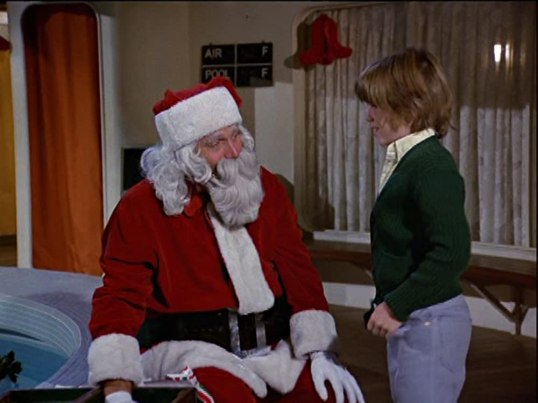
3. Edmund Gwenn wins Best Supporting Actor For 1947’s Miracle on 34th Street

He is Santa Claus!

4. Orson Welles Wins Best Original Screenplay for Citizen Kane

Yes, I realize he had to share it with Herman Mankiewicz and I realize that there’s a lot of people who think that they’re an expert on what happened because they sat through Mank.  The fact of the matter is that Citizen Kane is an Orson Welles film.  To give all of the credit to Mankiewicz is to ignore all of the talent and vision that Welles brought to shaping the film.  Even if we accept Mank‘s dubious claim that the majority of the script was Mankiewicz’s, Welles was the one who made the film into a portrait of America at its best and worst as opposed to just the bitter ramblings of an old alcoholic.  Citizen Kane and Welles deserved more than one Oscar but considering just how many powerful people in Hollywood tried to stop Citizen Kane, I’m a little amazed that the Academy even gave Welles one Oscar.

5. Crossfire Is Nominated For Best Picture

Even though 1947’s Crossfire lost the award to Gentleman’s Agreement, it still made history as the first “B” movie to receive a nomination for Best Picture.  Crossfire holds up quite well today as a portrait of the evil that comes with prejudice.

6. The Best Years of Our Lives and It’s A Wonderful Life Are Nominated For Best Picture

In 1946, two of the best films made about postwar America were nominated for Best Picture.  The Best Years Of Our Lives won, while It’s A Wonderful Life went on to become a holiday perennial and a cultural touchdown.  Both of them are powerful portraits of Americans trying to find themselves in the years directly after the end of World War II.  Both deserved their nominations.  It’s a shame that both couldn’t win.

Up next: The 1950s!

6 Times The Academy Got It Right: 1930s Edition


During the 1930s, American suffered through the Great Depression and the rest of the world first tried to prevent and then fearfully prepared for another world war.  It was a dark time and it’s not surprising that movies became an escape for many.  With so many people going the movies, it’s also not a surprise that the Oscars themselves became a far bigger deal than anyone had initially expected.  Today, it can be easy to forget that the awards were almost an afterthought, something that was added to the Academy’s original charter at the last minute.  In the 1930s, they went from being a quiet industry dinner to being a major cultural event.

Here are 6 times the Academy got it right in the 1930s.

  1. 1939

1939 was one of the first truly great years in American cinema and, for once, the Academy honored that greatness.  The slate of nominated films, which included everything from Gone With The Wind to Mr. Smith Goes to Washington to The Wizard of Oz to Stagecoach, and performances was the best that Academy had presented so far.  All of the nominees were impressive and deserved to be there.  One can perhaps disagree with some of the eventual winners but 1939 was one of the few years when no one can disagree with who and what the Academy chose to nominate.

2. It Happened One Night Win Best Picture

In 1934, the Academy honored It Happened One Night with the award for Best Picture.  Not only was it entirely deserved but it was also the first comedy to win the big prize.

3. The Thin Man Is Nominated For Best Picture

The same year that It’s Happened One Night won Best Picture, The Thin Man was nominated.  1934 was a great year for comedy.

4. Grand Illusion is Nominated For Best Picture

Jean Renior’s anti-war classic was nominated for Best Picture in 1937.  Not only was the nomination deserved but it also became the first film in a language other than English to receive a best picture nomination.

5. Fredric March Wins Best Actor for Dr. Jekyll and Mr. Hyde

At the 5th Academy Awards ceremony, March became the first actor to win an Oscar for a horror role and Dr. Jekyll and Mr. Hyde became the first horror film to win anything.  Of course, Wallace Beery also won Best Actor for The Champ.  This was one of the few years in which there was a tie.

6. Charles Laughton Wins Best Actor For The Private Life of Henry VIII

At the 6th Academy Awards ceremony, Laughton won an award for his lusty performance as Henry VIII.  While one could argue that Paul Muni technically gave a better performance in I Am A Fugitive From A Chain Gang, no one can deny that Laughton’s lusty and comedic performance set the template by which all future Henry VIII’s would be judged.  Add to that, Laughton became the first of many actors to win for their performance in a British-made film.

Up next: the 1940s!

4 Times The Academy Got It Right: 1920s


In previous years, I’ve used Oscar Sunday as a chance to write about what the Academy has gotten wrong over the years, the snubbed classics and the unworthy winners.  This year, though, I want to do something a little different.

I want to take a look at the time that the Academy made the right decision, either by picking the best film for Best Picture or even just by giving a nomination to someone who actually deserved it.  Consider this to be my attempt to add some positivity to what has otherwise been a pretty negative awards season!  We all love to criticize the Academy and goodness knows that much of that criticism has been deserved over the years but occasionally, they do get it right!

Here are 4 times the Academy got it right during the 1920s!

(Before anyone thinks that I’m condemning the Academy with faint praise, the first Oscars were handed out in 1928 so, for this decades, there are really only a handful of winners and nominees to choose from.)

  1. All Quiet On The Western Front Wins Best Picture

All Quiet On The Western Front was the third film to win the Oscar for Best Picture and it was the first truly great film to win the award.  If Wings and Broadway Melody were rewarded largely because of internal politics, All Quiet On The Western Front won because it truly deserved it.

2. Sunrise Wins The Academy Award For Unique And Artistic Picture

At the first Oscar ceremony, two awards for Best Picture were given out.  Best Picture went to Wings, which is good but not great.  The award for Unique and Artistic Picture, however, went to F.W. Munrau’s sublime Sunrise.

3. The Racket Is Nominated For Best Picture

The Racket was one of the three films to be nominated for the very first Best Picture Oscar in 1928.  It’s nearly forgotten today but it still remains significant because it was the first gangster film to be nominated for Best Picture and it was also the first genre film.  The Racket started a long tradition of American movies about organized crime, one that includes The Godfather, Goodfellas, The Irishman, and so many other films.  As well, The Racket was long considered to be a lost film until someone stumbled across the last remaining copy in the 70s.  Never stop searching for those lost films!

4. Warner Baxter Win Best Actor For In Old Arizona

The 2nd Academy Awards ceremony was a strange one, largely because only the winners were announced and no one is quite sure how the Academy settled on those winners.  That said, Warner Baxter’s award for starring in In Old Arizona does feel historically significant.  He was the first actor to win for appearing in a western and he won for playing not a lawman but an outlaw.  In fact, his amoral character served as a template for many of the characters who would populate the Spaghetti westerns of the 60s and the 70s.

Up next: the 1930s!

The Shattered Lens Live Tweets Oscar Sunday


Welcome to Oscar Sunday!

Scenes That I Love: The Opening of Reservoir Dogs


In honor of Quentin Tarantino’s birthday, today’s scene of the day is the opening coffeeshop scene from Tarnatino’s directorial debut, 1992’s Reservoir Dogs. 

While Tarantino will always be better appreciated as a director than an actor, it does seem somewhat appropriate that the very first lines in the very first Tarantino film are spoken by Tarantino himself.  There’s also something undeniably likable about Tarantino laughing at the sound of his own dialogue.

From Reservoir Dogs:

4 Shots From 4 Film: Special Quentin Tarantino Edition


4 Or More Shots From 4 Or More Films is just what it says it is, 4 shots from 4 of our favorite films. As opposed to the reviews and recaps that we usually post, 4 Shots From 4 Films lets the visuals do the talking!

Today is not just Oscar Sunday!  It’s also Quentin Tarantino’s 59th birthday!  Since Tarantino is one of the favorite filmmakers of this site, it only makes sense to celebrate with….

4 Shots From 4 Quentin Tarantino Films

Reservoir Dogs (1992, dir by Quentin Tarantino, DP: Andrzej Sekuła)

Pulp Fiction (1994, dir by Quentin Tarantino, DP: Andrzej Sekuła)

Kill Bill Volume 1 (2003, dir by Quentin Tarantino, DP: Robert Richardson)

Once Upon A Time In Hollywood (2019, dir by Quentin Tarantino, DP: Robert Richardson)

Music Video of the Day: Shallow, performed by Lady Gaga and Bradley Cooper (2019, dir by whoever directed the Oscars that year)


Who knows what tonight’s Oscar telecast will be like but I’m pretty sure it won’t come anywhere close to providing a moment as powerful as this.

Enjoy!

Lisa Marie’s Week in Television: 3/20/22 — 3/26/22


I didn’t watch much this week because I’ve been busy preparing for the Oscars.  Here’s a few thoughts on what little I did watch.

Allo Allo (Sunday, PBS)

Lt. Gruber thought that he spotted the ghost of Rene’s twin brother in the cemetery and was frightened for his life.  Of course, what we all know is that Rene never had a twin brother and instead, he’s been pretending to be his own twin brother after faking his death several seasons ago.  Somehow, no one on the show has figured this out yet or found it strange that Rene had to explain that both he and his twin have the same name.  Things only got more complicated from there, with Flick trying to disguise himself as a British spy and the Italian soldiers learning how to speak English.  Officer Crabtree still still thinks that he can speak French.  What I like is that, whenever he says “Good moaning,” all of the French characters respond with “Good moaning,” indicating that they are also mangling their French in sympathy for him.  That’s nice of them.  I’m also starting to get the feeling that those British airmen are never going to get out of France.

American Idol (Sunday and Monday Night, ABC)

ABC gave us two episodes of American Idol this week.  The auditions came to a close.  Because I was busy on both Sunday and Monday, it wasn’t until Tuesday that I watched both of the episodes on Hulu and I have to admit that it wasn’t long before I started to get bored and I ended up fast forwarding through some of the auditions.  From what I heard, some of the singers had good voices but there was still an overwhelming blandness to the whole thing.  Perhaps things will perk up in Hollywood.

Beyond the Edge (Wednesday Night, CBS)

The show is all about celebrities doing stuff in the jungle.  Aguirre, The Wrath of God, it is not.  So far, none of the celebs have had a breakdown and requested to leave the show so what even is the point?

The Brady Bunch (Sunday Afternoon, MeTV)

The Bradys went to a national park, laughed their way through a Native ceremony, and declared themselves to be The Brady Braves.  More like the Problematic Bunch, am I right?

The Dropout (Hulu)

I reviewed the latest episode of The Dropout here!

Full House (Sunday Afternoon, MeTV)

The Tanners and the Uncles are stranded at the airport on Christmas Eve and proceed to make life miserable for all of the other passengers.  Uncle Jesse gives a speech about the true meaning of Christmas.  Santa Claus is revealed to be a grumpy passenger who wears a toupee.  In a scene of maximum cringe, Danny falls asleep on the baggage claim carousel.  This was followed by three more episodes, all of which dealt with Jesse and Joey trying to work from home while Stephanie and Michelle demanded all of their attention.  DJ and Aunt Becky were the only characters on this show who ever seemed to worry about anyone else’s feelings.

The Love Boat (Saturday Afternoon, MeTV)

On Saturday’s episode, The Love Boat’s passengers included: Kim Darby, Howard Duff, Greer Garson, Lawrence Pressman, Louanne, and Jim Stafford.  To be honest, I didn’t know how the majority of those people were.  Greer Garson was a psychic.  Lawrence Pressman was a guy who used his best friend’s daughter to convince Kim Darby that he was a single parent.  In the episode’s serious plot, Isaac briefly went deaf.  It all worked out in the end.

The Office (All Week, Comedy Central)

On Sunday, I watched two episodes from season 1, both of which were classics of cringe comedy.  In Basketball, Michael challenged the warehouse to a game and Jim ended up getting punched in the face by Roy.  (Agck!  That was a lot of blood and, according to John Krasinski, it was real.)  Then, Amy Adams showed up at The Office to sell purses and Michael ran out to buy her a cappuccino machine.  Amy Adams deserved an Emmy for the look of horror she got in her face when Michael tried to flirt with her.  Will offices really let you sell purses out of their conference room?  I might actually check into that.

Open All Hours (Sunday Night, PBS)

This week, PBS aired the first ever episode of Open all Hours.  Granville looked younger and a smidgen less disgruntled than he did in later episodes.  He still seemed to be a bit of a ticking time bomb, though.

Survivor (Wednesday Night, CBS)

I wrote about this week’s episode here!  I enjoyed this week’s episode far more than I enjoyed the previous two episodes.

Talking Dead (Sunday Night, AMC)

Chris talked to Michael Biehn and Seth Gilliam, both of whom were absolutely charming.

The Walking Dead (Sunday Night, AMC)

I wrote about The Walking Dead here!

Now, on to the Oscars!

My Oscar Predictions


Well, since the big show is tomorrow, I guess it’s time for me to try to predict what I think will win. Up until four weeks ago, I would thought Power of the Dog would be the obvious front runner but CODA seems to be the film that people are responding too. The same is true of Penelope Cruz, who went from being an also-ran to the new front runner in just a matter of days.

In short, this Oscar race is up in the air. Almost anything could happen. It should be exciting, though I think most people will be tuning in not to see who wins but to see how bad the show is.

Anyway, here are my predictions! We’ll see how right I am (or how wrong I am) tomorrow night!

Best Picture — CODA

Best Director — Jane Campion, The Power of the Dog

Best Actor — Will Smith, King Richard

Best Actress — Penelope Cruz, Parallel Mothers

Best Supporting Actor — Troy Kostur, CODA

Best Supporting Actress — Ariana DeBose, West Side Story

Best Original Screenplay — The Worst Person In The World

Best Adapted Screenplay — CODA

Best Animated Feature Film — Encanto

Best International Film — Drive My Car

Best Documentary Feature — Attica

Best Documentary Short Subject — Audible

Best Live Action Short Film — The Long Goodbye

Best Animated Short Film — Affairs of the Art

Best Original Score — Dune

Best Original Song — Dos Origuitas from Encanto

Best Sound — West Side Story

Best Production Design — Dune

Best Cinematography — The Power of the Dog

Best Costume Design — Nightmare Alley

Best Makeup and Hairstyling — The Eyes of Tammy Faye

Best Film Editing — Don’t Look Up

Best Visual Effects — Spider-Man: No Way Home