4 Shots From 4 Films is just what it says it is, 4 shots from 4 of our favorite films. As opposed to the reviews and recaps that we usually post, 4 Shots From 4 Films lets the visuals do the talking!
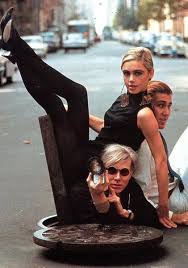
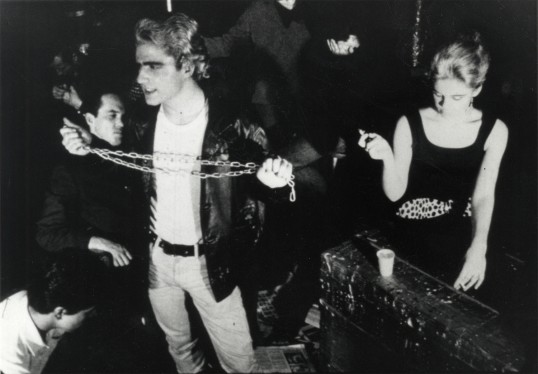
Today would have been Edie Sedgwick’s 77th birthday. Unfortunately, she died under tragic circumstances in 1971, after having briefly found fame as a model, a “youthquaker” (as some in the media called her), an actress, and Andy Warhol’s muse. Her tragic life is often held up as a cautionary tale and perhaps it is. For all of her talent and her appeal (not to mention that sharp wit that made her an outsider in the 60 but which would have made her a fascinating interview subject in 2020), Edie was far too often exploited by those who should have been protecting her. She was too beautiful not to be famous but, at the same time, too sensitive not be hurt by the experience. She’s truly a tragic figure but, because she also epitomizes everything that the New York underground art scene in the 60s represents in the popular imagination, she’s also an inspiring one. Edie lives forever as a symbol and a muse. Personally, I’ve been fascinated by her life for as long as I can remember.
Another week comes to a close. During previous years, I would really be freaking out if I had accomplished so little by April 19th. This year, I know that I’m actually probably doing better than most, just by the fact that I haven’t lost my mind yet.
I’m in a good mood. I’ll be in an even better mood when I can actually go out and watch a movie outside of my own home. I miss the theaters.
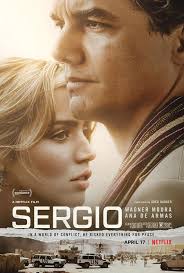
Sergio, which dropped on Netflix last Friday, is a biopic of the Brazilian diplomat, Sérgio Vieira de Mello. Sergio spent 34 years as a diplomat with the United Nations, going to some of the most dangerous places in the world and trying to negotiate with people who were determined to kill one another. Sergio was so respected within the UN that he was seen as a likely candidate for Secretary-General. Instead, in 2003, Sergio was killed in a terrorist attack while he was in Baghdad, observing the American occupation of Iraq.
Starring Wagner Moura in the title role, Sergio opens with Sergio arriving in Baghdad. For the majority of the film, he’s buried in the rubble of his blown-up office, thinking about his past life while an American soldier (played, with quiet authority, by Garret Dillahunt) tries to dig him and his assistant, Gil (Brian F. O’Byrne) out. Through the use of flashbacks, we watch as Sergio negotiates peace in East Timor and argues against the occupation of the Iraq. We also watch as he meets and falls in love with Carolina (Ana de Armas), pursuing a passionate affair with her despite being married.
Sergio is a rather staid biopic. If you’re expecting to see an Adam McKay-style screed about international diplomacy and American war crimes, that is not what this film is and we should be happy for that because, seriously, have you tried to watch The Big Short or Vice lately? Instead, Sergio is more like a Jay Roach film without the attempts at humor. It’s a blandly liberal biopic that is conventionally structured and a bit too convinced that the audience is going to automatically agree with its points. Indeed, one of the film’s most glaring flaws is that it assumes that we’re all as enamored with the UN as it is. Instead of making a case for why the UN should be taken seriously, Sergio just assumes that it is.
The other big problem with the film is that it’s just boring. There’s nothing interesting about the film’s structure and, as portrayed in the rather bland script, both Sergio and Carolina come across as being ciphers. We’re constantly told that Sergio is charismatic and controversial but we really don’t see much evidence of it. The film itself doesn’t seem to know what made Sergio tick but what’s even worse is that it doesn’t seem to be particularly interested in finding out. There’s not much interest in digging into Sergio’s mind or his motives, The film forgets that you can portray someone as a hero and celebrate their accomplishments without necessarily idealizing them. With the exception of one or two scenes (and there is an effective moment where one of Sergio’s assistants does call him out for putting everyone’s life in danger by refusing to accept protection from the U.S. army), Sergio is portrayed in such an idealized that he comes across as being a bit dull. Wagner Moura is an appealing actor but there’s no depth to his performance. Meanwhile, Ana de Armas is reduced to playing the stock girlfriend with a social conscience role.
All that said, I almost feel guilty about not liking Sergio. The film was made with good intentions but good intentions don’t necessarily translate to compelling storytelling.
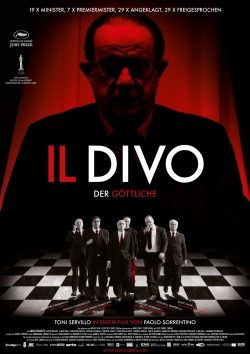
Earlier tonight, as I watched the 2008 Italian film, Il Divo, it occurred to me that political corruption really is an international language.
The film is heavily stylized biopic of Giulio Andreotti. Andreotti (who died five years after the release of this film) is nearly unknown figure in the United States but, in Italy, he spent several decades as a member of the country’s political elite. He was a controversial figure, a man who served several terms as prime minister and was later appointed senator for life but who was also accused of being politically corrupt and affiliated with some of the worst elements of the Mafia. People who threatened to investigate Andreotti or who could have contributed to his downfall had a habit of ending up dead. No sooner has Il Divo begun then we’re treated to a lengthy montage of Andreotti’s associates getting killed in various ways. Some are gunned down. One is found hanging underneath a bridge. One is in an exploding car. The film also opens with a title card that informs us that, over the course of Andreotti’s long career, he was rumored to be one of the leading members of the P2, a masonic lodge that counted among its members some of the most powerful men in Italy. P2 is one of those organizations that conspiracy theorists love to obsess upon.
Directed by Paolo Sorrentino, Il Divo is an Italian film that deals with the life of a prominent Italian political figure and, needless to say, it was made for an Italian audience. For an American viewer like me, it was often impossible not to get confused as I tried to keep up with who was working with who and who had just been killed. In short, this film was made to be viewed by people who already know who Guilo Andreotti was and who are familiar with the details of his long career. It was not made for someone like me who is still struggling to wrap her mind around the fact that Italy has both a prime minister and a president.
But, in the end, it really didn’t matter if I occasionally struggled to follow every twist and turn of Andreotti’s career. Il Divo may technically by a biopic of Giulio Andreotti but, on a larger scale, it’s about how power corrupts and the banality of evil. Those are universal themes and you certainly do not have to be any particular nationality to be familiar with the fact that people who dedicate their lives to accumulating political power often turn out to be, at the very least, willing to cut some ethical corners. I may not have always understood every detail of Il Divo‘s story but I did understand exactly what the film was ultimately about.
As played by Toni Servillo, Andreotti does not come across as being particularly charismatic politician. With his hunched back and his bat-like ears, Andreotti almost seems like a caricature of a corrupt leader. In the film, one immediately sees that Andreotti hasn’t held onto his power because he’s particularly loved by the people. Instead, he’s held onto power by being smarter than those who would try to defeat him. No matter how determined his enemies may be, Andreotti is always just a little bit more ruthless. Andreotti succeeds because he’s willing to do what he has to do to succeed and he’s willing to ally himself with people who have a stake in his continued success. While the film never comes out and says that Andreotti was personally responsible for ordering the deaths of any of his enemies, it does suggest that he purposefully surrounded himself with men who would do anything to keep Andreotti in power, if just to protect their own fiefdoms of corruption.
There’s an early scene in Il Divo where Andreotti’s allies all arrives for a meeting with the prime minister. Most of them are politicians. One of them is a cardinal. Another is simply identified as being a “businessman.” They pull up in their expensive cars and then we watch as they walk across the screen in slow motion, arrogantly confident in the fact that they’re above any and all legal or ethical considerations. They’re all wealthy men and they all seem to understand the importance of keeping Andreotti happy. Carlo Buccirosso plays Paolo Cirino Pomicino, who was one of Andreotti’s chief allies. Buccirosso plays Pomincino as being glibly hyperactive, a cheerfully corrupt ball of energy who seems to be having all of the fun that Andreotti denies himself. Because Andreotti denies himself an interest in anything other than wielding and holding power, he is invulnerable to attack and prosecution but sometimes it’s hard not to wonder if he would have rather have been Pomincino, dancing at parties and sliding across tiled floors.
Indeed, Andreotti begins and ends Il Divo as an enigma. How deeply involved is he in the murders occurring around him? Is he ordering them or is he just turning a blind eye? What makes Andeotti tick? By the end of the film, his main motivation seems to be bitterness. Death may be inevitable but he’s not going to go until everyone else goes first. That is a motivation that many politicians across the world probably share. Corruption is universal.