Rest in peace, Christine McVie.
Rest in peace, Christine McVie.
Twenty-five years ago today, a horrified nation watched as Barney The Dinosaur fell victim to high winds and a street light. It was a Macy’s Thanksgiving Day Parade that will never be forgotten.
Previous Moments In Television History:
On October 30, 1978, WKRP in Cincinnati changed Thanksgiving forever.
Happy Thanksgiving!
Previous Moments In Television History:
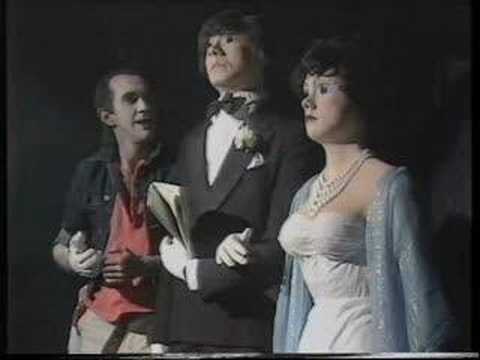
“Laugh, you buggers, laugh!”
Set in Manchester, Comedians is about a group of working class men who are enrolled in an evening class for aspiring comedians. Sammy Samuels (Linal Haft) and Mick Connor (David Burke) both tell jokes about being a member of a minority in England. (Sammy is Jewish while Mick is Irish.) George McBrain (Derrick O’Connor) works on a loading dock and tells stereotypically racist and sexist jokes. Phil and Ged Murray (James Warrior and Edward Peel) are brothers and a tense comedy team. Phil is desperate to become a star and escape Manchester while Ged is more laid back. Finally, Gethin Price (Jonathan Pryce) is an aggressive comedian who is willing to take risks on stage. Teaching the class is Eddie Water (Bill Fraser), a veteran comic who was a star during World War II but who has since faded into obscurity. Gethin says that he’s lost his edge.
Bert Challenor (Ralph Nossek), a retired stand-up and an old colleague of Eddie’s, is in town. Challenor is now the President of the Comedy Federation and he is scouting new talent. Eddie’s class will be performing, between games, at a bingo hall. Before the performance, Eddie admonishes all of them to stay true to themselves and to not pander to the audience with cheap, racist, or sexist jokes. However, when Challenor drops by the class, he gives the comedians the opposite advice. He tells them that getting laughs is the most important thing and the only way to do that is to make the audience like you. Stick to the acceptable targets, move quickly from one joke to the next, and don’t make any of your humor too personal.
The bingo hall performance is the highpoint of Comedians. Each student performs and each one has to make their own decision whether to follow Challenor’s advice or to stay true to what Eddie told them. Some sell out and some don’t. One act implodes on stage. The bravest performance of the night is greeted by stony silence from the audience. Each performance allows a look into the mind of the man telling the jokes, even the ones who are trying to hide behind Challenor’s advice. After the performance, the students return to the classroom and consider what they’ve done and they’ve become. Challenor comes to the class to offer some of the comedians a contract while dismissing the others as not being ready or worthy of his time.
Comedians started life as a play by Trevor Griffiths. It opened in London in 1975, where it was directed by Richard Eyre. Just as he would in the eventual film, Jonathan Pryce played the role of Gethin Price. When the play moved to Broadway in 1976, Mike Nichols took over as director and Pryce was the only actor to make the transition from New York to London. Pryce would go on to win his first Tony for his performance in Comedians. In 1979, when Comedians was filmed for the BBC’s Play For Today, Richard Eyre returned to direct and Pryce, again, played the role of Gethin Price.
As a debate about what makes comedy “good,” Comedians feels especially relevant today. The debate about how comedians should view their audience and the role that comedy should play in an unstable world is still going on today. As opposed to the current argument that comedy should always “punch up,” Challenor encourages all of the students to punch down and to get laughs by appealing to the prejudices of the audience. As Challenor suggests when giving his notes to the students, it’s more important to get laughs than to actually be funny. As unsympathetic a character as Challenor is, Comedians does acknowledge that the students who got those easy laughs are also the same ones who going to escape the drudgery of working dead end jobs in Manchester. Comedians like Gethin Price may stay true to themselves but they’ll also probably never become a star.
Very much a filmed version of a theatrical production, Comedians is undeniably stagey. But the dialogue and the themes remains sharp and Pryce’s performance is still electrifying. Unfortunately, several of the BBC’s Play For Today productions have been lost or destroyed but Comedians survived and can be viewed on YouTube.
I don’t have much to say about this video so instead, I’m just going to say, HAPPY BIRTHDAY, LISA MARIE!
Enjoy!
In memory of Steve Ditko, on what would have been his 95th birthday, here are a few words of wisdom from Mr. A:

Steve Ditko, 1968
Another Day In Paradise is one of two songs that Phil Collins has recorded about the homeless. (The other was Man On The Corner.) When this song first came out, Collins was accused of being a wealthy and condescending rock star who was more interested in singing about a problem than actually doing anything to solve it. In an interview with Rolling Stone, Collins responded to the criticism with, “When I drive down the street, I see the same things everyone else sees. It’s a misconception that if you have a lot of money you’re somehow out of touch with reality.”
The video, which juxtaposes Phil singing with images of the homeless, was directed by Jim Yukich, who did the majority of Phil Collins’s and Genesis’s videos in the 80s and the 90s. The scenes of Collins singing were filmed in New York City and were completed in under an hour.
I am fairly certain that I’ve heard a version of this song in which George H.W. Bush is heard giving a speech about the homeless. I cannot find any official online confirmation that it exists but I know it’s out there somewhere.
Enjoy!
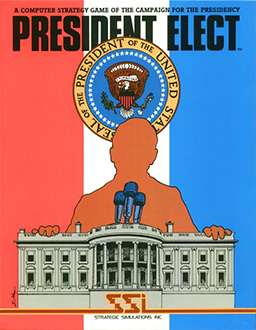
For my final President Elect simulation of this year’s horrorthon, I decided to see what would happen if, in 1964, Dracula had been the Republican nominee against LBJ. I had already discovered that Dracula would have easily defeated both Frankenstein’s Monster and Jimmy Carter in a presidential election. Would he be able to do the same with LBJ?
In the real world, LBJ easily defeated the Republican nominee, Barry Goldwater. LBJ benefitted from public sympathy for the Kennedy family and also from a brutally negative campaign that portrayed Goldwater as being a war monger. Johnson won 61% of the popular vote and he carried 44 states (and DC). Goldwater won only 38% of the popular vote and carried only 6 states (5 in the Deep South and his home state of Arizona). At the time, Goldwater’s defeat was portrayed as being the end of the Republican Party. Instead, Goldwater’s losing campaign set the foundations that would later lead to election of Ronald Reagan in the 80s.
How would Dracula have done against LBJ? Would Dracula, with his superb speaking skills and his hypnotic magnetism, have been able to defeat LBJ despite the incumbent’s strengths?
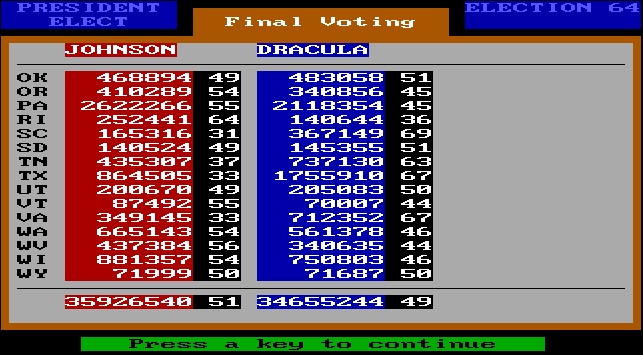
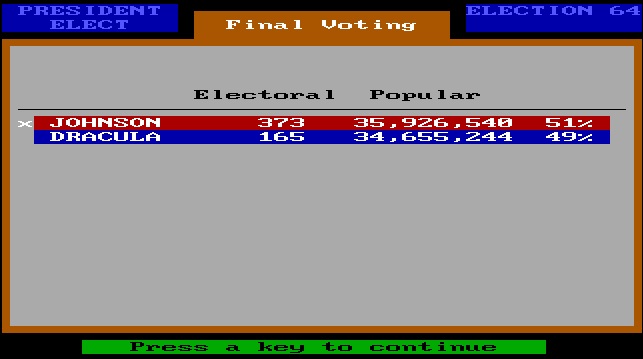
According to President Elect, LBJ would have still won if Dracula had been the nominee but the election would have been much closer, as far as the popular vote was concerned. During the simulation, Dracula was such a strong candidate that LBJ even debated him twice. Dracula won both times but LBJ was still able to hold his own. If LBJ had made a serious gaffe during the debate, the election would have turned out differently. It was a risk but it was a risk that paid off for Johnson.
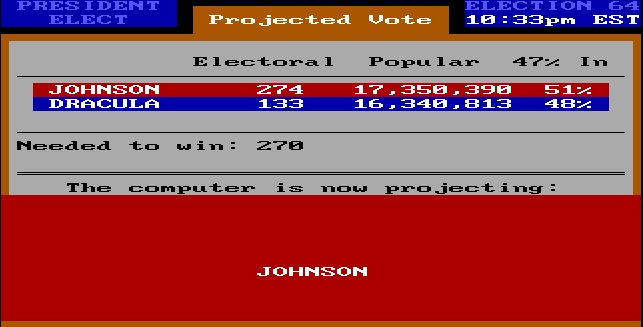
The first results of election night tells the story:
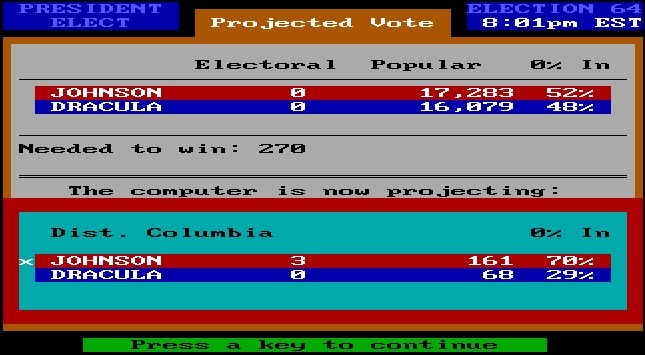
Though Johnson easily won the District of Columbia, the rest of the states were much closer. Dracula did well in the South and in the west. Johnson did well in the North and the Industrial Midwest. It was Iowa that put him over the top.
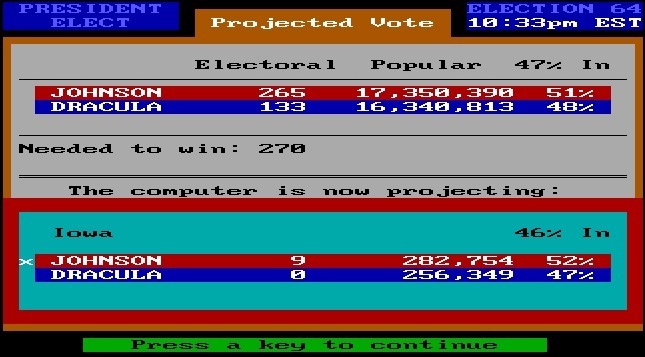
In the end, Dracula carried 18 states while Johnson won the other 32 (and D.C.).
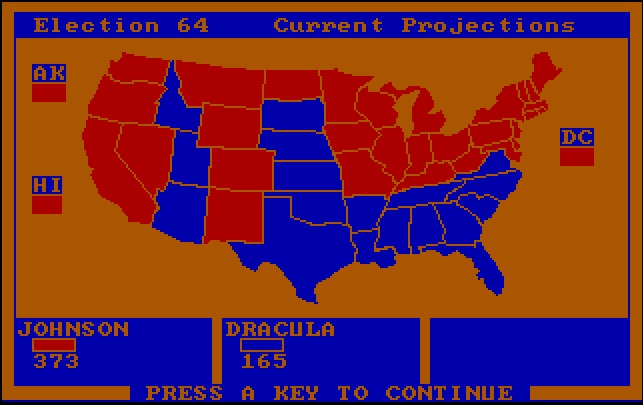
(In President Elect, the Republican states are colored blue while the Democratic states are red. It took me a while to get used to it too.)
Against Dracula, Johnson still scored an electoral landslide but the popular vote was much closer.
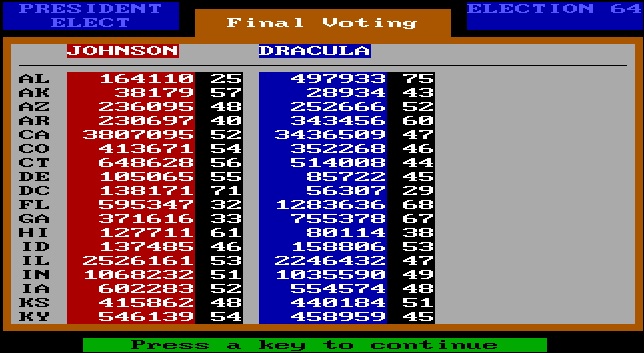
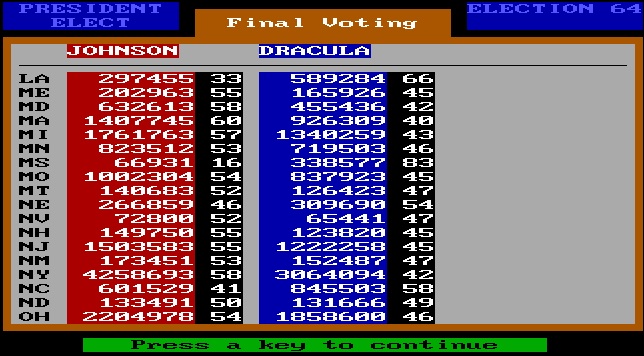
So, if you’re ever wondering which President could have defeated Dracula, the answer is Lyndon B. Johnson.
And Ronald Reagan. But you already knew that.
When this music video first came out, it was one of the most expensive music videos ever made. It was also one of the longest. Axl Rose plays a singer who marries a model (who is played by real-life model Stephanie Seymour, who was dating Axl at the time.) Their marriage ends tragically. This video is often described as being a sequel to Don’t Cry but I think that, even though they’re based on the same short story and are thematically connected, Rose and Seymour are playing different characters here than in the first previous video. Seymour and Rose split up after making this video, which meant that the concept for the third video in the projected trilogy, Estranged.
Slash’s signature guitar solo was filmed in New Mexico. The scenes inside the church were filmed in Los Angeles’s St. Brendan Catholic Church.
This is a video that I used to laugh at but, as I’ve gotten older, I’ve come to better appreciate its themes of loss and regret.
Enjoy!
In Tomb of Dracula #43 (April, 1976), a reporter named Paul Butterworth discovered the existence of not only Dracula but also the people (like Blade, Frank Drake, and Rachel Van Helsing) who were trying to stop his reign of terror.
Paul thought it would make a good story but he knew he needed proof so, when he met Dracula, he was sure to take a few photographs. The joke was on Paul because vampires can’t be photographed! When Paul’s editor sees the blank photos, he demotes Paul to doing the helpful hints column.
Not a bad story. Tomb of Dracula was always at its best when it brought in “normal” characters and allowed them to interact with Dracula and the vampire hunters. Paul Butterworth never made another appearance but he was still a part of the series’ overall mythology.
However, the thing that made this issue great was the cover. Illustrated by Bernie Wrightson, this cover may not have much to do with the story but it perfectly captures the feel of Tomb of Dracula.

Previous Great Moments In Comic Book History:
 Through the Shattered Lens