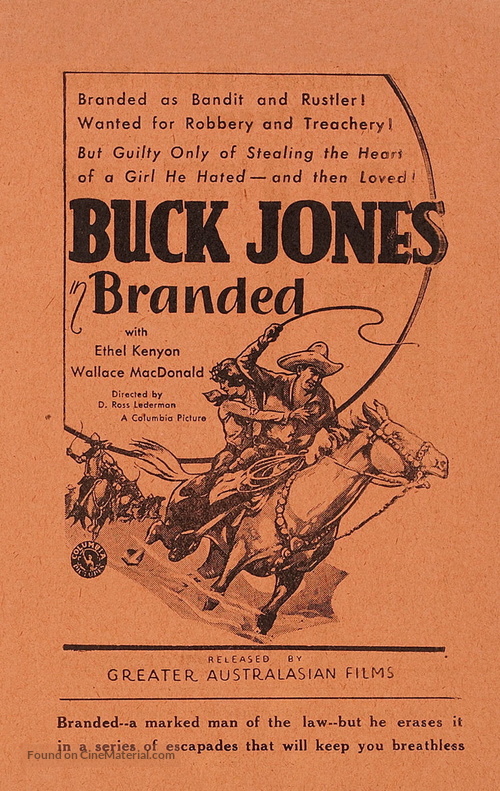
Branded (1931, directed by D. Ross Lederman)


Tom Dale (Buck Jones) and his employee, Swede (John Oscar), come across a stage coach robbery.  Though the robber gets away, Tom and Swede recover a stolen mailbag.  Tom finds a letter to himself and it is revealed that his real name is Cuthbert Chauncey Dale.  After explaining that he goes by Tom because that was his uncle’s name, Tom says that he’ll shoot anyone who calls him Cuthbert and he’s the movie’s hero!

When the local posse comes upon Tom and Swede, they accuse them of having robbed the stagecoach.  Tom and Swede manage to escape from jail during the dead of night and ride to a neighboring town, where Tom has inherited his uncle’s ranch.  Tom and Swede work on the ranch, building fences and branding cattle.  Tom starts to fall for Lou Preston (Ethel Kenyon), earing him the enmity of Joe Moore (Albert J. Smith), who is also in love with Lou.  Joe frames Tom and Swede for cattle rustling.  Tom and Swede attempt to clear their names with the help of their new friend, the same man (Wallace MacDonald) who previously robbed the stage coach!

This short but complicated B-western has its share of gunfights and chases on horseback but it still has some slow spots.  There are a lot of scenes of Tom and Swede working around the ranch.  When you’re ready for another gunfight, Tom and Swede have to go work on the fence.  Still, fans of early westerns will probably enjoy Branded.  Wallace MacDonald is a likable rouge as the Stagecoach Robber and the movie ends on a little more of a serious note than the typical poverty row western.  Buck Jones was an authentic cowboy before he went into the movies and he’s believable whenever he’s riding a horse, shooting a gun, or just walking around his ranch.  Just don’t call him Cuthbert!
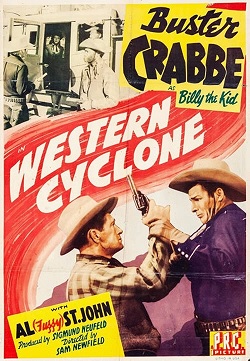
Western Cyclone (1943, directed by Sam Newfield)


Feeling that the old west has become a dangerous place, law-abiding gunslinger Billy the Kid (Buster Crabbe) fakes a stagecoach robbery and pretends to kidnap the governor’s daughter, all to show him that the west needs more law enforcers.  The governor is so impressed by Billy’s ruse that he agrees to stand tough on crime.  This upsets Dirk Randall (Glenn Strange, who also played Frankenstein’s monster is some of the later Universal horror films), a businessman who has been funding the criminals in order to make the governor look weak so that Randall could defeat him in the next election.

Randall orders one of his men to pull a gun on Billy while Billy is leaving the local saloon.  Billy pulls and fires his own gun in self-defense but it’s Randall who actually kills the man by shooting him in the back and then running off in the confusion.  Because the man was shot in the back, Billy is accused of murder, arrested, and sentenced to death in record time.  With Billy in jail, it falls to his comic relief sidekick, Fuzzy Jones (Al St. John), to prove that Billy didn’t actually fire the shot that killed the man.

By most accounts, Billy the Kid was a nasty piece of work who would kill anyone who look at him in the wrong way but, in the 30s, the character was the hero of a series of 42 Westerns that all featured him as a hero and a valued member of the community.  (Originally, Bob Steele played Billy.  Buster Crabbe took over the role with the seventh film.)  Western Cyclone was the 17th Billy the Kid film and, as long as you’re not a stickler for historical accuracy, it’s an entertaining B-western.  The plot is formulaic but Crabbe was a good hero, Strange was a diabolical villain, and, for once, Al St. John got to play an important role in resolving the film’s story.  Fuzzy Jones did some impressive detective work.  The real Billy the Kid probably could have used someone like Fuzzy in his corner.

The Lucky Texan (1934, directed by Robert N. Bradbury)


After graduating from college, Jerry (John Wayne) travels down to the ranch owned by his uncle, Grandy (George “Gabby” Hayes).  Jerry wants to look after the cattle but it turns out that Grandy doesn’t have any more cattle.  They’ve all been stolen by rustlers.  What Grandy does have is a dog, some horses, and a granddaughter named Betty (Barbara Sheldon) who Jerry is eager to marry even though the two of them are related.  Things start to look up when Grandy and Jerry discover gold in a nearby creek.  When a crooked assayer named Mr. Harris (Lloyd Whitlock) and a rustler named Joe Cole (Yakima Canutt) find out about the creek, they scheme to steal both it and the ranch from Grandy.  It’s up to Jerry to save the ranch and to expose the bad guys, even after they attempt to frame him for murder.  Fortunately, both Jerry and Grandy have a few tricks up their sleeves.

This was one of the many B-westerns that John Wayne did for the poverty row studios in the years before Stagecoach made him a star.  (Though the film is a western with its ranches and its search for gold, the climax features Gabby Hayes driving a car so it’s hard to say for sure when it’s supposed to be taking place.)  Though he seems too old to be playing a recent college graduate (John Wayne was 27 when he starred in The Lucky Texan but he looked closer to 40), Wayne gives a relaxed and likable performance as Jerry.  Watching him in this film, it’s possible to see hints of the screen presence that led to John Ford casting him as the Ringo Kid in Stagecoach.  As always, Yakima Canutt is on hand to do some impressive stuntwork during the film’s many chase scenes and Gabby Hayes provides the comic relief.  Like most of the poverty row productions, the film can seem more than a little creaky by today’s standards but fans of John Wayne will not be disappointed with either his performance or the film’s action.

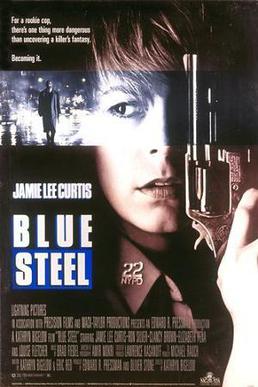
Blue Steel (1990, directed by Kathryn Bigelow)


On her first night on the job, rookie cop Megan Turner (Jamie Lee Curtis) blows away a robber (Tom Sizemore) who was holding up a convenience store.  The robber was holding a gun when he was shot but, right after his body hits the ground, the gun is stolen by a stockbroker named Eugene Hunt (Ron Silver).  Somehow, no one notices Eugene grabbing the gun from the floor and he improbably gets away from the crime scene without any of the investigating officers noticing that he’s concealing a gun in his suit.

Because Eugene stole the gun, Megan is accused of shooting an unarmed man and she is suspended from the force.  Meanwhile, Eugene becomes obsessed with the gun, hears voices, and starts to shoot random people.  He even carves Megan’s name on one of the bullets.  When the bullet is found in the body of one of Eugene’s targets, Megan becomes the number one suspect even though it wouldn’t make any sense for a murderer to carve their name on the evidence.  This isn’t The Wire.  None of the dead are going to be found with a note in their hand that says, “Tater Killed Me.”  It should be obvious to everyone that Megan is being set up but instead, everyone just assumes Megan is a stupid murderer who doesn’t know how to cover her tracks.  Eugene also starts to date Megan but when Megan rejects him after he confesses to being the murderer, Eugene starts to stalk her and her friends.  Not even Megan’s new boyfriend (Clancy Brown) can keep her safe from a stockbroker with a grudge.

Blue Steel benefits from Kathryn Bigelow’s stylish direction and Jamie Lee Curtis’s dedicated performance but it suffers because Eugene is so obviously crazy from the get go that it never makes sense that he would be able to get away with his crimes for as long as he does.  Even after Megan realizes that Eugene is crazy, she can’t get anyone to believe her even though everything about Eugene suggests that he’s the murderer.  Not even confessing to the crime is enough to keep Eugene in prison.  Somehow, Eugene is able to commit multiple murders and attempted murders right in front of Megan and then escape before Megan or anyone else can even react.  Megan’s been trained at the Police Academy while Eugene has no criminal training whatsoever but he’s still always able to outthink and outrun her.  It makes it seem as if Megan just isn’t a very good cop.  Luckily, Bigelow, Curtis, Silver, and Clancy Brown would all be involved with better movies in the future.

Kill and Kill Again (1981, directed by Ivan Hall)


Martial artist Steve Hunt (James Ryan) is back!

When last we saw Steve, he was defeating a Nazi war criminal in Kill or Be Killed.  In this sequel, James is recruited by Kandy Kane (Anneline Kristel) to rescue Dr. Horatio Kane (John Ramsbottom) from the evil Marduk (Michael Mayer).  Marduk has forced Dr. Kane to develop a drug that allows him to control the minds of anyone who is injected with it.  Marduk wants to put the drug into the world’s water supply but, for now, he is content to control the isolated town of Irontown.

Before Steve can rescue Dr. Kane, he has to put together a crew.  Steve recruits four of his fellow fighters, Hot Dog (Bill Flynn), Gorilla (Ken Gampu), Gypsy Bill (Norman Robinson), and The Fly (Stan Schmidt).  Along with Kandy Kane, the team infiltrates Irontown and faces off against Marduk’s champion fighter, Optimus (Edie Dorie).

If Kill or Be Killed owed a lot to Enter the Dragon, Kill and Kill Again is more of a martial arts-themed take on Mission: Impossible.  Marduk, with his fake beard and his name that makes him sound like a cartoon dog, is never an intimidating villain and it turns out that it is laughably easy to defeat him.  Instead, the movie’s emphasis is on Steve putting together his team and everyone playing their part to free the people of Irontown.  Kill or be Killed‘s Olga is nowhere to be seen as Steve falls for Kandy Kane.

Unfortunately, the fights are pretty boring this time around and James Ryan doesn’t really have the screen presence to be a believable James Bond or Ethan Hunt-style secret agent.  Especially when compared to the relatively serious Kill Or Be Killed, there is a good deal of broad comedy in Kill and Kill Again, which makes it difficult to any of Marduk’s plans seriously.  The best action films convince you that only the hero has what it takes to defeat the villain but Marduk is such a weak bad guy that anyone could defeat him.  Even if Steve and the crew hadn’t shown up at Iron Town, Marduk probably would have defeated himself in just a few more months.

Originally, there was supposed to be a third film about the adventures of Steve Hunt but Film Ventures, the company behind Kill and Kill Again, went bankrupt before filming could being.  Steve Hunt’s adventures came to an end but the first two Kill films will live forever.

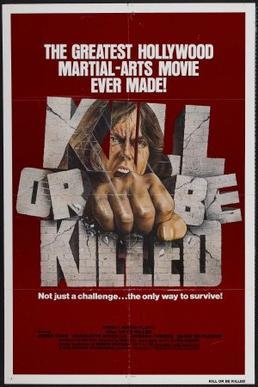
Kill or Be Killed (1977, directed by Ivan Hall)


Martial artist Steve Hunt (James Ryan) is offered a spot in a martial arts tournament that is to be held at a castle in the desert.  Steve accepts but, once he reaches the castle, he thinks that something is off about the tournament’s sponsor, the German Baron von Rudloff (Norman Coombes).  Could it be because the Baron wears a swastika armband, travels in a limousine the flies a Nazi flag, and spends his spare time talking about how much he misses Hitler?

Braon von Rudloff is a former Nazi general who is still bitter that his marital arts team was defeated by Japan’s team at the 1936 Summer Olympics. The tournament was just a ruse to recruit a new martial arts team that will take part in a do-over competition against the team led by Rudloff’s rival, Miyagi (Raymond Ho-Tong).  Steve doesn’t want any part of that so, with the help of a former circus dwarf named Cico (Dani DuPlessis), Steven escape from the castle with his girlfriend, Olga (Charlotte Michelle).  They return to Steve’s home in South Africa.  The Baron sends his main henchman, Ruell (Ed Kannemeyer), to bring Olga back to him.  After Olga is kidnapped, Steve joins Miyagi’s team and returns to the castle.

The best thing about this South African film is that there is rarely a moment when a fight is not breaking out.  Steve and Ruell will fight at the drop of a hat.  My favorite part of the movie is when Steve is trying to find a loophole in a contract that the Baron made him sign and Ruell grabs a torch and sets the contract on fire.  Steve grabs another torch and the two of them spend several minutes swinging torches at each other.  Later, Ruell and his friends turn on Chico for some reason and it turns out that Chico is just as good a fighter as anyone else in the movie.  The plot is just an excuse for one fight after another but the fight choreography is pretty exciting and always entertaining to watch.  Almost everyone in the cast was a real-life martial artist and it shows.  The story is nothing special and it’s hard to have sympathy for Miyagi after it’s revealed that the Baron isn’t lying about Miyagi bribing the judges in 1936 but fight scenes make up for all of that.

Kill or Be Killed was a surprise success when it was shown in the United States.  It was followed by a sequel, Kill and Kill Again, which I’ll review tomorrow.

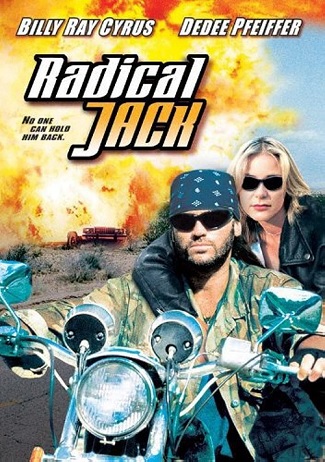
Radical Jack (1999, directed by James Allen Bradley)


Billy Ray Cyrus is Jack, a tough-as-nails former CIA agent who is still traumatized by his actions during Desert Storm and the murder of his wife by the international terrorist, Riotti (Benny Nieves).

Stop laughing.

I’ll admit that the idea of Billy Ray Cyrus, the most mild and unthreatening of mullet-headed country music stars, playing a CIA burnout who has killed countless men may sound like something to laugh about but … forget it, I’ve got nothing.  Laugh all you want because it is ridiculous casting and, throughout the film, Billy Ray looks increasingly uncomfortable with the character’s R-rated antics.  Sometimes, you have to do what you have to do, though.  When this movie was made, it’d been seven years since Achy Breaky Heart and even one-hit wonders need to pay the bills.  In 1999, reinventing Billy Ray Cyrus as a second-tier action star probably seemed like a good idea.  Billy Ray may not be the most convincing CIA agent but he’s still more likable than Steven Seagal.

Billy Ray is sent undercover to a small town in Vermont.  Somehow, by working as a bouncer at the local roadhouse, Billy Ray Cyrus is supposed to find a way to expose two local arms dealers, Lloyd (George “Buck” Flower) and Lloyd’s good for nothing son, Rolland (Noah Blake).  Lloyd and Rolland are selling weapons to Riotti so this is personal for Billy Ray.  But Billy Ray is also romancing Rolland’s ex-girlfriend, Kate (Deedee Pfeiffer) so it is personal for Rolland too.

As both an action hero and a film, Radical Jack isn’t all that radical and Billy Ray Cyrus never looks comfortable in any of the action scenes or the scenes where he makes out with Deedee Pfieffer but there are still plenty of explosions, fights, and chase scenes.  Though she doesn’t have much romantic chemistry with Billy Ray, Deedee Pfieffer gives the best performance in the film, playing Kate as someone who knows that she deserves better than what life has given her.  Radical Jack was produced by the same people who did Time Chasers and fans of that film will be happy to visit the exact same landing strip and hangar that was featured so heavily in that sci-fi epic.  There’s also a twist at the end, which you’ll see coming from miles away and Billy Ray does something unexpectedly cruel with a hand grenade.  Radical Jack did not make an action star out of Billy Ray Cyrus but, two years later, he showed an unexpected talent for comedy with his small role in Mulholland Drive.  Seven years after playing a burned-out CIA assassin, Bill Ray Cyrus found new fame as Miley Cyrus’s father and Radical Jack would never ride again.

Great Moments In Comic Book History #33: Iron Man #182


Tony Stark, the first Iron Man, was an alcoholic.

Those who only know the character from the MCU might be surprised to discover just how self-destructive of an addict Tony Stark was.  Though elements of the classic “Demon in a Bottle” storyline were used in Iron Man 2, Tony’s alcoholism was only referenced in one scene and it was largely played for laughs.  In the movies, Tony was irresponsible but in the comics, he was so self-destructive that he often could not be trusted with the suit that he created.

Tony’s alcoholism was first addressed in 1979, in a nine-issue story arc that is best-remembered for the issue where Tony finally decides to stop drinking.  Unlike a lot of Marvel’s story arcs, Tony’s alcoholism was not forgotten after the conclusion of the initial story.  Instead, it was a problem that flared up frequently over the next few years.  Whenever Tony ran into any sort of personal or business trouble, he would be tempted to pick up the bottle again and often, he would give in.  One reason why other people started to wear the Iron Man armor was because Tony was often too drunk to do so himself.

Finally, 5 years after Tony first realized that he had a drinking problem, this happened:

In the morning, Tony Stark will be sober or dead.  This cover, which was done by Luke McDonnell and Steve Mitchell, is one of the best to come out of Iron Man‘s initial run.  Along with the imagery of one man sitting alone in the snow, the cover reminds us that Iron Man is just a human being and, like all human beings, Tony Stark is going to have to make an important decision.  Will he do the hard work to improve himself or will he give up.

Caught out in the middle of blizzard and helping to deliver the baby of a fellow alcoholic, Tony makes his decision.  Though the freezing temperatures kill his friend Gretl, Tony manages to survive and he finally does the one thing that he still needed to do to kick his addiction.  He asked his friends for help.  From this issue on, it was not unusual to see Tony Stark at AA.  Tony still struggled but, in Iron Man #182, he finally made the decision to live.

Previous Great Moments In Comic Book History:

  1. Winchester Before Winchester: Swamp Thing Vol. 2 #45 “Ghost Dance” 
  2. The Avengers Appear on David Letterman
  3. Crisis on Campus
  4. “Even in Death”
  5. The Debut of Man-Wolf in Amazing Spider-Man
  6. Spider-Man Meets The Monster Maker
  7. Conan The Barbarian Visits Times Square
  8. Dracula Joins The Marvel Universe
  9. The Death of Dr. Druid
  10. To All A Good Night
  11. Zombie!
  12. The First Appearance of Ghost Rider
  13. The First Appearance of Werewolf By Night
  14. Captain America Punches Hitler
  15. Spider-Man No More!
  16. Alex Ross Captures Galactus
  17. Spider-Man And The Dallas Cowboys Battle The Circus of Crime
  18. Goliath Towers Over New York
  19. NFL SuperPro is Here!
  20. Kickers Inc. Comes To The World Outside Your Window
  21. Captain America For President
  22. Alex Ross Captures Spider-Man
  23. J. Jonah Jameson Is Elected Mayor of New York City
  24. Captain America Quits
  25. Spider-Man Meets The Fantastic Four
  26. Spider-Man Teams Up With Batman For The Last Time
  27. The Skrulls Are Here
  28. Iron Man Meets Thanos and Drax The Destroyer
  29. A Vampire Stalks The Night
  30. Swamp Thing Makes His First Cover Appearance
  31. Tomb of Dracula #43
  32. The Hulk Makes His Debut


Great Moments In Television History #31: Rodney Dangerfield On The Tonight Show


Since we could all probably use a laugh or two right now, here’s ten minutes of Rodney Dangerfield doing what he did best on the May 30th, 1979 episode of The Tonight Show.

Previous Moments In Television History:

  1. Planet of the Apes The TV Series
  2. Lonely Water
  3. Ghostwatch Traumatizes The UK
  4. Frasier Meets The Candidate
  5. The Autons Terrify The UK
  6. Freedom’s Last Stand
  7. Bing Crosby and David Bowie Share A Duet
  8. Apaches Traumatizes the UK
  9. Doctor Who Begins Its 100th Serial
  10. First Night 2013 With Jamie Kennedy
  11. Elvis Sings With Sinatra
  12. NBC Airs Their First Football Game
  13. The A-Team Premieres
  14. The Birth of Dr. Johnny Fever
  15. The Second NFL Pro Bowl Is Broadcast
  16. Maude Flanders Gets Hit By A T-Shirt Cannon
  17. Charles Rocket Nearly Ends SNL
  18. Frank Sinatra Wins An Oscar
  19. CHiPs Skates With The Stars
  20. Eisenhower In Color
  21. The Origin of Spider-Man
  22. Steve Martin’s Saturday Night Live Holiday Wish List
  23. Barnabas Collins Is Freed From His Coffin
  24. Siskel and Ebert Recommend Horror Films
  25. Vincent Price Meets The Muppets
  26. Siskel and Ebert Discuss Horror
  27. The Final Scene of Dark Shadows
  28. The WKRP Turkey Drop
  29. Barney Pops On National TV
  30. The Greatest American Hero Premieres

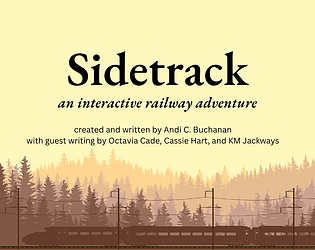
Game Review: Sidetrack (2023, Andi C. Buchanan)


In Sidetrack, you are a teenager who walks the same route to school every day.  Every day, you walk past an abandoned subway station.  Today, though, you see that the station is suddenly open and you decide to explore.  From the first station, you can take the train to as many or as few locations as you want.  Each location has a different feel to it.  The first station that I visited featured people who were made of wood and I had to exchange my money for wooden coins.  Another station was full of friendly spiders while another had biting fish.  Exploring each station brings the chance of finding something that you can use to enhance the experience your experience at another station.  You can visit and re-visit all of the stations as much as you like but when you finally decide to return home, the experience is over.

Designed with Twine and featuring stations that were created by guest authors, Sidetrack is about as pure of an Interactive Fiction experience as you could hope to have.  It’s a story that lasts for as long as you want it to and that goes where you direct it to go.  Well-written and intriguing, this is not a game where you have to worry about getting stuck because you picked the wrong verb or you missed a step in solving an intricate puzzle.  This is a game that you experience like a surreal but unforgettable dream.  Take the journey and see how many stations you can explore.

Play Sidetrack.