Future Zone (1990, directed by David Prior)


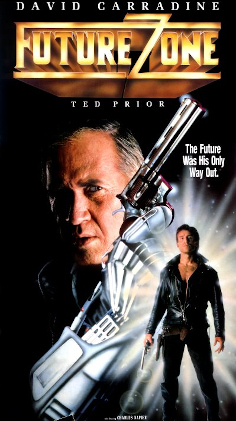
David Carradine is back as super glove-wearing bounty hunter John Tucker in this sequel to Future Force!

Once again, it’s the future.  In the future, everyone drives a car that was made in the 70s and spends most of their time in the abandoned warehouses that are meant to represent their places of business.  Hard-drinking John Tucker meets and starts to work with the newest C.O.P.S. recruit, Billy (Ted Prior).  Billy can shoot just as fast as Tucker and seems to know all about Tucker and his wife, Marion (Gail Jensen).  That’s because Billy is from the future.  As he explains it, some “friends of mine built a time portal,” and Billy used it to come back to the past and save Tucker from being killed by a bunch of criminals.  Why is Billy so concerned about saving John Tucker?  Did I mention that Marion is pregnant?

Future Zone is just as dumb as Future Force but it is set apart from the first film by its use of time travel.  The best part of the movie is that neither John nor Marion are surprised to hear that Billy’s friends just happened to build a time portal.  Nobody asks why they built a time portal or even how they built a time portal.  The time portal is the most important thing about the movie but everyone shrugs off its existence.  Are time portals a common thing in the future?  Does everyone have a time portal?  How does the time portal work?  How is Billy able to go into the past at exactly the right moment?  When it is time for him to go back to his time, how does he let his friends know?  These are all good questions that no one asks.

The other thing that no one asks is why Tucker doesn’t wear his super glove all the time.  His super glove can do anything, from shooting lasers to blocking bullets.  If I had a super glove, I would wear it all the time.  Tucker keeps it in the trunk of his car and only summons it at the last possible moment.  Why even have a super glove if you’re not going to use it?

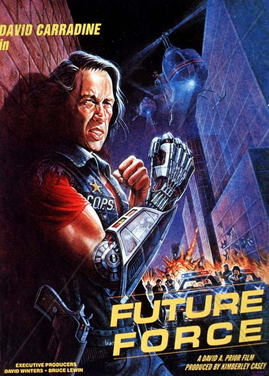
Future Force (1989, directed by David Prior)


The time is the future, which looks a lot like 1990s Los Angeles.  Because of out of control crime, the police have been deemed useless and have been defunded.  (Like that could ever happen in real life!)  Seeing a need and a decent profit margin, private enterprise has stepped up.  The law is enforced by C.O.P.S., which stands for Civilian Operated Police Systems.  Not held back by the Constitution or any oversight at all, C.O.P.S. has become just as corrupt and dangerous as the criminals that it battles.  When a reporter named Marion (Anna Rapagna) threatens to do a story about the out of control C.O.P.S., the head of the company hacks the justice system and puts out a warrant for Marion on the charge of treason.  Because of the seriousness of the charge, the bounty hunters of C.O.P.S. don’t have to bring her in alive to get paid.  In fact, they are encouraged to bring her in dead.

Tucker (David Carradine) is weary and disillusioned member of C.O.P.S. but he is still enough of an idealist that he wants to arrest Marion without killing her.  When he discovers that Marion is being set up, Tucker goes out of his way to protect her from the evil Becker (Robert Tessier) and all the other C.O.P.S.  It turns out to be pretty easy because Tucker is apparently the only members of C.O.P.S. who isn’t terrible at his job.   Helping Tucker out is a wheelchair-bound hacker named Billy (D.C. Douglas) and a robotic glove that can shoot laser beams.

A Robocop rip-off that lacks that film’s satiric bite, Future Force takes place in a future where everyone drives cars from the 70s and where every bar is a strip club that looks like it could have been used in the type of movies that used to show up on late night Cinemax.  It’s a future of empty warehouses, deserted streets, and fires in trash cans.  Robot glove aside, the movie’s future is unconvincing even by the standards of 1989.  There’s a lot of car chases and strange gunfights where no one seems to be aiming at each other but there’s also many scenes that were added to pad out the movie’s running time.  Marion gets upset when Tucker ruthlessly kills two people who were trying to kill her but she barely shrugs when she later discovers that the bad guys have killed her sister.  As bad the movie is, give some respect, though, to David Carradine whose general air of “I don’t want to be here, just give me my paycheck so I can go home,” fits his character like a glove.

Mutant Hunt (1987, directed by Tim Kincaid)


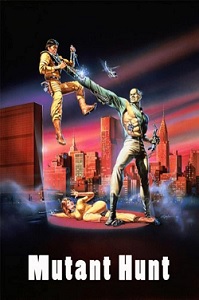
The time is the near future.  Paul Haynes (Mark Umile) has invented the Delta 7 cyborgs, who are supposed to help humanity.  However, the evil Z (Bill Peterson) has somehow gotten the cyborgs addicted to a drug that causes them to commit a murder every six hours.  When Paul objects his cyborgs being turned into killing machines, Z takes him hostage.  Paul’s sister, Darla (Mary Fahey), runs from two of the cyborgs and they all end up in the apartment of Matt Riker (Rick Gianasi), a mercenary who is an old acquaintance of Paul’s.  Riker defeats the two cyborgs in his apartment, though his own pleasure droid is sadly sacrificed in the battle.  Riker then gets together with his friends Johnny Felix (Ron Reynaldi) and Elaine Eliot (Traunie Vrenon) so that they can destroy the remaining Delta 7s and rescue Paul.  Johnny knows martial arts and has come up with a way to track the remaining cyborgs.  Elaine is a stripper who is also one of the world’s best fighters.  They’re about as strong a group as I guess society could hope for.  What they don’t know is that Z and his associate, Domina (Stormy Spill), have got a Delta 8 waiting to meet them.  What Z does not know is that Riker is a pyromaniac who, unlike the typical movie hero, doesn’t worry about fighting with honor.  What the audience never knows is why Z corrupted the cyborgs to begin with or why he took Paul hostage instead of just having the cyborgs kill him.  It’s an evil plan but it’s not one that appears to really be about accomplishing anything.

Mutant Hunt is a low-budget science fiction film that has a plot that is impossible to follow.  Again, even though I sat through the entire movie, I am still not sure what Z was actually trying to accomplish with his murderous cyborgs.  This is one of those films where the future is represented by empty warehouses and plenty of neon signage.  Because the film is so low budget and the acting is so unconvincing, Mutant Hunt has developed a cult following among those who think that the film is so good that it’s bad.  Actually, despite some impressive makeup work with the mangled cyborgs, Mutant Hunt is just bad.  It takes a little from The Terminator and a little from Blade Runner and then mashes it all together with a plot that feels like dystopian mad libs.  The end result is an incoherent movie that feels much longer than just 77 minutes.

Midnight Ride (1990, directed by Bob Bralver)


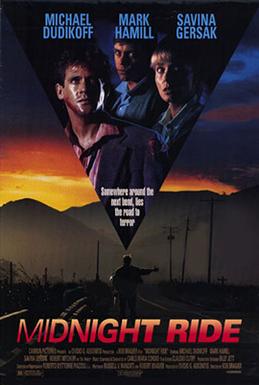
Driving to a friend’s house after getting into a late night argument with her husband, Lara (Savina Gersak) makes the mistake of picking up a hitchhiker.  At first, Justin McKay (Mark Hamill) seems like a nice guy but he quickly reveals himself to be a serial killer.  Haunted by his terrible childhood and the abuse he suffered at the hands of his mother, Justin has decided to get revenge on the world by going on a killing spree.  He’s even got a polaroid camera with him so that he can have a souvenir of every murder that he commits over the night.  Holding Lara hostage, Justin forces her to drive him to his ultimate destination, the hospital where he was once the patient of Dr. Hardy (Robert Mitchum).  Following behind Lara and her murderous passenger is Lara’s husband, Lawson (Michael Dudikoff).  Lawson is a former military policeman turned civilian cop and has experience taking down the bad guys.  But Lawson’s leg is also in a cast and not even he is prepared for how savage and dangerous clever Justin turns out to be.

What is Midnight Ride like?  Think of The Hitcher, just without that film’s subtext of an unacknowledged attraction between the driver and the hitcher.  Also replace Rutger Hauer giving a smooth, menacing, and seemingly indestructible performance with Mark Hamill sweating, bulging his eyes, and fidgeting throughout the entire film.  Midnight Ride is a competent thriller and Michael Dudikoff is a good working class hero but the main reason to see Midnight Ride is to watch Mark Hamill chew the scenery and play a character who is so evil and destructive that not even Luke Skywalker would have risked going anywhere near him.  Justin McKay has much more in common with The Joker than with Luke Skywalker.  Justin is the type of killer who, after murdering a hotel clerk, steals her glass eye and wears it as a necklace.  Hamill really throws himself into the role, savoring every crazy moment.  Dudikoff is stolid and dependable while Hamill often seems like he might be trying to burn the entire movie to the ground.  While Hamill chews up the scenery, Robert Mitchum barely seem to notice the scenery at all.  Hamill gives a masterclass in overacting while Mitchum gives a masterclass in barely bothering to act at all.  Mitchum was famous for saying that he didn’t give a damn and I can’t think of any film where he gave less of a damn than Midnight Ride.  Dudikoff may be top-billed but this is a Hamill/Mitchum joint all the way.

Boxing Time (2016, directed by Evan Jacobs)


About as pointless as a film can get, Boxing Time is 65 minutes of a boxing promoter named Art (played by director Evan Jacobs) talking on his phone.  He tries to convince his wife to allow him to talk to his daughter.  He talks to the boxing commissioner, who is being a real pain about the upcoming fight.  He talks to people who want to fix the fight.  Art talks and talks.  Usually, only his side of the conversation is shown and the movie doesn’t even show us the boxing match that everyone is so worked up about.  After all the build up, the movie cheats the audience by not letting them watch the main event.

It’s set up as a found footage film with a title card explaining that Art was filming himself because he had been diagnosed as having a paranoid personality disorder and that the footage comes from the last month of Art’s life.  Despite knowing that we’re watching the last days of a doomed man, it’s hard to care about Art.  He’s not a sympathetic character and watching him talk on the phone for 65 minutes is about as much fun as watching anyone talk on the phone for 65 minutes.  Boxing Time (also known as #boxingtime because why not?) is an extended acting exercise that ends up lying flat on the canvas.

The Brawler (2019, directed by Ken Kushner)


The Brawler is a biopic of boxer Chuck Wepner (adequately played by Zach McGowan).  A resident of Bayonne, New Jersey and nicknamed “The Bleeder” because of how much he usually bled in the ring, Wepner was the first boxer to face Muhammad Ali (played by Jerrod Page, who looks and sounds like Ali but who has none of his fabled charisma) after Ali’s famous defeat of George Foreman.  No one gave Wepner much of a chance.  Ali barely bothered to train for the match and falsely accused Wepner of using racial slurs while talking to him.  To everyone’s shock, Wepner not only went 15 rounds with the champ but he even knocked Ali off of his feet.  Wepner ultimately lost the fight but he won the hearts of many of the people watching.  He also inspired Sylvester Stallone to write and star in a movie called Rocky.

Though he was famous being “the Real Rocky,” Wepner initially didn’t make a dime off of Rocky or any of the sequels that followed.  While Stallone became a superstar, Wepner got addicted to cocaine, fought exhibition matches against Andre the Giant and a bear, and finally ended up in prison.  After getting out of prison, Wepner returned to his old job of selling liquor and made money signing memorabilia.  After he nearly got arrested as a part of a fraudulent autograph scam, Wepner finally took Stallone to court and sued for the money that he felt Stallone owed him.  Stallone settled, making Chuck Wepner the only man to go the distance with both Muhammad Ali and Sylvester Stallone.

If the plot of The Brawler sounds familiar, maybe you’ve seen one of the many documentaries that have been made about Chuck Wepner.  Or maybe you saw Chuck, a 2016 film about Chuck Wepner that starred Liev Schrieber.  The Brawler hits all of the same points as Chuck, so much so that it almost feels like an unofficial remake.  (Both films even features a voice-over narration from the actor playing Chuck.)  The main difference between the two films is that The Brawler spends a lot more time on Wepner’s time as a drug addict and it also portrays Stallone (played unconvincingly by Anthony Mangano) in a much more negative light.  Even though Wepner screws up every opportunity that he’s offered (including a chance to appear in Rocky II), it’s Stallone who is portrayed as being a villain because he didn’t always return Wepner’s calls and Stallone’s assistants were sometimes rude.  While Chuck spends all of time whining about how unfair his life is, Stallone comes across as being often clueless but hardly malicious in the way he treated Chuck.  It’s not easy to make a Hollywood superstar into a more sympathetic character than the poor underdog who is suing for the money that he’s owed for inspiring one of the most successful franchises of all time but The Brawler manages to pull it off.  In Chuck, Wepner is an inspiring underdog who never lets life keep him down.  In The Brawler, Wepner is a self-destructive child who lets down everyone who tries to help him.  When it comes to Chuck vs The Brawler, it’s Chuck by a clear knock-out.

The most interesting thing about The Brawler is that Burt Young has a cameo as a man watching the Wepner/Ali fight in a bar.  You have to wonder how Stallone felt about that.  Et tu, Paulie?

Missile X: The Tehran Incident (1979, directed by Leslie H. Martinson)


The international terrorist and casino owner known as The Baron (Curd Jurgens) has stolen a Soviet-made nuclear warhead.  With the help of Prof. Nikolaeff (John Carradine), the Baron is planning on dropping the warhead on an international peace conference that is being held off the coast of Iran.  American Alec Franklin (Peter Graves) and Russians Konstanine Senyonov (Michael Dante) and Galina Fedorovna (Karin Schubert) want to prevent the Baron from doing that but, in order to stop the Baron, they’re going to need the help of Leila (Pouri Baneai), a member of the Shah’s secret police.

Missile X was a German-Italian-Spanish co-production that was shot on location in Tehran with the full cooperation of the Shah of Iran.  The film goes out of its way to attempt to present the Shah-era Tehran as being a modern and welcoming city, the type of place that anyone would by a fool not to choose for a vacation.  The Shah’s secret police are portrayed as being friendly and heroic and the only time the name “Ayatollah Khomeini” is mentioned is when Alex and Leila are listening to a radio and a news report mentions that Khomeini is far away in Paris.  Leila turns off the radio in the middle of the report, as if to say, “There’s someone will never have to think about again.”  Unfortunately, for both the film and the world at large, that was the case.  In an example of truly bad timing, Missile X was not released in the United States until December 10th, 1979, six days after Khomeini officially took control of Iran and a month into the Iran hostage crisis.  By the time the film was released, the Shah had long-since fled Iran and was seeking asylum and medical care in the United States.

As for the film itself, imagine a Bond film with no car chases, no exciting action sequences, no creative gadgets, and no one-liners.  Imagine also that the main Russian was played by an American who don’t even attempt to speak with any sort of accent.  On top of that, imagine if James Bond himself came across less like a ruthless super spy and more like an insurance executive trying not to overspend on the company account while on a business trip.  Curd Jurgens actually did play a memorable Bond villain in The Spy Who Loved Me but he sleepwalks his way through Missile X.  Not even giving him a mute henchman with a knife-hand can make the Baron seems dangerous.  Even if you can overlook all of that, the Baron’s plan never makes sense.  What does he have to gain from blowing up a peace conference?  Alec and Konstantine both agree that the Baron’s actions will probably start World War III and lead to the end of the world but it’s never explained why the Baron would want that.  Presumably, the Baron would end up getting blown up with everyone else.

Of course, you don’t have to imagine any of this.  You can just watch Missile X — The Tehran Incident.

Who Killed Nancy? (2009, directed by Alan G. Parker)


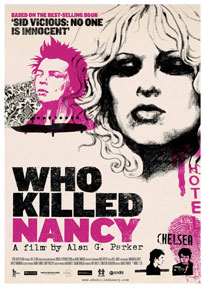
On October 12th, 1978, a 20 year-old, heroin addict named Nancy Spungeon was discovered dead in the bathroom of her room at the Chelsea Hotel.  Nancy was best-known for being the girlfriend of Sid Vicious, the bassist of the Sex Pistols.  The police arrested Vicious and charged him with second degree murder.  Vicious initially said that he couldn’t remember what had happened the previous night because he had been knocked out on barbiturates.  While being interrogated, Vicious changed his story and said that he and Nancy had an argument during the night but that he hadn’t meant to kill her when he stabbed her.  Later, Vicious said that Nancy fell on the knife but Vicious was such a heavy drug user that many felt it was doubtful he had any real memory of anything that might have happened that night.  After pleading not guilty, Vicious was released on $50,000 bail but he was sent right back to Riker’s after assaulting Todd Smith (brother of Patti Smith) at a nightclub.  At Riker’s Vicious went through a detox program before being once again released on bail.  Vicious died of a heroin overdose the night after he was released.

Who Killed Nancy? is a documentary about Sid and Nancy’s relationship and Nancy’s death.  The film features interviews with friends and cotemporaries of the couple.  (Glen Matlock is the only former Sex Pistol to be interviewed, though Malcolm McLaren is heard in archival footage.)  Sid Vicious comes across as being a deeply damaged individual with no impulse control.  Listening to some of the things that Vicious did before finding fame as the sneering face of punk rock, it is easy to believe that, as much as he did love Nancy, he was also capable of losing his control and killing her.  Glen Matlock’s flatmate describes how he was traumatized for life by watching Sid strangle a stray cat.  Others describe Sid as being childlike and almost innocent, a shy virgin until he met Nancy.  But anyone who could strangle an animal has obviously got some screws loose.

However, the documentary also makes a convincing argument that, even if he was capable of impulsive violence, Vicious was so wasted on the night of Nancy’s death that he couldn’t have even lifted a knife, much less stabbed someone with it.  The documentary suggests that Nancy was murdered by one of the many drug dealers who were coming in-and-out of the couple’s hotel room.  Unfortunately, due to his own public image, it was easy for the press and the public to assume that Sid committed the crime and, suicidal after Nancy’s death, it was easy for Sid to convince himself that he must have been responsible.  If the documentary is correct about Sid’s innocence, at least one person got away with murder.  It’s an interesting documentary.  You do have to feel bad for Nancy.  Even in death, none of the interviewees seems to be willing to say anything nice about her.  After all these years, she is still being blamed for Sid Vicious’s downfall but, as this documentary makes clear, Sid was probably doomed whether or he met Nancy or not.

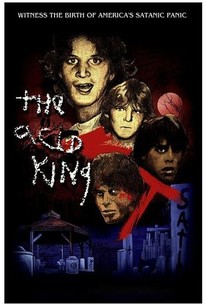
The Acid King (2019, directed by Dan Jones and Jesse B. Pollack)


In 1984, a Long Island-based teenage drug dealer and wannabe gangster named Ricky Kasso murdered a childhood friend named Gary Lauwers, reportedly because he was angry that Gary had stolen some drugs from him.  While tripping on LSD, Ricky brutally stabbed Gary to death in the woods.  Ricky later said that he demanded that Gary say “I love Satan,” while killing him.  Ricky claimed to be a Satanist, though he never actually learned how to spell the name of his supposed Dark Lord and instead would tag walls with graffiti exhorting the viewer to “Hail Satin.”

Not being the smartest drug dealer/Satanist to ever grace the state of New York, Ricky spent the next two weeks bragging about the murder and taking his friends to view Gary’s corpse.  While none of the people who saw Gary’s body ever called the police, rumors started to spread about what had happened.  Acting on an anonymous tip, the police arrested Ricky and two of his friends.  Ricky Kasso, the self-described “Acid King,” committed suicide in his jail cell a month after murdering Gary Lauwers.  Supposedly, the other inmates in the jail egged Ricky on while he hanged himself.  No one liked the Acid King.

Ricky Kasso had been in-and-out of trouble for the majority of his short life and, at the time of the murder, he was living on the streets because his family had kicked him out of the house.  What set Ricky apart from other murderous drug dealers was that he claimed to be a Satanist and that he demanded that Gary declare that he loved Satan before killing him.  This played right into the burgeoning Satanic Panic of the 80s and, in death, Ricky became a symbol of the Satanic conspiracy that many were convinced had taken hold of the teenagers.  (Especially teenagers who, like Ricky, listened to AC/DC.)  A book called Say You Love Satan was written about Kasso and his crimes.  Though the book has since been discredited, it was a best seller when initially published.  (I can still remember, when I was a kid, coming across a copy in Waldenbooks and reading a few pages.)  Ricky Kasso became a cult figure, inspiring both filmmakers and bands.  Meanwhile, all of Ricky and Gary’s former friends had to deal with the burden of being branded as Satanists by the rest of America.  Heavy metal music was blames for leading kids like Ricky into Satanism.  Tipper Gore campaigned for the labeling of offensive music.  Satin would have been proud.

The Acid King is an eye-opening documentary about the case, featuring interviews with the people who knew both Ricky and Gary.  While criticizing the way the case was reported on by the press, The Acid King also makes it clear that Ricky Kasso was a twisted individual.  (More than one interview subject describes him as being evil.)  The documentary takes a look at how Ricky and his friends were essentially abandoned by their parents in their privileged community, leaving them with next to no guidance on how to deal with the real-life consequences of their actions.  Of course, for the media, it was much easier to blame Satanism and heavy mental music than it was to ask where the parents were while Ricky Kasso was plotting to kill Gary Lauwers.

The first half of the documentary deals with Ricky and Gary.  The second half features interviews with the horror filmmakers and the musicians who were inspired by the sordid media coverage of Ricky’s crimes.  Lori S, the lead singer of Acid King, took the name of the band from a passage in Say You Love Satan while director Jim VanBebber, while being totally dismissive of the book’s claim that Ricky was directly inspired by Satan, still directed a short film about Ricky Kasso.  The second half is a less interesting than the first, until you consider that none of these people would have heard about Ricky Kasso if not for the attempts of people like Tipper Gore to turn him into the poster child for her crusade against heavy metal music.  Instead of scaring people away, the Tipper Gores of the world made Ricky Kasso, a barely literate idiot, into a cult figure.  Again, Satin would be proud.

The Acid King provides a valuable service by separating the fact from the rumors, revealing that the mundane truth is even more disturbing than the sordid fiction.
The Star Packer (1934, directed by Robert N. Bradbury)


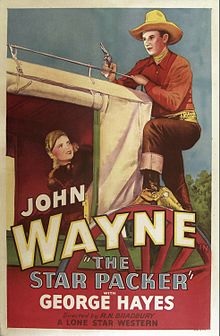
A mysterious outlaw known as the Shadow is terrorizing turn-of-the-century Arkansas.  He and his gang have killed the last few sheriffs of Little Rock.  No one is sure who the Shadow is or how he communicates with his gang but somehow, he is always one step ahead of the law.  However, the Shadow didn’t count on federal agent John Travers (John Wayne) riding into town and declaring himself to be the new sheriff.  Working with his Native sidekick, Yak (Yakima Canutt), Travers sets out to expose the Shadow and take him down.  Along the way, he falls for Anita (Verna Hillie), the niece of rancher Matt Matlock (Gabby Hayes).  Luckily, Anita knows her way around a gun too.

This is one of the 50 B-westerns that John Wayne made before Stagecoach made him a star.  The Star Packer is more interesting than some of Wayne’s other poverty row productions because The Shadow is a more interesting and much more clever villain than the usual greedy but dumb outlaws that Wayne went up against in these movies.  The Shadow actually has a clearly thought-out plan and, for once, Wayne can’t defeat the bad guys on his own.  In The Star Packer, it takes a community to stand up to evil.  As always with Robert Bradbury’s westerns, the fights and the stunts are impressive.  Fans of Wayne’s B-period will probably especially be interested to see the legendary stuntman, Yakima Canutt, play a good guy for once.  He and Wayne both do a good job in this 52 minute programmer.