Excalibur (1981, directed by John Boorman)


During the Dark Ages, Britain is at war.  King Uther Pendragon (Gabriel Byrne) leads his men against The Duke of Cornwall (Corin Redgrave).  Uther and his men swear their allegiance to God and St. George but they trust in the magic of the mysterious Merlin (Nicol Williamson).

Merlin negotiates peace between Uther and Cornwall but Uther throws that peace away when he becomes obsessed with Cornwall’s beautiful wife, Igrayne (Katrine Boorman).  Merlin uses his magic to disguise Uther as Cornwall so that Uther can spend one night with Igrayne.  When Cornwall is killed in battle, Uther marries Igrayne and realizes it was never necesarry to use Merlin’s magic and that Merlin, who has the power to see the future, knew that.  Merlin takes Uther and Igrayne’s infant son from them and then disappears.  Later, Uther is killed by by three of Cornwall’s men.  Before dying, Uther drives his magic sword, Excalibur, into a stone.  On the true king of England will be able to remove it.

Uther’s son, Arthur (Nigel Terry), grows up with no knowledge about his parentage.  When he accidentally draws Excalibur out of the rock, Merlin returns to counsel the new king.  And the new king has much to learn, as not all of the nobleman are willing to accept him as their ruler.  Arthur proves himself worthy to be king while his half-sister, Morgan (Helen Mirren), waits for her chance to get revenge.

Excalibur is one of the most ambitious films made about King Arthur.  John Boorman fits the entire legend of Arthur, Lancelot (Nicholas Clay), Percevel (Paul Geoffrey), Guinevere (Cherie Lunghi), and the search for the Holy Grail into one movie and, as a result, there’s not a dull moment.  Boorman presents the reign of King Arthur as a conflict between England’s pagan past and the new era of man.  Merlin and Morgan’s magic is powerful but, in the end, power is determined by bloody battles fought by men encased in clunky armor.  Arthur, Lancelot, and the other knights claim to live by the honorable, chivalric code but only one of them is able to live up to the ideal.  The others become consumed by lust, jealousy, and a thirst for power.

In my opinion, Excalibur is the best movie made about King Arthur, mostly because John Boorman takes the story seriously and makes us feel like we are watching people who truly are living in different world and a different time.  The chivalric code is necessary to keep the peace in a time when there are multiple pretenders-to-throne.  Mordred (Robert Addie) is not just a villain because he seeks to overthrow his father but also because he is the one person to have no respect for the code or the mystic power of the Holy Grail.

Excalibur has a large cast with many familiar faces.  Keep an eye out for Patrick Stewart as one of Arthur’s earliest supporters and also Liam Neeson as a surly Sir Gawain.  Of all the Lancelots who have appeared in the movies, Nicolas Clay is the best and Helen Mirren is the perfect Morgan.  Nicol Williamson steals the movie as the mysterious Merlin.  And while Nigel Terry was too old for the scenes where Arthur is supposed to be a callow teenager, he grows into the role just as Arthur grew into being king of the Britons.

Monty Python and The Holy Grail will always make me laugh but John Boorman’s big, beautiful, and bloody Excalibur is the best film about Camelot.

Cops and Robbersons (1994, directed by Michael Ritchie)


Chevy Chase is Norman Robberson, a hen-pecked suburban dad who likes to watch cop shows.  When he is informed that his next door neighbor, Horace Obsborn (Robert Davi), is suspected of being a Mafia hitman, he agrees to allow Detectives Jake Stone (Jack Palance) and Tony Moore (David Barry Gray) to use his house as their stakeout location.

Cops and Robbersons is just as terrible as its title.  Norman is basically Clark Griswold without the excuse of a vacation or the holidays to explain away his stupidity.  Jack Palance growls and looks annoyed but without the same comedic flair that he brought to City Slickers.  Dianne Wiest is wasted as Norman’s wife.  Of course, Norman’s daughter develops a crush on Tony while Norman’s son dressed up like Dracula and tries to put the bite on Stone.  Norman keeps getting in the way of the two cops and trying to conduct an investigation on his own.  There has to be an easier way to capture a hitman.  The only thing that really works is Robert Davi’s performance as the hitman.  Davi doesn’t try to be funny, which actually brings out the best in Chase whenever they share a scene.  Chase’s goofy dad shtick works best when he’s dealing with someone who isn’t trying to score laughs of his own.

How did the great Michael Ritchie end up directing movies like this?  Whoever let that happen should be ashamed.


Memoirs of an Invisible Man (1992, directed by John Carpenter)


An accident at a laboratory renders stock analyst Nick Holloway (Chevy Chase) invisible.  CIA agent David Jenkins (Sam Neill) wants to recruit Nick to be an assassin but Nick doesn’t want to kill people.  He just wants to make his date with Alice (Daryl Hannah).  With Jenkins and his agents in pursuit, Nick flees to a beach house belonging to his friend George (Michael McKean) and tries to figure out what to do with his life now that no one can see him.  Fortunately, Alice is staying at the beach house too.  Nick and Alice fall in love but Jenkins is close behind.

Based on a science fiction novel by H.F. Saint, Memoirs of an Invisible Man started out as a vanity project for Chevy Chase, who felt that the film’s mix of comedy and drama would establish him as a serious actor.  The project went through a series of directors, including Ivan Reitman and Richard Donner, but in the end no one wanted to work with the special effects necessary to create the impression of invisibility and, even more importantly, no one wanted to work with Chase.  When the film was finally offered to John Carpenter, he was reluctant to do another studio film because of his bad experience with They Live.  He finally agreed because it had been four years since his last film.

The special effects in Memoirs of an Invisible Man are still impressive and the chase scenes show off Carpenter’s abilities as an action director.  The movie flopped with critics and audiences but that was not Carpenter’s fault.  Carpenter keeps the story moving and gets good performances out of Sam Neill and even Daryl Hannah.  The problem with the movie is that Chevy Chase is miscast as an action hero and he tries too hard to give a serious performance.  Carpenter later said he wanted to add more comedy to the film and to emphasize Chase’s talent for physical comedy but Chase refused to do so.  Chase also resented wearing the blue bodysuit that would be used to render him invisible onscreen and often removed the suit early, ruining whatever else Carpenter had planned to shoot during the day.  You can add John Carpenter to the long list of directors who have said they will never work with Chevy Chase again.

One good thing did come out of Memoirs of an Invisible Man.  Carpenter met and enjoyed working with Sam Neill.  (Memoirs of an Invisible Man probably would have worked better in Neill and Chase had switched roles.)  Neill would go on to star in Carpenter’s next film, In The Mouth of Madness.

Trading Places (1983, directed by John Landis)


It all starts with a bet.

As Christmas approaches, Mortimer (Don Ameche) and Randolph Duke (Ralph Bellamy) make a bet to determine whether it’s nature or nurture that shapes someone’s future.  The fabulously wealthy owners of Duke & Duke Commodity Brokers, the brothers casually frame their director, Louis Winthrope III (Dan Aykroyd), for everything from dealing drugs to sealing money to cheating on his girlfriend (Kirstin Holby).  After Louis is kicked out of both his job and his mansion, the Dukes hire a street hustler named Billy Ray Valentine (Eddie Murphy) to take his place.  Earlier Winthrope tried to get Valentine arrested for approaching him in the street.  Now, Valentine is living in Winthrope’s mansion, with Winthrope’s butler and Winthrope’s job.

While Winthrope tries to survive on the streets with the help of a outwardly cynical but secretly kind-hearted prostitute named Ophelia (Jamie Lee Curtis, in her first non-horror starring role), Billy Ray surprises everyone by using his street smarts to become a successful, suit-wearing businessman.  The Dukes, of course, have no intention of keep Billy Ray Valentine on as their director.  Not only are the Dukes snobs but they’re racists as well.  Once their one dollar bet has been settled, they start planning to put Billy Ray back out on the streets with Winthrope.

Trading Places was Eddie Murphy’s follow-up to 48 Hrs and he again showed himself to be a natural star while playing the type of role that could have been played by Dan Ayrkroyd’s partner, John Belushi, if not for Belushi’s early death.  (Jim Belushi has a cameo as a party guest.)  Murphy gets to show off a talent for physical comedy and Trading Places is one of the few films to really take advantage of Dan Aykryod’s talents as both a comedian and actor.  Winthrope goes from being a coddled executive to being as streetwise as Valentine.  This is probably Aykroyd’s best performance and he and Eddie Murphy make for a good team.

But the real stars of the film are four actors who weren’t really thought of as being comedic actors, Denholm Elliott, Don Ameche, Ralph Bellamy, and especially Jamie Lee Curtis.  Ophelia is a much edgier character than the “final girls” that Curtis was playing in horror films and Curtis steals almost every scene that she’s in.  Ameche and Bellamy are great villains and it’s fun to watch them get their comeuppance.  What screwball comedy would be complete without a sarcastic butler?  Denholm Elliot fills the role of Coleman perfectly.

Trading Places was a box office success when it was released and it’s now seen as being one of the new Christmas classics, a film for the adults to enjoy while the kids watch Rudolph and Frosty.  I think the movie ends up going overboard towards the end with the gorilla and Dan Aykroyd wearing blackface but, for the most part part, it’s still a very funny and clever movie.

Beverly Hills Cop (1984, directed by Martin Best)


Two years after teaming with Nick Nolte in 48 Hrs., Eddie Murphy returned to the action genre in what remains he best-known action comedy, Beverly Hills Cop.

We all know the story.  Eddie Murphy is Axel Foley, a streetsmart detective in Detroit whose childhood friend, Mickey (James Russo), is murdered because of something that he saw while working as a security guard in Beverly Hills.  Axel plays by his own rules and gets results even as he gives his boss, Inspector Todd (Gil Hill), heartburn.  Todd refuses to allow Foley to investigate Mickey’s death so Axel puts in for some vacation time and catches the first plane to Beverly Hills.

In Beverly Hills, he meets up with another childhood friend, Jenny (Lisa Eilbacher).  Axel thinks that Mickey’s murder was ordered by a shady businessman named Victor Maitland (Steven Berkoff).  The Beverly Hills Police Department orders Axel to leave Maitland alone and to return to Detroit.  Axel won’t go until he gets justice for Mickey.  Lt. Bogomil (Ronny Cox) assigns Taggart (John Ashton) and Rosewood (Judge Reinhold) to follow Axel in Beverly Hills.

Like 48 Hrs., the story is serious but the comedy comes from how the well-drawn characters interact with each other and from seeing how Axel reacts to the strange and wealthy world of Beverly Hills.  Axel has the same reactions that we would have but, because he’s played by Eddie Murphy, he always has the perfect response to everything that he sees, whether it’s dealing with a snooty hotel clerk or with someone like Serge (Bronson Pichot), Jenny’s co-worker who speaks with an unidentifiable accent.  Even more so than in 48 Hrs or Trading Places, Murphy reveals himself to be a natural star here.  One reason why we like Axel is because he’s not just funny but he’s also the type of confident hero that we all wish we could be.  He’s not intimidated by Beverly Hills for a second.

It’s now impossible to picture anyone else in the role of Axel Foley but, when the film’s script was first being shopped around, it was originally offered to Sylvester Stallone, who said the story had potential but was missing something.  He rewrote the script and took out all of the humor, turning it into a grim and serious action film.  (It is rumored that Stallone later turned his version of the script into Cobra.)  Fortunately, Stallone eventually dropped out of Beverly Hills Cop so that he could co-star with Dolly Parton in Rhinestone.  Producers Don Simpson and Jerry Bruckheimer, then at the start of their producing careers, then offered the role to Eddie Murphy, who took Stallone’s script and added back all of the humor.  Murphy also ended up ad-libbing several of the film’s best one-liners, improvising the hotel lobby scene and the meeting with Serge on the spot.

Beverly Hills Cop was a huge success, cementing Murphy’s status as a star and proving that Murphy could carry a movie on his own.  The film still holds up, certainly better than any of the sequels that followed.  Even though Murphy was clearly the main attraction, the movie also gave actors like John Ashton, Judge Reinhold, Ronny Cox, Bronson Pinchot, and even Paul Reiser a chance to shine.  The villainous performances of Steven Berkoff and Jonathan Banks would serve as a model for countless bad guys through the 80s and 90s.  Beverly Hills Cop is a movie that makes you happy that Sylvester Stallone didn’t have a better sense of humor.

48 Hrs (1982, directed by Walter Hill)


48 Hrs. begins with a violent and bloody jailbreak.  The fearsome Billy Bear (Sonny Landham) helps his criminal associate, Albert Ganz (James Remar), escape from a chain gang and kills several guards in the process.  Billy and Ganz then head to San Francisco, where they start killing their former associates while searching for Luther (David Patrick Kelly).  Another bloody shootout leaves several detectives dead and SFPD Detective Jack Cates (Nick Nolte) looking for revenge.

That’s not the way you might expect one of the most famous comedies of the 80s to begin.  It’s not until Jack arranges for another associate of of Ganz’s to be released from prison for 48 hours that anything humorous happens in the film.  However, because Reggie Hammond is played by Eddie Murphy, 48 Hrs. quickly becomes very funny.

Murphy was appearing on Saturday Night Live when he was cast in 48 Hrs, in a role that was written with Richard Pryor in mind.  One of the first things that Murphy requested was that the character’s name be changed from Willie Biggs to Reggie Hammond.  Murphy made the role his own and watching him, it’s hard to believe that he was only 21 and also that 48 Hrs was his first film.  Murphy performs with the confidence of a natural movie star.  He’s good in the film’s most famous scene, where he pretends to be a cop and talks down an entire bar full of rednecks.  (I can’t repeat his most famous line but everyone knows it.)  But Murphy is even better in the scenes where he’s just reacting to Nolte’s slovenly cop.

The comedy in 48 Hrs comes from the mismatched partnership and initially hostile chemistry of Jack Cates and Reggie Hammond.  Cates has a job to do while Reggie, understandably, wants to enjoy as much freedom as he can before he gets sent back to prison.  The humor is so effective because it’s almost entirely character-based.  There are no gags but there are two well-written characters with differing ways of looking at the world who have to learn how to work with each other.  The two of them start out disliking and distrusting each other but ultimately become best friends, even if Jack does punch Reggie and Reggie does keep trying to steal Jack’s lighter.  Because this is a Walter Hill movie, there’s still a lot of action.  Nolte and Murphy may make you laugh but there’s nothing funny about full-on psycho performances of James Remar and Sonny Landham.  48 Hrs. not only allows Murphy and Nolte to show off their comedic ability but it also allows them to be true action heroes.

Popular with critics and audiences, 48 Hrs. was the most commercially successful film of 1982.  It set the standard for most buddy-cop movies to this day and it introduced the world to Eddie Murphy.

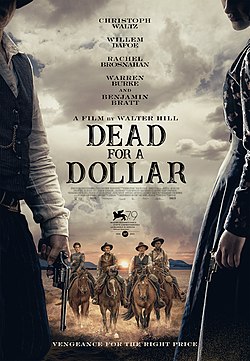
Dead For A Dollar (2022, directed by Walter Hill)


In 1897, bounty hunter Max Borlund (Christoph Waltz) is hired by wealthy Martin Kidd (Hamish Linklater) to track down Elijah Jones (Brandon Scott), the man who Martin says has kidnapped his wife.  Accompanying Max is Alonzo Poe (Warren Burke), who served with Elijah in the Army.

From the start, Max suspects that Martin is not being completely forthright about the kidnapping and it does turn out that Rachel Kidd (Rachel Brosnahan) voluntarily left with Elijah and is planning on traveling to Cuba with him.  Martin has hired crime baron Tiberio Vargas (Benjamin Bratt) to have Rachel raped and murdered because Martin thinks that the tragedy will help him launch his political career.  Because Martin suspects that Max might not be trustworthy, he has hired Max’s rival, Joe Cribbens (Willem DaFoe), to track down Rachel as well.

This film has a cast that is full of talented people and it’s a western directed by someone who has proven himself to be one of the masters of genre, Walter Hill.  I wanted to like Dead For A Dollar but the movie just didn’t work.  Waltz and DaFoe are great actors but they just seem to be going through the motions and Rachel Bsonahan is miscast.  Benjamin Bratt and Hamish Linklater are forgettable villains.  Even worse, Dead For A Dollar has a washed-out visual style that you would never expect from a director like Walter Hill.

Rewatch The Long Riders instead.

Silverado (1985, directed by Lawrence Kasdan)


In the old west, a cowboy named Emmet (Scott Glenn) teams up with a reformed outlaw named Paden (Kevin Kline) and they bust Emmet’s wild younger brother, Jake (Kevin Costner), out of jail.  After Mal (Danny Glover) helps the three of them escape from a posse, they all end up going to the town of Silverado, where all four of them have business.  Emmett and Jake want to protect their sister from the corrupt son (Ray Baker) of a cattle baron who was previously killed by Emmett.  Mal wants to save his sister Rae (Lynn Whitfield) from an evil gambler (Jeff Goldblum).  Paden discovers that Cobb (Brian Dennehy), his former partner-in-crime, is now the sheriff of Silverado and working for the cattle barons.  When Paden tries to protect the new settlers (including Rosanne Arquette), it leads to a confrontation with his former partner.

In the 80s, when he wasn’t directing films like The Big Chill and The Accidental Tourist, Lawrence Kasdan specialized in paying homage to the films of Hollywood’s golden age.  He started his directorial career with Body Heat, a modern film noir.  He worked on the screenplays of both Empire Strikes Back and Raiders of the Lost Ark.  With Silverado, Kasdan tried to resurrect the western.

Silverado is a traditional western with a few modern touches, like casting Jeff Goldblum as a gambler and John Cleese as the sheriff who wants to execute Kevin Costner.  Silverado also has more humor than a typical western, largely thanks to Kevin Kline.  Silverado starts out as a comedy before turning serious and grim once the four heroes finally reach Silverado.

Kasdan’s love of the genre is obvious in every frame of Silverado but, in trying to tell multiple stories at once, the movie spreads itself too thin.  I like that Kasdan tried to shake things up by casting actors who most people wouldn’t expect to see in a western but both Kevin Kline and Brian Dennehy seem miscast in their roles and their final confrontation never becomes the epic moment that it needs to be.  Scott Glenn and Kevin Costner are far more believable in their roles.  Danny Glover is also believable but his character is underused.

Silverado was obviously a labor of love for Kasdan and it shows that, if nothing else, Kasdan understood the appeal of the genre and the beauty of the wide open frontier.  The movie has its flaws but fans of westerns will appreciate his effort.

Great Moments In Television History #36: The Sopranos Premieres On HBO


On this day, 26 years ago, The Sopranos premiered on HBO and television (not to mention organized crime) would never be the same.  Today, it can be easy to forget just how revolutionary that first season of The Sopranos was.  What originally sounded like a joke — a gangster goes into therapy (a plot that had already been used in the film Analyze This) — turned out to be a powerful portrait of American society at the crossroads.

And it all started on January 10th, 1999.

Previous Moments In Television History:

  1. Planet of the Apes The TV Series
  2. Lonely Water
  3. Ghostwatch Traumatizes The UK
  4. Frasier Meets The Candidate
  5. The Autons Terrify The UK
  6. Freedom’s Last Stand
  7. Bing Crosby and David Bowie Share A Duet
  8. Apaches Traumatizes the UK
  9. Doctor Who Begins Its 100th Serial
  10. First Night 2013 With Jamie Kennedy
  11. Elvis Sings With Sinatra
  12. NBC Airs Their First Football Game
  13. The A-Team Premieres
  14. The Birth of Dr. Johnny Fever
  15. The Second NFL Pro Bowl Is Broadcast
  16. Maude Flanders Gets Hit By A T-Shirt Cannon
  17. Charles Rocket Nearly Ends SNL
  18. Frank Sinatra Wins An Oscar
  19. CHiPs Skates With The Stars
  20. Eisenhower In Color
  21. The Origin of Spider-Man
  22. Steve Martin’s Saturday Night Live Holiday Wish List
  23. Barnabas Collins Is Freed From His Coffin
  24. Siskel and Ebert Recommend Horror Films
  25. Vincent Price Meets The Muppets
  26. Siskel and Ebert Discuss Horror
  27. The Final Scene of Dark Shadows
  28. The WKRP Turkey Drop
  29. Barney Pops On National TV
  30. The Greatest American Hero Premieres
  31. Rodney Dangerfield On The Tonight Show
  32. The Doors Are Open
  33. The Thighmaster Commercial Premieres
  34. The Hosts of Real People Say “Get High On Yourself”
  35. The 33rd NFL Championship Game Is Broadcast In Color

No Holds Barred (1989, directed by Thomas J. Wright)


In No Holds Barred, Hulk Hogan plays a professional wrestler who is best-known for his mustache, his thinning blonde hair, and for ripping his shirt in half when he climbs in the ring.  Hulk Hogan is playing himself except that everyone in the movie calls him Rip Thomas.  Why is Hogan renamed Rip Thomas?  It seems strange because No Holds Barred features “Mean Gene” Okerlund and Jesse “The Body” Ventura as themselves and there’s nothing about Rip that’s any different from Hulk Hogan’s own wrestling persona.

Rip is the World Wrestling Federation Champion and is loved by fans across the globe.  Rip may be fierce in the ring but outside of the ring,  he loves children and is devoted to looking after his younger brother, Randy (Mark Pellegrino).  Tom Brell (Kurt Fuller), the evil owner of World Television Network, wants to harness the star power of Rip but, when Rip refuses to sign with WTN, Brell goes his own way and hires ex-convict Zeus (Tiny Lister) to star in The Battle Of The Tough Guys.

Rip still wants nothing to do with Brell, not even when Brell sends Samantha Moore (Joan Severance) to seduce him.  In fact, Rip is such a beacon of goodness that he brings Samantha over to his side.  But when Zeus puts Randy in the hospital, Rip has no choice but to seek revenge in the ring.

No Holds Barred is a movie with an identity crisis.  It’s a pro wrestling movie that was made to capitalize on Hulkamania and a lot of the humor was meant to appeal to the kids who were a huge part of Hogan’s fanbase but it’s also a movie in which people die, Samantha is nearly raped, and Randy is crippled by Zeus.  The movie lacks the sense of fun that has made professional wrestling a worldwide phenomena.  The most surprising thing about No Holds Barred is that Hulk Hogan has very little screen presence.  I don’t think anyone would expect him to be a great actor but he also shows little of the charisma that made him a phenomena back in the day.  Especially when compared to the ferocious Tiny Lister, Hogan is just boring.  Maybe that’s the difference between Rip Thomas and Hulk Hogan.

David Paymer has a small role in No Holds Barred, playing a nervous television executive.  Out of the cast, Paymer was the only one who later went on to be nominated for an Oscar and Jesse Ventura was the only one to later be elected governor of a state, at least so far.  Hulk Hogan’s only 71.  He’s still got time.