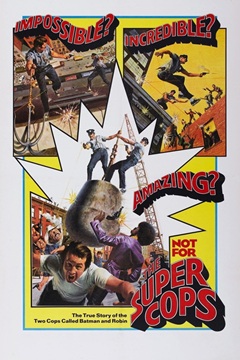
The Super Cops (1974, directed by Gordon Parks)


David Greenberg (Ron Liebman) and Robert Hantz (David Selby) are two tough and smart New York City cops who become detectives and play by their own rules.  They make arrests off-duty.  They drive their lieutenants crazy.  They bust drug dealers and prostitutes and single-handedly clean up their police precinct.  They’re the Super Cops and they’re even nicknamed Batman and Robin.  When they throw punches, a graphic “POW” appears on screen with a sound effect.

There’s an old saying about how, when the truth is different from the legend, always print the legend.  That’s certainly the case here.  The real-life David Greenberg went into politics and ended up doing time for mail fraud, insurance fraud, and obstruction of justice.  Robert Hantz was busted for possessing marijuana while he was on vacation in the Bahamas.  The arrest led to a demotion and Hantz quit the force as a result.  The film hints at Greenberg and Hantz’s involvement with the Knapp Commission, which investigated police corruption in the 70s.  (Lisa wrote about it when she reviewed Serpico.)  But the film does not mention that the Knapp Commission suspected that Greenberg and Hantz murdered two drug dealers.

You don’t get any of that with The Super Cops, which tries to mix the grittiness of films like The French Connection, The Seven-Ups, and Serpico with moments of cartoonish comedy and it really doesn’t work.  (Years after The Super Cops was released, Hill Street Blues proved that gritty drama and dark comedy could be mixed but it has to be done just right.)  Ron Liebman overacts while David Selby doesn’t seem to be acting at all.  (Liebman and Selby are both good actors but you wouldn’t know that from this movie.  For Liebman, I suggest checking out his performance in Night Falls On Manhattan.  For Selby, I recommend an overlooked dark comedy called Headless Body in Topless Bar.)  It’s hard to believe that Gordon Parks went from doing Shaft to doing this.  Shaft would have tossed the Super Cops through a window.  Popeye Doyle would have given him an assist.

There is one good thing to note about The Super Cops.  Edgar Wright is a fan of this film and it partially inspired the far superior Hot Fuzz.


Music Video of the Day: A Tout Le Monde by Megadeth (1994, directed by “Justin Keith”)


When today’s music video was first released, it was banned by MTV.  MTV claimed that the song and the video glorified suicide, which was certainly not the case when it came to either one.  As Dave Mustaine explained in interviews at the time, the song was about what Mustaine would say to his friends if he learned that he only had a few minutes left to live.  Mustaine sings that he would want to say, “I love you all and now I must go.”

(Some of the misunderstanding probably came from the song appearing on an album entitled Youthanasia.  Megadeth’s lyrics could certainly be dark and serious but they were just as often misunderstood, even by people who should have known better.)

Most only sources list Justin Keith as the director of this video.  In an interview with a German site, Mustaine explained that Justin Keith was actually the incredibly prolific Wayne Isham and that MTV apparently told Megadeth not to use Isham as their director because the channel was already “saturated” with videos that Isham had directed.  So, when Megadeth submitted the video, the listed Isham as being “Justin Keith.”  According to Mustaine, this — and not the the video’s content — is what actually caused MTV to ban the music video.

Mustaine later rerecorded this song for 2007’s United Abominations.

Enjoy!

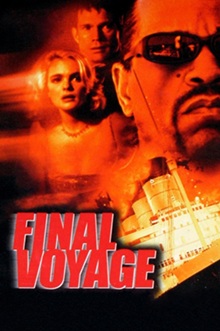
Final Voyage (1999, directed by Jim Wynorski)


Aaron (Dylan Walsh) has been hired to sever as a bodyguard for spoiled heiress Gloria (Erika Eleniak) while she takes a cruise.  Things go wrong when Josef (Ice-T) and Max (Claudia Christian) hijack the cruise.  They think that they’ll make a fortune by taking everyone hostage and searching the boat.  Little do they know that the boat is very slowly sinking.  (They would known except they killed the engineers when they first took over.)  Aaron and Gloria have to defeat the terrorists before the boat sinks.

Imagine Die Hard or Under Siege made not with expensive special effects but instead with a healthy supply of stock footage and built not around proven action stars like Bruce Willis and Steven Seagal but instead around the charisma-free Dylan Walsh and you have a pretty good idea why Final Voyage is one of the more forgettable movies to be ripped off from either one of those two films.  At least Dylan Walsh has the excuse of being miscast.  Erika Eleniak actually was in Under Siege and still seems clueless as to what she’s supposed to be doing during Final Voyage.  Ice-T is an amusing villain and the movie opens with a gunfight on an airplane that is so poorly choreographed and improbable that it becomes entertaining to watch.  Otherwise, Final Voyage is a cruise best not taken.

This is a Jim Wynorski film so there’s plenty of gratuitous bra and cleavage shots for those who are specifically looking for that.  Jim Wynorski definitely has a style and he manages to bring it to every film that he makes, even when it doesn’t really make sense for the story being told.  Give Wynorski this, he understands why people are watching his movies.

Music Video of the Day: Oh, Pretty Woman, covered by Van Halen (1982, directed by Roberto Lombardi)


A woman has been kidnapped and it’s up to Van Halen to save her!  Eddie’s a cowboy.  Alex is Tarzan.  Michael Anthony is a samurai.  David Lee Roth, not surprisingly, is Napoleon.  This video says a lot of about the appeal of early Van Halen, which really was a mix of Eddie’s technical virtuosity and Roth’s showmanship.  Van Halen was a band that knew how to make amazing music but, at first at least, they were also a band who knew how to have a good time.

Playing the damsel in distress was International Chrysis, a transgender performer who worked in a number of revues and off-Broadway productions in the 80s, along with appearing in Sidney Lumet’s Q&A.  International Chrysis died of cancer in 1990.

This video was shot at Indian Dunes, near Valencia, California.  Director Roberto Lombardi was a musician who also acted and worked behind the scenes in a number of productions.  He appears to have been one of those people who dabbled in a bit of everything as far as his creative outlets were concerned.

In 1982, this video was considered to be so controversial that MTV banned it from the airwaves.  Of course, as Tipper Gore later learned, trying to censor something only made more people want to watch it.  The video has since been unbanned but MTV gave up playing music videos a long time ago.  I don’t know what the M stands for now but it’s definitely not music.

Perhaps due to the controversy, Van Halen’s cover of Roy Orbison’s signature tune because one of their biggest hits.

Enjoy!


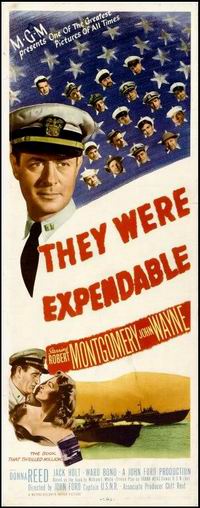
They Were Expendable (1945, directed by John Ford)


In December of 1941, Lt. John Brickley (Robert Montgomery) commands a squadron of Navy PT boats, based in the Philippines.  Brickley is convinced that the small and agile PT Boats could be used in combat but his superior officers disagree, even after viewing a demonstration of what they can do.  Brickley’s second-in-command, Rusty (John Wayne), is frustrated and feels that he will never see combat.  That changes when the Japanese attack Pearl Harbor and then turn their attention to the Philippines.  Brickley gets his chance to show what the PT boats can do but both he and his men must also deal with the terrible risks that come with combat.  Brickley and his men have been set up to fight a losing battle, only hoping to slow down the inevitable Japanese onslaught, because both they and their boats are considered to be expendable.  The hot-headed Rusty learns humility when he’s sidelined by blood poisoning and he also falls in love with a nurse, Sandy (Donna Reed).  However, the war doesn’t care about love or any other plans that its participants may have.  With the invasion of the Philippines inevitable, it just becomes a question of who will be sent with MacArthur to Australia and who will remain behind.

One of John Ford’s best films, They Were Expendable is a tribute to the U.S. Navy and also a realistic look at the realities of combat.  The movie features Ford’s trademark sentimentality and moments of humors but it also doesn’t deny that most of the characters who are left behind at the end of the movie will not survive the Japanese invasion.  Even “Dad’ Knowland (Russell Simpson), the fatherly owner of a local shipyard who does repair work on the PT boats, knows that he’s expendable.  He resolves to meet his fate with a rifle in hand and a jug of whiskey at his feet.  Rusty, who starts out thirty for combat, comes to learn the truth about war.  Ford was one of the many Hollywood directors who was recruited to film documentaries during World War II and he brings a documentarian’s touch to the scenes of combat.

Robert Montgomery had previously volunteered in France and the United Kingdom, fighting the Axis Powers before America officially entered the war.  After the war began, he entered the Navy and he was a lieutenant commander when he appeared in They Were Expendable.  Montgomery brought a hardened authenticity to the role of Brickley.  (Montgomery also reportedly directed a few scenes when Ford was sidelined with a broken leg.)  John Wayne is equally good in the role of the hot-headed Rusty, who learns the truth about combat and what it means to be expendable.  The cast is full of familiar faces, many of whom were members of the John Ford stock company.  Keep an eye out for Ward Bond, Cameron Mitchell, Leon Ames, Jack Holt, and Donald Curtis.

They Were Expendable is one of the best of the World War II movies.  It’s a worthy film for Memorial Day and any other day.
4 Shots From 4 Films: Special John Wayne Edition


4 Shots From 4 Films is just what it says it is, 4 shots from 4 of our favorite films. As opposed to the reviews and recaps that we usually post, 4 Shots From 4 Films lets the visuals do the talking!

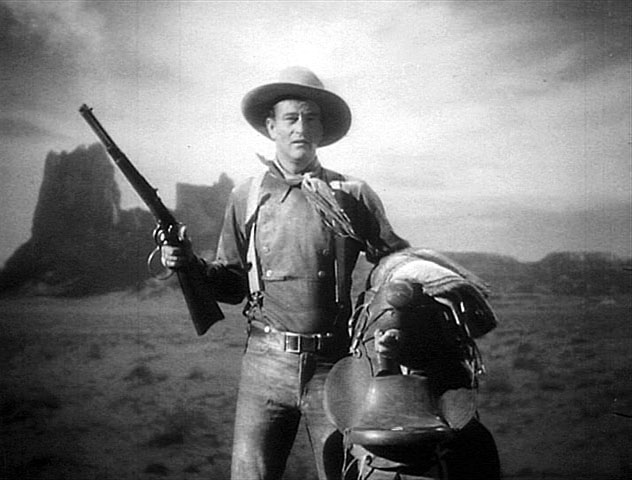
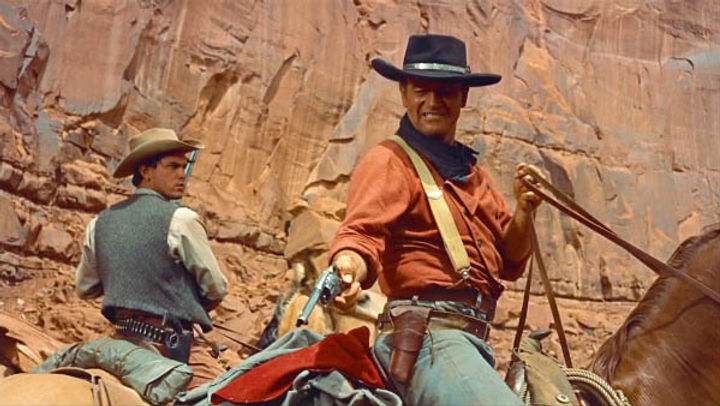
It’s John Wayne’s birthday!  Here’s 4 shots from the Duke’s unforgettable career.

4 Shots From 4 Films

Stagecoach (1939, directed by John Ford)

Sands of Iwo Jima (1949, directed by Allan Dwan)

The Searchers (1956, directed by John Ford)

The Man Who Shot Liberty Valance (1962, directed by John Ford)


Ambush at Cimarron Pass (1958, directed by Jodie Copelan)


Immediately following the Civil War, a group of U.S. soldiers and a group of former Confederates have to work together to survive an Apache ambush.  The leader of the soldiers is Sgt. Matt Blake (Scott Brady) and he’s escorting a gunrunner (Baynes Barron) to a nearby fort.  Leading the former Confederates is Sam Prescott (Frank Gerstle).  The two groups are, at first, suspicious of each other.  Confederate Judge Stanfield (Irving Bacon) thinks that Blake should just give the gunrunner and his guns to the Apaches, since that’s what they want.  When Blake disagrees, Prescott tries to encourage a young and angry former Confederate named Keith (Clint Eastwood) to challenge Blake’s command.  In the end, the former enemies have to learn how to set aside their differences to survive and to make it to the fort.

This was one of Eastwood’s earliest performances and only the fourth time that his name actually appeared in the opening credits.  (Eastwood had appeared, uncredited, in several films before this one.)  Eastwood later called Ambush at Cimarron Pass “the lousiest western ever made” and claimed that he hated the film so much that he almost gave up on acting after seeing it.  I think he’s being too hard on the movie.  It’s a low-budget B-movie that pretty much takes place in one location and it has an tending that feels tacked-on but, when it concentrates on the action and the hostility between the two groups, it’s not that bad.  It feels more like an episode of Death Valley Days than an actual movie but Scott Brady is a convincing hero and his brawl with Eastwood is one of the movie’s highlights.  As for Eastwood’s performance, he’s stiff but convincing when he’s angry.  It’s obvious that, in 1958, Clint Eastwood still had a long way to go an actor but his physical presence makes him stand out whenever he’s in a scene.  Ambush at Cimarron Pass is nothing special but it’s good enough to work for fans of the genre who might be looking for a brief diversion that features a handful of familiar faces.

After appearing in this film, Eastwood would land the role of Rowdy Yates on Rawhide and spend the next six years on television.  His next film would be A Fistful of Dollars, a western that made a much deeper impression on audiences than Ambush At Cimarron Pass.

Music Video of the Day: Dragonfly by Fleetwood Mac (1971, directed by ????)


Dragonfly is from the early days of Fleetwood Mac, before the arrival of Lindsay Buckingham and Stevie Nicks and the resulting soap opera that made the band a boomer favorite.  Instead, Dragonfly is a far more psychedelic song that Fleetwood Mac’s later work and the music video reflects that psychedelic feel.

Written by the band’s then-guitarist Danny Kirwan, Dragonfly features lyrics adapted from W.H. Davies’s 1927 poem, The Dragonfly, and it was the first single that the band recorded after the band’s original frontman, Peter Green, had let the group.  By the time the single was released, guitarist Jeremy Spencer had also left the group.  Even before the arrival of Buckingham and Nicks, Fleetwood Mac was a band known for its backstage drama.

This single failed to chart when it was originally released in the UK, though the members of the band felt it was one of their best songs.  The psychedelic video, which was obviously made in the days before MTV caused bands to consider that people should be able to watch a music video without burning out their retinas, probably didn’t help.  The song is better than the video.  It was finally given a belated U.S. release in 2014 and managed to make it to 9th place on the Hot Singles Sales Chart.

Enjoy!


Lafayette Escadrille (1958, directed by William Wellman)


In the days leading up to World War I, spoiled rich kid Thad Walker (Tab Hunter) flees Boston after getting hit with a car theft charge and ends up in Paris.  He befriends a group of American expatriates (including David Janssen, Will Hutchins, Jody McCrea, and William Wellman, Jr.) and eventually joins the French Air Force as a members of the Lafayette Escadrille.  Thad also falls in love with a French prostitute named Renee (Etchika Choureau) and, after Thad strikes a French officer, he goes on the run with her.

I always wonder how many people have watched this film over the years because of the presence of a young Clint Eastwood in the cast, just to discover that he doesn’t get many lines and his character is largely interchangeable with the other young actors playing the members of the Lafayette Escadrille.  This is a Tab Hunter movie, meaning that the action is dominated by Hunter’s sincere but bland screen persona.  Director William Wellman wanted to cast Paul Newman in the lead role and that would have been something to see.  Instead, the studio insisted on Hunter.  They also insisted that Wellman change the film’s ending so that Hunter could survive instead of getting shot down on his very first mission.  William Wellman was so disgusted with the studio that he retired from directing.

What had to make it all especially galling for the director was that Lafayette Escadrille was based on his own life.  His son, William Wellman Jr., plays “Bill Wellman” in the film and Thad was based on actual friend of Wellman’s.  The film was meant to be a tribute to his friends, many of whom did not survive World War I.  Instead, the studio insisted that it be just another Tab Hunter service comedy.  The best scenes are the ones where it’s just Thad and his friends trying to make it through basic training.  Unfortunately, those scenes are overshadowed by Thad on the run.

The film is still there for those of us who enjoy catching future stars.  Clint Eastwood, David Janssen, Tom Laughlin, Will Hutchins, Brett Halsey, and Jody McCrea are all present and accounted for.  Rumor has it that James Garner can spotted in the background but I couldn’t find him and Garner had already co-starred with Brando in Sayonara when this move was made so I doubt he was doing background work.  Tab Hunter’s blandness sinks the production but the rest of the cast would go on to better things.

Hostage For A Day (1994, directed by John Candy)


Hostage For A Day is the only film that the much-missed John Candy ever directed.  (It premiered on Canadian television, a few months after his death.)  It’s also one of the only films to feature George Wendt in a leading role, as opposed to being a supporting player.  The film is full of funny people like Don Lake and Robin Duke.  John Vernon plays Candy’s father-in-law.  A lot of talent went into this movie.  It’s too bad that it’s not very good.

Wendt does give a good performance in the lead role.  He plays Warren Kooey, who is depressed on his 41st birthday.  His wife (Robin Duke) has drained their bank account to remodel their house and apparently shag their interior decorator, Hondo (Currie Graham).  No one respects him at work.  Warren’s reflection in the mirror tells Warren that he needs to do something with his life.  Warren decides to fake a hostage situation so that he can collect the ransom.  The problem is that the SWAT team has recently had their budget cut and can’t afford to pay the amount that Warren comes up with.  Then some real kidnappers (led by John Candy, making a very brief appearance) hold him hostage for real.  While this goes on, Wendt continues to talk to his reflection in the mirror and there are a few sweet but out-of-place scenes featuring him reuniting with his childhood sweetheart, Diane St. Clair (Christopher Templeton).

As a director, Candy never seems to be sure what type of film he’s trying to make.  The comedy is broad but Candy also tries to sneak in some sentimental moments and the end results just doesn’t mix well.  He gets some good performances for his cast but the film itself never really comes together.  This was George Wendt’s only starring role and he does a good enough job that I regret he didn’t get bigger roles once Cheers went off the air because, judging by this film, he could have handled them  I just wish this movie was better.