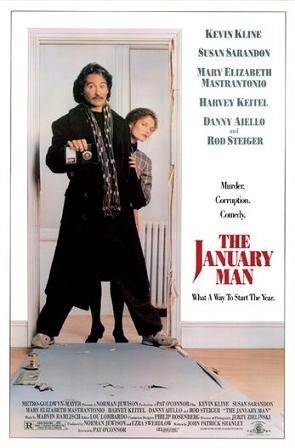
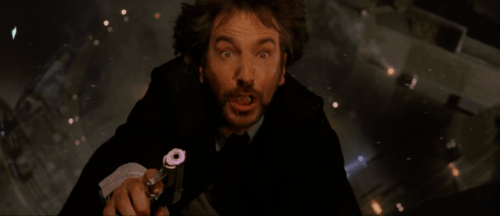
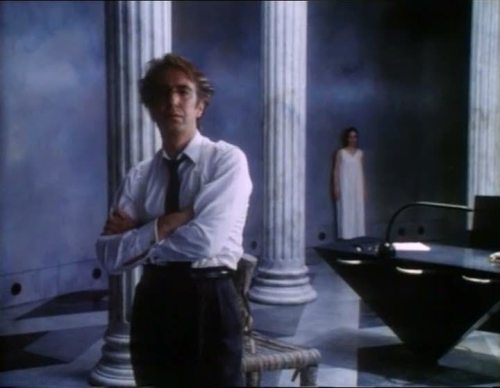
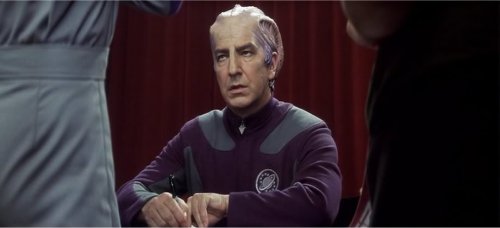
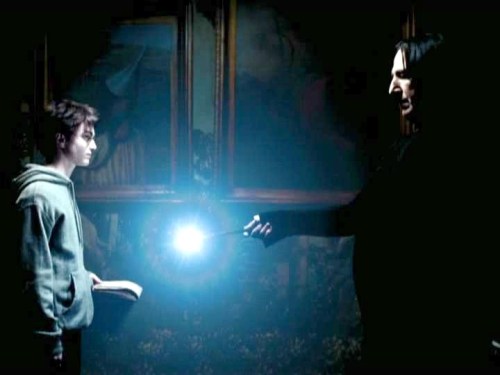
Last week, when the world first learned of the death of the actor Alan Rickman, it was shocking to realize just how many great roles he had played. He made his feature film debut as Hans Gruber in Die Hard. He played Colonel Brandon in Sense and Sensibility, Severus Snape in the Harry Potter movies, the Sheriff of Nottingham in Robin Hood: Prince of Thieves, Hilly Kristal in CGBG and Marvin the Paranoid Android in Hitchhiker’s Guide to the Galaxy. He even played Leonard Nimoy Alexander Dane in Galaxy Quest. But the first time I ever saw Alan Rickman, he was playing Ed the Painter in The January Man.
As The January Man begins, the new year is barely a day old and already Manhattan is in a panic. Over the past 11 months, a serial killer has terrorized the city, killing one woman per month. His latest victim, Allison Hawkins (Faye Grant) was murdered on New Year’s Eve. Now, it’s January and everyone in New York City is waiting for the killer to strike again.
Mayor Flynn (Rod Steiger, bellowing his lines as only an Oscar-winning “great” actor can) is upset because Allison was a friend of his daughter, Bernadette (Mary Elizabeth Mastrantonio). Flynn orders the police commissioner, Frank Starkey (Harvey Keitel), to put his brother on the case. Nick Starky (Kevin Kline) was the best detective in New York but Frank framed him on corruption charges. Now, Nick is working as a fireman and does not want to return to police work. However, Nick tells Frank that he will investigate the murders on one condition: Nick wants to make dinner for Frank’s wife (and Nick’s former lover), Christine (Susan Sarandon).
After cooking an octopus for Christine, Nick works the case. His unorthodox methods get on the nerves of Capt. Alcoa (Danny Aiello, bellowing almost as much as Rod Steiger) but also wins him the heart of Bernadette. Helping him investigate the case (and repainting his office) is his neighbor, Ed (Alan Rickman). Ed is not only a painter but he’s also a computer expert who figures out exactly where the killer is going to strike next.
The January Man was Alan Rickman’s second film and followed his debut in Die Hard. Other than sharing a similarly sarcastic sense of humor, Ed the Painter is the exact opposite of Hans Gruber. Gruber was a murderer who would do anything for money. Ed is an artist who wants only to paint and hang out with Nick Starkey.
When I first saw The January Man, I was seven years old and I was on an airplane flying to London. I was too young to really understand what was happening in the movie but I knew that Ed was my favorite character because he was the one who got all the funny lines and he spoke with a British accent. When he told one of his models “Don’t molest anything,” I thought it was hilarious even though I did not really understand what he was talking about. (Years later, I would watch The January Man on HBO and I would discover that Ed made his living painting nudes and that Bernadette and Nick were having sex, all information that was edited out of the airplane version.)
After I heard that Rickman had died, I rewatched The January Man for the first time in years. I discovered that The January Man is a terrible movie that tries to unsuccessfully to mix slapstick comedy with brutal serial killer action but Alan Rickman still gives a really good performance, the best in the film. (A close second would be Mary Elizabeth Mastrantonio, whose smile lights up every scene in which she appears. She married the movie’s director so at least she got something good out of appearing in The January Man.) That Alan Rickman is one of the film’s few bright spots is a testament to his talent as an actor. Alan Rickman was such a great actor that he even made The January Man watchable.
Last night, when I heard that David Bowie had died, I immediately flashed back to the summer of 2003. I spent that summer hanging out with my friend Jay. I was an aspiring writer and he was the musician who got all the girls. Jay was also a David Bowie fanatic whose cover of The Man Who Sold The World was at least as good as Nirvana’s. When I think about that summer, I remember the all-night bull sessions, smoking in Jay’s backyard, watching reruns of Hawaii 5-0 and agreeing that McGarrett was one cool dude, and the weekly poker games where I always seemed to lose. But mostly, I remember David Bowie providing the greatest soundtrack anyone could want.
Over his 50 year career, David Bowie reinvented himself many times. When he released his first single in 1964, he did so under his real name. He was 17 years old when Davie Jones and the Queen Bees released Liza Jane.
By the time he released Space Oddity in 1969, Davie Jones had become David Bowie. Space Oddity would introduce the world to Major Tom, a character to whom Bowie would return in the future.
1970’s The Man Who Sold The World is often erroneously believed to be a retelling of Robert Heinlein’s novella, The Man Who Sold The Moon. In 1997, Bowie himself said that the song was about being young and feeling incomplete.
Life on Mars? was once described by BBC Radio 2 as being “a cross between a Broadway musical and a Salvador Dali painting.”
1975’s Golden Years, with its chorus of “run for the shadows,” is one of my personal favorites.
In 1977, David Bowie appeared on the final Bing Crosby Christmas Special. He and Bing performed Peace on Earth/Little Drummer Boy. At the time, Bing was quoted as saying about Bowie: “clean-cut kid and a real fine asset to the show. He sings well, has a great voice and reads lines well.”
In 1980, Major Tom returned in Ashes to Ashes.
Rather than grow stagnant as an artist, David Bowie was always reinventing himself. In 1997, he proved he was still a force to be reckoned with when he released I’m Afraid of Americans.
In November, David Bowie released Blackstar. In the song’s video, Major Tom made his final appearance.
Lazarus was the last single that David Bowie released during his lifetime. The video was released three days before he died and feels like it was his way of saying goodbye.
Rest in peace, good sir. And thank you for the music and the memories.
Here’s wishing you and your family a Happy Festivus!
Whether gathered around the Festivus Pole or competing in feats of strength or listening to the airing of grievances, never forget the true meaning of a Festivus for the rest of us!
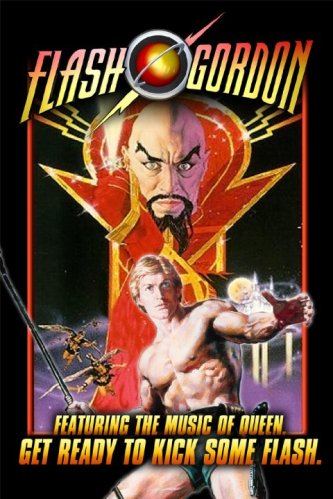
Life on the planet Mongo is not easy. Aided by Darth Vader wannabe Klytus (Peter Wyngarde) and the sadistic General Kala (Mariangela Melato), the evil Emperor Ming (Max Von Sydow) rules with an iron fist. All of the citizens are heavily taxed and kept in a state of perpetual war in order to keep them from joining together and rebelling. Those who attempt to defy Ming are executed.
There are many different races living on both Mongo and its moons. The Arborians, also known as the tree people, live in a jungle and are ruled by Prince Barin (Timothy Dalton). Until Ming overthrew his father, Barin was the rightful heir to the throne of Mongo. Barin is also one of the many lovers of Aura (Ornella Muti), Ming’s rebellious daughter.
Barin distrusts the Hawkmen, a group of winged barbarians. Led by the boisterous Prince Vultan (the one and only Brian Blessed), the Hawkmen live in a palace that floats above Mongo. Both Vultan and Barin share a desire to overthrow Ming but neither one of them can set aside their own dislike and distrust of each other.
Ming grows bored easily but Klytus has found him a new play thing, an obscure planet in the S-K system. “The inhabitants,” Klytus says, “refer to it as the planet Earth.”
It all leads to this:
You may have been too busy listening to Queen’s theme song to notice (and I don’t blame you if you were) but I have always found it strange that, even though Ming had never heard of Earth before Klytus brought it to his attention, he still had a button labeled “Earthquake.” Whenever I watch Flash Gordon, I wonder if I am the only one who has noticed this.
With Ming plaguing Earth with tornadoes, hurriances, and “hot hail,” it is up to three Earthlings to travel to Mongo and defeat him. Dr. Zarkov (Topol) is an eccentric scientist who was forced out of NASA because of his belief in Mongo. Dale Arden (Melody Anderson) is a reporter. And, finally, Flash Gordon (Sam J. Jones) is a professional athlete. Because this movie is a fantasy, Flash Gordon is a superstar quarterback for the New York Jets.
The character of Flash Gordon was first introduced in a 1934 comic strip and was played by Buster Crabbe in several classic serials. Among Flash’s many young fans was a future filmmaker named George Lucas, who would later cite Flash’s adventures as being a major inspiration for the Star Wars saga. After the unprecedented success of Star Wars:A New Hope, it only made sense that someone would try to make a Flash Gordon film.
That someone was producer Dino De Laurentiis. (Before writing the script for Star Wars, Lucas attempted to buy the rights for Flash Gordon from De Laurentiis.) To write the script that would bring Flash into the 80s, De Laurentiis hired Lorenzo Semple, Jr. Semple was best known for helping to create the 1960s version of Batman and he brought a similarly campy perspective to the character and story of Flash Gordon. As a result, the film ended up with scenes like this one, where Flash interrupts one of Ming’s ceremonies with an impromptu football scrimmage:
It also led to Brian Blessed’s entire performance as Prince Vultan, which is especially famous for the way that Blessed delivered one line:
(That also makes for a great ringtone.)
Sam J. Jones and Melody Anderson often seem to be stranded by Semple’s script but Max Von Sydow, Topol, Brian Blessed, Peter Wyngarde, and Ornella Muti all get into the swing of things. Seen today, Flash Gordon is entertaining but too intentionally campy for its own good. On the positive side, the images still pop off the screen and the soundtrack sounds as great as ever. When you listen to Queen’s theme song, you have no doubt that “he’ll save every one of us.”
As Flash Gordon himself put it after he saved the universe: “YEAAAAH!”
I think I was twelve when I first saw Heavy Metal. It came on HBO one night and I loved it. So did all of my friends. Can you blame us? It had everything that a twelve year-old boy (especially a 12 year-old boy who was more than a little on the nerdy side) could want out of a movie: boobs, loud music, and sci-fi violence. It was a tour of our secret fantasies. The fact that it was animated made it all the better. Animated films were not supposed to feature stuff like this. When my friends and I watched Heavy Metal, we felt like we were getting away with something.
Based on stories from the adults-only Heavy Metal Magazine, Heavy Metal was divided into 8 separate segments:
Soft Landing (directed by Jimmy T. Murakami and John Bruno, written by Dan O’Bannon)
Heavy Metal opens brilliantly with a Corvette being released from a space shuttle and then flying down to Earth, surviving reentry without a scratch. Who, after watching this, has not wanted a Space Corvette of his very own?
Grimaldi (directed by Harold Whitaker)
On Earth, a terrified young girl listens a glowing green meteorite called the Loc-Nar tells her that it is the source of all evil in the universe. This sets up the rest of the film, which is made up of stories that the Loc-Nar tells about its influence. The Loc-Nar is the film’s MacGuffin and, seen today, one of Heavy Metal’s biggest problems is that it has to find a way to force the Loc-Nar into every story, even if it meant sacrificing any sort of consistency about what the Loc-Nar was capable of doing. Even when I was twelve, I realized that the Loc-Nar was not really that important.
Harry Canyon (directed by Pino Van Lamsweerde, written by Daniel Goldberg)
In this neo-noir tale, futuristic cabby Harry Canyon (voiced by Richard Romanus) is enlisted to help an unnamed girl (voiced by Susan Roman) to find the Loc-Nar. Slow and predictable, Harry Canyon does feature the voice of John Candy as a police sergeant who attempts to charge Harry for police work.
Den (directed by Jack Stokes, written by Richard Corben)
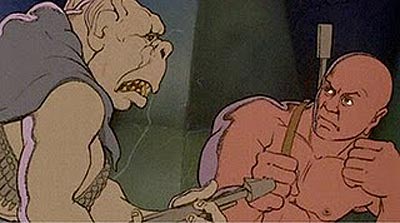
Nerdy teenager David (voiced by John Candy) finds a piece of the Loc-Nar and is transported to the world of Neverwhere, where he is transformed into Den, a muscular, bald warrior. As Den, David gets to live out the fantasies of Heavy Metal‘s target audience. On his new planet, Den rescues an Earth woman from being sacrificed, overthrows an evil queen and a sorcerer, and gets laid. A lot. Den is the best segment in Heavy Metal, largely because of the endearing contrast between the action onscreen and John Candy’s enthusiastic narration.
Captain Sternn (directed by Paul Sebella and Julian Harris, written by Bernie Wrightson)
On a space station orbiting the Earth, Captain Lincoln F. Sternn is on trail for a countless number of offenses. Though guilty, Captain Sternn expects to be acquitted because he has bribed the prosecution’s star witness, Hanover Fiste. However, Hanover is holding the Loc-Nar in his hand and it causes him to tell the truth about Captain Sternn and eventually turn into a bloodthirsty giant. Captain Sternn saves the day by tricking Hanover into getting sucked out of an air lock.
Captain Sternn was a reoccurring character in Heavy Metal Magazine and his segment is one of the best. Eugene Levy voices Captain Sternn while Joe Flaherty voices his lawyer and Dean Wormer himself, John Vernon, is the prosecutor. Even National Lampoon co-founder Douglas Kenney provided a voice.
B-17 (directed by Barrie Nelson, written by Dan O’Bannon)
After the Loc-Nar enters Earth’s atmosphere, it crashes into a bullet-riddled World War II bomber, causing the dead crewmen within to reanimate as zombies. Scored to Don Felder’s Heavy Metal (Takin’ a Ride), B-17 is one of the shorter segments and its dark and moody animation holds up extremely well.
So Beautiful and So Dangerous (directed by John Halas, written by Angus McKie)
Nubile Pentagon secretary Gloria is beamed aboard a spaceship that looks like a giant smiley face. While she has sex with the ship’s robot captain, the two crew members (voiced by Harold Ramis and Eugene Levy) pour out a long line of cocaine and shout “Nosedive!” before snorting up every flake. So Beautiful and So Dangerous is so juvenile and so ridiculous that it is actually all kinds of awesome.
Taarna
In the film’s final and most famous segment, Taarna, the blond warrior was featured on Heavy Metal‘s poster, rides a pterodactyl across a volcanic planet, killing barbarians, and finally confronting the Loc-Nar. She sacrifices herself to defeat the Loc-Nar but no worries! We return to Earth where, for some reason, the Loc-Nar explodes and the girl from the beginning of the film is revealed to be Taarna reborn. She even gets to fly away on her pterodactyl. Taarna was really great when I was twelve but today, it is impossible to watch it without flashing back to the Major Boobage episode of South Park.
Much like Taarna, Heavy Metal seems pretty silly when I watch it today. But when I was twelve, it was the greatest thing ever.
The year 2005 was a dark time to be a fan of Star Wars.
The first two parts of the highly anticipated prequel trilogy had been released and had left fans feeling as if millions of voices had cried out in terror and suddenly been silenced. No sooner had fans started to recover from the trauma of The Phantom Menace then Attack of the Clones was unleashed and they were stunned to learn that a movie could be even more pointless than The Phantom Menace.
The summer of 2005 promised the release of Star Wars Episode III: The Revenge of the Sith. Fans were excited because they knew that Anakin Skywalker would finally be transformed into Darth Vader but they also knew that he would still be played by Hayden Christensen. Many of us who went to see the movie on its opening weekend did so with low expectations and mixed feelings.
“WAR!” the opening title crawl of Revenge of the Sith declared, as if it was trying to reassure those of us in the audience that it would not be another boring Star Wars prequel. There was nothing in the crawl about taxation or trade routes. Instead, it was all about how the Galactic Republic was at war with separatists and how Chancellor Palpatine was being held prisoner by General Grievous. After an exciting battle on Grievous’s flagship, Anakin not only rescued Palpatine but also decapitated Christopher Lee’s Count Dooku, despite the fact that Dooku had surrendered and was unarmed. That’s when those of us watching knew that Revenge of the Sith was not going to be like the other two prequels. Revenge of the Sith was going to be darker and edgier and not just for kids. A headless Count Dooku action figure would not be sold at your local toy store.
Looking back, it is easy to forget how relieved many of us were that Revenge of the Sith was not terrible. After the bitter disappointment of the first two prequels, we were happy that Jar Jar Binks only appeared during one shot towards the end of the film and he did not speak. We were happy that Ewan McGregor and Natalie Portman both finally got to give performances that justified casting actors of their caliber as Obi-Wan and Amidala. We were happy that, since Anakin and Amidala were secretly married between Attack of the Clones and Revenge of the Sith, we did not have to sit through any more scenes of them falling in love. Many of us had found Hayden Christensen’s performance to be petulant in Attack of the Clones and, intentionally or not, Revenge of the Sith seemed to validate our suspicions by having both Yoda and Mace Windu say the same thing about Anakin. After the embarrassment of Phantom Menace and Attack of the Clones, this was a prequel that we felt we could get behind.
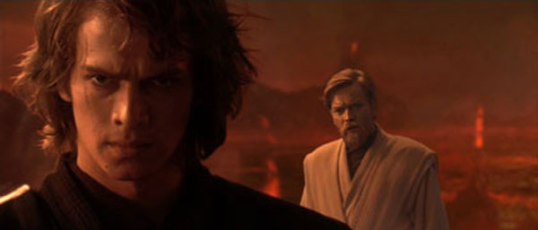
And we were really happy with the climatic battle between Obi-Wan and Anakin. After Anakin had gone over to the dark side, he and Obi-Wan dueled on a volcanic planet. “You were supposed to be the chosen one!” Obi-Wan shouted after chopping off Anakin’s legs. After being left to die by Obi-Wan, Anakin was rescued by Emperor Palpatine. It was only after being encased in that famous black armor that Palpatine told the new Darth Vader that Amidala had died. Darth Vader’s “Nooooooooo!” would go down in history.
At the end of the film, Jimmy Smits was seen giving an infant Luke to Owen and Beru Lars and Darth Vader and the Emperor were seen standing on the bridge of an imperial ship and looking out at the skeleton of the Death Star. For the first time since the prequels were first released, some of us applauded at the end of a Star Wars film.
When, ten years later, I rewatched Revenge of the Sith for the first time in a long while, my immediate impression was that it was nowhere close to being as good as I remembered. Without a doubt, it was still the best of the prequels but how much was that really saying? Of all the prequels, it came the closest to capturing the sense of awe and excitement that made the original trilogy (even Return of the Jedi) so entertaining but, at the same time, it still had many of the same flaws that afflicted Phantom Menace and Attack of the Clones. Hayden Christensen was as stiff and inexpressive as ever, as was George Lucas’s dialogue. (When Obi-Wan tells Anakin that Palpatine is evil, Anakin actually replies, “From my point of view, the Jedis are evil!” He shouts this in the middle of a light saber duel.) Even the movie’s most shocking moment, when Anakin murdered a group of children, was no longer effective because everyone in the movie insisted on calling the children “younglings.”
Throughout the entire prequel ordeal, George Lucas would insist that it was necessary to see all three of the prequels to really understand the story he was trying to tell and how it fit in with the original trilogy. However, of all the prequels, Revenge of the Sith is the only one that feels as if it adds anything to what we had already learned from watching the original trilogy. Nor is there anything to be gained from having seen the first two prequels before watching Revenge of the Sith for the first time. The main accomplishment of Revenge of the Sith was to prove that The Phantom Menace and Attack of the Clones were entirely unnecessary. (Revenge of the Sith actually works better if you have never seen Phantom Menace because there is no way that the Anakin played by Jake Lloyd could have grown up to be the Anakin played by Hayden Christensen.)
Why, when we originally watched Revenge of the Sith, did so many of us think that it was so much better than it actually was?
In the year 2005, we were just happy to have a Star Wars film that did not totally suck.
After airing for seven seasons and counting on the Cartoon Network, Regular Show has finally gotten its own feature-length movie! In Regular Show: The Movie, the Earth is in danger of being destroyed by a time jumping volleyball coach and it is up to our two favorite slacker groundskeepers — Mordecai the Blue Jay and Rigby the Racoon — to save the world. But to do so, they are going to have to confront their past and Rigby is going to have to reveal something that not even his oldest friend, Mordecai, knows about.
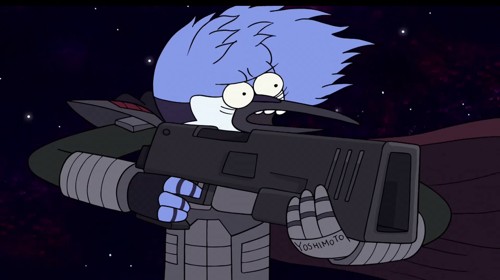
Regular Show: The Movie opens in the future, with a massive battle in space. Rigby is leading a squadron composed of his former co-workers at the state park against the forces of the evil Mr. Ross, a former high school volleyball coach-turned-cyborg who is using a “timenado” to destroy time itself. (Ross is in a hurry to destroy Earth because, after devoting 25 years to his evil plan, he has a lot of television to catch up on.) During the battle, Rigby is shocked to discover that his former friend Mordecai is one of Ross’s soldiers. Mordecai tells Rigby that he wants revenge for something that Rigby did in the past. Rigby manages to escape in a time ship but not before getting shot by Mordecai.
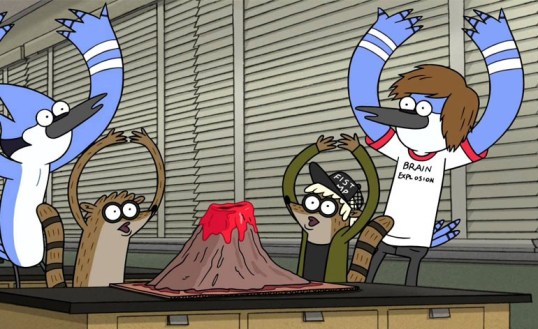
Future Rigby lands in a Georgia state park where, as usual, present day Rigby and Modecai are trying to get through the day by doing as little work as possible and without getting fired by their boss, an uptight gumball machine named Benson. Before Future Rigby dies, he reminds Present Rigby and Mordecai of the time that they built a time machine in high school. The time machine malfunctioned and caused the science lab to explode, which led to Rigby and Mordecai being expelled from high school. It also caused Mr. Ross to lose a volleyball game, which set Mr. Ross on his path to madness (or, as Mr. Ross, puts it, drove him “craze-o” because that is how they say crazy in the future).
Using the time ship, Present Rigby and Mordecai try to stop Past Rigby and Mordecai. But before they can save the world, Rigby has to find the courage to reveal his secret to Mordecai, a secret that causes them to question and reconsider their friendship.
Regular Show: The Movie is a fun and trippy movie that is full of nods to 80s and 90s pop culture. (The Ferris Bueller homage was my favorite.) The voice work is also excellent, with Mark Hamill a stand-out in the role of Skips, a very intelligent and reasonable Yeti. Devotees of the series will not be disappointed by this frequently hilarious expansion.
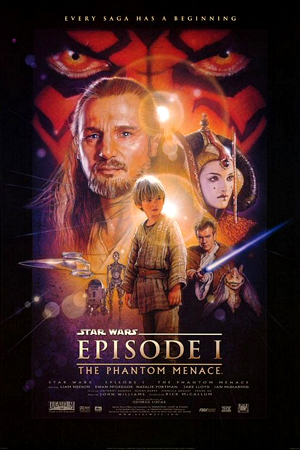
The time was May of 1999. The place was a movie theater in Baltimore, Maryland. The theater was packed with people waiting to see the most anticipated film of their lifetime. The film was The Phantom Menace, the first prequel to the original Star Wars trilogy. For two years, the people in the audience had followed every detail of the film’s production. Some of them had gone to showings of Meet Joe Black and Wing Commander, just so they could see the first trailers for the film.
Sitting out in that audience was one 16 year-old boy who, a few nights earlier, had been standing outside a Target at midnight so that he could be one of the first to buy Phantom Menace merchandise. He bought two Jar Jar Binks action figures because, even before Phantom Menace opened, he suspected Jar Jar would be the most controversial character.
When the lights went down, the audience cheered. At the start of every trailer, someone in the dark theater shouted, “I bent my Wookie!” The audience laughed the first two times. By the fifth time, there were only a few pity titters.
Finally, it was time! The first few notes of John Williams’s Star Wars theme echoed through the theater. Again, the audience cheered as the familiar title crawl appeared on-screen.
The 16 year-old read the opening crawl and he started to get worried. What was all this talk about taxation? Trade routes? Trade Federation? Blockades? It seemed more appropriate for Star Trek or even Dune. Except for the mention of Jedis at the end of the crawl, it did not sound much like Star Wars.
Things started to look up as soon as Liam Neeson and Ewan McGregor made their first appearance as Qui-Gon and Obi-Wan. Obi-Wan’s first line was, “I have a bad feeling about this.” A few people in the audience clapped. “I bent my Wookie!” a familiar voice shouted. Nobody laughed.
When a hologram of Darth Sidious appeared and told the Trade Federation goons to kill Qui-Gon and Obi-Wan, everyone in the audience knew that Darth Sidious was Palaptine, the future Emperor, and the excitement was palpable. When Qui-Gon and Obi-Wan fought off the battle droids and escaped to the besieged planet of Naboo, the audience started to relax. Maybe this wouldn’t be as bad as the critics were saying.
Then Qui-Gon and Obi-Wan met Jar Jar Binks and the whole movie went to shit.
In the months leading up to the release of The Phantom Menace, everyone had heard about Jar Jar Binks and how he was a totally computer-generated character. Jar Jar Binks was the future of movie technology and, from the minute he first appeared, the future was fucking terrifying. Jar Jar was a Gungun, an amphibious creature who was characterized as being clumsy and cowardly. He shrieked in a high-pitched voice and spoke in an indescribable dialect. As much as the audience tried, there was no way to avoid or ignore Jar Jar Binks. He was not in the entire movie but he was at the center of every scene in which he did appear.
As Jar Jar led Obi-Wan and Qui-Gon to the underwater city of the Gunguns, a voice in the dark theater shouted out, “I bent my Wookie!”
“Shut the fuck up!” the 16 year-old snapped back.
The 16 year-old was not sure if anyone heard him but the voice was silent for the rest of the movie.
Sorry, Ralph.
No sooner had the audience recovered from their introduction to Jar Jar then they met young Anakin Skywalker. Anakin’s story was the whole reason that The Phantom Menace had been made. The audience knew that the prequels would show how Anakin Skywalker would grow up to the greatest and most evil badass in the universe, Darth Vader. But in Phantom Menace, he was just a 9 year-old slave on the planet of Tatooine, conceived by immaculate conception. Even before Phantom Menace was released, the word was out that Jake Lloyd, the child cast as young Anakin, was not exactly the best actor in the world. But even though they had been forewarned, the audience was not prepared for just how terrible little Jake Lloyd was in the role. There was no darkness to Jake Lloyd’s cutesy performance. There was no sadness or toughness. Jake Lloyd came across like the type of hyperactive child who would end up in the ensemble of a Christmas play, breaking character and waving to his parents during the Crucifixion. Not only could the audience not see him growing up to be Darth Vader but they could not imagine him as a slave living on an inhospitable desert planet.
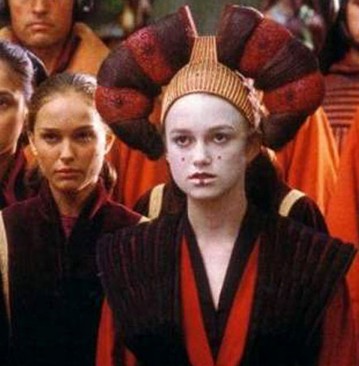
Qui-Gon, Obi-Wan, Jar Jar, Queen Padme (Keira Knightley), and Padme’s handmaid, Amidala (Natalie Portman) were stranded on Tatooine when they first met Anakin. Qui-Gon felt that Anakin was “the chosen one,” who would bring balance to the force. It was hard for the audience to believe him when they heard Anakin shout, “Yippe!”
For that 16 year-old who had stayed up past midnight to buy two Jar Jar Binks action figures, that “yippe” was the final straw. He had watched the original Star Wars trilogy on VHS tapes. He had gone to the re-releases. He loved Star Wars and he wanted to love The Phantom Menace. Instead, he felt so let down by the film that he could barely look at the screen.
The 16 year-old wondered why C3PO and R2D2 were in the film. Phantom Menace revealed that they were built by the future Darth Vader. R2D2 would even help Anakin in the film’s final battle. It made no sense. The 16 year-old wondered if anyone else in the audience was as confused as he was. He wondered why, if he could see that this made no sense, George Lucas could not understand the same thing.
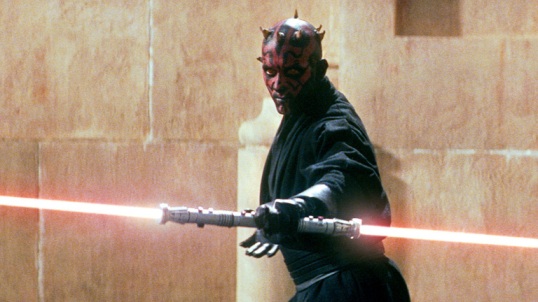
Anakin won a pod race and was allowed to leave Tatooine. The film’s action was moved to the Coruscant, a planet that was covered with one huge city. Samuel L. Jackson appeared as Mace Windu and, when he stared out at the audience, he seemed to be saying, “I fucking dare you to yell anything about bending your motherfucking Wookie!” There were scenes set in the galactic senate, presumably to appease everyone who wanted a meticulously detailed portrait of how a galactic Republic would be governed. Padme turned out to be a fake and Amidala was revealed as the real queen. There was a final battle between the forces of the Republic and the Trade Federation. Qui-Gon was killed in a duel with the evil Darth Maul (Ray Park) but Obi-Wan promised to train Anakin in the ways of the Jedi. Palpatine promised that he would be watching Anakin’s development.
And, of course, there was this:
For many in the audience who truly loved the original trilogy and who had spent the past two years scouring every corner of the Internet in search of news about The Phantom Menace, the midi-chlorians was the point that they give up on the movie. The Force added a hint of mysticism to the original trilogy. Because it was so mysterious and its origins so deliberately obscure, fans of Star Wars could imagine that The Force was inside of them as well as Luke and Darth Vader. “May the force be with you,” was more than just a catch phrase to those fans. It was a reminder that, even in a galaxy far far away, there was still mystery and faith. When Qui-Gon talked about midi-chlorians, fans realized that not only did they understand the appeal of Star Wars better than George Lucas but George Lucas did not even care why they loved his film. For those fans, the midi-chlorians not only ruined The Phantom Menace but cheapened the original trilogy as well. The Force was no longer special or mystical. Anakin might as well have just been bitten by a radioactive spider.
For the 16 year-old, it was somehow even worse that, before asking about the Force, Anakin apologized to Qui-Gon for causing so much trouble. Sitting out in the theater, he knew that the boy who would grow up to be Darth Vader would never yell “yippie!” and he would never apologize for causing any trouble.
At the end of the movie, the audience did not know how to react. The 16 year-old talked to his friends as they filed out of the theater. Everyone was in a state of denial. They knew that they had seen something very disappointing but, after all the excitement leading up to the release of The Phantom Menace, they did not want to admit how disappointed they really were with the actual movie. They talked about what did work. They talked about the pod race, which had been fun. They talked about the exciting light saber duel between Qui-Gon, Obi-Wan, and Darth Maul. Being teenage boys, they also talked about Natalie Portman and Keira Knightley.
They tried not to talk about Jar Jar Binks, beyond agreeing that he sucked. They tried not to talk about Jake Lloyd as Anakin. It was too painful to know that Star Wars had been reduced to Jar Jar Binks and Jake Lloyd. They did make fun of the “I bent my Wookie” guy. In the face of grave disillusionment, it was all that the 16 year-old and his friends could do.
Today, enough time has passed that it is easier to laugh about Jar Jar Binks and The Phantom Menace. Though the initial trauma may have faded into memory, it all came rushing back to me as soon as Lisa asked me if I would be willing to review The Phantom Menace for this site. I cautiously agreed and hoped that, since I already knew what I was getting myself into, The Phantom Menace would not be as disappointing the second time around.
It was a strange experience rewatching The Phantom Menace. While I remembered how bad the movie was, I’d forgotten how equally boring it was. Jar Jar Binks was even more annoying than I remembered and Jake Lloyd was even worse. Of the film’s best scenes, the pod race went on too long and the duel with Darth Maul was too short. For such a badass villain, Darth Maul was underused for much of the film, as if George Lucas did not understand that the kids he claimed to have made the film for would be far more interested in the dynamic Darth Maul than the histrionic Jar Jar Binks.
Emphasizing Jar Jar Binks over Darth Maul made as much sense as emphasizing the Ewoks at the expense of Boba Fett.
Worst of all, the entire movie felt even more pointless the second time around. When the prequels were first released, George Lucas always said that all three of them should be viewed in the context of the larger story that they were telling. But what do we really learn from The Phantom Menace or any of the prequels? Did anyone really want to know about how trade was regulated before the Empire? Did we really need to know the exact details of how Anakin became a Jedi? Watching The Phantom Menace, the answer is no.
I was especially surprised by how bad the CGI looked. When The Phantom Menace was first released, the CGI was often the only thing that was critically praised. Critics may have hated Jar Jar Binks as a character but they all agreed that it was impressive that a major character had been created by a computer. It is easy to forget just how big a deal was made about The Phantom Menace‘s special effects. At the time, we had yet to take it for granted that an entire movie could be made on a computer.
But seen today, the CGI not only seems cartoonish but, like the midi-chlorians, it feels like a betrayal of everything that made the original Star Wars special. The universe of New Hope and Empire Strikes Back felt lived in. It was imperfect and real. It was a universe where even the most fearsome storm trooper could accidentally bump his head on a doorway.
But the CGI-created universe of The Phantom Menace was too slick and too perfect. There was no chance for spontaneity or anything unexpected. The universe of the original Star Wars trilogy was one in which you could imagine living but the universe of The Phantom Menace seemed only to exist in the computers at Lucasfilm. With The Phantom Menace, George Lucas seemed to be reminding those who loved his films that the Star Wars universe belonged to him and him alone. Our imagination was no longer necessary.
As for that 16 year-old who first saw The Phantom Menace in that Baltimore theater, I still have those Jar Jar Binks action figures. I keep one of them on my desk at work and I enjoy the strange looks that it gets. If you push down its arms, Jar Jar sticks out his tongue.
 Last week, when the world first learned of the death of the actor Alan Rickman, it was shocking to realize just how many great roles he had played. He made his feature film debut as Hans Gruber in Die Hard. He played Colonel Brandon in Sense and Sensibility, Severus Snape in the Harry Potter movies, the Sheriff of Nottingham in Robin Hood: Prince of Thieves, Hilly Kristal in CGBG and Marvin the Paranoid Android in Hitchhiker’s Guide to the Galaxy. He even played


 Life on the planet Mongo is not easy. Aided by Darth Vader wannabe Klytus (Peter Wyngarde) and the sadistic General Kala (Mariangela Melato), the evil Emperor Ming (Max Von Sydow) rules with an iron fist. All of the citizens are heavily taxed and kept in a state of perpetual war in order to keep them from joining together and rebelling. Those who attempt to defy Ming are executed.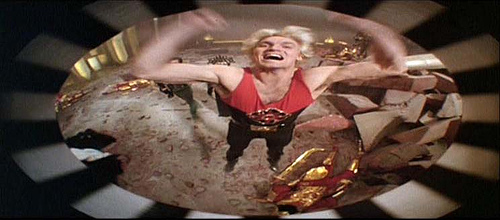
 I think I was twelve when I first saw Heavy Metal. It came on HBO one night and I loved it. So did all of my friends. Can you blame us? It had everything that a twelve year-old boy (especially a 12 year-old boy who was more than a little on the nerdy side) could want out of a movie: boobs, loud music, and sci-fi violence. It was a tour of our secret fantasies. The fact that it was animated made it all the better. Animated films were not supposed to feature stuff like this. When my friends and I watched Heavy Metal, we felt like we were getting away with something.
 Den (directed by Jack Stokes, written by Richard Corben)
 On a space station orbiting the Earth, Captain Lincoln F. Sternn is on trail for a countless number of offenses. Though guilty, Captain Sternn expects to be acquitted because he has bribed the prosecution’s star witness, Hanover Fiste. However, Hanover is holding the Loc-Nar in his hand and it causes him to tell the truth about Captain Sternn and eventually turn into a bloodthirsty giant. Captain Sternn saves the day by tricking Hanover into getting sucked out of an air lock.
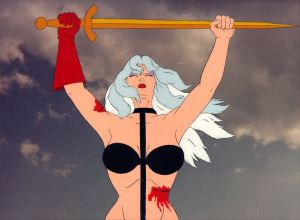 In the film’s final and most famous segment, Taarna, the blond warrior was featured on Heavy Metal‘s poster, rides a pterodactyl across a volcanic planet, killing barbarians, and finally confronting the Loc-Nar. She sacrifices herself to defeat the Loc-Nar but no worries! We return to Earth where, for some reason, the Loc-Nar explodes and the girl from the beginning of the film is revealed to be Taarna reborn. She even gets to fly away on her pterodactyl. Taarna was really great when I was twelve but today, it is impossible to watch it without flashing back to the Major Boobage episode of South Park.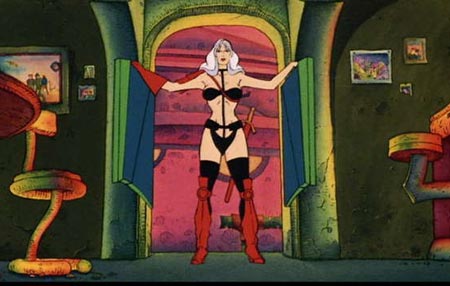
 The year 2005 was a dark time to be a fan of Star Wars.

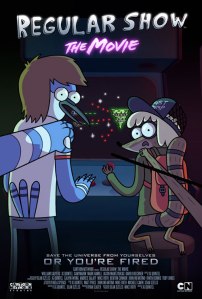 After airing for seven seasons and counting on the Cartoon Network, Regular Show has finally gotten its own feature-length movie! In Regular Show: The Movie, the Earth is in danger of being destroyed by a time jumping volleyball coach and it is up to our two favorite slacker groundskeepers — Mordecai the Blue Jay and Rigby the Racoon — to save the world. But to do so, they are going to have to confront their past and Rigby is going to have to reveal something that not even his oldest friend, Mordecai, knows about.
 A long time ago in a galaxy far, far away…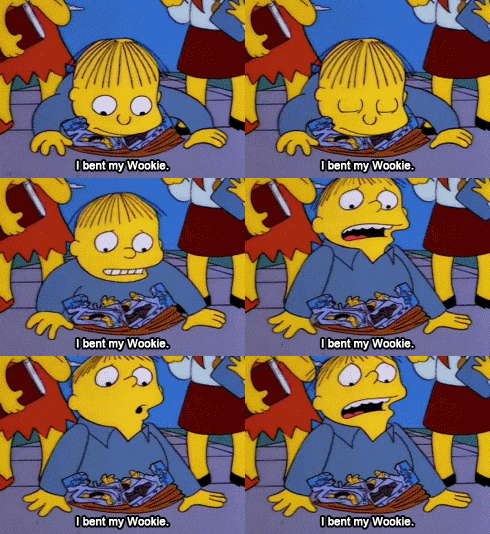
 Through the Shattered Lens