Freefall: Flight 174 (1995, directed by Jorge Montesi)


During a routine flight from Montreal to Edmonton, the two pilots (played by William Devane and Scott Hylands) discover that they do not have enough fuel to make it to their destination.  Their aircraft was one of the first in the fleet to use the metric system but a conversion era led to the ground crew measuring the plane’s fuel in pounds instead of kilograms.  With the help of an air  traffic controller (Nicholas Turturro), the pilots try to land their plane before it falls out of the sky.

Based on a true story, Freefall is one of the many airflight disaster films that were made for television in the 80s and 90s.  (Not surprisingly, the genre became less popular after 9-11.)  The emphasis is on the pilots and ground control remaining calm and professional in the face of seemingly insurmountable odds.  While Devane and Hylands look for a place to land, flight attendant Shelley Hack keeps the passengers from panicking.  In typical disaster movie style, the passengers have their own dramas that are wrapped up as they wait for the plane to either land or crash.  It’s a low-budget movie but the cast does a good job.  William Devane is one of those actors who just looks credible flying an airplane.

The movie’s main lesson?  Don’t use the Metric System unless you absolutely have to,


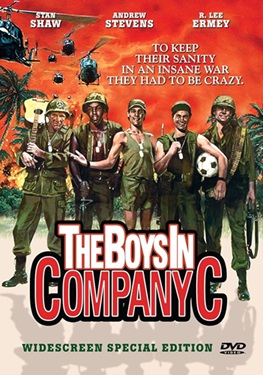
The Boys In Company C (1978, directed by Sidney J. Furie)


In 1967, a group of young men arrive at the Marie Corp. Recruit Depot in San Diego.  Tyrone Washington (Stan Shaw) is a drug dealer from Chicago who tells everyone not to mess with him and who soon emerges as a natural born leader.  Dave Brisbee (Craig Wasson) is a long-haired hippie who tried to feel to Canada and who shows up for induction in handcuffs.  Vinny Fazio (Michael Lembeck) is a cocky and streetwise kid from Brooklyn.  Billy Ray Pike (Andrew Stevens) is a country boy from Texas.  Alvin Foster (James Canning) is an aspiring writer who keeps a journal of his experiences.  Sgt. Loyce (R. Lee Ermey, making his film debut) molds them into a combat unit before they leave for Vietnam, where they discover that all of their training hasn’t prepared them for the reality of Vietnam.

The Boys In Company C has the same basic structure as Stanley Kubrick’s Full Metal Jacket, right down to R. Lee Ermey playing the tough drill sergeant.  The sharp discipline of basic training is compared to the chaos of Vietnam.  Ermey always said that he was playing a bad drill sergeant in Full Metal Jacket because he tore down the recruits but never bothered to build them back up.  In The Boys In Company C, Ermey plays a good drill sergeant, one who is tough but fair and who helps Washington reach his potential.  It doesn’t make any difference once the company arrives in Vietnam, though.  Both The Boys In Company C and Full Metal Jacket present the war in Vietnam as being run by a collection of incompetent officer who have no idea what it’s like for the soldiers who are expected to carry out their orders.

Of course, The Boys In Company C is nowhere near as good as Full Metal Jacket.  Full Metal Jacket was directed by Stanley Kubrick and it’s a chilling and relentless look at the horrors of combat.  The Boys In Company C was directed by Sidney J. Furie, a journeyman director who made a lot of movies without ever developing a signature style.  The basic training scenes are when the film is at its strongest.  When the company arrives in Vietnam, Furie struggles with the story’s episodic structure and it can sometimes be difficult to keep track of the large ensemble cast.  The Vietnam sequences are at their best when the emphasis is on the soldiers grumbling and bitching as their officers send them on one pointless mission after another.  The soccer game finale tries to duplicate the satire of the football game that ended Robert Altman’s M*A*S*H but it does so with middling results.  The Boys in Company C is a collection of strong moments that never manage to come together as a cohesive whole.

The movie is still important as one of the first major films to be made about the war in Vietnam.  However, it’s since been overshadowed by The Deer Hunter, Apocalypse Now, Platoon, and, of course, Full Metal Jacket.


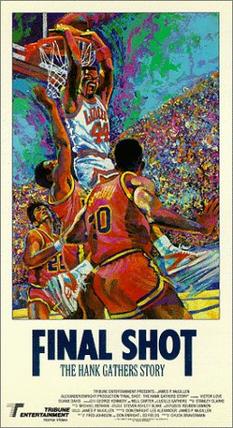
Final Shot: The Hank Gathers Story (1992, directed by Charles Braverman)


Hank Gathers is one of the most intriguing “what if?” stories of modern basketball.  Growing up in the Raymond Rosen Projects of Philadelphia, Hank stayed out of trouble by playing basketball.  An outstanding high school player, he went first to USC before transferring to Loyola Marymount.  Along with his friend Bo Kimble, he was a stand-out player at Loyola.  However, on March 4th, 1990, the 23 year-old Gathers collapsed during a game with Portland and died on the court, the victim of an abnormal heartbeat.  His last recorded words were, “I don’t want to lay down!”  Gathers set records in college.  Would he have done the same in the NBA?  Sadly, we’ll never know but he definitely had the talent and the ability to be one of the best.

Final Shot is a by-the-numbers biopic of Hank Gathers, focusing on his life in the projects and his friendship with Bo Kimble.  Victor Love plays Gathers while Kimble is played by Duane Davis and they both give good performances.  Their friendship feels real and when Hank helps Bo recover from a broken leg and when Bo worries about Hank’s recently diagnosed heart condition, the scenes are sincere in a way that lifts the film above the normal biopic clichés.  Nell Carter and George Kennedy both have good roles as well, Carter as Hank’s mother and Kennedy as Hank’s high school coach and mentor.  This is the type of role that Kennedy could have played in his sleep so I appreciated that he actually gave a believable performance.

Final Shot is a made-for-TV movie so it doesn’t dig too deeply into Gathers’s life outside of basketball, the way that college treat their athletes, or the systems that made playing basketball Hank’s only way of escaping the projects.  For what it is, though, it’s a fitting tribute.

Sweetheart of the Navy (1937, directed by Duncan Mansfield)


I watched this movie by accident.

I was looking for Sweetheart of Sigma Chi, an obscure Buster Crabbe film that is nearly impossible to find.  I was happy to see that someone had uploaded it to YouTube but then I watched and discovered that, even though the video was entitled Sweetheart of Sigma Chi, they had actually uploaded a movie called Sweetheart of the Navy.  I was disappointed but I went ahead and watched because the movie was only 61 minutes long and I needed something to post for today’s review.

In other words, I’ve got no one to blame but myself.

Cecilia Parker plays Joan Whitney, who co-owns a cafe on the harbor.  When her business partner runs off, he takes all the money and leaves her with all the bills.  Joan has to raise the money to keep her bar open.  Her friends, Andy (Cully Richards) and Pete (Don Barclay), decide to stage a fight against the boxing champion of the Navy, Bumper (Jason Robards, Sr., father of the  more famous Jason Robards).  They recruit the overmatched Eddie Harris (Eric Linden) to fight Bumper and then get all of their friends in the Navy to bet on the fight.  Commander Lodge (Roger Imhof) views Eddie has being his protege and tries to change his mind about fighting.  Joan tries to convince Eddie to get in the ring.

I may be biased because I was already annoyed that Buster Crabbe wasn’t in this movie but Sweetheart of the Navy was instantly forgettable, creaky, and corny.  Forgettable songs, stagey directing, and boxing action that won’t exactly put Rocky to shame, Sweetheart of the Navy took 61 minutes of my life under false pretenses.

And again, I have no one to blame but myself.

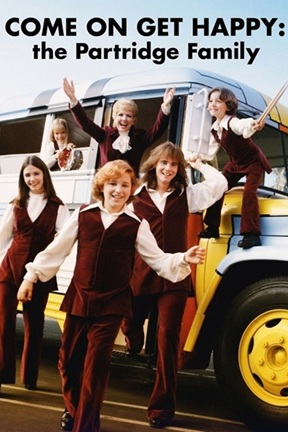
Come On Get Happy: The Partridge Family Story (1999, directed by David Burton Morris)


In 1969, a group of television network executives get together and decide the world needs a sitcom that will mix music with family comedy.  The result is The Partridge Family.  While Shirley Jones (Eve Gordon) tries to keep her television family safe from the networks and, in some cases, their own dysfunctional families, David Cassidy (Rodney Scott) struggles with being a teen idol and Danny Bonaduce (Shawn Pyfrom) deals with living with an abusive father (William Russ).  Danny finds a new father figure in the form of co-star Dave Madden (Michael Cheiffo) while Danny dates his tv sister, Susan Dey (Kathy Wagner).

This was one of the many made-for-TV movies that took advantage of boomer nostalgia at the turn of the 20th Century.  Like most of those movies, Come On Get Happy is on the shallow side, providing the details that everyone had already heard without digging too far underneath the surface.  The main thing that sets this film apart from so many other behind-the-scenes movies is that the cast, for the most part, actually resemble the real-life people that they’re playing.  That’s especially true in the case of Shawn Pyfrom.  If you’re a fan of the show or Cassidy’s music, this movie might appeal to you.  I Think I Love You is still a banger.

It’s well-made but it’s still hard not to feel that it would have been more entertaining just to watch a 2-hour interview with the real-life Danny Bonaduce.

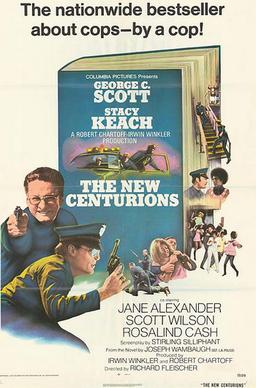
The New Centurions (1972, directed by Richard Fleischer)


Fresh from the police academy, three rookie cops are assigned to a precinct in East L.A.  Gus (Scott Wilson) is a father of three who just wants to do a good job and support his family.  Sergio (Erik Estrada) is a former gang member who saw the police academy as a way to get out of his old neighborhood, and Roy (Stacy Keach) is a new father who is going to law school at night.  Most of the movie centers on Roy, who goes from being an idealistic rookie to being a hardened veteran and who comes to love the job so much that he abandons law school and eventually loses his family.  Roy’s wife (Jane Alexander) comes to realize that Roy will never be able to relate to anyone other than his fellow cops.  Roy’s mentor is Andy Kilvinski (George C. Scott), a tough but warm-hearted survivor who has never been shot once and whose mandatory retirement is approaching.

Based on an autobiographical novel by real-life policeman Joseph Wambaugh, The New Centurion’s episodic structure allows the film to touch on all the issues, good and bad, that come with police work.  Gus is shaken after he accidentally shoots a civilian.  Sergio feels the burden of patrolling the streets on which he grew up.  Roy becomes a good cop but at the cost of everything else in his life and he deals with the stress by drinking.  There are moments of humor and moments of seriousness and then a tragic ending.  Just as Wambaugh’s book was acclaimed for its insight and its realistic portrayal of the pressures of being a policeman, the movie could have been one of the definitive portraits of being a street cop, except that it was directed in a workmanlike fashion by Richard Fleischer.  Instead of being the ultimate cop movie, The New Centurions feels more like an especially good episode of Police Story or Hill Street Blues.  (The New Centurions and Hill Street Blues both feature James B. Sikking as a pipe-smoking, martinet commander.)

George C. Scott, though.  What a great actor!  Scott only has a supporting role but he’s so good as Kilvinski that you miss him when he’s not around and, when he leaves, the movie gets a lot less interesting.  Scott makes Kilvinski the ultimate beat cop and he delivers the closest thing that The New Centurions has to a cohesive message.  A cop can leave the beat but the beat is never going to leave him.

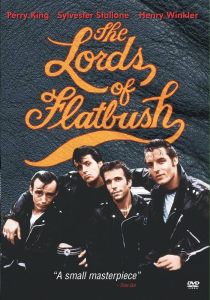
The Lords of Flatbush (1974, directed by Stephen F. Verona and Martin Davidson)


The year is 1958 and four Brooklyn teenagers, all members of a largely non-violent street gang called The Lords of Flatbush, have enough grease in their hair to start a city-wide kitchen fire.  It’s their senior year of high school.  Chico (Perry King) tries to hook up with a new, blonde transfer student (Susan Blakely).  Butchey (Henry Winkler) makes everyone laugh and hides the fact that he’s secretly really smart.  Stanley (Sylvester Stallone) deals with his impending marriage to Frannie (Maria Smith).  Everyone has to grow up eventually but at least the Lords of Flatbush will always have their memories and probably their leather jackets.

Nostalgia films that were extremely popular in the 70s, as the baby boomers were already starting to mythologize their youth.  Lords of Flatbush is very much about that nostalgia, leading to a film that feels sincere but which is also pretty predictable.  With its coming-of-age storylines and its mix of drama and comedy, Lords of Flatbush owes an obvious debt to American Graffiti.  The movie, like its characters, is likable but not exactly memorable.  Today, it’s really only known because it featured early performances from Sylvester Stallone and Henry Winkler.  Winkler got his signature role as the Fonz on Happy Days largely based on his performance as Butchey, though Butchey is nowhere near as cool as the Fonz.  Pre-Rocky, this movie was Stallone’s calling card in Hollywood and he rewrote enough of his own lines that he got an additional dialogue credit.  Stallone actually gives a pretty good performance, even if he is obviously closer to 30 than 18.

Stallone’s best scene is when Stanley is trying to buy an engagement ring and Frannie insists that he buy one that costs $1,600.  For the first time, Stanley realizes that getting married means committing to something other than hanging out with his friends and working on his car.  Stanley buys the ring but threatens the jewelry store owner afterwards, telling him to never show Frannie a $1,600 ring again.

The Lords of Flatbush is a film about the past but it’s mostly interesting due to the future of its stars.

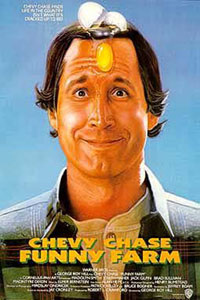
Funny Farm (1988, directed by George Roy Hill)


Andy Farmer (Chevy Chase) is a New York sports writer who leaves the city and moves to the small town of Rosebud, Vermont so that he can work on his novel.  He and his wife, Elizabeth (Madolyn Smith), struggle to adjust to living in a small town.  The delivery of their furniture is delayed by the collapse of a covered bridge.  When they try to make a phone call from inside their own house, the local operator tells them to deposit ten cents.  They were expecting a Norman Rockwell-type town and instead, they find themselves having to pay for the funeral of a man who was buried on their property long before they moved in.  When Elizabeth makes more progress writing a children’s book than Andy does with his heist novel, their marriage starts to feel the strain.

Chevy Chase is now so much better known for the stories of his unprofessional and diva-like behavior on film and television sets that it’s easy to forget that he was, at his peak, a very funny actor.  Chase may be playing a variation of his put-upon everyman but, compared to the first two Vacation movies, most of the humor in Funny Farm is very mild.  George Roy Hill was a classy director who had been making movies since the 50s and Funny Farm feels like a throwback to the type of family-friendly comedies that Disney would make in the 60s.  That I laughed as much as I did was largely due to Chase’s performance.  Whether he was tripping over a Dutch door, reacting to his wife’s dislike of the first few chapters of his new novel, or offering to pay the townspeople $50 to pretend to be nice for a weekend, Chase was consistently funny and even likable.  I don’t know if this is the type of performance that Chevy Chase could give today.  There’s a bitterness that’s now integral to screen persona and it’s made him into someone who audience want to laugh at instead of with.  It’s too bad because Funny Farm is a reminder of the type of comedic actor that Chevy Chase used to be and who he probably still could be if not for the failed talk show and the infamous Friar’s Club roast.

As for Funny Farm, it’s an amusing and likable comedy and it still holds up well today.  Chase is the key to the film’s success but he’s not the only reason that the film works.  I liked the scene where Mike Starr and Glenn Plummer, as the two movers, watch as the bridge they tried to drive over collapses.  I even liked the running joke about the two ducks who refused to leave the Farmers’s property.  Funny Farm may not have been a hit when it was first released but it’s since built up a cult following.  There will always be a place for a funny comedy that leaves you in a good mood.

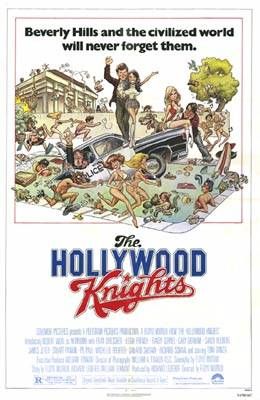
The Hollywood Knights (1980, directed by Floyd Mutrux)


Halloween Night, 1965.  While the high school holds a pep rally and the Beverly Hills Homeowners Association debate the best way to tackle the problem of juvenile delinquency, the Hollywood Knights hang out at Tubby’s Drive-In, their favorite burger joint.  The Hollywood Knights are a car club and a group of fun-loving rebels, determined to have a good time and to always humiliate Officers Clark (Sandy Helberg) and Bimbeau (Gailard Sartain).  In practice, this amounts to a lot of jokes about flatulence and Newcomb Turk (Robert Wuhl) mooning the cops every chance the he gets.  I’m hoping a stunt butt was used for the mooning shots.  If I had known watching Hollywood Knights would mean seeing Robert Wuhl’s bare ass a dozen times over 91 minutes, I wouldn’t have started the movie.

The humor is crude but the movie has a serious side, one that was cribbed from American Graffiti.  Duke (Tony Danza), a senior member of the club, is upset that his girlfriend (Michelle Pfeiffer, in her film debut) is working as a car hop.  He’s also sad that his buddy, Jimmy Shine (Gary Graham), is leaving in the morning for the Army.  Jimmy’s not worried about being sent to Vietnam because Americans are only being sent over there as advisors.  Hollywood Knights doesn’t end with a Graffiti-style epilogue but if it did, Jimmy would be the one who never came home.  The serious scenes work better than the comedy, due to the performances of Gary Graham, Michelle Pfeiffer, and Tony Danza.  I can’t believe I just said that either.  Danza, though he’s way too old to be playing a high school student, is actually really good in this movie.  Pfeiffer doesn’t get to do much but, from her first scene, it’s easy to see why she became a star.  The camera loves her and she brings her character to life, despite not having much screen time.

Unfortunately, the drama takes a back seat to a lot of repetitive humor.  The problem isn’t that the humor is crude.  One thing that has always been true is that, regardless of the year, teenage boy humor is the crudest humor imaginable.  Even back in prehistorical times, teenage boys were probably drawing dirty pictures on the walls of their caves.  The problem is that the humor is boring and Robert Wuhl is even more miscast as a high school student as Tony Danza was.  Fran Drescher plays a high school student with whom Turk tries to hook up.  Drescher, like Pfeiffer, comes across as being a future star in the making.  Robert Wuhl comes across as being the future creator of Arli$$.

The Hollywood Knights has a bittersweet ending, the type that says, “It’ll never be 1965 again.”  This movie made me happy that it will never be 1965 again.  1965 should have sued The Hollywood Knights for slander.  Hollywood Knights tried to mix the nostalgia of American Graffiti with the raunchiness of Animal House but it didn’t have the heart or creativity of either film.  At least some of the member of the cast went onto better things.
 

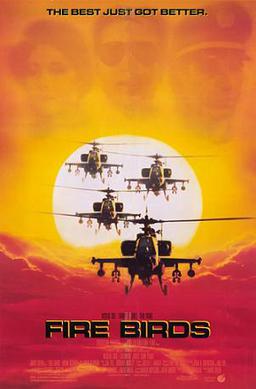
Fire Birds (1990, directed by David Green)


The South American drug cartels have been getting too aggressive so the American government decides to take them out with Apache helicopters.  Missions leaders Tommy Lee Jones and Dale Dye know that these helicopters are the ultimate weapons of death and that things could go terribly wrong if they recruit the wrong pilots.

So, of course, they get Nicholas Cage and Sean Young to fly them.

Fire Birds was an attempt to redo Top Gun with helicopters.  It does actually improve on Top Gun in that it gives the pilots an actual villain to fight.  The drug cartels and the German mercenary (Bert Rhine) that they hire are good B-movie villains and an improvement on the faceless and apparently nationless bad guys who showed up at the end of Top Gun.  What Fire Birds cannot improve on are the flying sequences because fighter planes are just more exciting than to watch than helicopters.

The best thing about the movie is that it brought Nicolas Cage and Tommy Lee Jones together and their acting styles mesh far better than I think anyone would expect.  Sean Young is about as believable as a helicopter pilot as you would expect her to be, which is to say not at all.  There’s a reason why Young’s best performance was as a robot.

“I.  Am.  The.  Greatest!” Nicolas Cage says in the movie and he sounds convinced.  Fire Birds makes the case that Cage is the greatest when it comes to making something bad watchable.  This movie would be thoroughly forgettable if not for his presence and the same can be said about a lot of other movies as well.  But, Tommy Lee Jones can lay claim to the “Greatest” title as well.   Five years after Fire Birds, Tommy Lee Jones would tell Jim Carrey, “I cannot sanction your buffoonery,” and the passage of time has shown that Jones knew what he was talking about.  Nicolas Cage and Tommy Lee Jones should make more movies together.