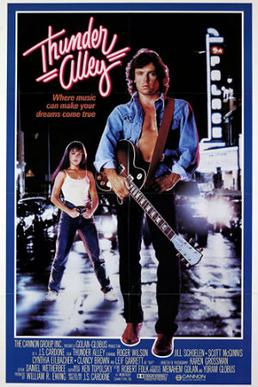
Thunder Alley (1985, directed by J.S. Cardone)


Richie (Roger Wilson) is an Arizona farm boy who can play the guitar like a riot and who, after he joins a band called Magic, discovers that success is a hideous bitch goddess.

Thunder Alley was a Cannon production and it features all of the usual rock movie clichés.  Though Richie is reluctant to join Magic and leave his family behind, he soon emerges as the most talented member of the band and he starts to overshadow the arrogant lead singer, Skip (Leif Garrett).  Donnie (Scott McGinnis), who is Richie’s best friend in the band, gets hooked on cocaine while Richie struggles to resist groupie temptation and remain loyal to his sweet girlfriend, Beth (Jill Schoelen).  The band depends on their road manager, Weasel (Clancy Bown), to get them on stage in time and to protect them from dishonest club owners.

As predictable as it may be, Thunder Alley is one of the better films to be distributed by Cannon Films in the 80s, which is saying something when you consider that Thunder Alley doesn’t feature Michael Dudikoff, Chuck Norris, or Charles Bronson.  The thing that sets Thunder Alley apart from so many other similar films is that, when you actually see Magic perform and hear their music, you actually believe that the band could be a success.  This isn’t one of those films where everyone is feigning enthusiasm for a band that sounds terrible.  Instead, Magic actually sounds like a band that could have gone all the way in 1985.  The scenes of them going from one cheap motel to another while coming together as a band feel as authentic and real as the scenes of Skip angrily realizing that Richie has replaced him as the face of Magic.

Though he was probably cast because he was one of the stars of Porky’s, Roger Wilson was also an actual musician and he’s credible whenever he’s performing on stage.  The same can be said of former teen pop idol Leif Garrett, who plays an actual rock and roller in Thunder Alley and who is surprisingly convincing in the role.  Sporting an impressive beard, Clancy Brown is the ideal road manager while Jill Schoelen brings a lot of life to her small role as Richie’s loyal girlfriend.

For a film that is all about sex, drugs, and rock and roll, Thunder Alley has an innocent side.  Even after he becomes a star and he’s got groupies going crazy every time he steps up to a microphone, Richie’s main concern is making sure that he gets home in time to help his father with the harvest.  Thunder Alley not only asks how far you would go to be a star but also suggests that there’s nothing wrong with choosing, instead, to be a loyal boyfriend or a good son.  Thunder Alley brings it own earnest approach to all of the usual rock and roll clichés and suggests that, with the right combination of talent and hard work, you can have it all, the farm and the stage.

Of course, it helps if you’ve got Clancy Brown looking out for you.


Shell Game (1975, directed by Glenn Jordan)


Max Castle (John Davidson) is a conman who gets arrested in Florida because of a shady real estate deal.  The judge releases him into the custody of his older brother, an attorney named Stephen (Robert Castle).  Though Max is technically just a paralegal, he secretly helps out his brother’s clients but running elaborate scams on the people who have cheated them.  When businessman Lyle Rafferty (Jack Kehoe) embezzles money from his own charity and then lets one of his employees take the fall, Max decides that Rafferty is going to be his next target.

Shell Game was a made-for-TV movie.  It’s pretty obvious that it was meant to be the pilot for a weekly series, where I guess Max would have pulled a con on every different evildoer every week.  Because the show is more interested in setting up who Max is and why he cons people, there’s not much dramatic tension in Shell Game.  Max tricks Rafferty into buying a worthless gold mine and Rafferty falls for every single trick that Max pulls on him.  Unfortunately, since Rafferty is such an easy target, there’s no real pay-off to seeing him get conned.  It’s not like The Sting, where there were real stakes and dangers involved in Paul Newman and Robert Redford’s pursuit of Robert Shaw’s money.  The con is just too easy.

On the plus side, Max’s old partner-in-crime is played by Tom Atkins.  Atkins is so believable as a veteran conman with a heart of gold that he probably would have been a better pick for the lead role than the likable but bland John Davidson.  The rest of the cast is forgettable.

Would Shell Game have worked as a weekly series?  Maybe, especially if Tom Atkins was a part of the regular cast. The idea of a former conman now running scams on other con artists had the potential to be intriguing and Max hints that he was framed by his partners in Florida.  I guess a weekly series would have explored that in greater detail.  However, it was not to be.  This shell game was played once and then forgotten.

A Cry For Help (1975, directed by Daryl Duke)


Harry Freeman (Robert Culp) is a radio talk show host in California who specializes in abusing his listeners.  They call in and they tell Harry their problems and their opinions and then Harry tells them that they’re stupid and whiny.  Despite (or maybe because of) his abrasive style, Harry is very popular.  Everyone on the California coast listens to him in the morning.

When a depressed teenage girl named Ingrid (Elayne Heilveil) calls his show and says that she’s going to kill herself, Harry doesn’t taker her seriously and tells her to go ahead and do it.  It’s only after he hangs up on her that he realizes that she might have actually been telling the truth.  When Harry calls the cops to tell them about the call, they treat him in much the same way that he treated Ingrid.  They refuse to take him or Ingrid seriously.

Not getting any help from the police, Harry turns to his listeners.  He asks them to help him track down Ingrid and to keep her from harming herself.  The film alternates between scenes of Ingrid meeting people throughout the day and then Harry in his studio, taking calls from those people.  Since Ingrid is no longer listening to Harry’s show, she has no idea that people are looking for her and it becomes a race against time to find her before she carries out her plans.

A Cry For Help is largely a showcase for Robert Culp, a talented actor whose career was often harmed by his own independence and reputation for being abrasive.  That reputation made him the perfect choice to play Harry and Culp gives a terrific performance as a not particularly nice man trying to do the right thing for once.  Interestingly, the film keeps it ambiguous as to whether Harry has really had an attack of conscience or if he’s just trying to save Ingrid for the publicity and the ratings.  Even at the end of the film, it’s hard to know if Harry was really worried about Ingrid ending her life or if he was just looking to promote himself.

Along with Culp, the film’s cast is a who’s who of 70s television actors.  Among those who Ingrid and Harry deal with during the day: Michael Lerner, Bruce Boxlietner, Ken Swofford, Chuck McCann, Julius Harris, and Gordon Jump.  Seeing Jump in the film was especially interesting since he would later star in another production about the potential power of radio, WKRP In Cincinnati.

A Cry For Help is a suspenseful made-for-TV movie from 1975.  It’s never been released on DVD but it is on YouTube.

Cease Fire (1985, directed by David Nutter)


Tim Murphy (Don Johnson, with a huge mustache) is a Vietnam vet who is still haunted by his actions during the war. As a result, he can’t hold down a job, he’s abusive to his wife, and he’s woken up in the middle of the night by constant nightmares.  One day, at the unemployment office, he meets another vet named Luke (Robert F. Lyons) and the two of them bond over their shared experiences.  While Tim tries to come to terms with what happened during the war, his wife Paula (Lisa Blount) tries to keep the household together.

Barely released in 1985, Cease Fire is a largely but unfairly forgotten Vietnam film.  According the film’s imdb page, Don Johnson once told an interviewer that he couldn’t even remember starring in a film called Cease Fire.  That piece of trivia sounded too good to be true and, after doing a google search, I have not been able to come across any interviews where Johnson says that.  In fact, in an interview with the AV Club, Johnson says that he filmed Cease Fire in Miami shortly after doing his first audition for Miami Vice.  According to Johnson this was in the early stages of Miami Vice‘s development, before Michael Mann was even attached to the project.  Since Miami Vice premiered (with Mann producing and Johnson starring) in 1984, that probably means that Cease Fire was filmed in either 1982 or 1983.  Considering that it was a low-budget and talky film about a very unpopular war, it is not surprising to discover that it sat on the shelf for a few years before finally being released in order to capitalize on the sudden stardom of its main actor.

Even though both take place in Miami and feature Don Johnson as a Vietnam vet, Miami Vice and Cease Fire are as different as night and day.  Cease Fire is a low-key and muted character study of a traumatized man who is struggling to face what happened in the past.  There’s not much action but there is a lot of talking.  Some of the dialogue is clumsy and obvious but both Don Johnson and Robert F. Lyons give good performance as the traumatized vets and Cease Fire is honest enough to admit that, even if he does take a few steps in the right direction, Tim still has a long road ahead of him.  Cease Fire, which never got a DVD release but which is available on Amazon Prime, is a sincere look at the reality of PTSD and the struggle that many vets face when they first return home.  It’s not a perfect movie but it’s saved by its own good intentions and Johnson’s sincere performance in the main role.

Cease Fire was also the first film to be directed by David Nutter.  Nutter is today probably best known for directing several episodes of Games of Thrones, a show that has even less in common with Cease Fire than Miami Vice.

Repo Jake (1990, directed by Joseph Merhi)


Jake (Dan Haggerty) is a former Marine and sock car racer from Minnesota who comes out to Los Angeles in search of a new beginning.  A fan of John Wayne, the laid back Jake always tries to do the right thing.  His first day in L.A., he thwarts a purse snatching and gets a girlfriend named Jenny (Dana Bentley).  He also gets a job as a repo man.  He repossesses cars from people who aren’t paying their bills and he always does it with a polite smile on his face.  He’s the nicest repo man around but that doesn’t keep him from getting on the wrong side of some of the people he meets.  When he repossesses the car of a local pornographer, the mob demands that Jake take part in an illegal demolition derby.  If he wins, he’ll live.  If he loses, both he and everyone who matters to him will die.

Haggerty’s genial presence is the best thing about Repo Jake, a low-budget movie that would probably be unwatchable without him.  Haggerty’s so likable that he makes scenes work even when they shouldn’t.  My favorite moment was when he walked in on a sleazy photographer trying to manipulate a model into posing topless. “I’m here to repossess your car and I’m pissed off,” Jake politely says before knocking the photographer across the room.  If you didn’t know who Dan Haggerty was, you might think that the producers just grabbed a real repo man off the streets and made him the star of their movie.  With his big beard and his mellow vibes, Haggerty was a legitimate Hollywood character.  Though he found fame playing Grizzly Adams on television, he was arrested in 1984 for selling cocaine to an undercover police officer and his career never really recovered.  Haggerty went from being a TV star to appearing in movies like Repo Jake.

The plot of Repo Jake is pretty dumb and nearly impossible to follow.  It never makes sense that Jake would be forced to take part in the demolition derby.  Actually, nothing about the movie makes sense but a lot of cars get wrecked, a helicopter gets repossessed, and Dan Haggerty knocks a purse snatcher through a store window and it’s all so stupid and Jake’s so friendly that the end result is actually pretty cool.  Repo Jake is saved by the sheer likability of Dan Haggerty.  It’s hardly a good movie but, at the same time, it’s not a terrible way to spend 90 minutes of your life.

Demolition University (1997, directed by Kevin Tenney)


Terrorists have taken over the local power and water plant and are threatening to poison the water supply if their demands are not meant.  Among those that they are holding hostage is a group of college students who were on what would have otherwise been the most boring field trip of their lives.  While Colonel Gentry (Robert Forster) tries to negotiate with the terrorists, one college student, Lenny Slater (Corey Haim), takes matters into his own deadly hands.  Lenny also finds time to ask track star Jenny (Ami Dolenz) to go to the homecoming dance with him.

How many times can the exact same thing happen to the same person?  That’s what you might expect Lenny Slater to ask as he finds himself sneaking around and taking out terrorists one-by-one.  Demolition University is a sequel to Demolition High, with Lenny Slater now in college and a member of the school’s football team.  What’s strange is that, even though Haim is playing the same character from the first film, no one mentions the events of Demolition High.  No one mentions that Lenny not only blew up his old school but he saved the entire midwest from being bombed into a nuclear ash heap.  When Lenny tries to tell Prof. Harris (Laraine Newman!) that it’s obvious that terrorists have taken over the power plant, she ignores him because he has a history of playing pranks.  But he also has a history of tracking down and killing terrorists!  I would listen to him.

Demolition High wasn’t good but it was watchable.  Demolition University is just dull.  Haim actually gives a better performance here than he did in the first film, if just because it’s easier to buy him as a college student instead of as a high school student.  But he’s actually barely in the film.  Most of the running time is taken up with Robert Forster trying to negotiate with the leader of the terrorists.  That’s kind of cool because Robert Forster was the man but the movie still seems like what Die Hard would have been if it had just been two hours of Paul Gleason standing outside the tower while Bruce Willis killed people offscreen.  Even when we do get Lenny fighting the the terrorists, the action scenes feel flat and interchangeable.  There’s nothing to really distinguish them from every other 90s action film that you’ve ever seen.

Demolition University has higher production values than Demolition High and it actually looks like a real movie but it’s just not much fun.  I’m not surprised that there was never a Demolition Grad School.

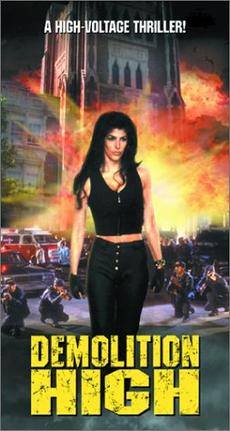
Cinemax Friday: Demolition High (1996, directed by Jim Wynorski)


A group of terrorists take over a high school and announce that, unless their demands are met, they will launch a nuclear missile at a nuclear power plant which I guess will cause double the nuclear destruction.  Since they already have a nuclear missile, it feels like also threatening to blow up the power plant is definite overkill.  With the school now full of terrorists and explosives, it’s up to one student to kill the terrorists one-by-one and save his classmates.  It’s Die Hard in a High School (cool!), with the Bruce Willis role being taken on by … COREY HAIM!

That bit of casting tells you both why Demolition High doesn’t work and also why anyone would be watching this direct-to-video “action” film in the first place.  The 25 year-old Haim plays Lenny Slater, a high school student who knows Kung Fu because he grew up in the Bronx.  His father (played by Alan Thicke!) moves to a small town, both to become a police chief and to hopefully keep Lenny from getting into any more trouble.  Lenny’s all trouble, though, and terrorist leader Luther (the great Jef Kober) is about to discover that he’s invaded the wrong high school.

If I had watched this film in the 90s or even the early aughts, I would have laughed at how bad Corey Haim is as an action hero but today, knowing all we know about his life and how Hollywood essentially enabled his worst tendencies and then abandoned him when he become too self-destructive to work, it’s not as easy to watch an obviously troubled actor who has gone from being a big star to appearing in a direct-to-video Die Hard rip-off.  Trying to disguise the fact that he’s too old to be playing a high school student, Haim wears a flannel shirt and an earring and has a bowl cut.  Whenever he talks to his classmates, you expect him to say, “How do you do, fellow kids?”  As heavily edited as the fight scenes are, it’s still obvious that Haim had no idea how to throw a punch.  On the plus side, even while obviously addled by drug abuse, Corey Haim was still a better actor than Stephen Seagal.

Demolition High is pretty dumb but it was directed by Jim Wynorski so at least there’s some inside jokes.  Gerrit Graham and Dick Van Patten both have small roles and Alan Thicke gets to tell an FBI agent to “Think with your heart, not with your badge.”  Wynorski also cast Melissa Brasselle as Tayna, a sexy terrorist who wears black leather.  He deserves some credit for that.  (When the film was released on video, Brasselle was featured on the cover, not Haim.)  Some of the techniques that Lenny uses to take out the terrorists are creative, if never really plausible.  In this case, Lenny is helped by the stupidity of the terrorists.  It’s not every evil terrorist who is clumsy enough to stumble head first into a table saw.

Demolition High was apparently successful enough to be followed by a sequel, Demolition U.  I’ll look at the movie tomorrow.

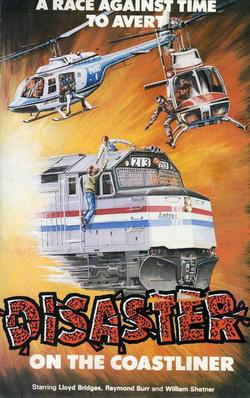
Disaster on the Coastliner (1980, directed by Richard C. Sarafian)


A completely computerized passenger train is traveling across the country, with the Vice President’s wife as one of the passengers.  When Jim Waterman (Paul L. Smith), a man who blames the railroad for the death of his family, manages to hijack the train he plans to ram into a locomotive until his demands a met.  He wants railroad president Estes Hill (Raymond Burr) to take responsibility for the crash that killed his wife and children.  With Waterman determined to crash the two trains, it falls to dispatchers Al Mitchell (Lloyd Bridges) and Roy Snyder (E.G. Marshall) to try to figure out a way to stop the collision.  Helping them out on the train is a con artist named Stuart Peters (William Shatner!) who may be wanted by the police but who is still willing to do whatever it takes to save his fellow passengers.

Disaster on the Coastliner is an above-average made-for-TV disaster movie.  Even though it was obviously made for a low-budget and that the majority of the money was probably spent on securing the B-list cast, there are enough shots of the train careening on the tracks to bring happiness to the hearts of most disaster movie fans.  The cast is full of the type of people who you would typically expect to find in a movie like this, people like Raymond Burr, Lloyd Bridges, and William Shatner.  Bridges, interestingly enough, gives the same performance here that he gave in Airplane! and when he starts ranting about how everything’s computerized, he sounds like he could be reciting dialogue from that film.  The only difference is that Airplane! was a comedy while Disaster On The Coastliner is meant to be a drama.  Raymond Burr also does a good job hamming it up as the president of the railroad.  He spends most of the movie sitting behind his desk and looking annoyed, which was pretty typical of Burr in the years after Perry Mason and Ironside. 

For a lot of people, the main appeal of this film will be seeing what William Shatner was doing in between Star Trek movies.  This is a typical early 80s Shatner performance, when he was still trying too hard to win that first Emmy but also when he had just starting to develop the self-awareness necessary to poke fun at his own image.  Shatner really digs into the role of a conman with a heart of gold.  He delivers his lines in his trademark overdramatic style but, in scenes like the one where he sheepishly discovers that a door that he’s been pounding on was unlocked all the time, Shatner actually seems to be in on the joke.  Shatner also did his own stunts in this film, including one where he had stand on top of a speeding train.  In his autobiography, Shatner wrote that he wasn’t even wearing a safety harness in the scene so give it up for Bill Shatner.  That took guts!

Fast-paced and agreeably unpretentious, Disaster On The Coastliner is an enjoyable runaway train movie.


The Gladiator (1986, directed by Abel Ferrara)


A serial killer known as The Skull is prowling the dark streets of Los Angeles.  Driving a customized death car, he chases down other motorists and forces them into fatal accidents.  Though the police aren’t convinced that the Skull’s real, Rick Benton (Ken Wahl) knows that he’s out there.  Rick was teaching his younger brother (Brian Robbins) how to drive when the Skull chased them down and ran them off the road.  His brother was killed.  Rick spent several days in a coma.  Even after the police try to convince him that he was the victim of a drunk driver, Rick suspects that he and his brother were deliberately targeted.

Rick is a car guy, himself.  After attending a support group for people who have lost loved ones to drunk drivers, Rick decides to take the law into his own hands.  He modifies his pickup truck and then takes to the streets, tracking down drunk drivers and ramming them off of the road.  He then calls the police, letting them know where they can pick up the drunks.  Rick is careful to never actually hurt anyone but Lt. Frank Mason (Robert Culp) still isn’t happy that there’s a vigilante out there, taking the law into his own hands.

With all of Los Angeles wondering about the identity of the vigilante that the media has dubbed “The Gladaitor,” Rick prepares to track down the Skull.

The Gladiator was directed by Abel Ferrara, who brings his trademark style to the film.  Rick is not just a vigilante with a super truck.  He’s also a man who is clearly still in mourning and who deals with his own feelings of guilt by tracking down unsafe drivers.  When he realizes that someone is deliberately killing other drivers, he becomes grimly obsessed with tracking down the Skull and, in typical Ferrara fashion, it often seems as if his quest for vengeance might leave him as unhinged as the man he’s trying to stop.  Though Rick is clearly the fim’s hero and all of the drunks that he stops are obnoxious and deserving of what they get, Ferrara doesn’t blindly celebrate Rick’s actions.  Some of the people who treat the Gladiator as a folk hero are just as dangerous as the ones that Rick is taking off the streets.

It helps the film that both the Skull’s death car and Rick’s vigilante pickup are pretty cool.  Who wouldn’t want to own a truck that can fire projectiles at bad drivers?  In typical Ferrara fashion, almost all of the action takes place at night and the chase scenes are excitingly filmed.  Though the cars and the stunts may be the main reason to watch the film, Ken Wahl still does a good job with the title role and fans of Brian DePalma and RoboCop will enjoy the presence of Nancy Allen, cast here as a radio talk show host who is also Rick’s girlfriend.

The Gladiator is an effective car chase thriller.  Watch it and drive safely.

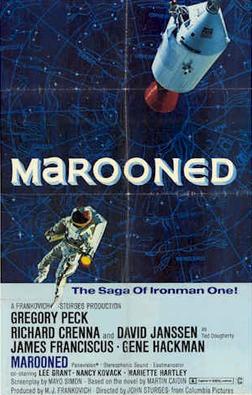
Marooned (1969, directed by John Sturges)


Imagine The Martian or Apollo 13 without any humor or narrative momentum and you’ve got an idea what Marooned is like.

Three American astronauts (played by Richard Crenna, Gene Hackman, and James Franciscus) are returning to Earth after serving on an experimental space station when the engine to their spacecraft fails.  Now stuck in orbit around the Earth, they only have two days before they run out of oxygen.  While flight commander Crenna tries to keep everyone calm and make sure that all the proper procedures are followed, Gene Hackman yells at NASA and demands to be rescued.

Down on Earth, the head of NASA (Gregory Peck) says that there’s nothing that can be done.  There’s no way to get a rescue mission set up quickly enough to save the lives of the astronauts.  Both the President and David Janssen disagree with him.  Janssen demands to be sent into space immediately, regardless of the dangers, so that he can bring America’s astronauts home.

Marooned is a painfully slow movie that went into production at the height of the space race and which was released just a few weeks before the first successful moon mission.  Because it was made at a time when there were still many who claimed that NASA was a waste of money, the movie goes out of its way to explain that, even though the astronauts are probably going to die in space, NASA is in no way to blame.  Richard Crenna absolves NASA of blame after being told that a rescue mission isn’t feasible.  Gregory Peck holds a press conference, where he gives a lengthy speech about why space exploration is still important.  The movie is very detailed in showing that NASA is staffed by personality-free professionals, which might have boosted confidence in NASA but which also leads to a dull story.  You’ll notice that I haven’t referred to anyone in this film by the names of their characters.  That’s because their names don’t matter because, other than Gene Hackman and David Janssen, none of them is really distinguished by any sort of identifiable personality.  Hackman chews the scenery while Janssen plays another surly character who seems like he has a permanent hangover.  I wouldn’t trust Janssen to pilot a spaceship.

Marooned won an Oscar for its Special Effects, which were probably impressive back in 1969 but which are dull by modern standards.  Winning that Oscar meant that Marooned would eventually earn the distinction of being the only Oscar winner to be featured on Mystery Science Theater 3000.  On MST 3K, it aired under the title Space Travelers, which is a perfectly generic name for a perfectly generic film.