This is from the 4th issue of 1994’s Marvels, in which Kurt Busiek reimagined the early history of the Marvel Universe through the eyes of photographer, Phil Sheldon. The artwork is by the amazing Alex Ross.
On this page, Spider-Man is climbing up the Daily Bugle. That’s something that happened frequently in Spider-Man’s own comics but Marvels was the first comic to capture what it would be like for the ordinary people inside the building to suddenly look over and see Spider-Man, complete with a wrinkled suit, climbing up the outside windows. Long before any of the movies were released or the PS4 game meticulously recreated New York, this page from Marvels made Spider-Man seem real.
After taking a month off from playing the Locked Door games, I got back to them this week by playing Locked Door VII: Out of Line.
Again, you start out in the most boring room you’ve ever seen. Bob is standing around and being useless. Rex is your faithful companion. Explore the area and, once again, you’ll find the shed and the stairs and the crate and all of the things that have been present in every Locked Door game. You’ll also find a few new rooms and a some new puzzles to solve. It may be because I was rusty after not playing the game for a month but I found the new puzzles to be challenging. Some of that is because the game still occasionally suffers from the “Guess the Verb” syndrome but, at the same time, some of the puzzles actually are clever and require some thought. The game is fun but it just needs a little bit of polish.
After I played the latest version, I glanced over the other Locked Door games. As of right now, there’s a total of 11 episodes, each with its own tag line. The tag line of Locked Door XI: The U.S. Theatrical Cut is “Can You Beta Test This Thing?” That does intrigue me. Could the game’s rough edges and guess the verb moments be intentional? From the start, Locked Door has satirized the needlessly complicated locked door puzzles that seem to show up in almost every work of Interactive Fiction. Could all of the Locked Door games be a part of an elaborate practical joke?
Maybe I’ll learn more when I played the eighth installment next week next week.
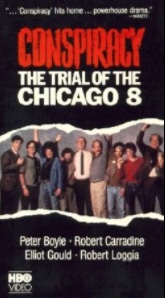
The year is 1969 and, in an Illinois courtroom, 8 political radicals stand accused of conspiring to disrupt the 1968 Democratic Convention. The prosecution is putting the entire anti-war movement on trial while the defendants are determined to disrupt the system, even if it means being convicted. The eight defendants come from all different sides of the anti-war movement. Jerry Rubin (Barry Miller) and Abbie Hoffman (Michael Lembeck) represent the intentionally absurd Yippies. Tom Hayden (Brian Benben) and Rennie Davis (Robert Carradine) are associated with the Students for a Democratic Society. Bobby Seale (Carl Lumbly) is one of the founders of the Black Panthers while David Dellinger (Peter Boyle) is a longtime peace activist. John Friones (David Kagan) and Lee Weiner (Robert Fieldsteel) represent the common activists, the people who traveled to Chicago to protest despite not being a leader of any of the various organizations. Prosecuting the Chicago 8 are Richard Schulz (David Clennon) and Tom Foran (Harris Yulin). Defending the 8 are two radical lawyers, Leonard Wienglass (Elliott Gould) and William Kunstler (Robert Loggia). Presiding over the trial is the fearsome and clearly biased Judge Julius Hoffman (David Opatoshu).
Conspiracy: The Trial of the Chicago 8 is a dramatization of the same story that inspired Aaron Sorkin’s The Trial of the Chicago 7 but, of the two films, it’s Jeremy Kagan’s The Trial of the Chicago 8 that provides a more valuable history lesson. By setting all of the action in the courtroom and recreating only what was said during the trial, director Jeremy Kagan and his cast avoid the contrived drama that marred so much of Sorkin’s film. Kagan trusts that the true story is interesting enough to stand on its own. Kagan includes documentary footage from the convention protest itself and also interviews with the people who were actually there. While Kagan may not have had the budget that Sorkin did, his film has the authenticity that Sorkin’s lacked. Kagan also has the better cast, with Michael Lembeck and Barry Miller both making Abbie Hoffman and Jerry Rubin into something more than the mere caricatures that they are often portrayed as being.
The Trial of the Chicago 8 was a film that Jeremy Kagan spent a decade trying to make. When he first tried to sell the idea behind the film to CBS in 1976, Kagan had Marlon Brando, Walter Matthau, George C. Scott, and Dustin Hoffman all willing to work for scale and take part in the production. CBS still passed on the project, saying that no one was interested in reliving the 60s. It wasn’t until 1987 that Jeremy Kagan was finally able to revive the film, this time with HBO. It actually worked out for the best because, with HBO, there was no need to try to come up with a “clean” version for the language that was used in the courtroom or in the interviews with the actual participants. The defendants could be themselves.
Though it has been overshadowed by Sorkin’s subsequent film, The Trial of the Chicago 8 is the definitive film about what happened in the aftermath of the the 1968 Democratic Convention.
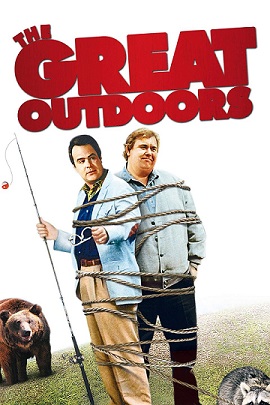
Chet Ripley (John Candy) wants to have a nice vacation up at the lake with his wife (Stephanie Faracy) and their two sons, Buck (Chris Young) and Ben (Ian Giatti). Unfortunately, no sooner has he arrived than the vacation is crashed by Chet’s sister-in-law (Annette Bening, making her film debut) and her husband, Roman (Dan Aykroyd). Roman represents everything that that the mild-mannered Chet hates. Roman is loud, obnoxious, and obsessed with showing off his wealth. Roman knows nothing about how to survive in the great outdoors and he treats Chet like he’s a loser but, for the sake of giving his family a good vacation, Chet tries to get along with Roman. At first, it doesn’t work but eventually, Chet and Roman have to team up to find Roman’s daughters and deal with not only a bear but also talking raccoons. Meanwhile, Buck falls in love with local girl, Cammie (Lucy Deakins). I imagine the same can be said of a lot of people who caught this film on HBO when they were twelve.
The Great Outdoors is very much a comedy of the late 80s. Roman may be a crass Yuppie but it doesn’t appear that Chet is suffering financially either. The humor is broad and physical but the film never resorts to the gross-out style that has since come to define cinematic comedy. It’s a film that makes fun of the obligations of family life while also celebrating them and you won’t be shocked to learn that the script was written by John Hughes. John Candy is likable and Dan Aykroyd has a demented twinkle in his eye.
It’s not a bad movie but I just wish it had been funnier. Don’t get me wrong. When you’re a kid and you come across The Great Outdoors on cable, it’s hilarious because it’s got John Candy waterskiing and a bear and, of course, the talking raccoons. Watching it as an adult, though, it’s easier to see just how much the material and the film’s family-safe approach holds back both Candy and especially Aykroyd. Both of them were capable of being wild comedic performance but, in The Great Outdoors, the movie doesn’t let either one of them really go crazy and that’s too bad. Instead of being a showcase for the best of SNL and SCTV, it becomes an amusing but ultimately very safe family comedy. (Arguably, Hollywood never really figured out the best way to use Candy and Aykroyd’s comedic talents, though Candy’s films before his untimely death suggested that he was on the verge of a genuine breakthrough.)
I did laugh when I rewatched The Great Outdoors but I didn’t laugh as much as I did when I was a kid. Now, I feel old and I’m thinking about how unfortunate it is that John Candy died before production could start on the biopic of Fatty Arbuckle that Candy was tentatively set to star in. Much like Phil Hartman, it’s hard to watch John Candy today without thinking about how he was taken when he was on the verge of probably doing what would have been his best work.
Whip Wilson (played, in a fortunate coincidence, by Whip Wilson) and his partner, Dave Conners (Rand Brooks) work for the railroad company as surveyors in the old west. They’ve come to the town of Martinville to convince the citizens that the town would benefit from having a train station. Mostly, they just want to go to the saloon, have a beer, and flirt with the local gals.
Albert Hawkins (WIlliam Fawcett) is the leader of the local homesteaders and he’s all for bringing the railroad to town. Land baron Max Martin (Hugh Prosser) disagrees. Martin is not really a bad person but his daughter, Clara (Peggy Stewart), is a greedy fanatic who doesn’t want to lose the water rights to the land. With her boyfriend, outlaw Arnold Benson (Bruce Edwards), Clara rules the town with an iron fist. Whip and Dave must defeat Arnold and Clara so that progress can come to the frontier.
Montana Incident is a standard western programmer but it is distinguished by having an evil female land baron instead of the usual male land baron. Stewart tears into the world, proving that she can be just as dangerous as any man. Fans of the old Adventures of Superman TV show will immediately recognize Noel Neill, playing the role of Clara’s much nicer sister.
If you’re a fan of B-westerns, Montana Incident is watchable enough. Wilson and Brooks are bland heroes but Peggy Stewart is so good at being evil that she makes the movie worth watching.
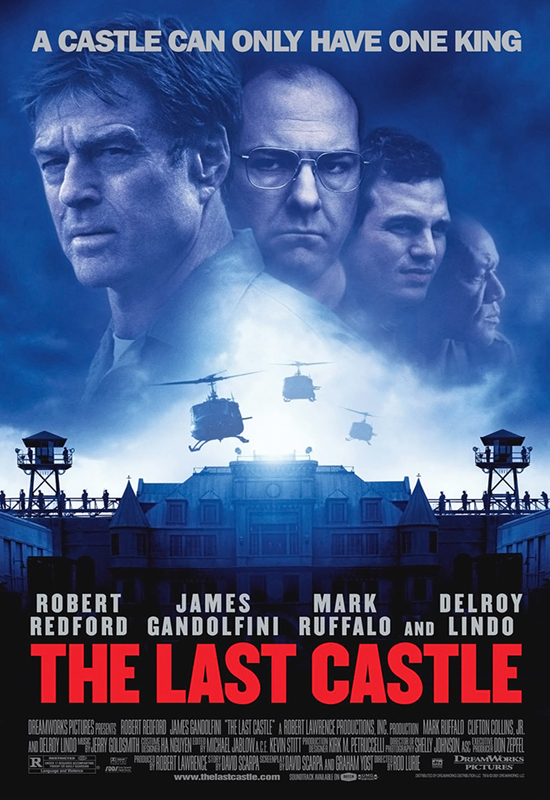
The last castle of the title is a United States Military Prison, one that was originally constructed during the Civil War and which resembles a castle, but with one big difference. Castles were originally designed to keep people from entering. The purpose of this castle is to keep people from leaving.
Colonel Ed Winter (James Gandolfini) is the prison’s commandant, a martinet who has never served in war but who keeps a collection of bullets and weapons in his office. Eugene Irwin (Robert Redford) is the newest inmate. Irwin was a highly respected general until he disobeyed a presidential order and eight of his men died as a result. Irwin has been stripped of his rank and sentenced to ten years. He tells Winter that he just wants to do his time and then go home. That’s fine with Winter, until he overhears Irwin disparaging his collection of battlefield memorabilia.
At first, Irwin tries to lay low. Even when he sees firsthand that Winter is a sadist who manipulates the inmates and who isn’t above ordering his guards to kill an inmate in order to make a point, Irwin tries to stay uninvolved. But eventually, Irwin’s natural military instincts kick in and he leads the prisoners in a revolt against Col. Winter.
The Last Castle requires a healthy suspension of disbelief. Irwin brings the inmates together by reminding them that they were once soldiers and that, even when serving time in a military prison, they’re apart of a grand tradition of soldiers who have been court-martialed. He soon has them saluting and standing at attention and walking in formation. The movie overlooks the fact that most of the prisoners were sentenced to the prison by men much like General Irwin. The idea that all of them are just waiting for someone to once again start barking orders at them just doesn’t seem plausible. Instead, it seems more likely the Irwin, as a former general, would be the least popular inmate in a prison that’s full of enlisted men who feel that they were screwed over the army. In the end, Irwin asks the prisoners to sacrifice a lot but, in the end, it doesn’t matter how heroically he’s framed in each scene or how much the music swells on the soundtrack, Iwin’s rebellion seems like its more about ego than anything else. Even if it means getting rid of Col. Winter, would any of the inmates realistically be willing to die for Eugene Irwin?
At the same time, The Last Castle is worth watching just to see James Gandolfini face off against Robert Redford. Gandolfini plays his role with the type of neurotic energy that only a method actor is capable of capturing while Redford is his typical move star self. The contrast between their two styles of acting translates well into the contrast between Winter and Irwin’s philosophy of leadership. Among the inmates, Mark Ruffalo and Clifton Collins, Jr. both have early roles. Of the two, Ruffalo gets to play the only character in the film with a hint of moral ambiguity and he runs with it. Clifton Collins, Jr., meanwhile, plays a character whose fate will be obvious to anyone who has ever seen a film before. The Last Castle has its moment but it’s never a surprising movie.
The Last Castle ends with a spontaneous display of patriotism, one that is effective but also feels implausible and out-of-place. It’s the perfect way to sum up this frustrating but occasionally diverting film.
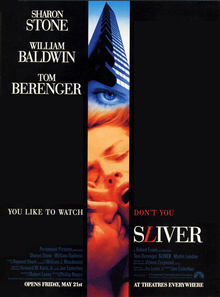
It may be hard to believe it but Sliver was a big deal back in the day. It was one of Robert Evans’s first producing gigs after getting out of rehab. It was Sharon Stone’s first film after Basic Instinct. The script was written by Basic Instinct‘s Joe Eszterhas, back when that was still something that people bragged about. It featured Tom Berenger, back before he found himself relegated to character roles, and William Baldwin. Remember William Baldwin? He was Alec Baldwin’s younger brother. He looked just like Alec but he never managed to project much of a personality whenever he was onscreen. Even Stephen Baldwin was a more interesting actor than William. Still, back in the day, William Baldwin was close to being a star.
William Baldwin’s lack of personality actually works for the role he plays in Sliver. He’s Zeke, who owns an exclusive high-rise apartment building. Zeke makes his money designing video games and he’s filled the building with secret video cameras so he can spend all day sitting in front of a wall of monitors and watching his tenants and experiencing their lives without having to get close to them. Zeke’s a voyeur. Back in the 90s, the surveillance thing was a big twist. Today, we take it for granted. We even applauded Batman for doing the same thing to all of the citizens of Gotham.
Sharon Stone plays Carly, the newest resident of the Sliver. Carly is a recently divorced book editor snd is lonely and repressed despite being played by Sharon Stone. She draws the attention of both Zeke and her neighbor, Jack (Tom Berenger). Both are interested when they discover that Carly has a telescope on her balcony. “She’s a voyeur!” Jack says. When Carly gets involved with Zeke, Jack is obsessively jealous. He insinuates that Zeke had something to do with the death of the previous tenant of Carly’s apartment.
After Basic Instinct, Sharon Stone made a series of films that were designed to show that she actually could act by casting her as characters who were meant to be sexually repressed. The films never seemed to work because, at the height of Sharon Stone’s 90s stardom, there was nothing about her that suggested that she was repressed in any way. What made her a star in the first place was that she was so uninhibited and not afraid to be as blunt about sex as any of her male co-stars. In Sliver, she gives a performance that is somewhere between her vampish work in Basic Instinct and her terrible ice queen performance in Intersection. At the start of the film, she feels miscast as a straight-laced book editor but her performance gets better once she starts hooking up with Zeke. Sharon Stone tries, even if she doesn’t succeed. That’s more than can be said for most of her co-stars.
“Get a life,” Sharon Stone says at the end of the movie and, as far as final lines go, it’s a bad one because it comes out of nowhere and her actions in the final scene don’t fit in with anything that she’s previously said or done in the film. That’s because the ending was hastily reshot after test audiences disliked the original ending. Test audiences often have the worst instincts.
Like many things, Sliver was big in the 90s but forgotten today. It was a popular Blockbuster rental for a while. VCRs were set for whenever it appeared on Cinemax. When it first came out, it was all about Sharon Stone. Today, it’s all about nostalgia.
Since today is Gary Oldman’s birthday, I decided to share a scene that I love from The Firm.
Directed by Alan Clarke, this 1989 film was originally made for the BBC and it stars Oldman as Bex Bissell. During the week, Bex sells real estate. During the weekend, he’s a football hooligan and the leader of his own firm. Though The Firm is not as well-known in the States as some of his other films, I think that Gary Oldman’s performance here might very well be the best of his career.
In this scene, Bex and his firm meet with two other firms in a London hotel. They’re arguing about who is going to be the “top boy” during the upcoming international football tournament in Holland. Mostly, they’re just trying to out-intimidate and one-up each other. Oldman controls the scene through pure attitude.
We leave you with the ICC motto — “we come in peace, we leave you in pieces.”
Ever since it was first released and this video first aired on MTV, Jump Around has been one of the unofficial anthems of St. Patrick’s Day. The video was so popular that many people continue to associate both the song and House of Pain with Boston’s Irish community, despite the fact that the band was from Los Angeles and only two members were of Irish descent.
All together now: “I came to get down, I came to get down, jump around!”
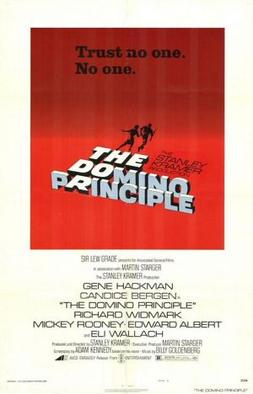
Roy Tucker (Gene Hackman) loyally served his country as a part of a “search and destroy” team in Vietnam but when he returned home, he discovered that America didn’t appreciate his sacrifice. When he was convicted of murdering his wife’s abusive first husband, he was tossed in prison. But now, two mysterious men (Richard Widmark and Edward Albert) have offered Tucker a chance to escape from prison and reunite with his wife (Candice Bergen) in Costa Rica. The only catch is that they also expect Tucker to do a job for “the Organization” and assassinate an unidentified target. As Tucker discovers, The Organization has been watching and manipulating him entire life, setting him up for this very moment. Every small event in Tucker’s life led to another event that eventually sent him to both the war and to prison. It’s almost like a game of dominos. And we have a title!
The Domino Principle gets off to a good start, with a black-and-white montage of actual assassinations and then an opening credit sequence that features someone placing dominos over pictures of Roy Tucker at different ages. (I am guessing that actual childhood photos of Gene Hackman were used because even the baby pictures feature the Hackman squint.) However, the scene immediately following the credits features Gene Hackman and Mickey Rooney as cellmates and the film never really recovers. Though they were both talented actors, Gene Hackman and Mickey Rooney don’t seem as if they belong on the same planet together, let alone sharing a prison cell in a grim and downbeat political thriller. Hackman is his usual surly self, while Mickey seems like he’s going to try to get the entire prison to put on a show. The film tries to do some unexpected things with Mickey’s character but it doesn’t change the fact that he’s Mickey Rooney and he just doesn’t belong here.
As for the rest of The Domino Principle, it’s slow and ponderous. Best known for earnest social issue films like The Defiant Ones and Guess Whos’ Coming To Dinner, Stanley Kramer is the wrong director for a film that aspires to duplicate the conspiracy-themed atmosphere of other 70s thrillers like The Parallax View and Three Days of the Condor. For all the time that film takes to build to its obvious conclusion, Kramer doesn’t even bother to identify who Tucker is supposed to kill or why the Organization wants him dead. Though he seems like he should be a good choice for the lead role, Gene Hackman goes through the movie on autopilot. Perhaps he was overwhelmed to be sharing a prison cell with Mickey Rooney or to be playing the husband of Candice Bergen, who the film unsuccessfully attempts to deglamorize.
Sadly, this would be one of Kramer’s last films. He followed it up with The Runner Stumbles, which starred Dick Van Dyke (!) as a conflicted priest, and then went into semi-retirement. (A few attempts to return to directing failed.) Kramer spent his twilight years writing about movies for The Seattle Times. Before his death in 2001, he also published a very entertaining autobiography, A Mad Mad Mad Mad World: A Life in Hollywood, which I recommend to anyone interested in the history of Hollywood.




 Through the Shattered Lens