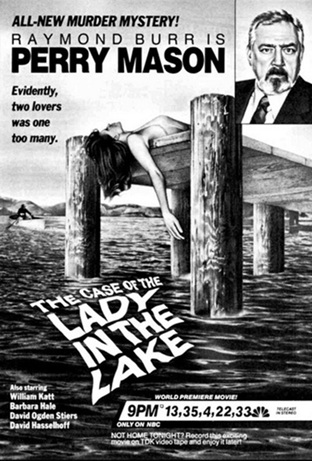
Fifteen years ago, the sister of Sara Wingate (Doran Clark) was murdered at a lake near the family home. Traumatized, Sara had a nervous breakdown. It was only when she married Billy Travis (David Hasselhoff), a former tennis player, that Sara started to get over her fear of the lake. When Sara disappears while walking along the lake, Billy is arrested and charged with murdering her. Because Perry’s is an old friend of Sara’s uncle (John Ireland), he takes the case. If you’re going to get arrested for murder, you better hope one of your relatives knows Perry Mason.
This movie wasn’t bad. It had a twist at the end, which I saw coming but which was still unique for the Perry Mason movies. The actual guilty party is pretty obvious but the mystery wasn’t as important as usual in this one. The supporting cast was pretty good, though David Hasselhoff seemed to be too calm for someone accused of murder. As Perry, Raymond Burr uses his cane again and leans against something whenever he has to stand up. Della jokes that Perry won’t be skiing anymore. Most of the action falls to Paul Drake, Jr. (William Katt), who gets beaten up even more than usual but who also gets to be the big hero in the end.
This was the last Perry Mason film for both William Katt and David Ogder Stiers, who played the district attorney. I’m going to miss both of them. William Katt’s hair was huge in this one and I was really looking forward to seeing how much bigger it could get.
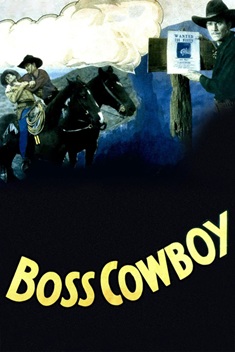
Boss Cowboy takes place in the 30s but it’s very much a western. One car shows up and telephone poles dot the countryside but almost everyone in the movie rides a horse. The Nolans and the Rosses are two ranching families. Both families are losing cattle. Nolan foreman Dick Taylor (Buddy Roosevelt) suspects that the culprit is the Ross foreman, Jack Kearns (George Cheseboro) and he’s right. Kearns is ripping off both families. Complicating Taylor’s effort to stop Kearns are his romantic feelings towards Mary Ross (Frances Morris), who is visiting from “back east.” Sally Nolan (Fay McKenzie) is also visiting and running joke is her handing off her small dog to a ranch hand named Slim (Alan Holbrook).
No apparent relation to either Teddy or FDR, Buddy Roosevelt was a respected stunt man who tried his hand at starring in a few westerns, Unfortunately, Buddy Roosevelt wasn’t much of an actor, which is painfully apparent while watching him in Boss Cowboy. He’s fine when he’s riding a horse and pulling a gun but when he has to speak, it’s difficult to watch. As bad as Buddy Roosevelt’s acting was, he was not the worst actor in Boss Cowboy. That honor was split between Frances Morris and Fay McKenzie. Boss Cowboy is pretty dull. Every scene drags and there are plenty of awkward silences while the cast tries to remember their lines.
Though he wasn’t much of an actor, Buddy Roosevelt remained in a demand as a stunt man throughout the 40s. In the 50s and 60s, he was kept busy playing townsmen in shows like The Life and Legend of Wyatt Earp. In 1962, he made his final film appearance in The Man Who Shot Liberty Valance. He then retired to Colorado, where he did at age of 75 in 1973. In all, his Hollywood career spanned 46 years, from 1916 to 1962.
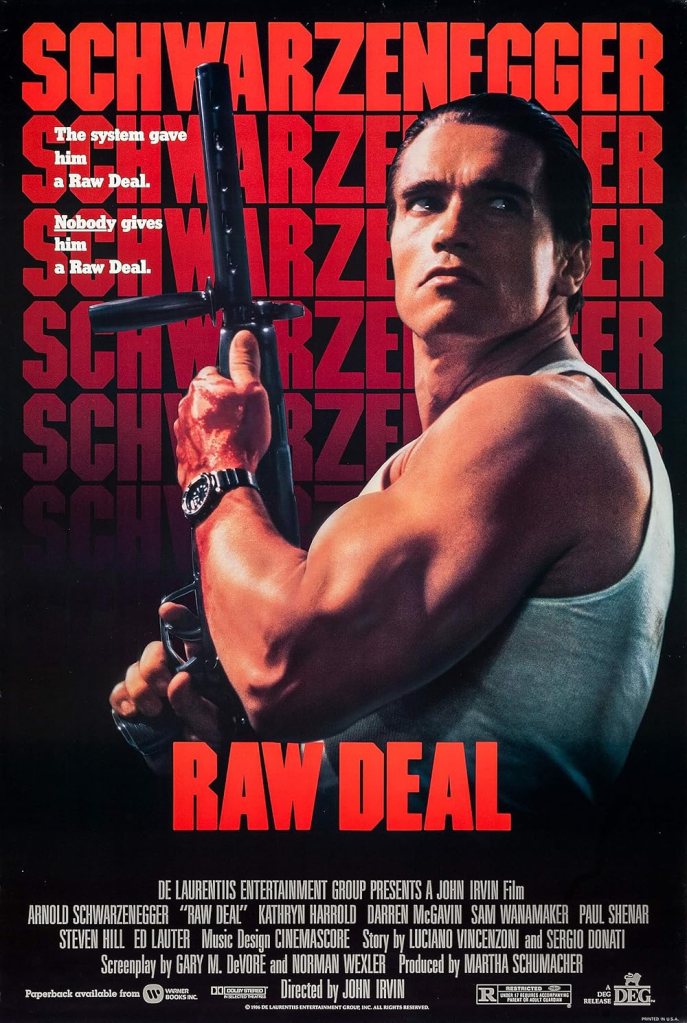
There is a point in every Arnold Schwarzenegger fan’s journey where they eventually circle back to Raw Deal and go, “Wait, how did this one slip through the cracks?” Set between Commando and Predator, this 1986 action vehicle often feels like the red-headed stepchild of Arnold’s golden era: a half-forgotten mob thriller dressed up as a one-man-army shoot-’em-up, with an undercover plot that keeps tripping over itself. Before Arnold was secret agent Harry Tasker in True Lies, he was already workshopping that whole undercover persona as former FBI man Mark Kaminski in Raw Deal. There is something strangely compelling about watching him play at being slick, whether he is posing as “Joseph Brenner” in mob circles or later reinventing himself as a suburban-family-man-turned-super-spy. Yet for all its clumsiness, tonal whiplash, and baffling choices, Raw Deal settles into that sweet, trashy groove where “this is bad” and “this is kind of awesome” blissfully merge. It is, in the purest sense, a guilty pleasure.
The setup is straightforward on paper. Arnold plays Mark Kaminski, a former FBI agent pushed out of the bureau for beating a suspect who assaulted and murdered a child, now stuck as a small-town sheriff in North Carolina with an unhappy, alcoholic wife and a life that feels like exile. His shot at redemption comes when his old FBI buddy Harry Shannon (Darren McGavin) recruits him for an off-the-books vendetta: infiltrate the Chicago mafia responsible for Shannon’s son’s death and tear them apart from the inside, in exchange for a possible path back into the bureau. Kaminski fakes his death, rebrands himself as “Joseph Brenner,” and sets out to worm his way into the organization run by boss Luigi Patrovita (Sam Wanamaker), while juggling mob politics, double-crosses, and a steady escalation of gunfire.
What makes the Kaminski era so weirdly fascinating is how hard the film leans on Arnold as a suave operator when his natural screen charisma is more brute-force than smooth-talking. In Raw Deal, he stalks through nightclubs and mob hangouts as an “undercover” tough guy, and you can almost see the movie trying to stretch him into a more traditional cool-gangster mode even as his sheer physicality keeps breaking the illusion. That tension carries right into True Lies, where the humor finally acknowledges how absurd it is to treat this gigantic Austrian bodybuilder as a low-key spy. The seeds of Harry Tasker’s double life are there in Kaminski: the awkward attempts at suave posturing, the undercover role-play, and the sense that the film is constantly asking the audience to accept him as something more than just the gun-toting tank he so effortlessly embodies. That tonal tug-of-war is kind of a mess, yet it’s also exactly why the movie is weirdly fun to revisit.
As an action piece, Raw Deal is very hit-or-miss, but when it hits, it goes all in on 80s excess. Director John Irvin stages a number of shootouts, but the standout sequence is the gravel pit massacre where Kaminski tears through mob soldiers with Mick Jagger’s “(I Can’t Get No) Satisfaction” blaring on the soundtrack, turning what should be a grim set piece into something closer to a music video about vengeance. The climactic assault on Patrovita’s casino base is another high point, with Kaminski stalking room to room, methodically mowing down henchmen in suits as the film abandons any pretense of undercover subtlety and embraces straight-up carnage. These moments are absurdly over the top, but they’re the reason the film lingers in the memory more than some “better” constructed movies from the same era.
The problem is that the film around those set pieces often feels oddly slack. For a movie with such a simple premise—ex-cop goes undercover in the mob—Raw Deal somehow manages to tangle itself in muddled plotting and underdeveloped subplots. Roger Ebert complained that the story is so basic it should be impossible to screw up, yet the movie still finds ways to make motivations cloudy and relationships confusing, especially when it comes to FBI leaks and why certain hits are happening. There are scenes, like the cemetery assassination setup, that should be loaded with emotional and narrative clarity but instead play as strangely opaque, leaving viewers wondering less “What will happen next?” and more “What exactly is going on?”
Despite the narrative wobbling, the cast gives the film more personality than it probably deserves. Schwarzenegger is still in that phase where his acting is limited but his screen presence is undeniable, and Raw Deal leans into that presence by letting him oscillate between stoic enforcer and deadpan comedian. He is not as effortlessly iconic here as he is in The Terminator or Predator, but he has a grounded gruffness in the early scenes as the weary small-town sheriff, and a playful swagger once he shifts into mob-infiltrator mode. The movie’s tonal confusion sometimes works in his favor: when he drops a ridiculous line in the middle of a supposedly serious undercover situation, it breaks the film’s self-seriousness in a way that oddly makes it more enjoyable.
On the supporting side, Darren McGavin brings a welcome dose of worn-out moral anguish as Harry Shannon, a man consumed by grief and desperate enough to go rogue, while Sam Wanamaker’s Patrovita and Paul Shenar’s lieutenant Max Keller give the mob side just enough theatrical menace to keep things lively. Kathryn Harrold’s Monique—Patrovita’s associate and Kaminski’s sort-of ally—is more underwritten than she should be, but she adds a smoky, world-weary charm to an otherwise thin role, bringing a touch of noir-vibe melancholy to a film that mostly cares about bullets. The dynamic between Kaminski and Monique hints at a more emotionally grounded movie lurking underneath, one that never fully arrives but peeks through in their quieter moments.
Visually and stylistically, Raw Deal fits comfortably into the mid-80s action aesthetic: slightly grimy urban backdrops, neon-lit nightclubs, smoky gambling dens, and anonymous industrial sites where bad guys go to die. John Irvin, better known for dramas and war films, occasionally tries to inject a more grounded tone, but the movie keeps undercutting that with comic-book logic and stylized violence, making it feel as if two different films are wrestling for control. On one level, that is a flaw; on another, that disjointed energy is part of what gives Raw Deal its “so off it becomes its own thing” quality, especially when watched now with decades of ironic distance.
Critically, the film was not well-loved on release, and its reputation has never really recovered in a mainstream sense. It holds a low Rotten Tomatoes score and only middling numbers on Metacritic, with reviewers at the time describing it as muddled, clichéd, and cheap compared to other action fare. Yet audience reactions have always skewed a bit warmer, with CinemaScore polling showing a respectable “B” grade and plenty of fans over the years framing it as an uneven but entertaining entry in Schwarzenegger’s catalog. The distance of time has turned Raw Deal into one of those movies where people admit its flaws freely but still find themselves rewatching it, chuckling at its corniness and vibing with its shootouts.
As a guilty pleasure, Raw Deal works because it is simultaneously too serious and not serious enough. It wants to be a gritty mob infiltration story but keeps indulging in gleefully excessive violence and dumb jokes; it dreams of being a tight cop thriller but never quite musters the narrative discipline. Yet that tension gives it a peculiar charm: it is a film that fails to be the sleek genre picture it might have been, but succeeds as a scrappy time capsule of 80s action sensibilities, carried by Arnold’s charisma and a few standout set pieces.
Viewed today, Raw Deal is hard to defend as “good” in any conventional sense, especially when measured against Commando’s pure cartoon energy or Predator’s lean genre perfection. But as a late-night watch, beer in hand, half-laughing at the dialogue while leaning forward during the gravel pit and casino shootouts, it absolutely delivers the specific pleasure it promises. The system may have given Mark Kaminski a raw deal, but for Arnold fans willing to embrace something messy, loud, and gloriously dated, this film still feels like a trashy little win
The Pittsburgh Film Critics Association has announced their picks for the best of 2025. And here they are:
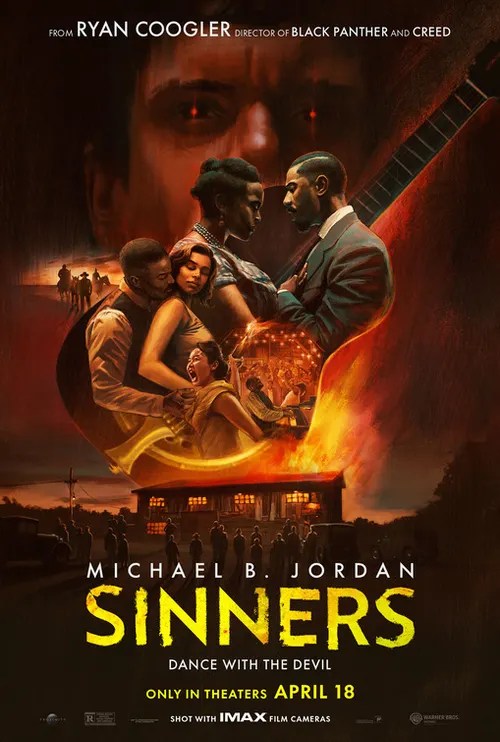
BEST PICTURE Winner: Sinners Runner-Up: One Battle After Another
BEST LEAD ACTOR Winner: Rose Byrne — If I Had Legs I’d Kick You Runner-Up: Jessie Buckley — Hamnet
BEST SUPPORTING ACTOR Winner: Amy Madigan — Weapons Runner-Up: Wunmi Mosaku — Sinners
BEST FEATURED ACTOR(15 minutes or less of screen time) Winner: William H. Macy — Train Dreams Runner-Up: Naomi Ackie — Sorry, Baby
BREAKTHROUGH PERFORMANCE Winner: Miles Caton — Sinners Runner-Up: Chase Infiniti — One Battle After Another Bark-through performance: Indy the Dog — Good Boy
BEST ANIMATED VOICE PERFORMANCE Winners (Tie): Arden Cho — KPop Demon Hunters; Ke Huy Quan — Zootopia 2
BEST DIRECTOR Winner: Ryan Coogler — Sinners Runner-Up: Paul Thomas Anderson — One Battle After Another
BEST ORIGINAL SCREENPLAY Winner: Ryan Coogler — Sinners Runner-Up: Eva Victor — Sorry, Baby
BEST ADAPTED SCREENPLAY Winner: Paul Thomas Anderson — One Battle After Another Runner-Up: Rian Johnson — Wake Up Dead Man
BEST SOUND DESIGN Winner: Steve Boeddeker — Sinners Runner-Up: Al Nelson — F1: The Movie
BEST HAIR, MAKEUP, & COSTUMES Winner*:* Siân Richards, Ken Diaz, Mike Fontaine, Shunika Terry (Hair and Makeup); Ruth E. Carter (Costumes) — Sinners Runner-up: Mike Hill, Jordan Samuel, Cliona Furey (Hair and Makeup); Kate Hawley (Costumes) — Frankenstein
BEST ANIMATED FEATURE Winner: KPop Demon Hunters Runner-Up: Zootopia 2
BEST FILM NOT IN THE ENGLISH LANGUAGE Winner: Sentimental Value Runner-Up: It Was Just an Accident
BEST STUNT PERFORMANCE & CHOREOGRAPHY Winner: Wade Eastwood — Mission: Impossible — The Final Reckoning Runner-Up: Andy Gill — Sinners
GOOD NEIGHBOR AWARD Winner: It Was Just an Accident for director Jafar Panahi’s continued critique of the Iranian regime.
Today would have been Lee Van Cleef’s 101st birthday.
Today’s scene that I love features Van Cleef as the title character in 1969’s Sabata. In this scene, he faces off in a duel with William Berger’s Banjo. Even when he’s playing the good guy, like in this film, Lee Van Cleef leaves no doubt that he’s not someone you want to mess with.
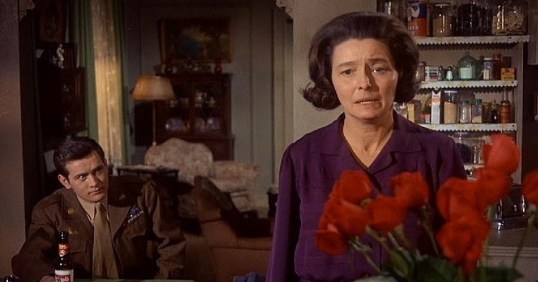
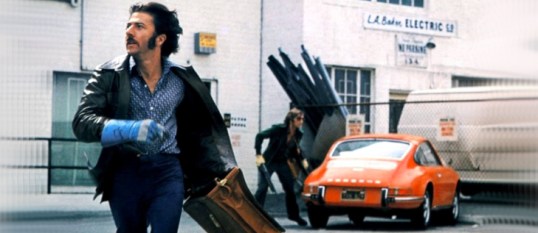
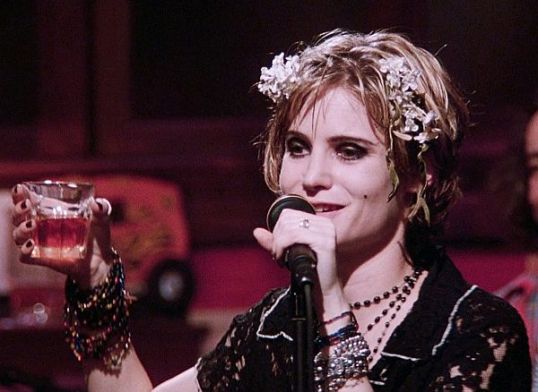
4 Or More Shots From 4 Or More Films is just what it says it is, 4 shots from 4 of our favorite films. As opposed to the reviews and recaps that we usually post, 4 Shots From 4 Films lets the visuals do the talking!
Today, on what would have been his 97th birthday, we pay tribute to director Ulu Grobsard with….
4 Shots From 4 Ulu Grosbard Films
The Subject Was Roses (1968, dir by Ulu Grosbard, DP: Jack Priestley)
Straight Time (1978, dir by Ulu Grosbard, DP: Owen Roizman)
True Confessions (1981, dir by Ulu Grosbard, DP: Owen Roizman)
Georgia (1995, dir by Ulu Grosbard, DP: Jan Kiesser)
As some of our regular readers undoubtedly know, I am involved in a few weekly watch parties. On Twitter, I host #FridayNightFlix every Friday and I co-host #ScarySocial on Saturday. On Mastodon, I am one of the five hosts of #MondayActionMovie! Every week, we get together. We watch a movie. We tweet our way through it.
Tonight, at 10 pm et, I will be hosting #FridayNightFlix! The movie? 1979’s The Humanoid, starring Richard Kiel!
If you want to join us this Friday, just hop onto twitter, find The Humanoid on Prime, start the movie at 10 pm et, and use the #FridayNightFlix hashtag! I’ll be there happily tweeting. It’s a friendly group and welcoming of newcomers so don’t be shy.
 The Critics Association of Central Florida has announced its picks for the best of 2025! And here they are: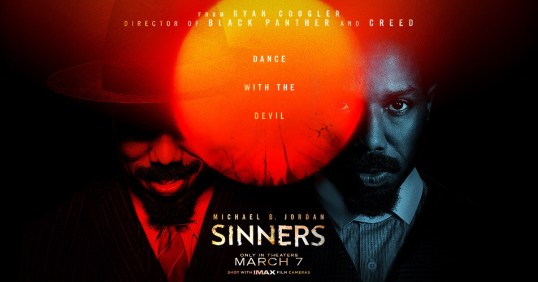

 Through the Shattered Lens