Welcome to Late Night Retro Television Reviews, a feature where we review some of our favorite and least favorite shows of the past! On Mondays, I will be reviewing CHiPs, which ran on NBC from 1977 to 1983. The entire show is currently streaming on Prime!
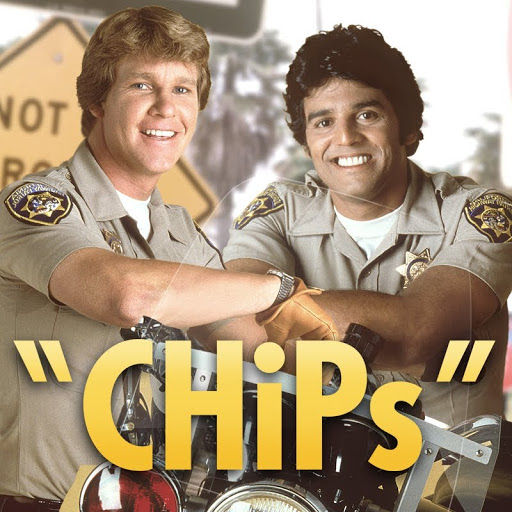
This week, it’s Ponch and Jon’s anniverary!
Episode 5.3 “Moonlight”
(Dir by Earl Bellamy, originally aired on October 18th, 1981)
A highway accident leads to a bunch of cars flying through the air in slow motion!
Ponch works off-duty as a security guard for an action film. Ponch being Ponch, he ends up flirting with the two female stars. He also ends up accidentally flirting with their stunt doubles, both of whom turn out to be men wearing blonde wigs. Oh, Ponch!
Someone is dumping toxic waste and ruining the beautiful California country side. Ponch and Jon turn to their old friend, trucker Robbie Davis (Katherine Cannon), for help. However, it turns out that the waste is being transported and dumped by someone close to Robbie!
There’s a lot going on in this episode but the majority of the screentime is taken up with Getraer, Grossman, Baricza, Turner, and Bonnie thinking about how to celebrate Ponch and Jon’s 4th anniversary as partners. At one point, Getraer does point out that it’s unusual for an entire department to celebrate the anniversary of a partnership. I’m glad that someone said that because, seriously, don’t these people have a job to do? I mean, aren’t they supposed to be out there, issuing tickets and preventing crashes like the one that opened this episode? You’re not getting paid to be party planners, people!
Knowing just how much Larry Wilcox and Erik Estrada disliked each other when the cameras weren’t rolling, it’s hard not to feel as if there’s a bit of wish-fulfillment going on with the anniversary storyline. Watching everyone talk about how Jon and Ponch are the perfect team, one gets the feeling that the show itself is telling its stars, “Can you two just get along? Everyone loves you two together!”
Reportedly, by the time the fifth season rolled around, Wilcox was frustrated with always having to play second fiddle to Estrada. Having binged the show, I can understand the source of his frustration. During the first two seasons, Wilcox and Estrada were given roughly the same amount of screen time in each episode. In fact, Estrada often provided the comic relief while Wilcox did the serious police work. But, as the series progressed, the balance changed and it soon became The Ponch Show. If there was a beautiful guest star, her character would fall for Ponch. If there was a rescue to be conducted, Ponch would be the one who pulled it off. When it came time to do something exciting to show off the California lifestyle, one can b sure that Ponch would be the one who got to do it. Baker got pushed to the side. This episode, however, allows Baker to rescue someone while Ponch watches from the background. “See, Larry?” the show seems to be saying, “We let you do things!”
As for the episode itself, it’s okay. There’s enough stunts and car accidents to keep the viewers happy. That said, the toxic dump storyline plays out way too slowly. At one point, Baricza finds a bunch of barrels off the side of the road and he looks like he’s about to start crying. It’s an odd moment.
The episode ends with Baker and Ponch happy. It wouldn’t last. This would be Larry Wilcox’s final season as a member of the Highway Patrol.
1972’s Tomorrow opens up in rural Mississippi, in the early 40s. A man is on trial for shooting another man. The majority of the juror wants to acquit the shooter because it’s generally agreed that the victim was a no-account, someone who was never going to amount to anything and who the entire country is better off without. Only one juror votes to convict, a quiet and stoic-looking farmer named Fenty (Robert Duvall). Fenty refuses to go into much detail about why he’s voted to convict. Despite the efforts of the other jurors, Fenty refuses to change his vote and the end result is a hung jury.
The film flashes twenty years, to show why Fenty eventually voted the way that he did. Even in the past, Fenty is quiet and shy, a farmer who also works as a caretaker at another property that is several miles away. He walks to and from his home. Even on Christmas Eve, he says that he plans to walk the 30 miles back to his farm and then, on the day after Christmas, the 30 miles back to his caretaking job. Fenty is someone who keeps to himself, answering most questions with just a few words and revealing little about how he feels about anything.
When Fenty comes across a sickly and pregnant drifter named Sarah Eubanks (Olga Bellin), he takes her into his farm and he nurses her back to health. The film examines the bond that forms between Fenty and Sarah, two people who have been judged by society to be of little significance. It’s not an easy life but Fenty endures. Fenty’s decision to take in Sarah is a decision that will ultimately lead to Fenty’s guilty vote at the trial many years later.
Tomorrow is a film that is not as well-known as it should be. Adapted by Horton Foote from a William Faulkner short story, the black-and-white film is one that demands a little patience. Audiences looking for an immediate pay-off will be disappointed but those willing to give the film time to tell its story will be rewarded. The action unfolds at a gradual but deliberate pace, one that will seem familiar to anyone who has spent any time in the rural South. The film allows the audience the time to get to know both Fenty and Sarah and to truly understand the world in which the live. In the end, when the film’s narrator comes to realize that Fenty is not an insignificant bystander but instead a man of strong character and morals, the audience won’t be surprised because the audience already knows. Fenty has proven himself to the viewer.
Robert Duvall has described Tomorrow as being his favorite of the many films in which he’s appeared. (The film came out the same year that Duvall co-starred in The Godfather.) Indeed, Duvall does give one of his best performances as the quiet but strong Fenty. In many ways, the performance feels as if its descended from his film debut as Boo Radley in To Kill A Mockingbird. Duvall gives an excellent performance as a man who can hide his emotions but not his decency. Tomorrow is a film that requires patience but which still deserves to be better known.
1970’s The Revolutionary tells the story of a young man named A (Jon Voight).
When we first meet him, A is a college student who lives in the industrial town of Axton. A comes from a wealthy family but he chooses to live in a tiny and quite frankly repellent apartment. He has a girlfriend named Ann (Collin Wilcox). A and Ann don’t really seem to have much of a relationship. “We should make love,” A says in a flat tone of voice. Ann is willing to show her emotions while the self-serious A goes through life with everything under wraps. Ann and A are both members of a radical political group. The group spends a lot of time talking and discussing theory but they don’t really do much else.
A grows frustrated with the group. He gets a job at a factory, where he falls under the sway of a communist named Despard (Robert Duvall). Despard is a bit more active than A’s former comrades. Despard, for instance, is willing to call a general strike but, when that strike still fails, A, along with Despard and everyone else involved, goes underground. Suspended from the university, he soon finds himself being drafted into the Army. His father asks A if he wants to be drafted. A questions why only the poor should be drafted. His father looks at A as if he’s hopelessly naive and his father might be right.
A continues to wander around Axton in an idealistic daze, trying to get people to read the flyers that he spends his time passing out. Things change when A meets Leonard II (Seymour Cassel), a radical who recruits A into an apparent suicide mission….
The Revolutionary took me by surprise. On the one hand, it’s definitely very much a political film. The movie agrees with A’s politics. But, at the same time, the film is also willing to be critical of A and his self-righteous view of the world. One gets the feeling that A’s politics have less to do with sincere belief and more to do with his own need to be a part of something. Up until the film’s final few minute, A is something of a passive character, following orders until he’s finally forced to decide for himself what his next move is going to be. A’s father thinks he’s a fool. Despard views him as being an interloper. Even Leonard II seems to largely view A as being a pawn. A wanders through Axton, trying to find his place in the chaos of the times.
It’s not a perfect film, of course. The pace is way too slow. Referring to the lead character only as “A” is one of those 70s things that feels embarrassingly cutesy today. As was the case with many counterculture films of the early 70s, the film’s visuals often mistake graininess with authenticity. Seriously, this film features some of the ugliest production design that I’ve ever seen. But for every scene that doesn’t work or that plays out too slow, there’s one that’s surprisingly powerful, like when an army of heavily armored policemen break up a demonstration. The film itself is full of talented actors. Seymour Cassel is both charismatic and kind of frightening as the unstable Leonard II. Jon Voight and Robert Duvall are both totally convincing as the leftist revolutionary and his communist mentor. (In real life, of course, Voight and Duvall would become two of Hollywood’s most prominent Republicans.) In The Revolutionary, Duvall brings a certain working class machismo to the role of Despard and Voight does a good job of capturing both A’s intelligence and his growing detachment. A can be a frustrating and passive character but Voight holds the viewer’s interest.
The film works because it doesn’t try to turn A into some sort of hero. In the end, A is just a confused soul trying to figure out what his place is in a rapidly changing world. Thanks to the performance of Voight, Duvall, and Cassel, it’s a far more effective film than it perhaps has any right to be.
1969’s The Rain People tells the story of Natalie Ravenna (Shirley Knight), a Long Island housewife who, one morning, sneaks out of her house, gets in her station wagon, and leaves. She later calls her husband Vinny from a pay phone and she tells him that she’s pregnant. Vinny is overjoyed. Natalie, however, says that she needs time on her own.
Natalie keeps driving. In West Virginia, she comes upon a young man named Jimmy Kligannon (James Caan). She picks him up looking for a one-night stand but she changes her mind when she discover that Jimmy is a former college football player who, due to an injury on the field, has been left with severe brain damage. The college paid Jimmy off with a thousand dollars. The job that Jimmy had waiting for him disappears. Jimmy’s ex-girlfriend (Laura Crews) cruelly says that she wants nothing more to do with him. Natalie finds herself traveling with the child-like Jimmy, always trying to find a safe place to leave him but never quite being able to bring herself to do so.
Jimmy is not the only man that Natalie meets as she drives across the country. Eventually, she is stopped by Gordon (Robert Duvall), a highway motorcycle cop who gives her a speeding ticket and then invites her back to the trailer that he shares with his young daughter. (Gordon’s house previously burned down.) Natalie follows Gordon back to his trailer, where the film’s final tragic act plays out.
The Rain People was the fourth film to be directed Francis Ford Coppola. Stung by the critical and commercial failure of the big-budget musical Finian’s Rainbow, Coppola made a much more personal and low-key film with The Rain People. While the critics appreciated The Rain People, audiences stayed away from the rather downbeat film. Legendary producer Robert Evans often claimed that, when Coppola was first mentioned as a director for The Godfather, he replied, “His last movie was The Rain People, which got rained one.” Whether that’s true or not, it is generally acknowledged that the commercial failure of The Rain People set back Coppola’s directing career. (Indeed, at the time that The Godfather went into production, Coppola was better-known as a screenwriter than a director.) Of course, it was also on The Rain People that Coppola first worked with James Caan and Robert Duvall. (Duvall, who was Caan’s roommate, was a last-second replacement for Rip Torn.) Both Caan and Duvall would appear in The Godfather, as Sonny Corleone and Tom Hagen respectively. Both would be Oscar-nominated for their performances. (It would be Caan’s only Oscar nomination, which is amazing when you consider how many good performances James Caan gave over the course of his career.)
As for The Rain People, it may have been “rained on” but it’s still an excellent film. Shirley Knight, Robert Duvall, and James Caan all give excellent performances and, despite a few arty flashbacks, Coppola’s direction gives them room to gradually reveal their characters to us. The film sympathizes with Knight’s search for identity without ever idealizing her journey. (She’s not always nice to Jimmy and Jimmy isn’t always easy to travel with.) As for Caan and Duvall, they both epitomize two different types of men. Caan is needy but innocent, a former jock transformed into a lost giant. As for Duvall, he makes Gordon into a character who, at first, charms us and that later terrifies us. Gordon could have been a one-dimensional villain but Duvall makes him into someone who, in his way, is just as lost as Natalie and Jimmy.
The Rain People is a good film. It’s also a very sad film. It made my cry but that’s okay. It earned the tears.
David Hall (Matthew Faison) is an obnoxious horror writer who invites a group of associates and former friends to spend the night at a “haunted” hotel. He’s invited them because all of them are on the verge of suing him for writing about them in his latest book, The Resort. Over the course of the night, he plays cruel practical jokes on all of them. Finally, someone gets fed up and tosses him over a railing. The police arrest publisher Jordan White (Robert Stack) and charge him with the murder. It’s a good thing that Jordan’s best friend is Perry Mason (Raymond Burr).
Perry uses a cane in this movie and is not that active outside of the courtroom. That means that it’s up to Paul Drake, Jr. (William Katt) to do most of the investigating. As usual, Paul falls for an attractive, younger woman, in this case the hotel’s owner, Susan Warrenfield (Kim Delaney). Every movie features Paul falling for someone and then we never hear about them again. Does Paul have commitment issues?
I enjoyed this Perry Mason mystery. The hotel was a great location and I appreciated that the movie tried to add some horror elements to the story. The Perry Mason movies can be predictable so I always like it when they at least try to do something a little bit different. This was a fun entry in Perry Mason’s career.
Chevy Chase, Gregory Hines, and Wallace Shawn all play small-time arms dealers who get involved in a scheme to sell the “Peacemaker” drone to the dictatorship that has seized control of the Latin American country of San Miguel. After Shawn commits suicide, Chase and Hines are joined by his widow, who is played by Sigourney Weaver. Selling the Peacemaker should be easy except that Hines has a religious epiphany and becomes a pacifist and Chase himself is starting to have qualms about the way he makes a living. As his brother-in-law puts it, something bad seems to happen in every country that Chase visits.
Deal of the Century has the unique distinction of being one of the two films that director William Friedkin did not acknowledge in his autobiography, The Friedkin Connection. When Friedkin was asked why he left it out of his book, Friedkin said that he didn’t consider Deal of the Century to be a “Friedkin film.” He wanted to do a Dr. Strangelove-style satire while the studio wanted a board Chevy Chase comedy. The studio won, Friedkin was not given final cut, the movie bombed, and Friedkin didn’t see any reason to revisit the experience of making it.
Deal of the Century is a disjointed film. The best scenes are the one that are probably the closest to Friedkin’s original vision. These are the scenes set in weapons expos and that highlight the commercials designed to sell products of mass destruction. But those scenes are dwarfed by scenes of Chevy Chase being pursued by cartoonish guerillas in San Miguel and Gregory Hines overacting after getting baptized. Chase has a few good smartass scenes at the start of the film, some of which are reminiscent of his career-best work in Fletch. But he loses his way as the film goes on and his change-of-heart never feels convincing. The film ends with a burst of special effects that are unconvincing even for 1983.
Deal of the Century may have been directed by William Friedkin but he was correct to say that it is definitely not a Friedkin film.
In the closing days of the frontier, a group of Rangers in New Mexico receive a telegram telling them that it is time to disband and to turn law enforcement duties over to the local sheriff. However, there’s a viscous outlaw named Hashknife (George “Gabby” Hayes) on the loose so Bob Houston (Bob Steele) and Slim (Al St. John) pretend that they never received the telegram so that they can arrest him. Hashknife kidnaps Bob’s girl (Gertie Messenger) and that makes thing personal.
Riders of the Desert is an appropriate name for this film because the majority of its 50-minute running time really was just taken up with footage of men riding their horses from one location to another. Even though the film was less than an hour long, the story sill needed some filler.
Riders of the Desert is still a pretty good western, though. It’s definitely better than the average Poverty Row western. As always, Bob Steele look authentic riding a horse and Al St. John provides good support as Fuzzy. The disbanding of the Rangers gives the first half of the film an elegiac feel that would later show up in several of the westerns made during and after the 1960s. The old west is coming to an end and there’s less need for the Rangers. The second half of the film is almost all action and George “Gabby” Hayes is a surprisingly effective villain. Of course, this movie was made before he became Gabby.
As with most Poverty Row westerns, this is not the film to watch if you’re not already a fan of the genre. But for those who like westerns, Riders of the Desert is a good one.
Welcome to Retro Television Reviews, a feature where we review some of our favorite and least favorite shows of the past! On Mondays, I will be reviewing Miami Vice, which ran on NBC from 1984 to 1989. The entire show can be purchased on Prime!
Retro television reviews returns with Miami Vice!
Episode 5.9 “Fruit of the Poisoned Tree”
(Dir by Michelle Manning, originally aired on February 3rd, 1989)
Crockett and Tubbs are trying to take down a drug dealer named Enriquez (Jeffrey Meek) but every time that they think they’ve got the guy, his shady lawyer, Sam Boyle (Stephen McHattie), is able to use a technicality to get the case tossed. Even sending Gina in undercover backfires as Gina’s cover gets blown and a bomb meant for her kills an innocent 13 year-old instead.
Crockett thinks that Sam and his associate, Lisa Madsen (Amanda Plummer), have evidence that could put Enriquez away. Crockett puts pressure on Lisa to become a confidential informant but Lisa is devoted to Sam. Lisa’s father was a crusading anti-drug prosecutor who was stabbed to death and Sam has promised that he will do everything within his power to prove that her father was actually assassinated by a drug cartel.
Of course, there’s some things that Lisa doesn’t know. Sam is heavily involved in the drug trade himself and he’s currently in debt to gangster Frank Romano (Tony Sirico, bringing some nicely realistic menace to his role). Sam plots to double cross Enriquez to get the drugs necessary to pay off Frank. Plus, it also turns out that Sam is the one who had Lisa’s father killed.
When Lisa (and hey, that’s my name!) finds out the truth, she uses her legal training to seek her own revenge. Enriquez has been arrested due to evidence that Lisa gave Crockett. But when Lisa reveals herself to have been Crockett’s informant, the case is tossed because Lisa violated attorney/client privilege. This frees up Enriquez to kill Sam right before Sam gets onto a private plane that would have taken him to freedom. The episode ends with Enriquez getting arrested yet again and Lisa staring down at Sam’s dead body.
This was a pretty good episode, especially considering that it aired during the final season. It feels like a throwback to the first two seasons, where the morality was always ambiguous and pretty much no one got a happy ending. Lisa may have gotten revenge for the killing of her father but she did it by arranging the murder of a man who she had spent years worshipping. The Vice Squad takes down a drug dealer but not before an innocent boy is murdered. The only reason that they’re going to a conviction this time is because they actually witnesses Enriquez killing Sam Boyle. Otherwise, the case probably would have gotten thrown out again.
Miami Vice was always at its strongest when it examined futility of the war on drugs. There’s a lot of money to found in the drug trade and there’s always someone willing to step up and replace anyone who the Vice Squad actually manages to take down. This episode may end with Enriquez defeated but there’s no doubt that someone else will step into his shoes.
“It’s not the result of one’s life that’s important. It’s the day-to-day concerns, the personal victories, and the celebration of life… and love. It’s enough if people are able to experience the joy that each day can bring…” – Terra Bradford
Final Fantasy VI is one of those JRPGs that feels bigger than the cartridge it shipped on, and even now it earns its reputation as both a high point of the 16-bit era and a blueprint for what narrative-driven RPGs could become. It is dense, melodramatic, occasionally clunky, but consistently ambitious in ways that still feel relevant to the genre’s modern landscape, blending theatrical storytelling with flexible mechanics and a structure that dares to rethink its own world midway through. Revisiting it reveals not just a classic, but a foundational text whose echoes show up in everything from ensemble casts to customizable skill systems in later titles.
The opening hours set the tone with impressive confidence, dropping you right into a steampunk-flavored world where magic has been industrialized into a tool of conquest. Terra, a half-human, half-Esper whose mind is shackled by an imperial slave crown, marches through snowy mountains in powered Magitek armor toward the mining town of Narshe, instantly hooking you with her vulnerability amid high-stakes espionage. This personal thread weaves into a broader guerrilla war between the Gestahlian Empire—led by the scheming Gestahl and his unhinged general Kefka—and the ragtag Returners resistance, but the real genius is how the story quickly pivots from standard “rebels vs. empire” to a sprawling ensemble piece that trusts no single hero to carry the weight.
That cast of fourteen permanent party members is the game’s boldest swing, each layered with backstories, quirks, and mechanical identities that make them stick. Terra grapples with her monstrous heritage and search for belonging, Celes wrestles betrayal and isolation after defecting from the Empire, Locke chases redemption for a lost love, Cyan buries himself in grief over his family’s slaughter, Sabin roams as a free-spirited brawler, Edgar plays the charming king-turned-inventor, and Setzer brings cynical gambler flair—it’s a roster that juggles melodrama like opera-house soliloquies and doomed romances with quieter, human moments that land surprisingly hard even today. Some inevitably get shortchanged if you beeline through the back half, feeling more like vivid archetypes than deep dives, but the sheer ambition of giving everyone a mini-arc amid the chaos set a new bar for character work in JRPGs, influencing how later games like the Persona series built entire identities around tight-knit parties and personal subplots.
Kefka anchors the escalating stakes as few villains do, evolving from a clownish psycho prone to war crimes like poisoning a town into a nihilistic force who hijacks the god-like Warring Triad, shatters the planet, and rules the resulting apocalypse as a tyrant-god cackling over the ruins. Midway through, he doesn’t just threaten doom—he delivers it, wiping cities off the map and thrusting the story into the World of Ruin, a time-skipped wasteland where survivors scrape by amid decay and despair. This pivot isn’t a cheap shock; it’s a structural earthquake that shifts the tone to post-apocalyptic reflection, forcing each character to confront whether they even have a reason to fight on, with Celes’ suicidal low point on a lonely island giving way to gradual reunions that feel earned because you choose the order. That willingness to let the bad guy win—and make the heroes rebuild emotionally as well as literally—rippled through the genre, showing JRPGs could handle survivor guilt, loss, and fragile hope without hand-waving the darkness.
Structurally, it’s like two games fused together: the linear World of Balance builds your crew through set pieces like infiltrations, multi-party defenses, and the iconic opera sequence, then explodes into a semi-open World of Ruin where you roam a shattered map, tackling side dungeons and personal vignettes at will. Pacing can wobble if you stray off-path early or grind too hard later, but the freedom to prioritize arcs—like Cyan’s haunted family dreams or Terra’s village sanctuary—mirrors the themes of recovery, prefiguring how modern titles blend cosmic plots with player-driven character priorities.
Combat nails a sweet spot with the Active Time Battle system, where gauges fill in real-time for flexible pacing—toggle “Active” for pressure or “Wait” to strategize—and row positioning adds tactics, frontliners tanking full hits while backrow slings safer damage. Character-unique commands keep it fresh: Sabin’s Blitz commands mimic fighting-game inputs, Edgar’s Tools hit formations, Cyan charges sword techs, Gau Rages as monsters, Setzer gambles on slots—making swaps feel playful and deliberate. The Esper system elevates this, letting anyone equip magical summons to learn spells via Magic Points and snag level-up bonuses, blending fixed identities with modular builds in a way that blurred roles late-game but normalized customization as core to JRPG fun.
This philosophy—strong personalities atop teachable, recombinable abilities—quietly reshaped the genre, with Persona‘s demon/persona fusion, Lost Odyssey‘s memory-tied skills, and similar systems in Clair Obscur owing a debt to Espers as a bridge from rigid classes to player-sculpted parties without erasing narrative flavor. Dungeons mix it up too, from pincer ambushes and gimmick bosses like the shell-hiding Whelk to timed escapes and that charming opera blending inputs with spectacle, though some late hauls drag with random encounters exposing 16-bit limits.
Visually, it’s pixel art at its peak: expressive sprites, detailed industrial backdrops, and a palette flip from Balance’s vibrancy to Ruin’s sickly decay, with ruined landmarks and evolving NPC lines selling irreversible change. Bosses escalate to surreal, painterly horrors fitting the finale’s otherworldliness, proving art direction trumps raw fidelity.
Nobuo Uematsu’s soundtrack is legendary for good reason, weaving leitmotifs—Terra’s theme, Kefka’s manic laugh, Celes’ aria—into a narrative spine that evolves with the story, from triumphant fanfares to haunting piano and faux-choral dread, all within SNES constraints. It established JRPG scores as orchestral-caliber storytelling tools, influencing fully symphonic later works and live concerts.
Final Fantasy VI‘s legacy permeates JRPGs today, its DNA visible in the way Persona weaves school-life bonds with supernatural showdowns, how Lost Odyssey probes immortal grief through written vignettes, or how ambitious indies like Clair Obscur chase painterly melancholy and hope amid ruin—the ensemble healing, world-shattering pivots, and trauma-to-recovery arcs all trace back here, proving a 16-bit game could set emotional and structural templates still in play. Hironobu Sakaguchi crystallized as the modern JRPG’s godfather through this title, fusing mechanical innovation like Esper flexibility with mature themes of identity and despair that Final Fantasy VII and beyond amplified into global phenomena, his vision elevating the genre from quest logs to profound, character-soaked epics.
The Final Fantasy VII Remake‘s blockbuster success—reimagining a classic with modern graphics, cinematic flair, real-time twists, and expanded character beats—has only intensified fan campaigns for VI to get similar lavish treatment, from a fully voiced, motion-captured opera house to a destructible world rendered in heartbreaking detail and Ruin reunions that hit even harder with modern intimacy. Yet Square Enix leadership has flagged the project’s nigh-insurmountable scale: the fourteen-character sprawl, mid-game reset, player-driven nonlinearity, and web of optional stories demand a development odyssey that could dwarf even VII‘s trilogy, risking dilution of what makes the original a personal, unpredictable journey if forced into rigid cinematic lanes.
Flaws persist—sappy dialogue dates it amid earnest monologues, sidelined characters like Gau or Strago need deliberate hunting for payoff, Espers can shatter balance into spell-spam routs, and marathon dungeons fatigue under random encounter spam—but these 16-bit quirks pale against a boldness that endures. Final Fantasy VI isn’t frozen nostalgia; it’s a living cornerstone, its sprawling heart, tinkering joy, musical sweep, and unyielding ambition still sparking JRPG evolution, demanding replays not as history homework but as a masterclass in what the genre can feel like when it swings for the fences and connects. Decades on, it whispers to every ambitious RPG dev: let your world break, let your cast breathe, let your systems invite play—and watch players find reasons to care long after the credits roll.
Hi, everyone! Tonight, on twitter, I will be hosting one of my favorite films for #MondayMania! Join us for 2019’s The Ex Next Door!
You can find the movie on Prime and Tubi and then you can join us on twitter at 9 pm central time! (That’s 10 pm for you folks on the East Coast.) See you then!