Oh wow, is it St. Patrick’s Day already?
Let’s welcome to the day with The Corrs!
Enjoy!
Oh wow, is it St. Patrick’s Day already?
Let’s welcome to the day with The Corrs!
Enjoy!
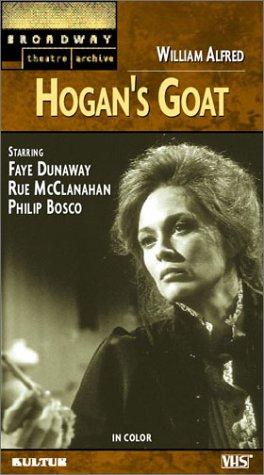
1971’s Hogan’s Goat opens in Brooklyn in the 1890s. This was when Brooklyn itself was still a separate city, before it become a borough of the unified New York City. If you’ve watched the video that I include with most of my Welcome Back Kotter reviews, you’ll notice the boast: “Fourth largest city” on the Welcome to Brooklyn sign. And indeed, if Brookyln had remained independent, it would now be the fourth most populated city in America, behind New York, Los Angeles, and Chicago. Sorry, Brooklyn.
(However, Houston thanks you.)
Local ward boss Matt Stanton (Robert Foxworth) heads home with what he thinks is exciting news. He tells his wife, Kathleen (Faye Dunaway), that he is finally going to be mayor of Brooklyn. The current mayor, a man named Quinn (George Rose), has been caught up in some sort of corruption and the Democratic political machine is ready to abandon him. Matt Stanton is about to become one of the most powerful men in New York. That’s not bad for a relatively young man who came to America from Ireland in search of a better life. Adding to Stanton’s happiness is the fact that he’ll be defeating Quinn, a canny politician towards whom Stanton holds a grudge. Kathleen, however, is worried. An immigrant herself, Kathleen met Stanton while the latter was in London. They were married in a civil ceremony and, ever since Stanton brought her back to Brooklyn, she has been lying and telling everyone that they were married in a church. Kathleen feels that she and Stanton have been living in sin and she wants to have a convalidation ceremony. Stanton refuses because doing so would mean admitting the lie in the first place and he can’t afford to lose the support of the Irish Catholic voters of Brooklyn.
However, it turns out that there are even more secrets in Stanton’s past, ones that Kathleen doesn’t know about but Quinn does. When those secrets start to come out, Kathleen comes to realize that there’s much that she doesn’t know about her husband. Stanton, with political power in his grasp, desperately tries to hold on to the image that he’s created of himself and Kathleen, leading to tragedy.
Hogan’s Goat was an Off-Broadway hit when it premiered in the mid-60s and its success led to Faye Dunaway getting her first film offers. The made-for-television version of Hogan’s Goat, which premiered on PBS and featured Dunaway recreating her stage role, is essentially a filmed play. Little effort was made to “open up” the story and, as a result, the film is undeniably stagy. It’s clear from the start the film was mostly shot to record Faye Dunaway’s acclaimed performance for posterity. Indeed, she’s the only member of the theatrical cast to appear in the film version. Dunaway does give a strong performance, easily dominating the film with her mix of nervous intensity and cool intelligence. The rest of the cast is a mixed bag. Robert Foxworth is appropriately driven and ambitious as Stanton but his Irish accent comes and goes. Philip Bosco does well as a sympathetic priest and George Rose is appropriately manipulative as Quinn.
In the end, the story of Hogan’s Goat is probably of the greatest interest to Irish-American history nerds like me, who have read and studied how Irish immigrants, especially in the 19th century, faced tremendous prejudice when coming to the United States and how they reacted by building their own political machines and dispensing their own patronage. In Hogan’s Goat, the conflict is less between more Stanton and Quinn and more between Kathleen’s traditional views and her devout Catholicism and Stanton’s own very American ambition. Whereas Kathleen still fights to retain her faith, pride, and her commitment to who she was before she married Stanton, Stanton fights for power and to conquer the man who Stanton feels has everything that he desires. In the end, Stanton’s hubris is not only his downfall but Kathleen’s as well.
St. Patrick’s Day has a long history in the United States. In the 19th century, when the Irish were regularly discriminated against, St. Patrick’s Day was a chance to show pride in one’s heritage and to also show off the unity of the Irish community. Now, of course, St. Patrick’s Day is a day when everyone celebrates Irish, even people don’t have a drop of Irish blood in them! Here are a few vintage of images of St. Patrick’s Day in America, through the years!

1872

1874

1874

1890s

1904

1908

1909

1913

1919

1949

1951

1955
Welcome to Late Night Retro Television Reviews, a feature where we review some of our favorite and least favorite shows of the past! On Sunday, I will be reviewing the Canadian series, Degrassi High, which aired on CBC and PBS from 1989 to 1991! The series can be streamed on YouTube!

Wake up in the morning, it’s time to make a feminist slasher film….
Episode 1.14 “It Creeps!”
(Dir by Kit Hood, originally aired on February 6th, 1990)
Shane’s back!
We haven’t seen Shane since he showed up at the last junior high dance. Shane, of course, is the ex-boyfriend of Spike and the wayward father of Emma. Shane took LSD while at a concert and either jumped or fell off a bridge. When we see him in this episode, he’s suffering from brain damage. One minute, he’s greeting Spike like his best friend. Another minute, he’s yelling at her and suddenly acting aggressive. Spike still tries to be nice to him, despite Liz’s comment of “He’s creepy.” (Seriously, what is going with Liz this season?) What’s really disturbing, though, is that Shane’s only close friend still appears to be Luke, the idiot who gave him the acid in the first place.
(Seriously, how did Luke get away with that?)
That was the B-plot of this episode. The A-plot featured Lucy finally making her feminist horror film, It Creeps!!, for her creative writing class. Personally, I like the idea behind It Creeps!! It’s a slasher movie where, for once, it’s the guys getting knifed in the shower instead of the girls. It’s the type of thing that would get Lucy a deal with Blumhouse today. I’m a little bit surprised that she was able to get away with making it for a school project but I guess that 80s were a more innocent time. If a student shot a bloody slasher film in her school today, she’d probably be suspended.
Lucy shows her film to the class and is shocked when they laugh at certain parts. She runs out the room but her creative writing teacher assures her that class is enjoying her film. He tells her that she did a good job, considering that it was her first film. (It’s a hundred times better than Michael Scott’s Threat Level Midnight.) Lucy returns to the classroom, just in time to find everyone cheering as Wheels dies on screen.
Of course, those of us who know our Degrassi history, know how this is going to turn out. After graduation, Wheels is going to be driving drunk and he’s going to have the accident that will not only send him to prison but will also leave Lucy crippled and temporarily blinded. Seriously, this show is a lot darker if you already know what’s going to happen in School’s Out!
As for this episode, it was a good one. The plot with Lucy’s film worked because the end result actually looked like something that had been filmed by a moderately talented teenager who owned a somewhat beat-up video camera. And I was glad that the show remembered that Shane existed. Amanda Stepto did a wonderful job portraying Spike’s reaction to seeing Shane. This was Degrassi High at its best.
Éirinn go Brách!

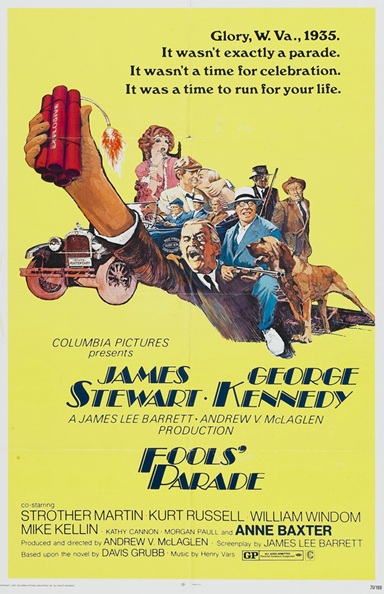
Happy St. Patrick’s Day, everyone! The 17th is not only St. Patrick’s Day but it’s also Kurt Russell’s birthday! Buckle up because things are going to get wild in about an hour!
Here’s a quick look at what I watched over the previous week.
Films I Watched:
Links From The Site:
News and Links From Last Week:
Want to check out last week? Click here!
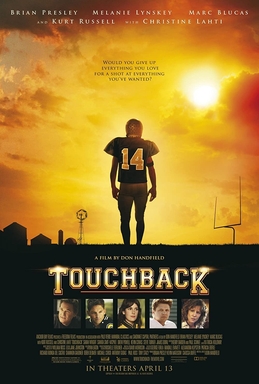
When he was in high school, Scott Murphy (Brian Presley) was nicknamed “Mr. Football.” He was the best high school player in Ohio and everyone knew he was going to make it far in the NFL. His dreams of football stardom ended on the night of the big game when his leg was shattered during a running play. Twenty years later, Scott is still living in his small town. He owns a farm that he can’t make the payments on and crops that he can’t bring in. When Scott learns that he is to he honored at the next high school football team for taking the team to the state championship years ago, it causes him to break down. He attempts to commit suicide but, when he passes out from inhaling carbon monoxide, he doesn’t die. Instead, he wakes up as a high school student in 1991.
Scott has his second chance. The championship game is coming up and, if Scott can keep from getting injured, he’ll be able to accept his scholarship to Ohio State and go on to the NFL. He makes sure to introduce himself to his future wife Macy (Melanie Lynesky) so he won’t lose her. He befriends the kids that he picked on the first time he was in high school. When a college scout tells him that his scholarship will not be rescinded if he chooses to sit out the big game, Scott decides to stay on the bench but then his coach (Kurt Russell) explains how much the game means to the people in the town. Scott realizes he has to play for them but can he get through the game without getting injured a second time?
What would you do if you had a second chance? That’s something that everyone wonders. If I had a second chance to relive my senior year of high school, I would take more risks, worry less about the unimportant stuff, and try to be nicer to everyone and not just the members of my social circle. If I knew I was going to suffer a life-changing injury, I would probably go out of my way to make sure it didn’t happen. That’s where Touchback loses me because I just don’t think Scott would have played in that game, no matter how eloquent the coach was. If Scott had sat out the game, the town might have lost the championship but Scott could have gone on to the NFL, still married Macy, and his family wouldn’t be struggling to make ends meet on the family farm.
If I didn’t really believe Scott would have made the decision that he made, there were still parts of Touchback that I liked. Kurt Russell was a great coach. I liked the way the town rallied to Scott, even when he was at his lowest and about ready to give up. That’s one thing I love about close-knit communities. They take care of each other.

Dreamer is based on the true story of a horse that did something that few horses have managed to do. It broke a bone but it still managed to make a comeback as a racehorse.
I love horses, which is why I’m not a fan of horseracing. I find horseracing to be cruel. The horses, which have an innate need to follow the orders of whoever is riding it, will literally run themselves to death to try to keep their jockeys happy. When you add that many racehorses are kept in deplorable conditions and that, with insurance, they are often worth more dead than alive, you have a sport that brings out the worst in a lot of people. Horses are wonderful animals because they are so loyal. That loyalty deserves better than being shot because they broke a leg due to their trainer’s negligence.
Given how I feel about horseracing, I’m amazed that I liked Dreamer when I saw it in the theaters and I was surprised that I still liked it when I watched it this weekend. I guess it’s because the horse in Dreamer is not euthanized. She would have been euthanized if not for the fact that her trainer (Kurt Russell) brought his daughter (Dakota Fanning) to work with him that day. Russell loses his job but he does gain a horse. After the horse recovers from its injury, Russell hopes to breed the horse. It turn out that the horse cannot have a foal but it can still race. With Russell and Fanning’s help, the horse returns to competition and shows up everyone who gave up on her. Russell and Fanning refuse to give up on the horse and the horse doesn’t give up on herself. Along the way, Russell and Fanning finally spend time together as father and daughter and Russell reconnects with his wife, Elisabeth Shue, and his father, Kris Kristofferson. Everyone involved gives a good job. The movie may be predictable but there aren’t any false notes in any of the performances. I not only wanted the horse to get better but I wanted the family to grow closer and I was happy when both those things happened.
Dreamer is a good family movie. If only every trainer was as kind and willing to admit his mistakes as Kurt Russell is in this film. There’s nothing surprising about Dreamer but it’s still a movie that makes me cheer. It makes me cheer in a way that a real horse race never would.
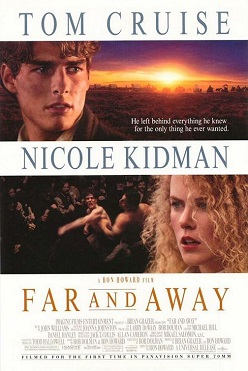 The year is 1892 and Joseph Donnelly (Tom Cruise) is a poor tenant famer in Ireland, used and exploited by the wealthy landowners. Joseph falls in love with Shannon Christie (Nicole Kidman), the rebellious daughter of his landlord. Shannon dreams of going to America, where rumor has it that land is being given away in the territory of Oklahoma on a first come/first serve basis. Shannon even has some valuable spoons that she can use to raise money once they arrive in America. Joseph, after being challenged to a duel by the Christies’ money manger, Stephen Chase (Thomas Gibson), also decides that heading to America might be a good idea.
Life in America is not as easy as Joseph and Shannon thought it would be. They first end up in the dirty town of Boston, where Shannon loses her spoons and Joseph works for a corrupt political boss (Colm Meaney) and makes money as a bare-knuckles boxer. They’ll reach Oklahoma eventually but not before Stephen and the Christies come to Boston and Joseph ends up working on the railroad and getting called “that crazy mick” multiple times.
Far and Away was Ron Howard’s attempt to make an American epic, in the style of John Ford. It doesn’t work because Tom Cruise is too contemporary to be believable as a 19th century Irish immigrant and Howard tries so hard to push everything to an epic scale that it just makes it even more obvious how slight and predictable the movie’s story is. Far and Away is full of big movie moments but it lacks the small human moments necessary to really engage its audience. I will always remembers Far and Away because it was one of those films that seemed to take up permanent residence on HBO when I was growing up. I didn’t really care about the film’s flaws back then. Nicole Kidman was attractive and tall and she had wild red hair and back then, that’s all a movie needed to hold my attention. Unlike Cruise, Nicole Kidman can effortlessly move between historical and contemporary films and, of the two leas, she comes off the best. The movie is really stolen, though, by Colm Meaney, playing a ruthless political boss who could have taught Boss Tweed a thing or two.
Tomorrow is St. Patrick’s Day, when we will be celebrating the legacy of immigrants like the Christies and the Donnellys. Far and Away tries to pay tribute to their courage and their refusal to give up, even when things were tough and deadly on the frontier. For me, though, Far and Away will always just make me think of HBO in the 90s.
Welcome to Retro Television Reviews, a feature where we review some of our favorite and least favorite shows of the past! On Sundays, I will be reviewing Homicide: Life On The Street, which aired from 1993 to 1999, on NBC! It can be viewed on Peacock.
No one’s happy this week.
Episode 3.6 “A Model Citizen”
(Dir by John McNaughton, originally aired on November 11th, 1994)
Welcome to Baltimore, where everyone is depressed. Consider this week’s episode of Homicide: Life On The Street.
This was a good episode, one that really captured the emotional turmoil of seeing the worse that humanity has to offer while, at the same time, acknowledging that depressed people often use humor to deal with their feelings. A few of Munch’s and Lewis’s line made me laugh out loud but seriously, I felt so bad for both of them!
Hopefully, everyone will have cheered up by next week.
 Through the Shattered Lens