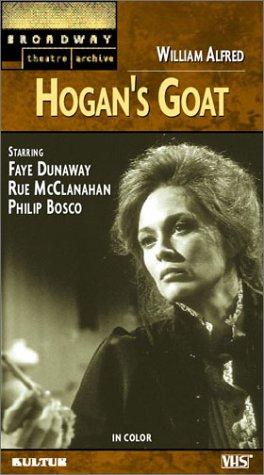
1971’s Hogan’s Goat opens in Brooklyn in the 1890s. This was when Brooklyn itself was still a separate city, before it become a borough of the unified New York City. If you’ve watched the video that I include with most of my Welcome Back Kotter reviews, you’ll notice the boast: “Fourth largest city” on the Welcome to Brooklyn sign. And indeed, if Brookyln had remained independent, it would now be the fourth most populated city in America, behind New York, Los Angeles, and Chicago. Sorry, Brooklyn.
(However, Houston thanks you.)
Local ward boss Matt Stanton (Robert Foxworth) heads home with what he thinks is exciting news. He tells his wife, Kathleen (Faye Dunaway), that he is finally going to be mayor of Brooklyn. The current mayor, a man named Quinn (George Rose), has been caught up in some sort of corruption and the Democratic political machine is ready to abandon him. Matt Stanton is about to become one of the most powerful men in New York. That’s not bad for a relatively young man who came to America from Ireland in search of a better life. Adding to Stanton’s happiness is the fact that he’ll be defeating Quinn, a canny politician towards whom Stanton holds a grudge. Kathleen, however, is worried. An immigrant herself, Kathleen met Stanton while the latter was in London. They were married in a civil ceremony and, ever since Stanton brought her back to Brooklyn, she has been lying and telling everyone that they were married in a church. Kathleen feels that she and Stanton have been living in sin and she wants to have a convalidation ceremony. Stanton refuses because doing so would mean admitting the lie in the first place and he can’t afford to lose the support of the Irish Catholic voters of Brooklyn.
However, it turns out that there are even more secrets in Stanton’s past, ones that Kathleen doesn’t know about but Quinn does. When those secrets start to come out, Kathleen comes to realize that there’s much that she doesn’t know about her husband. Stanton, with political power in his grasp, desperately tries to hold on to the image that he’s created of himself and Kathleen, leading to tragedy.
Hogan’s Goat was an Off-Broadway hit when it premiered in the mid-60s and its success led to Faye Dunaway getting her first film offers. The made-for-television version of Hogan’s Goat, which premiered on PBS and featured Dunaway recreating her stage role, is essentially a filmed play. Little effort was made to “open up” the story and, as a result, the film is undeniably stagy. It’s clear from the start the film was mostly shot to record Faye Dunaway’s acclaimed performance for posterity. Indeed, she’s the only member of the theatrical cast to appear in the film version. Dunaway does give a strong performance, easily dominating the film with her mix of nervous intensity and cool intelligence. The rest of the cast is a mixed bag. Robert Foxworth is appropriately driven and ambitious as Stanton but his Irish accent comes and goes. Philip Bosco does well as a sympathetic priest and George Rose is appropriately manipulative as Quinn.
In the end, the story of Hogan’s Goat is probably of the greatest interest to Irish-American history nerds like me, who have read and studied how Irish immigrants, especially in the 19th century, faced tremendous prejudice when coming to the United States and how they reacted by building their own political machines and dispensing their own patronage. In Hogan’s Goat, the conflict is less between more Stanton and Quinn and more between Kathleen’s traditional views and her devout Catholicism and Stanton’s own very American ambition. Whereas Kathleen still fights to retain her faith, pride, and her commitment to who she was before she married Stanton, Stanton fights for power and to conquer the man who Stanton feels has everything that he desires. In the end, Stanton’s hubris is not only his downfall but Kathleen’s as well.



 Through the Shattered Lens