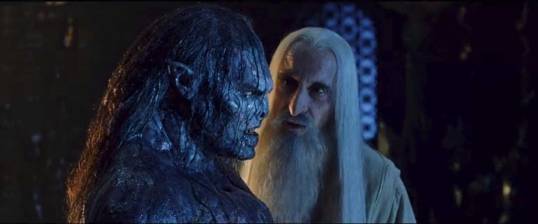
TV Review: Night Gallery 1.3 “The House/Certain Shadows on the Wall”


The third episode of Night Gallery aired on December 30th, 1970.  While Americans were undoubtedly finalizing their plans for a wild New Year’s Eve (because, after all, Nixon was president and every day was a party), NBC and Rod Serling invited viewers to take a tour through a darkened museum, one where every painting told a story.

This episode of Night Gallery featured two stories:
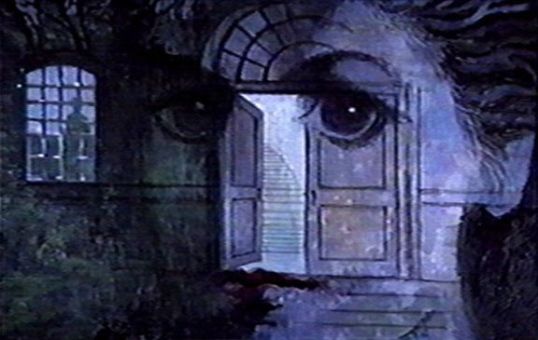
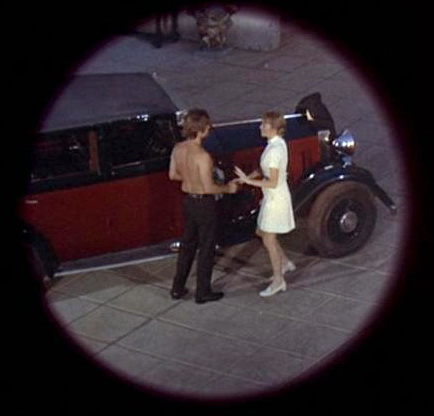
The House (dir by John Astin, written by Rod Serling)

The House opens with Elaine Latimer (Joanna Pettet) talking about a recurring dream.  She’s driving her car through the countryside when she comes across a large house.  Though she’s never seen the house, she finds herself drawn to it, as if she somehow belongs in the house.  As Elaine describes her dream, we come to realize that she’s talking to a psychiatrist (Steve Franken) and that Elaine is recovering from mental breakdown.  Her doctor tells Elaine that the dream is nothing to worry about.

However, when Elaine is driving home, she realizes that the countryside looks familiar.  Soon, she’s pulling up in front of the house from her dreams!  When Elaine gets out of the car, she’s greeted by a real estate named Peugeot (Paul Richards) who asks her if she’s interested in buying the house.  As Peugeot gives her a tour of the estate, he mentions that the house is thought to be haunted….

I liked The House.  It was an atmospheric little tale and, from the minute that Elaine started talking about her dream, the story captured my attention.  (I should admit that I also have recurring dreams about a house that I’ve never actually seen before.)  Admittedly, the story does play out at a very deliberate pace and requires a bit of patience but the dream sequences are effectively surreal and Joanna Pettet gives an empathetic performance in the lead role.
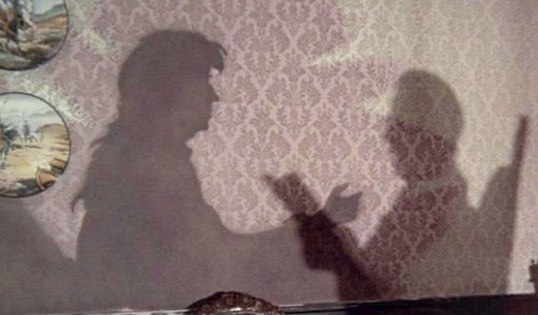
Certain Shadows On The Wall (dir by Corey Allen, written by Rod Serling)

This segment features Agnes Moorehead as the sickly Emma, who is poisoned by her own brother, the despicable Stephen (Louis Hayward).  After Emma’s death, Stephen is shocked to discover that, even though Emma is gone, her shadow remains on the wall.  While Stephen is trying to make sense of that, his other two sisters (played by Grayson Hall and Rachel Roberts) have plans of their own for how to deal with their duplicitous brother.

Like The House, Certain Shadows On The Wall is appropriately atmospheric.  The ending is a bit weak as Stephen gets what he deserves but the shadow itself doesn’t have much to do with his actual fate.  Just when you’re waiting for Agnes Moorehead to make a sudden, ghostly appearance, the story comes to an end.  Still, this is an effective segment and it features excellent work from its ensemble.  I especially liked the performance of Grayson Hall, which features one of the most frightening glares that I’ve ever seen.

The third episode of Night Gallery was a definite improvement over the two that came before it.  Both segments tell intriguing stories, though it’s obvious that the show was still better at coming up with good premises than effective endings.
Previous Night Gallery Reviews:

  1. The Pilot
  2. The Dead Man/The Housekeeper
  3. Room With A View/The Little Black Bag/The Nature of the Enemy

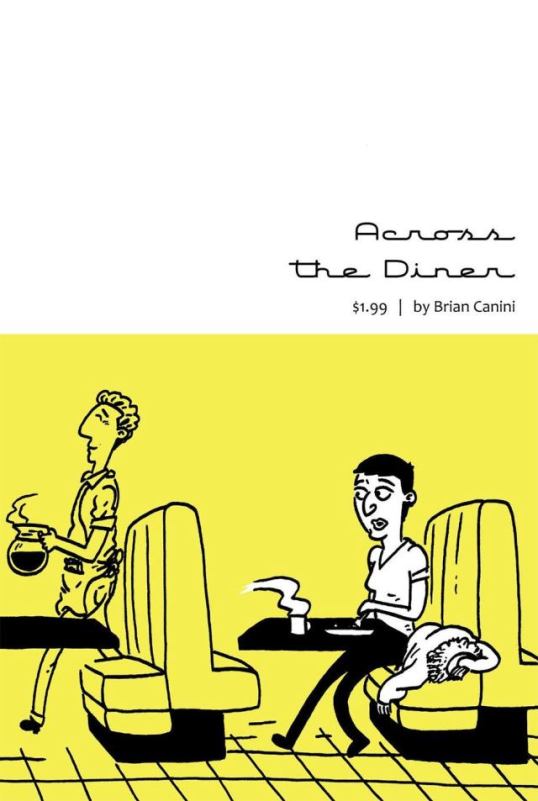
Two From Brian Canini : “Across The Diner”


Ryan C. (fourcolorapocalypse)'s avatarRyan C.'s Four Color Apocalypse

A simple story, well told, is always worth its weight in gold — a sentiment that’s perhaps never been more true than in these troubled and troubling times — and when he’s really hit on a nugget of an idea, when he’s firing on all cylinders creatively, a simple story, well told, is precisely the kind of thing that Columbus, Ohio’s Brian Canini excels at. Guess what? In his latest self-published (under the auspices of his Drunken Cat Comics imprint) mini,  Across The Diner, he’s hit on a nugget of an idea and is firing on all cylinders creatively.

Still here? ‘Cuz, I mean, I just pretty well gave away the game, which — at least according to what passes for conventional “wisdom” — is supposed to be seriously poor form. Even if what you’re saying is true — which, in this case, it absolutely is — you’re…

View original post 555 more words

Music Video of the Day: The Hardest Thing by 98° (2000, dir. by Wayne Isham)


The Hardest Thing is a skeevy boy band song about how the hardest thing is saying goodbye to your mistress.  That’s what the song is about.  That’s the hardest thing.  The hardest thing for some people is to figure out how to put food on the table and to make sure their children make it home safely.  The hardest thing for 98º is having to choose between being loyal to your significant other or hooking up with Becky and Tiffany and Sandy and everyone else on the strip.  Even though the band knows that the hardest thing they’ll ever have to do is say goodbye to the woman that they’re cheating with, they also know that they’ll meet up again someday and maybe the time will be right for them to continue their affair.  What?  How does that make sense?  I can’t cheat with you now but maybe in three months.  OK, guys.

According to the video, Nick Lachey is a boxer so maybe that’s why this song seems to be punch drunk.  His mistress is a showgirl.  I can’t imagine Nick every winning a fight, can you?  Ladies and gentleman, with a record of 1 win and 30 losses by knockout, it’s Nick Lachey!  His mistress can probably do better.  Are the Backstreet Boys in town?

Two From Brian Canini : “Four Stories”


Ryan C. (fourcolorapocalypse)'s avatarRyan C.'s Four Color Apocalypse

Apropos of perhaps nothing in terms of the overall scope of this review, but definitely worth a mention : Brian Canini is the most organized cartoonist around. Every few months, like clockwork, I get a nice little package from him containing his latest review submissions, complete with a little letter containing a brief synopsis of each. This is the kind of critical outreach that is very appealing to me and, I would guess, other critics, as it shows he is downright eager to have us check out his stuff, and he’s always been more than magnanimous about any critiques I may have about his work, taking them in the constructive manner in which they’re intended. And if that isn’t a natural segue right there, I don’t know what is.

Cutting to the chase, then, one of the two new minis from his own Drunken Cat Comics imprint that I sat…

View original post 632 more words

Chilling Adventures of Sabrina, Ep 3.6, (Dir. Michael Goi)


sabrina

I couldn’t totally tell if I was being entertained by this episode. I’m gonna say no because it’s taken me a week to write this. I have to review Sabrina in stages like getting oral surgery. They root canal you- Sabrina Season Opener, They put bone and hardware up into your gums – mid-season Sabrina, and finally you get a new fake tooth and it’s over- Sabrina Season Finale.

If it weren’t the live tweet sessions with Lisa, I would’ve lost it long ago.  Those banter sessions make the show pretty fun; it’s a shame that the writers and directors can’t achieve that on their very own. In that same vein, if Harvey gets to be any more boring, he’s just going to be recapping his favorite scenes from “How it’s Made” on the Science Channel.  Hey Sabrina, you know what’re swell? Diving Helmets!

https://www.youtube.com/watch?v=0MvSKYFDdMQ

At least in this episode, Sabrina didn’t have to find anything. FFS, every episode has been

I miss Nick. But, Sabrina the Town. NIIIIIIIICK!  Sabrina wait….

NO, I’ve to find Judas’ silver, a stop sign, and an Easter basket and have it back at the rec center by Midnight!

Meanwhile courtly intrigue, Caliban is proposing to Sabrina to be his Queen of Hell and he’ll prove he’s on the up and up by making a crappy spell to turn Roz back from stone.  To do this, Harvey has to give up the thing he loves most – his 19th Century Danish Coin Collection.  He actually had to kiss Roz and it would make her not want to have anything to do with him anymore.  They should’ve just had Harvey try express a fully formed thought- she would’ve rolled her stone body the hell out of Greendale lickity split! The kiss didn’t work because he supposedly still loves Sabrina.  Instead, they just capture Circe and she changes everyone back from stone. Oh well.

Hilda is super-gross and nearly full-on spider. She puts a glamour on and decides to hang out with Dr Cee.  Unfortunately, she losses her glamour and he sees all of her spiderness.  He does what any fiance would do and gets her some fast food.  Why not?  While he’s gone, she eats a guy who must be 90% balloon, given the blood splatter.  When he does return, Hilda corners Dr Cee, has him fertilize her eggs (somehow yeech), and kills him.  Hilda tells her sister to come and bring a gun and Zelda kills Hilda.  Afterall, Zelda used to kill Hilda once a month; so, Zelda puts Hilda in the resurrection plot device out front and waits for Hilda’s return.

Lastly, Lilith seduces father Blackwood so that she will have a Satan baby to keep Lucifer from killing her.  Why not?

This episode was not terrible, but not great.  It kind of made me sad for Hilda and the actress herself because she rarely gets to show any range.  In this episode, we find out that she has a broadway quality voice. Oh well, Lisa’s got the next one. Tag, you’re it!

TV Review: Night Gallery 1.2 “Room With A View/The Little Black Bag/The Nature of the Enemy”


The second episode of Night Gallery originally aired on December 23rd, 1970 and it featured three stories, two of which were written by Rod Serling.  Serling, himself, introduced all three of the stories by inviting us to look at the paintings that may or may not have been inspired from them.

Room With A View (dir by Jerrold Freedman, written by Hal Dresner)

When a cranky, bed-bound man (Joseph Wiseman) discovers this his wife (Angel Tompkins) is cheating on him, he comes up with an elaborate scheme to get revenge.  It all hinges on his somewhat nervous nurse (Diane Keaton), who has no idea that she’s being manipulated.

This short segment is well-done but it doesn’t really feel like it belongs on an episode of Night Gallery.  There’s no elements of horror or science fiction to be found in this story.  Instead, it’s just about a manipulative man seeking revenge on his wife.  It’s actually easy to imagine this segment as being a flashback on a Monk-style detective show.  You just need a detective saying, “I finally figured out how you did it!”

For most viewers, probably the most interesting thing about this segment will be the presence of a young Diane Keaton, playing the nurse and laughing nervously at her patient’s rather intrusive questions.

The Little Black Bag (dir by Jeannot Szwarc, written by Rod Serling)

In the 30th Century, a careless accident at a time travel station sends a black medical bag into the past.  It arrives in 1971, where it’s discovered by two homeless gentlemen.  One of the men is a disgraced former doctor named William Fall (Burgess Meredith).  The other, Hepplewhite (Chill Wills), has no medical experience but he does have a greedy spirit.  Fall wants to use the bag to do good,  Hepplewhite wants to use the bag to make money.  Meanwhile, in the future, poor put-upon Gillings (George Furth) is just trying to figure out what to do about the missing bag.

The Little Black Bag is this episode’s high point, featuring good performances from Meredith, Wills, and Furth and also ending with properly macabre twist.  This is another Rod Serling story about how terrible, at heart, most people are but Jeannot Szwarc’s direction is fast-paced and he never allows things to get too heavy-handed.

The Nature of the Enemy (dir by Allen Reisner, written by Rod Serling)

NASA’s latest expedition to the Moon has run into trouble.  The astronauts have discovered that there is something living on the lunar surface.  On Earth, the director of NASA (Joseph Campanella) tries to keep everyone calm while also figuring out the nature of the enemy.

This segment has an intriguing premise but it’s let down by a so-so execution.  Like a lot of less-than-effective Night Gallery segments, this one features a story that doesn’t so much conclude as it just stops after a somewhat weak punchline.

So, the second episode of Night Gallery was not an improvement on the first and it was nowhere close to matching the pilot.  Watching this episode, it was hard not to feel that the show had a few growing pains.  Did it want to be a horror anthology or a collection of short skits?  The 2nd episode reveals a show that was still trying to find it’s voice.

Previous Night Gallery Reviews:

  1. The Pilot
  2. The Dead Man/The Housekeeper


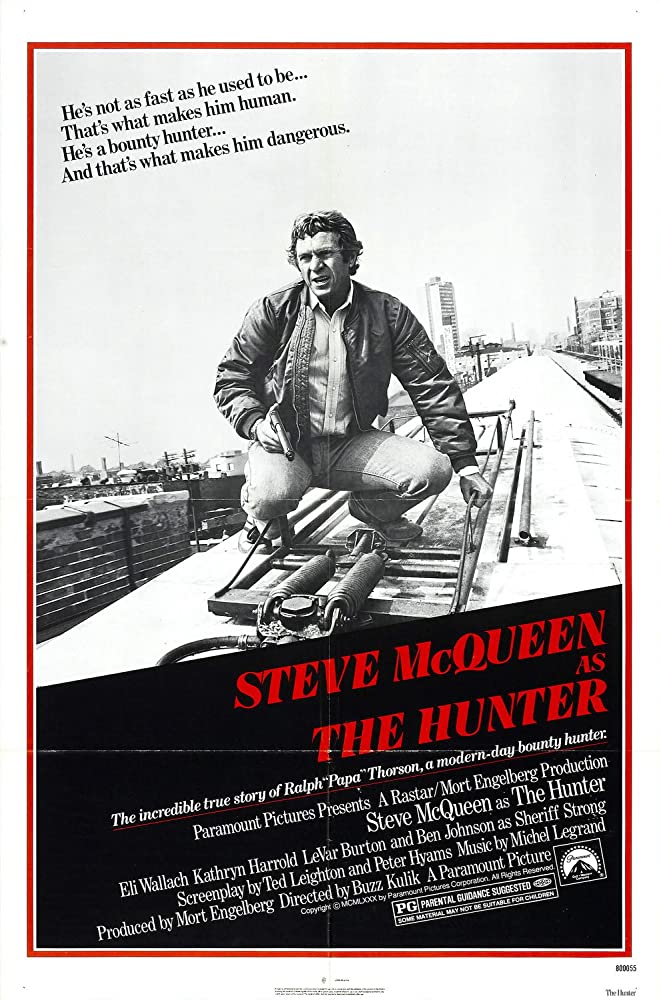
The Hunter (1980, directed by Buzz Kulick)


In The Hunter, legendary car nut, Steven McQueen, plays Papa Thorson, a bounty hunter who is a very bad driver.

That’s it.

That’s the joke.

Papa Thorson was a real-life bounty hunter, the Dog the Bounty Hunter of his day, and The Hunter was based on his own autobiography.  Maybe that explains why the film itself is so extremely episodic.  Thorson goes from one assignment to another, capturing criminals with relative ease and occasionally having to deal with an unappreciative sheriff (Ben Johnson).  Along the way, one of those criminals (Levar Burton) goes to work with Papa and becomes his protege.  Papa’s girlfriend (Kathryn Harrold) is pregnant and a crazed criminal (Tracey Walter) is targeting her because he wants revenge on Papa for putting him away.  It’s all Magnum P.I.-level stuff, without the backdrop of Hawaii to distract you from how predictable it all is.  It’s not terrible because there are a few good action scenes but it still feels more like a pilot for a weekly Papa Thorson television series than a feature film.

The Hunter was also Steve McQueen’s final film.  After The Towering Inferno, McQueen was inactive for most of the 70s.  He still received scripts and turned down good parts (including the roles of both Willard and Kurtz in Apocalypse Now) but the only film in which he appeared in a barely released version of An Enemy of the People.  It wasn’t until 1980 that McQueen finally started appearing in movies again, starring in both Tom Horn and The Hunter.  Tom Horn is an underrated western but The Hunter is largely forgettable.  Sadly, The Hunter would be McQueen’s last film as he died of lung cancer shortly after it was released.

McQueen was obviously ill during the filming of The Hunter, though he still had the laconic coolness that made him a star in the first place and he still looks credible, even at the age of 50, handling a gun and chasing criminals.  He doesn’t give a bad performance as Thorson and he even shows a talent for comedy.  Both Tom Horn and The Hunter show that McQueen wasn’t afraid to play his age.  Neither Tom Horn nor Thorson were young men and, in The Hunter, McQueen gets a lot of mileage out of being a cranky, middle-aged malcontent who has never figured out how to parallel park.  The film might be forgettable but Steve McQueen shows that, to the end, he was an actor who was often better than his material.

A Blast From The Past: Vincent Price Reads The Raven


109 years ago, Vincent Price was born in St. Louis, Missouri.

I have to admit that I’m always somewhat surprised to be reminded that Vincent Price was born in Missouri.  It seems like such a …. normal place to be born, especially for someone who was as wonderfully and cheerfully eccentric as Vincent Price.

Vincent Price is best-known for his horror roles, though he actually appeared in all sorts of films during his career.  He started out as a romantic lead and then he became a character actor, showing up in acclaimed films like The Song of Bernadette, Wilson, and Laura.  Early on his career, Price was even considered for the role of Ashley Wilkes in Gone With The Wind.  Later, he would be listed by Frank Capra as a possibility for the role of Mr. Potter in It’s A Wonderful Life.

That said, Price was always be best-known for his horror work and, because of the films that he made with Roger Corman, he will also always be associated with Edgar Allen Poe.  With today being his birthday, it seems like the perfect time to share this video of Vincent Price reading The Raven.

Unfortunately, I don’t know exactly when this was filmed.  But no matter!  It’s Vincent Price reading Edgar Allen Poe!

Enjoy!

4 Shots From 4 Films: Special Christopher Lee Edition


4 Shots From 4 Films is just what it says it is, 4 shots from 4 of our favorite films. As opposed to the reviews and recaps that we usually post, 4 Shots From 4 Films lets the visuals do the talking!

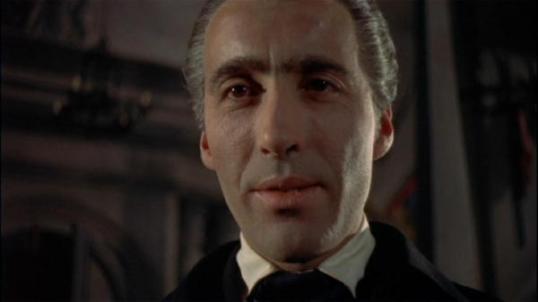
98 years ago today, the greatest actor of all time, Christopher Lee, was born in London!  Today, we honor a legacy of iconic performances, in films that were both good and bad.  Lee worked with everyone from Terence Fisher to Peter Jackson to Martin Scorsese to Laurence Olivier to John Huston to ….. well, if they were an important director, they probably made at least one movie with Christopher Lee!  He was Dracula.  He was Saruman.  He was one of the best Bond villains and it’s been rumored that, during World War II, Lee was a bit of a James Bond himself.

Today, we honor a brilliant career with….

4 Shots From 4 Films

Dracula A.D. 1972 (1972, dir by Alan Gibson)

The Man With The Golden Gun (1974, dir by Guy Hamilton)

Lord of the Rings: The Fellowship of the Ring (2001, dir by Peter Jackson)

Hugo (2011, dir by Martin Scorsese)