Off-Brand Spaghetti: MORE DEAD THAN ALIVE (United Artists 1969)


gary loggins's avatarcracked rear viewer

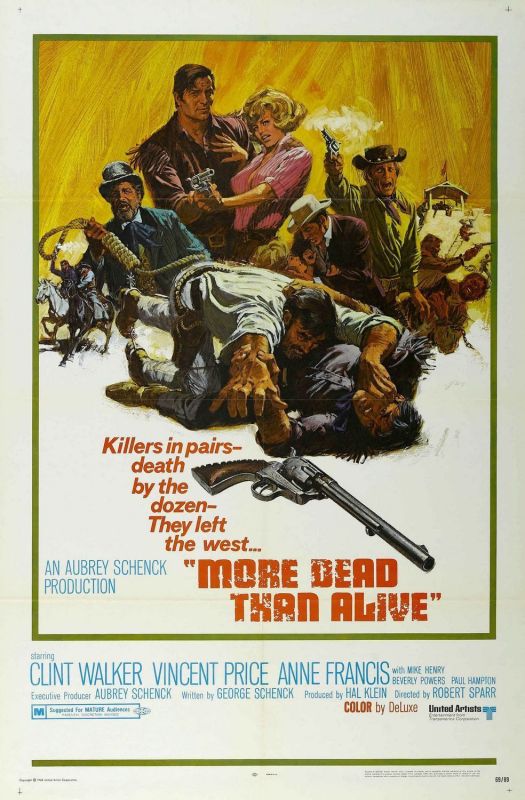
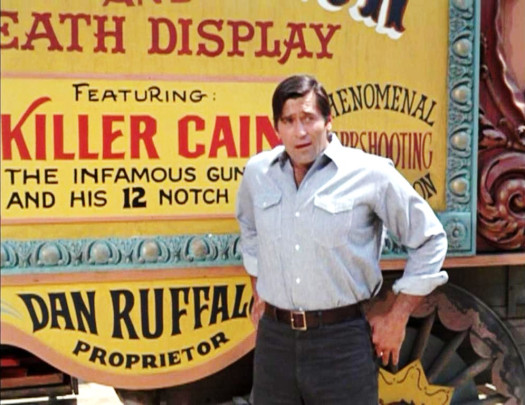
It’s hanging day at a remote Arizona prison outpost, and four men are scheduled to swing from the gallows. After they’re executed, the four pine boxes pop open, and outlaw Luke Santee and his gang commence firing, their six-guns blazing, as they try to free Luke’s baby brother. The escape attempt is an epic fail as ‘Killer’ Cain, a prisoner for 18 years now up for parole, stops the brother from leaving his cell and getting slaughtered, with Luke vowing revenge…

That opening scene, a violent, gory bloodbath, makes one think MORE DEAD THAN ALIVE is going to be a Sergio Leone-inspired American Spaghetti Western. It even stars a former TV Western hero named Clint – big Clint (CHEYENNE) Walker ! But the episodic nature of George Schenck’s script kills that idea, as the film doesn’t quite know what it wants to be. Spaghetti or Traditional Western? Character study, comedy…

View original post 323 more words

Film Review: Cocaine and Blue Eyes (1983, directed by E.W. Swackhamer)


When San Francisco-based private investigator Michael Brennen (O.J. Simpson) gives a ride to Joey Crawford (John Spencer) on Christmas Eve, he doesn’t know that it’s going to lead to the biggest case of his career.  When Joey asks Michael to help him track down his ex-girlfriend, Michael assumes that Joey would never be able to pay for his investigative services.  But one week later, Michael gets something in the mail from Joey.  Inside the envelope, there’s a picture of both Joey’s ex and a thousand dollar bill.  Ever after he discovers that Joey was mysteriously killed the night before, Michael decides to take on the case.  His investigation will take him not only to Joey’s ex but it will also lead to him uncovering a drug ring that involves one of San Francisco’s most prominent families.

Simpson not only starred in this made-for-TV movie but he also served as executive producer.  Watching the movie, it’s obvious that it was meant to serve as a pilot for a Michael Brennen TV series and it’s also just as obvious why that series never happened.  O.J. Simpson was not a terrible actor but, ironically for someone who set records as an NFL player, there was nothing tough about him.  Simpson may be playing a two-fisted, cash-strapped P.I. but, in every scene, he comes across like he can’t wait to hit the golf course.  Simpson’s pleasant demeanor may have served him well in other areas of his life but it didn’t help him with this role.  Whenever Simpson has to share a scene with John Spencer, Candy Clark, Cliff Gorman, or any of the other members of this film’s surprisingly talented supporting cast, Simpson’s bland screen presence and lack of gravitas becomes all the more apparent.

Of course, when seen today, the main problem with Cocaine and Blue Eyes is that it’s impossible to watch without thinking, “Hey, didn’t the star of this movie get away with killing his wife and an innocent bystander?”  Even the most innocuous  of lines take on a double meaning when they’re uttered by O.J. Simpson.  It doesn’t help that the movie opens with Michael visiting his estranged wife and their children on Christmas Eve and getting chased around the neighborhood by a guard dog.  When the movie was made, this scene was probably included so that O.J. could show off some of the moves that made him a star at UCLA and with the Bills.  Seen today, the scene takes on a whole different meaning.

Without O.J. Simpson, Cocaine and Blue Eyes could easily pass for being an extended episode of Magnum P.I., Simon and Simon, or any other detective show from the 80s.  With Simpson, it becomes a pop cultural relic.  I don’t think it’s ever been released on DVD but it is available on YouTube, where it can be viewed by O.J. Simpson completists everywhere.

Music Video of the Day: Vallotte by Julian Lennon (1984, directed by Sam Peckinpah)


I am as shocked as anyone to discover that this sedate video was directed by the director who was known (affectionately or not) as Bloody Sam but indeed it was.

Valotte was the first U.S. single from Julian Lennon, a musician whose talent was often overshadowed by the fact that he was the son of John and Cynthia Lennon.  John divorced Cynthia, leaving her for Yoko Ono, when Julian was only five years old and, by his own admission, Julian’s feelings towards his father have often been mixed.  (Paul McCartney reportedly wrote what would become Hey Jude in an attempt to console Julian after the divorce.)  When Julian Lennon pursued his own musical career, many reviewers spent more time discussing Julian’s physical and vocal resemblance to his father than his music.

As for the song, it was a ballad about finding love and not, as many have incorrectly assumed, a song about Julian’s relationship with John.  The song was initially written at a French chateau known as the Manor de Valotte, which is how the song got its name.  The single was subsequently recorded at Muscle Shoals Sound Studio in Alabama.  The line, “Sitting on a pebble by the river playing guitar” is a reference to the location of the studio.

As for Sam Peckinpah, both his career and his health were in decline when he directed this video.  Peckinpah made a huge impression in the late 60s and early 70s with films like The Wild Bunch and Straw Dogs but, by the time the 80s came around, the critics had turned on him and his abuse of drugs and alcohol had become so notorious that he couldn’t get a job in Hollywood.  Peckinpah directed both this video and Lennon’s follow-up, Too Late For Goodbyes.  His work on the videos was critically acclaimed but unfortunately, Peckinpah would pass away shortly after they were released.

Enjoy!

“What The Actual,” Indeed


Ryan C. (fourcolorapocalypse)'s avatarRyan C.'s Four Color Apocalypse

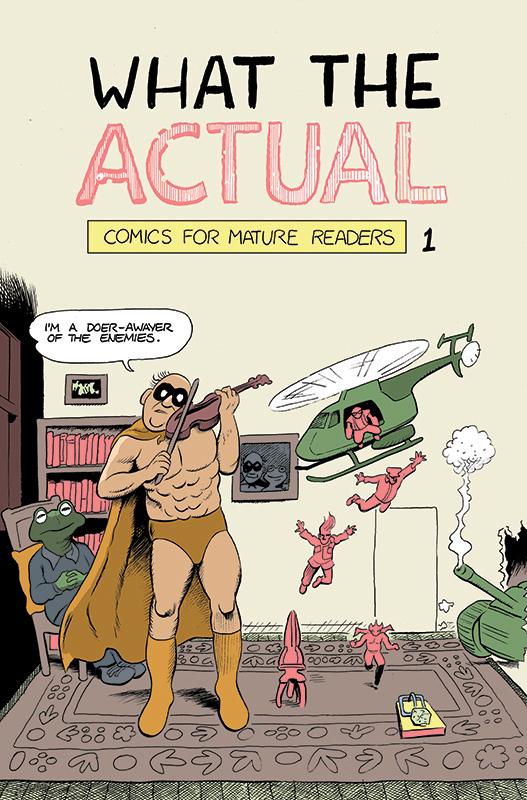
I’ve always been a fan of single-creator anthologies — having literally cut my comics -reading teeth on books like Chester Brown’s Yummy Fur, Daniel Clowes’ Eightball, Peter Bagge’s Neat Stuff and Hate, etc. — and while there are more small-press and “indie” comics to choose from than ever these days, “solo” anthology titles are a pretty rare thing to find, so I’m always on the lookout for them, and recently my never-ending quest led me to Jai Granofsky’s magazine-sized What The Actual #1.

Clearly we’re in “labor of love” territory here given that Granofsky financed the publication of this himself, but the contemporary comic book landscape is littered with work by people who think they have something worth saying despite no evidence being on offer to support that belief, so it’s not like putting a few thousand bucks of your own money — daunting as that no…

View original post 565 more words

4 Shots From 4 Films: Rest in Peace, Sylvia Miles (1924-2019)


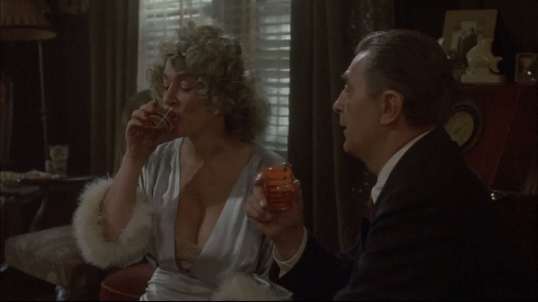
4 Shots From 4 Films is just what it says it is, 4 shots from 4 of our favorite films. As opposed to the reviews and recaps that we usually post, 4 Shots From 4 Films lets the visuals do the talking. Character actress Sylvia Miles passed away today at age 94. Though never a household name, movie lovers knew they were in for a treat whenever Sylvia appeared onscreen, as did her peers, nominating her twice for the Best Supporting Actress Oscar. In her honor, we present 4 shots from the films of Sylvia Miles.

Midnight Cowboy (1969; D; John Schlesinger)

Andy Warhol’s Heat (1972; D: Paul Morrissey)

Farewell, My Lovely (1975; D: Dick Richards)

The Funhouse (1981; D: Tobe Hooper)

Automotive Stardom: The California Kid (1974, directed by Richard T. Heffron)


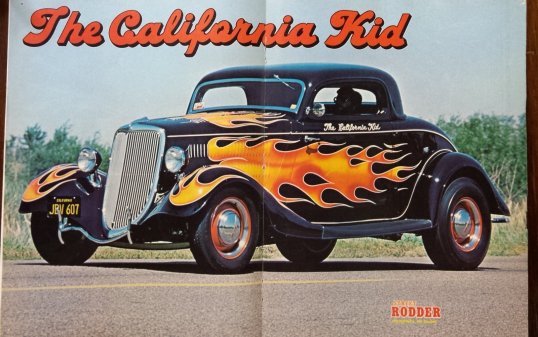
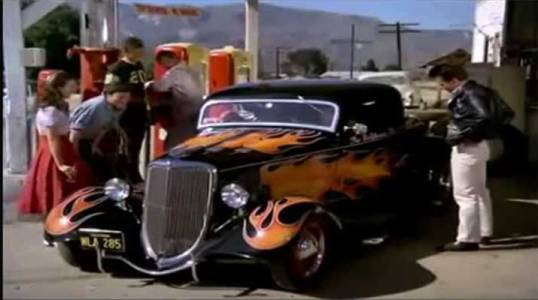
In 1973, a customized 1934 Ford three-window coup appeared on the cover of the November issue of Custom Rod.  The car had been created by legendary customizer Pete Chapouris and it was called The California Kid.  The cover caught the attention of television producer Howie Horowitz, who thought that maybe the car could become a star.

A year later, the car starred in it’s own made-for-TV movie.  Naturally, that movie was called The California Kid.
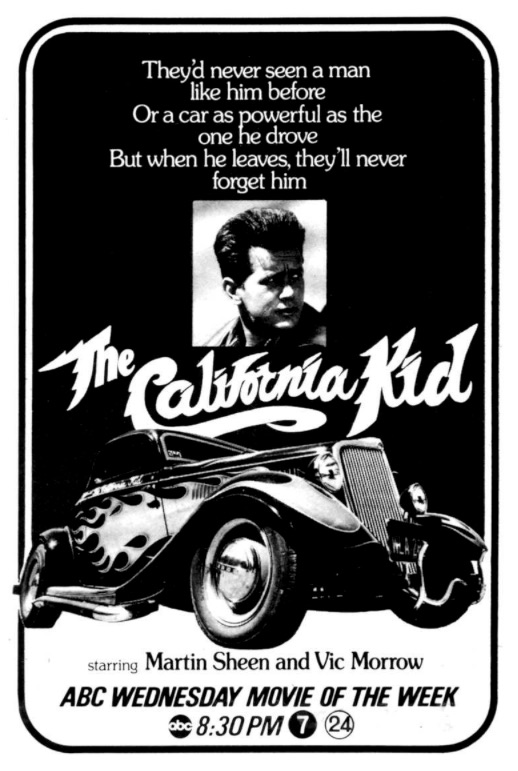
The California Kid takes place in 1958 in the small town of Clarksberg.  Clarksberg is known for being a town that does not tolerate speeders.  Sheriff Roy Childress (Vic Morrow) lost his wife and daughter to a speeder and, ever since, he’s become a fanatic about making sure that people respect the speed limits.  He’ll give a ticket to anyone who he sees going too fast.  He’ll even impound your car.  And if you don’t learn your lesson or if you try to outrun him, he’ll get behind your car, give it a push, and send both you and your vehicle plunging over the side of a mountain.

That’s what happens to Don McCord (Joe Estevez), a Marine who was just trying to get back to back to his base on time.  After Don and his car go over the side of a cliff, the official ruling is that it was an accident.  However, Don’s brother, Michael (Martin Sheen, real-life brother of Joe Estevez), doesn’t buy that.  Determined to prove that his brother was murdered, Micheal rolls into town, behind the wheel of the California Kid.

The California Kid is a typical 70s car chase movie.  There’s not much going on other than the sheriff chasing the Michael and the California Kid.  Martin Sheen coasts through the movie, doing the James Dean impersonation that he perfected in the previous year’s Badlands and Vic Morrow plays his thousandth sadistic authority figure.  The supporting cast is full of familiar names who don’t get to do much.  Michelle Phillips plays the waitress who falls in love with Martin Sheen.  (It’s always a waitress.)  Stuart Margolin is Morrow’s deputy and keep an eye out for Nick Nolte, playing a mechanic.  Interestingly, The California Kid was written by Richard Compton who, a year later, would direct Notle in his first starring role in the 1975 car chase film, Return to Macon County.  Of course, the real star of the movie is the car and the California Kid earns its star billing.  The movie might not be anything special but there’s no way you can watch it and not want to drive that car.

This is a made-for-TV movie so you won’t hear any profanity and the characters are all as simple can be.  However, there are enough shots of cars going over cliffs to keep chase enthusiasts entertained.
Music Video of the Day: Eve of Destruction by the Chemical Brothers, featuring AURORA and Nene (2019, dir by Marcus Lyall and Adam Smith)


Oh hell yeah!

From The Chemical Brothers, here’s the video for the lead track off of No Geography, Eve of Destruction!

Judging from what AURORA and Nene have to say on this track, it would appear that the world is on the verge of ending.  Humans minds are simplified.  Sacrifice is justified.  We can’t afford the water.  But maybe — just maybe — you can find a friend to dance with for the weekend.

And really, that’s the whole meaning of life, isn’t it?  Things are frequently terrible but at least you can still dance.  So, what are you going to do?  Sit around and whine on twitter or are you going to get out there and dance and at least enjoy the eve of your destruction?  Because seriously, if the whole world’s going to end anyway, you might as well have a good time before your turned into ash and wiped off of the face of history.

Fortunately, judging from this video, it does appear that we do have a plan in place in case the world gets attacked by vaguely goofy kaiju.  So, there’s at least one reason to be optimistic.

Anyway, I love the Chemical Brothers, I love this track especially, and I am totally in love with this video.  AURORA and the Chemical Brothers are exactly what the world needs right now!

Enjoy!

Eurocomics Spotlight : Sergio Ponchione’s “Memorabilia”


Ryan C. (fourcolorapocalypse)'s avatarRyan C.'s Four Color Apocalypse

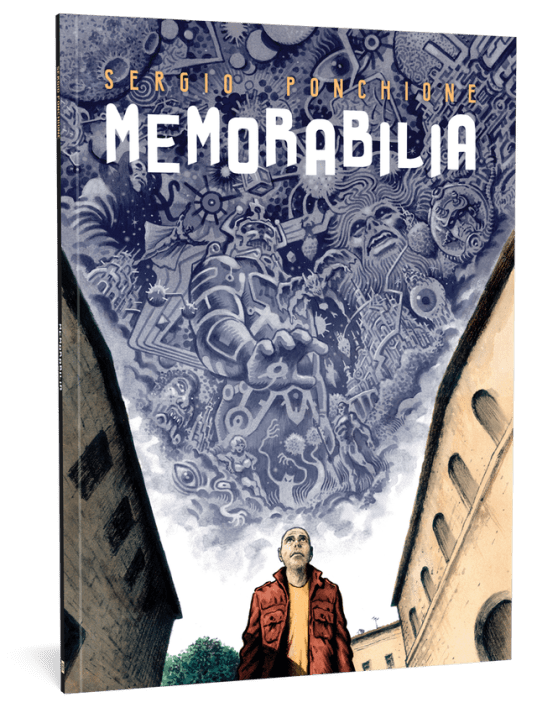
If imitation really is the sincerest form of flattery, then Italian cartoonist Sergio Ponchione is the most flattering guy around, as his late-2018 Fantagraphics book Memorabilia — extrapolated from, and featuring the entire contents of, his 2014 stand-alone (or so we thought at the time) “floppy” DKW – Ditko Kirby Wood — is pure homage, not just to the aforementioned “holy trinity” of Steve, Jack, and Wally, but also to Will Eisner and Richard Corben, all of whom Ponchione is capable of mimicking to the proverbial “T.” Consequently, this not-quite-a-graphic-novel is certainly fun to look at, at times even breathtaking.

And that, as they say, is the good news.

As for the not-so-good-news — ah, shit, where to even begin? Ponchione’s set-up here is simple enough that it could work — starry-eyed young cartoonist visits his hero (Ponchione himself, in case you were wondering), hoping to glean pearls of…

View original post 501 more words