
by James Avati
by James Avati

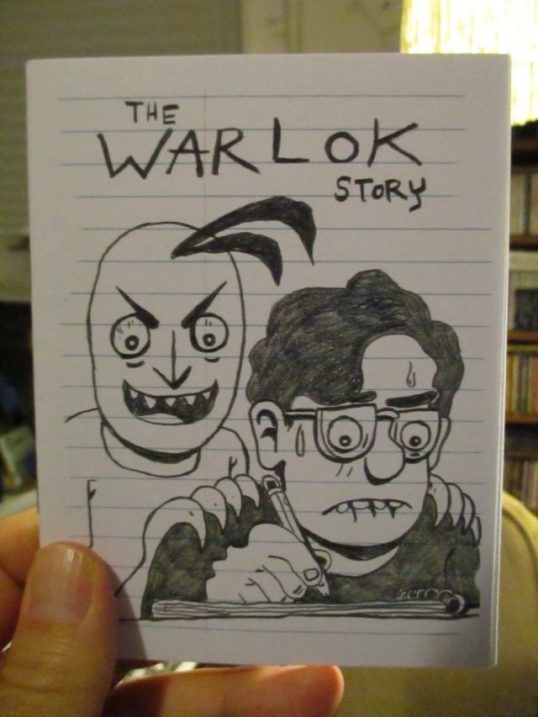
There’s one in every school — the kid with the depraved imagination. The kid with no reservations about tapping into the deepest recesses of his or her id and displaying the contents for all to see. The kid who’s something more than just a garden-variety oddball. The kid who hears, at least once every day, “dude, you’re sick” — and, fortunately for us all, for whatever unfathomable cosmic reason, those kids can usually draw.
They may not be especially good at it, mind you, but it’s more about ideas than execution. It’s about using paper and pencil as their instruments for self-exorcism, as interpretive devices for channeling what’s within to the outside world. About cooking up the sickest, most extreme shit imaginable not just because they can, but because they must.
Max Clotfelter was one such kid, and in his 2016 self-published mini, The Warlok Story…
View original post 830 more words
How did Chevy Chase come to star in a music video?
It all started with a case of mistaken identity. Paul Simon and his then-wife were at a party where they met French composer, Pierre Boulez. Boulez was not sure who Simon was and repeatedly called him “Al.” At the same time, Simon was suffering from a mid-life crisis that would not be resolved until Simon visited South Africa. Simon brought the two incident together when he wrote You Can Call Me Al, the lead single off of his 1986 album, Graceland.
As for the video, it was the brainchild of Lorne Michaels. Michaels, of course, is best known for producing Saturday Night Live and it was his idea to combine the tall and extroverted Chevy Chase with Paul Simon, who was neither of those things.
Lorne Michaels and Chevy Chase have had a long history together. Michaels originally hired Chase for SNL and was instrumental in Chase’s early success. Chase reacted to his sudden success by leaving SNL after its first season and subsequently trashing the show in interviews. When Chase first returned to host SNL, he got into a fist fight with his successor, Bill Murray. Chase’s subsequent appearances on the show have become legendary for Chase’s obnoxious and absuive behind-the-scenes behavior. (In 1986, for example, Chase suggested a sketch in which openly gay cast member Terry Sweeney would announce that he had AIDS and then be regularly weighed throughout episode.) Eventually, Chase managed to become the first former cast member to be banned from appearing on the show.
Paul Simon, though, is still welcome anywhere he goes.

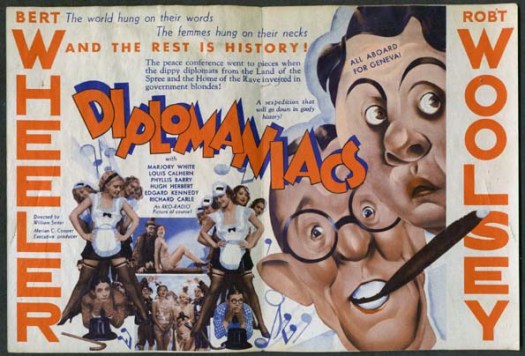
Political satire in film ran rampant during the Pre-Code Era. Somewhere between W.C. Fields’s MILLION DOLLAR LEGS and the Marx Brothers’ DUCK SOUP sits DIPLOMANIACS, Wheeler & Woolsey’s madcap take on war and peace, 1930’s style. It’s purely preposterous, unadulterated farce, and is guaranteed to offend someone, if not everyone.
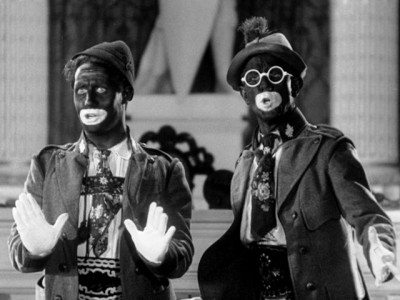
Let’s get it out of the way right now: DIPLOMANIACS is not politically correct in any way, shape, or form. It’s loaded with racist stereotypes, casting Hugh Herbert as a not-so-wise Chinaman (“It is written that it is written that it is written that it is written”), lambastes Jews, Native Americans, and homosexuals, and portrays women as sex objects (spy Marjorie White is delivered in plastic wrap). A bomb tossed into the peace talks causes everyone to turn blackface, leading to a prolonged minstrel number! If you’re already offended, stop reading… but if you can take the heat, by all…
View original post 476 more words

Well, here we are. We’re more than halfway through the year and, to be honest, the Oscar forecast seems just as cloudy as ever.
To be honest, I’m starting to get the feeling that this is going to be a year where the Academy is more concerned with sending a message than anything else. Just as the Emmy nominations were all about sticking it to Trump (as opposed to actually honoring the best that television has to offer), it wouldn’t surprise me to see the Academy try to do the same thing. That doesn’t mean that the nominees aren’t going to deserve to be nominated, of course. Instead, it just means that this might be a good year for films with a political agenda.
Anyway, here are my predictions for July! They’re still pretty random, to be honest. Be sure to also check out my predictions for January, February, March, April, May, and June!
Best Picture
Backseat
Black Panther
BlackKklansman
Boy Erased
The Favourite
First Man
If Beale Street Could Talk
Mary, Queen of Scots
Old Man and The Gun
Widows
Best Director
Damien Chazelle for First Man
Barry Jenkins for If Beale Street Could Talk
Yorgos Lanthimos for The Favourite
Spike Lee for BlackKklansman
Josie Rourke for Mary, Queen of Scots
Best Actor
Christian Bale in Backseat
Steve Carell in Beautiful Boy
Ryan Gosling in First Man
Robert Redford in Old Man and The Gun
John David Washington in BlackKklansman
Best Actress
Glenn Close in The Wife
Felicity Jones in On the Basis of Sex
Keira Knightley in Colette
Rosamund Pike in A Private War
Saoirse Ronan in Mary, Queen of Scots
Best Supporting Actor
Russell Crowe in Boy Erased
Sam Elliott in A Star is Born
Topher Grace in BlackKklansman
Michael B. Jordan in Black Panther
Sam Rockwell in Backseat
Best Supporting Actress
Claire Foy in First Man
Nicole Kidman in Boy Erased
Regina King in If Beale Street Could Talk
Margot Robbie in Mary, Queen of Scots
Sissy Spacek in Old Man and the Gun


Artist Unknown
For today’s music video of the day, we have the song that was ranked #40 on Blender’s list of the 50 Worst Songs Ever. From Color Me Badd (which I guess earned that extra d by being extra bad), here’s I Wanna Sex You Up.
Let’s break it down.
0:01 — “To the tick tock ya don’t stop” is sampled from La Di Da Di by Doug E. Fresh.
0:03 — Now, we meet the band, who appear to be Kenny G and his roadies.
0:15 — Kenny G and the boys, out for a stroll.
0:22 — “Yes, I will watch my video cassettes.” Are we watching Swedish porn now?
0:32 — This song was released in 1991, coming at the tail end of late 80s pop but before the start of the grunge revolution.
0:41 — “We’re dancing and we’re spinning! And now, we’re spinning and we’re dancing!”
0:47 — When listening to the vocals, take a moment to consider that this song came out the same year as Smells Like Teen Spirit and you’ll understand why Nirvana saved the music industry from itself.
0:55 — Kenny G. proves the chivalry is not dead.

1:09 — “Did I ever tell you guys my limo story?”

1:32 — 1991 was also the year that Anita Hill accused her former boss, Clarence Thomas, of sexual harassment.
1:39 — “Are you guys sure you don’t want to hear my limo story?”

1:47 — Kenny G’s trapped in an elevator!
2:16 — The community college art show is always the perfect place to pick up chicks.

2:20 — Meanwhile, Kenny G is still trapped in the elevator.
2:31 — “Doesn’t anyone want to hear about my limo ride? Anyone?”

2:42 — Where’s your sax now, Kenny?

2:54 — She secretly taped them!? Where are they, Russia!?
2:58 — She’s not the most discreet voyeur.

3:08 — “Come on, guys! Just like we practiced!”


3:12 — Kenny G doesn’t need his sax to make beautiful music.
3:17 — Vladimer will be pleased.

3:28 — Woo ew ooo ew!

3:48 — “Nirvana? What’s that?”

File this one under your mileage may vary…
Okay, so here’s the deal. I know that this 1984 film has a strong cult following. A few months ago, I was at the Alamo Drafthouse when they played the trailer and announced a one-night showing and the people sitting in front of me got so excited that it was kind of creepy. I mean, I understand that there are people who absolutely love Streets of Fire but I just watched it and it didn’t really do much for me.
Now, that may not sound like a big deal because, obviously, not everyone is going to love the same movies as everyone else. I love Black Swan but I have friends who absolutely hate it. Arleigh and I still argue about Avatar. Leonard and I still yell at each other about Aaron Sorkin. Erin makes fun of me for watching The Bachelorette. Jedadiah Leland doesn’t share my appreciation for Big Brother and the Trashfilm Guru and I may agree about Twin Peaks but we don’t necessarily agree about whether or not socialism is a good idea. And that’s okay. There’s nothing wrong with healthy and respectful disagreement!
But the thing is — Streets of Fire seems like the sort of film that I should love.
It’s a musical. I love musicals!
It’s highly stylized! I love stylish movies!
It’s from the 80s! I love the 80s films! (Well, most 80s films… if the opening credits are in pink neon, chances are I’ll end up liking the film…)
It takes place in a city where it never seems to stop raining. Even though the neon-decorated sets give the location a futuristic feel, everyone in the city seems to have escaped from the 50s. It’s the type of city where people drive vintage cars and you can tell that one guy is supposed to be a badass because he owns a convertible. All of the bad guys ride motorcycles, wear leather jackets, and look like they should be appearing in a community theater production of Grease.
Singer Ellen Aim (Diane Lane) has been kidnapped by the Bombers, a biker gang led by Raven (Willem DaFoe). Ellen’s manager and lover, Billy Fish (Rick Moranis), hires Tom Cody (Michael Pare) to rescue Ellen. Little does Billy know that Cody and Ellen used to be lovers. Cody is apparently a legendary figure in the city. As soon as he drives into town, people starting talking about how “he’s back.” The police see Cody and automatically tell him not to start any trouble. Raven says that he’s not scared of Cody and everyone rolls their eyes!
It’s up to Cody to track Ellen down and rescue her from Raven and … well, that’s pretty much what he does. I think that was part of the problem. After all of the build-up, it’s all a bit anti-climatic. It doesn’t take much effort for Cody to find Ellen. After Cody escapes with Ellen, it doesn’t take Raven much effort to track down Cody. It all leads to a fist fight but who cares? As a viewer, you spend the entire film waiting for some sort of big scene or exciting action sequence and it never arrives. The film was so busy being stylish that it forgot to actually come up with a compelling story.
I think it also would have helped if Tom Cody had been played by an actor who had a bit more charisma than Michael Pare. Pare is too young and too stiff for the role. It doesn’t help to have everyone talking about what a badass Tom Cody is when the actor playing him doesn’t seem to be quite sure what the movie’s about. Also miscast is Diane Lane, who tries to be headstrong but just comes across as being petulant. When Cody and Ellen get together, they all the chemistry of laundry drying on a clothesline.
On the positive side, Willem DaFoe is believably dangerous as Raven and Amy Madigan gets to play an ass-kicking mercenary named McCoy. In fact, if McCoy had been the main character, Streets of Fire probably would have been a lot more interesting.
I guess Streets of Fire is just going to have to be one of those cult films that I just don’t get.

I recorded this 1961 Italian film off of TCM on June 14th!
From 280 BC to 226 BC, a 108 feet high statue of the sun-god Helios stood in the Greek city of Rhodes. It was reportedly built to celebrate a major military victory and it overlooked the harbor, serving to both welcome friends and intimidate enemies. No one’s quite sure what it actually looked like but we do know that it was considered, by its contemporaries, to be one of the Seven Wonders of the World. No trip to Greece was complete without a stopover in Rhodes so that the curious could feast their eyes upon the Colossus. Eventually, the statue was destroyed in an earthquake and it was never rebuilt.
The statue serves as the centerpiece for the aptly named 1961 film, The Colossus of Rhodes. The film opens with its dedication and ends with the earthquake that toppled it. (Of course, in the film, the earthquake occurs just a week or two after the dedication.) The film imagines that the Colossus was not just a monument to a God. No, instead, this film suggests that the Colossus was an elaborate torture chamber, one that could pour fire down on anyone trying to sail underneath it. Inside the Colossus is an elaborate labyrinth of dungeons, where anyone who has displeased the king is punished.
And, indeed, quite a few people have displeased the king. King Serse (Roberto Camardiel), it turns out, is a mad tyrant who spends all of his days eating grapes and having people executed in the coliseum. (He’s like Nero but without the artistic temperament.) Not only do the rebels want him dead but so does his evil second-in-command, Thar (Conrado San Martin). With the people angry that they’ve been forced to build a giant statue for no reason other than their king’s vanity, it seems like a perfect time for a revolution!
Caught in the middle of it all is Darios (Rory Calhoun). Darios is from Athens and the only reason he came to Rhodes was to visit his uncle and see the statue. At first, Darios is more interested in trying to get laid than the revolution. When that doesn’t quite work out, Darios tries to leave the island, just to discover that, thanks to the Colossus, escape is impossible. When Darios is accused of being a supporter of the revolution, he has no choice but to take up arms against Serse, which is exactly what Thar wants him to do…
The plot’s is more than a little convoluted and Darios is never the most sympathetic of heroes but The Colossus of Rhodes is still an enjoyable example of the peplum genre. Though the acting is frequently stiff, the film is visually impressive, with both the Colossus and ancient Rhodes brought to wonderfully decadent life. The idea that the Colossus was actually just an elaborate torture chamber is handled well and the frequent battle scenes are well-choreographed. (I was particularly impressed with a scene of Darios fighting off an army while also trying to maintain his balance on the Colossus’s arm.) And, of course, the climatic earthquake is as grandly operatic as you would hope. Say what you will about the Italian film industry, it always delivered what audiences wanted.
That said, the main reason that The Colossus of Rhodes is known today is because it was the Sergio Leone’s first directorial credit. (It was, however, the second film that he actually directed. Though uncredited, he previously replaced Mario Bonnard as the director of 1959’s The Last Days of Pompeii.) While The Colossus of Rhodes was obviously very different from the spaghetti westerns for which Leone is best known, there are some thematic similarities between the film and Leone’s future work:
For instance, much like Clint Eastwood in the Dollars Trilogy, Charles Bronson in Once Upon A Time In The West, and the gangsters in Once Upon A Time In America, Darios starts out as an amoral hero. When Darios does join the revolution, it’s reminiscent of James Coburn aiding Rod Steiger in Duck, You Sucker.
The corrupt and greedy Serse has much in common with the crooked land barons and businessmen who lurked behind-the-scenes in Once Upon A Time In The West.
Even the torture chamber in the Colossus brought to mind the grisly torments that both Clint Eastwood and Eli Wallach had to endure in The Good, The Bad, and The Ugly.
(Unfortunately, unlike other Leone films, Ennio Morricone did not provide the score for The Colossus of Rhodes. Instead, Angelo Francesco Lavagnino provided a rather standard “epic” orchestration.)
The Colossus of Rhodes may not be a great film but, as an early work of a great filmmaker, it’s definitely worth watching.


by Don Neiser

 Through the Shattered Lens